
The Family and I were out of town for three days. In Pittsburgh, if you must know. Because sometimes you just gotta get a little Pittsburgh. Anyhoo, I’m back. So there.
Something for Thursday
A Random Wednesday Conversation Starter
Stuff that’s cool
Apparently when you set an official World Record, as recognized by the fine folks at Guinness, you get a certificate. And the official World Record certificate, which is cool enough, has a fake beer-mug stain on it, ostensibly from the certificate being used as a coaster for one’s flagon of, say, Guinness Stout. That’s just neat.
Share This Post
A to Z
I like it when I encounter a book that takes a different approach to its subject, or to framing its narrative, or both. Encyclopedia of an Ordinary Life by Amy Krouse Rosenthal is such a book. It is just that: a collection of brief pieces, organized alphabetically, about various events, attitudes, thoughts, feelings, and remembrances by this particular writer. It’s the kind of book that maybe couldn’t have been written (or perhaps collated is the right word) in any other era than the one it sprang from. Published in 2005, Encyclopedia of an Ordinary Life reads, in many ways, like a blog.
It’s a very quirky sort of book. The book’s jacket, above the title, includes an excerpt from the Foreword:
I have not survived against all odds.
I have not lived to tell.
I have not witnessed the extraordinary.
This is my story.
Opening the front cover, some text in the Frontispiece informs me that the word “really” occurs 69 times in the text. The copyright page informs us that the author is
Not responsible for the lovely ladybug
or purple iris
or flirtatious glance
that was yours to enjoy
but which you did not notice.
The copyright page also informs us as to the primary locations where Encyclopedia of an Ordinary Life was written: two cafes in Chicago.
Next comes the Reader’s Agreement, which takes a whole page to inform the reader thusly:
You agree not to reproduce, replicate, or reprint any of the material in this book without our consent. [Oh, shit. -Me] When reading this book, you agree to give it your undivided attention – that means no pretend half-reading while calling and placing an order for Thai takeout. And the end of each page, you agree to thrust your arms upward and emit a loud, staccato Hey! just like circus performers do at the end of each stunt.
And so on. Maybe this sort of thing seems a bit precious or cute or pretentious, and maybe it is meant to be that way, as a sort of device to hopefully weed the book from the hands of those readers who are likely to hate it if they go farther than this. I thought it all very funny. Before the actual encyclopedia entries begin, there’s an “Orientation Almanac”, in which Rosenthal provides a bunch of lists designed to give some sense as to what life was like in the early 2000s. I found this section mostly familiar, and occasionally a little depressing. The 2000s were a mixed bag for me, personally, but my general opinion of the entire decade, across the world, is that any day now, humanity just has to consult its road map and realize that we should have taken that left turn in Albuquerque. But back to the book.
Right in keeping with the title, everything in this book is cast in the light of just how ordinary it all is. Rosenthal uses her alphabetical format to include many thoughts, almost brief asides, that are alternately hilarious or touching or just plain…ordinary. Here are a few examples:
Cab of Truck
Seeing just the short, truncated nubby front part of a semi truck (the cab), one is always compelled to point and say look. It’s just an image you can’t get used to. It registers in the brain as funny, odd, on the loose.
E
The French writer Georges Perec is most famous for writing a three-hundred page novel without using a single e. One can envision the everyday small talk that must have occurred while Mr. Perec was working on this book.
Bonjour, Georges.
Bonjour, Pascal.
What are you working on these days?
I’m trying to write an entire novel without using the letter e.
Silence.
Did I tell you, Georges, about our new porch?Slow/Fast
I am a slow reader, and fast eater; I wish it were the other way around.
Not all the book is like that, however. Scattered throughout the entries are longer ones, ones that deal with weightier subjects. Death, marriage, childbirth. What’s interesting is that you have to look for the entries that touch on the Big Things In Life: you can’t just flip to Rosenthal’s entry on “death”. There’s no entry on Marriage; try to find it, and you’ll only read about her thoughts on Marshmallows. And while there is a temptation to just start flipping randomly through the book, there is a kind of narrative structure to the book. People mentioned in early entries turn up later on, in a way that’s intriguing: one person is mentioned; later on in the alphabet, it’s mentioned that this person was killed when Rosenthal was a certain age; later still, the circumstances of that person’s death are described in more detail.
I greatly enjoyed the book. At times it made me laugh out loud, and at others, it really did make me think a bit about what Rosenthal is saying. There seem to be two different strands of thought underlying everything she writes: first, that what we consider ordinary is often really remarkable in itself, and second, and conversely, that we are all so ordinary that any thought that we are remarkable is pure illusion. Both notions seem to be present, but I think the latter one wins out a bit. Rosenthal writes, in her entry on “Other People”:
And it is precisely why you think everyone is looking at you and your lopsided, Novocained mouth, when in fact, not only is the droop indiscernible, but there is not even a single gaze directed your way; you’re filler at best. You’re one of the endless chunks of extraneous, dispensible flesh flurrying about in the wings of the next person’s (equally delusional) center stage.
Ouch.
(By the way, the one thing libraries do that really irritates me – although I can’t think of how they could do otherwise – is their habit of firmly securing dust jackets to the book. I know why they have to do it, and I’ve accepted its necessity, but jeez, there are so many books that put content in their endpapers that this practice renders inaccessible. Lots of history books or historical novels put their maps there, which means that a chunk of map half the width of the cover is unable to be read. Same thing happened with Encyclopedia of an Ordinary Life. There’s stuff in the endpapers that I couldn’t read because the dust jacket was taped down.)
Share This Post
Sentential Links #240
Linkage….
:: Manning is alleged to have committed serious crimes. The correct response would be to put him on trial. To hold a person without trial in solitary confinement under degrading conditions is a perversion of justice. (If there’s one area in which the Obama Administration is proving to be a big disappointment to me, this kind of thing is it. Come on. “Rule of law” and “Due process” either mean something, or they don’t and we’re just another country.)
:: But since this is the Internet, it’s not enough to make a sweeping declarative statement: We need to turn it into a pointless, absurd comparison! (Woo, Internet!) So let’s go ahead and pit the Disney films of their classic era against the Pixar films of today, and see who comes up top. (A Bug’s Life over Pinocchio? That is just insane. I’m sorry, but if A Bug’s Life had been made, exactly as it is, by someone other than Pixar, I really don’t think anybody would even remember it.)
:: And hey, look at that. I just wrote a piece about “Kim”. (Sometimes I wish I had any kind of tolerance at all for rap music. It’s just not my cup of tea at all, but I do grant its artistry.)
More next week!
Share This Post
For Japan



Sunday Burst of Weird and AWESOME!
Oddities and Awesome abound!
:: Every so often I see an article about bad covers to SF novels, like this one, and I’m always disappointed that I own none of the books graced by those covers. Sigh!
:: So you make something craft-like, such as crocheting a hat. You want to sell it on your Etsy store, but you want someone to model it. Enter your less-than-thrilled boyfriend.
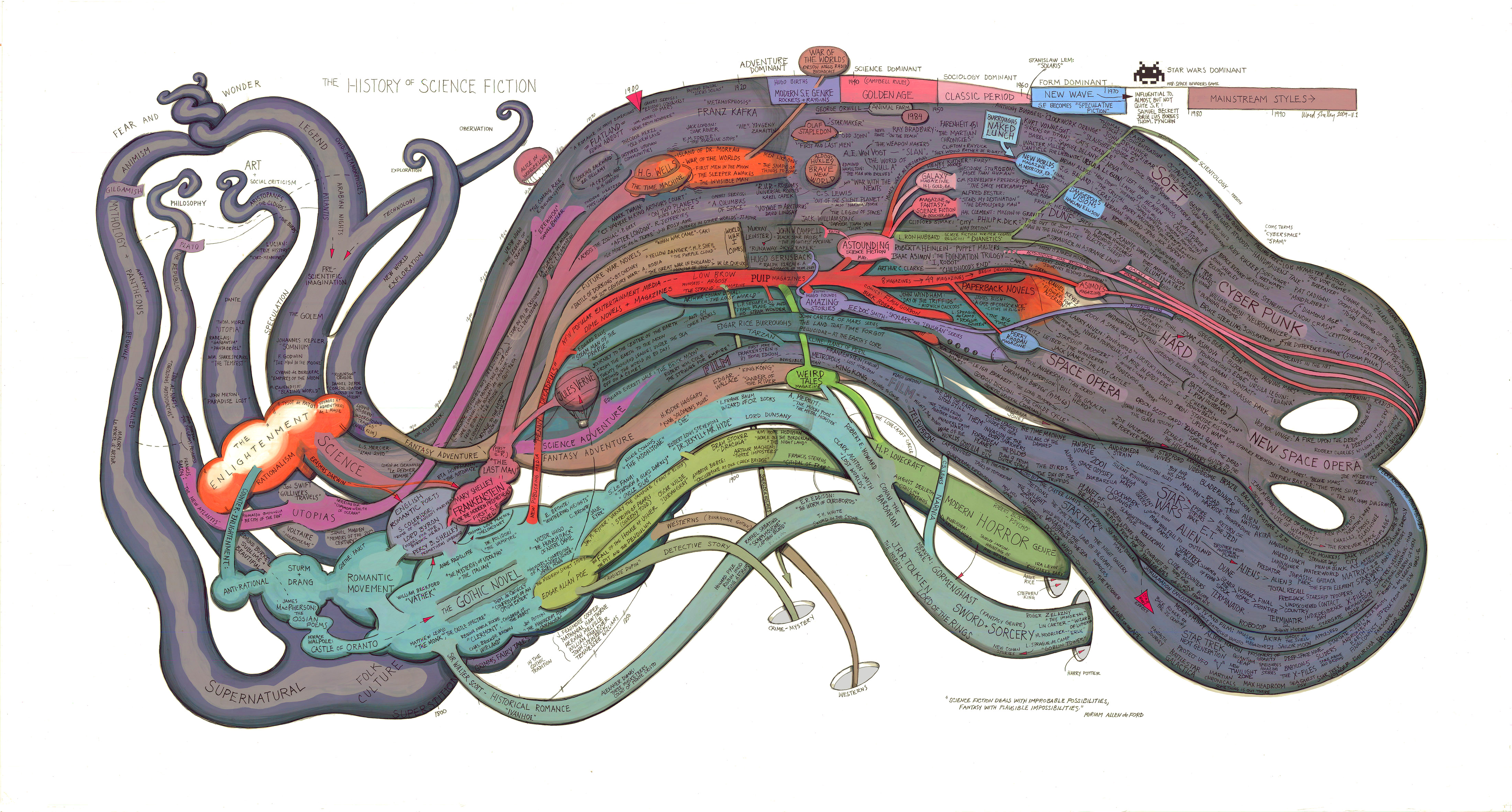
:: Do check out this graphical representation of the history of science fiction. It’s a wonderful picture!
More next week!
Share This Post
Answers! More answers!
The Ask Me Anything! 2011 cavalcade marches on…although at the pace I’m setting for getting these replies out, it’s probably more of a “mosey” than a “march”.
Anyway, a reader who prefers to remain unidentified poses these:
When you are pressed for time, what do you do less of to compensate?
It depends on what I’m doing in terms of being pressed for time. If I’m at work and time is running short, then I have to prioritize my tasks, usually according to what degree of inconvenience it will be to a particular department in The Store if they don’t get a certain job done that day. Of course, Management at The Store can weigh in heavily on this…if any of the store’s highest ranking management persons directly tell me that Job X must be done by the end of business today, then barring something emergency-like happening, that’s what gets shunted to the top of the priority list.
Mostly, though, I’m fairly good about identifying which tasks need to be done today and which can wait until tomorrow. Another factor is which tasks realistically can get done today and which have to wait; if it’s after 2:00 pm and I’m in the last hour or two of work, anyone who comes to me with a job that I know is going to take more time than I have left gets put off to another day. So it comes down to considerations like “How badly are they affected if they have to wait for this?” and “How much time do I have to do this in the first place?”
Other times, though, the time crunch is felt at home. In that case, I’ll identify what’s likely to take the longest chunk of time out of the time I have available to me, and either focus on that specifically, or eliminate it if there are other things that are more important to get done.
What really destroys me, in terms of time management, is — surprise surprise! — the Internet. I get sucked into timewasters online with appalling regularity, and it can get downright depressing for me to realize just how long I’ve been clicking this link and reading that site without doing any writing, or reading the stack of books from the library, or what have you. What I’d really like to do (as I mentioned in another answer) is set up my home network so I can disconnect the laptop from the Internet when I need to buckle down and write. Yeah, I can just flip the Wi-Fi switch on the computer, but it’s too easy to flip it back to ON again, reconnect, and launch a browser, “just to check the e-mail”.
What do you like to cook the most? Who in your home does the most cooking? (And who does the clean up afterward?) Are you teaching your daughter to cook? (And does she enjoy it, if you are?)
I love to cook! Love it. I tend to focus on one-dish meals: casseroles, baked pasta dishes, soups, stews, and the like. Making multi-item meals tends to flummox me a bit as I often misjudge how long one item is going to take whilst cooking the other(s), so I end up with one dish completely done while another finishes up. This frustrates me. My ideal is to serve when everything’s done at the same time, and when this fails, I get a little grumpy.
I suppose I actually cook more than The Wife does, simply because her job has her working nights five days a week, so I’m on “dinner duty” on the days she’s not here, plus I’ll often end up cooking on one of her two days off as well, if I feel like cooking or if she informs me that she doesn’t feel like cooking and therefore I’m either cooking or buying the pizza. Those nights are when I tend to branch out and try new recipes, anyway, because The Daughter is a bit on the finicky side which makes experimentation when it’s just her and myself a tad limited.
(Incidentally…I’ve been really in the mood to make my own fried chicken for a while now. I think I’m gonna have to scratch that particular itch fairly soon, sometime in the next month.)
The Daughter has started learning about cooking, partly out of interest at home and partly out of a Home-Ec style class she’s taking at school. The other night she made her own quesadilla for dinner, when she didn’t like what we were having. Now, it wasn’t the most exciting quesadilla in the world — sliced sandwich ham and cheddar cheese — but still, she cooked it. Cool! (Now if I could just get her to realize that onions are awesome, and that salad is wonderful.)
Have you viewed any TED talks? What ones (or types of talks) do you like, if you have?
No, I haven’t, and I’m kind of embarrassed to admit this. I totally should watch some of these. Going back to the time management thing — there’s a lot of stuff I want to do, but I never “get around” to it mainly because of a complete lack of planning. I need to make strides in this area, big time!
More answers to come!
Share This Post
Saturday Centus
Wow! It’s mostly a matter of luck and intuition, but this week’s Centus prompt suggested its story to me almost instantly. I’m serious: I knew within seconds of reading it what my tale would be. The actual writing, however, was a bit difficult; I actually generated four different drafts of the same notion, with each of the first three making me think, “Come on, I can make this punchier. It’s gotta hit harder.” I think that Version 4.0 is the most successful of my lot. So, here it is, with the prompt in bold.
(No science fiction this week for me, by the way. Although it could be; it wouldn’t take much to make this into an SF tale. Just a word or two, really, reaffirming my contention that the difference between SF stories and other stories is merely one of window dressing.)
“Guilty.”
The word hung there, like a knife. THE knife.
“But I didn’t do it!” sobbed Tommy Wayne Jones, over and over, as two policemen dragged him out of the courtroom for holding until sentencing. He tried, but really: DNA and fingerprints all over the knife and crime scene? Poor Tommy. He’d never been accused of being intelligent.
Neither had Sandra Allen, the victim’s wife. But she’d never been accused of framing a drug-addicted vagrant for the murder she’d committed, either, which is why she went home to spend her bastard husband’s insurance money while some other poor schlub went away for life.
Sandra wasn’t stupid. Nosiree, Bob.
Sandra seems pretty cold. I may have to look back into her doings at some future point….