A Silence of Three Parts

A few years ago, I started seeing mention of a new fantasy author in some of the blogs I read, a guy by the name of Patrick Rothfuss. His debut novel had just come out, called The Name of the Wind, and by the time I heard of this, Rothfuss was apparently starting to have some trouble with the sequel to his first book. I remember reading this in the context of the fan ire that bubbled over towards George R.R. Martin, whose ongoing struggles with the fifth book in A Song of Ice and Fire is a constant topic of vexation among fantasy fans. I didn’t actually read The Name of the Wind until just a few months ago, however, when I finally decided to see what the fuss was.

So, what was the fuss? A novel that, it turned out, I had several different reactions to. I loved it and found it to be a compulsive page-turner, so much so that I really didn’t find the book’s length cumbersome at all. Yes, I loved The Name of the Wind — and yet I wanted to like it more than I actually did.

The Name of the Wind falls, categorically speaking, in line with other recent fantasy novels that use a more modern approach to language to telling a story that is an epic fantasy. (Another example of this type of book is Scott Lynch’s The Lies of Locke Lamora.) And yet, the language is a major element to the novel, and language is also a major theme of the novel.

There are two stories at work in The Name of the Wind. We begin in that old stalwart setting of fantasy novels, the inn in a small, unremarkable village. The inn is run by a man who goes by the name Kote, and he is doted upon by an assistant named Bast who is not what he first seems to be. There are hints that there are troubles in the world at large, with demonic creatures on the loose, harvests failing, and business at the inn down. A scribe arrives who only goes by the name Chronicler, who recognizes Kote as a long-disappeared hero named Kvothe, and Chronicler convinces Kvothe to tell him his story.

At this point, most of the book takes place as flashback as Kvothe tells his life story. His life is deeply complex, and most of the pleasure of the book for me came from following Kvothe’s life as he struggles to overcome the horrible things that happen to him. He first grows up as a member of a traveling troupe of musicians and actors, but then his entire family is murdered by beings called the “Chandrian”, because his parents “have been singing entirely the wrong sort of songs”. Kvothe escapes, and ends up living on the streets in a brutal and filthy town. Using his innate intelligence and competence, he makes his way to the University, where he starts to learn about magic. This may sound like a Harry Potter tale, but Kvothe’s story has a very different feel, and despite the fact that Kvothe is intelligent, witty, and good at most things he tries, his life has the feel of constant disaster as he fails to recognize enemies even as he makes them, annoys teachers, commits errors of judgment, and falls in love with a woman named Denna who comes and goes with little or no warning.

This book is long and rich, and it’s so packed with stuff going on that it’s clear that Rothfuss is liberally scattering story seeds everywhere; the book is full of characters and details that scream out as “important somewhere down the road”. Part of the pleasure will be seeing how it all fits together, in the end, and how the two stories – Kvothe’s earlier experiences, and his adulthood after he has set aside his life as a hero – come together. My main, and really only, reservation, lies in the way Rothfuss often uses more modern idioms and methods of speech than one might usually find in a fantasy novel. I found the way a lot of the characters talked jarring and out of place, and it wasn’t something that I was able to quickly get used to. Nevertheless, the pages keep turning, and the richness of the story sneaks up on me. This novel would be a good book to give someone who doesn’t love fantasy all that much. Or for those who do love fantasy all that much. Basically, it’s good for people who like good stories that don’t always go where you think they’re going and which have engaging characters.

(My review of the sequel, The Wise Man’s Fear, will be appearing on GMR, probably a little bit after I write it. A preview: It’s good. Really good. I am now a Patrick Rothfuss fanboy. That cover art up there, also, is the German cover. I don’t have that cover art, obviously, but I love the way it looks, a lot more than the American paperback art that I ended up with.)

Share This Post

A teevee quiz!

From SamuraiFrog I get a quiz. Huzzah! Hooray, quizzes!

1. What is your favorite “Classic” TV show?

Star Trek.

2. What character from a “Classic” TV show would you like to be?

Dr. McCoy.

3. On which “Classic” TV Show would you have loved to have a walk-on role?

If I can’t be Dr McCoy, I’d like to be something else on Star Trek. Maybe a red shirt guy, and I could ham up a horrible death!

4. Can you remember a line you liked from a “Classic” TV show?

Of course I can! From the Star Trek episode “The Devil in the Dark”: “I’m a doctor, not a bricklayer!” And I’m always excited to tell people that “Quadrotriticale is a high-yield grain.”

5. Which TV doctor would you choose to remove your appendix?

Dr. McCoy wouldn’t have to remove my appendix. He’d give me a pill and it would go away.

6. Which TV doctor would you not let touch you with a 10- foot pole?

Morris on ER. Part of that show’s fall from grace came when they started morphing that guy from idiot screw-up to actual doctor. (More on why I stopped liking ER here.)

7. Which TV doctor/hospital would you choose for the best medical care?

Whatever hospital Dr. House works in, although I’d ask if he’s currently clean or if he’s hopped up on Vicodin again before I let them wheel me in the doors.

8. Everyone knows nurses run the hospital. Who was/is your favorite TV nurse?

Carol Hathaway on ER.

9. Do you consider yourself a “fan” of reality TV?

No. I like specific shows. I’m not drawn to genres in particular.

10. What’s your “can’t miss” reality TV show (or shows)?

The Amazing Race, Hell’s Kitchen. I also enjoy Undercover Boss somewhat, and Gordon Ramsay’s other shows, although most of those are of the “a little goes a long way” variety. I’ve become a Survivor fan, although I’m boycotting this season as long as Boston Rob and Russell are on. (One is gone, I’m told. I hate seeing these guys turn up like bad pennies every other season on these shows.)

11. What reality TV show do you suppose the devil plays on the TV in Hell as punishment?

I remember ten years or so ago when FOX was roundly pilloried for producing Who Wants to Marry a Millionaire?. Now, The Bachelor is on, what, it’s ninth or tenth season? And I just can’t stand Dancing with the Stars.

12. If you were given a free ticket to be on any reality show, which one would you choose?

I don’t want to be on the show as a contestant (maybe), but if The Amazing Race ever had its pit stop in Buffalo, I’d love to be the person standing next to Phil on the mat saying “Welcome to Buffalo!” as teams arrive.

13. What shows would make up a perfect night of TV viewing for you?

8:00: The Big Bang Theory
8:30: How I Met Your Mother
9:00: Mike & Molly
9:30: 30Rock (although I’ve missed all of this season thus far)
10:00: Castle

14. What show(s) would you cancel without a moment’s hesitation?

Two and a Half Men.

15. Is there a show (previously canceled or just no longer airing) that you’d bring back, original cast and all?

Firefly, Once and Again

16. You get to create one show to put on the schedule, with any stars you choose. Who and what would it be?

Hmmmm. I don’t know, but it would involve Sela Ward as the captain of a spaceship.

17. Is there a game show (past or present) you think you would do really well on, as a contestant?

No. I’d get “OMG, the camera’s on!” syndrome. Or I’d be like those unlucky folks on Jeopardy! who can’t get the buzzer to work right. (But then, those game shows that Nickelodeon used to air – the ones hosted by that Mark Summers guy, the ones that invariably featured lots of pie-throwing – would have been up my alley, too.)

18. Is there a game show you think is the stupidest thing you’ve ever seen?

I find Million Dollar Drop really stupid. And I hated Weakest Link when it was on. The lady on that show was really creepy. (Yeah, she was just a character, but so what?)

19. Is there a game show you watch, but don’t like to admit to watching? (A guilty pleasure!)

Nope. I don’t believe in guilty pleasures, anyway. I only watch Jeopardy! sporadically now.

20. Who is your favorite game show host? Who is your least favorite?

Bob Barker was awesome! I actually remember quite a few “old school” game show hosts: Bert Convy, Bill Cullen, Jack Barry. Those guys were good. Oh, and Wink Martindale! Least favorite? I dunno…I guess the creepy lady from the afore-mentioned Weakest Link.

21. Who is your favorite (past or present) TV cop?

Wow, game shows to cops. Right now, Detective Kate Beckett on Castle. All time? There have been a lot of great cops! I guess I’ll go with NYPDBlue‘s Andy Sipowicz.

22. Which TV cop do you think was the most crooked, or the most inept?

Sheriff Roscoe P. Colltrane, I guess.

23. Which TV show had the best ensemble cast of police officers?

NYPDBlue was masterfully done, especially since it turned over its whole cast (except for Dennis Franz, the glue holding it all together) more than once.

24. You need to hire a bodyguard for yourself. Which TV cop do you choose?

Secret Service agent Ron Butterfield from The West Wing.

25. Who is your favorite stand-up comedian of all time?

George Carlin.

26. Which one could you do without? (Not your type of humor, or just plain stupid!)

Andrew Dice Clay. Ugly, idiotic humor that I hated. I wasn’t a Sam Kinison fan, either.

27. Which comedian do you think has gone on to have a great career aside from doing stand-up?

Either Steve Martin or Jerry Seinfeld, I suppose.

28. If you went to a comedy club on amateur night, and they gave you some jokes and a microphone, would you go onstage?

No.

29. Who is/was your favorite TV mom?

Carol Brady (The Brady Bunch), or Lily Manning (later Sammler) on Once and Again.

30. Was she a realistic mother, or more of a TV fantasy type?

The former, fantasy; the latter, realistic.

31. Which TV mom did you find the most unrealistic? Or if you’d rather: creepy – sappy – mean – you choose the adjective, and you name the mom.

Howard’s mom on The Big Bang Theory. But then, she’s pure comedic effect.

32. No disrespect to your dear old mum, but which TV mom did you think it might be neat to have as your own?

I never thought of teevee moms in this way. Seems weird.

33. What show would you like to see brought back for an hour or two episode, to see how the characters are doing now? (This should be a show that it might be possible to do a reunion on.)

Once and Again. Firefly. The West Wing. Friends. And I’d love to know what happened with Frasier Crane’s following of the Laura Linney character on Frasier.

34. Pick a show that could not realistically be brought back for a reunion, because some or all of the cast members are gone. What if they could have done a reunion before it was too late? Name the show you’d most like to see.

I’m not sure, honestly.

35. Which reunion show have you watched and thought “Wow, they should have left that one alone!”

I can’t recall any reunion shows.

36. Which do you prefer- a “reunion” episode of the series, or a “cast reunion” where the actors sit around and talk about the making of the show?

Depends on the show, I suppose. If it’s been so many years that the characters are geriatric, then the latter, I suppose. Like the Happy Days reunion of a few years ago.

37. What is your favorite TV theme song?

Actual song with lyrics: The Big Bang Theory. Theme music without lyrics: Star Trek Voyager. (Wonderful theme for an ordinary show.)

38. Which song drives you crazy enough to hit mute on the remote?

That salsa-thing for Dancing with the Stars. Ugh.

39. Which song are you proud to say you remember (most of) the lyrics to???

It’s not a matter of pride, really, but I do know all the words to the theme from The Brady Bunch. As you might expect.

Share This Post

More answers….

I think I’m almost done…these ones are political, so I’m going to put them after a page break. (I also use some language.)

Kevin Hayden asks:

Why is it that Republicans have the distinct odor of a mutant pygmy goat taint swaddled in limburger cheese?

Also, considering the broad availability of joyful times crushing serfs, why do a few of them persist in having extraordinarily mundane sex? Is it for the lovely parting gifts?

Well…I’ll just assume those questions are meant from a metaphorical standpoint. I mean, how could anyone be familiar with the distinct odor of a mutant pygmy goat taint swaddled in limburger cheese?

Roger asks:

The Repubs are saying the the unions are crushing the middle class by their stand in WI and elsewhere. I suggest that the middle class has been attacked all right – for years by the wealthy. What say you?

Also, your take on Obama’s reversal on defending DOMA.

I take Obama’s reversal on defending DOMA as another incremental change toward an ultimate goal. In general, as a liberal I find Obama frustrating. On the one hand, he’s clearly the most liberal President our country has elected since Lyndon Johnson (although, quite frankly, I think an argument can be made that the most liberal President since Johnson was actually Richard Nixon, a thought that depresses me on any number of levels). But on the other, he just doesn’t get there often enough to make me happy. He seems to genuinely believe in making the small, incremental changes over the big strokes, but sometimes the big strokes are necessary, and Obama just doesn’t seem temperamentally aligned to the big idea.

And really, I wish someone on the Democratic side would stand up and say, “Hey, you know what, DC political culture? Fuck bipartisanship. Especially since ‘bipartisan’ is now functionally defined as ‘Democrats giving Republicans what they want.'”

As for the war on the middle and lower class…I’ve really tried to maintain a belief over the years that the Right in this country — and I include the Libertarian free-market worshiping lunatics in with the Right — genuinely believes that pursuing all manner of free-market nonsense will eventually lead to better lives for the middle and lower classes. Recent years, though, have led me to the inescapable conclusion that they don’t give a shit. Not one teeny, tiny bit. What the Right cares about is making sure that the ultimate direction of money flow in this country is upward, upward, upward.

Just one example: it was in the news this weekend that General Electric piled up profits of over three billion dollars, whilst paying no corporate taxes at all. The Wife and I paid more in taxes last year than General Electric. And now I read this:

After not paying any taxes and making huge profits, ThinkProgress has learned that General Electric is expected to ask its nearly 15,000 unionized employees in the United States to make major concessions.

This year, 14 unions representing more than 15,000 workers will negotiate a new master contract with General Electric. Among the major concessions GE has signaled that it will ask of union workers is the elimination of a defined contribution benefit pension for new employees, a move the company has already implemented for its non-union salaried employees. Likewise, GE is signaling to the union that it will ask for the elimination of current health insurance plans in favor of lower quality health saving accounts, a move the company has already implemented for non-union salaried employees as well.

Your money must end up in our coffers.” That’s what the rich, the wealthy, and the corporate in this country are saying to the rest of us, over and over and over and over again, and then we line up and elect a bunch of idiots who have taken a tea bag as their political symbol (but don’t call them “Teabaggers”!) and who promise to put policies in place that will only make it easier for this to happen.

And I listen to middle class people saying things that make clear that they are OK with this. I hear people complain about foreign aid. I hear others complain that their union-member spouses make a very large wage, but they don’t complain that they themselves do not. No matter how much I point out how many countries out there manage to have health care that is both better and cheaper than what we have, the most common response is some “We don’t want the government involved.”

I’m not sure what’s scarier to me: that the lower classes are getting continually screwed by the upper class and the political figures that do their bidding, or that the screwing is so often consensual.

Here’s Bob Herbert, in his last column for the New York Times.

So here we are pouring shiploads of cash into yet another war, this time in Libya, while simultaneously demolishing school budgets, closing libraries, laying off teachers and police officers, and generally letting the bottom fall out of the quality of life here at home.

Welcome to America in the second decade of the 21st century. An army of long-term unemployed workers is spread across the land, the human fallout from the Great Recession and long years of misguided economic policies. Optimism is in short supply. The few jobs now being created too often pay a pittance, not nearly enough to pry open the doors to a middle-class standard of living.

Arthur Miller, echoing the poet Archibald MacLeish, liked to say that the essence of America was its promises. That was a long time ago. Limitless greed, unrestrained corporate power and a ferocious addiction to foreign oil have led us to an era of perpetual war and economic decline. Young people today are staring at a future in which they will be less well off than their elders, a reversal of fortune that should send a shudder through everyone.

The U.S. has not just misplaced its priorities. When the most powerful country ever to inhabit the earth finds it so easy to plunge into the horror of warfare but almost impossible to find adequate work for its people or to properly educate its young, it has lost its way entirely.

Nearly 14 million Americans are jobless and the outlook for many of them is grim. Since there is just one job available for every five individuals looking for work, four of the five are out of luck. Instead of a land of opportunity, the U.S. is increasingly becoming a place of limited expectations. A college professor in Washington told me this week that graduates from his program were finding jobs, but they were not making very much money, certainly not enough to think about raising a family.

There is plenty of economic activity in the U.S., and plenty of wealth. But like greedy children, the folks at the top are seizing virtually all the marbles. Income and wealth inequality in the U.S. have reached stages that would make the third world blush. As the Economic Policy Institute has reported, the richest 10 percent of Americans received an unconscionable 100 percent of the average income growth in the years 2000 to 2007, the most recent extended period of economic expansion.

Americans behave as if this is somehow normal or acceptable. It shouldn’t be, and didn’t used to be. Through much of the post-World War II era, income distribution was far more equitable, with the top 10 percent of families accounting for just a third of average income growth, and the bottom 90 percent receiving two-thirds. That seems like ancient history now.

The opening sentence of that last graf is the most damning for me: We actually think that this is acceptable. We’ve decided that it’s only right. We’ve bought into the notion that if we end up in a bad spot, it’s our fault. We’ve internalized this idea that everyone who has ever had success did it by themselves, and that if we didn’t pull ourselves up far enough by our own bootstraps, well, we have only ourselves to blame and we have no right to expect anything from our moneyed overlords.

Right now I can’t even say that we’re better than this, because I look at the blase attitude about it all that surrounds me, and I think, maybe we’re not.

(By the way, I only post these thoughts because I was asked to do so as part of Ask Me Anything!. I am not the least bit interested in debating any of this, so comments are closed.)

Share This Post

Crap on toast.

This morning I had one of those “Ohhhh!” moments of writerly epiphany, when I realized why I’ve been finding the last three or four chapters of the Work-In-Progress something of a struggle, where the run up to that point had been really fairly easy. It’s because I screwed up and shouldn’t have written those chapters. I took the story in entirely the wrong direction, and I’ve ended up in this awful spot where nothing’s been happening; just a whole lot of exposition and introducing my main characters to new people for four chapters.

The good news about the epiphany is that I know exactly what I did wrong and where I did it. The bad news? I’ve been working on Chapter 13…and now, tonight, after I re-read the thing to refresh certain details in my head and prime the pump, I’ll be back on Chapter 9. Oh well.

Share This Post

Sentential Links #241

Time for linkage. Brace yourselves!

:: There they were. Walking home from work one day, all I could see was something that looked like lots of hair.

:: And I just learned yesterday that Doritos (any of the bright-orange nacho-cheese junk snacks, actually) pair best with Pinot Noir. I thought that was weird. (But what crunchy, salty snack pairs best with Valpolicella? I love a nice Valpolicella.)

:: So, let not my lack of ranting confuse you; in most cases, I tend to side with the labor unions, even though, I should point out, I do not belong to one.

:: Among the things we do is to tilt at windmills. We do this because we also fight City Hall, and sometimes the windmills look as thought they might be City Hall. We fight City Hall because that’s the only way to keep the system honest, and keeping the system honest is a lot more important than the guilt or innocence or rightness or wrongness of any particular individual or cause.

:: Blow in her face and she’ll follow you anywhere. (Holy crap.)

:: The point is that the unit value of “song” is not the same as the unit value of “novel.” The comparison is more song ==> short story or song ==> chapter, and album ==> novel.

:: It got me thinking, “what is the next homeowner going to think of some of my decisions?” Whenever I make changes or repairs to the house, I try to do it at least as well or better than a professional would. Not that I always succeed — sometimes I don’t have the skill or the time. I’m sure there are some things that I just live with that would make another person shake his head.

:: Three days ago I woke up thinking, “I wonder how Diana Wynne Jones is doing? I should crochet her a shawl.”

More next week!

Share This Post

Two of Three


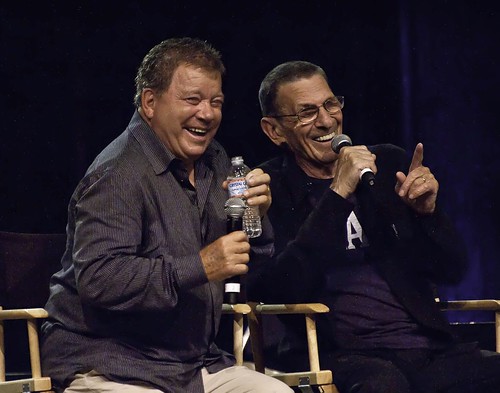
_DSC8763-1, originally uploaded by preloc and kanar.

Last week saw the birthdays of William Shatner (born March 22, 1931) and Leonard Nimoy (born March 26, 1931). Best to both! It’s too bad DeForest Kelley is no longer with us; way too many folks think of Star Trek‘s “Original Series” characters as Kirk and Spock instead of the real dynamic of Kirk, Spock, and McCoy. (Kelley was born January 20, by the way; if he were still around, he would be 91.)

The best recent tribute to Leonard Nimoy, of course, comes from the Christmas episode of Season Two of The Big Bang Theory. In the episode, Penny tells Sheldon that she has got him a Christmas present, which gives Sheldon pause, as he had no intention of exchanging gifts with Penny, and now he feels he must, out of social obligation. But he devises a strategy: he will buy a whole bunch of gift baskets from Bath&Body Works, and when he sees what Penny’s gift is, he will give her the basket that he judges the best match for what she has given him. Hilarity ensues.

(What does that have to do with Leonard Nimoy? Watch the clip!)

Share This Post