Longtime readers know that I love a good romantic comedy, and the trailer for this one makes me want to be there on opening night.
I can’t wait!

The official site of Kelly Sedinger: Reader, writer, photographer, and dreamer

The greatest force for evil in the sporting world, New England Patriots quarterback Tom Brady, has apparently just discovered water slides.

God help me…there’s just something a little bit endearing about this. There really, truly is. Of course, whatever it is that’s a little bit endearing about this is totally outweighed by the colossal wrongness of this, but it’s there.
(St. Tom the Overrated is having quite the time on this “organized-team-activity”-free lockout. First bad dancing, and now this!)
Linkage! Sorry to be so late with this tonight. But you know, stuff happens. And so on.
:: In Field of Dreams, Annie gets to be a dreamer, too.
:: If you saw this building in Miami you’d shrug, but in Buffalo it stands out.
:: We shouldn’t make the mistake of turning Jack into a hero though. Not in Black Pearl at least. He always acts selfishly in that film; it’s just that his goals tend to align with Will and Elizabeth’s. He’s a good guy by association. And because we like him. (It’s so nice to read something about the Pirates of the Caribbean movies that isn’t written from the standpoint of “first one good, all after suck”.)
:: Here are several facts about Wildroot Cream Oil: (Wow, now there‘s a substance I haven’t thought about in many a moon!)
:: On the whole, this is another reason why music and music collecting has such a hold on me.
:: In a better world, audiences would have flocked to see Serenity giving it a much larger box office and leading to a series of movies. Alas, we only got one film. But what a hell of a film. (A spoilerific appreciation of a great film!)
More next week!
Oddities and Awesome abound!
:: A helpful commenter (I think!) left this here the other day.
I’ve never watched Paula Deen or read anything by her, and on the basis of this video, I don’t believe I will. Not because I have anything against oxtails or someone who finds erotic pleasure in eating oxtails, but because I can’t deal with someone who uses the word “romantical”.
:: I don’t tote book bags around, but if I did, this would be a candidate.
:: On a sudden whim, I typed “Star Wars Yiddish” into Google and went with the first link I found. That would be this video, which appears to be the “Luke meets Yoda” scene from The Empire Strikes Back, dubbed into Yiddish, I assume for a school project. I don’t speak a single word of Yiddish. I wonder how the translator accommodated Yoda’s signature speech pattern?
More next week!
I’m stealing this from MeFi, but it’s awfully funny.
First, read Paula Dean’s recipe for English Peas. Then, click through at the bottom and read the comments.
That is all.
Longtime readers know of my love of goofy photos of Presidents of the United States. I’m not sure who’s the goofier-looking person here, the baby or the guy smirking at the camera on the other side of the President.
I haven’t seen Pirates of the Caribbean: On Stranger Tides yet, but I plan to. We’re big fans of the Pirates movies here at Casa Jaquandor, and we’re looking forward to this one.
However, I’m reading a lot of tepid-to-hostile reviews of the movie, which might give ma pause, except that many of these reviews are clearly written by people who probably shouldn’t be seeing the thing in the first place.
Example, from Associated Press
With the (unexplained) absence of Orlando Bloom and Keira Knightley this time around, Depp’s Sparrow is now front and center — he’s almost the voice of reason — rather than the bejeweled and eyelinered clown riffing in the corner, commenting on the action.
“Unexplained” absence? It’s only “unexplained” if you didn’t bother paying attention to the ending of the previous movie.
And there’s this, from Roger Ebert, whom I almost always respect:
Before seeing “Pirates of the Caribbean: On Stranger Tides,” I had already reached my capacity for “Pirates of the Caribbean” movies, and with this fourth installment, my cup runneth over.
Look. I don’t care if it’s your job to review movies or not, but if you can honestly lead off your review by saying “I never wanted to see another of these again”, then maybe you just should have recused yourself from reviewing it for your paper this time out. This kind of thing is as mystifying to me as when newspapers run reviews of science fiction books written by people who state up front that they don’t much like reading science fiction.
And the other thing I see a lot is referrences to the previous two Pirates films as too confusing and hard to follow, complaints for which I have absolutely no sympathy. In fact, if you couldn’t follow those two movies, then I have to wonder just what kinds of movies you can follow.
I don’t know if I’ll like On Stranger Tides or not, but that’s not the point. I’m just tired of seeing movie reviews like these, which will stake claims to being “objective” in their assessments while betraying a clear ignorance of the subject matter on one hand, or an outright chip-on-the-shoulder on the other, both of which give the lie to so-called critical “objectivity”.
Time to talk about some books I’ve read recently.
:: Somehow, in my life as a science fiction reader, I’d never read Dune until just a few weeks ago. Now, that’s nothing really abnormal; there are lots of SF classics I haven’t read. I haven’t read Dhalgren. I haven’t read The Book of the New Sun. I’ve read only one of Banks’s Culture novels. I still haven’t read A Canticle for Leibowitz. And I haven’t read…well, you get the idea.
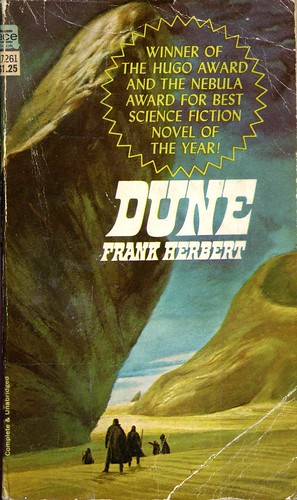
So, why not Dune? I actually started it, ten or eleven years ago, but it either didn’t grab me or something else came along that I wanted to read more. I do recall that my first attempt at Dune flummoxed me a bit because I had to flip back to the book’s glossary so often that it threw me out of the book a lot. Still, I always intended to return to Dune, and I finally have.
This just in: Dune is a great book. Water, also, is wet.
Again, as before, it took me a while to get into Dune, and this time I just generally found a certain coolness to the overall emotional tone of the book. Everything felt like it was at a distance, somehow. This isn’t a criticism per se, but I found myself admiring the book more than really getting involved in it. But still – it’s a great book.
What makes the book great are a combination of factors. First, the setting, the desert planet of Arrakis. Yes, I’ve seen desert planets before, but Dune was there before all of the ones that I’ve seen, and Herbert imbues this world with an impressive sense of scale and an even more impressive sense of importance. Whenever you depict a world where conditions are about as harsh for humans as can possibly be, you need to create a reason for them to live there, and this Herbert accomplishes impressively. (The reason is, of course, the spice called “melange”, which is important because…well, that’s beyond the scope of this post.)
Even better is how Herbert is able to depict the society that lives on Arrakis, the nomadic-bedouin-like Fremen. Herbert brilliantly depicts just what the effects upon society would be on a world where water is as precious as it is on Arrakis, as people have to wear special suits that reclaim every bit of moisture their bodies excrete, and Herbert has thought things through to the point where an act that we on Earth wouldn’t even think twice about – like spitting – is deeply significant on Arrakis. Herbert’s attention to detail is superb, and he packs a lot of detail into the book.
Oh yeah, and sandworms. Sandworms are all kinds of awesome. I won’t say anything more than that.
As noted above, I wasn’t as emotionally involved in the book as I like to be, but the book’s other strengths compensated for this. Part of the problem was the glossary-flipping I had to do a lot of this time around as I did the first time; another part is Herbert’s structuring the novel by including quotes from fictional texts of his world before his chapter. This device does create some dramatic tension in one key respect – establishing that one particular character is a horrible traitor well before the treason happens – but in other ways, those text quotes were sometimes distracting.
I’m not sure if I will read Herbert’s sequels to Dune. I own them all, having picked them up at library book sales, but the general consensus out there as I’ve sussed it out seems to be that the sequels aren’t nearly as good as the first one and that they drop in quality each time out. We’ll see.
(Seriously, folks. Sandworms.)
:: I suppose that most casual SF fans are only aware of Leigh Brackett, if at all, as the writer of the first draft of the screenplay to The Empire Strikes Back. Brackett was a prolific SF writer during the middle of the 20th century, though, and she produced a lot of fine space opera and planetary fantasy stories. In fact, Leigh Brackett is required reading for anyone interested in those strongly-related SF subgenres, and not least because she was simply a fine, fine writer.
I’ve only read a little bit of Brackett thus far, but I’ve loved everything of hers that I’ve read to date, and I can now add to that list of titles her novel The Starmen of Llyrdis.

A human male, Michael Trehearne, is approached by a beautiful girl who tells him that he looks like one of the Vardda, a race of humanoids who are the only beings in the galaxy who can travel between the stars. This gives them a monopoly over all interstellar trade, and most of the planet-bound species in the Galaxy hate them for it.
Trehearne is brought into the fold as a Vardda, but at the same time, he is viewed with suspicion by them, a suspicion that manifests throughout the book in betrayals and schemes and plots against him. Eventually Trehearne learns a deep secret of the Vardda: the fact that many years before, one of their scientists had figured out how it is that the Vardda can travel the stars, and how to give that ability to other species. Trehearne is now at the center of events that could change the galaxy forever.
Brackett’s writing is poetic and beautiful as she weaves a tale of adventure and galaxy-spanning mystery that even has a few action set-pieces. The story is a bit heavily skewed toward the male end of the spectrum, as might be expected of a book written in 1952, and in terms of style, there’s not a lot of humor in the book. But those are quibbles that are better taken in the context of the era in which Leigh Brackett wrote, and The Starmen of Llyrdis is a fascinating and entertaining space opera.