A to Z: Trains

There’s some part of me that thinks that no matter how far in the future we get, no matter how awesome the spaceships or starships we build, there’s a degree to which human transportation will never exceed railroads for romance, intrigue, and a just plain civilized feel. Trains rule…and judging by fiction out there, a lot of writers and creators agree.

What is it about trains? Well, you have a confined setting, but it’s a setting on wheels, and therefore, the setting moves. So you get the best of both worlds: you can lock your characters in one place and watch them interact, or you can have the train stop and have some other stuff happen. Trains increase the intrigue by virtue of the fact that once on, you can’t get off until it stops. Trains lend themselves to tension in so many ways.

Trains are also a concept which can be modified to fit nearly any time frame. Trains figure in a lot of far-future stories, as far from their ‘wild west’ forebears as you can get…and yet, there they are, strings of metal cars, riding atop rails or suspended from cables or embedded in tubes. Arnold Schwarzenegger’s Quade boards a train once he gets to Mars in Total Recall. In the Commonwealth of Peter Hamilton’s space opera novels, one travels from one world to the next not via starship but via train, as it’s the trains that pass through the wormholes to other worlds.

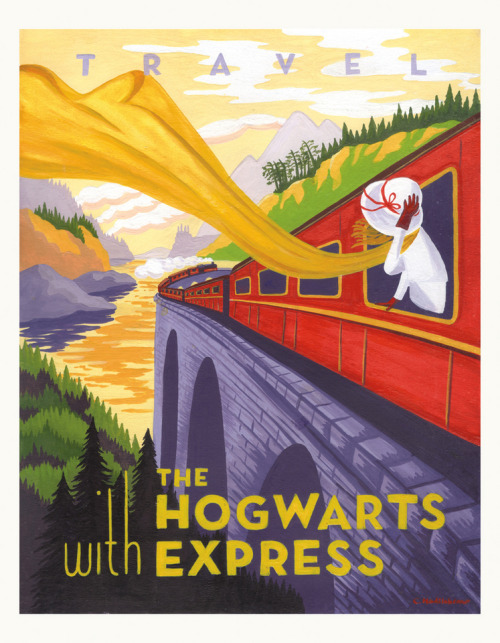
Trains can be futuristic, but they don’t have to be. The most famous fictional train right now may well be the Hogwarts Express, which departs from Platform Nine and Three Quarters in London for the great school of wizardry. The Express isn’t one of the major locations in the Potterverse, but it appears in each tale, its importance quietly understated.

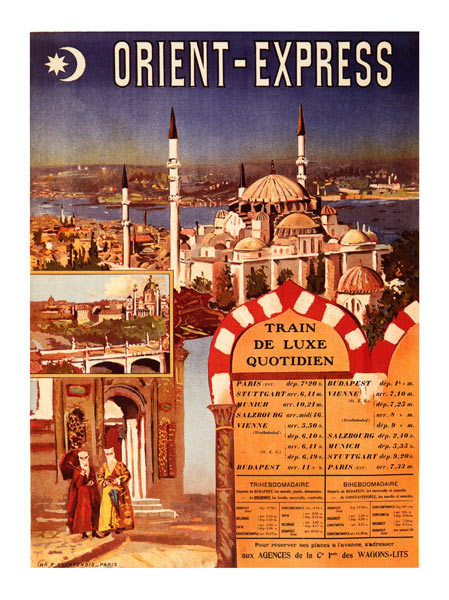
Of course, trains figure all the time in “real world” fiction. There’s the Agatha Christie novel Murder on the Orient Express (whose solution is one of the more elegant to be found in Christie), and the same train figures prominently in the James Bond book and film From Russia With Love. You can’t have Westerns without trains, and one of the most riveting action films of recent years, , dealt with a runaway train.

I wouldn’t want to live in a world without trains, and I deeply wish I lived in a country that took them more seriously than others.

Share This Post

A Question for Titanic Experts

I’ve been wondering this for a while, and I haven’t been able to find an answer in my cursory research, so I thought I’d throw the question up here. On the bow of the great ship, there’s a feature that I’ve always wondered about. Specifically, what is it? It’s the round thingie indicated by the arrow in this photo.

What is that? Anybody know? My geek brain tells me that this is the Titanic‘s main deflector dish, but I know that ain’t right. (Or, if that is right, man, did that thing ever fail spectacularly.)

Share This Post

A to Z: Spaceman Spiff

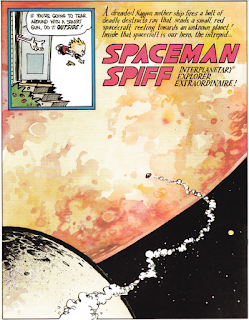
Once upon a time, the occasional adventures of one of the greatest of all Interplantery Adventurers Extraordinaire appeared in daily newspapers across the world. You couldn’t be certain of when he would appear, but sooner or later, there he’d be, and we’d thrill to his exploits, as envisioned by a young schoolboy with, shall we say, a fascinating combination of powerful imagination and a very short attention span. Yes, it’s our hero, Spaceman Spiff!

Spaceman Spiff is, as most cultured persons know, one of the imaginary alter-egos of young Calvin of Calvin and Hobbes. Spiff tended to turn up in moments when Calvin’s attention span was wandering wildly from something he probably should have been attending to more (such as school lessons), but not always.

Bill Watterson (creator of C&H) always seemed to me to have a really good grip on the fact that for children, the boundary between reality and imagination is nowhere near as strong as adults tend to prefer. Kids seem to have this ability to switch back and forth between their imaginations and their realities almost seamlessly, which can be confounding for adults who have lost this ability (or worse, the ability and the memory of how wonderful that ability made the world). This very ability seems to me a key component in the lives of creative individuals, and amongst the oft-cited characteristics of young Calvin, it’s his astonishing creativity that seems to go unnoticed much of the time.

I always thought that Watterson in C&H was able to stay right at the line of pointing out that imagination is a good thing, while also pointing out that yes, our hero Calvin can take things too far. But it’s fascinating to me that, in the last of the “Rosalyn the Evil Babysitter” storylines, Rosalyn was finally able to get some control over Calvin not by battling against him, but by giving in and making Calvin’s signature sport, “Calvinball”, work for her. She had to endorse imagination in order to corral this kid who was running out of control.

The Spiff stories were also notable in that tales like this — and when Calvin imagined himself to be other things, such as a dinosaur, or superhero Stupendous Man, or hard-boiled private investigator Tracer Bullet — allowed Watterson to really go all-out with his art in a way that you really can’t do when your comic strip is set in the real world. Watterson was thus able to cook up nasty-looking aliens, landscapes of other worlds, and various bits of explodey-spaceshippy-goodness. In creating a kid with an extremely potent imagination, Watterson created for himself the ideal playground for a cartoonist with an extremely potent imagination. (He would also cite that he would use such opportunities to pay tribute to the comics masters of the past, like George Herriman of Krazy Kat.)

So, let’s all raise a glass to the ongoing and incomplete and always-interrupted adventures of Spaceman Spiff, and to the imagination, both real and fictional, that created him!

Here’s my favorite of all the Spiff strips:

Share This Post

A to Z: Royalty

Kings and Queens, Dukes and Duchesses, Princes and Princesses, Lords and Ladies, Czars and Czarinas, and to an extent, Presidents and First Ladies. If there’s one thing about humans, it’s that we sure do love our Royalty.

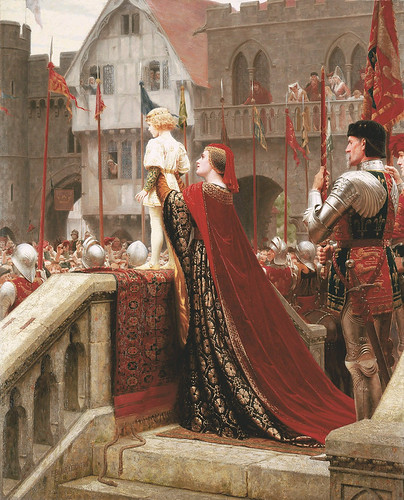
Edmund Blair Leighton (1853-1922), "A little prince likely in time to bless a royal throne"

The concept of royalty is almost impossible to escape, even in our democratic, pseudo-egalitarian society. Royalty commands an enormous level of fascination for us all, to the point where we are endlessly fascinated by real-life royalty in countries that have it; we have royalty figures in our public life and entertainment worlds; and royalty is an extremely common theme or facet in just about all of our storytelling. Why is this?

Well, I’m sure that rivers of ink could, and probably have, been used in the explorations of the anthropology of our continual fascination with the concept of royalty and in the specifics of its practice. I’d assume part of it is some fascination with authority figures — for the same reason that lots of stories set on ships, either sea or space, focus on the Captains — and our hopes that those who are high above in terms of societal importance are living lives that are filled with their own problems and difficulties. I also suspect that’s why writers gravitate to those types of characters, too: because you can really work in some conflict when normal human concerns have consequences that affect nations, or star systems, or even worse. (And I’m no different — I’ve just finished the draft of a novel about space princesses!)

But we also like glamour and pomp and ritual and that sort of thing as well, which following royalty provides in abundance. I think that’s a big part of why there was such a large American audience for last year’s wedding of Prince William to Kate Middleton; I think that ritual of that sort is pretty appealing on a very basic level. Even in this American democracy, we have pomp and ritual surrounding the Presidency. There’s a march that’s played for the entry of the President, and there’s ritual involved in installing a President every four years, including a sacred oath.

Will we ever be without royalty, or some form of royal impulse? I suspect that our tendency toward royalty is something that makes us very human. I can’t see a humanity that has totally divorced itself from fascination with those who drive our society, and if we do attain that, I’m not sure we won’t still be human but rather something else.

In fantasy, a common meme is that of a ‘rightful King’. The realm was once in a Golden Age, but something happened to the King or Queen at that point — a tragedy, perhaps, or maybe some kind of error of personal morality — and the Golden Age ends. The Kingdom suffers because the King has not returned to take his throne, or because the King has not atoned for his sins, and so on. In The Lord of the Rings, Gondor has remained Kingless since Isildur fell, and as a result, the realm has become weaker and weaker, until Aragorn can, as rightful King, set things right. In The Lion King, all is well in the Pridelands until Scar kills his brother the King and usurps his throne; only Simba’s return can again put things right. And when King Arthur commits the act (under sorcerous duress, but he does it all the same) of bedding his half-sister and then killing the children to prevent the fruit of that union from coming back to haunt him, the realm suffers to such a degree that Arthur decides that only the Holy Grail can put things aright, so he sends the Knights of the Round Table to find it.

Thus it often is that the land itself is seen as tied to its Royalty. This conceit is a very, very old trope in storytelling, and it shows the ongoing potency of the very concept of Royalty.

Share This Post

A to Z: Q

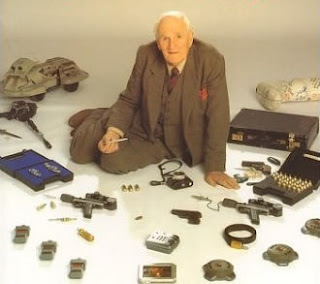
The obvious choice here is to talk about Q, but I couldn’t decide which one. This Q?

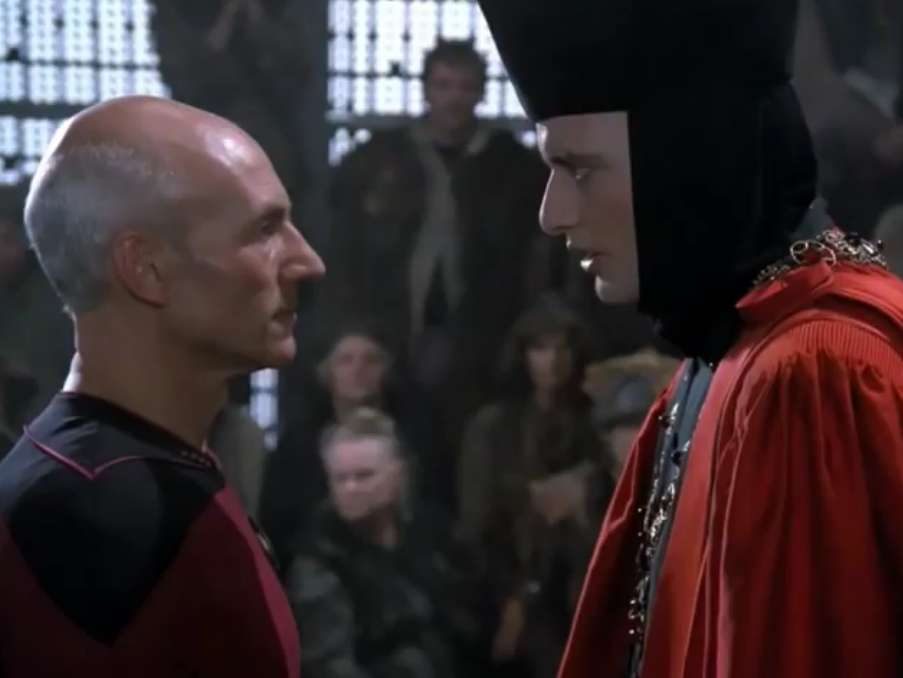
Or this one?

Luckily, this is my personal blog, where the only rules that apply are the ones that I choose for myself, and which I can summarily set aside any time I want, so…let’s talk about both Q’s!

Our first Q is less well-known as Major Geoffrey Boothroyd. (The only time we ever hear his name in the James Bond movies is in The Spy Who Loved Me, when he holds a door open for Agent Anya Amasova, and she thanks him by name.) Q’s first appearance was in From Russia With Love, when M informs Bond during his briefing that “Q branch has been working on something special for you.” In walks our man, looking pretty young and spry back then, played by actor Desmond Llewellyn. He’s got with him a briefcase that has trick catches that, if not opened properly, causes an explosive to go off; contains a rifle that’s nicely broken down into a bunch of small pieces (this was 1962, well before X-ray machines at airports!); and fifty gold sovereigns. There had been a character in Dr. No simply referred to as “the armorer”, who relieved Bond of his Baretta pistol (derisively calling it a fine gun “for a lady’s handbag”) and giving him his trademark Walther PPK, but the guy we would know as Q didn’t come until the second movie.

But it was in the third Bond film, Goldfinger, that Q would become iconic. That’s when he unveils his tricked-out Austin Martin DB-V, with machine guns in the headlights, spinning license plates, homing device trackers, and the ejector seat. It’s too bad that the car doesn’t end up amounting to much…but Q’s attitude toward James Bond becomes clear when Bond says “You’re joking!” in reference to the ejector seat, and Q replies, “I never joke about my work, 007.”

Q was a fixture for most of the remaining Bond films. He wouldn’t appear in Live and Let Die, but he’d be present for all the remaining films until Die Another Day; Q was revealed to be retiring in The World is Not Enough; he even introduced his successor, who was played by John Cleese, in an inspired bit of casting. There was a giant pall cast over the whole thing, though, when Desmond Llewellyn died in a car crash not long after TWINE came out.

The Daniel Craig films have not availed themselves of a Q character yet, which I hope is forthcoming, even if I also hope that the gadgets don’t get too outlandish (the invisible car in Die Another Day was too hard to believe). Maybe in Skyfall; I don’t know yet.

My favorite Q gadgets? I loved the exploding key ring in The Living Daylights, the wrist-activated blowgun of Moonraker, and the fountain pen filled with acid in Octopussy. And my favorite Q moment came in Licence to Kill. In that film, Q actually goes out into the field to assist 007, who has gone rogue. Now, all through Bond’s career, Q has constantly complained that Bond never returns his gadgets in their original working condition. Late in the movie, though, Q is posing as a peasant sweeping a sidewalk when the bad guy drives by. Q alerts Bond via the little radio he has attached to the broomstick…and then, with his job done, he casually tosses the broom aside.

But…what about the other Q?

This Q showed up immediately on Star Trek: The Next Generation, right in the very first scene of the pilot, and he was originally depicted as a representative of a nearly omnipotent species that is deeply ambivalent toward humanity. Played with zeal every time he showed up with John de Lancie, Q put all of humanity on trial through the persons of Picard and the rest of the bridge crew. I think the character of Q went through evolution, though, as all characters do. Originally, Q was seen more as a trickster character, but then he became more of a gadfly through whom the Enterprise crew learned their deeper lessons about the universe and about life. Most of Q’s episodes were highly memorable: it was Q who made the Borg aware of the Federation; it was Q who greeted Picard in the afterlife and somehow arranged for him to experience an astonishing life lesson.

I never liked Q as much when he started turning up on DS9 or Voyager, when the producers started to explore the entire ‘Q Continuum’ and the politics thereof, which had the unfortunate effect of turning Q into, well, another in a long series of alien races with their own concerns and whatnot. When he was by himself (for the most part), Q something unique unto himself.

Share This Post

Something for Thursday

Space Shuttle Discovery DC Fly-Over

They were chunky, clunky ships. They looked cool at first, since they looked like something that should fly, instead of the capsules and LEMs that had looked like distended tin cans or crumpled bits of tin foil. They looked, at first, like what you might think of when you thought “spaceship”.

But over time, they looked clunkier and clunkier. Their fragility became scarier and scarier, and two of them carried their crews to their deaths. An inevitability, that — we do not collectively flaunt danger without danger eventually exacting a price — but still, two of them ended their final flights in flame. They became something of a joke over time, a literal holdover of 1970s technology into the 1980s, then the 1990s, then the 2000s. Newer ships were promised; pretty pictures of potential newer ships were trotted out every so often. Presidents would show up, pay lip service to our destiny up there, and then go home. And yet, these clunky spaceships kept flying, until someone finally decided that they would fly no more.

And yet, there are no new ships. There will be again, someday…but not for a while. One day, someone will decide to take a slightly smaller step, but a much more giant leap. But for now, we look up and think, “We’ve gone far enough.” Really…what kind of human thought is that?

These ships are done, and none take their place. This saddens me greatly. I was no great lover of these ships, which were utilitarian and got the job done for longer than they should have. But they did a job, and now their voyages are done. I just wish it didn’t feel like the voyages were ending.

Godspeed, Columbia and Challenger; Godspeed, Enterprise (the one that never flew), Discovery, Endeavor, and Atlantis. Here is a selection of Bill Conti’s music from The Right Stuff.

Share This Post

From the Books: Lester Bangs on Dick Clark

Awww, dammit, Dick Clark is dead.

I’m not old enough for Dick Clark to be a rock-n-roll icon for me; he was a game show host first, and such is how I’ll default to remembering him. “Audience please, may we have absolute quiet. All right. For one hundred thousand dollars, here is your first subject. GO!”

I don’t have a lot to say about Dick Clark. The guy was an omnipresent fixture, and even in the much-derided appearances of his on New Year’s Rockin’ Eve the last few years, even as he struggled to form words, I could really see the spark in his eye, the one that said, “Yeah, I’m on teevee and how cool is that!”

But here is an excerpt from an interview that Lester Bangs did with Dick Clark for Creem, back in 1973. After some intro, Bangs notes that Clark’s thoughts spring from his head fully-made. (Keep in mind, folks, this interview took place 39 years ago, and is a product of its time.)

How wired would you have to get, for instance, to compete with this natural life stylin’ poppa’s rap: “There was a lady the other day that gave a fascinating speech in acceptance of an honorary degree she got at some college somewhere. Dolly Cole, she’s the wife of the chairman of the board of General Motors, so you know obviously where her politics lie and where her thinking goes, but she came up with a great line, she’s a self-educated lady and very charming, I did five television shows with her once, I got to know her reasonably well – she said to the graduating class, she apologized for her truck-driver language in front, she said, ‘All of you here attending this school who are complaining of the materialistic world can be assured that there are a couple of parents home working their ass off to keep you here.’ Which is an interesting thought. The other great line I read, and this is fabulous, is that in this generation of young people who all wanta be individualistic, the line is, ‘Look, I wanna be different just like everybody else!,’ we are really coming into a carbon-copy generation. It’s really unique. As a student of young people, I’ve never seen such a one-dimensional group of people in all my life – in thinking, in dress, even in music habits.”

I mean, did you ever! What I wouldn’t give to talk, hell, write like that – what incredible organization, what lucidity. But I suspected the facile flash of the superficial, generalized savant, so I lammed into him: Just why are you so interested in young people, Dick?

“Sheer unadulterated greed. That’s a facetious answer; it’s mostly true. It’s been a very good livelihood secondarily, and I would appreciate it if you wouldn’t excerpt it and just publish that part. I enjoy it. If I didn’t, there’s no amount of money in the world could make me do what I do. And let’s face it, it’s a hell of an interesting way to make a living. You never know from day to day what young people are gonna do next.”

That reminds me, Dick. Whadda you think of fag-rock?

He gets a worried look. “Do you think this is going to be widespread?”

Sure! David Bowie, Lou Reed, all those guys at the top of the charts, the queers are taking over the country!

He chews on that one a minute, and comes back typically unruffled, reflective: “Anything that’s new takes a while before it gets disseminated across the country. You get the JC Penney versions of fashions of what the style leaders are wearing. There’s an interesting premise in all of this, in the youth world, you take the lunatic fringe, the avant-garde, the style leaders, the nuts. And if you are careful enough to determine what they come up with that’s a legitimate trend, then you’ll be able to figure out eventually what the people in the middle, I don’t mean necessarily geographically but in the case of our country it is pretty much the middle, will be doing in the next number of months.

“Bisexual…what’s the other word, AC/DC? I think its partially fad and partially goldfish swallowing, as protest was. A lot of kids got into protest because it was ‘the thing’. It was not popular to criticize legitimate protest at the time, but I used to make the joke about the kid who had the sign in the bedroom closet that said ‘SHAME’, and would at any given moment take the sign and go out and march. The sign was apropos to anything. That may be what’s happening with the fag-drag crazy transsexual rock scene. I think that’s a quickie. I think more importantly that’s an indication of the desire to have show business return to music. That’s why you have an Elton John, a Liberace, an Alice Cooper. That’s show biz. We all know Alice is a put-on, a shuck. But what’s funny is when you read the sociological commentators and how torn up the whole straight world is over this craziness. I can’t attach any significance to that.”

Does he then see the hope of rock’s future in relatively wholesome groups like Slade, or the bubblegum androgyny of Marc Bolan? Nope. “I don’t think Slade will make it in the States for the same reason T. Rex didn’t make it. He thought he was Mick Jagger. He was Donny Osmond. Print it. The schmuck. I went over there at the time that there was a necessity to fill our subteen gap of idols, to try to convince [Bolan’s] people that it would be a good time to move on the American market in that area. The trouble was, the poor fellow believed his own publicity, when you had Ringo Starr running around taking pictures of him with an 8-mm camera. He believed he was going to be Mick Jagger, which he is not. He’s been so many things in his career I don’t guess he knows who he is. And he has been so ill advised – this happens with so many artistic people – a man of obviously great talents, but no business acumen. And so therefore never the twain shall cross and he went into the sewer.

“I’m always distressed by the supposedly bright people who don’t know what they are. Take the Monkees, who thought they were the Beatles. They could have had a very nice thing going in their area for another couple of years, despite the fact that it was a shuck. It was a commercially built commodity for which there was an audience from which they could have made a great deal of money and retired and passed it on to their children. Instead Mickey Dolenz thought he was Paul McCartney. He went up to Monterey and they laughed at him.

“Again statistically, look at the record books and you’ll see that every ten years in the middle of the decade some sort of freak superstar arises. You can take it back to Rudy Vallee and Bing Crosby, through Frank Sinatra and Perry Como, then you had Bill Haley and Elvis, the Rolling Stones and the Beatles, so now you’re upon it again. Sometime in the next two years there’ll be an individual who will be a white, male, single performing artist. Probably American.”

Changing the subject to his show, I wondered if he consciously strived to put forth a certain image of American youth in the kids that appeared on “American Bandstand”.

“Well, I dunno. They’re kind of middle-of-the-road kids, I guess. It wouldn’t be a typical concert audience because they’re dressed differently. The only dress requirements we have are that the girls can’t wear pants suits. It’s only because of the visual thing, because it’s a hell of a lot more interesting to watch a girl in a skirt. And with long hair in closeups it’s very difficult to distinguish male from female, so you use that attractive element. That’s only a matter of practicality,” he adds. “it’s not a prejudice on my part. I’m not a big leg man or anything.”

For some reason, Dick, hippies and counterculturites seem to think you’re stodgy. I asked him if he had a clue and he came back with both barrels. “That was very predominant about three or four years ago, but it’s become passe now. It was a good institution to play games off of. Than it suddenly dawned on a lot of them that I’d been around for twenty years and was carrying the ball for them and that’s the reason they were in business. I’m very cynical toward the underground press, of which you are one. I’ll be here longer than you will, is my attitude. I will be very happy to have you make fun of me or do whatever you want, I really don’t care.

“They have found now that there must be some semblance of order to stay alive. That’s why FM underground freeform radio died. Because you can’t turn seven freaky guys loose on the air to do whatever they wanta do whenever they wanta do it, play the same cut seventeen times or play some obtuse album, ’cause who cares?

“A lot of the whole world that kids don’t understand is politics and money. When you learn politics, money, the advertising world, where the skeletons are buried, you have then matured enough to stay alive. It’s part of the game. And a lot of kids don’t learn until they’re out wandering around saying, ‘Hey, I wonder why the place I was working at went out of business.’ They told too many people to shove it. That’s what happened to the Smothers Brothers. What a wonderful tool they had, except they painted one of the three major networks into a corner and said, ‘There’s no way for you to get out and we’ll win.’ They’re winning minor dollars, but it won’t amount to much by the time they pay the lawyers. So one must learn to screw the system from within.”

Okay, Dick, but just for the record, what did you do when you were a kid? “I was a student of the black arts. I was a hypnotist at thirteen. I lived all the way through that, my whole life I had bookshelves full of this stuff. And then when it got very big in the late sixties I said I better get out of this, I can’t stand listening to all of this again. I was a big hit at all the parties, reading palms, putting people out….”

So now how do you see yourself, the adult Dick Clark? As a moral leader for youth?

“I’m just the storekeeper. The shelves are empty, I put the stock on. Make no comment pro or con. Irving Berlin said, ‘Popular music is popular because a lot of people like it.’ That doesn’t mean it’s good or bad – that’s the equivalent of arguing the merits of hot dogs versus hamburgers. What the hell difference does it make?”

(From the collection Psychotic Reactions and Carburetor Dung, by Lester Bangs.)

Share This Post

A to Z: Planets

The Water Planet

Arrakis! Vulcan! Tatooine! Alderaan! Barsoom! Akir! Zeist! Veridian III! Hoth! Mustafar! Coruscant! Trantor! Krypton!

All hail the Planet!

Planets are everything. Without planets, we’ve got nothing, in SF. Without planets, we’ve got no place for stories to happen. Planets are where it’s at. Without a nifty planet, your space story isn’t going anywhere.

Some planets are Earthlike in most ways. Others are inhospitable almost to the point where humans can’t live there…but only just. Some planets are gas giants, leaving us to hope for livable environments on the moons; other planets are tiny, cold, airless rocks.

Planets give rise to amazing life forms. There are enormous worms that slither through the sands of the worldwide desert, catching entire towns in their gaping maws. Or there are scavenging little dwarfs, who wander around picking up bits of technology to sell at the settlements. There are planets whose inhabitants are governed by their fiercest passions, and there are planets whose cultures are rigidly devoted to logic and reason. Planets, planets, planets. Planets everywhere.

I speak here more of fictional planets, but it’s always worth remembering that planets are very real in our universe, and not just in our Solar System: planets are places, and reasoning out their motions is one of the greatest achievements of all time. Here’s Carl Sagan on Johannes Kepler and Tycho Brahe:

It’s interesting to note that for a time, in Carl Sagan’s early years in the spotlight, planetary astronomy wasn’t much of a going concern.

(I keep forgetting to include the A-to-Z graphic on these posts. Apologies to the event organizers!)

Share This Post