A to Z: Old People of Wisdom

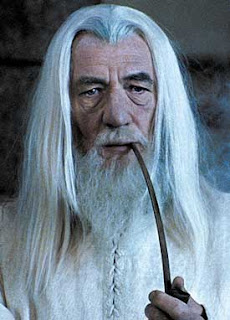
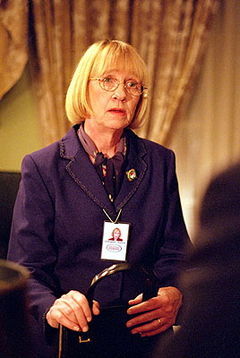
Gandalf. Loren Silvercloak. Mrs. Potts. Obi Wan Kenobi. Boothby the gardener. Sarek. T’Lar. Dumbledore and McGonagall. The Oracle. Jor-El. Maester Aemon. Mrs. Landingham. And, of course, Merlin.

What do all these folks have in common? They are Old People of Wisdom.

In the Campbellian Monomyth, the Old Person of Wisdom is the mentor-figure who provides the Hero with magical aid that he or she will need, going forward, to complete the adventure. It is also often the Old Person of Wisdom who provides the Hero with their initial ‘Call to Adventure’. So this figure is often the catalyst for the story.

“If you’re referring to the incident with the dragon, I was barely involved. All I did was give your Uncle a little nudge out the door.” –Gandalf the Grey, The Lord of the Rings: The Fellowship of the Ring (film)

Of course, those familiar with ‘the incident with the dragon’ know that Gandalf did a lot more than that. Yes, he showed up on Bilbo’s doorstep and introduced him to a bunch of dwarves who wanted to hire him to be their burglar, but how did it come to that? How did Gandalf settle on Bilbo, and not, say, some Bolger or Bracegirdle or Proudfoot? It’s often the role of the Old Person of Wisdom to see something in the hero that they don’t see in themselves. Gandalf sees in Bilbo a stalwart burglar. Obi Wan Kenobi sees in Luke Skywalker a future Jedi knight. (We’ll learn, of course, that he has a lot of reasons for seeing that.) Loren Silvercloak sees in five young University of Toronto students qualities that will prove essential in the final war with the darkness of Rakoth Maugrim.

One of the interesting things about the Harry Potter books is the way that multiple characters fulfill the function of the Old Person of Wisdom. Albus Dumbledore is the key of them all, but he doesn’t do it all. The Call to Adventure comes from Hagrid. Supernatural aid comes not just from Dumbledore but from McGonagall, Sirius Black, Remus Lupin…a whole host of people. Of course, JK Rowling didn’t blaze this trail on her own; in the James Bond movies, what are M and Q but Old People of Wisdom?

Why does this trope have so much power? It seems pretty obvious to me. Age implies experience and wisdom. We look to the mothers and fathers of our communities for wisdom. And we know that eventually they move on, into death, and that eventually the story will be ours and ours alone…until we have to serve as Old People of Wisdom ourselves.

I’m reminded of the wonderful closing speech that Sir Anthony Hopkins delivers in the movie Amistad:

The other night I was talking with my friend, Cinque. [The African man who was kidnapped into slavery and who is suing for his freedom in the film.] He was over at my place, and we were out in the greenhouse together. And he was explaining to me how when a member of the Mende — that’s his people — how when a member of the Mende encounters a situation where there appears no hope at all, he invokes his ancestors. It’s a tradition. See, the Mende believe that if one can summon the spirits of one’s ancestors, then they have never left, and the wisdom and strength they fathered and inspired will come to his aid.

James Madison, Alexander Hamilton, Benjamin Franklin, Thomas Jefferson, George Washington, John Adams: We’ve long resisted asking you for guidance. Perhaps we have feared in doing so we might acknowledge that our individuality which we so, so revere is not entirely our own. Perhaps we’ve feared an appeal to you might be taken for weakness. But, we’ve come to understand, finally, that this is not so. We understand now, we’ve been made to understand, and to embrace the understanding that who we are is who we were.

We desperately need your strength and wisdom to triumph over our fears, our prejudices, our-selves. Give us the courage to do what is right. And if it means civil war, then let it come. And when it does, may it be, finally, the last battle of the American Revolution.

What’s wonderful about this particular cinematic moment is that in the film, Hopkins’s John Quincy Adams is himself an Old Person of Wisdom…and yet here he is, citing the eternal need in our species for Old People of Wisdom. (You can watch the speech here.)

It’s almost impossible, I think, to avoid the trope of the Old Person of Wisdom. It’s not just ingrained in our storytelling. It’s ingrained in us.

Share This Post

“Who are you?” “No one.” “A lie.”

God, what a slog.
I was really hoping that my original impression of this novel, way back when, wouldn’t hold true this time around. When I first read Feast, it had been a few years since I’d read A Storm of Swords, so a lot of the finer points of the various plotlines were not at all fresh on my mind. I chalked up my impression partly to that…but now that I’ve read the entire series in the last few months, I still think this book is a giant slog. Parts of it are really good. Parts of it are duller than ditchwater. Too much of it is duller than ditchwater. My view of these books as a reasonably high-quality fantasy soap opera is more and more ingrained in my head. Here’s how I described that, in the afore-linked post:

When I was a kid, I actually became for a time a huge fan of General Hospital. This was back when each summer would have a long and sometimes “action-packed” tale involving spies and espionage and intrigue of such nature, usually featuring characters like Robert Scorpio and his former wife Anna, who were both also former agents of the WSB (World Security Bureau), when they’d square off against the nefarious agents of the enemy DVX. As these storylines wended their way through the summer months, lots of other characters would see their own lives intersect with the “main summer storyline”. This was all usually quite a bit of fun, but there were characters I didn’t really care about, and thus their bits in the storyline tended to slide beneath my radar. And not all of the show’s characters would be involved in the “main summer storyline”, so once a week — usually on a Tuesday or Wednesday — there’d be an episode of GH that served only to catch us up on the characters who had nothing to do with the fun stuff. These episodes were largely boring as hell; I was watching the show for Robert Scorpio’s heroics and whatnot, and I didn’t really care one whit about Steve Hardy’s son’s relationship problems or the various infighting of the Quartermaine clan or the trials-and-tribulations of hooker-turned-straight Bobbi Whatshername. But that was the price to pay for the good stuff.

So GRRM’s massive fantasy series is getting kind of like that. Each chapter is told from the viewpoint of a different character, with that character being named in BIG LETTERS at the top of each chapter, so as soon as one chapter ends, you know just by looking at the next page where you’re going next in the story. This is classic soap opera structure, and in the first two books it was extremely effective, but I’m finding that now as we’re into our fourth book here, it’s all starting to feel the same way it felt when I’d watch GH all those years ago. “Oh, cool! An Arya chapter! Her story’s interesting!…Oh, bugger, another chapter about Sansa. Snore.” If ASoIaF were to be filmed, I think it should be as a soap opera, titled Westeros!. And if they change actors, a voiceover guy could intone, “The part of Jaime Lannister will be played on this episode by….”

In Feast, George RR Martin found himself in a bit of a quandary. He was writing the fourth book in this series, with all the characters present, but it quickly became – surprise, surprise – too long. So he had to cut it in two. But that presented its own structural problem.
Consider, say, The Empire Strikes Back. Suppose, for whatever reason, that George Lucas and company had decided that the movie was too long and needed to be cut in half and released as two movies. Now, what you might suppose he would do is, well, pick a point halfway through and chop it in two right there: maybe just after Han and Leia and friends take up refuge in the asteroid and Luke meets Yoda.
But Martin didn’t want to do this. He felt, as he indicates in his afterword, that he found it preferable to “tell all the story for some of the characters, instead of some of the story for all of the characters”. So: imagine an Empire Strikes Back that follows Luke, and Luke exclusively, all the way to the end of the existing story…and then another one, a while later, that tells what Han and Leia and Chewie and C3PO were doing while Luke was doing all that other stuff. That’s what Martin does here. Does it work? Well…meh.
The problem is, as I note in my soap-opera metaphor, that telling part of the story is only partly satisfying. Of the four best characters in this series – Jon Snow, Tyrion Lannister, Arya Stark, and Daenerys Targaryen – only Arya appears in this one. Who is left to follow, then, over the course of almost 700 pages? Well, there’s Jaime Lannister, who continues to be interesting, although he suffers from blockheaditis. There’s Samwell Tarly, whose stock is rapidly rising in my estimation, although his story in this book largely consists of riding a boat and mooning over a girl. Cersei Lannister becomes a viewpoint character, but she does not become sympathetic at all, as Jaime did in the previous book. Sansa Stark is around, but her story doesn’t really go anywhere of great interest. Brienne of Tarth is here, but her story is really problematic.
And then there’s new stuff. Martin devotes a bunch of chapters to the royal succession of the Iron Islands, the seafaring, Viking-like society off the coast of Westeros. I remember this stuff being fairly interesting before, but this time it was just there. And there was a whole storyline involving Arianne, Princess of Dorne, that was…well, I guess I should just be blunt here. I didn’t care about it at all.
Of the stories presented in Feast, the only one that really works is Arya’s, and it suffers from feeling a bit shoe-horned in here. Martin’s apparent focus here is in depicting the events in Westeros basically south of The Neck (a narrow area of the continent between the North and the South, not quite narrow enough to be an actual isthmus), and yet, we have Arya, who is in Braavos, the city across the sea. And her story ends over a hundred pages before the book does.
I think that points up my increasing problem with this series: it’s becoming so big and epic that there is almost no sense of structure at this point. Aside from just a couple of points, there’s just not that much evidence to be had that we’re building toward anything. (Those two points? The fact that two of the factions in this book are apparently setting their eye on the dragons they’ve heard about in the East.) I don’t feel like I’m reading a story; I’m reading, well, a soap opera, with the feeling that I could leave off for a year or two and just start watching again and there everyone will be, give or take a character or two.
Random notes:
:: I have to admit that part of my distaste for large parts of this book have to do with the constant drumbeat of sex. Sex, sex, sex, sexity sexy sex. And none of it is, well, good sex, either. It’s all lust and rape and a bizarre fascination on Martin’s part with the word “nipple”. There’s constant probing of “the secret sweetness”, comment on how wet women are “down there”, and…I’m sorry, maybe I’m a bit of a prude, but this book is loaded with passages like this, and I felt my eyes rolling each and every time. Cersei dabbles with lesbianism, just out of curiosity (and decides that she’s grossed out by it, after). Samwell Tarly loses his virginity. Jaime constantly mopes over the fact that his sister hasn’t been faithful to him. Littlefinger seems to be coming on to Sansa, who points out numerous times that she’s a real maiden, flowered and all. Cersei sets a trap for a rival, which involves having the pious priests probe the girl’s privates to see if her ‘maidenhead’ is intact. And don’t get me started on Brienne, whose every interaction with another person must apparently begin with the other person telling her how ugly she is, and more than a few people telling her “What you need is a good raping!”. (I am not making that up.)
I haven’t much enjoyed the sexual parts of these books, but in Feast, it all becomes downright creepy. Maybe GRRM is exploring this all as a theme – how the lives of millions are affected by the sex lives of the few in power – and I believe firmly that depiction is not the same thing as approval. But, does there really have to be this much creepy sex? Really? None of it is even steamy sex – aside from Sam’s drunken lovemaking with Gilly, all the sex in this book, and most of it in the entire series, is violent sex that sounds more painful than anything else.
:: I like Brienne of Tarth a lot as a character. But her story sucks. It’s just her, wandering around, asking people if they’ve seen Sansa Stark, being told how ugly she is, and her pining for poor dead Renly Baratheon. Her final cliffhanger? That’s as purely a soap-opera moment as I can think of. You can practically see the show freeze-framing on that moment.
:: One of the rules of soap operas is that if you didn’t see the body, the person ain’t dead. Therefore, I do not believe that either of the Cleganes has died. (And in the case of Sandor, that would be a shame, as I was finding him a highly compelling character.) We’re also told that Davos Seaworth has been murdered, but I’m going to hold that in abeyance, as well.
:: Poor Theon Greyjoy. He was a viewpoint character in Book II, and now he hasn’t been seen at all in Books III or IV.
:: If you’ve ever watched any soap opera for any length of time, you’ve seen an instance of the producers introducing a new location – a new place in town, for instance – where all the characters claim to have been going for years but which we’ve never seen before. I kind of felt like that with Dorne. Yes, there have been a few characters from that region in the first few books, but now, suddenly, we had to spend a lot of time there, for reasons I’m not entirely sure of.
:: I’m being pretty hard on this book, but I really did find it a slog and at times a not terribly interesting read. I’ve read that at one point, GRRM was planning to execute a ‘time slip’ in between Books Three and Four, which means that he was going to skip over all the stuff that’s happening in this book (and in what has become the fifth book). Obviously, I won’t know until much later on – if ever, as I’m still unconvinced that this series will ever be finished – but maybe it’s the case that the conclusion of this saga makes the events in this book seem more important in retrospect. For now, it bothers me that for a great deal of A Feast for Crows…I found myself not caring.
Oh well. One book to go, and then I’m caught up. At least that one will be totally new to me.

Share This Post

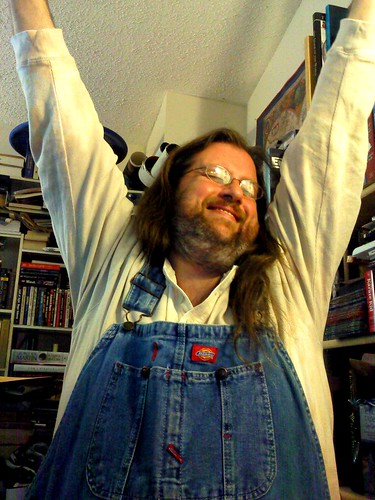
DONE!!!


DONE!!!, originally uploaded by Jaquandor.

Victory is mine! Let the streets flow with wine and song!

Yes, earlier today I finished the first draft of Princesses In SPACE!!! (not the actual title). And since a while back I figured on being done by Memorial Day Weekend, I’m actually a month and a half early. Future editors, take note. Deadlines are nothing to me! Ha!!!

By way of some stats: the final word count of this first draft is 178,575 words — under my target of 180,000, which makes me happy, especially since that word count is likely to plunge when I get to the editing. Since I started tracking my daily production, I’ve produced over 28,000 words, for an average of over 1500 words a day on the days that I’ve written. And in that time, I only missed three days — this past Thursday, Friday, and Saturday, which I’m fine with given that Thursday involved preparations for a trip and Friday and Saturday were, you know, the actual trip.

In truth, I must admit that over the last couple weeks, I’ve felt a subconscious applying of the brakes, as if I wasn’t really ready to leave this world yet. And in a way, I’m not…but it’s time. This tale is done, in its first telling, and now I need to just let the manuscript sit for three months. I won’t allow myself to even look at it again until July 16 at the earliest. I’m a firm believer in letting writing fade into memory a bit before moving onto the “Kill your darlings” phase.

So what now, then? No writing? Perish the thought! I’m going to move seamlessly right into the next project, “The Lighthouse Boy Who Ran Away” (not the actual title). Who knows — I may even start that one tonight. I can’t be stopped, man!

(By the way, how much of a dork am I? It was 80 degrees here today, which I deem ‘too hot for overalls’. So for this photo I put ’em on, took the photo, and went back to shorts. There’s a cautionary tale in that, but I’m not sure what it is.)

Share This Post

A to Z: North!

Direction is always important…and in a lot of fantasy, specific directions carry with them specific connotations. Such as North.

finding north

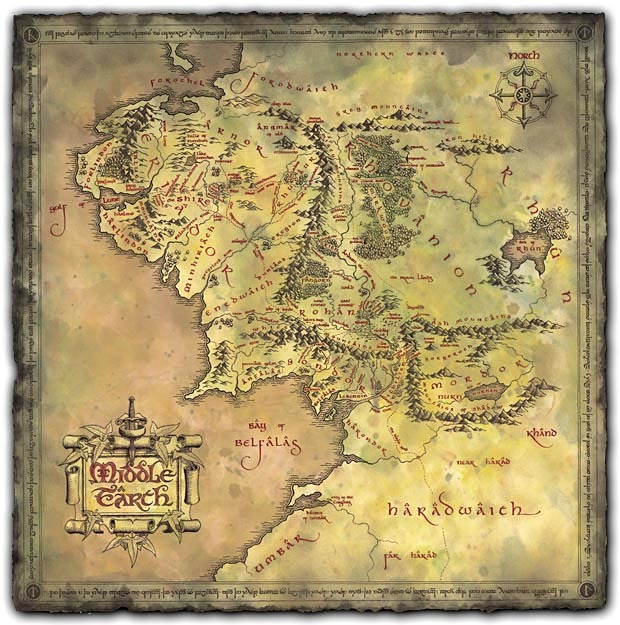
North is often portrayed as cold and desolate and lonely. Just about every fantasy that I know is set in the northern hemisphere of its particular planet, so north really does tend to be a land of cold and, sometimes, a land of unknown. In some cases, the North is where Evil lives: Guy Gavriel Kay’s The Fionavar Tapestry puts Rakoth Maugrim’s fortress up north, just below the “Ruk Barrens”, which are endless lands of ice. In Tigana, he flips things around – it’s the warm lands that are in the north, and to the south are the snowy mountains. But it’s easy to miss this geographic flipping.

George RR Martin uses the North as a source of cold grim things, as well; in fact, it could very well be that the main existential threat of his books is coming from the North, beyond the Wall that was built thousands of years ago to hold the North at bay.

I don’t recall what is in the far north in Stephen R. Donaldson’s “The Land”, the setting of his Thomas Covenant books, but he does invert things a bit by placing Revelstone, the chief fortress of his forces for Good, in the northern part of The Land, while Foul’s Creche – the stronghold of villain Lord Foul – is in the east.

For JRR Tolkien, the north seems to have been also a source of cold, of snows, and of dark things. In the north is the kingdom of Angmar, whose Witch King would later come to serve Sauron as Lord of the Nazgul. The North is never really visited in The Lord of the Rings; it is a location of legend more than action of the story. But it’s not only a source of grim things, for the Rangers of the North are also there, protecting the Shire and from their number comes Aragorn, heir to Isildur and rightful King of Gondor.

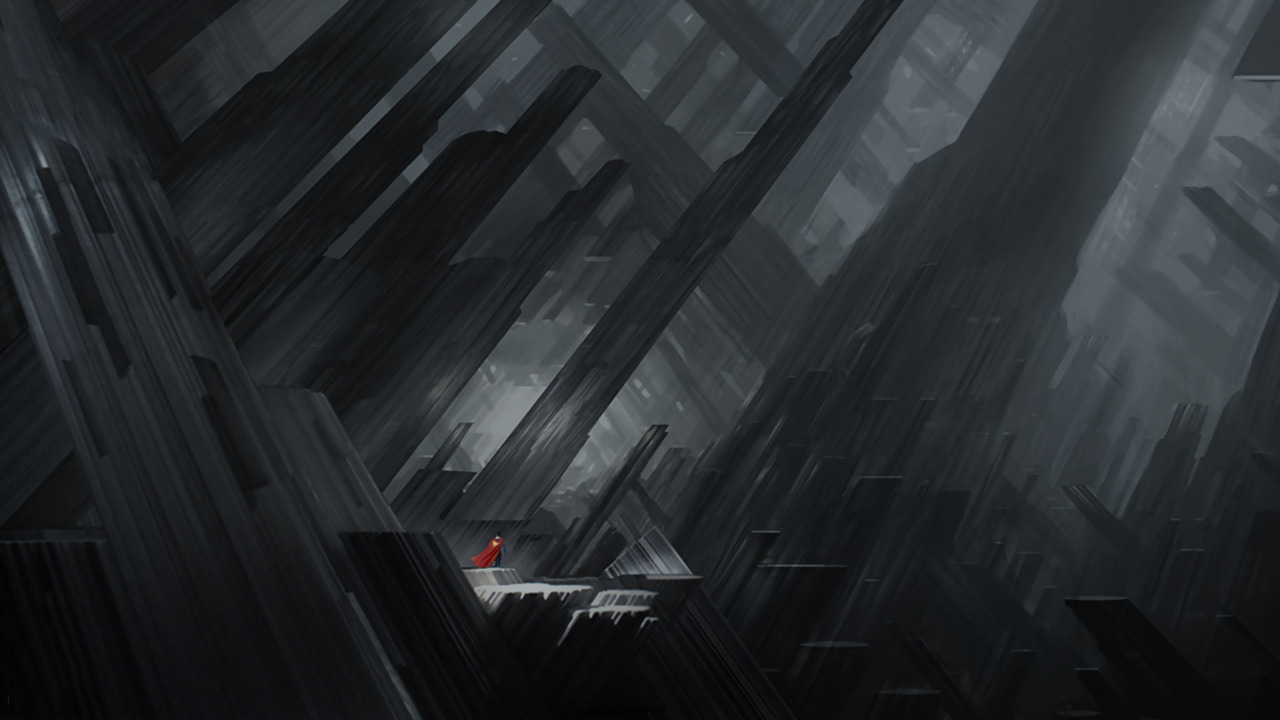
The North is not always a source of darkness, cold, villainy, or evil. For Superman, the North is a place of quiet and contemplation, where he goes to rest. It is in the North that he builds his Fortress of Solitude, his unearthly home on Earth.

How do you see the North? Cold and desolate and full of dark beings? Or stark and majestic and a place of enormous solace?

Share This Post

Another Very Public Service Message

OK folks, obviously we’re back from our brief trip to Toronto (too brief, it turns out…my long-simmering admiration for that city is swiftly turning to full-on lust), so blogging will begin again as regularly scheduled…sort of. I’ll be skipping this week for the Burst of Weirdness and Sentential Links, though. I do hope to get back to the Saturday Centus; I have an entry in mind for this week’s entry, but I’ve skipped several weeks due to focusing on Princesses In SPACE!!! (not the actual title), about which I may have a small announcement later on. (Very small. Not ‘Holy shit, I sold the book’. Smaller than that.)

Anyway, onward and upward!

Share This Post

A to Z: M5

Ah, the supercomputer that is benignly invented as a means of making life easier, but which ends up wanting to kill us all! What a nice, fun, reliable SF trope. All hail our digital overlord, the M5 computer from Star Trek! (And other supercomputers.)

The M5 (from the episode “The Ultimate Computer”) is built by a supergenius named Richard Daystrom, and it is installed on the Enterprise for a series of wargame-style tests that will put the M5-controlled Enterprise against several other starships. Everything is going swimmingly, until the wargames get intense enough that the M5 assumes that it is actually under attack, at which point it opens a computer-driven can of whoop-ass. It turns out that Daystrom used engrams from his own mind to program the M5, so it thinks the way he does – which is unfortunate, as Daystrom turns out to have some psychological issues. The computer is going all-out, which forces Starfleet to also go all out, planning to destroy the Enterprise, unless Captain Kirk can save the day. Which he does, of course, using his tried-and-true method of talking the computer into a logical contradiction that forces it to shut itself down.

Kirk would do this a few other times in the course of the series, and it became enough of a cliché that in the DC Comics Trek series in the late 80s, there was an issue where the Enterprise crew comes up against a supercomputer and the first thing Kirk does is say something like, “Well, I suppose I could try talking it into a logical contradiction. That usually works.” Needless to say, it doesn’t.

But supercomputers with a malevolent bent are certainly not unique to Star Trek. There was the computer in Wargames, the one designed to manage the entire nuclear defense of the United States. There was the Master Control Program in TRON, and, of course, the granddaddy of all malevolent supercomputers, the HAL-9000 in 2001: A Space Odyssey, whose insanity would later be explained in 2010: Odyssey Two, which ends on some tension as the entire crew’s survival depends on HAL, whose sanity is open to question. (To the extent that one can even talk about sanity in a computer.)

And let’s not forget about Skynet. That one turned out poorly, didn’t it? Beware the supercomputers! They’ll kill us all!!!

Share This Post

A Very Public Service Message

Greetings, Star Warriors!

I and the Family Unit will be generally away from the Interweb for most of today and almost all of tomorrow. I have a few posts that will appear via the magic of scheduling (hooray, scheduling!), but I won’t be able to approve comments as quickly as usual. So if you comment — and absolutely, feel free to do so! — don’t be dismayed if a largish number of hours elapse before I get ’round to sending it through.

Thank you, and buy war bonds!

Share This Post

A to Z: Lancelot

One thing I noticed in all my years of reading Arthurian fiction was that Lancelot is an awfully hard character to pull off.

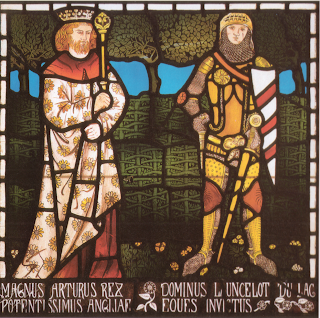
Lancelot, for those not ‘in the know’, is the magnificent knight from France who comes to Camelot to serve King Arthur and sit the Round Table. Lancelot is the greatest knight anywhere (well, until Galahad shows up); no one can best him in any test of skill, and what’s more, he’s morally pious to the point that being around him is a real downer. At least, he’s those things until he meets the Queen, Guinevere, and falls in love with her. This would be bad enough, but she falls in love with him, too. Lancelot and Guinevere carry on an affair that eventually becomes the moral crisis that causes the Knights of the Round Table to splinter, and in the end brings about the end of King Arthur’s reign.

Now, depending on which version of the tale you read or watch, it’s not all the fault of Lancelot and Guinevere. Many tellings of the story also include Arthur’s magical seduction by his witch sister, Morgause, who bears a son, a force for malevolence named Mordred. In these tellings, it’s Mordred who finds out about Lancelot and Guinevere and forces their affair into the open, in turn forcing King Arthur to choose between enforcing his morality or allowing his deepest friend and wife to go free.

The problem with Lancelot, then, is two-fold. First, you have to establish that he’s virtually perfect, which makes it nearly impossible to sympathize with him. Then you have to make him sleep with his best friend’s wife, which also makes it nearly impossible to sympathize with him. This is why, when I’ve read Arthurian fiction, it’s the Lancelot character who usually suffers the most, and in reality, this is why I can’t honestly even recall a book where Lancelot comes off very well at all. T.H. White’s The Once and Future King probably does it best of anybody, but even for him, Lancelot comes off feeling a bit unreal.

Lancelot’s origins are hazy, but that’s to be expected, as the origins of the entire Arthurian corpus are pretty hazy; the Arthurian legends – the “Matter of Britain” – were not so much created as they accrued over time, gathering bits and pieces from other, older legends and myths and folk tales. Back when I was studying Arthuriana a lot, I started to realize that I was finding that older material more and more compelling – tales such as the Welsh Mabinogion and other parallel stories.

Why has the definitive Lancelot not yet turned up? I think it’s probably part of the same reason that a definitive telling of the entire Arthur story hasn’t turned up. The story is not a story, but rather a collection of interrelated stories, a grab-bag of tales, told in many different styles over the centuries. As for poor Lancelot himself, he’s a tough nut to crack because he’s a jerk in two different ways and if there’s one thing we like, it’s to see a jerk get his comeuppance. But we also don’t like to see jerks take good people down at the same time, which is why the tale of King Arthur is such a tragedy.

As I note, Lancelot is a deeply troublesome character to pull off. Most authors, I have found, choose to make Lancelot less than perfect, and merely a likable guy and a very good knight. They also try to soften Guinevere’s appearance of fault by making her more sympathetic — possibly by making her marriage to Arthur an arranged marriage, so that while she honors him and may even love him after a fashion, he never has her heart. Making everyone sympathetic in a tragic story that involves moral failure is not an easy thing, and to my experience, no one has quite pulled it off.

Ultimately Lancelot seems to be a reminder that our greatest dreams for ourselves may well be unattainable, and that our hubris often contains the very seeds of its own downfall. King Arthur forms the Round Table out of a desire to have a peaceful realm where justice is served by all his knights, but along comes Lancelot, ostensibly the man most ideally suited to this lofty goal – and he’s the one who sets in motion the events that will eventually destroy the Round Table and cost Arthur himself his life (or, at the very least, see him carried off to Avalon).

Share This Post