Something for Thursday

Russian Romanticism in music appeals to me on nearly every elemental level of my being, so it’s always seemed odd to me that I tend to have a hit-or-miss reaction to the music of Peter Ilyich Tchaikovsky. There is some of his music that just leaves me kind of cold (the 1812 Overture); there’s other music of his that appeals to me on a basic level but leaves me wanting something with more substance (the Piano Concerto #1). And then…there is the music where he hits, and in these cases, the music has a startlingly deep emotional impact on me. The Nutcracker falls into this category, among others, but by far, my favorite work of Tchaikovsky’s is his Symphony #5.

Like many Russian symphonies, this one is cyclical, with melodies from the first movement returning for a glorious flowering in the final movement after appearing in insistent, almost unwelcome, form in the second and third. Lyricism triumphs throughout, but what always engages me in long Russian symphonies like this isn’t even so much the raw lyricism as the logic that is applied to it, a sense that the final triumph, long delayed, reaches a point in that fourth movement where you can just feel it pushing its way through.
Here is the entire Symphony No. 5 by Tchaikovsky, in a wonderful performance by the Boston Symphony Orchestra, conducted by Leonard Bernstein. Once again I am struck by how Bernstein was so my kind of conductor. I hate it when conductors don’t look like the music they are conducting is making them feel anything; Bernstein shows that the music is making him feel everything.
Share This Post

A to Z: Elphaba

There’s a certain subgenre in which existing, famous stories are retold from the inside-out. I’m not sure what this genre might be called, but when it’s done well, it can be a lot of fun. There’s a great example in Star Trek: Deep Space Nine‘s “Tribbles and Tribulations”, which has the DS9 crew time-travel back so they are actually inside the events of the TOS episode “The Trouble with Tribbles”. The second Back to the Future movie does this as well. And then there’s the Tom Stoppard play Rosencrantz and Guildenstern Are Dead.

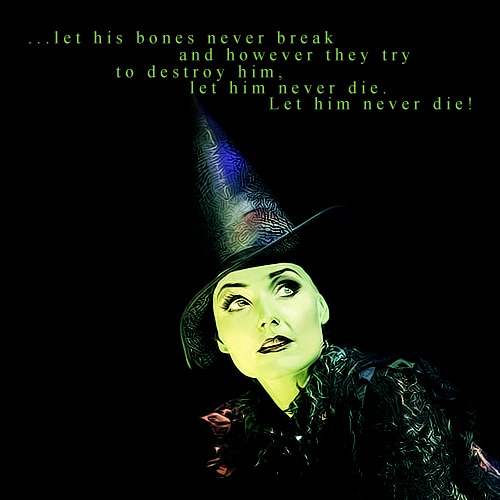
For these kinds of stories to work, the original story has to be fairly well-known, so the audience can notice when the events of the original are shown, but with the shift in point-of-view. One of the most famous recent examples of this kind of meta-story is the book Wicked (and its sequels), and its subsequent Broadway adaptation. It gives us The Wizard of Oz, from one possible viewpoint of the Wicked Witch of the West, whose name is revealed to be Elphaba. So there’s our ‘E’!

I haven’t read the books, so my only acquaintance with this character comes via the show, which I saw last year and blogged about here. Wicked, the show, takes sufficient liberties with the characters and the original story that I can’t honestly say that I’ll be thinking of that tale lurking in the corners next time I watch The Wizard of Oz. But as a meta-story, it’s a lot of fun, and in providing a sympathetic Elphaba, we get a good illustration that we’re all the heroes of our own stories. The really memorable villains aren’t always the ones who act the most evil, but rather the ones who are genuinely committed to their own causes and who really believe themselves to be on the side of the righteous.

Here’s Elphaba and Glinda in the big Act One showstopper, “Defying Gravity” (embedding disabled). Elphaba is played by Idina Menzel, and Glinda by Kristen Chenoweth. (Menzel had apparently suffered an asthma attack minutes before going onstage to do this, which is why her breathing in this performance is so pronounced.)

Trivia: Elphaba’s name came about by sounding out L. Frank Baum’s initials.

Share This Post

A to Z: Diana

So, now we have Diana. But not this one:

Phil Jimenez art in Wonder Woman #600

No, that would be too easy. We’re going with this one!

best villain of all times

Yes, it’s Diana from V, V: The Final Battle, and the series V that lasted only a single season on NBC back in the 1980s. Diana was the show’s main villain, and she was truly rotten to the core. Played with relish by Jane Badler, Diana never had, to my recollection, so much as a second of repentance or any kind of flash of good behavior. No Darth Vader-esque deathbed conversion for her; Diana was the show’s Hitler. (Although that’s probably not the best analogy, since she was a military leader and not a head of state.)

Here’s Diana being all evil and stuff:

In retrospect, I’m not sure how well V holds up. The central SF-nal premise is deeply silly; these aliens have come from across the Galaxy to steal all of Earth’s water, under the notion that water is a very rare commodity. Even given that it was the early 1980s, I think we knew at that point that water was more common than that; just a couple of years later, Arthur C. Clarke’s 2010: Odyssey Two made a key plot point out of the enormous amounts of water ice on Europa. It’s just awfully hard to believe that these aliens can build interstellar FTL starships that are three miles in diameter, but can’t figure out how to feed their people or come up with water.

And the characters are pretty much all stock characters, every one of them, right down to Diana, who could be a fascinating character to explore – what would the aliens’ ethics be, that they’re perfectly willing to slaughter a sentient species for food? Alas, this is never explored, in favor of action and derring-do. Which is all pretty fun to watch, it must be admitted. Diana herself is as one-dimensional as villains get. She doesn’t even get to seem terribly intelligent; her main defining traits seem to be visceral loathing for humans and utter ruthlessness in getting what she wants.

But she’s still really memorable, at least for me, because Jane Badler played her wonderfully.

Share This Post

Stop that, George.

OK. I’m about a quarter of the way through A Feast for Crows on the re-read, and of course, I’ll have more to say about it when I’m done. But I’ve just read the chapter featuring Asha Greyjoy, and got smacked in the face with this (A ‘maester’ is a man who has undergone a high degree of formal education, so an ‘archmaester’ is an extremely learned man, in service to a King or Lord.):

Archmaester Rigney once wrote that history is a wheel, for the nature of man is fundamentally unchanging.

Fantasy readers will be put in mind of The Wheel of Time, the long fantasy series mostly written by Robert Jordan…which is a pseudonym for a writer named James Oliver Rigney. Really, GRRM? A damned in-joke? GAHHHH!!!

(No, it’s not a big deal, but it did throw me right out of the story.)

Share This Post

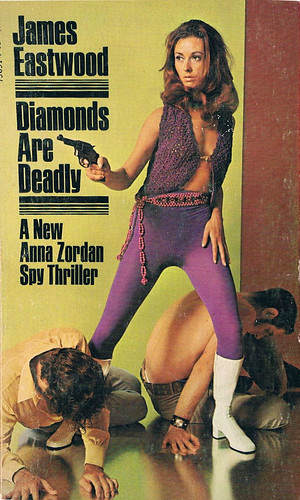
Where does she keep the gun when she's not pointing it at stuff?

And wait…diamonds are deadly? I thought they were forever. But then, death is forever. So:

Diamonds are Deadly
Death is Forever
therefore:
Diamonds are Forever

I wonder what other adventures our white-booted, revolver-pointing spy vixen had!

Share This Post

A to Z: Clint Howard

OK, we’re going with an actor here rather than a character or thing, but let’s be real here: Ron Howard’s younger brother Clint is, in addition to being one of the hardest working character actors anywhere, an absolute fixture in F&SF movies and, more generally, in geek culture. I mean, the guy has been in, as near as I can tell, just about everything. I mean, just go look at his filmography. It’s astonishing how much stuff he’s been in, and he’s always so professional about it.

You want to know how cool Clint Howard is? In 1998 he was given MTV’s Lifetime Achievement Award at the MTV Movie Awards. Now, this award was considered something of a spoof award, but when they gave it to Howard, it was an actual honor – so much so that they retired the award after he got it. Isn’t that a hell of a thing!

So here’s to you, Clint Howard. Geek culture and F&SF fandom would be poorer for your absence!

(That’s Clint Howard, as a kid, voicing the child elephant.)

Finally, I can’t embed this one, but it’s a pretty funny send-up of movies like Armageddon, where early on the experts have to brief the President and use some handy metaphors to convey the direness of the situation.

Bravo, Clint Howard!

Share This Post

Extruded Aaron Sorkin Product #19

Here’s a teaser-trailer thing for the new show Aaron Sorkin’s writing for HBO, about…a news anchor. I honestly can’t fathom why anyone still thinks Sorkin is a genius. Watch this and tell me it doesn’t sound exactly like every other thing he’s ever done.

Right there, in two minutes, is nearly every single annoying Sorkinism that exists. Ugh.

Share This Post

A to Z in April: Bib Fortuna

Continuing our alphabetical trek through the highways and byways and Fantasy and Science Fiction, here’s a very minor character from Star Wars Episode VI: Return of the Jedi. Bib Fortuna is the chief servant of Jabba the Hutt, to whom falls the duty of being Jabba’s main assistant and, I suppose, major domo.

Now, Return of the Jedi strongly implies that Jabba is an angry sort who tends to go through menial servants at a high rate. The only reason C-3PO is able to fill a job opportunity for Personal Interpreter to Jabba the Hutt is that Jabba reacted angrily to something his last interpreter had told him, and killed him. Bummer. Jabba is also given to torturing his droids in medieval ways, which seems kind of extreme, but what are you gonna do, right? Good help is hard to find.

However, in the Pod Race sequence in The Phantom Menace, we clearly see Bib Fortuna at Jabba’s side, which means that by the time of ROTJ, Fortuna has been serving Jabba for at least 23 years or so. This implies several possibilities:

One: Bib Fortuna is really good at his job.

Two: Bib Fortuna is OK at his job, but really good at not pissing off Jabba.

Three: Jabba isn’t as quick to murderous rage as he’s made out to be.

Now, the third seems the least likely. Not only are we told that he’s disintegrating his interpreter because he doesn’t like what he was told, he also tosses poor Oola into the Rancor pit when she resists his ‘charms’. And he does seem to keep a rather extensive catalog of Ways To Kill Individuals Horribly around, doesn’t he? He’s got a medieval torture chamber for droids, a Rancor, and for a really special execution, he’s willing to whisk his entire court off to the Dune Sea for a game of Feed-the-Sarlacc.

We can probably also rule out Number Two, because of the sheer length of time involved. Jabba really does seem to have a fairly short fuse, and he seems to view death as the proper punishment for all transgressions (unless carbon freezing happens to be involved, but remember, that wasn’t his idea). So I have to conclude that Number One is the case, and that Bib Fortuna may be the greatest single major domo in the history of science fiction. Too bad, then, that he died on Jabba’s Sail Barge…

…or did he? Hmmmmm!

(Actually, according to Bib Fortuna’s entry in Wookieepedia, it’s a combination of One and Two, and he did get off the Sail Barge and go on to live a long life of crime! Check it out, it’s interesting reading, if you’re in any way interested in ‘Expanded Universe’ stuff.)

Share This Post