A to Z: Klingons

So, let’s talk for a few minutes about Klingons.
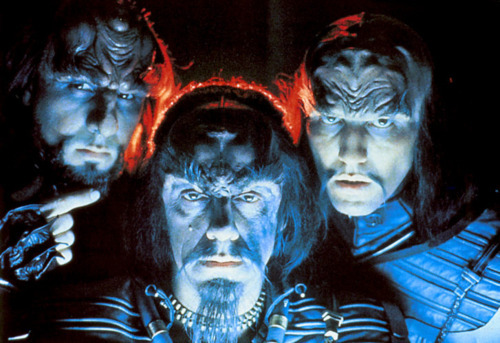
If one of the questions on Family Feud was ever “Name a fictional alien species”, I have to think that Klingons have a pretty solid shot to be the number one answer. (“Let me see…Gungans!” BZZZZZZZT “And the Laramie family with a chance to steal!”)

But why is this? Why are the Klingons so memorable?

The obvious first answer is in Star Trek‘s longevity. A thing doesn’t remain a pop-culture concern for as long as Trek has without having some of its terminology enter the pop-cultural lexicon, and the Klingons were the main bad guys of the Original Series, so there’s that. And more than that, a case could be made that the Klingons were the main alien species of the Original Series! More Klingons undoubtedly appeared on Star Trek TOS than Vulcans, and of the first ten Trek movies, there is exactly one in which no Klingons appear. (Wrath of Khan being the one – we see Klingon ships as part of the Kobayashi Maru test, but that’s it.)

I think it’s also easier to remember Klingons because they were often characterized as a group, more than as a race of specific individuals. Until Worf came along as a part of the Next Generation crew, we only saw a few Klingons at a time, and they never recurred (which was a shame – some of those early Klingons would have made great recurring characters, but recurring characters and stories just weren’t the style back then). Klingons were, basically, the ‘Indians’ in Gene Roddenberry’s space western that really wasn’t much of a space western at all. It amazes me to this day that one of Roddenberry’s concepts for pitching the show to the networks was “Wagon Train to the stars”, a concept that fits Battlestar Galactica better, orders of magnitude better, than Trek. But the Klingons were the disposable villains who would pop up, make life difficult for Kirk and company, and then disappear again.

This continued in the movies, too. The main villain of The Search for Spock was Klingon Commander Kruge, who was played very nicely by Christopher Lloyd, and who might have been a decently memorable villain if not for the fact that he was following up Ricardo Montalban as Khan. There’s another disposable Klingon bad guy in The Final Frontier — I don’t even remember his name, that’s how memorable he was – and then, in The Undiscovered Country, the TOS-era crew finally engages the Klingons as more than villains of the week, but as complex individuals. How did that happen?

Well, in between Treks V and VI came TNG, which decided to deepen the canvas a bit when it came to the Klingons. They weren’t boring villains of the week anymore; there was a weekly name attached to them. And with a spot in the regular cast, that meant installing a back story, which in turn meant finally delving into the nature of the Klingon society. TNG often did its best stuff in Klingon-culture related stories; instead of being the warlike goons of TOS, in TNG they were driven by honor more than drive for conquest. The Klingons of TNG came off as kind of a blend of Samurai and Vikings, if that makes sense. It was also interesting to me that as the Klingon Empire came to reach the limits it could reach without engaging in full-on war with other powers, their society turned its quest for honor in battle on itself, so for the rest of TNG and DS9, the Klingons were always engaged in a lot of violent interior politics and sometimes open warfare.

Of course, I can’t write about the Klingons without also mentioning the physical change they went through. In TOS, Klingons were just human-looking people with demonic-looking eyebrows and uniforms of gray and black. In the opening scene of Trek: The Motion Picture, though, the Klingons were well and truly alien, with enormous spiny ridges up their bald heads. This change was never explained, really; I assume that the original thought was to just go ahead and use the film’s large budget to re-do the Klingons in order to make them look a lot more alien, and that we were to just assume that the Klingons always did look like that and we were just supposed to accept the TOS Klingons as such.

But then, DS9 did its brilliant episode “Tribbles and Tribulations”, which had Worf – looking like very much the spiny-head Klingon – having to be in the same room with the ‘human’ looking Klingons. When someone asks him about it, he simply says, “We do not like to talk about it.” I’m sure this has been explained in some novel or some such, but I wouldn’t know. (Heck, they may have explained it in Enterprise, but again, I wouldn’t know.)

Anyway, long live the Klingons. Qapla’!

Share This Post

A to Z: James, Jerry, and John

The other day SamuraiFrog paid tribute to John Williams, which gave me the inspiration for this post. I grew up listening to film music, and at that time, my three favorite composers were John Williams, Jerry Goldsmith, and James Horner.

Williams was, of course, my favorite from the earliest, and he remains so to this day. His gift for melody, his orchestrations, his touch with a scene…he has an ability to get right to the heart of the emotions of a scene that has always been, for me, the key to film music.

Horner came along a few years later. I’m happy to say that I was on board with Horner very early on; his first major scoring assignment was the Corman B-movie space opera Battle Beyond the Stars, and Horner provided a nifty bit of space adventure scoring, even if I would realize in later years that it was pretty derivative of the work Jerry Goldsmith was doing at the time. Horner’s first major assignment was for Star Trek II: The Wrath of Khan, and what a score he turned in – exciting and adventurous, while at the same time elegiac and with a definite seafaring mood, as befitting the movie’s Moby Dick parallels. I’ve cooled on Horner in recent years, as I think that his compositional palette tends to be a bit limited. But I can’t deny his power in his best scores.

Goldsmith was the toughest nut for me to crack. I first experienced him via Star Trek: The Motion Picture, a score which I liked well enough but found harder to draw myself into, given long passages that were pretty free of bombast (remember, I was nine at the time, so bombast was my order of the day). I would come to love a great deal of Goldsmith’s music over the years, but my enthusiasm for him waned a bit during the last ten years or so of his career, when he seemed to eschew the wonderful complexity of his earlier work in favor of giving each film a single memorable melody or two and then leaning on those melodies, over and over and over again. But there’s no mistaking that Goldsmith composed a great deal of truly great film music.

Of course, I’d learn a great deal more over the years about other composers, some of whom could easily fit into this ‘J’ post (John Barry, Joe Hisaishi, Jan AP Kaczmarek….). But from my early days, those were the biggies for me.

Here are some musical selections. (I’ll provide links to YouTube rather than embed the videos, so as to keep this post uncluttered.)

John Williams:

1. Williams is often associated with bombast, but he can do churning suspense as well as anybody. Witness his main title to Dracula, with its haunting suggestions of lurking terror.

2. The Flying Sequence from Superman blends lyricism with magical wonder better than any music I can think of.

3. One of Williams’s most underrated scores is his music for Nixon, the Oliver Stone film about the 37th President. The 1960s: The Turbulent Years is a fascinating tone poem that suggests American idealism and paranoia in the same track, as well as Nixon’s often single-minded pursuit of his political goals. It’s Williams’s insight that allows him to musically portray these things in the same individual.

4. I don’t think I can write even a brief “What John Williams means to me” post and not include something from a Star Wars movie, so here is, for me, the musical emotional heart of the entire saga. This moment – when Luke attempts to raise his X-wing from the swamp and cannot – really drives home the mysticism of the story, and makes Luke’s failures more elemental in nature. The music is “Yoda and the Force”. (This cue, to me, also gives the lie to the notion that until a certain point, Williams was all about brassy bombast. His string writing in this cue is amazing.)

5. Well, one more from Star Wars, this time Return of the Jedi. Brother and Sister underscores the scene where Luke reveals to Leia who he is, who Vader is, and why he must confront his destiny. It’s gorgeous writing, and in three minutes, Williams employs three different themes to suggest what is going on.

Jerry Goldsmith:

1. I can’t talk in any emotionally true way about Goldsmith without talking about Star Trek, so here’s his amazing music for the Enterprise (in a live performance), from Star Trek: The Motion Picture. Lots of folks decry this long sequence of James T. Kirk undressing a starship with his eyes, but…I’m fine with it.

2. There’s another long sequence later in the same film, in which, just as we had earlier seen Kirk relating to the Enterprise, now we see the Enterprise relating to the massive ship called V’Ger. The first music was romantic and stirring; this is haunting and mysterious. It’s Vejur Flyover.

3. One of my very favorite Goldsmith scores is his stunning work for the Schwarzenegger skiffy action flick, Total Recall. Here’s the main theme. It’s just fantastic, the way Goldsmith keeps the musical momentum percussively driving forward, forward, forward, suggesting the story to come of a man on the run who can’t stop running, even though he has no real notion why he’s running.

4. Goldsmith did a lot of synthesizer work in the 1980s. Some of this stuff sounds awfully dated, but the scores still work, for the most part. He also scored one of the best sports movies ever, Hoosiers. Here’s the theme.

5. One of the greatest noir scores of all time is Goldsmith’s score to Chinatown, which he had to churn out in a very short time, which is part of what led him to compose a very minimalistic score for a very small ensemble. The main theme sets the stage for a weary, bleak story to come.

James Horner:

1. It’s been nearly thirty years since I saw the movie – and it wasn’t really all that memorable – but Horner’s score to Brainstorm is wonderful. I should probably watch it again, just to remind myself what’s going on during “Michael’s Gift to Karen.

2. Horner’s score to Titanic isn’t my favorite, but the gently simple solo piano arrangement of the love theme, heard when Jack is drawing the portrait of Rose, is a beautiful moment.

3. The finale to Legends of the Fall is a fitting conclusion to a big-skyed Western family epic melodrama. This is my favorite Horner score.

4. Re-entry and Splashdown from Apollo 13 is just a great bit of film scoring. Horner keeps the tension going, even during the parts of the scene where it seems that hope has been lost.

5. From Battle Beyond the Stars, here’s “Cowboy and the Jackers”. This bit of action music comes when our hero, a kid named Shad, encounters a guy named Cowboy whose ship is under attack. This is what Horner sounded like when he first came on the scene. He would mature a lot, and pretty quickly. (He’d also learn to orchestrate…at the end of the track, just listen to the long, slow execution of the trumpet section that Horner mounts. Ye Gods.)

Share This Post

A to Z: Incunabulum

Books abound in fantasy and science fiction. The book is a central plot device or Maguffin or important element in so many stories that to catalog them all would be an exercise in utter futility. But let’s explore some anyway, in this entry. Behold the Incunablum!

Strictly speaking, an incunabulum (plural incunabula) is a book printed in Europe before 1501. According to Wikipedia, this is an arbitrary distinction, which is why I can get away with it here. But it’s a cool word, and it kind of connotatively suggests not just any old book, but rather the types you see a lot in fantasy: big, heavy tomes with lots of pages between leather covers. A locking clasp is also good; witness Indiana Jones’s Bible in Raiders of the Lost Ark.

Books are so often important objects within fantasy and SF stories that I can only offer a smattering here. The Neverending Story is a great example (even if I don’t like the movie all that much), in which the act of reading a story and the act of being in a story are melded into one. Books are a constant thing in the Gothic YA novels of John Bellairs; in one, the young hero’s adult friend is a literature professor, while in another, the adult companion is actually a librarian.

Books are the ultimate symbol, I suppose, of education and learnedness. Showing a person surrounded by stacks and stacks of books is almost a cliché for “This person is smart!” But it can also be shorthand for “This person is really eccentric!” — hence all the somewhat dotty wizards and witches in fantasy literature who are forever losing themselves in the pages of their tomes. And books can also establish one more facet of someone’s ass-kickingness:

Magic books? Those can be found, too. A magical book is at the center of Lloyd Alexander’s Prydain Chronicles, which begins with The Book of Three. Books are the magical gates between worlds in the computer game Myst. Books as central organizing principles of civilization? The original series Star Trek episode “A Piece of the Action” gives us a society that has organized itself around the rules of a civilization they read about in a book they recovered from a crashed starship. Unfortunately, the book was about mob men of Prohibition-era Chicago. This notion would later be repeated in the Next Generation episode “The Royale”, in which some well-meaning aliens construct a ‘world’ for the sole human survivor of a crashed spaceship on their world; they assume that the crappy novel he’s reading is an accurate depiction of human society, so they create that novel’s setting for him. (This is one of my favorite episodes of the series, although it doesn’t seem terribly popular.)

And books can be key moments of villainy, too. George RR Martin has well established King Joffrey’s colossal sociopathic status by the time we get to A Storm of Swords, but that doesn’t stop Martin from giving us a scene where Joffrey receives a very rare book as a wedding gift, and then uses another wedding gift – a sword of Valyrian steel – to chop the book in two. When someone points out that there were only four existing copies of that book in the world, Joffrey shrugs and says, “Now there are three.”

I could go on and on, but I’ll stop there. But remember: books rule!

Share This Post

A to Z: Horses

If there’s an animal more suited to heroism and derring-do than the horse, I don’t know what it is. Horses abound in fantasy and in science fiction. If you want a big heroic moment, you can do it without having a horse there…but a horse or two really helps.

Horses aren’t just well-suited to heroism. Horses lend themselves to tearjerking, too; if you want the audience to sympathize for the main character, well, just kill his poor horse, and that’ll do it. Dances With Wolves starts to become gut-wrenching when Cisco, John Dunbar/DWW’s horse, is killed out from under him.

Horses are, of course, a major factor in The Lord of the Rings. You have Gandalf, claiming for himself Shadowfax, the greatest of all horses, and one of the most heroic moments in the story – book and film – comes when the Riders of Rohan, a culture devoted to the horse, finally arrive on the scene at the Battle of the Pellenor Fields. Even the hobbits get into the horse act, with their use of ponies; Sam’s beloved pony Bill, who gets turned away at the Mines of Moria, is long-missed, and Sam’s relief many months later to discover that Bill has turned up back at Bree is a wonderful moment. And in truth, the fact that the Fellowship is mostly horseless seems to put them at a psychological disadvantage already, before they ever set out from Rivendell.

LOTR also gives us evil horses, in the black steeds that the Nazgul ride in the first half of The Fellowship of the Ring. In the film, Peter Jackson depicts this by use of close-ups of the horse, from strange angles, shots of the spittle dripping from the horse’s mouth, and so on. And when the power of the river is unleashed against the Black Riders, the foaming waters take the form of white horses.

On the flip side of that particular coin we have the sacred horses of Stephen R. Donaldson’s Chronicles of Thomas Covenant, the ‘Ranyhyn”. These horses are larger than their Earthly equivalent, and they are somehow in touch with “Earthpower” – the magic inherent to the world – and will not allow anyone to ride them that they themselves do not choose. One of the most potent moments depicting the power of Thomas Covenant comes when Covenant, as an act of atonement, commands the Ranyhyn to visit Lena, the girl he raped earlier.

Great horses are the key plot point of Guy Gavriel Kay’s brilliant novel Under Heaven, when a distant princess decides to gift a relatively minor man with two hundred fifty of her great horses, an act which sends shockwaves across the dynastic rule of Kitai (GGK’s medieval China). And let’s not forget the Firemares of Krull!

Horses in SF? Well, there are horses aplenty in Firefly, which is fitting as the show is essentially a space western. There are no horses, per se, in Star Wars, but the Tauntauns of The Empire Strikes Back are rather horselike. In Star Trek V, there are beasts on Nimbus III (the “Planet of Galactic Peace”) that aren’t horses, but might as well be. (I think they’re there because William Shatner, who directed that one, is a noted horse enthusiast.) Shatner’s equestrian enthusiasm would be indulged again in Star Trek Generations.

Not SF or fantasy, but here’s a scene from a good movie called Hidalgo, which has Viggo Mortensen playing a guy who, along with his horse Hidalgo, enters a race across the Sahara. I like this scene because it shows the beginning of the race…and what happens once the racers are out of sight of the people watching them start.

All hail the horse!

Share This Post

A Deepness in the Sea

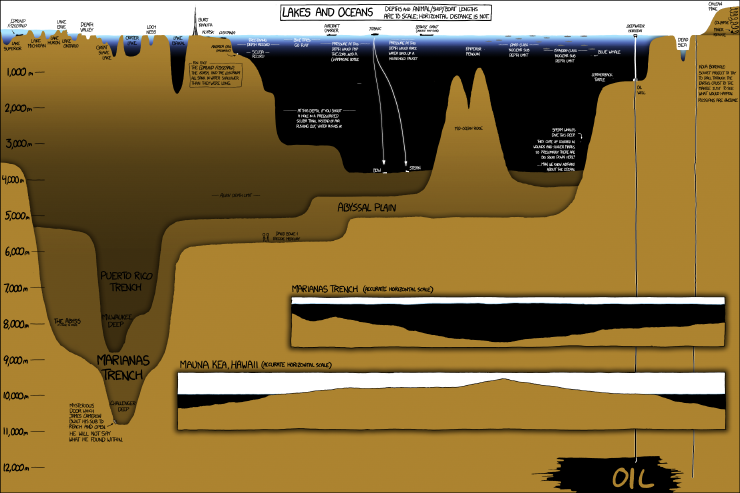
By rights I should save this for next week’s Sunday Burst, but it’s too good for that. xkcd brings the infographic goodness to the depths of the large lakes and oceans.

Note the depth of Lake Erie, relative to the other Great Lakes — that’s why Lake Erie usually freezes over during winter (although not so much the last couple of years, and in the future, who knows — thanks, Global Warming!).

On a related note, I think that we may be living in the Golden Age of Infographics. I love losing myself in these things!

Share This Post

Sentential Links

Here are some linky things…but first, a lanky thing!

(I know, I know, maybe ‘lanky’ isn’t the best descriptor for Yao Ming, given his level of athleticism.)

:: I wonder if Star Trek has a technology for getting cheese dust off your hands? I mean, something more advanced than the technology we have now. Which is the pant-leg.

:: Okay, here is my plan. I am going to go to the 7-11 on Monday and I am going to purchase a bag of Fritos. Then I will ask the girl how much I need to pay to make generous use of their free cheese and chili and onions. (Ahh, chili and Fritos!)

:: Being defined by your stupid disappointments is petty and makes you pretty boring and small. There’s so much to enjoy in genre, why would you obsess over the things you don’t like? Because you can’t get over it? (I couldn’t agree more.)

:: My personal philosophy is to err on the side of caution. Given the choice, I’d prefer to give too little description and leave you wanting more, rather than give a lot and risk you being bored. (This is my approach too, if it matters….)

:: That’s just hateful, frankly. He has less of a chance at the Republican nomination daily, but all over the country there are people who are voting for this guy, and that is dismaying. People should be crossing the street to avoid him. I feel like spitting between my fingers when I hear his name. (Now there’s an unambiguous take on Rick Santorum!)

:: You never feel as far from self-government as you do in our health-care system. It ought to be a lot harder to barter for someone else’s life.

More next week….

Share This Post

Sunday Burst of Weird and Awesome

Oddities and Awesome abound!

:: This is neither odd nor awesome, actually, but it always amuses me when Star Wars fans write 1000+ word missives about why they just don’t care anymore.

If they didn’t care, they wouldn’t write the missive.

:: Roger answers questions posed by a right royal nitwit.

:: Did I link this already? I may have…but if I did, here they are again. I am so building these at the next Casa Jaquandor, whenever such a place comes to pass!

More next week!

Share This Post

A to Z: Gagh!

There’s an episode of Star Trek: The Next Generation in which Commander Riker takes part in an officer exchange program and goes to serve on a Klingon vessel for a time. As part of his effort to familiarize himself with Klingon food, he goes to Ten Forward and orders himself up a smorgasbord of Klingon food, all of which looks very odd. The most notable dish here is Gagh, which he later learns is “best eaten live”. (When he looks askance at eating live Gagh, a Klingon japes, “Perhaps we can arrange for one of the females to breastfeed you!”)

So what is Gagh, anyway? Well, the experts, Gagh is:

A Klingon delicacy of serpent worms (pronounced “gawk”). Connoisseurs of Klingon cuisine claim that gagh is best served very fresh — i.e. live.  But it is sometimes served stewed. Gagh is one of the most popular foods served aboard Klingon warships.

Apparently the chief appeal of Gagh is its unique mouthfeel as the live worms pass through your mouth and into your digestive tract to die. Awesome! (It also turns out that in Klingon, Gagh is spelled qagh, so I could have done this one under Q. I haven’t yet pre-selected my Q entry for this series, so I’ve missed an opportunity!) But even vegans don’t have to feel left out, as they can simulate Gagh thusly.

Which brings up the more interesting topic of fantasy and sci-fi food. Food is one of the best ways to convey an alien quality of any situation, which is why we’re told that Klingons like to eat a dish of live worms because they like the feeling of slithery things going down their gullets. “Normal” food in science fiction? Never! There’s not a whole lot of food in Star Wars, but there is “blue milk” at Luke’s table on Tatooine. Jabba the Hutt likes to eat little beasties live, and so on. And Star Trek was forever giving us different alien foods, some of them live, like the eggs that the Cardassians like to eat, the ones that you crack open and see the embryo squirming about inside.

Of course, science fiction food used to be all about taking pills. You’d take a single pill and there’s all your nutrition! Food would be a thing of the past in our technological future. And then you have food, real food, used as a way to suggest certain luxuries. Witness Firefly, when Shepherd Book’s ability to cook with a few actual spices is welcomed warmly, and when he is able to partially guarantee passage on Serenity by giving Kaylee a single strawberry.

Fantasy food tends to be different. In fantasy, food is often where some of the magic happens. The Lord of the Rings gives us lembas, the Elven bread that can sustain a grown man for an entire day in a single bite. In the Chronicles of Thomas Covenant, one of the main foods is aliantha, the berries of The Land, which provide sustenance in much the same way as lembas does. Magical foods abound, and turn out to be an outstanding way to get magic into the story without resorting to wizards and spells; the magic in food is a part of the fantasy world itself, and not a creation of the people in it. There’s even food inside the computer, as TRON indicates, as the programs have to stop and drink some pure energy after escaping the Game Grid.

Guy Gavriel Kay’s use of food is tied to themes of nationality, a common theme in his books. For example, in A Song for Arbonne, much is made of Cauvas Gold, a wine that is especially beloved in the land of Arbonne. And then there is George RR Martin, who provides a lot of descriptives for the foods served in A Song of Ice and Fire. There, food creates mood: when writing about highborn characters in their castles, he lovingly describes a lot of gourmet-sounding foods; on the other hand, when characters are out in the wilderness or among the ‘smallfolk’, the food is characterized as ‘rustic’, at best. So descriptive can Martin be of his food that there’s a blog devoted to recreating it.

Why is food so central in storytelling? Because food is tied to so many prime emotions. Spirituality? Food is a central part of Christian ritual. Food’s a part of football – just try throwing a Super Bowl party with little or no food. Food as love? There’s your chocolate. Food as laughter? My beloved pie in the face. Food as horror? Well, what does Dracula need to live?

Food is also a gateway to character. Jean-Luc Picard has to have his tea (Earl Grey, hot). James Bond and his vodka martinis. When you think about it, food does an awful lot of heavy lifting in stories, doesn’t it!

So next time you’re watching a fantasy or SF show or reading a novel, pay attention to the food! And if you engage a story with little or no food in it, ask yourself if that world seems quite as real as others that tell us what their people are eating.

And you know…I’ll bet with plenty of hot sauce, gagh would be just fine.

Share This Post

A to Z: Florin

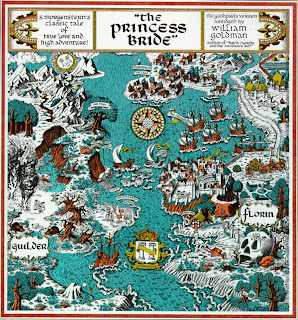
Stories have to take place somewhere, don’t they? In the best of tales, the someplace is almost as important as what goes on there. Heck, there are times like The Lord of the Rings when the setting is, or seems, more important than the tale. The rule of thumb holds: if the setting isn’t memorable, then the tale of the fantastic isn’t going to be, either. Conversely, if you have a really good tale, your setting’s going to be good. So, it stands to reason that one of the greatest of all tales – a tale featuring fencing, fighting, torture, revenge, giants, monsters, chases, escapes, true love, and miracles will take place in a very special realm indeed. Hence Florin, the land of The Princess Bride.

We don’t learn a whole lot about Florin as a country, really. What we know is that it is a monarchy, ruled currently by a very old King and Queen, with a nasty Prince waiting in the wings. Florin is the sworn enemy of Guilder, a nation that lies across the sea. Florin is largely agrarian, and yet it has a number of notable geographic features, such as the enormous Cliffs of Insanity and a horrible place called the Fireswamp. Florin is also the location of vicious sea creatures like the Screaming Eels, and the rumored ROUS’s that dwell in the Fireswamp.

The people of Florin don’t appear to be terribly wealthy, and the castle itself looks fairly spartan in its appointments, so it’s to be assumed that Florin doesn’t have much of a standing army. This likely explains why the elite of Florin seem to prefer schemes against Guilder to open wars of conquest. The latest such scheme, hatched by Prince Humperdinck, involved his murder of his own wife and framing Guilder for it. This plan turned out to be overly complicated, to the point where Humperdinck had to claim that it was a major reason for his being ‘swamped’, and in any case, Humperdinck failed to take into account the power of Twoo Wuv…er, True Love.

Florin’s greatest achievements as a nation may well end up being the fact that the Greatest Kiss of Them All took place there, and its placement of the phrase “As you wish” among the most powerfully romantic things one can say to one’s lover.

Huzzah for Florin!

(image credit)

Share This Post