
What’s a food you consider to be criminally underrated?
A very public thank you….
…to Roger, who sent me a copy of the Paul Simon album Graceland, which I have never heard. I look forward to listening to it, and hope to do so later this week or this coming weekend. Thanks, Roger! I can’t wait!
Share This Post
It came from the freezer case, vol. 1

You know what the world needs now? I mean, besides love, sweet love. The world needs someone to go on a self-guided tour through the wonderful world of frozen pizza and report on his or her findings. Of course, come to think of it, this is 2012, so I’m thinking that somebody out there in Blogistan is already doing this. Well, dammit, I’m gonna do it too.
Frozen pizza makes me happy. Always has. Now, I won’t maintain that frozen pizza is ever as high-quality a product as the best freshly-made pizza, but I absolutely will maintain that there are frozen pizzas out there that are frankly preferable to quite a few places that do the fresh thing. I mean, we have to be realistic here, don’t we? Not all pizzerias are wonderful. Many are. Many more are not, and many only manage to keep churning out their disappointing pizza by being cheap and/or conveniently located near a population of people predisposed to value cheap and convenient pizza (such as, say, college students).
I am no ‘expert’ on pizza, but I do love it and I think I have a fairly decent handle on whether something tastes good or whether it’s (as some frozen pizzas really are) crap-on-toast. And since I tend to have frozen pizza for dinner a couple times a month at least (hey, it’s an indulgence), why not blog about it?
I grew up eating frozen pizza. Not all the time, but my parents would keep a few in the freezer on a regular basis, so that I might have something quick and easy to feed myself in the event that Mom didn’t much feel like having any kind of real answer to the question “Whatsferdinner?” (Especially when I asked this question as soon as she walked in the door after work without so much as a “Hi Mom!” first, and I couldn’t get away with running it all together so it came out as “Himomwhatsferdinner?” either.)
During the 1980s, there were, as far as I recall, only two or three brands of frozen pizza available. My preferred brand back then was Totino’s, which came in a red box and which was called a ‘party pizza’. The pepperoni was not in discs, but tiny cubes all over the thing. I haven’t seen one of those in years. I think that Tony’s was the other one; Tony’s is still going strong, actually. And then there was a generic, store brand. These were pretty disappointing, generally. And that was about it. (Actually, not quite: late in the 80s a new brand showed up, called “Mr. K’s”. This was some kind of higher-quality item which came with its own metal baking dish in the box. I recall these being pretty good, but from what I can tell, the brand has not existed in years.)
Of course, frozen pizza has exploded over the last couple of decades. There’s DiGiorno, obviously, and a whole bunch of other brands. Paul Newman’s is now on the scene, and the store brands tend to be a lot higher quality these days than when I was a kid. The frozen pizza section at any grocery store is now significantly larger than it used to be, which is pretty cool. It used to be a couple shelves in one door. Now it’s four or five doors…or more.
So, time to get to tasting. First, on method: I will prepare all pizzas I write about in these posts according to the directions on the box. It’s tempting to figure that what works for one frozen pizza likely works for all of ’em, but that’s just not the case. I discovered this the hard way a number of times; I would get used to baking one brand at 400 for fifteen minutes and then not realize that the next brand called for ten minutes at 425. Some pizzas instruct you to preheat the oven; others specifically say not to. Ignoring these directions results in disappointing pizza. So, I’ll be following directions to the letter.
Second, on brands I’ll try: I’m up for nearly anything, but because of obvious conflicts of interest, I won’t be writing about any of the frozen pizzas currently produced (or produced in the future) under the label of The Store. (I will offer up a blanket statement that I do like our brand frozen pizza.)
Third, a couple of general statements: Look, we’re talking frozen pizza here. I’m not trying to compare each pizza to something made by a skilled pizzeria cook or deepdish pizza baker. I hope we’re clear that I’m not claiming any high standards of food quality here. Frozen pizza tends to be very different in terms of texture from what you get from a pizzeria, no matter where; cheese in a frozen state behaves differently than freshly-sliced or grated cheese, for one thing, so frozen pizzas will rarely give you that ‘cheese pull’ that’s familiar to lovers of fresh pizza. Also, frozen pizzas are frozen food, and frozen food tends to be higher in sodium. Some of these pies can end up tasting very salty indeed. I’ll make note of it when it happens, but in general, saltiness is to be expected from frozen pizza.
I think that’s about it for preliminaries. Time to talk about the first pizza!


Although I’ve come to like fewer and fewer toppings on my pizza over the years – no more than three toppings, usually – I rarely go the whole way and just have a pizza with nothing but sauce and cheese. But this one seemed like a good place to start.
‘Cheese Lover’s’, huh? According to the box, this pizza sports a blend of cheeses as follows: “Mozzarella, White Cheddar, Provolone, Parmesan, Romano cheeses.” OK. That sounds promising, actually. I can’t differentiate all the various cheese flavors in any cheese blend on a pizza, but a blend is still desirable because a cheese’s characteristics tend to change a lot when melted, so a blend of cheeses gives a balance to flavor that is hard to achieve with a single cheese. Other than the cheese blend, this pizza is very basic. Here’s what it looks like out of the box:


Yup. Basic indeed: just a thin circle of dough with sauce and cheese on it. And yes, this thing is thin. Palermo has a whole line of these ultra-thin crust pizzas. Super-thin crust doesn’t tend to be my favorite, but if done well, I like it quite a bit, if not really loving it. Thin crust can turn out too brittle and crispy, and I don’t like a great deal of crisp to my pizza. So what would happen? It’s been my experience that thin crust frozen pizzas tend to get overdone at the edges.
Anyway, into the oven: 450 degrees for 8 to 10 minutes. I checked at 8 minutes and decided that it wasn’t quite done, so I left it in the full 10. (Frozen pizza manufacturers always give a time range in their directions, to accommodate people’s differently-performing ovens.) When I took it out, it looked like this:


Yeah, a little but too crispy around the edge – but not horribly so. And the cheese all melted into a pretty attractive top, with brown spots and little visual evidence of the cheese’s former dry and frozen state. This one came out of the oven looking really tasty, though. And here’s the bottom of the crust:

That impresses me, to be honest. At that high a temperature, that low in the oven, I feared a burned crust. Instead, no burning – just too done around the edges. But what about the taste?
Well, this pizza was actually pretty good. It had the frozen-pizza saltiness, but it wasn’t overwhelming and I didn’t feel as though I needed to down several swigs of water every other bite. The crust here really does turn out to be really thin…but not as thin as, say, the Thin-and-Crispy at Pizza Hut. (Horrible dough to work with, by the way. Just horrible.) It’s just thin enough to give you a stiff slice of pizza and a definite crunch when you bite into it, but just thick enough to give that crunching bite some body. Again, aside from the outer rim (which was overdone), the crust was fine.
The tomato sauce? Very nice, actually – just enough so you know it’s there by taste, but not overwhelming, either. The sauce is more tangy than sweet, and it works very well with the cheese blend. And as for that: the cheese is probably the best thing about this pizza. Frozen pizzas generally won’t give you that elastic quality to the cheese, like fresh pizza will – generally when you bite into a slice of frozen pizza, you don’t get long tendrils of molten cheese dangling between you and threatening to detach and flop onto your own chin. Frozen pizza cheese tends to stay where it is.
And yes, the cheese here does just that: stays where it is. Within reason. I had a couple of ‘stretching cheese’ moments whilst eating this one, and the cheese really did start to trail away from the slice. It snapped back, but still, that was a nice thing to see in a frozen pizza. And while I did notice the saltiness of the pizza, the main flavor here was of cheese, not salt. I appreciate that.
So, I give this one a fairly high grade. Nice job by the Palermo folks on this one!
Share This Post

Scratching my political itch
I’ll get this bile out of my system below the break:
Lots of rich-guy pathos on display outside the gates of a big GOP fundraiser in the Hamptons, but I thought this was the most telling remark about the state of things in 2012:
“It’s not helping the economy to pit the people who are the engine of the economy against the people who rely on that engine,” Michael Zambrelli said as the couple waited in their SUV for clearance into the Creeks shortly after the candidate’s motorcade flew by and entered the pine-tree lined estate.
I’m not much of a car guy, but the way I understand this metaphor to work is that if you want to give rich people credit for being “the engine of the economy” then if the economy is performing subpar it follows that something’s wrong with your engine. And yet I suspect Zambrelli wouldn’t take kindly to that diagnosis.
But what’s really galling is the absurd level of self-regard among the winners in the modern American meritocracy. It’s completely true that many wealthy individuals garnered their wealth by developing useful products or devising useful approaches to management. But take a guy like Anthony Scarmucci, one of Mitt Romney’s national finance co-chairs. His stock in trade is ripping off successful-but-not-mega-rich professionals with a “fund of funds” business model in which management fees eat away all your investment gains. Taking advantage of the existence of suckers is a perfectly legal way to make money. In a world where Gilbert Arenas is paid $20 million, why shouldn’t a clever investment manager be able to find ways to skim off people’s hard earned savings? But skill at making money is just that—skill at making money. It’s not evidence that you possess a unique economy-powering genius without which the rest of us would all be paupers.
Exactly right. I’m getting awfully tired of the notion that people who have made lots of money doing various things are somehow people of whom the rest of us should show reverential respect, in hopes of keeping their mojo as ‘job creators’ intact. Frankly, the history of the United States in the last fifty years is, to a great extent, the story of a country making things consistently, almost relentlessly, easier for its richest segment…and yet we still see an economy that is still prone to boom-to-bust-to-boom cycles that seem to happen with no causal relation to whenever the most recent round of big tax cuts handed down happened to transpire.
Screw the rich, and screw the ‘job creators’. All this soaking-of-the-rich and waiting for them to toss it down upon us like manna from heaven is producing some pretty crappy results, so why not try something else?
Share This Post
Sentential Links
Links.
:: In my personal life, I have an eight-year-old, and that dictates a lot of my life. In the world, there are things (war, environmental catastrophes) being done, sometimes in my name, and it appears than I have absolutely nothing to do about it. (Roger answers the same questions that I answered a few days ago.)
:: I honestly don’t even think about money anymore. Well, that’s not entirely accurate. I don’t think about being able to spend it. (So does SamuraiFrog.)
:: So c’mon — gimme all your hot monkey love! (Oh, you have got to click through on this one. Trust me…especially if you had any love for the X-Men back in the day….)
:: Whenever I sit back to take a closer look at a series like Star Trek: The Original Series, a series that helped define who I am, I get an almost fuzzy feeling. I’m probably the wrong person to look at this series objectively. It can rarely do wrong and when it does, like your child, you are forgiving and still love it unconditionally. But more often than not it succeeds as it does here. (This is why I’ve long-since stopped believing in ‘looking at something objectively’. It’s a fool’s quest, seeking a target that simply does not exist.)
:: The thing about biographical movies is that for the actors playing people who were actual Real People In History, and particularly for recent Real People, there is a fine line you have to walk between “this is who that person sounded like” and “this is who that person actually was.” People become famous for their verbal tics and how they generally hold themselves, but that’s not who they were, not when you get right down to it. Any person is infinitely more complex than their public persona, and a good actor works to capture the person’s interior life (as best they are able) and use that to bring out the public side of things. (Interesting post about the Oliver Stone movie Nixon, which I blogged about myself a while back.
:: The whole notion of State’s Rights, and the necessity of state representation in Congress has caused a great deal of mischief, and I think the time has come to start rethinking it. (I tend to agree…but I’m not at all sure what to do about it.)
:: It’s not cool to like The Patriot, especially these days after the Fall of Mel Gibson, but even back in the day it had a bad reputation as the American Braveheart. That’s not fair. (As I pointed out in comments, I was liking this movie just fine up until the extremely gratuitous, ‘let’s ratchet the bad guy’s evil all the way up to 11’ torching-the-church scene….)
:: Whether you’re a reader or a writer, reading poorly-written dialogue is the same as being a musician and listening to music being played off-key. There’s only so much of that you can take before it becomes almost painful — and I think that’s why so often bad dialogue is a book killer. (This is what makes me most nervous about re-reading my own stuff…I’m afraid that my dialog is shit. We’ll see…editing starts [gulp] tomorrow….)
More next week! (or not. You can never tell, with me.)
Share This Post
Ernest
Actor Ernest Borgnine has died. I try not to be too sad when folks die at such an age (he was 95); after all, Borgnine led a long life and he led it well, the kind of life where one might honestly say that the rest at the end of it is a well-earned reward. But it still saddens me, a bit.
I honestly don’t recall ever seeing Borgnine in anything in which I didn’t like him, unless he was playing a villain, in which case I disliked him in exactly the right way. His was an utterly unmistakable face, between the roundness of his head, the slight bulging quality of his eyes, and the gap between his two front teeth — but he was also one of those actors who was able to look the same and yet make you think of nothing else other than the character he was playing at any one time. (I consider Steve Carell to be another actor of this type.) Borgnine was able to put just the right look in his eyes to convey exactly what he wanted to convey about any character he played.
I assume that I first saw Borgnine in a guest-starring role on some show in the 1970s or so, maybe The Love Boat (which, yes, he was on — but then, so was everybody). The first thing I really remember him in was an episode of Little House on the Prairie that I’ve mentioned before in this space. It’s a two-parter called “The Lord Is My Shepherd”, and it’s one of the tear-jerkingest things I’ve ever seen. In Part 1, Charles and Caroline have a baby boy, whom Laura resents and (if memory serves) she actually wishes to die. Sadly, as infants sometimes did back then, little Baby Charles actually did die, and Laura became racked with guilt — so much so that, in part 2, she runs away from home to seek God and petition him to take her instead of Baby Charles. Quite logically for a child, Laura recognizes that her best bet of being heard by God is to seek high ground, so she goes atop a craggy mountain (we won’t ask what this mountain is doing there, in the middle of ‘the prairie’), where she meets a wise old man named Jonathan, played by Borgnine.
Here’s the entire episode of part 2:
Now, this episode can really only stand or fall based on what Borgnine does, and he conveys a pitch-perfect combination of warmth, wisdom, and mystery that suggests who or what he must be, well before a final reveal (of sorts) happens at the end. This episode made a mark on me years ago when I saw it as a kid, when Little House was an after-school re-run. Little did I ever suspect that this particular story would one day turn out to have some fairly uncomfortable parallels to events in my own life.
For a totally different side of Ernest Borgnine, there is his malevolent stockade administrator in From Here to Eternity. He’s a mean and sadistic bully, but Borgnine knows to portray a bit of the cowardice that lies at the heart of most bullies. Here he’s forced to stand down, but he knows that he’ll have his chance again, one day.
Thanks for the memories, Mr. Borgnine. About the only good thing about the passing of fine actors is that their memories are enshrined forever on film.
Share This Post
Sunday Burst of Weird and Awesome
Oddities and Awesome abound!
:: Roger Ebert linked this on Facebook, and it’s pretty great, actually: the 50 greatest matte paintings of all time. For non-film geeks in the audience, a matte painting is how filmmakers used to create vistas onscreen that were too expensive or fantastic to actually build as sets. One of the most iconic ones — and featured in the article — is the crate-filled warehouse at the end of Raiders of the Lost Ark.
Matte painting — the actual painting of a sheet of glass for superimposition of the filmed images — has largely gone the wayside in the era of digital composition, and while I’ve never been one to lament the passing of special-effects-by-hand in favor of CGI (having seen lots of bad FX-by-hand in my day), but there is something nifty about knowing that an artist was literally painting a piece of glass to make the movie magic happen.
:: This is an amazing video comprising all of the launches of the space shuttle. Yes, including that one — but you can’t really show them all and leave off the one that ended poorly. And once again, I’m reminded that while the shuttle’s day was overdue to end, it’s a sad thing that it ended with no new ship to have its day afterward….
:: As of this writing, the Pittsburgh Pirates are ten games over .500, in first place in the NL Central, and they are assured of entering the All-Star Break with at least a share of first place. Their record right now is 47-37, and after a really slow start at the plate, their hitters have produced nicely the last month or so (not that they couldn’t add another bat for the stretch run, and given how they’ve stocked the farm system that last few years, they could do so without mortgaging their future the way they did in 1990 when they traded Moises Alou for Zane Smith). Go Bucs!
More next week!
Share This Post
Fixing the Prequels: Revenge of the Sith (part four)

two
three
Aaaaand again, it’s been ridiculously long for an installment of this series, for which, again, my apologies. But this time the reason is different, aside from the fact that time, as always,, continues to occasionally get away from me. No, this time I’ve genuinely been vexed with how to fix the part of Revenge of the Sith we’re now entering.
This part of the film – the political part – is the most problematic. After a slam-bang first forty minutes or so, the film has to spend half an hour or so going set-up for the last hour, which will include, as we well know going into this one, all manner of grim stuff happening. As a well-established lover of all things Star Wars, I don’t dislike this part of the movie, but I do have to admit that structurally, this is the weakest part of Sith. It’s mostly a lot of talking, and I’ve really had trouble figuring out what to do here.
So part of what I did was reconnect myself with the entirety of the Star Wars saga by rewatching, over the course of six consecutive Sundays, all six movies (in their proper order: ANH, TESB, RotJ, TPM, AotC, Sith). And while I’m on that subject, I highly recommend doing precisely this! When watched in fairly close quarters like that, the emotional beats of the entire story become a lot more clear. And as fas as this blog series goes, the rewatch more than served its purpose, because it crystallized for me a few things about this movie:
1. There are times when George Lucas chooses to linger when he should move.
2. Conversely, there are times when Lucas moves when he should linger a bit!
3. The film doesn’t contain quite enough politics.
4. The film doesn’t quite connect the dots strongly enough with regard to Anakin’s temptation.
Again, these observations are meant more mildly than they might sound. I think that Sith is a fantastic experience, but it could have been even better had the Problem Portion worked just a bit better. The problem here, I think lies in the talky nature of the material and the fact that a lot of the talk is, well, rather stilted and expository in nature. So, what to do?
Well, there are two possible ways we can go. We can add more action in order to give the impression of plot movement by having things explode. I didn’t want to do that because you have to justify action, and I don’t see how to do that and retain what we need of the political material without resulting in a hugely bloated movie, so I’m prepared to stick with the action in the film that exists. That leaves the other option, which is to make all that talking more interesting in itself.
And how do we do that? Well…and given some of my recent postings, I can’t believe I’m saying this…but we need to take a lesson here from Aaron Sorkin.
I may have spent lots of time ripping the guy recently, and for what I feel are entirely justifiable reasons, but if there’s one thing we can learn from the fairly consistent success of Aaron Sorkin’s scripted films and shows, it’s that lots of talking need not be boring. At his best, Sorkin was able to make the corridors of politics a deeply fascinating place. That’s what needs to happen with Sith…maybe not in Sorkin’s style, obviously. I don’t want characters answering every yes/no question affirmatively with “Yeah”; I don’t want people referring to “the thing” or “this thing” or saying “I’ve gotta go do a thing”; I don’t want Anakin complaining to Obi Wan that the Jedi Council has just “screwed me with my pants on”. But more dynamic conversation, more quickly applied, is certainly called for.
So! When we left off, Anakin had started having nightmares about Padme’s death in childbirth, and in an act of total responsibility that I find pretty impressive (especially as no one seems to notice it), Anakin took his problem to Yoda, who then helpfully told him basically, “Death happens. Let it and don’t be sad when it does.” Yoda’s advice is, shall we say, not all that useful.
So now we start getting into some politics. What is the aim here? Well, we have to show Anakin’s increasing ties to the Chancellor eroding his confidence in the Jedi. We also need to establish that the Chancellor is slowly but surely acquiring enormous amounts of power, to the alarm of the Jedi. This story isn’t just the fall of Anakin Skywalker, it’s about the seizure of power by the Sith and the fall of the Jedi order. Now, in the original script and in some deleted scenes, the seeds of what will eventually be the Rebel Alliance are sown, but none of this made it into the finished film, on the basis that those scenes slow things down too much (and this is not a point without merit). Finally, it seems to me that at least a bit of light needs to be shone upon the exact relationship of the Jedi to the Chancellor and Senate, and on the public in the Galaxy’s view of the Jedi. How to do all this? Read on!
Just after Anakin’s scene with Yoda, he runs to get to a war briefing by Obi Wan, and he gets there late. I would add a little bit, in blue, and what didn’t make the film in red:
INT. CORUSCANT-JEDI TEMPLE-BRIEFING ROOM-DAY
ANAKIN rushes into the Briefing Room. By the time he reaches the Chamber, the last of the Jedi are leaving. Only OBI-WAN remains at the front of the lecture hall. He is shutting off some holograms and electronic charts and maps.
OBI-WAN: You missed the report on the Outer Rim sieges.
ANAKIN: I’m sorry, I was held up. I have no excuse.
OBI-WAN: In short, they are going very well. Saleucami has fallen, and Master Vos has moved his troops to Boz Pity.
ANAKIN: What’s wrong then?
OBI-WAN: The Senate is expected to vote more executive powers to the Chancellor today.
ANAKIN: What powers?
OBI-WAN: The Chancellor wishes the authority to commission more clones from Kamino, and to appoint regional governors to directly control Republic affairs in their territories.
ANAKIN: Well, that can only mean less deliberating and more action. Is that bad? It will make it easier for us to end this war.
OBI-WAN: Anakin, be careful of your friend Palpatine.
ANAKIN: Be careful of what?
OBI-WAN: He has requested your presence.
ANAKIN: What for?
OBI-WAN: He would not say.
ANAKIN: He didn’t inform the Jedi Council? That’s unusual, isn’t it?
OBI-WAN: All of this is unusual, and it’s making me feel uneasy. You’re probably aware that relations between the Council and the Chancellor are stressed.
ANAKIN: I know the Council has grown wary of the Chancellor’s power, mine also for that matter. Aren’t we all working together to save the Republic? Why all this distrust?
OBI-WAN: The Force grows dark, Anakin, and we are all affected by it. Be wary of your feelings. The Council isn’t concerned about your power, Anakin. But they are concerned about how close you are to Palpatine.
I add the little bit enumerating the specific powers being voted upon because I generally think it’s best to be more specific when you can.
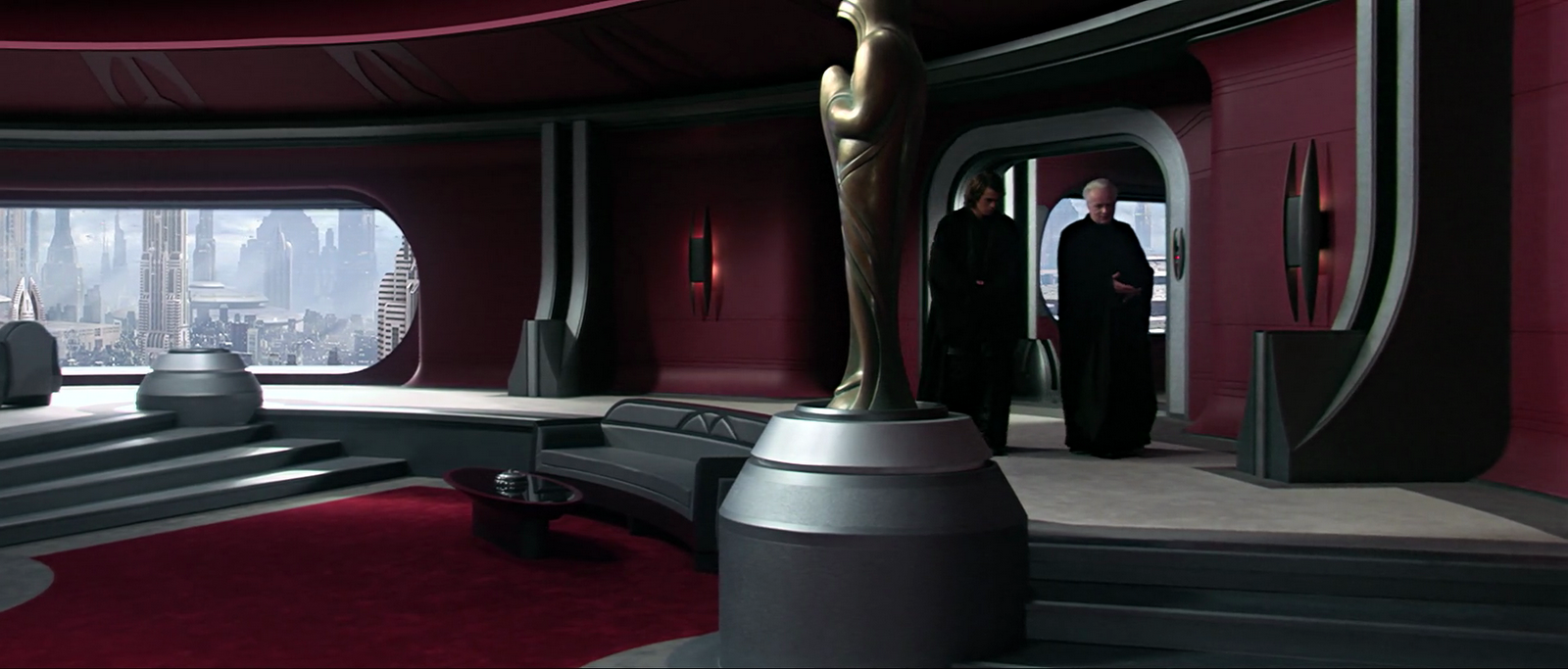
Now, in the movie, we cut right to Palpatine’s office, and Anakin and Palpatine are slowly walking around the enormous room, having a discussion. Only about half of it shows up in the film, though:
INT. CORUSCANT-CHANCELLOR’S OFFICE-DAY
ANAKIN stands with PALPATINE at his window overlooking the vastness of Coruscant. Several buildings have been destroyed. A brown haze hangs over the landscape.
PALPATINE: Anakin, this afternoon the Senate is going to call on me to take direct control of the Jedi Council.
ANAKIN: The Jedi will no longer report to the Senate?
PALPATINE: They will report to me . . . personally. The Senate is too unfocused to conduct a war. This will bring a quick end to things.
ANAKIN: I agree, but the Jedi Council may not see it that way.
PALPATINE: There are times when we must all endure adjustments to the constitution in the name of security.
ANAKIN: With all due respect, sir, the Council is in no mood for more constitutional amendments.
PALPATINE: Thank you, my friend, but in this case I have no choice . . . this war must be won.
ANAKIN: Everyone will agree on that.
PALPATINE: Anakin, I’ve known you since you were a small boy. I have advised you over the years when I could … I am very proud of your accomplishments. You have won many battles the Jedi Council thought were lost . . . and you saved my life. I hope you trust me, Anakin.
ANAKIN: Of course.
PALPATINE: I need your help, son.
ANAKIN: What do you mean?
PALPATINE: I fear the Jedi. The Council keeps pushing for more control. They’re shrouded in secrecy and obsessed with maintaining their autonomy . . . ideals. I find simply incomprehensible in a democracy.
ANAKIN: I can assure you that the Jedi are dedicated to the values of the Republic, sir.
PALPATINE: Nevertheless, their actions will speak more loudly than their words. I’m depending on you.
ANAKIN: For what? I don’t understand.
PALPATINE: To be the eyes, ears, and voice of the Republic . . .
ANAKIN thinks about this.
PALPATINE: (continuing) Anakin . . . I’m appointing you to be my personal representative on the Jedi Council.
ANAKIN: Me? A Master? I am overwhelmed, sir, but the Council elects its own members. They will never accept this.
PALPATINE: I think they will . . . they need you more than you know.
As I watched all six movies, I noticed that George Lucas – even in TESB and RotJ, the ones he didn’t direct – likes to join scenes with conversations already in progress (good example: in ANH, after Ben rescues Luke from the Sandpeople, we cut to Ben’s home and Luke is saying, “No, my father didn’t fight in the wars, he was a navigator on a spice freighter.”). A lot of the time it works, but there are a couple of times – most notably the fireplace scene in AotC — where it doesn’t. This is another such example. I suspect that the scene was cut as is to keep it short and simple, but sometimes short and sweet isn’t so great. Interestingly, this scene as written openly addresses something I wondered about while rewatching the PT: the relation between the Jedi and the Republic. This scene strongly indicates that the Jedi are virtually an independent body, and very rigid in guarding their independence. And that, frankly, seems a tad important to me.
I’d like to establish all this, but I wouldn’t do it this way, with a simple Anakin-and-Palpatine in the office thing. Instead I would replace this whole scene with a longer sequence:
EXTERIOR: Coruscant – Senate building – dusk.
The sun is setting behind the great Senate building.
INTERIOR: Senate chamber.
The Galactic Senate is in session, with PALPATINE presiding from his center rostrum. A SENATOR FROM MALASTARE has the floor.
MALASTARE SENATOR: We have heard the reports from the Jedi that their offensive is pushing back the Separatist armies, but if that were true, how could General Grievous have launched such a devastating attack against the very heart of the Republic? How can we trust the Jedi reports of success when they just barely avoided utter failure in our own skies? Malastare moves that an immediate investigation into this affair be undertaken!
PADME: This is outrageous!
The Senate pod from Naboo floats out into the debate space, bearing PADME and JAR JAR BINKS.
PALPATINE: The Senator from Naboo.
PADME: The Jedi have served the Republic with honor for a thousand generations! If we question them now–
MALASTARE SENATOR: This failure was theirs. The Force did not warn them of the attack, did it? This war grinds on and on, and now, look about you! A third of this body is vacant, and a third of these Pods stand empty because their systems have joined the Separatists! The Jedi are failing us. Chancellor, I serve official notice that Malastare is introducing an amendment to place the Jedi Council under the direct authority of the Chancellor and the Senate!
PADME: No! You can’t–
She is drowned out by the shouts from every Senator in the building as the entire place erupts with fierce debate.
MAS AMEDDA: Order! Order in the Senate! Order!
Through all this, PALPATINE shows almost no reaction, even when he meets PADME’s gaze.
INTERIOR: Senate building – Shuttle bay.
PALPATINE is walking toward his personal shuttle, with MAS AMEDDA and his councilors behind him.
MAS AMEDDA: Will you schedule a vote on the Malastare amendment?
PALPATINE: I shall hold that off as long as I can, but eventually the Senate will force the issue…ah, Anakin!
ANAKIN rises from his seat outside the shuttle.
ANAKIN: Chancellor. I was told you wished to see me.
PALPATINE: I do. Come.
He takes ANAKIN aboard the shuttle.
INTERIOR: Chancellor’s shuttle – continuous.
PALPATINE and ANAKIN sit down inside the shuttle as it departs for the Chancellor’s office building.
PALPATINE: These Senate sessions become harder and harder to control. Odd, with fewer and fewer Senators.
ANAKIN: I watched it on the screen. The Jedi Council will not easily submit to being placed under Senate control, no matter what law they pass.
PALPATINE: I agree, which is why I wished to speak with you. I’d heard that Malastare was planning to propose that amendment, but I’d hoped those rumors were false. Perhaps what I have in mind will ease the Senate’s concerns somewhat.
ANAKIN: Sir?
PALPATINE: I need your help, son. I need you to become the eyes and ears of the Republic.
ANAKIN: I don’t follow–
PALPATINE: The Republic has faced times like these before, Anakin. The Jedi Council’s independence was not always taken for granted. I have decided to invoke a very old statute and make a direct appointment to the Jedi Council.
It starts to dawn on ANAKIN….
PALPATINE: I wish you to be my personal representative to the Jedi. They will resist, but I have the right. Of course, by their own by-laws, this will force them to do what they should have done years ago, and make you a full Jedi Master.
ANAKIN: A Master?! Sir…I am…I don’t know what to say….
PALPATINE: You need not say anything. In fact, if the Council’s reaction is what I expect, you may not even wish to thank me. But the Republic needs you, Anakin. More than you know.
EXTERIOR: Sky above Coruscant.
The Shuttle arcs toward the Capital building.
INTERIOR: Senate building – corridor.
PADME is walking with several other SENATORS.
PADME: We have to start working to assemble a coalition that will back the Jedi Council. We can’t have these divisions in the middle of a war–
A young SENATE PAGE approaches, bows, and hands PADME a slip of paper, which she unfolds and reads.
PADME: Thank you.
The PAGE runs off.
SENATOR: We will not vote to obstruct the Jedi.
PADME: Thank you. If you’ll excuse me, I’m late for a meeting….
She nods a farewell and then heads off down another corridor.
INTERIOR: Senate building – Observation room.
The observation room is near the top of the Senate building itself, overlooking the mighty expanse of the Coruscant city. PADME enters and is greeted by SENATOR BAIL ORGANA and several other SENATORS, including a tall and regal-looking WOMAN.
PADME: Senator Organa? Why are we up here instead of one of our offices?
BAIL ORGANA: Greetings, Senator Amidala. I believe you know the others.
PADME: Yes, good to see you all. (to the WOMAN) You’re newly elected?
WOMAN: Just last month. I am Mon Mothma.
PADME: Oh yes. Of Chandrila. A pleasure, and my apologies – I usually get around to welcoming new Senators more quickly. But why are we up here?
BAIL ORGANA: These observation rooms are informal locations.
PADME: And not subject to Senate guidelines for official business. I think I understand.
MON MOTHMA: Those of us here have concerns about some things that are happening in the Republic, and we think that you may share some of those concerns.
PADME glances from face to face in the room. Something about this seems harmless, and yet deeply significant. She knows that a line is about to be crossed….
PADME: Go on.
The point here is to show a number of things: that the Jedi are facing opposition not just from the Chancellor but from the Senate as well, to get the bit in there about Palpatine intruding upon the functions of the Jedi Council while seeming reasonable about doing so, and to show what is probably the moment when the Rebel Alliance is born.
It really struck me how skillfully Palpatine played the Jedi Council and Anakin and everyone else, when I rewatched the films. He just doesn’t seem all that unreasonable in doing some of the things he does, before he unmasks himself. Of course, a part of that is the amazing performance of Ian McDiarmid, whose performances as Palpatine in the Prequels are, to my mind, criminally underrated. He gives Palpatine a kind of fatherly gravitas that is utterly convincing and all the more chilling when it starts to become clear what he’s up to.
And that’s where we’ll stop. The galactic politics continues next time! Excelsior!
Share This Post

Something for Thursday
When in the course of human events (repost)
This is a repost from July 4, one year ago today. Happy birthday, America!
Here’s a really weird story. It’s so weird, I’m not sure the historians didn’t make it up out of whole cloth. It seems that around 235 years ago or so, some folks living in a place under the rule of a King decided that they didn’t much like the way that King was ruling them. At all. They pretty much decided, en masse, that their King was behaving, to use a current term, like a douche.
Now, over the many centuries before these folks came along, lots of other folks in other lands have decided that their Kings and Queens were being douchey, so they came up with ways to replace them. They’d organize revolts, usually behind the banner of some obscure relative of the monarch’s so they could say that their person has a better claim to the throne, and off they’d go. So you’d expect that the folks we’re talking about here would have just said, “You know what? Our King is a douche. Let’s replace him with a new King.”
But these folks didn’t say that. What they said was, “Not only does our King suck, but he sucks so much that we’re now thinking maybe we won’t even have any more Kings. We’ll do it all ourselves.”
Over a year or so, there were some battles and skirmishes between these folks and the troops sent by the King to put down the pesky rebels, but it didn’t work, and that notion — “No more Kings and Queens!” — took hold. It became a really popular idea, so finally, these folks appointed some representatives to gather in one of their cities and talk these issues over. The conversation went like this:
GUY #1: So, we’re all agreed then? Kings suck?
GUY #2: Yes, Verily, they suck.
GUY #1: OK, so what do we do?
GUY #3: Well, we’re already fighting, so we just keep fighting. But we should probably tell the King that we’re being serious and we’re not just a bunch of rabble-rousers here.
GUY #1: Right! How do we do that?
GUY #4: How ’bout a letter? I’ve got some nice parchment, quills, and a new bottle of ink.
GUY #2: Good idea! But you’re about as eloquent as my cow. You’ll just write “Hey King, sod off” and be done with it. We should be a bit more poetic about it.
GUY #4: How about Tom? He’s pretty poetic.
GUY #1: Good idea! Let Tom do it. Now where’s that Adams guy with the beer?
So a guy named Tom wrote the King a sternly-worded letter. It was pretty wordy, given the standards of the time, so here’s a paraphrase:
Dear King,
We the undersigned, being representatives of the people of your colonies, have collectively decided that you are a douche and we don’t want to live under your rule anymore. Furthermore, we’re going to come up with a government of our own that won’t even have a King. Now, we’ve just called you a douche, so you’re probably thinking that we should be kind enough to at least tell you all the reasons we have for thinking you’re a douche, so there’s a list of those reasons later on. For now, suffice it to say that we believe in Life, Liberty and the Pursuit of Happiness. And you don’t. And since we like the whole Life and Liberty thing a lot more than we like you, we’re gonna take those and let you do whatever it is you do with your time in that Palace of yours.
So, here’s the list of ways you’ve pissed us off. Note how long it is. You don’t have to be a douche, you know.
…
See? Really, dude. There’s no reason for some of that stuff, right? So anyway, have a good life and all. You’ve still got your island, and Canada seems pretty happy with you for some reason (but really, they’re weird folks to begin with, what with that odd game they like to play on ice). But we’re out of here.
Signed,
All the guys presentPS: Could you make sure your soldiers always wear those bright red coats? It makes it really easy to see ’em in the forests. KTHXBAI.
And so it came to pass that after some years of war, and some further years of cruddy government, they all got together again and figured out how they wanted to set up their new, “No Kings!” government. Their notion was to spread power out amongst a bunch of folks who were accountable to the people, and to further make sure that their government was required to respect certain rights that couldn’t be taken away. It was a really weird idea…and yet, these folks worked hard to make it work, and their children kept working hard to make it work, and their children kept at it, and so on and so on and son on, until today.
Does it still work? Sometimes yes, sometimes not so much. But we’re still here, and we’re still working at it.
So Happy Birthday, United States of America! You’re a wonderful, weird, beautiful, maddening, and awesome country.
(Hey! Uncle George is in there!)