“Until that one day, the day I went Crazy, I was fine.”

I finished reading a new book, The Long Walk: A Story of War and the Life That Follows, by Brian Castner, the other day. Since then I’ve been thinking about one question: What good comes from war?

This is one of the great all-time questions, because like all such questions, it doesn’t yield any easy answers. There are many aspects of our world today which can be traced back to this war or that war, this conflict or that one. Some of those aspects are a net positive, while others are not. Our own country sprang into being as a result of a war, it put itself on solid footing as one of the world’s nations in a war, it nearly tore itself asunder and ultimately put itself together as a result of a war. Our country fought a war that led to our becoming an imperial power; our country joined a war that was raging an ocean and a continent away and brought it to a swift end, but was unable to prevent the seeds of the next war from being sown.

L. Fletcher Prouty once wrote, “The organizing principle of any society is for war. The basic authority of a modern state over its people resides in its war powers.” I wouldn’t put it that strongly, but there is something about the fact that so much of our human narrative is the story of war.

So, what good comes from war? One good, from my perspective – although not, perhaps, a good worth spilling rivers of blood to achieve – lies in literature. War inspires great writers to great thoughts and great works. It just does. No matter how sad a statement that may be on our species, it’s a simple fact. The Red Badge of Courage, All Quiet on the Western Front, A Farewell to Arms…there is a long history of great books from war. And not just novels: from World War II, we saw the brilliant work of Ernie Pyle and Bill Mauldin. From the Vietnam era, there were Born on the Fourth of July by Ron Kovic and We Were Soldiers Once…and Young by Harold G. Moore and Joseph Galloway.

What books will our most recent wars inspire? Castner’s is one. I don’t know where it will rank among the great war narratives, but it wouldn’t surprise me if it takes a place among them. This is a searing, brutal, sad, thrilling, visceral, and ultimately saddening memoir of one soldier’s time during the Iraq war.

Castner is a Buffalonian. I’ve never yet met him personally, but I have interacted with him online for a couple of years now, during which he has always struck me as an interesting and intelligent commenter on a lot of topics. He had a blog with WNYMedia.net in which he wrote a lot about the offerings Western New York provides for outdoor enthusiasts; now he blogs at briancastner.com. I didn’t know that he was military man at first, although his original headshot in his WNYM blog made me wonder, looking as it did like a standard military headshot. Over time I realized that he’d served, although he didn’t really discuss the details too much. Only gradually, in that way one does when one interacts in little bits here and there with someone online over a period of time, did I put some details together. Castner served as an EOD specialist. EOD: Explosive Ordnance Disposal.

The EOD is the ‘bomb squad’ of the military. Consisting of members of all four branches of the military, the EODs are the guys who show up to investigate explosions of bombs and to defuse or dispose of active ones. Castner indicates that in other wars, the EOD men are something of a ‘clean up’ crew for after the major combat operations are complete and the country (or some territory of it) has been secured; the EODs are charged with destroying the stockpiles of explosive weaponry left behind by the retreating enemy forces. In Iraq, however, this mission – dangerous enough, but manageable – became much more terrifying once the war shifted from ‘major combat operations’ to ‘counter-insurgency’. The job now requires coming to dispose of active IEDs (Improvised Explosive Device) that have been discovered roadside or in the cities, and also to investigate the ones that have been detonated. This involves sifting through debris, shrapnel, and shredded human remains. In one such episode, they smell the unmistakably strong scent of human excrement, and trace the source to an intact colon, lying in the middle of the street. I’m not sure how long I would have to stare at a colon before I realized what it even was.

This work is staggeringly dangerous, and death does loom over this book, as it must. Castner discusses at length some of the men with whom he serves who never returned. Not all of them are killed by IEDs; the stories of their deaths are heartbreaking tales of things that go wrong in war. Castner tells these tales with a keen sense that, in some cases, there were numerous times when it could have very well been him dying. Speculating on what it must be like to be in an overloaded helicopter that is going down, to know that the bird you’re in is about to crash and that with all your gear on it would take you minutes to get free to save yourself at the same time that you know you only have seconds…Castner’s visceral descriptions bring home as much of the horror of hot, dusty, explosive Iraq as it would be possible for someone who was never there to understand.

My rifle means it’s time to do a job. It’s time to focus, to observe, to stalk, to prepare, to react, to be ready for that constant song: incoming fire. If gunshots per IED call were a batting average, we’d win the Major League title every year. Potshots while driving through town ringing off the side of your truck. Zips and pings while crouched behind your Humvee, building an explosive charge with a cigarette hanging from your mouth and the robot ready to tear downrange. Single shots from a sniper in the center of Hawija. A sustained firefight while clearing a bridge. The soft breath of a stripper blowing on your neck, on the edge of your ear, a tingle across the very surface of your skin, then an answering shout from the .50-cal machine gun mounted on the security Humvee next to you. Gunfire in the distance. Gunfire in ambush. Gunfire to sing you to sleep.

Every moment you are being shot at you are blissfully, consciously, wonderfully, tangibly alive in the most basic visceral way imaginable.

Castner structures his book not as a straight-line narrative, but as a series of memories, which at first seem distinct and separate, but which gradually take on an appearance of mosaic. He writes in his Author’s Note:

Everything in this book feels true. It’s as correct as a story can be from someone with blast-induced memory lapses. Nothing was changed to create a moral or to ease discomfort. It’s as real as I can make it, though reality and objectivity sometimes have little to do with one another.

Castner juxtaposes his memories of the war and his service there with equally searing reflections on what his life was like when he returned from war to try and resume the life he had left on hold, only to realize at length that this would not be possible. The war is a constant companion for him, a constant presence that always stalks him. He calls it ‘the Crazy’:

The first thing you should know about me is that I’m Crazy.

The second thing you should know about me is that I don’t know how to fix it. Or control it. Or endure from one moment to the next. The Crazy is winning.

What increasingly scares me about war is that it’s only now that we’re really starting to get some kind of notion of the effect that war has on the people who fight it, and the effects that can have on society when we bring those soldiers home and expect them to live and contribute and do all the ‘normal’ things that one does. How much societal strife after past wars might have been traceable to shell shock, or PTSD, or Castner’s ‘the Crazy’? At one point, Castner describes the way a bomb blast physically jolts the brain, the pathology of how a bomb blast speeds up and slows down through whatever medium it traverses, be it air, followed by body armor, followed by flesh, followed by the air inside the body, followed by more flesh on the other side of that air. The mental is the physical, and the physical the mental. It can’t be separated, it can’t be pulled apart. There’s a reason that Brian Castner’s chosen method for beating back ‘the Crazy’ is to run.

The title The Long Walk refers to the walk a EOD man must make when there is no other choice, and it’s time to put on the extremely heavy armored suit and take on the bomb by himself. There is no either-or in this scenario. It’s the ultimate military version of Russian Roulette. It’s the real-life equivalent of all those somewhat clicheed scenes from movies and cop shows where the bomb squad guy has to decide which wire to cut, the red one or the green one. But Brian Castner is on another Long Walk, a longer one, one that doesn’t have a definite end of either an unexploded pile of bomb parts or a detonated IED that’s just taken a soldier with it. There’s a much larger metaphor here that Castner explores, and unfortunately, he can’t really give any definite conclusions, because he hasn’t reached them yet – and there really is no guarantee that he ever will.

I died in Iraq. The old me left for Iraq and never came home. The man my wife married never came home. The father of my oldest three children never came home. If I didn’t die, I don’t know what else to call it.

I liked the old me, the one who played guitar, and laughed at dumb movies, and loved to read for days on end. That me died from a thousand blasts. Died covered in children’s blood. Died staring down my rifle barrel, a helpless woman in the crosshairs and my finger on the trigger. That me is gone.

The new me is frantic and can’t sit still. The new me didn’t laugh for a year. The new me cries while reading bedtime stories to my children. The new me plans to die tomorrow. The new me runs almost every day, runs till knees buckle and fail. The new me takes his rifle everywhere. The new me is on fast-forward. The new me is Crazy.

The new me has a blown-up Swiss-cheese brain, and doesn’t remember all of the old me. But he remembers enough. Enough to be ashamed. Enough to miss the old me. Enough to resent the old me. Resent the way everyone mourns him, while I am standing right in front of them.

Do you remember when Daddy used to? That daddy is gone. He doesn’t do those things anymore. Do you remember when we used to be happy? Husband isn’t happy anymore.

Maybe my wife should pull out the letter I left for my sons and read it to them. Maybe it would explain why Daddy didn’t come home.

When you go to war, and die, and come home Crazy and with a ragged brain, you get to watch your family carry on without you.

Everyone longs for the old me. No one particularly wants to be with the new me. Especially me.

These scenes, in which Castner grapples with his inability to reconcile his new life with the fact of his old one, are deeply saddening, and deeply real. As sharply drawn and visceral as the war parts of the book are, it’s the story of his life at home that I found the most deeply emotional. There is grief in his writing, and his marriage is fraying and he sees one counselor and then another, one shrink and then another. The PTSD diagnosis is not a surprise…but it doesn’t stop there.

Through the book, Brian Castner reveals no easy answers, he doesn’t indicate any particular faith that he will make it through. The book is ultimately haunting because there’s something deeply affecting about seeing a skilled writer penning an elegy, not just to brothers in arms who went with him and never returned except in a box, but to himself.

The Long Walk is an engrossing and heartbreaking read. Castner’s story is not without its hopeful moments, but he’s clear that there really aren’t any answers; there is only life and its sad opposite. I honestly can’t recommend his book highly enough. I sometimes think it’s become something of a cliché in our country to remind others to ‘Thank the troops’. Brian Castner has written a deeply moving and powerful reminder of just part of what it is that we should be thanking those troops for.

(Incidentally, I read The Long Walk in its Kindle edition, via the Kindle app for my new seven inch Samsung Galaxy Tab. It’s the first e-book edition of a full-length book I’ve ever read, so in a way, Brian Castner has served as my inauguration into yet another facet of the twenty-first century.)

Share This Post

Fud notes!

I haven’t blogged about food lately, which is kind of dumb, since I’ve had some good times with food lately. Here are a few items:

::  I’ve used my wok more the last few months than in the first twenty years I owned it. (Wow…I’ve owned my wok for 20 years. The only reason I might see to get another one is to get an all-metal one, as mine has wood handles. But that’s low priority. I love the wok!)

So far I’ve done mostly stir-fries with it, although in the past I have used it for deep fat frying. I made a wonderful spinach fried rice last week, from a recipe in a Martin Yan cookbook (Chinatown Cooking). Here are the results:

Spinach Fried Rice I

Spinach Fried Rice II

The only problem I had with this dish was that the result was a tad too salty, but that’s easily corrected next time out. I could very easily live on fried rice. (Well, rice in general.) The only other change I made is that I used brown rice, instead of long-grain white. I know, the white rice is what you’re supposed to use for fried rice, but I really prefer the flavor of the brown. Plus, it’s better in terms of nutrition.

(Funny thing about that Martin Yan cookbook: I bought it at The Store, because I like Martin Yan and I wanted a new Chinese cookbook. When I got it home and thumbed through it in more detail, I found, inside the frontispiece, that it had been signed by Mr. Yan. He signed it, “Good food, Good wine, Good health — a wonderful life!” How cool is that!)

:: The biggest food development at Casa Jaquandor was my Father’s Day gift from The Wife and The Daughter: a new Weber grill, to replace the old one that served well through the years but rusted away (partly due, I must admit, to my somewhat lackadaisical care for it over the seven or eight years we owned it). The new grill has a 22.5 inch cooking surface, with a grill whose side panels are hinged so that I can add charcoal to the fire when slow-cooking something or when cooking with indirect heat. And it has a nifty pan beneath the kettle to catch ashes! Ash removal is the most annoying part of grilling, but now, I just let them fall into the pan and dump the pan when it’s full. Awesome!

And the gift came with something else: a charcoal chimney, so that I can finally graduate from lighter fluids or fluid-treated briquettes. Now I can use good quality lump charcoal, ignited with only two sheets of newspaper! Huzzah!

Grill II: Chimney

And of course, our first meal on the new grill had to be steaks. Nice, thick, New York strip steaks. Yum, steak.

New grill III: Steaks!

So far I’ve used the grill for steak, chicken, sausages (twice), and, just last night, burgers!

Here is a blue cheese burger (blue cheese mixed right into the patty), topped with green leaf lettuce, a slice of tomato, and instead of ketchup or mustard, a lovely Greek yogurt dressing. I served it with a halved white peach (which is my favorite of all summer fruits).

Burger time!

More food adventures to come!

Share This Post

Man of steel, suit of rubber

Here’s a problem: the teaser poster for the new Superman movie, unveiled at Comic Con:

I just don’t like this poster at all. It does nothing to make me want to see the movie. I hate the washed-out colors (I really wish this era of dull color schemes in movies would come to an end), and I really dislike the weird rubber-material appearance of the costume itself. I know, I know, I’m one of those people — but Ye Gods, the first Superman movie is one of the iconic superhero movies ever made, and in that one, Superman wore a suit made of…cloth. Now, no, this doesn’t mean that the movie itself will stink. If it’s good and the script is good and it’s shot and acted well and the score doesn’t stink (which is, frankly, six to five and pick ’em, what with Hans Zimmer composing it), something little like a costume isn’t going to stop me from seeing it and enjoying it. But I’m not complaining about the movie, just a poster.

And as a poster, this does spectacularly little for me. All this does is remind me that there’s a Superman movie coming out at some point. Here, on the other hand, is a fan-made tribute image for the original Superman movie:

This (via) makes me want to drop what I’m doing and watch that movie again right now.

Share This Post

When I am Lord of the Planet, this fellow shall be my Science Advisor.

A few weeks ago, Kevin Drum had a post (yes, I am too lazy to track down the link) in which he indicated that he just doesn’t think the evolution-versus-creationism “debate” is that big a deal, and his reasons basically boiled down to the notion that the only place this ‘debate’ takes place is in elementary schools; nobody is challenging the teaching of evolution in colleges or in the use of evolutionary theory in medical research and so on. This strikes me as tragically wrong-headed, because in a society that is only going to become more and more scientifically dependent, the current American retreat from science can really only be counteracted on a generational basis. If we don’t make it a priority to teach our kids the right science, then we’re going into the future societally hobbled.

This is a point that comes up repeatedly in Neil DeGrasse Tyson’s new book, Space Chronicles: Facing the Ultimate Frontier. The book is a collection of many short pieces Tyson has written over the years, from magazine articles to op-eds to speeches and even a few poems. As such, the themes of the book can get a bit repetitive, but Tyson may well be the most engaging science writer since Carl Sagan (although Timothy Ferris is not to be discounted). As a collection, the book covers a fairly wide range of topics, almost all of which deal with science in general or space exploration in the particular. Tyson’s writing on these subjects is less poetic than Sagan’s, but Tyson makes up for it with infectious enthusiasm.

Here is an excerpt from an interview Tyson gave Calvin Sims:

CS: Some studies have shown that only about 20 to 25 percent of the adult population can be considered scientifically literate. And one study found that one American adult in five thinks that the Sun revolves around the Earth, a notion that was abandoned in the sixteenth century. Does that surprise you?

NDT: Didn’t you just ask me whether we’re in a crisis? Yes, we are. And yes, it concerns me deeply. There’s fundamental knowledge about the physical world that the general public is oblivious to. And by the way, science literacy is not simply how many chemical formulas you can recite, nor whether you know how your microwave oven works. Science literacy is being plugged into the forces that power the Universe. There is no excuse for thinking that the Sun, which is a million times the size of Earth, orbits Earth.

CS: This is particularly troubling because so much political debate has a basis in science: global warming, stem cell research. What do we do about this?

NDT: I can only tell you what I do about it. I hate to say this, but I’ve given up on adults. They’ve formed their ways; they’re the product of whatever happened in their lives; I can’t do anything for them. But I can have some influence on people who are still in school. That’s where I, as a scientist and an educator, can do something to help teach them how to think, how to evaluate a claim., how to judge what one person says versus what another says, how to establish a level of skepticism. Skepticism is healthy. It’s not a bad thing; it’s a good thing. So I’m working on the next generation as they come up. I don’t know what to do with the rest. That 80 percent of the adults, I can’t help you there.

This strikes me as terribly sad, but also terribly true. Throughout the book, Tyson repeatedly sounds the alarm about where we are headed as a nation. Here’s another excerpt, this from a speech:

Recently I gave a talk in St. Petersburg, Florida. The last question of the night – I don’t know if this person was particularly worried about the upcoming election – was, “What would you do if, a year from now, all the money for science and engineering research was cut to zero, yet Congress allowed you to pick one project you could do? What would that project be?” I promptly replied, “I would take that money, build a ship, and sail to some other country that values investment in science. And in my rearview mirror would be all of America moving back into the caves, because that’s what happens when you don’t invest in science and engineering.”

There was a day when Americans would construct the tallest buildings, the longest suspension bridges, the longest tunnels, the biggest dams. You might say, “Well, those are just bragging rights.” Yes, they were bragging rights. But more important, they embodied a mission statement about working on the frontier – the technological frontier, the engineering frontier, the intellectual frontier – about going places that had not been visited the day before. When that stops, your infrastructure crumbles.

There’s a lot of talk about China these days. So let’s talk more about it. We keep hearing about ancient Chinese remedies and ancient Chinese inventions. But when do you hear about modern Chinese inventions? Here are some of the things that the Chinese achieved between the late sixth and late fifteenth centuries AD: They discovered the solar wind and magnetic declination. They invented matches, chess, and playing cards. They figured out that you can diagnose diabetes by analyzing urine. They invented the first mechanical clock, movable type, paper money, and the segmented-arch bridge. They basically invented the compass and showed that magnetic north is not the same as geographic north – a good thing to know when you’re trying to navigate. They invented phosphorescent paint, gunpowder, flares, and fireworks. They even invented grenades. They were hugely active in international trade over that period, discovering new lands and new peoples.

And then, in the late 1400s, China turned insular. It stopped looking beyond its shores. It stopped exploring beyond its then-current state of knowledge. And the entire enterprise of creativity stopped. That’s why you don’t hear people saying, “Here’s a modern Chinese answer to that problem.” Instead they’re talking about ancient Chinese remedies. There’s a cost when you stop innovating and stop investing and stop exploring. That cost is severe. And it worries me deeply, because if you don’t explore, you recede into irrelevance as other nations figure out the value of exploration.

What else do we know about China? It has nearly 1.5 billion people – one-fifth of the world’s population. Do you know hoe big a billion is? In China it means that if you’re one in a million, there are 1,500 other people just like you.

Not only that, the upper quartile of China – the smartest 25 percent – outnumbers the entire population of the United States. Lose sleep over that one. You’ve seen the numbers: China graduates about half a million scientists and engineers a year; we graduate about seventy thousand – much less than the ratio of our populations would indicate. A talk-show host in Salt Lake City recently asked me about those numbers, and I said, “Well, we graduate half a million of something a year: lawyers.” So the guy asked me what that says about America, and I said, “It tells me we are going into the future fully prepared to litigate over the crumbling of our infrastructure.” That’s what the future of America will be.

Ouch. Really, truly, ouch. But the flip side of Tyson’s grim picture of the state of affairs in America as regards to science and engineering is that the fix is pretty obvious: reinvest in those things, reinvest in those things now, and reinvest in those things heavily. It’ll take a lot of investment and a lot of time – probably a couple of decades as new students come all the way through the educational systems and enter the workforce – but it’s the only thing that can guarantee our continued position as one of the leaders of the world. Nothing else is going to get it done: not deregulating every business sector known to exist, not squashing every labor union, not eliminating every tax, not scratching every libertarian itch. Humanity is going to need to depend more and more and more and more on science and engineering, and if we willingly abdicate our leadership and mortgage our futures therein, well, all the tax cuts and military expenditures in the world won’t be enough to keep America from becoming just one more name on the UN roster.

I don’t want to depict Tyson’s book as relentlessly pessimistic, because it’s not. Reading between his lines, I think that I can say that while Tyson is not terribly optimistic about America right now, he’s more optimistic about the human species. And his sense of wonder, still intact after years of being an astrophysicist, comes shining through. The passages I quote, though, are the ones that stick with me, because they’re issues that I continue to think about a lot and I frankly wish would come up once in a while over the course of our political campaigns. Anyway, Neil DeGrasse Tyson is emerging as one of our country’s most valuable voices.

(By the way, a neat feature of the book is that it includes a selection, scattered throughout, of Tyson’s postings to Twitter. For example: “First mammals to achieve orbit, in order: Dog, Guinea pig, Mouse, Russian Human, Chimpanzee, American Human”.)

Share This Post

Sentential Links

Links! Get ’em while they’re…well, here’s some links.

:: It has been easy for a lot of people (mostly non-drummers) to take Ringo’s gifts for granted through the years because he was pretty happy to sit back there on his riser (no one had ever done that before), contributing his steady, reliable backbeat. He has always been the most overlooked Beatle. A lot of people have described him as a “meat and potatoes” drummer, but I beg to differ. (Me too. There are some moments in “A Day in the Life” when Ringo fills in a silence with something interesting on the drums — something interesting that lasts all of a second and a half. But that’s what drummers do. They’re the ultimate in music’s temporal, ‘in the moment and now the moment’s over’ nature.)

:: I guess he figured that if I knew who Ryan was I knew everything I needed to know and if I didn’t know who Ryan was then I also knew all I needed to know or at least all it was my business to know. (My parents once told me a story about a time they were driving out west, as they used to do every summer, and stay in campgrounds. They would stay up late, sitting by a fire, and sipping beer. Well, at one campground, apparently a bunch of bikers pulled into the campsite next to theirs, and one of them, a big burly lad all in leather, came over to ask: “Are you folks gonna stay up late and make a lot of noise? ‘Cause we’re really tired and we got a long way to ride tomorrow.” I love that.)

:: It might be different in other cities but you know, Buffalo is in Western New York. It, really as far as the layout, the landscape and the area was kind of like the South, in New York. It’s not anything like the city. It’s real laid back in the country, but the people are horrible. As far as getting in trouble in Buffalo or socially, there’s nothing to do. (That’s a quote from former Buffalo Bills receiver Josh Reed, who decided to leave town as a free agent a few years ago and seek his fortune elsewhere, after two contracts here with the Bills. He was drafted in the second round way back in 2002, which means that in his time here he never played for a single playoff team, and in all honesty, despite some flashes here and there, Reed never rose much above the level of ‘guy who’s nice to have on your team but he’ll never make the big clutch play for you’. Now, over the last bunch of years we’ve seen a lot of such players leave the team and badmouth the city afterwards — Rob Johnson, Willis McGahee, now Reed — and hey, if you didn’t like it here, fine. But then, you didn’t really contribute much to a team that wasn’t very good, so what do you expect? It’s telling that none of Reed’s attempts to catch on someplace else have succeeded; he signed with the Chargers after his last season here but was cut in training camp.

What also interests me is when these young athletes complain that their particular brand of fun isn’t to be found in Buffalo. That’s entirely possible, as this is neither a particularly big city nor a particularly rich one. But here’s the thing: these guys make a ton of money. If it bothers them that the kind of club they like to hang out in doesn’t exist here, well — real estate’s cheap in Buffalo and these guys are getting paid a ton of money. Why not open your own place and create the kind of scene you wish existed here? Why the sense of entitlement? I don’t get this. Anyway, enjoy your post-NFL days, Josh. Oddly, while you were never a great player, I never disliked you…until now.)

:: My life is now one where campfire stories are becoming another word for Tuesday – to which I mean adventures are the new normal.

:: I’ve used it before on several novels, notably ones where the plot got so gnarly and tangled up that I badly needed a tool for refactoring plot strands, but the novel I’ve finished, “Neptune’s Brood”, is the first one that was written from start to finish in Scrivener, because I have a long-standing prejudice against entrusting all my data to a proprietary application, however good it might be. That Scrivener was good enough to drag me reluctantly in is probably newsworthy in and of itself. (I read this post all the way through, and I barely understood it. I’m generally fascinated by matters of writerly process, but now I’m wondering if I’m doing it wrong now, by just writing my books in OpenOffice.)

:: Apparently some people read “getting a PhD in English” as “getting a PhD in creative writing.” I find this hilarious because it demonstrates a profound ignorance of what studying English entails.

:: Le Guin’s argument appears to be that all human societies are prone to dysfunction and corruption, no matter how well-meaning people are. (I read this book when I was in seventh grade. I did not understand it, and I definitely should read it again. I’ve heard it cited a lot as an SF classic in the years since I read it. Come to that, I’ve read a pathetically small amount of Ursula Le Guin.)

:: When you consider the amount of time spent making this film and the amount of people who were involved in it, it is really quite baffling. Someone had to write the script (namely Akiva Goldsman). That script undoubtedly had to be approved by the higher ups at Warner Bros. Then actors had to be cast, costumes and sets had to be designed, an entire production crew assembled and at no point did anyone stop and say, “Are we really making this movie? This movie?”

More next week!

Share This Post

Sunday Burst of Weird and Awesome!

Oddities and Awesome abound!

:: One thing that gets made fun of a lot about Star Wars Episode III: Revenge of the Sith is the long, anguished cry of “Nooooooooo!” that Darth Vader gives when he learns that after all his Dark Side stuff, Padme is dead. This seems to me a great pity, because after all, people giving long, anguished cries of “Nooooooooo!” is a long and proud tradition from the movies.

:: Overquoted movies. I agree on some of these — the insatiable need some folks feel to endlessly recite the same couple of quotes from Monty Python and the Holy Grail at the Renaissance Faire is a longtime source of irritation of mine, but generally…I like it when people quote movies. I do try to go for more obscure quotes, though — when quoting The Princess Bride, for example, it’s fun to list a long list of things I have to do, and then wrap it up with, “I have a wife to murder and Guilder to frame for it. I’m swamped.” Or, when someone questions whether I can do something, to grin and say, “Ahh, but I am not left-handed!”

All for this week!

Share This Post

Film Quote Friday

Well, I’ve already been a day late a couple of times, and last week, I missed this series completely. Par for the course with regular features here!

Anyhow….

I love this silly, raunchy, hilarious ode to how a few men in a rustbelt city will scheme to make a few bucks. The rustbelt town is Sheffield, England, and our heroes are out of work steelmill employees, who concoct an odd plan, led by Gaz (Robert Carlyle), to put on a strip-tease show for pay. Of course, these guys aren’t the best looking examples of the male species, so Gaz decides to go one better: he promises that his group of strippers will do “the full monty” — meaning, they’ll go all the way. Complete nudity.

What always gets me about this movie is its sheer warmth. Everybody in it is really likable, everybody in it has problems that seem real, and it just doesn’t seem that outlandish for these guys to pull this scheme together. Even at the end, during the final strip dance, the guys are making eyes to the ladies and laughing while they do it. They’re in on the joke, and they’re fine with it. Because they’re going all the way, see…the full monty.

Anyway, the movie’s first big laugh for me comes when Gaz and his chubby friend Dave are out jogging, and they come upon a motorist whose car won’t start. The motorist sits in the car morosely as Dave diagnoses the problem and gets the car running again and cheerfully jogs away, only belatedly realizing that this sad sack motorist has a hose running from his tailpipe to the inside of his car. Dave runs back and drags him out of the exhaust-filled car, saving his life — and when the guy complains, Dave grabs him and stuffs him back in the car, until the guy relents. Then comes this delightfully absurd scene where Gaz, Dave, and Lomper (our suicidal friend) are comparing notes about ways to off oneself.

EXTERIOR: Hillside.

GAZ and LOMPER sit in the grass; DAVE is lying on his back looking at the clouds. An air of failure hangs over LOMPER at his failure to end it all.

DAVE: You could shoot yourself.

GAZ: Where’s he gonna find a gun from around here? You might wanna find yourself a big bridge here, then.

DAVE: Yeah…like one of them bungee jumps, only without the bungee bit.

LOMPER: I can’t stand heights, me.

A moment of silence….

DAVE: Drownin’. Now there’s a way to go.

LOMPER: Can’t swim.

GAZ: You don’t have to fucking swim, ya divvy, that’s the whole point! God, you’re not very keen, are you?

LOMPER: Sorry.

DAVE: I know. You could stand in middle of road and get a mate run smack into you right fast.

LOMPER: Haven’t got any mates.

GAZ: Listen, you, we just saved your fucking life so don’t tell us we’re not your mates, all right?

LOMPER: Really?

GAZ: Yeah.

DAVE: Yeah, me and all, I’d run ya down as soon as look at ya.

LOMPER: Oh aye? Cheers.

Lomper starts to grin at the turn of luck from attempting suicide to finding two mates.

LOMPER: Thanks a lot.

I love well-done gallows humor, and this scene always tickles me. You can watch the whole scene here.

Share This Post

DIE BAD WRITING DIE DIE DIE!!!!!


Manuscript 2, originally uploaded by Jaquandor.

The time has come at last: it’s editing time. Hoo-boy. I didn’t wait quite three months, but I got more than two and a half, and I’ve at last started digging through Princesses In SPACE!!! (not the actual title). I’m hoping that this process will be done by Labor Day, but as in all things, we shall see. This process is, as you might guess, fairly time-consuming.

And for anyone who might worry about whether or not I am sufficiently steel-willed to drag my literary darlings out of their coops in the middle of the night and chop their bloody heads off, well — witness the amount of red ink of corrections on those two pages! I’m about ten pages in thus far, and only one page doesn’t look like that. That’s page one. Because it starts halfway down the page (in keeping with proper manuscript format). Yes, folks — I can rip other people’s writing when the spirit moves me, but when it comes to my own, I’m utterly medieval.

Onward and upward!

Share This Post

Something for Thursday

An interesting thing happened in the 2004 and the 2005 Academy awards: the first year, the Oscar for Best Original Score went to Howard Shore for his enormously epic score for The Lord of the Rings: The Return of the King, a score which featured huge orchestral and choral forces over three-plus hours of music. The next year, Oscar recognized what might be the polar opposite of Shore’s work, a score with a delicate, almost impressionistic, chamber music-like sound. And both are among my very favorite filmscores of the last ten years. Here are several selections from Jan AP Kaczmarek’s Finding Neverland.

Share This Post

Why is she so hung up on Ryan, anyway? He’s such a douche!

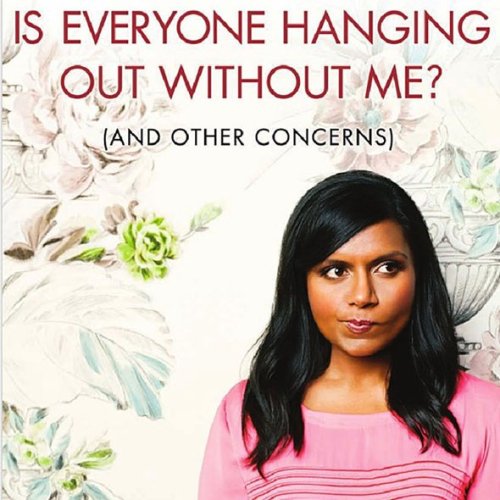
If you watch The Office without paying attention to the credits, you might assume that Mindy Kaling’s sole purpose on the show is to play Kelly Kapoor, the materialistic ‘office girl’ who is more interested in appearance and various superficialities than in professional accomplishment. But if you do pay attention to the credits, you quickly discover that Mindy Kaling is the complete opposite of Kelly Kapoor. As a writer, occasional director, and listed producer, Kaling is one of the main creative contributors to The Office. And now she has a new book, called Is Everyone Hanging Out Without Me? (And Other Concerns).

This delightful book is part autobiography, part musing on the current state of entertainment, part musings on romance and dating here in the 21st century, and…well, the book reads simply like the conversational thoughts of a person who leads an interesting life and has interesting things to say without having led so interesting a life as to be completely intimidating. Is Mindy Kaling the ‘girl next door’? Sure…if the girl next door is a hard-working, smart, and pretty woman who has a number of impressive talents.

Here is Kaling describing some of the types of characters you will find in a typical romantic comedy these days:

THE KLUTZ

When a beautiful actress is in a movie, executives wrack their brains to find some kind of flaw in her that still allows her to be palatable. She can’t be overweight or not perfect-looking, because who would want to see that? A not 100-percent-perfect-looking-in-every-way female? You might as well film a dead squid decaying on a beach somewhere for two hours.

So they make her a Klutz.

The 100-percent-perfect-in-every-way female is perfect in every way, except that she constantly falls down. She bonks her head on things. She trips and falls and spills soup on her affable date. (Josh Lucas. Is that his name? I know it’s two first names. Josh George? Brad Mike? Fred Tom? Yes, it’s Fred Tom.) Our Klutz clangs into Stop signs while riding a bike, and knocks over giant displays of expensive fine china. Despite being five foot nine and weighing 110 pounds, she is basically like a drunk buffalo who has never been a part of human society. But Fred Tom loves her anyway.

THE ETHEREAL WEIRDO

The smart and funny writer Nathan Rabin coined the term Manic Pixie Dream Girl to describe a version of this achetype after seeing Kirsten Dunst in the movie Elizabethtown. This girl can’t be pinned down and may or may not show up when you make concrete plans. She wears gauzy blouses and braids. She decides to dance in the rain and weeps uncontrollably if she sees a sign for a missing dog or cat. She spins a globe, places her finger on a random spot, and decides to move there. The ethereal weirdo abounds in movies, but nowhere else. If she were from real life, people would think she was a homeless woman and would cross the street to avoid her, but she is essential to the male fantasy that even if a guy is boring, he deserves a woman who will find him fascinating and pull him out of himself by forcing him to go skinny-dipping in a stranger’s pool.

And thanks to Mindy Kaling, I now desperately want to see the movie Darling, which has not been made yet, but would tell the story of Peter Pan from the viewpoint of the Darling family’s alcoholic father. That movie needs to happen, dammit!

Share This Post