Toward the late 19th century, Russia came into its own in a big way as artistic Romanticism took hold in that country. One of the greatest composers to emerge from that period, slightly before Tchaikovsky, was Nikolai Rimsky-Korsakov.
I haven’t heard too much of Rimsky-Korsakov’s work, but I’ve yet to hear a piece of his that isn’t somehow deeply scintillating and evocative. The Russian gift for lyrical melody and brooding atmosphere is almost a stereotype, but Rimsky-Korsakov really was a magnificent melodist, but even more, he was one of the most brilliant orchestrators ever. He had a way of using the instruments of the standard orchestra in new and exciting ways to achieve tonal effects and colors that are as brilliant and fresh today as ever. This is particularly evident in this, my favorite work of his, and one of my favorite works of all time: the symphonic suite Scheherazade.
The idea of ‘program music’ has always been mildly problematic for composers. Can purely orchestral music really tell a story? Or can it only suggest mood and color? I tend to think the latter, but the visual associations in this music are very hard to forget once you read the titles of the movements. In any event, Scheherazade is an utterly spectacular musical entertainment, big and bold and vivid and melodic and thrilling and passionate and exotic. I used to pore over the score to Scheherazade, noting with amazement the things Rimsky-Korsakov did with just the standard symphony orchestra.
This particular performance, by the way, may sound slightly odd to modern ears, because the orchestra performs on period instruments, using period performance standards (such as a mellower trumpet sound and much less vibrato in the strings). I often find period-instrument performances fascinating and compelling if the performance carries a passion to match. This one nails the passion of Scheherazade fairly well.
Only eight letters left. What to do with ‘S’? We’ll see on Monday!
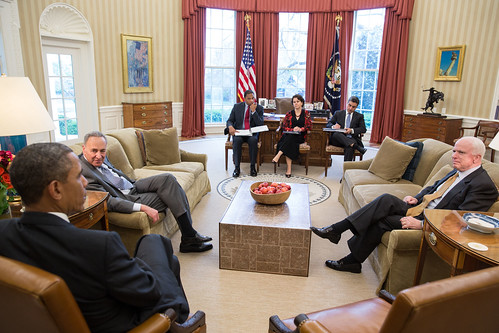
I continue to love the White House’s Flickr stream and its photographic documentation of the goings-on at the White House. White House photographers do great work, and I enjoy paging through it.
This particular photo is pretty cool because of its symmetry, the fact that the Obama Apple Bowl is in the center, and that you can really see how well the Oval Office’s wood furniture is polished. Senator McCain’s face is reflected with almost perfect clarity in that table.
And note that through the windows behind the President’s desk, it almost looks like there’s some sort of cabin or something out there, on the grounds. Anybody know what that is?
Between following the news (what an irritating week it was, news-wise — thanks for that, Boston terrorists and United States Senate), trying to work my way through a thorny scene that represents a bit of a plot problem (coming up with a logical rationale for the characters to do something that I needed them to do but have it seem like their idea and not mine was a real struggle), and the general lack of brain power left for last evening that came from getting up at 4:00 am to do a job at The Store…well, I just did not manage to get a lot of production done on Princess In SPACE!!! II: The Princesses’ Bogus Journey. I have spent the requisite amount of time hanging my head in shame and doing penance, and now it’s time to delve back in.
As for the first volume of the adventures of the Princesses, no agents have bit yet. But I’m not even close to exhausting that pool, so I’ll be getting more queries out. Oh yes!
Future writing plans: Finish first draft of The Princesses’ Bogus Journey, which should take me into the fall, hopefully in time for NaNoWriMo, during which I will switch genres and write the horror book I’ve had knocking around my head for just a bit less time than the Princesses have. And after that, I’ll jump back into Lighthouse Boy, because I’ve had some interesting thoughts about that particular tale of late that could bear fruit. And beyond that? Editing The Princesses’ Bogus Journey, thinking about Princesses III: The Princesses In 3D!!!…and who knows, maybe somewhere in there, the publishing process will start.
Well, you gotta do what you gotta do when you get to Q. I don’t know anything about this composer at all. Not a thing. His Wikipedia page indicates that he was born and studied in China and eventually emigrated to the United States, where he continues to compose. That’s all I know.
So obviously, I’ve never heard this piece before. It’s in two parts (because of YouTube length restrictions), and I don’t think it’s complete, but it’s interesting enough that I don’t care: a short opera called The Death of Oedipus. And it’s fascinating. I’d love to see this staging live, with the stylized acting using masks on the singers. Wow. I love finding works like this! Back in college, the music department had a thing called “Opera Workshop”, in which the vocal majors would learn and perform works like this. I’ve never much thought about the world of short opera since then. I wonder why that is?
Anyway, here is The Death of Oedipus.
Tomorrow: R. So many directions I could go…but probably back to Mother Russia.
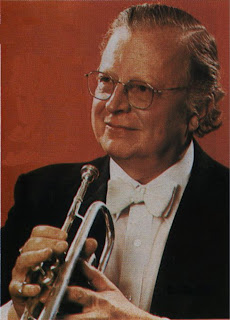
God-in-Heaven, a lot of people have died lately. But this one is the one that hits me in the heart. Adolph Herseth is dead. Herseth was the principal trumpet player for the Chicago Symphony Orchestra, for a career that spanned nearly fifty years.
When you’re a young musician and you become the slightest bit serious about your musical endeavors, you start to learn the names of those who are really, really good at your instrument. It’s not at all unlike…well, you know, it’s exactly like how young athletes in school idolize the best in their sport. The school’s star baseball player wants to be Howard Johnson or Doc Gooden. The star football player wants to be Marino or Montana or Bruce Smith. (I’m using names from when I was young, obviously.)
Well, the same thing happens for musical kids, too. Flute players hear about Galway or Rampal. Clarinetists idolize Richard Stoltzman. Percussionists? Well, if they’re jazz players, they dream of being the next Lionel Hampton, maybe. This is totally natural.
I remember one day, when we in the Allegany Senior Jazz Band were on one of our band trips for a competition, to Binghamton or Syracuse or some such place. We had already had our morning performance and were due to come back in the afternoon to play again, which gave us some free time for lunch, so we ended up at some local burger joint, where conversation turned, as it so often does for young trumpet players, to who we are idolizing now. Wynton Marsalis’s name came up, obviously, especially then, because this was the late 1980s, when Marsalis’s musical star was just starting to really shine. And Doc Severensen. Maurice Andre. Even Chuck Mangione’s name came up (a flugelhorn is just a trumpet with a larger bell and bore, for a darker, mellower sound).
I was the only one to mention Adolph Herseth.
I’m pretty sure that none of them had any idea who Herseth was, and that was fine. Herseth wasn’t a soloist, after all – he was a member of a symphony orchestra. But my tastes always ran to the orchestral; my attitude was always that the orchestra itself was the ultimate instrument (an attitude I likely acquired in the course of my hero-worship of Hector Berlioz). But I was still a trumpet player, too, and I had to have a narrower focus at times. Hence, Mr. Herseth.
I still remember when I first heard of him. Not the date or time, actually, but the circumstance: I was spending a study hall not in the actual study hall but practicing in the band room one day during school, and I spotted a stack of old magazines. There’s a magazine for band and orchestra teachers called Instrumentalist, and we had a bunch of these things lying there. I thumbed through the stack and pilfered out a bunch that had articles I wanted to read – a profile of a conductor here, a composer there…and on the cover of one, a guy in the standard orchestral uniform of tux with white tie, holding a trumpet. The caption identified the man as Adolph Herseth. Inside was an absolutely fascinating interview with the man, and it just…informed everything I would ever want to do with the trumpet.
I’ve long since lost that issue of that magazine (although maybe it’s still floating around some of the music-related ephemera at my parents’ house), but I remember a great deal from it, even though I haven’t read it in many years. Specifically, two points stuck with me. First, Herseth’s amusement with the tendency of American brass players to worry about mechanics to an odd degree. I always saw this with my brass brethren: worrying about the embouchure. (The embouchure is the group of muscles, mostly around your lips and jaw but also including your neck and even your upper arm, that you use to produce sound in a wind instrument.) Brass players, in my experience, tend to spend a lot of time thinking about their embouchures: how to properly place the instrument upon the lips. How to angle the mouthpiece for optimum pitch, range, and endurance. How to develop the muscles properly. How to, how to, how to…but Herseth found a lot of that plainly ridiculous, citing Maurice Andre who asked him, “Why do Americans worry so much about their lips? Why don’t you just pick it up and play?” Herseth agreed, and I’ve come to think of that as kind of a Chicago way of thinking. You just show up and do your job, and you do it well because it’s your job. Herseth’s attitude toward trumpet playing doesn’t strike me as being all that different from Roger Ebert’s approach to writing movie reviews, or Mike Royko’s approach to writing columns.
That sense of practicality served Herseth well when, early in his career, he was involved in a really bad car accident that put his face into the steering wheel, smashing his jaw and mouth terribly. After his recovery he literally had to relearn how to play, moving the trumpet back and forth to accommodate his dead nerves and two dead teeth, until he found a spot where it worked, and then he practiced his way right back to where he’d been to start with. I tend to have the most respect for people who take what they’re given and just say, “OK, let me figure out how to make this work.”
Second was Herseth’s comparison of the trumpet to the human voice. He openly referred to the voice as the primary and greatest instrument, and insisted that the job of the instrumentalist is to approach the quality of the human voice as closely as possible. This struck the young musician in me as very odd, but the more I thought about it, the more correct I thought he was. Herseth said that the greatest singers, the greatest musicians, were the ones who told a story in their music, and that he always wanted to be able to do that. That leads into this wonderful NPR feature, on the occasion of Herseth’s final concert with the CSO:
I love how he indicates that he never wanted a solo career, finding far greater musical satisfaction in the life of the orchestral musician. I always agreed with this, finding no greater musical rush than being one voice in this giant, unwieldy instrument that is the orchestra. Herseth refers to being able to get immense musical satisfaction out of so simple a passage as a simple, three-note descending figure in the Brahms Symphony No. 1. I never played that symphony (to my regret, as it’s one of my very favorite symphonies), but I did play the Strauss waltz On the Beautiful Blue Danube, toward the end of which is one of my very favorite bits in all music. The trumpet simply sounds a major arpeggio, three times. But when I played that piece as a freshman in college, I was so thrilled to see it on the program, because I knew that I got to sing those three slow arpeggios with my trumpet.
There’s a terrific book, long out-of-print, called Season with Solti by William Barry Furlong, which recounts a single season of the the Chicago Symphony in grand behind-the-scenes fashion, profiling many of the musicians as they go through an entire year in the life of a great American orchestra. I suppose a lot of the book’s details of orchestral life are well out-of-date, given that it was written in 1974. But there’s a good sense in which musicians are musicians. Today’s trumpet players still have to confront that horribly exposed passage in Strauss’s Also Sprach Zarathustra, or Bach’s Brandenburg Concerto No. 2, or the awkward syncopated entrance in one of the Schumann symphonies (which Herseth himself screwed up one night, in concert, prompting him to approach the infamously-tyrannical conductor Fritz Reiner afterwards to apologize for ‘conduct unbecoming the principal trumpet player of the Chicago Symphony Orchestra’).
Here is part of the section from the book on Bud Herseth.
Just as scrupulous – but far different – in his practice habits is Adolph “Bud” Herseth, the first trumpet player. “I practice every day,” he says. But not the same amount every day. It’s three hours on days when the work with the orchestra is light; it’s one and a half hours when it’s heavy. He also paces the practices to the style of music that’s being played in the Hall – by doing the opposite. When the week’s work involves ‘heavy’ music – “Mahler, Bruckner, Strauss, Wagner” – he spends his practice time on the light, highly refined works. When the week’s program is light, he turns to the heavier works. “I just try to balance it out.”
This he works on his articulation – in opposition. In weeks of work on pieces demanding heavy, almost percussive, articulation, he looks for “soft” works to practice on, so that he’s always in shape for the music that’s coming up. “I sometimes have to remind myself that, if we’ve played several weeks of ‘hard’ concerts – very aggressive, very hard playing – you tend to fall into the habit of using your articulation, your tongue, in a forceful way. And then you are playing nothing but delicate little things, like Mozart or something like that the next week.” So his practice is not always aimed at what the work of the week is, but at what it is not. For he’ll get seven and one-half to ten hours of rehearsal on the work of the week at Orchestra Hall, and he feels he needs to use his private practice time to balance it all out.
Nor does he practice on just one trumpet. At some point every week he’ll practice with smaller trumpets. He’s got a total of thirty-four different trumpets at home, most of them experimental in one form or another. (“We try a lot of different things – different shapes of the bell, different bore sizes, different tapers in the lead pipe – any changes that might make a big difference in the quality of sound in the instrument and in the gradation of volume that is available.”) In particular, he’ll work intensely in the extremely high ranges of the instruments. “Well beyond the range where I play,” he says. “I practice so that the high C’s are easy to reach – once you’ve played enough above them, you know that you can cope with them.”
He augments all this quite religiously with a program of exercise patterened after the Canadian Air Force system. He got started on it as a way to avoid a recurrence of an attack of sciatica nine or ten years ago, and he continues it as a way of maintaining his endurance on the trumpet. “The trumpet is physically the most strenuous instrument in the orchestra,” he says. “That is one reason why the trumpeters do not play as continuously as the violins, for instance. The violins’ type of strenuous work comes from the continuity with which they have to play. But their actual effort is nothing – bar for bar – compared to playing the high registers in the trumpet.”
The rewards of this labor are many and varied.
Some of them come from particular performances. A season or so ago, Herseth was asked by Solti to play Bach’s Brandenburg Concerto in F Major, no. 2. That, he says, “is the hardest single piece in the repertoire for the first trumpet. That is the most demanding of all. Nothing – nothing can be compared to the Brandenburg.” For one thing, the range is extremely high, so high that many orchestras do not give it to the trumpet to play. Instead they’ll turn to the soprano saxophone to take the trumpet part; in fact, the Chicago Symphony often had it played by an E-flat clarinet in the days before Herseth took over the first trumpet’s chair. Another problem is in the articulation. “Not only do you have to play some phrases hard, but you have to remember to play select phrases lightly because you are in a concert-type group, trying to balance with a flute, fiddle, and oboe and you do not want to be too predominant.”
He was so stunningly successful at it that Solti asked him to repeat the last movement as an encore, in response to the storm of applause that the performance arouses. “I don’t remember any other time that we did an encore on a Thursday night performance,” he says – and he’s been in the orchestra for twenty-five years. Solti himself was so moved by the work that he wanted to hear it again. (“He said to me, ‘Can you do the last movement again?’ And I said, ‘Well, let’s find out.'”) He did it again, to new and thunderous applause – and one suspects that Solti was barely restrained from doing it once more. Certainly the audience wanted it.
…
The Curtis Institute never answered his letter [of application to study music]. Juilliard and Eastman put him off for a year. But the New England Conservatory said they’d admit him at the next semester, in January 1946. He started his studies there are was still immersed in them – spending his free time hanging around the Boston Symphony Orchestra – when he got a telegram telling him that Maestro Artur Rodzinski would be pleased to audition him in his Fifth Avenue apartment in New York City. Herseth knew that Rodzinski was music director of the Chicago Symphony, but he’d never given much thought to playing in a symphony. He just figured that Rodzinski was between appearances in Chicago and was looking around for some reserves, perhaps “someone to play down at the end of the section.” He adds, “I did not know how he got my name or anything else.”
He went to New York and auditioned in Rodzinski’s apartment for an hour and a half. When it was over, Rodzinski congratulated Herseth: “You are the new first trumpet player for the Chicago Symphony.” Herseth was astounded. “I about went through the floor,” he says. But he wasn’t inclined to turn the job down.
Subsequently he discovered that the job had been offered to the first trumpet player of the Boston Symphony. He’d turned it down but, having heard Herseth play, he recommended him for the job. The irony was that Rodzinski left the Chicago Symphony after that and Herseth never played under him. “I often joke that they fired him as soon as they learned he’d hired me” – a twenty-four year-old who hadn’t finished his musical studies, as the first trumpet in the Chicago Symphony.
One final personal note: in my junior year of college, my last with the Concert Band, the major work on our spring concert program – the program we took on our annual tour – was a transcription, and quite a good one at that, of the first movement of Mahler’s Symphony No. 5. This symphony begins with a funeral march that in turn opens with a solo trumpet, and that trumpet part comes and goes throughout the entire movement. It’s not the most technical of parts, but it’s tremendously difficult, musically: you, the trumpet player, are setting the tone for the work. If you don’t sing that part and sing it just right, the entire piece just doesn’t get off the ground. For inspiration, I went out and bought a CD of the Symphony: Solti conducting the CSO, with Adolph Herseth playing, obviously. I didn’t try to consciously emulate Herseth’s performance in mine, but I tried to sing it as well as he did. I don’t know how successful I was, but I like to think I got part of it right.
Here is the Chicago Symphony Orchestra, with Adolph “Bud” Herseth at principal trumpet, conducted by Daniel Barenboim, in Mahler’s Symphony No. 5.
Obviously, as Robert Frost wrote, way leads on to way, and music wasn’t my destiny. I didn’t become Bud Herseth, but who knows – maybe I’m approaching writing in some of the same way he approached music. I hope I am. Music is still an extremely central part of my creative life, and I’ve always been of the belief that I’d rather lose my vision than my hearing. I do know this, too: one’s life need not track a path identical to that of one’s heroes in order for that relationship to bear fruit.
Farewell, Maestro Herseth! May yours be one of the trumpets that heralds the Ending of the World!
UPDATE: Actually, Bill clarifies that he’s not the one suffering the malady in question. Still the well-wishes are extended to the likely complete stranger who is!
I really don’t know nearly as much about lyric opera as I think I probably should. I’m not sure why that is, as its characteristics really seem to line up with what I look for in art: interesting people in curious circumstances, elevated to statuses larger than life, living lives of overwhelming emotion shot through by melodies that shine like sun through the cracks in storm clouds. Alas, I’ve seen far too few operas in my lifetime, and perhaps it’s time to change that, if not through live performance, then through video.
One opera that I have seen live, though — in college — is Madama Butterfly, by Giacomo Puccini. I suppose that Puccini and Wagner comprise what most people think of, almost stereotypically, when they think of opera: from the latter you have giant sopranos wearing horned helmets and breastplates, while from the former you have tenors belting out soaring arias as they go to their deaths. Butterfly is a well-known story, and a sad one; it was later updated, not entirely successfully, by the Les Miserables team in Miss Saigon.
Today’s selection comes not from Butterfly, but rather from Puccini’s last opera, Turandot, during the composition of which Puccini actually died, leaving the work unfinished. He was close enough to the end, though, and had left enough sketches for a student to ‘finish’ the piece, and Turandot has been a standard in the opera repertoire ever since. And part of that is because of arias like this one, which has become one of those works from opera and classical music that have woven their way into the cultural mainstream. This aria is very closely associated with Luciano Pavarotti, who only died a few years ago; Pavarotti performed this aria often in concerts as an encore, and it was a mainstay of his “Three Tenors” concerts.
I honestly don’t know what the dramatic situation is when the tenor sings “Nessun dorma” in Turandot; I should probably hear the aria in the proper context at some point, because as gorgeous and famous as this is, its emotional impact is probably even greater in the context of the story of which it is a part. You can tell that the music is supposed to keep going, as opposed to building up to a huge chord; that chord at the end, designed to close out concert performances, always feels terribly out of place to me.
Pavarotti and the “Three Tenors” turned into quite the classical-kitsch enterprise toward the end, but for all that, I never heard Pavarotti fail to sing “Nessun dorma” without a lot of passion. And in this performance — not from the Three Tenors, but from the closing ceremonies at the 2006 Winter Olympics in Torino (it’s pre-recorded, actually) — Pavarotti wrings about as much passion from the music as you could want. And well he should have: this was his last public performance.
Tomorrow: I got no idea. I need to research what to do with ‘Q’!
Just a reminder, folks: it’s Delurking Week here on Byzantium’s Shores! Drop in comments and say Hello or…whatever! I’ll be turning anonymous commenting back off on Sunday morning, so say something!
I really have very little to go on with this piece. I’ve never heard it until as I’m writing this, and I’ve never heard of this composer, either. I got nothin’, folks!
The work in question is Ohki’s Symphony No. 5, subtitled Hiroshima. It’s a very modernistic work, often atonal and impressionistic. There is little light or optimism to be found in it, as might be expected from a work so titled. I honestly don’t have a great deal to say about it, other than to note that is an undeniably powerful work.