
Go back in time to when you were a kid. Your parents tell you they’re taking you out for dinner, and you get to pick the place. Where are you eating?
A to Z: Tower
As I near the end of this alphabetic exercise, I look back and note a complete lack of women cited here. Now, this blogging meme-thing was clearly not meant to serve as any kind of exhaustive, or even representative, survey of the long and rich history of classical music. But the question cannot be avoided: why is the long and rich history of classical music so dominated by men? Literature and art had prominent women in their history, but women seem oddly absent.
One answer is that they weren’t absent at all, we just don’t really bother with what they were doing. And that’s a fair point; googling “female classical composers” turns up an enormous number of names. But why have so few works by women endured to eventually enter the standard classical repertoire?
I wish I had a good answer other than “Music has a pretty sexist history”, which is a tautological answer, when you get right down to it. But it is true, nevertheless; witness the fact that the Vienna Philharmonic Orchestra has had to be dragged kicking and screaming into the notion that women were even worthy of being allowed to appear within its ranks. It just seems to me that music has been an undeniable area of enduring sexism; just why that is the case is beyond my knowledge as a layperson. One argument I read recently is that music, unlike literature or visual art, is dependent upon others to work. You can write a symphony, but a fat lot of good it does you if you can’t get an orchestra to play it. As orchestras were, for most of history, dominated by men — well, that’s kind of the ballgame. I suspect that’s at least a chunk of the answer. Even the great male composers often had to struggle to get their works performed, with many of the most cherished masterpieces of all time having never been heard at all by their own composers. Here’s a good article as a starting point on this topic:
Classical music — at least in the United States — is one of those areas that tend to be something of a hole in a lot of people’s education. I’ve been continually surprised by the number of extremely intelligent people I know who can discuss politics, visual art, film, philosophy and popular music in detail who, nevertheless, don’t know very much about classical music – at least, beyond the three B’s (Bach, Beethoven and Brahms) and Mozart. Maybe Haydn or Handel. Maybe Wagner (but usually only Ride of the Valkyries). Maybe a 20th-century composer or two like Stravinsky or Copland. But certainly, never about any of the women over the years who have written classical music. After all, just about every field of art tends to diminish the accomplishments of women, but especially classical music, since most of it that outsiders pay attention to was made in a time when women’s roles in the arts were limited. Even today — in an era where there are countless amazing female composers — when I tell people I studied music composition in college, I still get “Wow, a woman writing classical music! I’ve never heard of that!” about as often as I get, “Wait, people still write classical music?”
But women have always been writing classical music; it’s just that, now, we’re more able to make a career of it, and compete with the guys. In the past, women were often limited in what they could write, thanks to gender roles. The rules for a female composer of the 18th or 19th century (when most of the best-known male composers flourished) were: only solo and small-ensemble works that you could play in your living room (which is why we now know this as “chamber music”). Never large-scale works, like operas or symphonies, where you would need to rent out a concert hall to have them properly performed. It’s easy to see how this was able to limit women; while there are a number of male composers known primarily for their chamber music (such as Chopin), most of them, while they wrote in a variety of genres, made their names through the big stuff. In fact, some of the biggest, most influential composers of that era were known mainly for writing operas, like Verdi and Wagner, or symphonies, like Gustav Mahler. Even the men who became famous for their chamber music were usually able to get them performed in large halls, unlike women, who were limited precisely so they wouldn’t be taking attention — and careers — away from men.
There is a great deal of classical music by women that deserves very much to be heard. Here are a few works by one such composer, Joan Tower, who is still with us and active. I find these works fascinating, particularly the Percussion Quintet.
Fanfare for the Uncommon Woman (the inspiration here is pretty obvious):
Petroushskates:
DNA for Percussion Quintet (percussion ensembles can make for some really riveting listening):
Tomorrow: I have no idea. ‘U’ is not the easiest letter….
Share This Post
Redeeming April
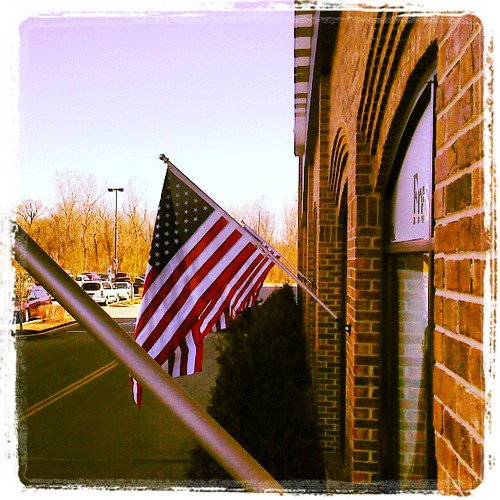
This has been a pretty trying month, all the way around. But at least I get to put the flags out on the front of The Store for the first time of the year. That helps!
Share This Post
Earth Day
A to Z: Sibelius
Jean Sibelius is one of those composers I struggle with from time to time. He seems like a composer whose music I should like more than I do, and yet, I don’t dislike his music. I’ve never really made a huge effort to listen to him, so I suppose the fault is mine. His life and career straddled the transition from Romanticism to Modernism, but Sibelius is generally best seen as one of the Romantics, albeit a highly nationalized one, coming from Finland and thus having a sound world all his own, quite distinct from the Wagner-Brahms thing going on farther south. Sibelius’s music is more of a cloth with Carl Nielsen’s, I suppose, but I tend to find it more distant, more difficult to really find the emotional center. But I also find that the more I listen to it, the more the internal logic of what he’s doing shows up. Sibelius’s music doesn’t so much sing or emote, as contemplate. It’s very inward-looking music.
In terms of performance, Sibelius was on my very first orchestral program, way back in the college days. It was the work below, his Concerto for Violin and Orchestra. It was nearly impossible in those early rehearsals to get any real feel for the work, as our orchestra only had half its complement for most rehearsals (our ranks would be padded out by paid pros from Waterloo/Cedar Falls, the large city twenty miles south), and we didn’t have the soloist (a violinist from the University of Iowa, named Leopold La Fosse) available for most of it, either. These were hardly ideal circumstances on which to engage with a piece of music, which is a shame because it was — and is — quite the concerto, when you really hear it.
(Those sparse rehearsals got a lot better over time. The orchestra’s director, Dr. Janice Wade, was in the early stages at that point of really striving to build a string program from almost nothing at Wartburg. By the time I graduated, four years later, we had a full orchestra present each week at rehearsal. Dr. Wade could be idiosyncratic, to say the least, but I came to deeply admire and respect the job that she did with that group. Indeed, some of my fondest musical memories come from my time under her baton. She retired a short time ago.)
Here’s the Sibelius Violin Concerto.
Tomorrow: A really modern composer!
Share This Post
Taking a break from writing about fictional spaceships….
…here are some photos, from a NASA FLickr stream, of an actual real spaceship launch. Specifically, the Antares rocket, developed by a private company. I think that the human future in space will depend in great part on private enterprise, and also that the future of the human economy will depend on our future in space.
Plus, there’s still something awfully thrilling about a rocket launching for space.


Space still beckons!
Share This Post
Sentential Links
Pilfering more participants from A-to-Z this week….
:: For the challenge this year, I have decided to challenge you. Because I love mathematics codes, and riddles, my 26 posts will test your brain. (Gotta look back on this one….)
I wanted it to be more than a diary. I have to be honest, I always felt a little corny when I would write a daily entry in the diary I received when I was younger. The process felt forced to me.
:: The electronic format is definitely a large part of the future of gamebooks, but I’m hopeful that printed versions will continue to be produced, aka Destiny Quest. I’d like to see gamebooks explore different concepts – while hack ‘n’ slash has its place, it would be great to see gamebooks where the choices made have real consequences, beyond “you don’t have this item so the dragon eats you”. Imagine a gamebook based on the ideas explored in Planescape: Torment or Tides of Numenera. (I have no idea what a ‘gamebook’ is. I need to look this up.)
I LOVE writing them and watching as chaos erupts around me.
However, I hate being on the reading end when a bomb drops and you know theres no way you’re sleeping tonight because you just have to finish the whole book after that.
More next week. Maybe. Or not. Who can tell, in these times of unpredictability? I could just end this post in the middle of a word, breaking off in highly strange fash
Share This Post
Some random thoughts on “Once Upon a Time”
I like this show a lot. We watch it every week. But it’s a really maddening show, because there are times it’s so wonderfully written (thank God they’ve got Jane Espenson on the staff), and other when it is so…not (too bad they can’t clone Jane Espenson).
:: Snow White / Mary Margaret is kind of irritating. She reminds me of the way Mary Ingalls was always depicted in the Little House books: insufferably good. The current storyline, of forcing her to do evil, could be interesting, but so far all they can figure out what to do is have her roll around in bed as she processes her existential crisis.
:: Regina / The Evil Queen is, by far, the most interesting character on the show. And Lana Parrilla plays her magnificently. She’s the most three-dimensional character on the show, and Parrilla captures that beautifully.
:: The next most interesting character on the show? Robert Carlyle’s Mr. Gold / Rumpelstiltskin. He seems to get the best lines, and so far, the writers have managed to keep him treading the line between good and evil in exactly the way a good Trickster character is supposed to do.
:: Come to think of it: Lana Parrilla will sadly be too old to play one of the Princesses when the totally inevitable movie of Princesses In SPACE!!! (not the actual title) gets made, which gives me a sad, because frankly, she’d be perfect for the older of the two. She has a very expressive face and a lot of range as an actress. (As opposed to Ginnifer Goodwin, who as Mary Margaret / Snow White seems to only have two expressions: happy smile and sad smile.) Robert Carlyle has a part waiting for him, too.
:: The worst character, by far, no competition, is Captain Hook. He is awful. The guy exudes zero menace, his sexual innuendos are embarrassing since he has no charisma or chemistry at all with anybody, he only serves to show up at inopportune moments to do something evil, and then he invariably gets his ass kicked. Hook isn’t a character, he’s a plot device, and a badly-acted one at that; every single time he shows up, any energy the show has gets sucked right out. The sooner the writers come to their senses and jettison this guy, the better.
:: I hope they never show August / Pinocchio as an adult wooden guy again. That was one of the creepiest damn things I’ve ever seen. Made that episode nearly impossible to watch.
:: I like the guy who plays David / Prince Charming, but his lips are distractingly red. Seriously, I’ve never seen a guy with lips that red before. Every time he’s onscreen, at some point during the scene I find myself staring at his lips. And I won’t lie — that makes me feel a little strange.
:: Some of the mining of old stories and folklore is pretty creative. Some of it, though…I don’t really know about. The last episode seemed to be going toward some kind of Asian lore, in a Big Trouble in Little China kind of way. I’m not sure where they’re going with that.
:: I’m honestly not sure how much longer this show can last — maybe one more season? My problem is that the worldbuilding feels increasingly tenuous. The town of Storybrooke can’t interact with the ‘outside’ world? Well, OK…but it’s a modern town, with all the modern trappings, so how do they get stuff? Where does the food at the store come from? How do they get gas for the vehicles they drive? It’s a town, not a separate world.
That’s about it. The second season starts winding down tonight…I think there are only three or four episodes left. I wonder how they’ll leave things hanging?
Share This Post
Sunday Burst of Weird and Awesome
Oddities and Awesome abound!
:: This is kind of creepy: the library of dust.
“In 1913, the Oregon State Insane Asylum began to cremate the remains of unclaimed patients and their ashes were stored in copper canisters.
After decades in storage the canisters have undergone chemical reactions resulting in explosions of vivid blue-green corrosion. Maisel was granted access to the room in which the canisters were stored to document them for his book.”
The full image of the room, with the cannisters all nicely arranged on the shelves like items in someone’s pantry, is particularly troubling to behold.
Well…that’s about it, I guess. This week really sucked, folks. We’ll get better, though!