previously:
six
five
four
three
two
one
Diving right back in with both lightsaber blades ignited…or something like that. Anyway, when last we left, Palpatine had engineered Anakin Skywalker’s elevation to the Jedi Council, but the Council, angered at Palpatine’s machinations, denied him the traditional promotion to Jedi Master that usually is part and parcel of a seat on the Council. Anakin is then asked to report to the Council on the Chancellor’s dealings, which he is not comfortable doing. Then Palpatine revealed to the Jedi the location of General Grievous, forcing them to take action; he suggests that Anakin be given the assignment of going after Grievous, and again annoyed by Palpatine’s machinations, the Council gives the job to Obi Wan. So, thanks to Palpatine, Anakin’s already troubled relationship with the Jedi Order is now simmering, he’s been left behind on Coruscant to do nothing while the war enters its most critical phase, and Palpatine reveals to Anakin a Sith legend about the power to defeat death.
The die is pretty much cast at this point. Palpatine has sown the seeds of Anakin’s discontent with the Jedi, he has sown the seeds of Anakin’s temptation for power he can’t get with the Jedi, and he has sown the seeds of Anakin’s desire for action. Well done, Palpatine! All he has to do now is keep pressing.
At this point in the film, we cut from the start of the battle on Kashyyyk to Obi Wan departing Coruscant for the Utapau system, so he can investigate the report that Grievous is there. In the script, however, two scenes happen before that: a scene in which Obi Wan visits Padme, and another in which Padme meets with the Senators who are concerned over the Chancellor’s continued acquisition of power. I won’t quote either of those scenes, because they really don’t add much to the story, and I’m glad that Lucas cut them from the finished film. They’re OK, but hardly essential.
Instead, Obi Wan bids farewell to Anakin:
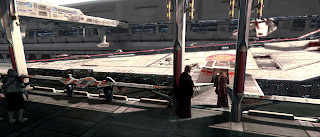
EXT. CORUSCANT-CLONE LANDING PLATFORM-DAY
ANAKIN and OBI-WAN walk onto a landing platform overlooking a docking bay where THOUSANDS OF CLONE TROOPS and armored weapons, tanks, etc., are being loaded onto a massive REPUBLIC ASSAULT SHIP.
ANAKIN: You’re going to need me on this one, Master.
OBI-WAN: Oh, I agree. However it may turn out just to be a wild bantha chase.
OBI-WAN starts to turn and leave.
ANAKIN: Master!
OBI-WAN stops and ANAKIN walks over to him.
ANAKIN: (continuing) Master, I’ve disappointed you. I have not been very appreciative of your training . . . I have been arrogant and I apologize . . . I’ve just been so frustrated with the Council. Your friendship means everything to me.
OBI-WAN: You are strong and wise, Anakin, and I am very proud of you. I have trained you since you were a small boy. I have taught you everything I know. And you have become a far greater Jedi than I could ever hope to be, and you have saved my life more times than I can remember. But be patient, Anakin. It won’t be long before the Council makes you a Jedi Master.
OBI-WAN starts down the ramp, then turns back.
OBI-WAN: (continuing) Don’t worry. I have enough clones with me to take three systems the size of Utapau. I think I’ll be able to handle the situation . . . even without your help.
ANAKIN: Well, there’s always a first time.
OBI-WAN laughs.
They talk for a few more minutes before ANAKIN watches OBI-WAN depart.
ANAKIN: Obi-Wan, may the Force be with you.
OBI-WAN: Good-bye, old friend. May the Force be with you.
OBI-WAN heads down a ramp toward the waiting Republic cruiser.
This is a nice little scene that I’ve always liked. The way the film ends up playing out, this is the last time Anakin and Obi Wan are together, as friends and comrades, before things go terribly awry. This, to me, only highlights the awful tragedy of what’s about to unfold, because it so completely takes the Jedi, and Obi Wan among them, by surprise. Their undoing comes from within, and they never saw it coming. I’d make an addition here, though:
As the Republic cruiser lifts away from the platform, Anakin turns to depart as well, when a Clone trooper approaches him.
TROOPER: Master Skywalker? The Chancellor is requesting you right away.
Anakin sighs.
ANAKIN: Very well.
Next is some nice banter and stuff as Obi Wan gets ready to investigate Utapau for General Grievous. No need to quote that stuff, but it’s another little character moment that I like. Real camaraderie has grown between Obi Wan and the clone troopers, at least a few of them. It’s another example of the Jedi’s complete lack of awareness of the tragedy to come.
Meanwhile, the following transpires in the script but not in the film. I’d restore it:
EXT. CORUSCANT-CITYSCAPE-CHANCELLOR’S TRANSPORT-DAY
The Chancellor’s Transport races through the city and heads for the Senate Office Building landing platform. Waiting on the landing platform is a LONE JEDI. The Transport lands, and CHANCELLOR PALPATINE emerges with FOUR ROYAL GUARDS and MAS AMEDDA. The FOUR ROYAL GUARDS move off in another direction as PALPATINE greets ANAKIN, who has been waiting for him.
PALPATINE: Well, Anakin, did you see your friend off?
ANAKIN: He will soon have Grievous’s head.
PALPATINE: We can only hope the Council didn’t make a mistake.
ANAKIN: The Council was very sure in its decision.
They exit the landing platform.
INT. CORUSCANT-SENATE OFFICE BUILDING-MAIN HALLWAY-DAY
They enter the main hallway of the Senate Office Building. They pass SEVERAL SENATORS, including REPRESENTATIVE JAR JAR BINKS from Naboo.
JAR JAR: Helloo Annie. Good en to see yousa . . .
The Gungan waves to Anakin.
ANAKIN: Hi, Jar Jar.
JAR JAR: Oopsin da Chancellor!! So sorry, Your Highness, sir.
Anakin turns back to the Chancellor. [None of this appeared in the movie, but I would not restore the Jar Jar bit. Nothing against Jar Jar, but it’s just a pointless bit.]
PALPATINE: There are rumors in the Senate about Master Kenobi. Many believe he is not fit for this assignment.
ANAKIN: Not fit? Why would anyone think that?
PALPATINE: They say his mind has become fogged by the influence of a certain female Senator.
ANAKIN: That’s ridiculous. Who?!?
PALPATINE: (slyly) No one knows who she is … only that she is a Senator.
ANAKIN: That’s impossible. I would know.
PALPATINE: Sometimes the closest are the ones who cannot see.
ANAKIN becomes worried.
PALPATINE: (continuing) Idle Senate gossip is rarely true and never accurate. I’m sure your Master will do fine. But you and I both know they should have sent you.
In the script, the deleted scenes paint a picture that Palpatine is trying to drive wedges all over the place: between Anakin and Padme, between Anakin and Obi Wan, between Anakin and the rest of the Jedi. I’d keep a very small bit of it – this bit, to be precise:
PALPATINE: Well, Anakin, did you see your friend off?
ANAKIN: He will soon have Grievous’s head.
PALPATINE: We can only hope the Council didn’t make a mistake.
ANAKIN: The Council was very sure in its decision.
PALPATINE: As they always are. Master Kenobi is capable, but you and I both know they should have sent you. Well, since the Council has decided that you are to watch me and report on my doings, you can have the pleasure of watching me meet with one group of Senators after another.
ANAKIN: Anything important?
PALPATINE: From this faction? No. Just jockeying for power when the war comes to an end. It’s all very silly…the usual business about taxation and trade routes….
ANAKIN looks bored as PALPATINE continues discussing statecraft.
Next, in the film, Anakin has another vision of Padme’s childbirth, but this one is a bit different:
INT. POLIS MASSA-MEDICAL CENTER-DREAM
PADME calls out in pain. OBI-WAN is near her and softly speaks to her.
OBI-WAN: Save your energy.
PADME: I can’t!
OBI-WAN: Don’t give up, Padme. Don’t give up . . .
That’s interesting in that he’s now seeing Obi Wan as involved somehow, as being present at the birth of Padme’s children, and not himself. This is a pretty interesting vision because that’s the one that ends up playing out, but in this context, it starts feeding into Anakin’s anxieties.
The next scene is where we really start to see some of Anakin’s internal turmoil. The scene as is works OK, but I’d still re-tool it:
INT. CORUSCANT-PADME’S APARTMENT-LANDING ROOM-DAY
ANAKIN snaps awake from the dream.
ANAKIN: No!
He is on the couch, where he had dozed off. He hears the sound of an approaching and slowing speeder, and he stands as PADME climbs out of the speeder that has just halted outside. C-3PO had been piloting.
PADME: Thank you, Threepio.
She smiles when she sees ANAKIN; they embrace and kiss.
PADME: I didn’t expect you.
ANAKIN: I had some free time, I guess. Chancellor Palpatine is in his daily meditations, and the Council doesn’t seem to think I’m to be allowed to do anything else.
PADME: It’ll be all right. You don’t always have to be on the front lines.
ANAKIN: I’m a Jedi. Yes, I do.
PADME lays down her parcels and pours a glass of water.
PADME: If you’re with the Chancellor, I’ll see you tomorrow. I’m part of a group of Senators who are meeting with him tomorrow about reducing the scale of executive power once—what is it?
ANAKIN: I sense someone familiar . . . Obi-Wan’s been here, hasn’t he?
PADME: He came by this morning.
ANAKIN: What did he want?
PADME looks at him for a moment. ANAKIN seems tense.
PADME: He’s worried about you. He wanted to talk about you before he left.
ANAKIN: Did you tell him about us?
PADME: No! But…I think he suspects. Maybe. We can trust him, though!
ANAKIN: He’s a Jedi.
PADME: You can’t trust a Jedi? Anakin, listen to yourself!
ANAKIN: You’re right…I just feel…weak. Like I’m not useful to anyone. And I shouldn’t feel that way. I’m the most powerful of all the Jedi, but I’m stuck here.
PADME tousles his hair.
PADME: Here’s not such a bad place to be.
ANAKIN: You know what I meant.
PADME: I know, but why worry about it? You said that you’re going to leave the Order when the baby comes, anyway. Is that still what you want?
ANAKIN: I want you. More than anything.
He puts his hand on her belly.
ANAKIN: I have to know that you’ll be safe from whatever is in my nightmares. I have to stop it.
PADME: Anakin, I’m sure you’re worried about nothing.
ANAKIN: I don’t think so. The Force shows me what will happen–
PADME: What might happen.
ANAKIN: I won’t let this happen, Padme. I won’t let you die.
They embrace and kiss again…not noticing the PROBE DROID outside their window.
INT. JEDI TEMPLE – MEDITATION ROOM.
MACE WINDU sits in the meditation chamber by himself, looking at holographic footage of ANAKIN and PADME kissing. Then he looks at a report on a computer screen, and shakes his head.
My purpose there is to get a lot of stuff in play: Padme’s ongoing involvement in what will become the Rebellion, Anakin’s anger at the Jedi and how it’s starting to color his perceptions of the Order itself, and his continued fear of losing his loved ones. And the fact that for all Anakin’s worrying about Obi Wan finding out about his marriage, it’s Mace Windu who knows.
Next comes the arrival of Obi Wan Kenobi on Utapau, his discovery of General Grievous there, and the start of that battle. This is one of my favorite parts of the movie, and I wouldn’t change a single thing about it. Not one bloomin’ thing. This entire sequence is just cool, from Obi Wan’s landing on Utapau (the music does this really cool rendition of the “Force Theme”), and then his jumping on the back of some beastie to ride, and then his confrontation with General Grievous which serves as a diversion as the clone troopers attack. I love this entire sequence. It’s just terrific.
Back on Coruscant, though:
INT. CORUSCANT-JEDI WAR ROOM-EARLY EVENING
KI-ADI-MUNDI, ANAKIN, YODA, MACE, CLONE COMMANDER CODY, and AAYLA SECURA talk via holograms.
CLONE COMMANDER CODY: Master Windu, may I interrupt? General Kenobi has made contact with General Grievous, and we
have begun our attack.
MACE WlNDU: Thank you, Commander. Anakin, deliver this report to the Chancellor. His reaction will give us a clue to his
intentions.
ANAKIN: Yes, Master.
ANAKIN leaves the room. COMMANDER CODY’s hologram disappears.
MACE WINDU: I sense a plot to destroy the Jedi. The dark side of the Force surrounds the Chancellor.
Kl-ADI-MUNDI: If he does not give up his emergency powers after the destruction of Grievous, then he should be removed from
office.
MACE WiNDU: That could be a dangerous move … the Jedi Council would have to take control of the Senate in order to secure a peaceful transition . . .
Kl-ADI-MUNDI: . . . and replace the Congress with Senators who are not filled with greed and corruption.
YODA: To a dark place this line of thought will carry us. Hmmmmm. . . . great care we must take.
Interesting! The Jedi are scheming to put matters right if the Chancellor does not leave his office after the war ends. I’d clarify this scene just a bit:
INT. CORUSCANT-JEDI WAR ROOM-EARLY EVENING
KI-ADI-MUNDI, YODA, MACE, CLONE COMMANDER CODY, and AAYLA SECURA talk via holograms. ANAKIN enters.
MACE WINDU: You’re late.
ANAKIN: I’m sorry, Master Windu. I was detained.
MACE WINDU: Indeed.
ANAKIN and MACE WINDU exchange glances, but nothing is said.
CLONE COMMANDER CODY: Master Windu, may I interrupt? General Kenobi has made contact with General Grievous, and we have begun our attack.
MACE WlNDU: Thank you, Commander. Anakin, deliver this report to the Chancellor. His reaction will give us a clue to his intentions.
ANAKIN: Yes, Master.
ANAKIN leaves the room. COMMANDER CODY’s hologram disappears.
YODA: It has come. The last battles of the war, these are.
MACE WINDU: I sense a plot to destroy the Jedi. The dark side of the Force surrounds the Chancellor.
YODA: Manipulated by Darth Sidious, you believe he is?
MACE WINDU: That’s the most likely way of it.
Kl-ADI-MUNDI: If Chancellor Palpatine does not give up his emergency powers after the destruction of Grievous, then he should be removed from office.
MACE WINDU: That could be a dangerous move … the Jedi Council would have to take control of the Senate in order to secure a peaceful transition . . .
Kl-ADI-MUNDI: . . . and replace the Congress with Senators who are not filled with greed and corruption.
YODA: To a dark place this line of thought will carry us. Hmmmmm. . . . great care we must take.
I think it needs to be shown that the Jedi are on the right track, but they are also one step behind, which ultimately ends up destroying them. This is an important point and a subtlety that I think often gets lost amongst Star Wars commentators: the Jedi in the Prequel Trilogy are not at their best. Indeed, they are a slow-moving train wreck. Here they are planning to act to restore the Republic’s democracy, but Palpatine will be able to use that very plot against them.
And that’s where we’ll stop. Next time, Anakin – who has been teetering on the brink – finally tips. Or…is he pushed? Hmmmmm…tune in!
Share This Post