

A to Z: Chopin

One part of my character make-up against which I have struggled all my life is my tendency to simply not work that hard at stuff I don’t care as much about as other stuff. I suppose everybody has that tendency to some degree, but in me, it can really get damaging sometimes. This isn’t an example of that, but it is a coming-to-grips of sorts with the fact that I could have been pretty damned good at something, had I not wanted to be pretty damned good at something else.

The something I cared about a whole lot? My trumpet playing. The thing I cared less about? My piano playing.

I just never ever worked as hard at the piano as I did the trumpet. That’s inevitable, as the trumpet was my serious focus back in my musical days. But I have to admit that I could have worked harder at the piano and been better at it. I’m sure that I was a terribly frustrating student for both my piano teachers, first a wonderful woman named Margaret Hooker, and then a fine college prof named Dr. Ted Reuter. There were a number of piano pieces that I was technically good enough to handle, but which I never mastered, simply because I didn’t work hard enough at them.

One such piece is the Polonaise Op. 40 No. 1 in A Major (“Military”) by Frederic Chopin. There’s no reason that I couldn’t have played the hell out of this. I just…didn’t.

Chopin (1810-1849) is generally considered Poland’s greatest composer, and he is one of the greats of the Romantic era. He wrote almost nothing for orchestra, except for a couple of concertos; the vast majority of his output is for piano, which makes his music an absolute staple of piano students all over the world. Nocturnes, etudes, mazurkas, and, in this case, polonaises. A polonaise is a Polish dance, performed in ¾ time, and Chopin wrote quite a few of them. This one, the “Military”, is full of stately grandeur; in my ears it sounds less like a dance and more like a processional. Every time I listen to it, I wish I’d gotten off my arse and learned to play the thing.

I like this video because it shows the score of the piece in time with the performance. This kind of thing is extremely valuable!


Tomorrow: American music that really isn’t!


Share This Post

Cats and Wife

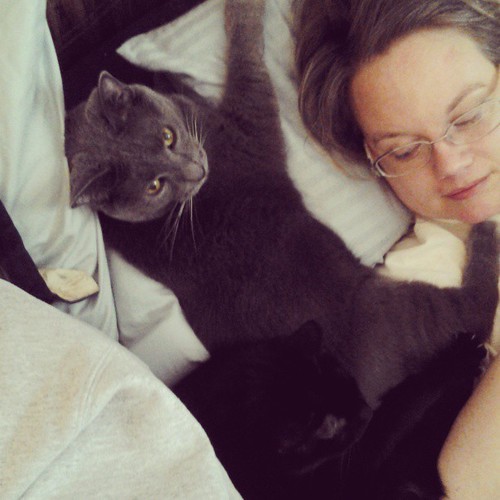
I was lucky enough to get this lovely shot of our two feline doofuses in a cuddly moment with The Wife, who was snoozing in ever-lovely fashion.

Life ain’t all bad.

Share This Post

A to Z: Bach

“Writing about music is like dancing about architecture.”
–Somebody (we’re not really sure who)

Yesterday I indicated that I don’t much care for Baroque music, because of its inherent sanity. But as in all things, there are exceptions, and the major one for me is the music of Johann Sebastian Bach, whose music transcends nearly everything. Bach is one of the great transformational figures of all time, and there are very few figures in the history of Western music whose influence has been so wide-spread and so lasting.

Why is this? Well, the above quote provides a way in. Writing about music is slippery business, because it’s just plain hard to capture in one medium the essence of another. As Leonard Bernstein once wrote, in discussing a Chopin etude, “If Chopin could have said in words what he was trying to say with the music, why would he have used music at all?” When writing about music, we can only ever get what feels to the writer an approximation of the essence of the work, which is why good music writing is so hard to find and so valuable.

The quote above also pertains to Bach in that, in the course of drawing an absurd metaphor in order to make a point, it uses precisely the word that leaps to mind when I think of Bach’s music. That word is architecture.

Bach’s music is, to me, architectural. It is mathematical. Now, to some that might make it sound like the music is clinical and sterile in emotion, but nothing could be further from the truth. Bach’s music often suggests, more than any other composer’s, something cosmic, and his work springs from the deep connections between music and mathematics. It’s the primal sense of wonder that may well be the very first emotion we all experience, that sense of grandeur before a Universe that is vaster than we can conceptualize and yet we have innate abilities to conceptualize a great deal of it. That’s what Bach means to me.

Architecture. Every great Bach work is an edifice, in which you can sense each musical building block as it is laid into place. In every great Bach work, you can see how each phrase relates to another, how each chord is structured together. The melodies that emerge from the unerring logic of his musical architecture make sense in a way that few other composers’ do, and it’s that emergent quality of his melodies that is so remarkable about them. Bach draws the ear to a certain place just as a great architect, or painter, knows how to draw the eye to a certain place.

Here is one of Bach’s most famous works, and indeed, one of the most famous musical works in the entire history of the world: the Toccata and Fugue in D minor. I’m providing three versions here. First, you can hear the work as it may have originally been heard, as written for church organ. In the second, the Toccata is played as a MIDI recording (surprisingly good-sounding), but with an accompanying visualization that really clarifies the way Bach stitched this astonishing piece together. And finally, you can hear what many purists likely consider an abomination, but which I enjoy a great deal: Leopold Stokowski’s arrangement of the Toccata for full orchestra, in the piece’s segment from the Disney film Fantasia (Watching Stokowski here, I always wonder if he was mugging or if that’s really how he conducted, because some of his motions are incomprehensible).


Tomorrow: a piece that chewed up the teenage me and spit me back out.

Share This Post

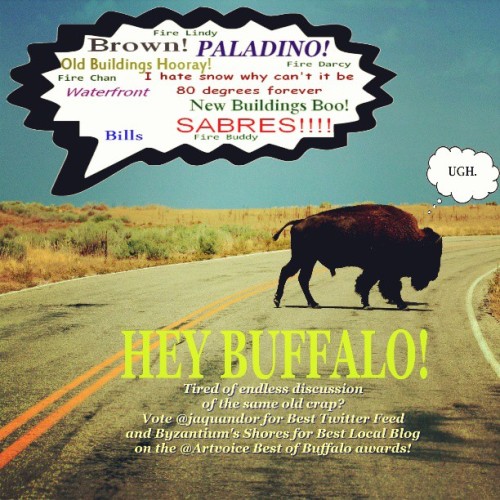
Remember, Buffalo!

This city seems to have a fetish for old things. Well, Byzantium’s Shores is one of Buffalo’s oldest blogs, dating back to February 2002! In blogging terms, that’s like a house that Tom Jefferson might have walked by on his way to sleeping someplace. Vote for something old, Buffalo! THIS BLOG MATTERS!

(Yes, this is a capricious exercise — but hey, somebody’s gotta try to stand up for personal blogs that aren’t about the Same Old Buffalo Niagara BS!)

Share This Post

A possibly depressing exercise

I’ve written of this before, but the names change every year, so let’s do it again! For me, when I think of an ‘old movie’, my brain always defaults to Casablanca, which by the time of my awareness of its existence, had become a venerable classic movie. Now, when I was born, Casablanca was 29 years old. So here is a list of films that, as of this year, are as old as my brain’s canonical ‘old movie’.

Ghostbusters
Indiana Jones and the Temple of Doom
Splash
Gremlins
The Karate Kid
Star Trek III: The Search for Spock
Amadeus
Revenge of the Nerds
Romancing the Stone
Red Dawn

Lots more, obviously, but those are stand-outs. Not all in terms of quality, obviously — Red Dawn is trash, no matter how you slice it — but it’s interesting to note that of the ten movies I list here, all of them among that year’s twenty top-grossing films, two have been remade. (So has a third of the 1984 top twenty, actually — Footloose!)

Meanwhile, Casablanca has never been remade. Its story beats have been mined a lot, and the film has an enduring place in popular and wider culture, but no one has yet actually made a new version of the film. Will it happen? Who knows? Anyhow, all hail the newest Old Movies!

Share This Post

Art in SPACE!!!

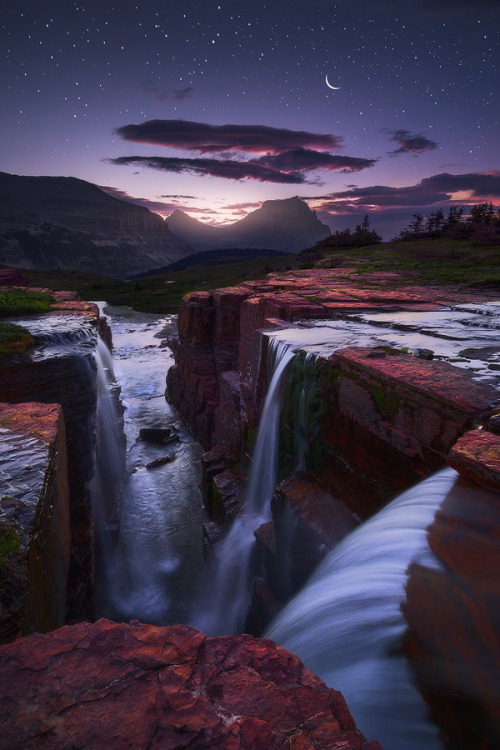
I saw these two images on Tumblr yesterday, and both put me in mind of Princesses In SPACE!!! (not the actual title). The first seems like an actual possible location from the book, so I’ll keep this in mind:

This one doesn’t fit anything specific from the book(s) at all, but it does convey, to me at least, a bit of the sense of adventure that I’m trying to partly capture with these stories.

The first image is sourced on Tumblr to here, and the second, to here.

Share This Post

A to Z: Arutunian

Welcome to this year’s Blogging A-to-Z Challenge! My topic this year, as I indicated yesterday, is Classical Music. My approach will be generally of a piece with my approach to all such things: personal reflections and whatnot.

So, let’s get started!

As a trumpet player back in the day, I remember with quite a bit of clarity my frustration that a pretty sizeable chunk of the solo repertoire for the instrument sprang from the Baroque era. This frustrated me because, as a general rule, I’ve never been much of a Baroque music fan. I had a trumpet teacher in high school, Mr. Craig Fattey (huh – I wonder if he’s still around? Note to self: look him up), who was of like mind, and he summed it up one night thusly: “There’s a sane-ness to Baroque music that doesn’t lend itself all that well to listening, for me.” I think that’s about right. I’m drawn to music that’s got some insanity in it, and if that’s your thing, you’re not going to find it much in the Baroque.

(Bach is, of course, an exception, because he was such a towering genius that his lack of insanity is totally irrelevant. But that’ll be for another day.)

So if you’re a trumpet student, you find yourself playing a lot of Baroque stuff. And two major concertos of the Classical era, one by Haydn and the other by J.N. Hummel. Both are fine works, but it always bugged me that after those two, music for solo trumpet just doesn’t exist until you get into the 20th century. For the Romantics, the trumpet was pretty much exclusively an orchestral instrument. For the most part I was fine with that, because I always wanted to be an orchestral player anyway, but I still longed for a nice trumpet concerto by a Schumann or a Berlioz or a Dvorak. Alas!

But in the 20th century, the trumpet became more popular as a solo instrument, and the Arutunian Concerto is of that era. And what a wonderful, amazing work it is! Alexander Arutunian (who died just over a year ago, March 28, 2012) was an Armenian composer who was apparently nationalist in his music (which means, he used a lot of Armenian folk melodies or characteristics of Armenian folk music in his work). The Trumpet Concerto is just teeming with wonderful melodies and interesting rhythms, and the orchestration is superb, with the soloist and the orchestra achieving a beautiful partnership. It’s a technically difficult work, but it’s difficult in the musical way, as opposed to being a virtuoso showpiece. This is one of my favorite classical works of all time.

The performance below sounds great, even if the camera work – plunk it on a tripod in one spot and never move it – is strictly utilitarian. The soloist is Tine Thing Helseth, with whom I was unfamiliar until I listened to this. Her sound is fantastic – she has a big, bold sound that meshes perfectly with the orchestra, and in her hands, the Arutunian by turns dances, trots, and sings its heart out. This piece is a great deal of fun for the soloist, with its unusual rhythms and places where you just get to belt out a high note and hold it while the rest of the orchestra does its thing. Listen for the recurring rhythmic motif that binds the entire piece together.


Tomorrow: One of the most famous works in the entire history of music.

Share This Post

Sentential Links

Links….

:: “I can’t believe we missed the ham party at the fire hall because we were sick.”

:: Well, there are multiple meanings. That’s the point. Imaginative acts, stories, are told in part because of their polyvalence, their richness, their ambiguity. We can talk about how freedom hits us unprepared; how it always requires outside assistance, and cannot be accomplished on one’s own; about how it requires various restrictions, symbolized by abstaining from leaven for eight days; about how it is communal and not individual. That our freedom was given, not earned; that it is not yet complete. It forces us to think about the nature of liberation and history and memory. It opens to the meanings we give it.

:: Shutting off the comments, even for just a few days now, has been such a positive experience. I still hear from you guys, but the conversation seems to be more in-depth, more useful. (See? I coulda killed the comments altogether!)

:: Finally, speaking of Shatner’s age, does he look great for a man of 82 or what? We should all age so gracefully…

:: I am not sure why people will line up for stupid Spider-Man movies where Peter Parker goes out hunting for revenge but not for awesome movies about G.I. Joe. This seems rather silly to me.

:: Mars is such an odd place. Thick gray basaltic sand is everywhere, covered itself by fine dust (tinged red due to iron oxide: rust). Cratered, battered, barely holding an atmosphere, yet it still has ways of reminding us of home. Comparative planetology is a fascinating field.

:: I have been reading like crazy, writing every day, exercising every day, and pushing many projects forward, with my sheer force of belief in them. This is challenging but it’s also the only way. It requires a belief in the unknown. It requires the ability to see your own success, however much it is not manifested in the current moment. (It is the only way. It really, truly is. I wish they could find a way to put that lesson into the minds of people at 21, because I’d have a lot more done with my life had I realized this way back when I was younger and more energetic. But then, I didn’t know shit back then, so it’s a tradeoff, innit?)

:: You want to be a writer?

Keep writing. (That says quite a lot of it, doesn’t it?)

More next week. Or not. Harumph.

Share This Post

A to Z 2013: Classical Music!

Yup, folks, it’s that time again — the A to Z Blogging Challenge! The idea is to simply blog each day in April on a certain topic (excluding Sundays), using the letters of the alphabet as your guide. This year, my theme will be Classical Music. I’m not taking any particularly organized approach here; I’ll just be posting twenty-six different works with a few notes on each. Some will be very well-known to me; some will be very well-known in general. And some will be entirely new to me, which is exciting. (And yes, for long-time readers, some may well have been used in Something for Thursday installments. I’m not searching my archives for each piece as I go.)

The idea? Not to educate or evangelize, just to share a lot of music that I love or might love. (Or hate, if I choose something that makes me crazy.) I had a lot of fun with last year’s A-to-Z Challenge, so I hope I can have similar fun this year. (And hey, if you want to do your own A-to-Z, go ahead and sign up! There’s still time. More the merrier!)

By the way, Something for Thursday will continue to exist this month, but I’ll lay off the classical music for that feature until May. So in general, expect this blog to have a more musical air about it this coming month!

Share This Post