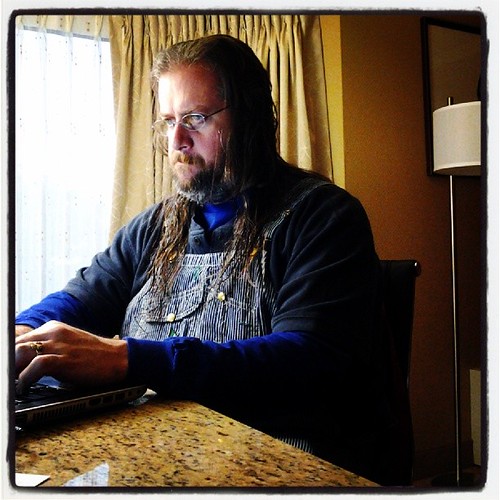
Getting a little work done before we head to Ithaca, because as Captain Malcolm Reynolds once said, “We work before we play.”
He also said some other stuff, but that’s the one that’s relevant here.

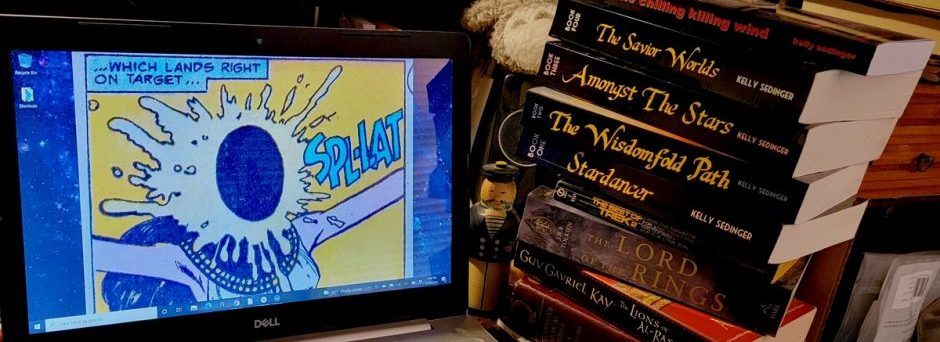
The official site of Kelly Sedinger: Reader, writer, photographer, and dreamer
Getting a little work done before we head to Ithaca, because as Captain Malcolm Reynolds once said, “We work before we play.”
He also said some other stuff, but that’s the one that’s relevant here.
I was in a pretty oddly dark mood this morning, so I tweeted the following:
I like to think that when he turned 18, Encyclopedia Brown got sick of the whole thing and committed a string of still-unsolved murders.
Of course, my brain being the brain it is, I couldn’t stop turning that over in my head, so I imagined the following scenario:
:: Encyclopedia grows more and more grim and despondent; maybe he starts dressing in black. He spends less time with Sally Kimball, who is hurt by this. He closes his detective business.
:: His first victim is, of course, Bugs Meany, whom he kills in a way that leaves no visible markings of trauma on the corpse and which vexes the Idaville medical examiner, who hasn’t had much to do in eighteen years. Encyclopedia leaves the body by the back door of that delicatessen that the first paragraphs of each Encyclopedia Brown book make a point of mentioning.
:: Encyclopedia’s string of murders begins after his father, the Idaville police chief, announces his intention to retire.
:: When the second victim is found near one of Idaville’s two movie theaters, a palpable sense of fear descends on this quiet community. Chief Brown’s years of successful law enforcement are called into question. He brings details home to Encyclopedia, who uses his own knowledge of the case to send his father down wild goose chases before he ultimately just refuses to do anything more.
:: The murders continue, until finally Sally Kimball discovers the key piece of evidence that Encyclopedia forgot about, and gives it to Chief Brown, who must now arrest his own son.
But…
WHAT WAS THE CLUE THAT TIPPED SALLY OFF?
(turn to page 78 for the solution!)
All right, let’s get our nose off this particular grindstone, shall we?
Here’s the final question of the ones that were posed by various anonymous readers:
Is the middle class terminal? Assuming it is how do we convince people to strive if opportunity is not there? If we are not striving aren’t we just, well, breathing?
This is a question that I think about a lot. I honestly am not really sure, but I do wonder from time to time if the pace of technological improvement is going to render large parts of our economy obsolete. And then, what?
Manufacturing is going to become more and more automatic. I think most folks believe that our kids will live to see cars that drive themselves, and in fact, in a hundred years, our descendants may look back on us, shaking their heads, and say, “Can you believe they used to take control of two-ton vehicles and maneuver them in tight quarters at high speeds?!”
Putting the problem bluntly: What do we do if and when we reach a point where there simply isn’t enough work for people to do? Our entire economy is built on the idea: Someone with money determines that work needs done, and pays someone some of their money to do it. There really could be a time when there isn’t enough work for people. The natural question then is, then what? Can people be trusted to find things to do to occupy their time? Will they make work for themselves, as the growing artisal movements have? And will we (meaning, we as a species) be able to do enough of this sort of thing to keep our idleness from being a breeding ground for all of our usual hatreds and resentments?
I also worry a great deal about the current economic climate in the United States, which has been more and more tilted in the favor of funneling the nation’s wealth upward. So I don’t know if the middle-class is in “terminal” shape, but…there are some enormous challenges, and current policy seems to me utterly unlikely to meet them.
And then, we have…Roger. Roger, Roger, Roger!
what TV shows, movies, books, comic books, et al. have affected you in terms of your politics/geopolitical world view?
It’s interesting: I’m not entirely sure that a lot of the fiction I’ve experienced has affected my worldview all that much. I suppose it would have to, but I’m not readily coming up with any great examples of books or movies or whatever that made me think, “Wow! What a wonderful expression of liberalism!”
I know, I know: The West Wing. But in a recent re-watch of the first 3.5 seasons of the show (I petered out right about when the slow-leak in Sorkin’s balloon, which started in Season Three, finally let all the air out completely in Season Four), I found that the show isn’t quite as liberal as most think. Sure, the administration and most of the main characters are Democrats, but many of the Republicans in the show are not depicted as fire-breathing demons, and it’s actually pretty surprising how often it’s the conservative argument that ends up winning the day. Liberalism is mostly depicted on The West Wing as an idealistic world view, and many times, a character will give a full throated expression of some liberal idea only to have to concede that it’s just impossible or unwieldy or unaffordable or something similar.
It’s not so much my liberalism that’s informed about my approach to fictional properties, then…but my more general sense of right and wrong, and my feel of optimism for our future as a species. That is influenced hugely by a lot of science fiction, such as Star Trek and, yes, Star Wars, even though the latter is more mythic in approach and doesn’t depict a “future” at all. But I like tales that suggest that we do have a bright future as a species, that we’re not just doomed to do our thing on this planet until something happens and we all die, leaving only a few space probes in the dark as evidence of the things we once did. Peter F. Hamilton is an author who is good at this; so was Iain Banks. I get a bit of this from John Scalzi, too, although his future tends to be more violent.
Have you ever participated in a buycott, rather the opposite of a boycott, in which you buy some product or service to support someone whose values you admire?
I have to confess that I try to do this, but it’s not always the easiest thing to do in the world. Often the businesses that are really admirable are hard to access (lots of driving), or they’re more expensive (luckily, this is becoming a bit less of a concern for me these days), or…well, that sort of thing. I do feel the need to do more of that, especially since it’s so often very easy to not do business with companies whose values I find ugly or abhorrent.
If I’m to believe what I watch on FOX News, the white man feel mighty oppressed in America! Why is that?
Well, by way of a short answer, the world they’ve always known is changing, and that can be scary. Things are getting difficult that weren’t always difficult, and things are getting easy for “The Other” — whomever your particular “other” happens to be — in a way that they have not been. Simplistic answer, I know, but I really think that covers it.
What is your opinion of the Presidential Medal of Freedom nominees?
Hmmmm. First, by way of definition (via Wikipedia):
The Presidential Medal of Freedom is an award bestowed by the President of the United States and is—along with the comparable Congressional Gold Medal bestowed by an act of U.S. Congress—the highest civilian award in the United States. It recognizes those individuals who have made “an especially meritorious contribution to the security or national interests of the United States, world peace, cultural or other significant public or private endeavors”.[3] The award is not limited to U.S. citizens and, while it is a civilian award, it can also be awarded to military personnel and worn on the uniform.
Here is the roster of this year’s honorees:
Ernie Banks
Ben Bradlee
Bill Clinton
Daniel Inouye
Daniel Kahneman
Richard Lugar
Loretta Lynn
Mario Molina
Sally Ride
Bayard Rustin
Arturo Sandoval
Dean Smith
Gloria Steinem
Cordy Tindell “C.T.” Vivian
Patricia Wald
Oprah Winfrey
I don’t really have a problem with any of these, to be honest. All are important figures (even if I wasn’t familiar with a few of the names — more info on each at WhiteHouse.gov) I don’t see anyone on the list whose contributions I consider trite or silly. It’s tempting, maybe, to think so of the sports figures, but sport is such a central part of American culture and identity, for better or worse, that to ignore it for things like this would seem odd. It’s always hard with awards like this, because frankly, for every person out there, there’s another person who can tell you either why they should or should not receive an award like this. These are all remarkable, important Americans, though, as far as I’m concerned.
This is less question than request: could you write a verse of song/poetry about the end of you finishing writing something. The thing I had in mind was for you to write something called “Put a Fork in It” to Beyonce’s “Put a Ring on It”, but you can pick another title as long as it’s to a widely recognizable song.
OK…well, this is weird…huh…well, here goes. And before any of you rip me to pieces over this, I’m coming up with this right now, as I write this, off the top of my head. So yeah, it probably sucks.
(To the tune of the Discovery Channel song)
The book is finished,
The manuscript is done,
The plot is wrapped up,
And man, I had some fun!I love to write books,
It’s what I’m here to do,
Boom de yada, boom de yada,
Boom de yada, boom de yada!I think the book is good,
And so will all the world,
When it’s on the bookshelves
And my flag’s unfurled!All folks will read it,
And fortune will be mine,
Boom de yada, boom de yada
Boom…sound of needle being dragged across record player. Music stops.
MAN WITH VOICE OF JAMES EARL JONES: Stop singing and write the next book, dumbass.
And with that, folks, I think we’re done with Ask Me Anything August 2013! Thanks for playing and being patient, and we’ll play again in February!
It’s fall now, although here in Buffalo we’re enduring a couple more days of unseasonably warm weather: upper 70s when we really should be in the upper 60s. Oh well: it’s fall, darn it, and I’m gonna wear overalls anyway. It’s my vacation and I can do that.
As for music, well, for me the fall is when I feel the strongest sense of “awakening”, so I guess one could say that for me, fall is a bit spring-like. That being the case, here is Aaron Copland’s Appalachian Spring, but in the original orchestration for small ensemble. As wonderful as the more commonly-heard version for full orchestra may be, there’s something refreshing about hearing the clarity of Copland’s original writing.
What’s your preferred work schedule? Do you respond best to Monday-Friday, 9 to 5? Do you like a mix of days, nights? Is working weekends OK or godawful?
The last restaurant company I worked for, not long before I left, rolled out an interesting approach to the management schedule (that has since been abandoned, I believe). Their original approach had been to have managers work five consecutive days, and then always have back-to-back days off (which is always nice; split days off can be a pain), with one extra day off each month. But then they tried this, which I thought worked really nicely for the short time I was there: managers worked four consecutive days and then had their two days off. Obviously, this means that your days off change each week: one week you’re off Wednesday-Thursday, then you’re off Tuesday-Wednesday, and so on. I liked this because it meant that every five weeks, you would have consecutive Sundays off (Sunday being the busiest day at that restaurant, this was nice), and that every six weeks you would have a weekend off. In restaurants, weekends off are really hard to come by. They can happen, but you’d better be prepared to work a lot of days up to and after the weekend off.
Anyway, what do you like to work?

I’ve been reading The Count of Monte Cristo of late, and I just really liked this particular paragraph. I know I’m reading a translation, but I am greatly enjoying what I’m getting of Dumas’s style. It’s hard to explain, I must admit…it’s like he uses a lot of words, fairly poetically, to state something bluntly.
I am now up to where Edmund Dantes has recovered the treasure and is investigating what has become of the shards of the life that was exploded years ago, when he was unjustly imprisoned. Good stuff!