Why the Internet is Awesome, part 7568273

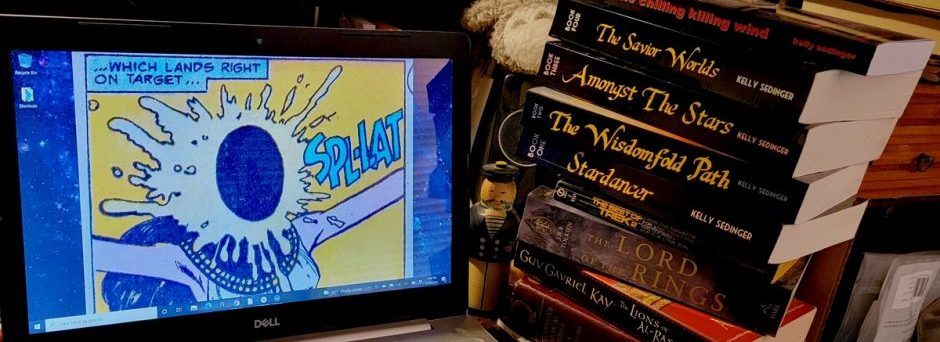
Last night, as SnowRagnarok descended upon the part of Buffalo Niagara in which Casa Jaquandor stands, I tweeted the following:


And a bunch of people I know got the reference. That’s awesome!

BTW, here’s what it looks like outside right now:


Right now there are police-enforced driving bans in a number of towns here, including the one in which I live AND the one into which I drive to go to work. So, here I sit!

Share This Post

Sentential Links

Links!

:: But I’ve had a great year of reading, and a whole new routine surrounding bedtime (I’m like an infant, having to be put into a routine), and cutting down on Internet/phone time, all of that, and so I just started picking up books, books I own but haven’t read yet. I read before bed now, for an hour, sometimes two, and it’s become a cherished part of my routine. I’ve had a lot of fun reading this year.

:: Art does not justify being an asshole to others.

:: When people ask about one’s best physical feature, I have no idea what mine is. But I surely know my worst ones: my feet.

:: I have big writing goals and I have big reading goals.

:: There is a widespread belief that you will be good at the things you enjoy and not good at the things you don’t enjoy. I am living proof that this is not true.

:: I cannot afford to go off the map.

:: Is it okay to write utter garbage sometimes? How do you get through those lapses in inspiration and motivation? (Remember: The only way out is through. Maintain a straight line, and you’ll come out sometime.)

:: A genuinely strong female character should have these five qualities: (Hmmmm. I’m filing these away for future reference, for obvious reasons.)

More next week!

Share This Post

Sunday Burst of Weird and Awesome

Oddities and Awesome abound! Only not so much this week, as I wasn’t online much. But here’s one of those things that’ll make you feel old, if you’re of a certain mindset.

When I was nine, there was a teevee show called The Greatest American Hero. In this show, aliens come down and give a schoolteacher a suit like a Superman or Captain Marvel get-up, which gives him superpowers. (Only when wearing the suit.) However, he loses the instructions, and thus our hero is unable to use the suit to its full potential. For instance, when he flies, he doesn’t do so in a Christopher Reeve-like graceful straight line or in elegant swoops as he woos Margot Kidder. No, he caroms about, flailing his arms and crashing into stuff. Fun show, if you were 9 in 1980. As I was.

Anyhow, the show had a theme song that’s pretty familiar to anyone from that time period:


Greatest American Hero went off the air in 1983, and that was that, although you’d still hear the song once in a while, and it later turned up in, among other places, as a parody in an episode of Seinfeld, wherein George Costanza used the song with his own lyrics as his answering machine’s outgoing message.


Now. As I said, Greatest American Hero last aired on February 3, 1983. This episode of Seinfeld aired Fabruary 13, 1997 — a little over fourteen years after Hero ended. And next month, it’ll be seventeen years since the Seinfeld episode aired! There’s something interesting about a pop-culture reference being almost two decades old, especially when the thing the reference was referring was more than a decade passed at the time it was made.

Anyway….

Share This Post

Symphony Saturday

Here’s something new I think I’ll try doing: a weekly exploration of the world of the symphony.

In discussions of music I’ve had through the years, one topic that comes up a lot within classical afficionadoes is just what classifies a work as a “symphony” anyway. It’s generally thought of as a large-scale work for full orchestra — but then, there are symphonies for chamber orchestra, symphonies for winds, and the like. It’s generally thought of as a work in four movements — but then, you have symphonies by Sibelius with one movement, symphonies by Berlioz with five, a symphony by Schubert with two, and…so on and so on. It’s thought that the first movement of a symphony is supposed to follow the general requirements of “sonata-allegro” form, a requirement that is almost completely ignored by a bunch of symphonies I can name off the top of my head.

Some symphonies can be heard in their entirety in the time it takes me to shower. Others, though, last longer than half the time it takes to roast your Thanksgiving turkey. Symphonies are large-scale orchestral works — except for the ones that add chorus, or voices, or soloists. I had a guy complain once on one of the film music boards I frequented years ago that Howard Shore’s “Lord of the Rings Symphony” — the two-hour long program Shore arranged of his LOTR scores after the third film came out, which was performed all over the country — “isn’t a real symphony”. When I asked why, out came all the objections above, which I then followed with every counterexample I knew.

Point is, the “symphony”, as a concept, seems as flexible and changeable as the “poem” or “novel”. Ultimately, if the composer calls it a symphony, then, well, it’s a symphony. Artistic nomenclature doesn’t work like biological classification, no matter how much we all might wish it did. Just ask any fantasy or science fiction fans to define the genres, and you’ll see what I mean.

So anyway, we’ll start with one of the short ones, from fairly early on in the period when the “symphony” started to settle into something of a regular form. This is the Symphony No. 25 by Mozart, in G minor. It’s one of only two symphonies he wrote in a minor key (the other being the magnificent No. 40, also in G minor). Mozart was only 17 years old when he wrote this work, which is famous for its opening bars (used as opening credits music for the film Amadeus), but is also loaded with typical Mozartean confidence, charm, and his restrained but very clear drama.

Here we have a typical four-movement structure, with the opening movement in sonata-allegro form, followed by a slow movement, a minuet movement, and closing out with a forceful allegro finale. It’s as good a starting point to the world of the symphony as I can think of. To my ears, this work always sounds surprising and fresh, no matter how many times I hear it; those opening syncopations and Mozart’s way of alternating between moments of high drama and lingering lyricism always captivate. Enjoy!


Next Saturday we’ll flash forward in Mozart’s life to the very end.

Share This Post

Suck it, LouisCK!

So, last week The Wife and I took a chunk of the money we received for Christmas and got smartphones. So now I can look as smug as anybody else who’s got a smartphone. In fact, I’m gonna look smug with my new smartphone right now!


Yup, that’s some smartphone, all right! I’ll bet it’s way nicer than your smartphone. Now I’m connected all the time, man! Hooray!!

And yet I can’t help thinking that something’s missing from my life…something real…like I’ve taken a step away from what really matters in life….

Nah.

Fact is, I love this thing. It’s awesome. I don’t want to be without this thing, ever.

Nah, that’s overstating the other way.

Look, it’s a phone. It’s a tool, and it’s easy to use and fun. I can’t believe how many things it does. I know, this won’t be all that shocking to anyone who’s been on the smartphone bandwagon for years, but the idea of all this online content being as available as it is just stuns me. I love having such easy access to e-mail, Twitter, Facebook, and everything else. It’s just cool. And the camera on this phone rocks. Instagram is a blast, and it’s so easy with this phone — easier, by several orders of magnitude, than my old combination of regular phone-and-tablet.

This isn’t to say that I’m on the phone more than I was before. I don’t take it to bed, and I don’t look at it for long periods when I’m at work. As many things as it can do, I have a very hard time ever seeing a phone as any kind of writing tool. I like using it to play music — the other day I listened to it for hours, during a long job at The Store — but the computer will remain my primary music tool.

Oddly, I received my first call on the phone eight days after we got them, which I find amusing — it’s funny that we’ve created these devices so that we don’t have to take calls on a thing that’s corded to the wall, and in the course of refining these gizmos, we have so advanced the technology that the very primacy of the phone call concept has fallen on hard times. When I got that call — it was The Wife — I actually had to stare at my new phone for a few seconds, as I tried to figure out how to answer the call.

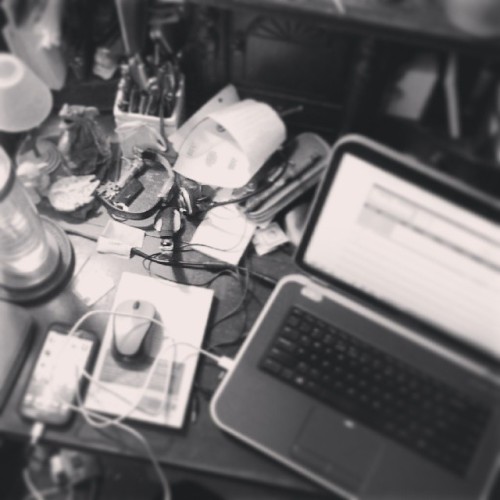
Some people pull out their phones to check the time, which is farther than I expect I will ever go in my adoption of the phone for all things informational. Proof? Well, here’s the other major piece of tech I got for Christmas:


And for really old-school tech, you can’t go wrong here:


Yup: an enameled cast-iron Dutch oven. To the cookbooks, Batman!

Share This Post

Something for Thursday

Happy New Year, folks, and welcome to 2014! It’s weird how, the farther I get into the future, the more looking back at the past I end up doing…but that’s a thought for another day.

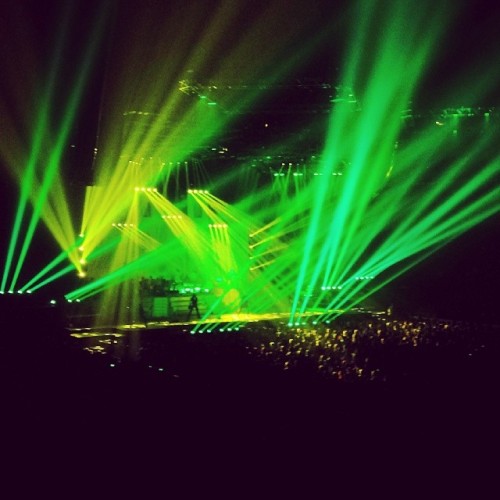
Here’s a piece I had never heard before until the other night, when WNED played it during our drive home from the Trans Siberian Orchestra concert. (Yes, we went, and yes, we loved it. What’s not to love? It’s a glam metal, hair-band Christmas concert with lasers and guitars and fire and stuff. Part of me is still a thirteen-year-old kid rocking out to Van Halen, and that part of me is a happy, happy camper today.)

Giacomo Puccini is primarily thought of as a composer of operas, and rightly so, as his operas are some of the most beloved works of that genre. But he also wrote this short string quartet, called “Chrysanthemums”, apparently in a single night as tribute for the passing of a local nobleman of his day. It’s an illuminating piece to hear from a composer almost exclusively remembered for his hugely lyrical and dramatic works for the opera stage — this came from the same pen that wrote “Nessun Dorma”. There’s always more to us than we know!

Here is the “Chrysanthemums” quartet by Puccini.

Share This Post