

Name your “White Whale” book: that book that has defied your multiple attempts to read it all the way through, but which you keep attempting anyway.
Killing the Darlings
“In writing, you must kill your darlings.” –William Faulkner
So, I’ve been making progress on the first phase of editing on Princesses In SPACE!!! The Sequel to Get Equal (not the actual title). It’s going to be tough making my goal of having a second draft ready to go by the Super Bowl, but you never know. I took this photo the other day to show how the manuscript is coming:
The pages on the right are the ones I haven’t marked up yet; as of this writing I have less than 100 pages to go. And on Instagram, fellow writer Anya Monroe asked about my general editing process, so here’s what I do:
1. Finish the first draft. I’m not kidding, but this is part of the process. I do very little editing along the way. In general, I will only go back and make a change if it’s for a structural reason in the story itself. Examples include realizing that I’ve made a Huge Mistake and have literally gone off the rails, or it might be that I’ve just had a really nifty plot twist pop into my head, which I can’t resist — but then, I have to go back and add something to set it up. If I’m going to suddenly have a gun go off late in the book, I have to put it on the mantelpiece early on. Other than that, however, I never edit as I go.
But, as I finish, I will generally have a few ideas as to what needs to be fixed or changed already. These I will write down in a notepad or in my journal, and then I print the manuscript out and…do nothing with it for at least three months, if not more.
The “fallow” period is key to me. I have to get distance from the story and the universe, freshen my gaze, and let it roll about my subconscious while I switch gears and do something else. In this case, I wrote GhostCop‘s first draft and started working on Lighthouse Boy‘s first draft.
2. At the appointed time, I get out the manuscript and start reading it. This I do with the following at hand: several red pens, my note-pad, and post-it notes. As I go, I make markings in the book with the red pen:
What am I marking up? Awkward wording, for one thing. Redundant wording — this happens a lot in my writing; I’m not sure why, but I find that I very often say the same things over and over again, as if I’m afraid the readers won’t get it without the repetition (or, maybe when I write the passage, I can’t remember that I said the same thing the day before). Anyway, I’ve noticed that I really get repetitive at times.
I look for opportunities to tighten my prose. I’m never going to be Hemingway, mind you — this particular book I’m working on is over 180,000 words in its first draft — but I’m looking to cut it down to at least 160K words, if not fewer. Will I get there? I don’t know, but we’ll see.
I also look for bad dialog, or places where the pacing could be improved, or where things are just off. Just the other day I cut out a passage that seemed like a good idea when I wrote it, but now bugs the living hell out of me. I had one of my characters lash out at someone she loves in a moment of stress, and while it made sense to do that when I wrote it, reading it now, I just found myself thinking, “Wow, she’s being a whiny turd right there.”
This brings me to the quote with which I open this post, the famous advice to writers that they must “Kill their darlings”. The idea is that all writers produce prose that they love but doesn’t really serve the book or story, and these such passages must be stricken from the record, no matter how much the author loves them. Oddly, though…well, maybe it sounds arrogant, but I rather like my darlings, which is why they’re my darlings in the first place. So what do I do? I go through the book and kill everything that is not a darling. I kill the ugly and the troll-like; I strike out the annoying and the repetitive. Basically, I do what Stephen King suggests and remove everything from the story that is not the story.
Or, at least that’s what I try to do.
Oh, the post-it notes? Those are for if I need to add copy to any particular page, like rewrite an entire passage or stick in a line or something like that. It’s easier for me to write what I’m inserting on a post-it note and stick it on the page where it goes, with the word INSERT in the body of the page at the place where the new material is to be placed. I try to avoid adding material. I’m all about subtraction at this phase, but it does happen — and I know there’s a big one coming toward the end of the book, because I want the climactic action sequence to go a completely different way than what I had originally written.
3. At this point, hopefully I’ve got a decent book in hand! Then the book goes to beta-readers, who read it and tell me what works and what doesn’t. I always miss some awkward prose, or some other important stuff. For instance, I tend to be very light in my physical descriptions of characters, and make do with just a couple key things about them. But in the last book, one of my readers pointed out that I never gave any description of a particular character at all. Oops!
Anyway, once I have their feedback in hand, I go through the book again — on the computer this time, not red-penning the manuscript — and make changes that I hope strengthen things.
4. I’ve not gone past the last step yet, although I will with Princesses In SPACE!!! (not the actual title), as I start moving toward self-publication. I’ll make another run through the book, tightening it up even more and making any changes that are desperately called for. I don’t know yet if I’ll have to change anything to make that book line up more precisely with its forthcoming sequel, but I do have a list of backstory details to fix so everything agrees in the end.
5. And as in all things at Casa Jaquandor, the process is both enhanced and delayed by cats.
The cats don’t really help, actually. But they’re here, so, that’s that.
Share This Post
Sentential Links
Linkage….
:: After I explained it this way, my friend said, “So, it’s just like life.”
Yes.
Definitely.
:: Faith is strong in the hearts of men,
who depend on the weak to make them strong.
More next week!
Share This Post
Sunday Burst of Weird and Awesome
Oddities and Awesome abound!
:: I’ve probably shared this before, but it made the rounds of Facebook again, so here’s what might be the most jaw-dropping walk up a hill in the entire world.

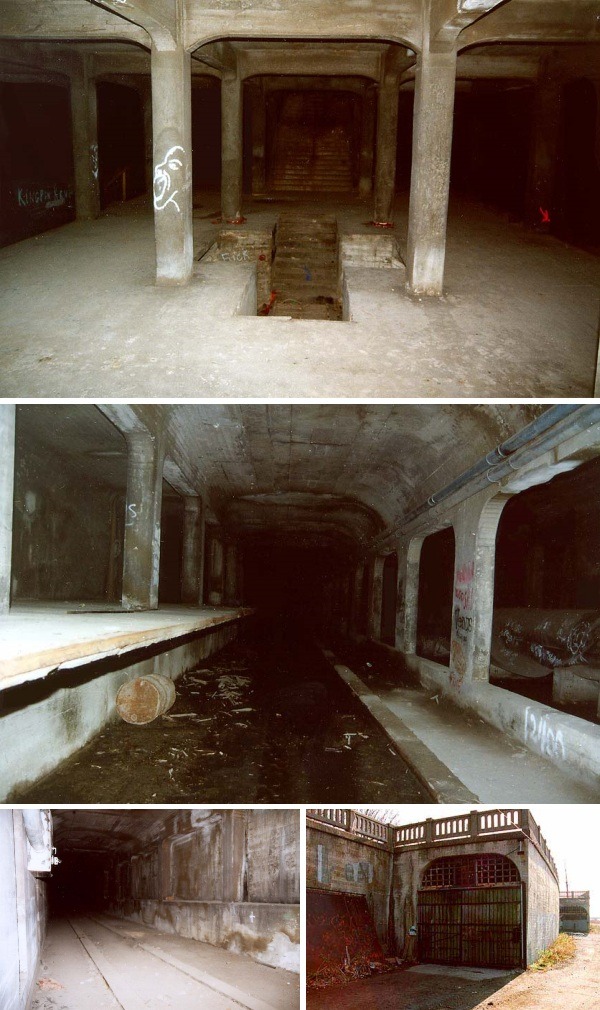
:: Abandoned subway infrastructure in Cincinnati.
:: And, via Facebook, the best photo on the entire Internet.

More next week!
Share This Post
Symphony Saturday: Mozart
Last week’s inaugural Symphony Saturday post featured one of Mozart’s youthful works. This week, we turn to what might be his greatest symphony, the Symphony No. 41 in C Major, K 551. Mozart died just three years after completing this work. Mozart’s death at the age of 35 is, perhaps, a canonical example of an artist dying young, but while the world was surely deprived many amazing works that went uncomposed after his passing, it surely cannot be said that Mozart did not fulfill his staggering potential. Indeed, the artistic heights he achieved in his last few years on Earth were so lofty that one wonders how he could possibly have continued growing had he lived.
The Symphony No. 41, sometimes subtitled the “Jupiter” symphony (a title not given the work by Mozart), is Mozart’s longest symphony, and technically, his most perfect. There isn’t a single note out of place in this entire work, and the whole thing builds so amazingly toward that great final movement, a wonderful classical fugue. Whenever I hear this symphony, I wonder, where could Mozart have possibly gone as an artist after this?
Here’s the symphony. Enjoy!
Share This Post
Instaweek
Something for Thursday (The “Oh yeah, it’s Thursday!” edition)
A Random Wednesday Conversation Starter
Wow

That is all….
Share This Post
That’s funny…he NEVER asks for a second cup at home….
I was in a brief conversation yesterday pertaining to coffee-brewing methods. It started when one friend indicated that he’d just witnessed a guy spend fifteen minutes making “pourover” coffee, which struck him as excessive. Well, I make pourover coffee here at home, and I can say…yes, fifteen minutes is excessive.
I’ve pretty much stopped using my drip maker for my own coffee, because after doing a lot of reading about coffee, I’ve learned that drip machines, with very few exceptions, simply don’t get the water quite hot enough to really extract the coffee. You need water that’s just off the boil, about 200 degrees, so I’ve adopted two main methods of brewing: the French press and the pourover.
The pourover method is actually the same thing your drip machine does, only it’s all done manually. You put a filter into a holder, measure your ground coffee (freshly-ground, mind you!) into the filter, and then pour the water through it. The water drips through into the receptacle below. When I make pourover coffee, here are the steps I use:
1. Fill kettle and put on stove to boil. (I’m told that if you use an electric kettle instead of the stove, the water boils a lot more quickly.)
2. While water heats, measure out and grind beans.
3. Transfer beans to filter in pourover brew basket.
4. When water boils, lift kettle from stove, hold aside for ten to fifteen seconds, and then slowly pour the water over the grounds, filling the brew basket.
5. When all the water has dripped through, repeat if necessary.
That’s it. The whole process, if I’m taking my time and not acting with any urgency, might take ten minutes. It certainly doesn’t take any longer to do the ritual needed to get the drip machine going, and I get better coffee for the bargain.
Here’s what the process looks like:
Now, that basket is a Melitta doohickey that I got for less than ten bucks, and the filters are standard #2 cone filters. It’s utilitarian and it works just fine. However, my friend on Twitter mentioned that the guy he watched used a Chemex pourover system, which is the Cadillac of pourover coffee. It looks like this:
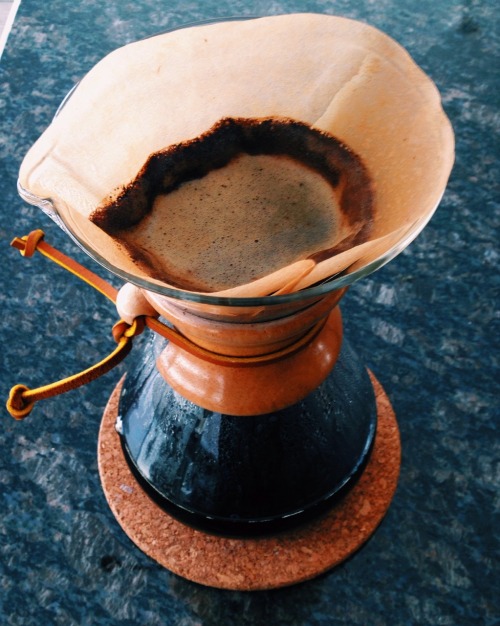
Yes, that looks nifty. And if I had more money than I do, maybe I’d have one on the basis that they look pretty cool. But – and I say this never having actually tasted coffee brewed in the Chemex pot – I am perfectly satisfied with the flavor of the coffee that results from my cheap gizmo. I have a suspicion that my friend’s coworker isn’t just about having quality coffee, but about being seen executing the process using Chemex smallware.
The other brewing method I use a lot is my French press. This is more familiar-looking, even if most folks likely don’t use one of these, either. You put your measured grounds at the bottom of the carafe, pour in the proper amount of water, stir, and then wait a few minutes. After the few minutes (about four) you slowly push down the plunger, clearing the grounds out of the way and then you pour off the coffee. When I use the French press, I pour my resulting coffee into a thermal carafe for hotkeeping.
What’s the difference, taste-wise? Well, the French press method leaves a lot more of the oils and particulates in the coffee than does the pourover method, so for me, the result isn’t very different in taste but fairly different in terms of mouth feel. French press coffee has a thicker feel, more “body” to it. I was a bit gun-shy about the French press at first, because I wondered if the coffee would lose a lot of heat just sitting there in a glass carafe for four minutes as it steeped, but it turns out that it really stays hot for that period of time. I suppose four minutes isn’t long enough for four cups of water to lost that much heat once they’ve been brought up to a boil and I further suppose that the inch-thick layer of coffee grounds that forms up top provides some insulation against heat loss out the top of the pot.
(By the way, if you try a French press for the first time, when you press the plunger down — press slowly. Some interesting things happen with water pressure as you push that thing down, and it can get a bit explosive if you push too quickly!)
Now, I will admit that there is one area of the whole procedure where I obstinately refuse to do things in any more of a complicated way. That’s in the grinding of the beans. I still use a cheap, $20 blade-style grinder. I’ve been told my numerous folks whose food tastes I trust that blade grinders are awful and that you really really really have to use a burr-style grinder so as to get the uniform size of grounds that result in optimal coffee. And maybe that’s even so, but I just have no desire to spend over $100 on a single-task machine for grinding coffee beans. On this point my sense of economy will go no farther! (Plus, our tiny-arsed kitchen simply does not have counter space for such an item.)
I’ve also heard that tossing a pinch of kosher salt into the grounds before brewing removes some of the bitterness, but…I dunno. I’ve tried it, but I really couldn’t detect a significant enough difference to do that on a regular basis.
And there you have it: more than you wanted to know about how I make coffee!