
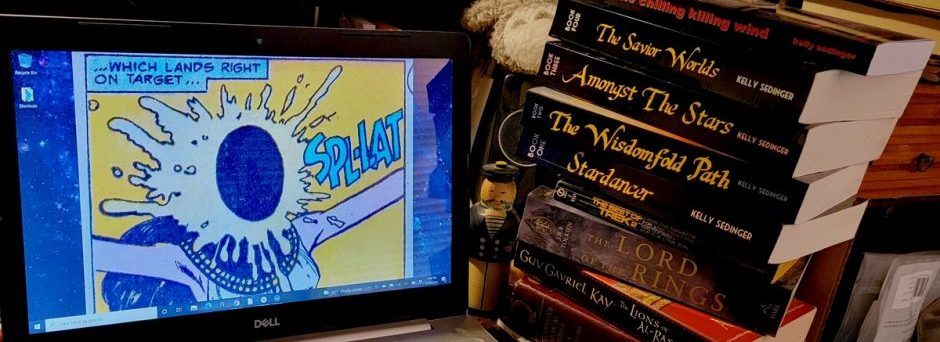
One Day More!!!
LOOK HOW SOON THIS IS, PEOPLE
Nobody Did It Better: Thank You, Sir Roger Moore
Sir Roger Moore has died.
I’ve loved all the James Bonds, to be honest. My favorite is George Lazenby, but I appreciate each and every actor who has played the part. There is a special place in my heart for Roger Moore, though, because he was my first Bond, and you don’t forget your first. That initial Bond experience for me was Moonraker in 1979, and I’ve been a James Bond fan ever since.
Here’s Moore as I first saw him:
Oddly, Moore’s first film as Bond is the Bond film I like the least — in fact, I dislike Live and Let Die so much that to this day I do not own a copy of it, and I don’t think I ever have. This isn’t Moore’s fault, though. He’s actually very good in the movie, and my distaste for it is based on other complaints. Moore’s reputation as Bond is unfortunately skewed: many see him more as a comic figure, when the Bond films had a lot more broadly comedic moments than in the Connery (or Lazenby) years. (Witness Jaws flapping his arms after his ripcord breaks in the clip above.) It always struck me as unfair to blame Moore for faults in the writing of the scripts, to be honest, and the Bond films of the 70s were all written with that kind of broad comedy that often bordered on outright slapstick. This started with Sean Connery’s last turn in the role, Diamonds are Forever, and didn’t end until 1981’s For Your Eyes Only toned things down significantly. That film and its successor, Octopussy, are two of my absolute favorites, and I even have a soft spot for the troublesome A View to a Kill, which starts trending to over-the-top comedy again.
Witness this clip from For Your Eyes Only, when Moore’s Bond gets the drop on a vicious hit-man who has been dogging him throughout the film:
That is as lethal a moment as anything that Connery’s Bond ever did, and it’s worth noting that no matter who plays him, James Bond is rarely that cold. But Moore could play it.
Moore’s Bond was an enormous part of my geek childhood, and I wouldn’t be a Bond fan if not for his work. So thank you, Sir Roger Moore, for your wonderful work, and I hope there are some wonderful ladies and nifty Q gadgets awaiting you!
Share This Post
Tone Poem Tuesday
I’ve featured this before, of course, because Alexander Borodin is a relatively newly-discovered favorite composer of mine. But I find myself returning to this work often, not only because of its beauty but because of its depiction of two groups of people, traveling opposite directions on the same road, meeting each other and spending a bit of time before departing again as peacefully as they met.
Borodin described the work thusly:
In the silence of the monotonous steppes of Central Asia is heard the unfamiliar sound of a peaceful Russian song. From the distance we hear the approach of horses and camels and the bizarre and melancholy notes of an oriental melody. A caravan approaches, escorted by Russian soldiers, and continues safely on its way through the immense desert. It disappears slowly. The notes of the Russian and Asiatic melodies join in a common harmony, which dies away as the caravan disappears in the distance.
Here is In the Steppes of Central Asia.
Share This Post
EVEN SOONER
Mere days now!
SOON
Symphony Saturday
Sir Arthur Sullivan has a hallowed place in the history of classical music for his work in setting the librettos of W.S. Gilbert to music, resulting in the enduring operettas of Gilbert and Sullivan, which are probably the greatest musical achievement of Victorian England. Sullivan didn’t just write operettas, however. He was a prolific composer who wrote a number of operas, oratorios, various orchestral works, and this single symphony, which he considered titling “the Irish Symphony”. He didn’t officially choose that title, and in fact it didn’t end up being attached to the work on a de facto basis until after his passing.
The symphony is a youthful work and as such it is uneven and in places clearly inspired by Sullivan’s musical models — in this case, Mendelssohn and Schumann. Nevertheless, the piece is an engaging listen. I’m not familiar enough with Sullivan’s more mature work to know if and where you can hear in his Symphony hints of what is to come later on when he writes, say, The Mikado or Iolanthe, but Sullivan’s Symphony is a pleasantly typical Romatic-era symphony, with some moments of pleasing lyricism — particularly in the opening, when a portentous opening in the low brass yields to an almost ethereal chord in the strings.
Here is Sir Arthur Sullivan’s Symphony in E Major, the “Irish”.
Share This Post
AMONGST THE STARS, chapter three
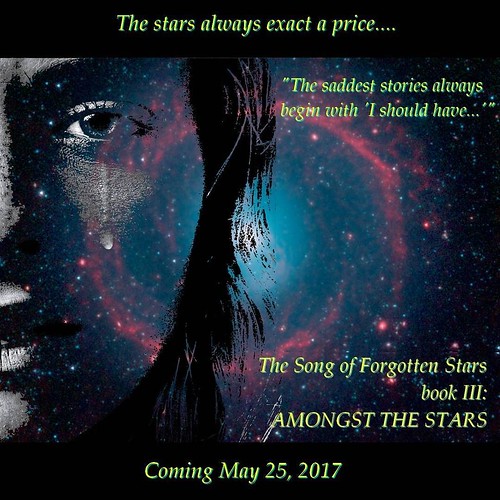
And here we are with the final of the teaser chapters for Amongst the Stars! The book launches on May 25, in paperback first and then with the ebook to come a few weeks later. Here, the plot starts to thicken….
(And did you read chapters 1 and 2? If not, what are you waiting for!)
Continue reading “AMONGST THE STARS, chapter three”