
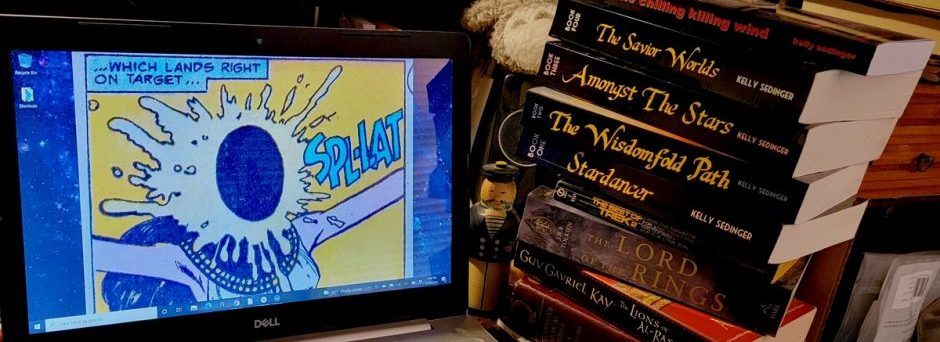
I’m seeing this movie tonight on the big screen…so here are a couple of selections from that oh-so-wonderful camp classic, Flash Gordon!!!
Twenty Years















Tone Poem Tuesday
Max Bruch’s Scottish Fantasy exists somewhere in the space between tone poem and concerto, with its prominent and technical part for solo violin. It’s not a concerto, however; its structure more casts it as a fantasy on a number of Scottish folk tunes. Bruch was a prolific composer in the Brahmsian tradition, although not much of his music is heard today. His Violin Concerto is a mainstay in the repertoire, and the Scottish Fantasy has not disappeared either. The nature of the work puts me in mind of Berlioz’s great symphony Harold in Italy.
Share This Post
In other news….
Two developments:
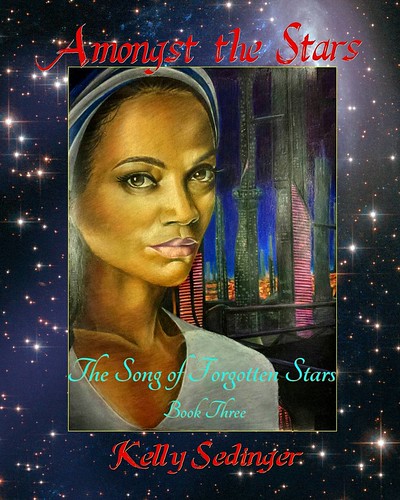
:: Amongst the Stars: The Song of Forgotten Stars Book III will be available on May 25! As is my usual practice, the book will be in paperback first with e-books to follow a couple of weeks later. And I am planning to start selling signed copies of all my books through ForgottenStars.net!
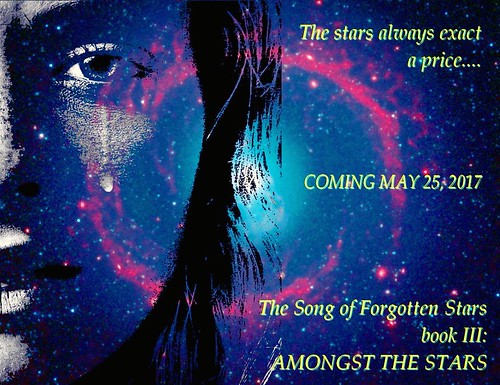
Front cover:
Back cover copy:
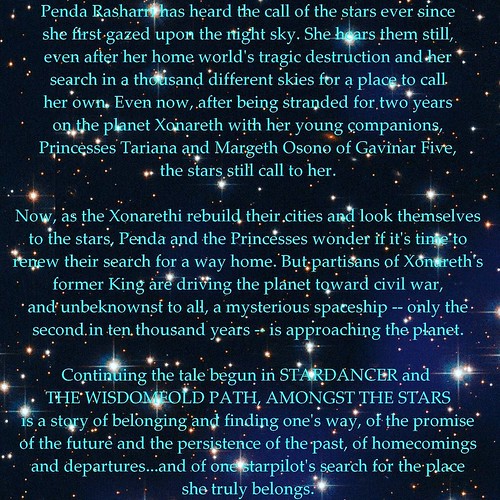
I’ve already posted the first two chapters to ForgottenStars.net, and there will be a third chapter up later this week, probably Thursday.
:: The jury is still out on this particular development on the home front. I’m sure we’ll get it all figured out, but for now, things are a bit of a whirlwind at Casa Jaquandor.
Meet the source of the whirlwind: Carla, aka Dee-oh-gee 2.0.


So there we are.
Share This Post
Symphony Saturday
I seem to recall once owning a set of Franz Berwald’s symphonies. They made no impression on me whatsoever in the occasions I tried listening to them, and I’m not even sure if I still own the CDs. I’m not even sure what led me to listen to him again now, in 2017, but I did, and I’m glad I did so.
Berwald is a virtually canonical example of an artist whose work was obscure in his lifetime to the point of being almost completely ignored. Berwald, a Swede who lived from 1796 to 1868 — a decently long life in that time — couldn’t even earn a living as a musician, instead making his way as a surgeon and then as a factory manager. Of his four symphonies, only the first was played during his lifetime. He didn’t toil in complete obscurity; he had a few champions here and there, but virtually none in his own homeland.
His four symphonies certainly don’t deserve their obscurity, and one wonders just why they were so roundly disregarded during his lifetime. They are not massive works, nor do they place undue demands on the performers; their harmonic language is interesting but would surely not have been unlistenable in a musical climate that was trending toward Tristan. The world of art is a capricious one, and it is hard to escape the notion that what separates those who achieve recognition and those who do not is some celestial roll of the dice. (Enduring legacy? That’s another matter entirely.)
I present two of Berwald’s symphonies here: the Third in C major, titled “Sinfonie singulaire”, and the Fourth in E-flat major, called “Sinfonie naive”. Both symphonies abound with life and rustic nature, and it’s even tempting to hear — since Berwald was Swedish, after all — tantalizing hints of what would come decades later when Sibelius or Nielsen.
Here are the Third and Fourth symphonies of Franz Berwald.
Next week…I’m not sure. I want to do some more homework before I start in on Mahler.
Share This Post
Bad Joke Friday

AMONGST THE STARS, chapter two
Did you read Chapter One? If not, you’d better!
(Come to that, did you read STARDANCER and THE WISDOMFOLD PATH? Because if not, well, come on, folks!)
Chapter Two below the fold!
Continue reading “AMONGST THE STARS, chapter two”
Share This Post
Something for Thursday
It seems odd to me that one of the greatest Hollywood film composers, Jerry Goldsmith, had to wait until thirteen years after he died to get a star on the Walk of Fame, but there it is.
Here is some Goldsmith, who is almost always worth hearing.
Share This Post
Tone Poem Tuesday
Here is an oddity of sorts. I can’t really say much about it, because I have found almost no information whatsoever about it online. It is a symphonic poem called Visions, by Jules Massenet. Massenet was a French Romantic who is best known for his operas, and for the “Meditation from Thais“, which is one of the most famous solo violin works in all of classical music and a staple on “Music for a peaceful mood” compilations. Massenet was a gifted melodist whose work tends to exhibit high craftsmanship. Debussy eulogized Massenet thusly:
He was the most genuinely loved of all our contemporary musicians. His colleagues never forgave him for having such a power to please; it really was a gift. Massenet realized he could better express his genius if pastel tints and whispered melodies in works composed of lightness itself.
Visions is a late work in Massenet’s life, and it was never published. How it saw the light of day, I have no idea; nor do I have any information about its composition or its inspiration. All I have here is, quite literally, the music, which is meditative and playful and ultimately dreamlike, with an offstage solo violin and an offstage soprano. It’s a highly meditative work that seems a cross between Romanticism and Impressionism, or between the symphonic language of Europe in the 1800s and the glass-like textures of Ralph Vaughan Williams to come. There is something compelling about this piece, which I found simply by doing a YouTube search for “Jules Massenet”. I ended up listening to it three times in succession as I worked.