The Polar Express is rather a polarizing movie, mostly because of the style of animation Robert Zemeckis used in making it. The landscapes and a whole lot of the film’s compositions are frankly gorgeous, and the story is (for me, anyway) fun, fleshing out what is a classic picture book in which not a whole lot happens. (This is not a criticism of the book, by the way! It’s a picture book that’s about 30 pages long, and the main attraction there is the amazing art.)
What turns people off Polar Express seems to be one big factor, but it’s not one you can really escape if it does bother you: the characters’ eyes, which in this style of digital-capture animation tend to look…glassy, lifeless, dead. The eyes look unblinking and like what you’d see in a doll. This never impedes my enjoyment of the movie, but I can’t argue with people who react strongly against the movie on that basis, either.
And all of that has nothing to do with the music, which is wonderful and amazing. This is one of the best scores Alan Silvestri has written, and for me it’s absolutely a Christmas classic. Silvestri blends engaging action music with quotes of traditional material and his own gorgeously sweeping melody that’s all about the magic of this time of year.
It’s almost here! Can you still hear the ringing of that bell?
Beethoven’s Symphony No 7 in A Major, op. 92, isn’t just one of Beethoven’s personal greatest works. It’s one of the greatest works of music ever composed, and its stature is such that it even rises beyond the history of music and into the history of art. Beethoven’s Seventh is in the same rarefied air as Michelengelo’s Sistine Chapel, Da Vinci’s The Last Supper, Wagner’s Ring Cycle, the Tale of Genji, the terra cotta warriors of China, Hamlet, and…you get the idea. When we engage with the Seventh Symphony, we’re engaging with one of the great works of human art.
But for today, let’s set aside the superlatives. I’m not really the best person to talk about the how and why of what makes this symphony so great, beyond its near perfection in its proportions, its emotional sweep from the sunny optimism of the first movement to the soul-rending meditation of the second, or the way the work culminates in a movement that has been described as “the apotheosis of the dance”. Instead, let’s try to hear the Seventh as it might well have sounded to those hearing it for the first time.
Though his hearing loss was progressing inexorably in December of 1813, Beethoven was still able to perform and conduct at this point in his life, although not for very much longer. Beethoven himself led the orchestra in the very first performance of the Seventh Symphony at a charity concert for victims of the Napoleonic Wars. (The same concert would also see the premiere of Beethoven’s strange potboiler, Wellington’s Victory.) The Seventh was an acclaimed success right from the very first hearing, and it has always been a beloved work, often showing up near or at the very top of lists of Beethoven’s greatest works. For me, I for many years ranked it second, just behind the monumental Ninth Symphony–but in recent years, I have reversed that view.
Over the last few decades, trends in classical music performance have led away from the kinds of excesses that were normal in the middle of the 20th century as orchestras have reduced their sizes and striven to perform works in something resembling the kind of air and style of their times. Some have gone even farther with this, though, leading to the rise of “period instrument” ensembles. These groups perform on instruments either directly dating to the Baroque or Classical periods, or on instruments carefully made to those standards. Strings instruments with strings made of genuine materials, flutes of wood instead of brass, trumpets with no valves, and even percussion instruments with heads and mallets made the same way they would have been made in the 1700s or 1800s.
It’s not just about the instruments themselves, either. It’s in the way they are played. Vibrato in the strings is greatly reduced, percussion sounds sharper, and the woodwinds often more piercing. The conductors, too, adhere as much as they can to the standards of music when it was composed. Tempi are often faster, and interpretive flashes tend to be kept to a minimum. All of this is in an effort to present as authentic to the music’s time a performance as possible. Of course, since recordings didn’t exist, all of this hinges on our knowledge of the instruments themselves and on our knowledge of performance standards of the time, based on writings left by people in attendance back then: accounts of concerts, pedagogical materials, and so on.
The ensemble in the performance of the Seventh Symphony below is the Orchestra Revolutionnaire et Romantique, founded in 1989 by conductor John Eliot Gardiner (who also conducts this performance). This recording is part of a cycle of Beethoven’s nine symphonies, which I happen to own on compact disc someplace in the archives. Gardiner and his orchestra are among the leading performing groups in the historically-informed performance movement, and I love his Beethoven cycle a great deal. Some listeners avoid historically-informed performance (which I’ve just now, as I researched this piece, is the preferred term now for “period performance”!) because they may expect a rather clinical and unemotional, and thus unmoving, approach to the music-making.
But look! If it’s true that Gardiner and the ORR have, in fact, managed to reproduce Beethoven’s Symphony No. 7 in something approaching what those first audiences heard…well, how could that possibly be clinical or unmoving? The Seventh was, as I have indicated, virtually beloved from its first hearing. Beethoven knew what he was doing, after all. Great music can’t be suppressed entirely, and it certainly isn’t suppressed here. Instead, it shines.
Here is the Symphony No. 7 in A Major, op 92, by Beethoven, performed by John Eliot Gardiner conducting the Orchestra Revolutionnaire et Romantique. Imagine hearing this in a concert hall in Vienna on December 8, 1813. Imagine hearing this along with musicians such as Louis Spohr, Johann Nepomuk Hummel, Giacomo Meyerbeer, and Antonio Salieri (who, in real life, had a long and successful career in music after the death of Mozart, whom he did not poison or manipulate into drinking himself to death as he composed a Requiem).
If I ever get my hands on Doc Brown’s Delorean, I will probably use it to travel back to the premieres of some of the great masterworks of music history, starting here.
Here’s an album I grew up with…or maybe it wasn’t quite this album, but it was certainly this guy singing. I most definitely remember this version of “We Three Kings”, but I don’t know if this is actually the original record or if this selection is a repackaging. Anyway, it’s the Christmas stylings of American tenor Mario Lanza.
This music is really a throwback to a style of operatic singing that isn’t much in vogue anymore. Born Alfredo Arnold Cocozza, and taking the name “Mario Lanza” as a stage name later on, Lanza started out as a classical tenor before his big voice and good looks carried him straight to Hollywood, where stardom beckoned. After World War II he ended up with MGM, where he made several films before various difficulties led to him being dismissed from MGM, spending a year as a recluse, returning to film but with less success, and finally to planning a return to the opera stage in 1959. By this time Lanza had a number of health problems owing to his weight and probably alcoholism, and he died in 1959 of an aneurysm.
His personal life seems to have been a mess, and his family didn’t really life happily ever after, either. His wife died of a drug overdose just months after he did; his son died of a heart attack when he was just 37 (younger than Lanza himself had been at his death), his daughter was killed when she was hit by a car while crossing a street, and his other son died in 2008 at just 55 years of age.
Setting aside the sadness of Mario Lanza’s life, his voice is something to hear. No, he’s not Pavarotti or Domingo, but he had a big and golden-sounding voice, and listening to this record now, I’m struck by his command of phrasing and his superb diction. He’s not just a big-voice, big-chested tenor belting out high C’s from the sky, and like many things I remember from my youth, I appreciate this sound a lot more now than I did then.
Do you have any musical items on your lifelong wish list? Something you’d be sad if you reached the end of your days and never got to hear? I do! I’d love to attend a performance of Tchaikovsky’s The Nutcracker, the full ballet, with full-on Russian choreography and a live orchestra (sometimes, in smaller venues, ballet companies perform to recorded music). Here is the Bolshoi in 2011, performing a wonderfully arresting version of the great ballet. This is some amazing stuff!
I had a music teacher in third and fourth grade, when I was going to an elementary school in Hillsboro, OR, who at one point taught us a song from an opera based on the old fairy tale of “Hansel and Gretel”, called, appropriately enough, Hansel und Gretel. The song is a cheery thing near the beginning of the story when Gretel is teaching Hansel a dance. I remember the teacher, Mrs. Sturdevant (I think that was her name), telling us about the opera that had been written a hundred years or so before, by a composer named “Englebert Humperdinck”. I hate to admit that this particular name had a predictable effect on a room full of nine-year-old children, and I seem to recall Mrs. Sturdevant being a bit irritated that we giggled.
Sorry, Mrs. Sturdevant.
Anyway, I actually bought a recording of Humperdinck’s opera many years ago. It was a pretty nifty CD box that in addition to the 3 CDs and the booklet containing notes and the libretto, also had a little jigsaw puzzle depicting a scene from the opera. There was a period when sometimes CD box sets would come with little things like that, especially if they were recordings of music that might appeal to young listeners. Humperdinck’s Hansel und Gretel is often considered a children’s opera, because it is not terribly long, it’s full of folk tunes and dances, and its story is loaded with magic and wonder and an evil witch who wants to back the kids in her oven. Hansel und Gretel has become something of a Christmastime staple, even though it doesn’t exactly have anything specifically to do with Christmas. I haven’t heard it more than once or twice and those many years ago, so I addressed that this weekend.
Hansel und Gretel is like Wagner-lite: the orchestration and the drama are pure Wagner (Humperdinck himself was a committed Wagnerian), as is a lot of the imagery in the show. But because the story is lighter and free of Wagner’s heavier tendencies, the opera is a pretty good bridge between the Wagner-parody of Carl Stalling’s work on the Loony Tunes shorts and, well, actual Wagner. As for the opera’s Christmas associations, there’s the story of two children who get into trouble, and the magic of a life-size gingerbread house; also, the opera was premiered very near Christmas in 1893. When you think about it, a lot of our Christmas trappings don’t really have anything to do with Christmas specifically. The Sound of Music song “My Favorite Things” is a good example.
Having freshly heard Hansel und Gretel, I certainly plan to make it a part of my annual listening from now on. The performance I’m featuring here is especially nifty, because it’s actually a film made out of the opera, with Sir Georg Solti conducting (and this type of repertoire was Solti’s wheelhouse, so it’s a treat on that score as well). Live action is combined with animation to create the requisite sense of magic, and the performances are thrilling throughout. This film was intended for television, and aired on PBS’s Great Performances in 1981–not long after Mrs. Sturdevant was dealing with a bunch of kids laughing at the name “Engelbert Humperdinck”.
If you have a spare hour and forty-five minutes, give this a listen! It really is something of a delight. And look at the screen once in a while, because there’s actually usually something neat going on.
And now we’re into the last seven days before Christmas. As tends to be my practice, the selections will get longer as we get close to Christmas, because we could all use more music!
This is an entire album by Chanticleer, a magnificent all-male vocal ensemble based in San Francisco. Originally founded to perform Renaissance music according to historical performance practice, the group has branched out over the years to recording other genres. But their main “bread and butter” remains their Renaissance work, and I always love listening to them. It gives me the feeling of walking through stone cathedrals on cold days and nights, illuminated by either sun streaming through stained glass windows or by candles in sconces casting too little light to keep the vaulted ceiling above me from vanishing into the shadows. It’s the music of spice and incense and torchlight, of colorful robes and fine doublets and, yes, a dagger tucked into one’s belt or boot.
The final track of this album, by the way, is not a Renaissance piece at all, but a composition by Franz Biebl, a twentieth century German composer who only died in 2001. While Franz Schubert’s setting of the Ave Maria is undoubtedly the most famous, for me Biebl’s is the more beautiful. I won’t claim it’s the most beautiful, since there are many settings I haven’t even heard, but the one here is truly magical. I’ve known it ever since the Wartburg College Choir sang it as part of our annual Christmas program, back in the day.
Here is Chanticleer, performing their entire album. A Chanticleer Christmas. The days are truly growing short now, so find what light you may!
Obviously I’ve known for years that Elvis Presley recorded a number of Christmas songs over the years, but I did not know that a bunch of his best-known ones spring from a single album called Elvis’s Christmas Album, and neither did I know that not only is this album one of the best-selling albums of all time, but it is also Elvis Presley’s only diamond-certified album. These are things I learned yesterday from a Facebook post by Sheila O’Malley, who gave me permission to reproduce it here, so here are her words. (If you’re going to inquire as to Sheila’s Elvis fandom credentials, well, to quote Captain America: “Son, just don’t.”)
Here’s Sheila:
“ ‘Santa Claus is coming down your chimney tonight’ sounds absolutely filthy when Elvis sings it. It might be his best blues vocal ever, with those beautiful stops that nobody could do but him.” — Tom Petty
When I was writing that Eminem piece this summer I went down the rabbit hole of “diamond” albums. There are less than 100 of them IIRC and it is a fascinating and sometimes bizarre list. Adele and Kenny G. Boyz II Men right next to ZZ Top. The Titanic soundtrack! Multiple Garth Brooks albums. MC Hammer. Hootie and Def Leppard. Em’s got 2 diamond albums on there – the Marshall Mathers LP and The Eminem Show. Usher. Carole King hand in hand with Biggie. Wikipedia has the full list – I came across a very funnily written ranked list of all 92 diamond albums (92 at the time – the piece is from 2016 – I’ll link it in the comments.
[AN INTERJECTION: Here’s the piece Sheila mentions, summing up the diamond albums up to 2016. It’s an interesting piece, especially since I had no idea some of these records were THAT huge: “Mellon Collie and the Infinite Sadness”? Really? I do remember that album being a big deal, and I even think I own a copy, but I had zero notion that it was that big a deal. Granted, the 1990s were not a period when I was terribly up to date on pop music, but you’d think I’d have heard that that album was doing THAT well.
I also find it slightly irritating that the writer disses the film score tracks from the “Lion King” soundtrack album. “Making you sit through four Hans Zimmer instrumentals in between the two sets (of songs or Elton John tracks) is pretty low,” he writes, which is exactly the kind of dismissive attitude to any kind of music other than what the reviewer prefers that I always find off-putting. It was, actually, this kind of thing that ultimately led to me canceling my ENTERTAINMENT WEEKLY subscription many moons ago, but that’s not especially relevant to this discussion. Back to Sheila! -Ed.]
Elvis’ 1957 Christmas album is diamond-certified. It wasn’t reviewed all that well at the time – but of course it sold millions and has gone on to be the best-selling Xmas album in the US as well as one of the best-selling albums – period – of all time. The album is a MONSTER. It was a monster THEN and it’s a monster NOW.
In other words: on a list featuring mostly contemporary people like Britney Spears, a Christmas album from 1957 is still going strong.
The album features traditional carols, Irving Berlin’s “White Christmas” (the story about him calling for EP’s version to be banned is … suspect, imo.), and “Here Comes Santa Claus” and of course “Blue Christmas” – the Christmas song always associated with him, with Millie Kirkham’s swoopy soprano in the background (his idea! Everyone else was like, “Uhm, are you sure you want her to do that through the whole song? It’s a bit much.” He loved it. He insisted. He was right. Near the end of her life, Kirkham gave an interview where she joked, “If I was gettin’ royalties, I’d be a rich old woman.”)
The B-side features religious songs like “O Little Town of Bethlehem” and “Silent Night”. Elvis incorporated gospel in his repertoire from the jump – a bold move for someone who was going where he was going. In his 3rd and final Ed Sullivan appearance in January 1957, where Ed Sullivan shook his hand and looked right into the camera saying, “This is a fine young man” – (which almost single-handedly calmed down the fervor of controversy around him) – Elvis sang “Peace in the Valley” – meanwhile, his “Baby Let’s Play House” – an ode to happily living in sin with your girlfriend – is a #1 hit – at the very same time. And his teenage fans didn’t reject the gospel. “Peace in the Valley” was released as a single at first – and it went to #1. They didn’t make enough albums to satisfy the demand – fans had to WAIT to get “Peace in the Valley.” That was his superpower at the time. When he sang “Peace in the Valley” on the Ed Sullivan show, and he sang it straight, filled with an earnest and simple faith – it created major cognitive dissonance in the “he’s an evil sexpot ruining our youth” crowd.
But the opener of the Christmas album, the first song on the album, is one of the raunchiest tracks in his entire raunchy repertoire – and that’s saying something! This is the ferocious and dirty “Santa Claus is Back in Town”, written by the great duo Jerry Leiber and Mike Stoller. Even to modern ears the song – or, what Elvis does with it – is so over-the-top dirty it still conceivably could be seen as shocking. (There are some good covers – not too many though, because why would you put yourself in the position of competing with the original. Dwight Yoakam’s is good! Totally different feel, but it SWINGS.)
The song starts with the Jordannaires quartet crooning sweetly, “Christmaaaaaas Christmaaaas Christmaasss” – there are little bells chiming behind them. Like it’s going to be a sweet little sleigh ride. This is a fake-out. It’s a trick. The Jordannaires say: “This is what you can expect from this song.” You feel safe. You reach for the hot cocoa and settle into your armchair by the fire.
And then Elvis arrives. You’ve had no time to prepare for him.
The way he sings “You be a real good little girl” is not just dirty, it’s debauched.
“Hang up your pretty stockings .. turn off the light … Santa Claus is coming … DOWN YOUR CHIMNEY TONIGHT.” (See Tom Petty’s comment above. You’re almost embarrassed by it, but it’s also so funny!)
And listen for his evil cackle during the bridge.
The fact that this is the first track … that Elvis didn’t bury it to appease the haters … that he included this track basically alongside “Silent Night” … represents an aspect of him that is still not wholly grasped. He LED with this. I still can’t get over it.
Elvis asked you to reconcile the boy who loves Jesus with the boy who cackles like a sexy demon during the bridge of “Santa Claus is Back”. Neither was an act.
Can the culture embrace such inclusion and inclusiveness? Can the culture accept the secular and the divine, simultaneously? We are so much more comfortable when only one thing is true at one time.
Elvis says, “Both are true. And I’m not the only one who feels that way. Deal with it.”
And here is the entire album, on a single YouTube video. I love a good long epic listen as much as anybody, but there is also something to be said for Elvis Presley creating this much magic in just a single 30 minute record.
In the wonderful movie Mr. Holland’s Opus, Richard Dreyfuss plays Mr. Holland, a classically-trained composer who needs to make ends meet so he gets a job as a high school music teacher and band director. He figures this will be an easy gig leaving him plenty of time to write his masterworks, and yet, very quickly he is buried by the difficulties of a job he never saw himself doing.
After a lot of teeth-gnashing and garment-rending over his complete inability to reach his students, he decides to change his approach. He sits down at the piano in front of his class, which is full of students who have come to view him with near disdain, and he says something like, “Who can tell me what this piece is?” and he starts to play. They all brighten up: “Lover’s Concerto!” they all say, and he smiles and says, “Wrong!” as he informs them that the piece is actually the Minuet in G by JS Bach.
Mr. Holland is making a larger point about the connecting tissue between the staid, almost cute, little minuet and the thrill of honky-tonk, but it’s also worth noting, for our purposes here, that pop musicians have made it a standard practice to not just write their own melodies, but to feel free to swipe melodies wholesale from the work of classical masters. Big-voiced ballad belters would be lost without “All By Myself”, which takes its tune from Rachmaninov’s Piano Concerto #2. The entire show Kismet wouldn’t even exist if it hadn’t been able to mine Alexander Borodin for its tunes (I knew the song “Stranger in Paradise” long before I knew the “Polovtsian Dances”).
And Billy Joel did the same thing in his song “This Night”, in which he cheerfully apprehends for his own purposes the melody from the second movement of Beethoven’s Piano Sonata no. 8 in C minor, the “Pathetique” (previously featured here). That melody is one of Beethoven’s finer ones, and the movement comes as a welcome lyrical respite after the storm of the sonata’s opening movement; the Joel song is…well, it’s a perfectly nice Billy Joel song, but it’s not exactly one of his better-known efforts, even despite the fine pedigree of its chorus. Maybe that’s even partly why? To me, the song loses a bit of authenticity by virtue of its melody putting me in the mood to turn off Joel and turn on Beethoven.
But it’s another indication of Ludwig van Beethoven’s long musical reach in the 250 years since his birth, isn’t it? Not even the “Piano Man” is immune.
One of my favorite Christmas carols is “The Wexford Carol”, which has that pre-Western harmony thing going on that gives it an air of mysterious beauty. Here it is, performed by Allison Krauss, Yo Yo Ma, and others. Just wonderful!
Music is the one incorporeal entrance into the higher world of knowledge which comprehends mankind but which mankind cannot comprehend.
–Ludwig van Beethoven
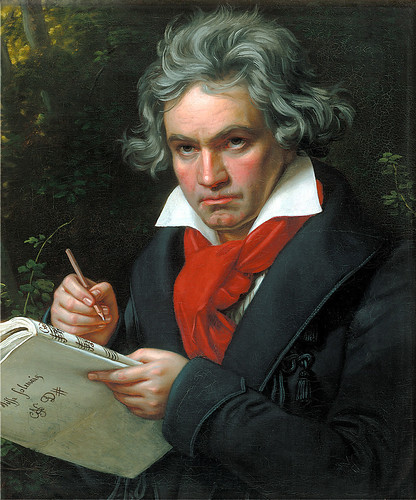
Two hundred fifty years ago today, Ludwig van Beethoven was likely born.
We don’t know if this is his actual birthdate. All we can surmise is that he was likely born on this date because he is known, by church records, to have been baptized on December 17, 1770, and it was common practice in his time for infants to be baptized the day after their birth.
I’m not done with Beethoven yet, not by a longshot! I’ll be celebrating his life and music for the rest of this month, right up until December 31. But for now, here are some things that others have written about him.
Harold Schonberg, from his book THE LIVES OF THE GREAT COMPOSERS:
The difference between Beethoven and all other musicians before him–aside from things like genius and unparalleled force–was that Beethoven looked upon himself as an artist. Where Mozart moved in the periphery of the aristocratic world, anxiously knocking but never really admitted, Beethoven, who was only fourteen years Mozart’s junior, kicked open the doors, stormed in, and made himself at home. He was an artist, a creator, and as such superior in his own mind to kings and nobles.
Edna St. Vincent Millay, “On Hearing a Symphony of Beethoven”:
Sweet sounds, oh, beautiful music, do not cease! Reject me not into the world again. With you alone is excellence and peace, Mankind made plausible, his purpose plain. Enchanted in your air benign and shrewd, With limbs a-sprawl and empty faces pale, The spiteful and the stingy and the rude Sleep like the scullions in the fairy-tale. This moment is the best the world can give: The tranquil blossom on the tortured stem. Reject me not, sweet sounds; oh, let me live, Till Doom espy my towers and scatter them, A city spell-bound under the aging sun. Music my rampart, and my only one.
Schonberg:
Beethoven had decidedly revolutionary notions about society, and Romantic notions about music. “What is in my heart must come out and so I write it down,” he told his pupil Carl Czarny. Mozart would never have said a thing like this, nor Haydn, nor Bach. The word “artist” never occurs in Mozart’s letters. He and the composers before him were skilled craftsmen who supplied a commodity, and the notion of art or writing for posterity did not enter into their thinking. But Beethoven’s letters and observations are full of words like “art”, “artist”, and “artistry”. He was of a special breed and he knew it. He also knew that he was writing for eternity. And he had what poor Mozart lacked–a powerful personality that awed all who came in contact with him. “Never have I met an artist of such spiritual concentration and intensity,” Goethe wrote, “such vitality and great-heartedness. I can well understand how hard he must find it to adapt to the world and its ways.” Little did Goethe understand Beethoven. With Beethoven, it was not a matter of adapting himself to the world and its ways. As with Wagner later on, it was a matter of the world adapting its ways to him.
Jan Swafford, from THE VINTAGE GUIDE TO CLASSICAL MUSIC:
Above the proscenium in Boston’s Symphony Hall, one name rests in a marble medallion, presiding over the music like a resident demigod: Beethoven. In many concert halls around the world that design is repeated in one form or another. The reason for this single-minded iconography is that most of these halls were built in the nineteenth century, when Beethoven was the unquestioned sovereign of composers, seeming to epitomize all music. Common opinion in this century has inherited that attitude.
Albert Einstein:
It would be possible to describe absolutely everything scientifically, but it would make no sense. It would be without meaning, as if you described a Beethoven symphony as a variation of wave pressure.
Victor Hugo:
[In Beethoven’s music] the dreamer will recognize his dreams, the sailor his storms, and the wolf his forests.
Hector Berlioz:
In the life of an artist thunderclaps sometimes follow each other in quick succession as in great storms, when the clouds, charged with electricity, seem to bounce lightning around and blow up a hurricane.
I had just had a double vision of Shakespeare and Weber, when immediately on another point of the horizon I saw the immense figure of Beethoven arise. The shock I received was almost comparable to that from Shakespeare. He opened up a new world in music, just as the poet had unveiled to me a new universe in poetry.
Leonard Bernstein in THE JOY OF MUSIC:
Many, many composers have been able to write heavenly tunes and respectable fugues. Some composers can orchestrate the C-major scale so that it sounds like a masterpiece, or fool with notes so that a harmonic novelty is achieved. But that is all mere dust–nothing compared to the magic ingredient sought by them all: the inexplicable ability to know what the next note has to be. Beethoven had this gift in a degree that leaves them all panting in the rear guard. When really did it–as in the Funeral March of the Eroica–he produced an entity that always seems to me to have been previously written in Heaven, and then merely dictated to him. Not that the dictation was easily achieved. We know what agonies he paid for listening to the divine orders. But the reward is great. There is a special space carved out in the cosmos into which this movement just fits, predetermined and perfect…Form is only an empty word, a shell, without this gift of inevitability; a composer can write a string of perfectly molded sonata-allegro movements, with every rule obeyed, and still suffer from bad form. Beethoven broke all the rules, and turned out pieces of breathtaking rightness. Rightness–that’s the word! When you get the feeling that whatever note succeeds the last is the only possible note that can rightly happen in that instant, in that context, then chances are you’re listening to Beethoven. Melodies, fugues, rhythms–leave them to the Tchaikovskys and Hindemiths and Ravels. Our boy has the real goods the stuff from Heaven, the power to make you feel at the finish: Something is right in the world. There is something that checks throughout, that follows its own law consistently: something we can trust, that will never let us down.
Here is what might well be the most famous piece of classical music ever written. Try and listen to it anew, if you can: not just to the thundering opening that is almost a cliche now, but to the varying moods of the slow movement, and the scintillating way the scherzo builds into the soaring chords that dispel the clouds and return us from the land of C-minor to that of C-major. There’s a reason that the Fifth Symphony is one of classical music’s foundational stones. If Beethoven had written nothing else in his life but this symphony, his place would be ensured.
Thankfully, he wrote so much more than this.
Happy Birthday, Ludwig van Beethoven! Your music endures, and thus, so do you.