
Because we are privileged to live alongside one of the very greatest of all Americans, a person who has generated more light for the world than most power plants…here is Dolly Parton.
Beethoven: Why?
On the eve of what is likely Beethoven’s two-hundred fiftieth birthday, one might ask, “Why do we still listen to him? Why is this music still potent? Why is it still relevant?”
More tomorrow and for the rest of the month, but…this is why. All it takes is being willing to listen, and to go where the music takes you, and Beethoven does all the rest.
Thanks to Sheila O’Malley, who shared this with me over on her blog.
Share This Post
Your Daily Dose of Christmas
I feature this song every year: Dan Fogelberg’s “Same Old Lang Syne”, which to me perfectly captures a normal part of the emotional fabric of Christmas: the wistful looking-back as we get ready to add another year to the pile. It’s easy to gaze into the past and wonder about the futures that might have been had we made one decision or another along the way, and this song describes a moment in Fogelberg’s life–a real moment, as it turns out–where he came face to face with someone with whom he shared a past before their lives diverged.
Share This Post
Beethoven and “Wellington’s Victory”: when a genius mails it in
There’s something about the work that results from a genius deciding to just…go on autopilot for a bit. Beethoven found himself in 1813 being requested by a friend to write a piece of music for an automated music device, basically a wind-up machine with wind instruments and such, not unlike a player piano but a bit more complicated. The gizmo was called a panharmonicon, and I wouldn’t mind hearing what one of these sounds like. Apparently Beethoven wrote a piece too large for the actual machine, so he expanded it further for full orchestra with a lot of extra percussion and brass, and then he performed it at a concert benefitting surviving soldiers of the Battle of Hanau. The work is a musical depiction of Wellington’s defeat of Joseph Bonaparte, and as such it is simply called Wellington’s Victory.
The music starts with snare drums, playing softly and getting louder, as if to suggest the marching infantry. Then…well, it’s not really a piece on describes or analyzes. It’s a series of popular martial tunes, some of which are still familiar to this day. There is also a sequence of actual “battle” music, complete with muskets. The whole thing is just…well, it’s a fun listen. It really is. It is also impossible to take seriously. There is no sense at all that Beethoven put any serious effort into this piece whatsoever. He needed a piece that could be played by a machine, so he wrote a mechanistic potboiler. And yet…well, it’s Beethoven. When a towering genius does something that for them is no real effort whatsoever, they still have a habit of turning out something of interest.
And Beethoven himself knew this, because when the thing was criticized, he made a rather pointed retort: “What I shit is better than anything you could think up.” Ahhh, Beethoven. Ever the social charmer, even when he was right.
Here’s Wellington’s Victory. The thing that staggers my mind about this piece is that it was programmed on the exact same program as his genuine masterpiece, his Symphony No. 7. One of the enduring masterworks of not just music, but of all Western art…and a trifle commemorating a battle no one much remembers. It’s the kind of thing that makes you remember that Abraham Lincoln’s little speech at Gettysburg wasn’t actually the headlining event that day; that was a two-hour droning oration that Lincoln followed with ten sentences that endured into history.
Share This Post
Your Daily Dose of Christmas
I just heard this a few minutes ago on Sirius XM and thought, “Well, there’s today’s selection!” I had, to my current recollection, never heard this before. It’s called “Joys Seven”, and our performers are the Ensemble Corund. It is based on an older carol, “The Seven Joys of Mary”, which numbers seven specific joys Mary experienced as she beheld the life of her son, Jesus Christ. This subject matter is not specifically Christmas, but Christmas is a lot of things, isn’t it?
Share This Post
Beethoven: The Piano Concertos, part 1: Concertos 1 and 2
Ahhh, the numbering of the works of the classical masters! If you’re old enough, you may well remember owning an LP of Dvorak’s Symphony No. 9 (From the New World), but it would have been labeled as his Symphony No. 5, before scholars renumbered it. Likewise, Beethoven’s Piano Concerto No. 1 in C Major was actually the second piano concerto he wrote, after the one that would later be published as the Second Concerto. (There had also been an unpublished student work, but we don’t need to consider that one here.) Beethoven chose to publish this concerto first, so the numbering reflects not the compositional order but the publishing order.
Classical music can be confusing.
So let’s listen to both concertos, No. 1 in C Major, and No. 2 in B-flat Major.
Both of these works reflect the youthful classicism of Beethoven’s early period. In each of these concertos you hear the strong influences of Mozart (who was already gone) and Haydn (who was not). But in each you do catch glimpses of the more expansive Beethoven to come, the Beethoven who would take classical forms and stretch them to unprecedented lengths. More important than that, though, is that in each work you hear Beethoven’s humor and musical wit, which are characteristics not always called to mind when considering this composer. Of particular note for me in a Beethoven concerto is the third movement, the rondo, when Beethoven always seems to have a great deal of fun with the rhythms, almost making the listener wonder, at first, where the bar line and the beat even are. There’s a feeling of syncopation even where there’s no technical syncopation happening at all.
In the first performance I am featuring here, of the Piano Concerto No. 1, the Israel Philharmonic Orchestra, conducted by Zubin Mehta, is joined by pianist Khatia Buniatishvili, who is a wonderful artist I’ve just discovered this year. She plays with technical control that is amazing to behold, and she’s also one of those pianists who does put on a bit of a show as she plays. (Her hair would be quite the distraction if she were playing from the score as opposed to memory.) But note also how attentive she is when she goes tacit and the orchestra picks up the main thrust of the music. Buniatishvili performs truly as a partner with the orchestra and with Maestro Mehta, and it’s a fantastic performance.
In the second performance, the Piano Concerto No. 2 is played by soloist Martha Argerich and conductor Daniel Barenboim, leading the West-East Divan Orchestra. Some years ago I listened to the entire cycle of the Beethoven symphonies that Barenboim and this orchestra performed at the BBC Proms, and this combination of musicians has, to my ear, a particularly special touch with Beethoven. Argerich is, of course, an absolutely brilliant musician of Argentine and Swiss descent, and she brings here the weight of experience and years of musical training and insight to her performance of the Second Concerto. Which was really the first…but we won’t go into that again.
Share This Post
Your Daily Dose of Christmas
For some years now, The Wife’s cars have had Sirius XM radio enabled, in order to make our road trips more pleasurable. One thing I’ve noticed about the Sirius channels–in addition to there simply being VERY MANY of them, enough to satisfy a whole lot of music tastes–is that since their revenue is already built-in, not only are ads minimal, but the channels aren’t limited to small but popular playlists. If you listen to an “oldies” station now, the only Van Morrison you’ll ever hear is “Brown Eyed Girl”, and this despite the man’s very long and prolific recording career. On Sirius you’ll hear obscure deep-cuts, songs that were hits back in the day but which have not stood the test of time, and more.
(I know, that all sounds like a paid ad, but I’m getting somewhere with this, I swear! The Sirius folks have not paid me for any of this.)
So yesterday I’m driving about to run a couple of errands, and I’m in The Wife’s car, so I’m playing one of the Sirius Christmas channels–the one that’s devoted to older songs, so it’s the channel where you’ll hear Roy Coniff’s “White Christmas” and Doris Day’s “Silver Bells”. A song came on that I don’t recall hearing before, or if I did, it’s been a long time and it’s certainly not a Christmas standard. It was called “Pretty Paper”, and after an introduction by a pop-music chorus, the main singer starts in, and I was floored. Did you ever hear a song that you’d never heard by a singer whose voice was unmistakeable? That’s what happened yesterday. This fellow has one of the recognizable voices of all time.
Here’s “Pretty Paper” by Roy Orbison.
Share This Post
Beethoven at 250: The Cello Sonata no. 5
For most casual listeners, the words “Beethoven” and “sonata” almost always indicate one of the sonatas for solo piano, and with good reason; the piano sonatas comprise some of the greatest writing for piano in music history, and they are important listening for anyone. And if you happened to be a piano student of any skill, likewise your piano teacher eventually had you work on one of Beethoven’s sonatas.
However, Beethoven didn’t just write sonatas for piano alone. He also wrote sonatas for solo violin and piano, and for solo cello and piano.
Before turning to a specific sonata, it’s interesting to look at the term itself. Sonata is an Italian term, which differentiates an intrumental work to be played rather than a vocal work to be sung (a cantata). Over time, especially in the Classical era when forms began to settle in to certain sets of expectations, a sonata became somewhat standardized as a large-scale work of three movements, which in turn were usually in a standardized sequence: an allegro which used a form in which a single melody (or maybe two) were stated, then developed, before being played again one final time before ending; a middle movement which was usually in a slower tempo; and a fast finale, often much faster than the first movement, and often in a Rondo form. The structure of the first movement–intro, theme, development, recapitulation, coda–became so entrenched that it in itself became known as sonata, or sonata-allegro, form. So important did sonata-allegro form become that it became the almost universal form in first movements of symphonies.
Of course, the history of the symphony is as complicated as that of the sonata, and as Classicism gave way to Romanticism and then to Modernism, adherences to standard forms came and went and came again. Even Beethoven was not always locked into the expected forms: he would start a three-movement piano sonata with a slow movement (the “Moonlight”), or he would write two- or four-movement sonatas. It is best, when thinking about musical forms and definitions of musical terms, that one remember the wise words of Captain Hector Barbossa of Pirates of the Caribbean fame: “The code is more what you’d call ‘guidelines’ than actual rules.”
And when you’re a towering genius like Beethoven, who is literally shaping the course of music history for centuries to come, well then…the guidelines are there to be ignored at will.
After all that, let’s turn to Beethoven’s Sonata for Cello and Piano No. 5 in D Major, which follows all the usual rules and adheres to the usual structure. Beethoven wrote this sonata at the same time as the one preceding it, the Sonata No. 4, in 1815 when his deafness was reaching its endpoint. He was entering what historians have called his “third period”, which is when his most introspective and profound music seems to have resulted.
This sonata is apparently less frequently performed than the Sonata No. 3 (which as of this writing I have not heard), which I find interesting. The Fifth Sonata begins with a simple declarative statement by the piano, which sounds twice, seeming to hesitate after each sounding, before taking off into the initial allegro. The movement then propels through its formal demands before drawing to a close before the listener really expects. The second movement puts the cello’s lyrical strengths on display, before a final movement that is fugal in nature. When the entire work ends, it is with a feeling of reflective abstraction as Beethoven, only left with his inner ear at this point, is transcribing sounds he can only imagine.
As much as I love the violin as a solo instrument, the cello is not to be slighted in its uses. The technical demands of the instrument are entirely different from those of the violin (which Beethoven had already mastered). Playing the cello has its own physical demands, and the instrument’s voice resides in a much lower register, which means that it has to be treated differently than the violin if it is to be heard in full partnership with its accompanying instrument. Beethoven clearly understood the cello as well as he did the violin, judging by the results in this sonata.
Share This Post
Your Daily Dose of Christmas
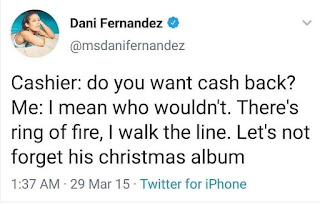
I saw this amusing post online this morning:

And I saw that just as I was starting to think, “Hmmm, I wonder what I should post for my Christmas music of the day?” I love how every once in a while, the Interwebs anticipate my needs.
Here is some Johnny Cash for your wintry morning. (Well, very late autumn, I suppose is technically correct…and as I look outside at this moment there’s not much “winter” in evidence yet. We’re having one of those years where winter seems to be a slow developing thing, as opposed to other years where at some point in October or early November winter shows up to shout “HEY! I’M HERE!!!” as it wallops us with snow. Right now it’s just eternally damp and muddy. What were we talking about? Oh yeah, Johnny Cash. Sorry about that; I’m writing this as the coffee is only just starting to kick in.)
There was always something special about Johnny Cash’s voice that I could never put my finger on. It really shouldn’t work, that gravelly baritone that doesn’t always home in on the exact pitch the way a singer should. Sliding into a pitch instead of hitting it dead on is a standard device of country singing (Reba McIntyre and Garth Brooks are canonical examples of this technique), but what Cash does is…more than that. Sometimes he sounds like he’s perfectly content to waver in the vicinity of the actual pitch without actually getting there. If you heard a young music student singing like that, you’d question their ability. When you hear Johnny Cash doing it, you know that you’re listening to a master who is doing exactly as he wishes with his voice.
Most of all, though, that guy knew how to home in on the emotional content of a song and use his instrument to make it work. He never stresses the wrong word or puts the em-PHAS-is on the wrong syl-LAB-le, and he somehow makes it sound like every song he sings was written for him and him alone, no matter if he actually did write it or if it’s an old standard like “White Christmas” that has been sung by everyone, some of whom are icons with every bit as much stature as Mr. Cash.
Share This Post

Liberatopia: Now with hungry bears!
Years ago I was driving someplace and an odd segment came on the NPR show This American Life, which was about a libertarian guy who was spearheading what seemed to me a pretty Quixotic notion: rallying a whole bunch of like-minded libertarians to move to a single state, massing enough numerical strength to force through the engines of democracy a large-scale implementation of libertarian policies. Eventually they would be able to show the world entire how wonderful and glorious things are when there is minimal government, minimal idea of public life, and a strong focus on individual freedom.
I remember this very keenly: so strongly did it hit me that I blogged about way back in 2003 (!), when this blog was barely a year old. Here’s some of what I wrote back then:
The story focuses on one particular Libertarian, an earnest and intelligent young fellow who is steeped in Libertarian theory, and yet he strikes me as so steeped in theory that he doesn’t seem to have a handle on some of the more mundane concerns of life. He completely downplays the inevitable local resistance that his movement is certain to face whenever his twenty-thousand brethren arrive in Vermont or Delaware or Wyoming. His faith in the marketplace strikes me as scary — private companies will pick up the cigarette butts and maintain all the roads, for instance. We’re told that since zoning laws won’t exist in Liberatopia, McDonald’s will be able to build next door to your house if they so desire. But it’s all good, because you’ll be allowed to paint your house any color you want. Well, OK…but I fail to see how being allowed to treat my aluminum siding as a Jackson Pollack canvas really compensates for having what goes on behind fast-food restaurants doing so beside my back yard. (I worked in restaurants for years, and I know damn well what goes on outside the back door when the employees are bored. Especially since Liberatopia will have no drug laws.)
Then there is the surreal moment when the guy discusses, as an example of what he doesn’t like about public parks. He breezily says, “We’ll privatize this common area”. He scoffs at all the regulations typical of a town park — no skateboarding, for instance (this one I can somewhat agree with; there should be more places for skateboard and rollerblade use in this world). But he also scoffs at “No alcohol and no glass containers”, which he thinks is Draconian — but any parent who has ever encountered broken glass around the swings at the playground won’t quite share the same view, I suspect. “Parks” equal “theft”, he tells us: governmental funding of parks equals theft. When the interviewer points out that no private company is simply going to want to operate a free public park, he concedes, “Yeah, it’ll be gated”, and then states broadly that there will be no purely public spaces in Liberatopia. I’m glad the interviewer didn’t ask what happens to the library. I probably would have broken down in tears at this guy’s answer to that one.
This Libertarian travels around Vermont, one of the candidate states for Liberatopia, talking to the locals and trying to get them to sign the pledge promising to move once enough folks are signed up. One guy seems to be hearing these ideas for the very first time, and yet signs on the dotted line almost immediately — we get to hear the scratching of his pen — leaving me to wonder if he’s really thought things through. I wonder what happens when some of these people move and discover just how much they really, truly, deep-down love little things like parks for the kids and libraries and not having to worry about some company putting a set of dumpsters on the other side of their driveway. I don’t know, but something about this whole endeavor makes me envision Bart, after one of Homer’s schemes has predictably turned out poorly, saying: “Bet you wish you’d researched this plan a little, eh, Dad?”
After that, I kind of lost track of (and interest in) the Liberatopia Project, because…well, at that time I could claim that I didn’t have a lot of experience with libertarians, but now, I have had a lot more experience with them, and suffice it to say that while my reaction to libertarianism back then was a bemused “OK there, champ”, my reaction now tends to be “Oh lord, get this nut away from me, and somebody open a window once they’re gone.”
Well, earlier today I saw this article, which is an interview with the author of a book about what eventually happened with the whole “The Libertarians Are Going To New Hampshire!” movement. Last time I looked in on these goons, they were imagining taking over an entire state; they seem to have eventually scaled down their idea to taking over a town, and they actually managed to pull this off in the unfortunate burgh of Grafton, NH.
Maybe I should give a spoiler warning, but come on: anyone with a pulse knows that this whole notion was bound to be a shitshow, and a shitshow it was:
By pretty much any measure you can look at to gauge a town’s success, Grafton got worse. Recycling rates went down. Neighbor complaints went up. The town’s legal costs went up because they were constantly defending themselves from lawsuits from Free Towners. The number of sex offenders living in the town went up. The number of recorded crimes went up. The town had never had a murder in living memory, and it had its first two, a double homicide, over a roommate dispute.
So there were all sorts of negative consequences that started to crop up. And meanwhile, the town that would ordinarily want to address these things, say with a robust police force, instead found that it was hamstrung. So the town only had one full-time police officer, a single police chief, and he had to stand up at town meeting and tell people that he couldn’t put his cruiser on the road for a period of weeks because he didn’t have money to repair it and make it a safe vehicle.
Basically, Grafton became a Wild West, frontier-type town.
Sean Illing
When did the bears show up?
Matthew Hongoltz-Hetling
It turns out that if you have a bunch of people living in the woods in nontraditional living situations, each of which is managing food in their own way and their waste streams in their own way, then you’re essentially teaching the bears in the region that every human habitation is like a puzzle that has to be solved in order to unlock its caloric payload. And so the bears in the area started to take notice of the fact that there were calories available in houses.
Yikes. Read the whole thing, but as a writer, I have to note that wonderful sentence: “You’re essentially teaching the bears in the region that every human habitation is like a puzzle that has to be solved in order to unlock its caloric payload.” That’s some good stuff, right there!