My Icelandic roots!

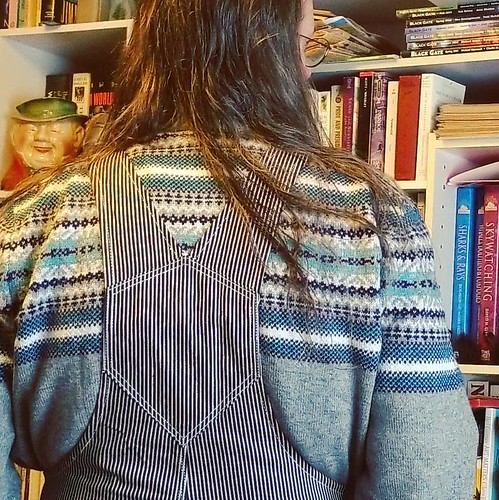
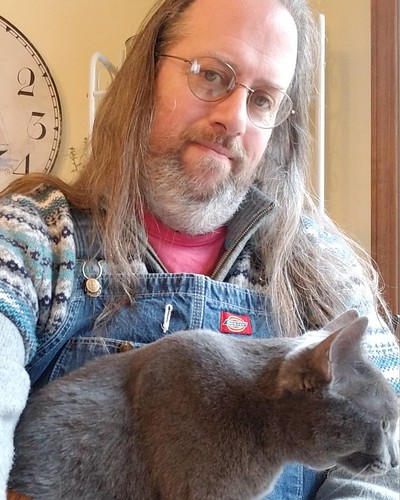
 One of my requests last Christmas was a new sweater or two, in a lighter color to counteract the general dark tone of my existing sweater collection (some of which are also getting a bit old). The Wife gave me a wonderful light-blue sweater with a neat pattern around the top, and a cowl neck that zips up. It’s similar to an Icelandic Lopapeysa sweater, but it’s not made of wool. This has quickly become one of my very favorite sweaters, and as a bonus, it seems to go really well with overalls!

I'm really digging this sweater. #ootd #overalls #dungarees #biboveralls #vintage #dickiesworkwear #dickiesoveralls #denimoveralls #overallsarelife #vintageoveralls #sweatersandoveralls #scarf #crochet

New sweater! New overalls! Yay! #ootd #overalls #dungarees #biboveralls #BerneOveralls #hickorystripe #denimoveralls #overallsarelife #sweater #sweatersandoveralls

The collar on this sweater really does not want to lay flat, so I'm just going with it.... #ootd #overalls #dungarees #biboveralls #vintage #lee #leeoveralls #hickorystripe #denimoveralls #overallsarelife #vintageoveralls #sweatersandoveralls

Here’s a suitably dramatic pose, taken in an alley in Hamburg, NY. The Dee-oh-gee and I were killing time outside while The Wife went into our favorite local bakery to buy stuff. I like the color contrasts here, between the sweater, the overalls, the scarf, the doggo, and the wall behind us:

I'm not even sure how to describe this one.... #Cane #dogsofinstagram #greyhound #greyhoundsofinstagram #HamburgNY #alley #overalls #dungarees #biboveralls #vintage #dickiesworkwear #dickiesoveralls #denimoveralls #overallsarelife #vintageoveralls #sweate

The color and pattern (apparently called a yoke design) go well with either solid blue overalls or with hickory stripes. I assume it will go well with the herringbone overalls as well, but I haven’t worn the sweater with those yet.

From the back #overalls #dungarees #biboveralls #BerneOveralls #hickorystripe #denimoveralls #overallsarelife #sweater #sweatersandoveralls

Sweater and bib

As always, I make few (if any) apologies for the fact that my main criteria for judging whether or not I want to add a top to my wardrobe is, “Do I think this will look good under a pair of overalls?” I mean, it’s my thing, y’know?

Oh, and the title of this post constitutes a little joke. I have no Icelandic roots at all.

Share This Post

Tone Poem Tuesday

 Caroline Shaw is a composer, singer, and violinist who has emerged as one of the bright new voices in classical music. She has already won the Pulitzer Prize for one of her works, and she has composed a lot of music already in her 39 years. And I had never heard of her until last week, when I found her name after Googling “21st century classical composers”. I read a bit about Shaw, whose career has taken her from the Baltimore Symphony Orchestra to recording with Kanye West. That sort of eclecticism appeals to me; I have always responded well to artists with as wide a view of their artistic expression as possible.

As of my writing this, I’ve only heard one work by Shaw in its entirety, and it’s the one featured here today. It’s called The Observatory and it was commissioned (and premiered) by the Los Angeles Philharmonic, where apparently it opened a program that ended with Beethoven’s Ninth Symphony. That’s gotta be a hell of a thing for a composer, right? “We want you to write a new work for us, you’ll be filling out the program with Beethoven’s Ninth. You can do that, right?”

Well, Shaw most certainly could. The work is a grand-scaled tour de force, opening with huge chords reminiscent of those that open Brahms’s First Symphony, and then taking a 16-minute stream-of-consciousness tour of wonder. The work’s inspiration was apparently LA’s Griffith Observatory and Shaw’s own love of science fiction and the Cosmos. Obviously these themes drew my attention almost immediately. As Shaw herself writes, describing the compositional process of this piece, on the Hollywood Bowl website:

It was a wild ride, and I remember feeling like an observer of a mysterious workshop that somehow churned beauty out of chaos. There is also something about writing an orchestral work for a summer evening in Hollywood that got me thinking about my favorite genre of film and storytelling — sci-fi. I love the way epic tales of the beyond can zoom in and out, using grand imagined alternate universes to tell stories about ourselves. And I love how music in these films carves and colors our attention to those worlds (in their various scales).

While writing music, I often imagine some kind of visual (usually abstract, sometimes figural, rarely narrative), as a guide for myself and sometimes as a thing to write against. There’s an invisible counterpoint here, but I’d rather someone simply listen and create their own contrapuntal narrative adventure than read an account of mine — to leave space for one’s own observation and reflection, whether it be of the music or their neighbor’s t-shirt or cosmology or tomorrow’s grocery list. (The grand story arcs of our lives sometimes play out in minutiae and the mundane.) And often the imagined visuals that I write to are nothing more than shifts in color or a quick cut between undefined scenes. (Sometimes the juxtapositions and transitions [and parentheticals] are where the stories are.)

I greatly enjoyed this work and I will certainly be exploring more of Caroline Shaw’s music! I wonder if she’s given any thought to film scoring…since the inevitable screen adaptations of my Song of Forgotten Stars books are going to need a composer, eh?

Here is The Observatory by Caroline Shaw.

Share This Post

Recent reading: Space wizards, zombie apocalypses, reflections of Paris, universes ending, and a LOTR-but-not-LOTR fantasy

 A few more books I’ve read of late:

::  I can’t possibly keep up with the eternal flood of new books that is Star Wars publishing, but I do try to pick and choose the ones that sound good or come with good referrals. Last year, Lucasfilm announced a new project in their Star Wars publishing empire: a new series within the larger overall tale that focuses on life in our favorite galaxy far, far away two hundred years before the rise of the Sith, the fall of the Republic, and the arrival on the scene of a couple generations of Skywalkers. This series is called The High Republic, and it depicts the Republic at is height and the affairs of the Jedi as they act as the guardians of peace and justice and all that.

Light of the Jedi, Charles Soule

The High Republic is going to play out in books, comics, and who knows what else (no filmed entertainment set thusly has been announced yet, but who knows what the future may bring, as currently Star Wars is changing directions on an almost monthly basis). It all starts with Light of the Jedi by Charles Soule, and…well, it’s not bad, but it’s got a lot of room to get better.

Light of the Jedi has to do a lot of heavy lifting: it has to establish the time period we’re in, which means that it has to show all the ways this time period contrasts with the one with which we’re most familiar. It also has to establish the new threat that the Jedi are going to be facing through all this, which can’t be the traditional Sith because canon has already established that the Sith have been gone for centuries and they stay gone until Darth Sidious steps into the open around the time of The Phantom Menace. Light also gives us a lot of viewpoint characters, probably too many, all having adventures that play out over relatively short chapters.

The sad result is that Light of the Jedi ends up feeling overstuffed and underfocused, so that in its attempt to be really exciting it ends up under-engaging. I have to admit that I came close to DNFing this book halfway through, and ended up skimming a lot of the last act. It’s a shame, because there is interesting stuff here and it does set up some possibly exciting story possibilities to come. The book does the job of getting The High Republic out of the gate, but it’s not the galloping start it should have been.

::  I’m reading more indie books of late, which I should do because I’m an indie author myself, and which everybody should do because there’s a lot of great writing out there beyond the world of the standard publishers. I’ve been following author Anna Vera on social media for a while, and I finally got around to reading her book When Stars Burn Out, a dystopian science fiction novel about the zombie apocalypse and the human response to it.

When Stars Burn Out, Anne Vera

I freely admit that this genre is not generally my cup of tea, which is to say, it’s almost never my cup of tea. But I do enjoy it on a selective basis when it’s handled well, and Vera is one of the ones who handles it well. There is darkness and grim death here, because how could there not be, but for once it’s not wildly overdone with spectacular deaths just for the sake of deaths (like in, say, The Walking Dead). There are intriguing mysteries and an interesting society of people trying to live without becoming zombies themselves, and the character work is particularly good. Heroine Eos Europa is a fascinating person, and I hope to read more of her adventures soon.

::  I’ve had Paris to the Moon by Adam Gopnik on my shelf for years, and I finally got around to it. I have to admit to finding it slightly disappointing. I was expecting a travel book, but it’s really not that; it’s a collection of essays Gopnik wrote in the 1990s for The New Yorker about his and his family’s experiences in Paris when they packed up and moved there. It’s all well-written and all, but unlike the best travel writing, Paris to the Moon‘s essays feel distinctly rooted in a particular time and place, and from a particular vantage point. I felt an odd disconnect while reading it, like perusing the mundane dispatches from someone’s life decades ago.

Paris to the Moon, Adam Gopnik

It’s not bad, though! Not at all, and if life in Paris interests, there’s much here that’s interesting. I cite one passage, which I found particularly amusing:

Late last year the French government assembled a committee to choose a name for the vast new stadium that’s being built in a Paris suburb. The committee included an actor, and “artiste”, some functionaries, and even a few athletes. It took a long time deliberating over its choice. Names were submitted: Some people liked the idea of naming the stadium after Verlaine or Saint-Exupery, and lots of others liked the idea of calling it Le Stade Platini, after Michel Platini, the great French soccer player. At last, late in December, the committee announced that it had come to a decision, and the government decided to broadcast the verdict on television. The scene was a little like the end of the Simpson trial: the worried-looking jurors filing to their seats, the pause as the envelope was handed to the minister of youth and sports, the minister clearing his throat to read the decision to the nation. The stadium that would represent France to the world, he announced, would be called (long, dramatic pause) Le Stade de France. The French Stadium. “Banal and beautiful at the same time,” one journalist wrote. “Obvious and seductive. Timeless and unalterable.”

I suppose there is something oddly comforting, albeit in a kind of depressing way, in learning that the bureaucratic way of spending a lot of time and money coming to a perfectly boring decision isn’t something unique to the United States.

::  Katie Mack’s The End of Everything (Astrophysically Speaking) is a book about the end of our universe.

The End of Everything, by Katie Mack

Apparently the current state of science has a handful of scenarios by which our brightest minds think our universe will end, and Dr. Mack has written this helpful, clearly-written, and humorous (given the subject matter) book summing it all up. If you like a bit of science to help back up your low-level existential dread, The End of Everything is the book for you! Yes, there are passages that I didn’t entirely understand, but Mack does a very good job of explaining how we came to our current theories of how the universe began, and given our understanding thereof and of how the universe works now, how we might expect it to end. Her ultimate takes aren’t terribly optimistic (for ideas on what the end of the universe might look like from the standpoint of sentient starfaring civilizations, Michiu Kaku is the author to seek out), and there’s something particularly chilling about what’s called the “Heat Death” of the universe, as ultimately the unending expansion of space results in our skies growing ever, ever darker as the stars become too far from us for light to ever arrive. But, as Dr. Mack writes:

In fact, the one thing that all the universe-ending scenarios we’ve already discussed have in common is that they definitely aren’t coming around anytime soon. As far as we can tell from our best understanding of physics, we have at least tens of billions of years before even the most extreme version of a sudden Big Crunch reversal could occur, and no Big Rip could be less than a hundred billion years off. A Heat Death, considered by most to be even more likely, would be so far into the cosmic depths of the future that we hardly have terms to describe it.

So there’s that. Of course, she writes this just before sequeing into a chapter about a “Vacuum Decay”, in which a bubble of true vacuum forms someplace and expands at the speed of light, destroying everything it takes in as it expands. This, apparently, is a thing that can happen at any time, and since the horizon of the destructo-bubble’s edge moves at the speed of light, we’d never know it was coming. For all we know, there could be a universe-destroying bubble right now someplace, expanding toward us at the the speed of light…and depending on where it is, that’s how much time we’d have left. So…sleep tight, I guess!

::  Finally, a re-read of a book I liked a lot as a kid. Between 7th and, I think, 9th grades, I went on a huge epic fantasy reading kick. I read a lot of epic fantasy back then, between roughly 1982 and 1986. (After that I fell into spy and espionage fiction in a big way.) In those years, epic fantasy was far more dominated by the JRR Tolkien model than it is now, thankfully. I love JRRT, but wow, did the genre need some new thinking for a long time. Luckily that new thinking has long since arrived and the genre is healthier for it…but for years fantasy novels seemed really stuck in the same trope wonderland, and the biggest title in the post-JRRT swords-and-dwarves-and-elves type of fantasy was Terry Brooks’s The Sword of Shannara. I read Sword once, back in my junior-high days (along with its two immediate sequels, The Elfstones of Shannara and The Wishsong of Shannara), but I’ve never revisited them since…until now. A while back I was shopping at my local Savers store and I found the original three Shannara books in the Used Books section*, so I picked them all up. Last week I finally re-read Sword, and…well, it was like dipping my toes in Heraclitus’s river. It’s not the same river it was when I was thirteen.

The Sword of Shannara, by Terry Brooks

It’s close to forty years since I read Sword all the way through, so I don’t remember much of it at all from back then, except that I do remember finding it kind of padded back then. Nothing specific, but I definitely recall skimming through chapters I didn’t really care that much about. And lo and behold…that happened again.

In Sword you have the Tolkien model almost in its entirety: a malevolent Dark Lord is threatening the existence of everything, while the races of Man (it was the 70s, so yes, it’s called “Man”), Dwarves, and Elves don’t really get along terribly well. There’s a single magical weapon, though, that can prove the Dark Lord’s undoing, and it can only be wielded by a specific individual who happens to be a member of a peaceful, pastoral people who live about as far away from the Dark Lord’s palace as you can get. A wizard-like figure who is known all over the world for his strange comings and goings arrives to send our young hero on his quest, which after many dangers leads him to a single quest to find the magic weapon. On this quest he is joined by a…what should we call it? A “fellowship”?…helpful team comprising men, Elves, Dwarves, and our hero and his pastoral buddy.

Off they go to deal with the weapon and the Dark Lord, but eventually their “fellowship” is forced to break apart, and the others go off to deal with specific wars and stuff while Our Hero proceeds to his ultimate journey into the Dark Lord’s realm, which is a barren desolate wasteland of dust and sharp mountains.

I don’t want to sound dismissive, but Sword really really does read like a Tolkien clone for people who wanted more Tolkien but who didn’t want to re-read Tolkien for the 80th time. All the tropes are here, with just about all the story beats; what Sword seems most to accomplish is reducing the Lord of the Rings from its 576,000 words down to about 226,000. This isn’t always a good thing, as I found it very hard to care about some of the “side adventures” that Brooks takes us on in the back half of the book. We meet a guy named Balinor early on, but we get little of his backstory until much later, which we get right before the book diverts us to his struggles against his crazy jealous brother. I found it nearly impossible to care about any of that.

Ultimately I found Sword a slog to get through this time. Brooks overwrites and overdescribes to an amazing degree, and from a stylistic standpoint, his paragraphs are way too long, sometimes lasting entire pages. And look, I know he wrote this in the 1970s, but still: it’s a 726 page book, and our first (and only) female character doesn’t show up until we’re well past page 400.

I do plan to read the other two books in the trilogy at some point. I remember liking Wishsong most of all from these, and I’ve also heard that Brooks’s various explorations in the Shannara universe after these initial volumes perk up quite a bit. I don’t know if I’ll go any farther past Wishsong, but…you never know.

* I don’t know about anybody else’s Savers location, but the Used Books section at my local one almost always has something worth grabbing. I never leave that place without a book or two. Not huge hauls, but there’s always something!

Share This Post

Tale of a morning….

 On weekends I am awoken usually by the whimpering of the Dee-oh-gee, who usually gets to somewhere between 7:30 and 8:00am before he has to go out and relieve himself. Fine. Then I make coffee and usually try to sit and read a bit before getting on with the day.

This morning, however, Carla and Rosa (one of the two cats we adopted recently…huh, not sure I ever blogged about them!) decided they had other plans for me.

My morning, start. Hi, Carla. #Carla #dogsofinstagram #pitbullsofinstagram #pitbullmix #pittie #staffordshirebullterrier #staffiesofinstagram #overalls #dungarees #biboveralls #vintage #dickiesworkwear #dickiesoveralls #denimoveralls #overallsarelife #vin

I found this. It's vibrating. #Rosa #catsofinstagram #graycat #overalls #dungarees #biboveralls #vintage #dickiesworkwear #dickiesoveralls #denimoveralls #overallsarelife #vintageoveralls #sweatersandoveralls

Sigh.... #Rosa #catsofinstagram #graycat #Carla #dogsofinstagram #pitbullsofinstagram #pitbullmix #pittie #staffordshirebullterrier #staffiesofinstagram #overalls #dungarees #biboveralls #vintage #dickiesworkwear #dickiesoveralls #denimoveralls #overallsa

Sigh, indeed #Rosa #catsofinstagram #graycat #Carla #dogsofinstagram #pitbullsofinstagram #pitbullmix #pittie #staffordshirebullterrier #staffiesofinstagram #overalls #dungarees #biboveralls #vintage #dickiesworkwear #dickiesoveralls #denimoveralls #overa

Such is the life of a pet owner, I guess. Sheesh.

Share This Post

A Linkage Clearance!

 Here are some links to stuff I’ve perused the last few days:

::  An Incredible Move: In 1930, an Indianapolis office building was literally moved, including rotating it 90 degrees. While it remained open for business. That’s amazing.

::  Dana Schwarz is sick of desaturated and dark-looking movies:

But with the coronavirus pandemic hitting its one year anniversary, we’ve reached reached a tipping point where cinematic content that perhaps was designed to be released on massive, high-contrast theater screens is now being released to our living rooms. Which means I’m stuck squinting at the screen asking my boyfriend if Superman’s new suit is actually black or if I just couldn’t make out the colors. (It’s actually black.)

::  On the eternal hopefulness of The Lord of the Rings:

The most important thing that the Lord of the Rings movies grabbed from the books wasn’t any particular plot detail, but an earnest belief that hope can coexist with despair, so long as we never surrender to it. Boyens, Jackson, and Walsh took the emotional themes of their subject entirely seriously and sincerely, imbuing the trilogy with humor that never pointed back on itself, no matter how operatic.

::  On a favorite 1990s show of mine, Millennium:

Never envisioned as an X-Files spinoff, but rather as “a sister series,” Millennium readily broke new television ground, becoming a relatively short-lived mainstream network series that spawned a host of pay-TV imitators. It engages difficult questions around violence, grief, and art in startlingly stark and sophisticated ways. Millennium’s creative team, many of the same forces behind The X-Files, took advantage of the smaller-scaled, more esoterically textured series to take storytelling risks that would have been ill-suited for Millennium’s ratings-behemoth elder brother.

::  The Medusa Nebula. Wow!

Share This Post

Something for Thursday

 It’s been False Spring here in The 716 of late, as I noted the other day. Today at work I spent about twenty minutes doing my twice-monthly rooftop inspection (a regular part of my job!), and during this, I put in my earbuds and listened to this piece of music. I chose it because its duration is such that it would last roughly the length of time it takes me to inspect the roof, and I searched this out in the first place because I’ve been intending to listen more to this particular composer.

Rachel Portman is known mainly for her film music, though she has written a lot of other stuff too (including an opera based on The Little Prince). Her film work tends to quieter, character-driven films, like Jane Austen adaptations (she won an Oscar for her score the 1996 version of Emma, becoming the first woman composer to do so) and the like. This selection is a collection of several cues from her score to the film The Cider House Rules, which I know nothing at all about other than Michael Caine plays a headmaster of a boarding school or something like that, and he bids his resident boys a decent night’s sleep every night with the words “Good night, you Princes of Maine, you Kings of New England.” The movie was well regarded when it came out, something like twenty years ago, but I certainly have heard nothing of it since.

Portman’s music is gently pastoral in its approach to the drama (at least as it’s represented in this suite), putting me in mind of the fine English pastoral music of the early 20th century–composers like Butterworth and early Vaughan Williams.

If it’s a lovely spring day where you are, may this enhance it…and if not, may this put you in mind of warmer days to come!

Share This Post

Tone Poem Tuesday

 A very modern work today, by Canadian composer Cassandra Miller. Duet for Cello and Orchestra is almost avant-garde in its conception: a solo cello plays the same droning two notes, a perfect fifth apart, through the entire work, marking the time insistently throughout even as the orchestra enters and departs at intervals that feel almost random. The orchestral passages start out sounding like trumpet fanfares, but they become increasingly frantic as we move through the work’s thirty minutes. The work apparently quotes an Italian folksong throughout, while our solo cello keeps playing this weird two-note ostinato until the very end, when at last the soloist gets to do something else: a strange kind of cadenza that soars above the orchestra’s dying ostinato.

It’s a fascinating work. Here is Cassandra Miller’s Duet for Cello and Orchestra.

Share This Post

Rabbit Holes

 A while back I shared a fascinating video of a guy doing his job, which I labeled “Competence Porn”. I found another such example the other day, and since this new guy’s videos are mostly shorter than that first one, I’ve watched more of these. I’ve “gone down the rabbit hole”, as the kids say (in an allusion to Alice’s Adventures In Wonderland), and this is something that interests me in itself. During our COVID-19 isolation times, I’ve seen a lot of people discover new things and delve into them a lot more deeply than they might have otherwise. Baking is one I’ve seen a lot (especially sourdough starters!). Ditto knitting, and other hobbies. Gaming. Cooking. Home brewing. And in my case, going deeply into music again, and hitting the books hard.

And…”competence porn” videos!

In my earlier example, that’s a guy doing his job. This one is a hobbyist…with a very interesting, strange, and useful hobby. This fellow likes driving around on very rainy days, finding flooding streets, and unclogging the storm drains. And that’s it! So why would I find this fascinating?

Well, these videos are pleasant sonically. I have always responded quite happily to the sounds of rain, rushing water, splashing, and all the things that water does. I just like listening to this guy’s videos. But he also says interesting things along the way, pointing out the physics as to how this stuff works, why the water does what it does, what the design flaws are sometimes in the drains he encounters, why the drain pipe runs this way and not that, and sometimes how dumb and inconsiderate people can be (a couple videos have cars deciding they don’t want to drive through the flood so they go around it…on the sidewalk).

Anyway, here’s a guy unclogging a street drain. What rabbit holes have you gone down lately?

Share This Post

Sprung?

 I’ve long been of the belief that as delightful as three of the four seasons in Buffalo Niagara are, the last one is usually just annoying. It might surprise you to learn that the one I don’t like is not winter, but rather, spring. I stand by this! Spring in these parts is not a welcome return to warmth, but rather it is generally a two-month affair of temperatures remaining stubbornly in the mid-to-upper 40s. Spring in Buffalo Niagara is usually a pretty gray affair, as the clouds maintain their stranglehold over the sun until mid-May at the earliest. It takes forever for trees and bushes and everything else to come back to life, to the point that green isn’t the dominant color here until Memorial Day at the earliest. The snowpiles in parking lots and at the ends of streets endure, in their dirty grayness, and it seems like mud is everywhere.

And yes, it usually snows in April around here. Last year it even snowed not near Mothers Day, but actually on Mothers Day.

But we do once in a while get to enjoy a day like today in springtime around here, a day when it is warm and sunny out, when we get to open windows and switch out the stuffy indoor air for fresh outdoor air, when we can walk the dogs multiple times, and when the sun shines from sunrise to sunset.

Geology and astronomy may be in agreement that it is spring here, but it’s just not. Not yet. Not in a way that feels real.

That’s not stopping nature from looking like it’s embracing the early wake-up call….

Larger view of the stream at Chestnut Ridge

That’s Chestnut Ridge park, just this morning. It’s one of my favorite places, where The Dee-oh-gee and I visit often on our weekly Sunday morning nature walks. That particular stream is a combination of two streams that tumble from the upper reaches of the park; this is at the park’s northern, and lower, end. Here it tumbles down through what’s left of a deep ravine, and under a steel-deck bridge before it flows on, winding its way toward Lake Erie before it finally empties into Eighteen Mile Creek, which then flows on to Lake Erie. A lot of that water will eventually flow out of Lake Erie, down the Niagara River, over the Falls, and out to Lake Ontario…and on and on, eventually to the sea.

There’s still snow up there (Chestnut Ridge is in what the weather people call “the upper elevations” when they are threatening snowfall for some of us), and as of now there hasn’t been enough warmth to cause the grass to really start greening or for dormant trees and bushes to start budding. But it’s tempting to look for those things.

Spring in Buffalo Niagara. It’s here…kind of.

Share This Post