Lately reading: Ken Jennings on Maps

 Time to catch up on some of my recent reading!

::  Maphead by Ken Jennings is about maps and the people who like maps. More than that, it’s about people who love maps. Some people love maps so much they end up seeming a bit odd, but that’s fine! And who better to write about such strange people, committed to esoteric knowledge, than Ken Jennings, trivia champion extraordinaire?

Maphead, Ken Jennings

It’s safe to say that Jennings’s authorial career would not have taken flight had he not put together that wonderful winning streak on Jeopardy! back in the Aughts, but now that he’s writing, I hope he keeps doing it for a long, long time. He seems to be a cheerier version of Bill Bryson, able to write engagingly about topics that don’t often get written about (I love Bryson, but his work often has something of a dark tinge to it), and in this book especially Jennings is able to write both about maps and the entire subculture that has sprung up about maps.

Along the way in Maphead, Jennings visits the London Map Fair, an event I never knew existed. I’ve read a lot about book collectors, though, and this little world intersects that of people who seek out First Folios very neatly. I also learned about things like road geeks, who learn about specific odd details you’ll find on America’s roadways if you look closely (like a traffic light in Syracuse where the green light is on top of the fixture!) and who nurse grudges against people like a Pennsylvania Congressman who used his power to insist that a new section of Interstate Highway in that state be numbered I-99, even though that number is in violation of federal highway numbering guidelines.

Jennings visits the map collection at the Library of Congress, relating stories of how international incidents have actually been settled by other countries referring to maps in the LoC’s collection, and he writes about the National Geography Bee, which is exactly what it sounds like: an event like a spelling bee, where the goal is not to answer questions like “How do you spell chiaroscurist?” but rather questions like “What is the local name given to the katabatic winds in southern France that can cause damage to crops in the Rhone Valley?” (The answer is “mistral”. No, I don’t know what any of that means, and I am taking Jennings at his word here.)

My favorite chapter, though, as a writer of fantastic tales myself, is the chapter on maps of places that don’t exist. Some people create elaborate maps of fictional locales as a hobby in themselves. but Jennings also discusses the role of maps in fantasy and science fiction novels, helpfully enlisting his former college roommate, bestselling fantasist Brandon Sanderson, to provide some comment. I personally get a bit antsy when I try to read an epic fantasy novel that has no map, and I’ve read a few advance copies of epic fantasies over the last few years that had blank pages where the eventual map would go. This always bugs me. Some readers are fine with no maps, but if you give me an imaginary world, I have to be able to see how its locales fit together. Jennings writes:

It’s the importance of place to the genre, not just slavish imitation of Tolkien, that explaisn why todays’ fantasy authors still make sure maps are front and center. David Eddings, one of epic fantasy’s most popular writers, went so far as to put maps on the covers of his books. (Eddings’s nation of Aloria was born the same way Stevenson created Treasure Islans: he doodled the map first, and the map inspired the adventure.) The maps are certainly functional too; many fantasy novels are episodic quests, and a map is an easy way to plot that course for a reader–it’s no accident that the word “plot” can refer to the contents of both a chart and a narrative. But Brandon’s tried hard to get away from the quest narrative in his own books, most of which take place in contained urban settings, yet he still makes sure his books have maps. His latest novel–the first volume in a projected ten-books series–is called The Way of Kings, and it includes no fewer than nine maps.

I haven’t read The Way of Kings yet (in a genre that tends to long books, Way is a doorstop of doorstops), but it does contain a lot of artistic ephemera, including maps. I never re-read Tolkien without constantly referring to his maps, and I’ve rejected owning several editions of The Lord of the Rings (primarily in mass paperback) because the maps are printed so badly as to be illegible. What I love most about Tolkien’s maps isn’t just how detailed they are (I admit to being frustrated by fantasy books that give me a giant world and yet the map is basically a blob with three or four place names on it), but also how much wider they are than the story! Just look at the map of Middle Earth as it appears in LOTR: most of the places depicted aren’t places the story ever goes! I love that. (And no, I don’t care that the geology makes no sense. It’s a world of dark lords, great wizards, elves, and magic rings. In the midst of all that, I think I can make room in my brain for the right angles formed by the mountains surrounding Mordor.)

Jennings also takes some time to explore the degree to which love of maps, and knowledge of geography itself, has been pushed out of the realm of things we expect everyone to know and into that of self-applied geekdom. We’ve all seen the results of quizzes and polls showing how few Americans can identify a given percentage of the states. Jennings writes:

There are obvious ways to explain an ongoing drop in geographic literacy. Geographers like to blame the curriculum revolution of the 1960s and 1970s, in which the clear-cut history and geography classes of grade schools were replaced by a wishy-washy amalgam called “social studies”. The adoption of social studies was the well-intentioned result of academics in a wide variety of social sciences hoping to expose kids to their pet fields: anthropology, economics, political science, and so on. But, as a side effect of the new curriculum, classes specifically devoted to geography virtually disappeared from the nation’s schools. The United States is now the only country in the developed world where a student can go from preschool to grad school without ever cracking a geography text.

I can attest to this. I remember my social studies classrooms, decorated with lots of maps…to which my teachers (and these were good teachers! I enjoyed just about all of those classes) almost never referred or made the basis of a lesson. This didn’t stop me, of course, from learning about them. In fact, the maps on the walls often became my refuge in the midst of the occasional boring lecture.

And it seems, from reading Maphead, that I am far from alone in this.

Share This Post

Something for Thursday

 Ever have something that was a favorite of yours at some point, but which for no real reason–just the normal moving on to new things, Robert Frost’s “knowing how way leads on to way”–you just leave the favorite thing behind, and then some time later–years later, even–you suddenly remember it?

I’ve been listening to an album by Brona McVittie, an Irish folk singer and songwriter, that I discovered by…well, more on that another time. In listening to McVittie’s album, I found myself reminded of an artist I listened to a lot way back in the early 2000s, but whose track I lost since then. She’s an English folk singer and songwriter named Kate Rusby. I found several of her albums on YouTube and played part of one on my night’s commute…but for now, here’s a song from her debut album, from way back in 1997. This is called “Sir Eglamore”, and it’s a delight.

So why haven’t I heard it in so long? Well…yeah. Way leads on to way, doesn’t it? It’s not just about two roads in a yellow wood.

Here’s Kate Rusby with “Sir Eglamore.”

Sir Eglamore was a valiant knight,
fa la lanky down dilly,
He took up his sword and he went to fight,
fa la lanky down dilly.
As he rode o’er hill and dale,
All armored in a coat of mail,
Fa la la m ba di n da da n da, lanky down dilly..

Out came a dragon from her den,
fa la lanky down dilly,
That killed God knows how many men,
fa la lanky down dilly.
When she saw Sir Eglamore,
You should have hear that dragon roar
Fa la la m ba di n da da n da, lanky down dilly.

Well, then the trees began to shake,
fa la lanky down dilly,
Horse did tremble and man did quake,
fa la lanky down dilly.
The birds betook them all to peep,
it would have made a grown man weep,
Fa la la m ba di n da da n da, lanky down dilly.

But all in vain it was to fear,
fa la lanky down dilly,
For now they fall to fight like bears,
fa la lanky down dilly.
To it they go and soundly fight,
the live-long day from more ’till night,
Fa la la m ba di n da da n da, lanky down dilly.

This dragon had a plaguey hide,
fa la lanky down dilly,
That could the sharpest steel abide,
fa la lanky down dilly.
No sword could enter through her skin,
Which vexed the knight and made her grin,
Fa la la m ba di n da da n da, lanky down dilly.

But as in choler she did burn,
fa la lanky down dilly,
He fetched the dragon a great good turn,
fa la lanky down dilly,
As a yawning she did fall,
he thrust his sword up, hilt and all,
Fa la la m ba di n da da n da, lanky down dilly.

Like a coward she did fly,
fa la lanky down dilly.
To her den which was hard by,
fa la lanky down dilly,
There she lay all night and roared,
the knight was sorry for his sword,
Fa la la m ba di n da da n da
Fa la la m ba di n da da n da da.

Share This Post

DNF

 I read this article with interest. It’s on the topic of DNFing books. What does that mean? It means Did Not Finish. For some people, DNFing a book is a simple matter, but for many there’s almost an honor code among readers that you have to finish a book when you start it.

Dear reader, you can.

I’ve tried to force myself at times to join Team Finish What You Started, but in honesty, I’ve always been on Team DNF. Many times I’ve found myself simply not enjoying a book that much, not “clicking” with it. I’m not the type of reader who needs the all-night page-turning experience, and I am not the type of reader who insists that the first page has to GRAB GRAB GRAB me. Of all the books I’ve read and loved over the years, I honestly can’t think of very many at all where I can say “Wow, this book had me hooked from the very first paragraph!”

I know there are readers like that, because I’ve encountered them, but giving a book the first page or just the first few pages is like buying a ticket to a movie and walking out during the opening credits. It makes no sense to me at all.

So when do I DNF a book? Generally, if I find myself reaching the halfway point and I’m just not enjoying it, that’s a sign. If I get that far and I open it up to read and I have to think a bit about what the plot is, or even backtrack a bit to remind myself what’s going on, that’s a bad sign. More often, though, I’ll DNF something if I get roughly a quarter or a third of the way in and the book just isn’t clicking with me. Life’s too short and there are too many books I want to read! Why spend the effort on something I’m not enjoying?

However! There are a couple of caveats to this:

First, I almost never indicate on Goodreads that I DNFed a book. I will only do this once in a great while (I think that at this point I have only listed four books as DNF over there.) This is why my reviews almost entirely skew positive: While I’m fine with not finishing a book, I am not fine with reviewing a book I did not finish. So, by definition, my Goodreads books are books I finished, and therefore I enjoyed just about all of them.

And second, I never hold a DNF against a book, really. All I’ll say is that at the time I tried reading it, a book just didn’t click with me, for whatever reason. Did you ever have a pizza for dinner that you weren’t really in the mood for, and you ended up having it because it was easy and it was there and hey, you gotta eat something? The pizza doesn’t suck, it’s just not doing it for you. Same thing with books, and there are a lot of books that are beloved to me that I DNFed the first time around. Hell, my very first attempt to read Guy Gavriel Kay, who has since become my favorite living author, ended in a DNF.

How do you all approach your reading? Are you DNFers, or are you Finish Or Die types?

Share This Post

Tone Poem Tuesday

 Works that are entirely for percussion are always interesting. I just discovered this one today: it is called Six Japanese Gardens, for mixed percussion and electronics, written by Finnish composer Kaija Saarioho. Not only did I just discover this work today, I just discovered Saariaho today! Apparently a BBC poll of musicians and composers ranked her as the greatest living composer, which seems to indicate to me that there’s a lot of fruitful exploring to do, as far as her music goes.

This work is a dreamy and meditative piece (not all percussion pieces are loud headbangers!), apparently commissioned by a music school in Japan in remembrance of that country’s own great composer, Toru Takemitsu. Saariaho has written that her basis for the piece was, as the title indicates, impressions of six gardens she saw while in Kyoto during the summer of 1993.

It’s a very interesting piece, by turns calming and exciting, as Saariaho explores specific rhythms in each section of the work and accompanies the soundworld of the percussion instruments with prerecorded electronic material. It all blends together to make a fascinating dreamscape of a piece. Solo percussion works, for me, always have something of a cleansing effect: without tone or melody (for the most part), my ear is able to focus on something else entirely: rhythm and pure sound, and the form that follows from the use of these instruments as exclusive expressive devices.

Give this a listen!

Share This Post

Snack Time!

 Boy, the snack aisle at the grocery store is quite a place, isn’t it? I remember when there was a lot less variety down that aisle. I remember a time before every conceivable flavor of chip or cracker. I remember a time before Cool Ranch Doritos, when Ruffles were a new thing, and when Cheez Balls were the new miracle snack.

Of course, the drive for snack food innovation continues with new flavors of various salty snacks showing up pretty regularly! Some of these I try willingly, while others I…don’t. (I don’t care how many people tell me that Cappuccino Lay’s Potato Chips tasted good, when they were around; no way was I trying that shit.)

But here are a couple of recent samplings of mine:

Snacks (for the blog)

Pringles are nifty because they’re not quite a chip, right? They’re just different enough, in texture and in that saddle shape, to scratch the “crunchy and salty” itch in a way that regular potato chips don’t. And for years, there was only one flavor Pringles, but those quickly diversified. Nowadays there are a number of “standard” flavors that stick around, while other new flavors show up and usually disappear pretty quickly. One of these is out now: Rotisserie Chicken Pringles.

Are they good? Well, yes…in the sense that you can eat them without hating yourself. They do taste vaguely “chickenish”, as if the chips were seasoned with the flavoring packet from some chicken-flavored Ramen noodles. I don’t get that they’re particularly rotisserie chicken flavored, though. They’re edible and pleasing enough, but they’re certainly not memorable enough to turn to on a regular basis, for me. They’re a solid “OK, good enough.”

But then there are these:

Snacks (for the blog)

These…just don’t work. Not for me.

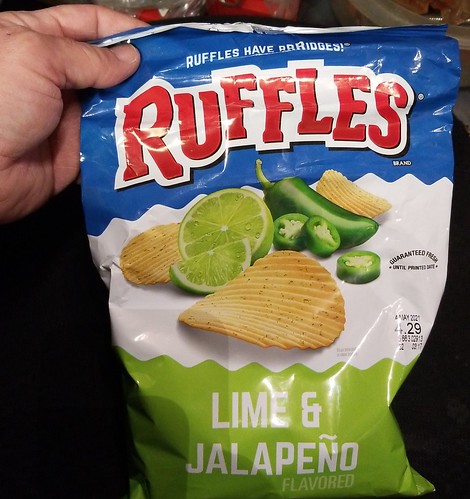
Lime and jalapeno should work, and they probably do work together, but the problem is the medium here. A potato chip by itself brings its own flavor to the party, and in that context, the lime and the jalapeno flavors just don’t go well with fried potato. As a result the chips taste constantly…off, as if the mouth can’t quite figure out what’s going on in the flavor department. Ruffles has a lot of terrific flavors out (try the Queso flavor! Those rock!), but this is a misfire.

However, it’s not all bad in the lime department:

Snacks (for the blog)

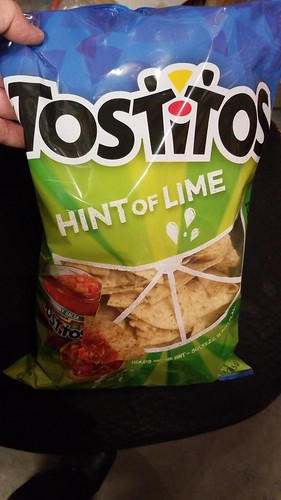
Now, I suspect the lime-and-jalapeno combo would work in a tortilla chip, a corn chip, because there’s not as much strong flavor to work against the two “guest” flavors. There’s no jalapeno here, just lime, and like the package says, it’s not a strong dose of lime. The “Hint of Lime” is pretty accurate, so you get the crackle of the corn tortilla chip followed by the lime flavor that lives somewhere south of the salt, with the effect…well, let’s just say that when I get back to making margaritas, I’ll be enjoying them with these chips. These are terrific! My only complaint is that they are just a bit too salty. I’ll bet that lime flavor adds a nice accent to whatever salsa or picante sauce one uses as a dip. (I had them dry with my sandwich at lunch.)

So, what salty snacks are on your menu these days?

Share This Post

2021 in the Books: Grief, and the Learn’d Astronomer

 I generally try to avoid reading grief memoirs, for various reasons that mainly boil down to…well, I’ve had enough grief in my life already and I know that more is on the way someday*, and it’s a subject I don’t much enjoy plumbing any more than I have to. But sometimes I find a grief memoir that piques my interest and I read it anyway. Smallest Lights is such a book, and I am very glad that I read it. It’s so much more than a grief memoir, really. It’s about science and love and life and death and love again and parenthood and dealing with autism.

The Smallest Lights in the Universe, Sara Seager

It’s also beautifully written.

Not every planet has a star. Some aren’t part of a solar system. They are alone. We call them rogue planets.

Because rogue planets aren’t the subjects of stars, they aren’t anchored in space. They don’t orbit. Rogue planets waner, drifting in the current of an endless ocean. They have neither the light nor the heat that stars provide. We know of one rogue planet, PSO J318.5-22–right now, it’s up there, it’s out there–lurching across the galaxy like a rudderless ship, wrapped in perpetual darkness. Its surface is swept by constant storms. It likely rains on PSO J318.5-22, but it wouldn’t rain water there. Its black skies would more likely unleash bands of molten iron.

It can be hard to picture, a planet where it rains liquid metal in the dark, but rogue planets aren’t science fiction. We haven’t imagined them or dreamed them. Astrophysicists like me have found them. They are real places on our celestial maps. There might be thousands of billions of more conventional exoplanets–planets that orbit stars other than the sun–in the Milky Way alone, circling our galaxy’s hundreds of billions of stars. But amid that nearly infinite, perfect order, in the emptiness between countless pushes and pulls, there are also the lost ones: rogue planets. PSO J318.5-22 is as real as Earth.

There were days when I woke up and couldn’t see much difference between there and here.

Sara Seager is an astrophysicist at MIT whose main body of work involves exoplanets, their discovery around other stars, and analyzing them for signs of life. Among other things, if you wonder how on Earth (literally!) we can look for life on planets lightyears away that nobody in our lifetime (or, likely, in our great-grandchildrens’ lifetimes) will ever see directly, this book will give you some hints as to how that search is currently going. (It involves ingenious analysis of light coming from those planets. It really is amazing, when you think about it, the degree to which light energy is the main carrier of information in this universe of ours.)

In her book, Seager discusses her own work and the degree to which her work has shaped her personal life, and how her personal life has shaped her work in return. Her first husband was a man of considerable energy, whom she met on a canoeing trip; their courtship progressed on more canoeing trips all over the place. But he developed cancer, which eventually killed him at a terribly and unfairly young age. Thus this brilliant astrophysicist, whose work is an important part of the current growth of human knowledge of our universe, finds herself a single parent attending meetings of the local widow’s club, figuring out the nature of this new world she’s been thrust into. It’s the cruelest of ironies, I suppose, that this woman whose life’s work is understanding the universe and seeking other worlds suddenly finds herself in a new world, one that’s familiar to people who have known deep grief, where everything is the same and yet everything is deeply different.

Throughout Seager’s book, I found myself frequently hit in the heart by some of her observations:

:: Everybody dies instantly. It’s the dying that happens either quickly or over a long period of time. Mike spent a long time dying: eighteen months separated his diagnosis and his death.

:: There have been lessons I have chosen not to teach. Not all knowledge is power; not all things are worth knowing. Max and Alex [her sons] never saw Mike’s body. They did not see him leave the house. 

:: [On the Widow’s club] All of our children had become friends. They didn’t gather because their fathers had died; they gathered because it was fun. There is a reason every children’s book is written from the perspective of the child. Children don’t care about adult concerns. We think of children as helpless when they are the embodiment of resilience, more impervious to outside forces than we could ever be again. Despite their suffering, our kids still knew pure joy. 

:: Sometimes you need darkness to see. Sometimes you need light.

:: I don’t think it’s an accident that there’s a mirror at the heart of every telescope. If we want to find another Earth, that means we want to find another us. We think we’re worth knowing. We want to be a light in somebody else’s sky. And so long as we keep looking for each other, we will never be alone.

I love that last one (which actually closes the book, so apologies for the ‘spoiler’). Seager casts loneliness not in terms of presence but in terms of action: we’re only truly lonely when we accept that we are alone and stop seeking others to enrich our lives. True loneliness, really being alone, comes of a permanent turning inward, of looking down and not up. And really, how else would someone who loves the stars see things?

The Smallest Lights in the Universe is a wonderful book that stands in stark contrast, it seems to me, to the view of science as cold and mechanical and mathematical, an enterprise that somehow forgets about emotion and wonder. No less a genius than Walt Whitman expressed this view, in “When I Heard the Learn’d Astronomer”. But the numbers and the proofs surely don’t have to get in the way of the wonder; rather they inform it and give it focus. Science is not an impediment to love and life. Science is a part of those things. Sara Seager’s book shows us how.

Share This Post

How do you measure, measure a year…. (Something for Thursday)

 One year, give or take, more or less.

There’s a famous song from the Broadway show Rent, called “Seasons of Love”. The song talks about the measure of time, specifically, a year:

Five hundred twenty-five thousand six hundred minutes
Five hundred twenty-five thousand moments so dear
Five hundred twenty-five thousand six hundred minutes
How do you measure, measure a year?

In daylights, in sunsets
In midnights, in cups of coffee
In inches, in miles, in laughter, in strife
In five hundred twenty-five thousand six hundred minutes
How do you measure, a year in the life?

That’s how many minutes there are in one year: 525, 600.

As I write this (a few days before I’m publishing it), the COVID-19 death toll in the United States, according to the CDC website, is 519,064. We’re just under a death a minute from this disease, over the last year.

“How do you measure, measure a year.” Indeed.

I’m not sure when I consider the COVID-19 virus to have really “begun”, in terms of being a major concern in my personal world. Maybe it was when the World Health Organization declared it a pandemic (March 11, 2020). Maybe it was when Tom Hanks announced that he and his wife, Rita Wilson, had tested positive (March 12, 2020). Maybe it was when the National Basketball Association had to start canceling games because players were testing positive (the same day). I remember watching this segment on John Oliver’s Last Week Tonight, which aired on March 1, 2020, a few weeks before everything went haywire. The segment is worth watching again, because it’s astonishing how wrong everybody was at the beginning…but even given that proviso, note Larry Kudlow confidently saying, “We’ve got this thing contained already.”

What strikes me most about that video–and this was not only before vaccine development was even at a hopeful stage, but when our best science still hadn’t homed in on COVID-19’s respiratory nature and was still not really endorsing mask use and was instead focusing on rigorous hand-washing and avoiding face-touching–is what Oliver says at the 18:25 mark:

“At this point, you may be wondering, how scared should you be? And the answer is probably, a bit. A bit. I don’t want to be alarmist here, but I don’t want to minimize what we might be facing here.”

It turned out that we should have been a bit more than a bit scared, but then, we didn’t know then what was to come or how Americans would react to it all. Those first weeks, though? Those were…incredible.

It’s all a bit hazy right now, but as COVID-19 began to take hold in the US, and as we all realized that Mr. Kudlow’s lying aside, we most certainly did not have this contained, and as we all saw in the news stories of massive lockdowns in China and Italy and other places with soaring case and death counts, Americans started to panic. For those of us who work in grocery stores, that panic turned into something pretty epic. The run on cleaning supplies was obvious, as were the runs on a number of food staples. People were suddenly wondering: Are we about to be locked in our homes for weeks on end? Are we going to be forbidden to go outside? Will we not be able to buy food or other supplies?

By the end of those first days, the shelves at The Store looked like…well, I struggle to come up with a metaphor, but we’ve all seen the pictures from grocery stores in the South when the hurricane that’s on its way has been upgraded to Category Four. Our delivery schedules were thrown into serious awry as individual stores were suddenly ordering two, three, four times as much supply as they usually did; this surge got passed on to corporate warehouses and then to suppliers. Some brands disappeared from our shelves and have yet to show back up, even now. Buyers scrambled to get stocked with brands we’d never heard of (and if I may say so, Sugardale pepperoni is really tasty!), and of course there were the buying limits that seemed to go on forever. One can of beans. One jar of peanut butter. One package of toilet paper.

And oh, toilet paper. Somehow that one item became the “poster child” for the pandemic’s early run of panic shopping, didn’t it? I came in to work on Saturday morning for a sixth day, just to assist our overwhelmed Grocery department, and the first thing I did at 6:45 am was to pull a pallet of toilet paper out onto the sales floor. The entire pallet was emptied by eager customers in minutes. So was the second one. So was the third one.

At that point, no one had any real idea of how to best combat the virus. The best advice was to wash your hands constantly and avoid touching your face. My hands were absolutely raw after all that washing, and that’s when hand lotion became an indispensable part of my life. We didn’t know yet that the virus was mainly transmitting via respiratory droplets, but that became clear pretty quickly (I remember a horrifying story about a choir someplace in Washington that had a rehearsal that led to nearly all the choir members becoming infected), and then…masks were upon us.

This may make my RBF worse. #Mask

I never liked wearing masks as a kid, not even as part of a Halloween costume, so this took me some time to get used to. It took me a bit of experimenting to realize that the best masks for me were the ones where the straps or cords go around the head and not around the ears, and I bought several masks online from makers who knew what they were doing (i.e., not cheaply-made single-ply thin cotton ones). A year later, I’ve mostly become accustomed to wearing the mask, though I do consider myself fortunate in that my job affords me ample opportunity to take the mask off when I’m alone in my own work room. But even so, I have to admit to being shocked and dismayed at the reaction to masks by an awful lot of Americans.

I’ve seen people wearing masks with anti-mask slogans printed right on them, which strikes me as deeply weird. One said “This mask is USELESS!”, and naturally, it was, given that its wearer had it below her nose. Another said “Worn by FORCE, not FEAR!!!”, which is just goofy. I do not for the life of me understand that macho American attitude toward “fear”, as if self-preservation is a non-manly thing to want. I periodically see snark online: Why would you wear your mask when you’re DRIVING BY YOURSELF, sheeple! Well, speaking just for myself, I’m making several stops in one trip and I don’t want to bother with putting the mask on, taking it off, putting it on, taking it off, each time I stop someplace or come outside. And don’t get me started on the people who will, upon exiting a store or office, rip their mask off and take in a giant deep breath as if they’ve just broken the surface after a deep dive in the sea beyond the limits of their lung capacity.

I’ve reached a point where much of the time I’m wearing a mask, I don’t even think about it and barely notice that I have it on, to the point that I’ve actually caught myself trying to do things like blow a bit of hair off my phone or take a sip of coffee while masked. I cannot understand the sheer levels of anger something so simple as a face mask has inspired. I am once again confronted by the degree to which a great many of my own fellow citizens hold beliefs with which I cannot even begin to remotely empathize…but this is not that post.

As crises go, it’s been very strange for me that this one has been fairly well tailored to suit my particular lifestyle. As an introvert who is quite happy to live a mostly inner life, this pandemic has not been that hard to live with. I miss eating out with The Wife, and the festivals that we love visiting were all canceled last year: no Nickel City Con, no Sterling Renaissance Festival, no Erie County Fair, no Ithaca Apple Harvest Festival. But I still got to go on nature walks with the dogs, and while eating in restaurants hasn’t been a thing in a very long time, we’ve had a lot of wonderful takeout meals. But we don’t find ourselves missing out on desperately-needed human contact; we don’t find ourselves starved for hugs and we don’t find ourselves aching for a return to “normal”. I would, in fact, be lying if I did not admit that some small part of me finds a bit of satisfaction in seeing the world’s extroverts, so many of whom act like introverts like me are somehow problematic, being forced into my way of living for a little while.

Still, though: it’s been a year, and it’s been a hard year, a bad year, a terrible year. It’s been a year that was always going to be bad, but didn’t have to be as bad as it was (and I have a lot more to say about that, whether or not I actually do decide to say any of it). But there were moments along the way, moments of light, moments of goodness, moments that made me think that maybe, just maybe, this entire experience would be a learning experience for enough of us–a critical mass, if you will–that maybe we can still build a future to come in which we put aside the notion that we’re all in this alone, that we’re all marked for our individual fates and that our purpose here is just to serve as our own tiny cogs in the great machine that we call The Economy.

As the light grows at the end of this tunnel, I hope and pray that we take the lesson with us that nothing had to be this way, and that our world can be better. If a crisis does nothing else, it affords us an opportunity to look deeply at our society and ask serious questions about why we do certain things the way that we do. A “return to normal” would be so incredibly disappointing, wouldn’t it? I don’t know about you, but I was never in love with my “normal”. I dare us to do better.

And I think that those 525,600 people–one for every minute, and counting–dare us to do better too.

Share This Post

Speaking of Albums: Marine Band Showcase

marine band showcase
So years ago I had a short-lived posting series called “Exploring the CD Collection”, in which I wrote about entire albums I had in my collection. I’ve been thinking about revisiting that series, but expanding it beyond the limits of my personal CD collection, because after all, these days thanks to streaming services we have a lot more access to complete albums than we once did. Since the focus won’t entirely be my CD collection, it seems odd to call the series “Exploring the CD Collection” anymore. I thought about “The Record Shelf”, since records are an even older tech than the CD (though one that’s been coming back of late), but then I remember that The Record Shelf is the title of a public radio show by critic Jim Svejda, so that’s out. Then I thought about an allusion to some of my favorite Saturday Night Live sketches, the classic Celebrity Jeopardy! sketches in which Will Farrell’s Alex Trebek would square off against various boneheaded celebrities and the viciously bawdy and acid-tongued Sean Connery (Darryl Hammond), who would gleefully mispronounce the show’s subjects to make them sound dirty. Thus I would have called this series “Anal Bum Cover” (the topic, to Trebek’s chagrin, is “An Album Cover”), but…well, I chickened out. “Speaking of Albums” it is.
I won’t promise to always embed an entire album in these posts; that will depend on availability of the album online, and I’m not going to limit myself to only writing about music that I can embed in its entirety. However, in those cases I will at least try to embed a few representative tracks.
My thoughts on doing this were jumpstarted by this Sheila O’Malley post, in which she shares a photo she once took of a Marine Band musician boarding the tour bus. I yield to no one in my respect for the United States Marine Band, which I mentioned in her comments; she asked if I’d written about them, and in searching my archives, I found that I had…seventeen years ago. Rather than share that old post, I thought I’d update it. So, here we go!
Speaking of albums, let’s consider Marine Band Showcase, featuring the United States Marine Band, conducted by Colonel John Bourgeois.
Ever since my days in the concert band both in high school and college, I’ve felt that the concert band (occasionally called the “wind ensemble”) tends to be unfairly treated in classical music circles. Many think of it as a symphony orchestra minus the strings, with the woodwinds “beefed up” to take over those parts in transcriptions of symphonic repertoire. The concert band, or wind band, tends to be seen as mainly a student group in schools and colleges, or as a local “town band” in some lucky villages. Band music isn’t taken terribly seriously, and relatively few of the great composers ever wrote for the concert band, which is a shame.
The truth of the matter – that the concert band is its own animal, with advantages and disadvantages of its own, and is capable of musical expression to a greater degree than just about any other possible ensemble with the exception of the full symphony orchestra – isn’t often granted, and this seems to me a pity. There’s a lot more to concert band music than Sousa marches and the music for those wonderful competitive British brass bands. (Not to slight either genre, there, for both are fascinating.)

The “Gold Standard” for wind bands in the United States is the United States Marine Band, which is actually the oldest continuously operating musical ensemble in our nation, having been established by an Act of Congress signed into law by President John Adams in 1798. Often called “The President’s Own”, it is the Marine Band that provides the music for Presidential Inauguration ceremonies, receptions of foreign dignitaries on the White House South Lawn, state dinners, and more, including public concerts. This is no organization of “second-rate” musicians; performers are selected by an audition process as rigorous as that employed by many professional orchestras, and the members of the Marine Band are career professionals, as well as members of the United States Marine Corps.

The Marine Band performs a lot, though for the vast majority of Americans, the main venue where they get to hear the band is on Inauguration Day every four years when depending on how much of the ceremony they watch, they might hear “The Star Spangled Banner”, “America the Beautiful”, “The Stars and Stripes Forever”, and “Hail to the Chief”. That’s a pity. There is an enormous wealth of wonderful music for concert band beyond the marches and circus music, and the US Marine Band has recorded a ton of it over the years.

Marine Band Showcase is an album I sought out because of one piece on it, and at the time I had to order it through a subscription service called the Musical Heritage Society, which was basically Columbia House for classical music lovers. It has since turned up for sale in various outlets, and the whole thing is available on YouTube, which is nice. The album is perfectly titled: it’s a showcase of the wide range of musical expression a wind band is capable of achieving.

The disc opens with a transcription, Bach’s Toccata, Adagio and Fugue in C Major, BWV 564. This is the only transcription on the disc, which is notable because transcriptions of orchestral and keyboard works used to comprise the majority of the repertoire for wind bands. The other seven selections are music specifically written for wind band, and there isn’t a single Sousa or K.L. King march in evidence. There is one by Beethoven, the March in D Major, that the great composer wrote for the bands of his day, and there is Percy Grainger’s wondrous Children’s March: Over the Hills and Far Away, which is one of the most charming pieces of music ever composed. Grainger’s Marching Song of Democracy is here, and it’s an interesting work in its own right. There is Camille Saint-Saens’s work for wind band, Orient et Occident, which is a standard of the band repertoire. And there are several “modern” works, one of which is the reason I sought this disc out. That work is Elegy, by Mark Camphouse, and it is one of the most moving pieces of music I have ever heard.

I was fortunate enough to get to perform this work in my freshman year of college, and I still remember how stunning I found the piece. It opens with a solo flute, sounding a motif that recurs throughout the piece, and very, very gradually the rest of the woodwinds enter. Listen to the Marines play this! It’s some of the best woodwind playing you’ll ever hear, and gradually the rest of the band arrives. Elegy is a piece that questions and strives, always seeming to gather its strength and then ebb away, and parts of it sound like a liturgical comment on death. There are passages of mystery and anger; melodies seem to arise but then disappear again throughout as the music poses questions whose answers never seem to satisfy. Finally, though, we come to the work’s final segment, starting at the 10:42 mark below, in which Camphouse finally seems to be pushing toward an answer. This starts with a more contemplative tone, but it builds and builds and builds until we arrive at a final flowering that is one of the most astonishing musical climaxes I have ever known. (Playing this in college had the effect of leaving more than a few of us in the band in tears.) Elegy ends with a feeling of peace and calm and acceptance, but…one final tolling of the bell, off the tonic, leaves the listener with a slight sense of non-resolution.

Elegy is a work that plumbs some of the deepest mysteries of human existence, and I consider it to be a masterpiece. It’s a work to which I turn often in times of emotional stress; it was the first piece of music that I could listen to after 9-11-01. I’ve listened to it a number of times over the last year, for obvious reasons.

The Marines play all of this amazingly, with utter technical command of their instruments, and their sound is full and robust, the way a great band should be. This is a great, great recording.

Here is the entire album, embedded as a playlist. Enjoy!

Share This Post

Tone Poem Tuesday

 Here’s an interesting piece! I didn’t realize this was even available online until a few weeks ago when I looked up the composer by name. Linda Robbins Coleman is a composer, conductor, and teacher from Iowa whose symphonic poem Journeys was commissioned by the Wartburg Community Symphony Orchestra while I was there. Yes, I was privileged to take part in a world premiere, under the baton of Dr. Janice Wade

Coleman’s website describes Journeys thusly:

Journeys, A Symphonic Poem, marked a turning point for composer Linda Robbins Coleman in that it was her first large-scale work conceived and produced without utilizing another medium for inspiration. As the composer says, “I chose the title in part because the years leading up to its composition were quite a personal and professional journey for me. When I began to write I discovered that Journeys would not be a programmatic description of a picturesque country or great work of literature, but that it would tend more towards a reflection of where I have been within myself, and where I am struggling to go.

Prior to Journeys, most of my larger works had been for theatre, writing incidental music, scores, or songs for plays ranging from Euripides and Shakespeare to modern and avant-garde productions. All were highly descriptive both in mood and language. This experience enabled me to learn how to experiment with various tone colors to convey the different feelings expressed in plays. But with Journeys I was on my own. Even though my music is very tonal and accessible to all audiences, I still found that expressing personal feelings and moods–from my own script this time–to be a most stimulating challenge.

I hadn’t heard Journeys since I played it back in February of 1992, so revisiting it is a surprising exercise in…well, not nostalgia, but an exploration of things not quite remembered. There is a passage in here that I remember quite clearly, as the piece’s middle section reaches it climax; there is some daunting trumpet writing in there, in which I was required to hit notes loudly that I wasn’t terribly confident of hitting much at all. I did manage to nail them, though.

I’m glad to read that Journeys didn’t disappear down a musical memory hole. It has apparently been performed a bunch of times since, as this recording proves (that is not my orchestra). Journeys is bold and dramatic, and quite modern in its conception. I hope you enjoy it.

Here is Journeys by Linda Robbins Coleman.

Share This Post