I’ve added a permalink under “Other Journeys” to a pretty good left-leaning blog by William Burton, provocatively titled….”William Burton”. Interestingly, every post Burton has ever written appears on the main page. He does not appear to have an archive set up.
Untitled Post
Steven Den Beste is back on the air, with an interesting article on gambling. I don’t much enjoy gambling; if I’m going to spend money on a vacation, I would like to at least get something — the memory of a show, or a fun ride, or the like. And if I’m going to spend money on a machine that flashes neat lights at me, I’d rather it be a vintage 1980s video game, like “Ms. Pac-Man” or “Marble Madness” or “Defender” (surely the goofiest set of game controls ever). I’ve been to Casino Niagara, the big casino in Niagara Falls, Ontario. It’s a gorgeous facility, and the constant tinkling of coins falling loudly into the tray of the slots is addictive, as are all the attractive lights and bells and such, but spending a few hours there — while enjoyable — leaves one with a very unfulfilled sensation. “So, that’s it?” was my overwhelming feeling upon my departure from the place. (I only played slots; I steered well clear of blackjack because I am an amazingly bad card player. Of course, I suspect that blackjack is not a game that requires skill in the way that poker or 500 do, but I’ve developed something of a card-phobia over the years, so bad at cards am I.)
What also struck me about Casino Niagara was the escalator ride from the smoking floor down to the non-smoking floor. You know that line of faint haze that forms in a room where the air is still and you’re burning incense? Imagine that line of haze, much thicker, as your head drops beneath it when the escalator carries you down to the non-smoking floor. And people were spending hours in that haze, happy as clams. Yeesh.
Share This Post
Untitled Post
SF author Charles Sheffield passed away yesterday. To my knowledge I have not read any of his writing, but it is still sad to note the passing of a member of the community that I’m working to enter.
Share This Post
Untitled Post
One nice thing about film score collecting that appears to be going by the wayside is the fact that it was a sufficiently small market to avoid some of the more irritating tactics that surround film franchise merchandising — there would be a single release of a film’s score, but that’s pretty much it. This has started to change in recent years, though. For instance, the soundtrack release of Star Wars Episode II: Attack of the Clones was fairly irritating. The score CDs featured four different covers, which was fine by me, as I don’t care much about such things. But then different releases of the score, sold at different outlets, included different “extras” on the disc. If you bought the thing at Wal-Mart, you got a screensaver or some such thing; however, if you bought it at Target, you got an extra track of music. (For me, music’s the thing, so that’s the version I got.) Another example was the score release for The Lord of the Rings: The Fellowship of the Ring, in which the “normal” releases also had multiple covers (I got Saruman, simply because that’s all the store had the night I bought the thing), as well as a “special” release in a leather-backed case that came with some other goodies (I don’t know what), but no extra music.
And now the same sort of thing is going to be the case with The Lord of the Rings: The Two Towers, with a normal release and a “deluxe” release and then a “limited” release only available online. What’s particularly galling in this case is that the more expensive versions will include the extra track of music, but not the “normal” release — but of course, the running time of the normal release will be the same as the other releases minus the “bonus track”. Asking score collectors to pony up an extra $10.00 just to get that extra track is, well, kind of mean. I’ll be getting the “normal” release. (Info on the various releases of The Two Towers can be found here.)
Share This Post
Untitled Post
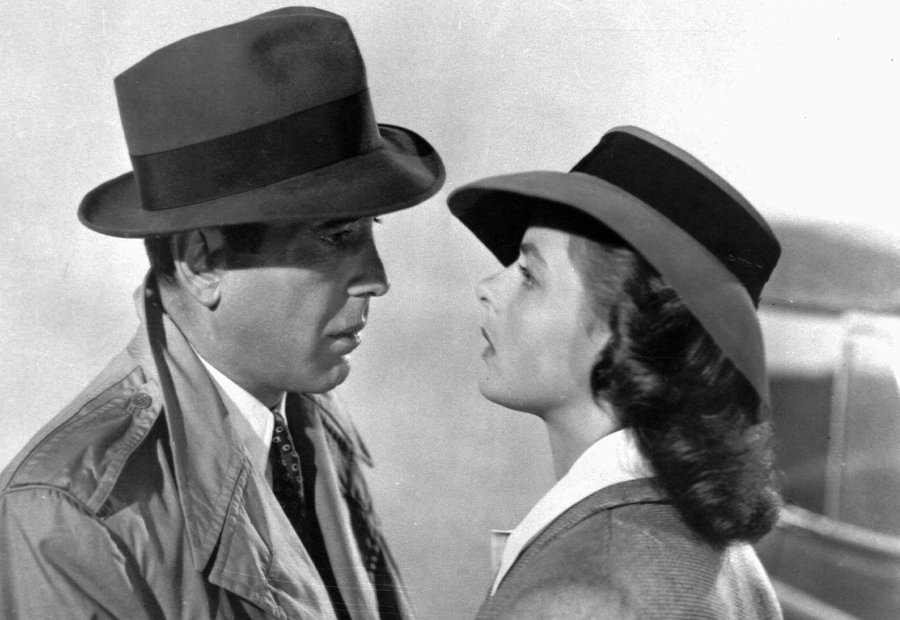
I watched Casablanca last night.
I used to watch Casablanca much more frequently than I do these days. One year, during college, I watched the film every Sunday afternoon for six consecutive weeks. Doing so has ingrained upon me a preferred way of watching the film, that is almost a ritual. I love to watch the film on an early winter evening, starting it around 5:00 or so, while it is still light out and with no lights on in the room. Then, as the film progresses, it becomes dark outside and as the light in the room diminishes, the light from the television — from Casablanca — takes over until it is the only light at all. It’s odd, the rituals we create in our lives and the objects we use to create them. I’m sure there are better ways to watch Casablanca. In a theater, perhaps. But this is my way of watching it. And you know what? I just may watch it again today, transporting myself to the heat and desperation of North Africa in World War II, even as the snow falls outside in Upstate New York.
Some thoughts on Casablanca:
:: If there has ever been a film with better dialogue, I’ve not seen it. This film is a study, a virtual clinic, in how to construct dialogue. It isn’t merely that the film is loaded with some of the most famous lines in film history, except one (do I really need to tell you that “Play it again, Sam” is not a line in this movie?). What amazed me so about the dialogue last night as I listened to it is the way the dialogue flows. The conversations in the film all follow a logical progression. So many film conversations sound like characters talking past one another, with lines that don’t seem to follow from the context of what’s been said, and we sometimes wonder: “Now why did he say that? Where did her line just now come from?” That doesn’t happen here. These characters are really talking to one another: exchanging information and viewpoints, feeling out each other’s emotions, seeking out weaknesses or strengths.
:: I read somewhere — I think it was in Robert Silverberg’s book Science Fiction 101 — that Islamic carpet weavers will purposely introduce a flaw into the pattern of their magnificent rugs, on the theory that to fashion perfection by the hand of man would be an act of heresy toward God. I wonder if the same might be true in Casablanca‘s script, because there are only two false-sounding lines in the entire script. Both come from Ilsa Lund, during the Paris sequence. Once, when she tosses Rick a coin and says, “Franc for your thoughts”; and then a bit later, when the Nazis are coming and she says, “Kiss me as if it were the last time….” There isn’t another false note in the entire screenplay, which would be amazing enough by itself. It seems almost miraculous, though, in light of the famous fact that the script wasn’t even finished while the picture was shooting.
:: Max Steiner’s score is absolutely wonderful. Three main motifs work their way through the score: “La Marseillaise”, “As Time Goes By”, and a darker theme, characterized by low brass, low strings, and deep timpani rolls. Of course, “As Time Goes By” is totally associated with this film. Fittingly, that melody does not appear in the score until the moment when Ilsa requests that Sam play it, but from then on it is woven into the score with amazing subtlety — sometimes at the same time as the dark German music, sometimes forming a segue into “La Marseillaise”. Max Steiner was one of the greats of film music’s Golden Age, and Casablanca shows why. (The quality of his music is even more incredible when one considers that Steiner hated “As Time Goes By, and he was very nearly successful in his lobbying for the song to be dropped in favor of an original song he had written. Only the fact that Ingrid Bergman had moved on to another film and cut her hair for the new role, which made reshooting the necessary scenes impossible, saved “As Time Goes By”.)
:: Have there ever been more great close-ups in a movie than in Casablanca? Witness the very long closeup on Ingrid Bergman, as Ilsa listens to Sam singing “As Time Goes By”. I can’t think of any actors or actresses today who could pull off such a long closeup.
:: A sometime-quoted rule of writing is “Always leave them wanting more”. I hold Casablanca as a counterexample to that theory. At the end of this film, I do not want more. I don’t want to know what Rick and Louis go on to do when they get to Brazzaville. I don’t want to know about Victor Laszlo’s work in the resistance once he escapes. I don’t want to know if Ilsa and Victor have children after the war, and I don’t want to know if Ilsa grows old and wonders about the life with Rick that she passed up. Casablanca does not leave me wanting more. It leaves me satisfied.
:: Only a film as good as Casablanca could have me overlooking the fact that the “Letters of transit” make absolutely no sense.
Share This Post
Untitled Post
I haven’t been making regular predictions of the Bills’ games this year, because I’m not terribly good at the predicting business. But I’ll make an exception this week, just for kicks.
While I think that the Bills may be better than I gave them credit for initially — I had forecast a 6-10 season, and they’re 5-3 already — I think that the Patriots are still the defending Super Bowl champions (despite my feeling that their title last year owes more to the sacrifice of ninety-nine chickens in some kind of weird ritual than anything else), and while the Bills are playing quite well with their defense especially showing improvement in their last two games, this game simply means more to the Patriots. If they lose this one, their season is effectively done; they would be 3-5 and have to go at least 7-1 (and maybe 8-0) the rest of the year just to make it back to the playoffs. I think the Bills will be tough, and I think Drew Bledsoe will have a good game, but I think the Patriots will win it in something of a squeaker. So, my pick is Patriots 30, Bills 27.
Share This Post
Untitled Post

What do you do when you are a former member of one of the most renowned comedy troupes in history? If you’re John Cleese, you move on to various writing and acting endeavours, including taking over for Desmond Llewelyn as Q in the Bond films. If you’re Terry Gilliam, you direct movies….really offbeat, strange movies. And if you’re Michael Palin, you become a world traveler and film your exploits for the BBC and PBS. Check out his site; it’s wonderful for the photography alone.
(crossposted to Collaboratory.)
Share This Post
Untitled Post
Today recorded the first snowfall of 2002 in the Syracuse region, resulting from that most wonderful (or hated, as the case may be) fact of climate and geography: the lake effect. For those who have better things to do than watch the Weather Channel, the “lake effect” happens when cold air blows across the surface of a warmer body of water, picking up a substantial amount of moisture as it does so. Then, when that now-moisture-laden air moves over land again, the moisture comes out as precipitation — generally, snow, and lots of it. How much snow falls, and where, is determined by the direction of the winds as they cross over the water onto land. Lake effect snow tends to set up in narrow “bands” of intense snowfall, so one can be in the middle of a blizzard in one spot while someone else, just miles away, can be experiencing no snowfall whatsoever. And even weirder is if one is outside the band where the snow is currently falling, one can actually see the band of clouds during the day — there will actually be this long, dark stretch of threatening-looking clouds to the south or north.
The gigantic snowfall that paralyzed Buffalo last December was a lake-effect storm. In that case, the winds traveled up the entire length of Lake Erie, picking up pretty much the maximum possible amount of moisture before encountering the first bit of land at the lake’s opposite end — which just happens to be where Buffalo sits. Ergo, gigantic blizzard in the city and the south and eastern suburbs, but nothing in the northern suburbs and little in “ski country”, which is about thirty-five miles south of Buffalo.
Now that I’m living in Syracuse, though, the operative lake is no longer Lake Erie but Lake Ontario. The key difference now, the “unknown factor” as it were (unknown to me, that is; I’m sure the locals know all about it) is that Lake Ontario, being much deeper than Lake Erie, does not freeze over during the winter. This means that lake-effect snow is a constant possibility all through the winter. In Buffalo, though, once Lake Erie freezes over during the winter — Erie is the shallowest of the Great Lakes — the lake-effect “snow machine” stops, and for the most part Buffalo stops recording snowfall.
Another key difference is that Buffalo is far enough inland that the infamous Nor’easters do not affect it, unless the Nor’easter in question is positively gigantic. (The “Storm of the Century” in 1993 is a prime example.) Syracuse, on the other hand, appears to be poised to catch the westernmost cusp of the Nor’easters as they make their Baltimore-Philly-New York-Boston-Portland trek. Thus, in short: I am bracing myself for a lot of snow this year.
Share This Post
Untitled Post
Someone earlier today visited Byzantium’s Shores via a Google search asking how many bullets Francisco Scaramanga’s gun could hold in The Man With the Golden Gun. On the off chance that this person is still looking for that bit of info and looks back here, the answer is: One.
This is established in a bit of dialogue between Bond and Scaramanga at the end of the film, when Scaramanga proposes the gun duel between the two men. Bond says something like, “My six bullets to your one?” and Scaramanga replies, “I only need one.”