How Superman’s Butt Saved Christmas

(Blame SamuraiFrog for this one, folks — he gave me the title! I deny all accountability. Except for the part where I write the following tale. Which I’m doing stream-of-conscious, right off the top of my head. No editing.)

Lore has it that there is one, and only one, substance that can stop Superman dead in his tracks.

Kryptonite.

Irradiated fragments of rock hurled into the deep dark of space when his planet exploded, Kryptonite’s radiation and other qualities unique to its place of origin make it near-lethal whenever Superman comes in contact with it. So, of course, every one of Superman’s antagonists knows of this weakness, and they all try, at one point or another, to use Kryptonite to get the drop on him.

What they don’t know is that there is another substance that can significantly weaken Superman. This one is not so lethal; in fact, it’s not lethal to Superman at all. He survives a brush with this substance within a day, and he’s back to normal. But he finds its effects extremely unpleasant, both because of what they do to him, and what he has to do to keep those effects from being lethal to those around him, because his body magnifies those effects over what they would do to a normal human being.

What is that substance, you ask?

Beans.

Whether out in public as Superman or as Clark Kent, the fact remains…Kal-el cannot eat beans.

He was never able to figure it out, but as a kid, the first time Ma Kent put beans on the table — of any kind, except for jelly — he became very, and explosively, gassy. Imagine Kal-el’s digestive tract, super-charged as was every other aspect of his body over the normal human version. Gas, for him, was survivable — but disastrous for anybody nearby. So, no beans.

This was pretty easy to deal with, as he got older. Nobody really ever tried to give him beans to eat as Superman, and as Clark Kent, he could just claim either allergy or that he didn’t like them. Problem was, he said the latter to the wrong person.

Enter Lois Lane.

Now, Lois Lane is a great reporter. One of the best. She fearlessly charges in to get stories that no one else can get, and she reports them with snappy writing that defines her newspaper, the Daily Planet. But to anyone who isn’t remotely as strong-willed as she is, or possessed of super-patience (like Mr. Kent), Lois Lane is basically a giant pain in the ass. It’s true. She has to have the last word on everything, she has to be right, and if you disagree with a single position she takes, she will make it her mission in life to show you how wrong you are. So when Clark Kent told her one night when they went out to dinner at a Mexican place that he didn’t care for beans, she said a polite “Mm-hmm” as she filed that away in her head.

I’ll change your mind about beans, Clark. Oh yes. I will change your mind about beans!

Lois Lane could be a little bit creepy and weird, come to think of it.

So there was Lois one day, hatching a plan to convert Clark Kent to liking beans. Her scheme involved getting him to eat some without him knowing that they were beans, and when he said how much he liked the dish, she’d be able to spring on him the fact that he’d just eaten beans and liked them so he could now see how silly he was being with that whole bean thing.

Yeah. As plans go, that’s about as complex as Lois Lane could muster. Lex Luthor, she wasn’t.

Which brings us to: Lex Luthor.

See, Lex Luthor was pissed off that year as Christmas rolled near, same way he was every year when Christmas rolled near. He was angry because his schemes had been thwarted. He was also angry because the snowmobile he was on kept wanting to tilt over to the right, because of the weight of the rocket launcher they had with them.

“I can’t believe it,” said Lex. “How hard can it be to figure out where Superman goes all the time! It’s not that big a planet! There’s only so much ‘north’!”

“Maybe he starts out north and then turns left,” his henchman offered. This henchman was fat and portly and looked something like that guy from the movie Network.

“Shut up, you nitwit. Let me think.”

He pulled the snowmobile over — who knows why, they weren’t even on a road — and looked at his map. “I’ve triangulated every course Superman’s ever taken when he flew north from Metropolis. I can’t believe he’d fly in anything other than a straight line, but the lines never converge on anything. And yet, I swear he must have a Fortress up here somewhere!”

“Maybe he just likes his solitude?”

“Oh shut up.” Lex fired up the snowmobile again, and off they went. (How did they have enough gas to snowmobile all the way that far north? Why are you asking me?!)

Meanwhile, some hundred miles south in the city of Metropolis, someplace in the eastern United States but totally not New York City even though it really looks like NYC and all, Clark Kent arrived at Lois Lane’s apartment. He awkwardly knocked on her door, and she opened it and let him in.

“Hi, Clark! Merry Christmas! I’m glad you could make it.”

“Oh, well, gosh, Ms. Lane, thanks for inviting me! You know, I was really surprised that you invited me to your Christmas party. I just figured I’d stay home and read some more Reader’s Digest.”

“Don’t be silly, Clark! It’s Christmas! Look everybody, Clark’s here!”

The other guests all just kind of nodded in Clark’s direction. Anyone other than Clark Kent would have thought the whole lot of them a bunch of assholes, but not Clark Kent. He was nice, that way.

“Want something to drink, Clark? Bar’s over there. You know where it is.”

“Oh thanks, Lois. I just thought I’d have some water.”

“Uhh…sure. Water. Well, there’s that, too, I guess. I have to go check the food!”

And with that, Lois disappeared into her kitchen, where wonderful smells were wafting out. That piqued Clark’s curiosity, so he wandered toward the kitchen door and peaked in. Jimmy Olsen was in there, doing all the cooking, while Lois buzzed around him. That explained it. Lois could barely boil water without burning it.

“I don’t know about this plan, Miss Lane,” Jimmy said.

“Just do it, Jimmy. I have to find out the truth about what Clark says.”

“This seems kind of mean though!”

“Just get it done!”

Clark turned away, alarmed. So that was it: another one of Lois’s hare-brained schemes to see if he was really Superman or not. Why wouldn’t she just give it up! Clark sipped his water, wondering what it was going to be this time.

Meanwhile, way up north, Lex Luthor was getting more and more angry. He pulled the snowmobile over again, shut it off, got off, and kicked it.

“Careful Mr Luthor!” his henchman said. “You broke your foot doing that once!”

“Then maybe I’ll kick something soft and fleshy!” Lex shouted. “Like…your ass!”

His henchman shook his head in amazement at the way Mr. Luthor’s voice in such moments always managed to sound like a blend of Gene Hackman and Kurtwood Smith.

“I can’t believe I can’t find Superman’s fortress! It has to be up here somewhere! He can’t just break laws of physics like that!”

“He can fly,” the henchman offered.

“Shut up!” Lex began to pace. “All right, think. He’s always up here. He always goes north. Why north? What is up here? Polar bears? Inuit natives? Frozen white men from Europe who thought they’d find the North Passage? What could possibly be up here?”

“Maybe that train can tell us,” the henchman said.

“Train? What the hell are you babbling about now?”

“Look,” the henchman said. “A train.”

He pointed. Sure enough, there in the distance was…a train. Six passenger cars, pulled by a locomotive whose headlight cast a golden sheen across the ice in front of it.

“A train? Up here? Where could that be going?”

“Maybe Superman doesn’t have a fortress!” the henchman offered. “Maybe he flies up here and catches a train!”

Lex stopped and slowly turned toward his henchman as his brain tried to process what it had just heard.

“You think…that Superman…flies thousands of miles to catch a train?”

“Er…well…maybe he likes trains. Maybe they’re his hobby. Kind of like you and those magazines you collect, the ones with the pictures of pretty–”

“Shut it!”

“Sorry, Mr. Luthor.”

Lex turned his attention back to the train. Where could it be going…and then, in a flash…he knew. A grin spread across his face.

“Come on,” he said to his henchman. “We’re going to need that rocket launcher after all!”

“Oh! Did you find Superman’s fortress, Mr. Luthor?”

“No,” Lex said. “But there is a fortress up here. And it belongs to another superhero with whom I have a score to settle.” He got the snowmobile running and gunned it, almost before his henchman could jump on board again. He needed to get there. Oh yes, he needed to get there, indeed. And a certain other superhero, this one whose suit was red, had some answering to do for a broken model ship Lex had got for Christmas when he was ten.

Oh yes.

Meanwhile, at that moment, Lois started putting out the food that Jimmy had made. And he’d done a great job of it, too: crab puffs, lobster dainties, shrimp shrimp and more shrimp, Buffalo chicken wings, authentic Metropolis-style pizza (indistinguishable from New York thin crust, but let’s not go there right now, shall we), and chips with the most creamy, luscious, cheese dip you ever saw, cut with just the right amount of hot sauce and spices. Everyone tucked in, and Jimmy headed for the bar to make himself a reward drink when Lois slapped his wrist and sent him back to the kitchen to wash dishes.

“Aren’t you going to eat, Clark?”

“Uhhh…sure, Lois.” What was the trick here? How was she using food to test him? What was this all about? Best just to go along with it, he thought. So he made himself a little plate of food, returned to his corner where he resumed his conversation with the potted plant, and ate. It was all really good, but Oh my God, the cheese dip was fantastic! He’d never tasted anything so wonderful in his life. The creaminess, the smoothness, and the blend of cheese and heat from the sauce! Clark made a mental note to take Jimmy aside next week and ask him why he was doing photography for the Planet when he could be cooking in a restaurant.

Clark didn’t notice Lois’s smug expression of victory when he went back for more cheese dip.

Meanwhile, Lex Luthor guided his snowmobile to the edge of the icy sea, where the train rumbled across a series of bridges made of brick toward a gleaming city of brick. “The North Pole,” he said.

“Why doesn’t it look like it did in National Geographic?”

“That’s the geographic North Pole,” Lex said. “This is the mythic North Pole.”

He could practically hear his henchman’s brain gears a-grinding away on that one.

“All right.” He checked his watch. Fifteen minutes to midnight. “Help me get this rocket launcher ready. It’s almost time.”

“Time for what?”

Lex couldn’t keep it in any longer. He laughed and laughed and laughed.

“We’re going to shoot down Santa Claus!”

“Awwww!” His henchman began to cry as Lex got the rocket launcher ready.

Meanwhile, in Lois Lane’s apartment, Clark Kent’s super digestive system began to go…awry.

It started with a simple little gurgling feeling, but that gurgling became stronger and stronger. Clark leaned into the corner, behind the potted plant, and emitted a belch as stealthily as he could. It made no sound, but the plant’s leaves rustled and then wilted a bit. When he stood back up, he felt worse. A lot worse.

“Oh my,” he said. “Uh, Lois?”

“Yes, Clark?” Lois said sweetly.

“I don’t mean to accuse you of doing anything nasty,” Clark said, “but were there, by any chance, beans in any of the food you made tonight?”

“Just in the cheese dip,” Lois said, with triumph in her voice. Sweet, sweet triumph. “And you always say you hate beans! Now how do you feel about them, Mister Kent!” She put her hands on her hips. “How about that, folks! Clark Kent likes beans now!”

Oh God, Clark thought. His stomach was starting to churn like something that churns a lot. An old-school butter making thing, perhaps. “Lois, was this just…” he pushed down a burp — “…a scheme to get me to eat beans?”

“Not the whole party,” Lois said. “I do like to have people over. You’re just icing on the cake!”

The silence in the room was pretty awkward at this point — not the least for Clark, who desperately wished for loud music and loud conversation to drown out what he needed to do.

“Well gosh Lois I really wish you hadn’t done that,” Clark said in one big rush. His stomach felt like he’d eaten Kryptonite, and the feeling was already spreading…down. Lower. Farther into the tract. “I…I need to go. Sorry!” And with that he grabbed his hat and his coat and ran out the door.

Lois frowned. “Now where do you think he’s off to?” she asked.

“Hey listen!” someone shouted. “Sirens! There’s a fire down the street! Maybe we’ll see Superman!”

Lois’s eyes narrowed. Funny how Clark and Superman were never in the same place….

Superman did make an appearance at the fire. He stopped in the air long enough to blow it out with one super-gust of air. Then he tore off. He was going to explode, and it was going to be ugly. He had to get away from the city, away from everybody.

He had to get north.

Lex Luthor checked his watch. One minute to midnight. “All right, here we go.”

“Awww gee, Mr. Luthor. Thinka the children!”

“Children? I’m doing them a favor! Now they’ll all be equally disappointed. That’s a good lesson to learn. You want something in this life, you gotta go get it! Oh look! There he is!”

And in fact, something was arising from the glittering city. Lex Luthor lifted the rocket launcher to his shoulder and put his eye to the scope. There it was: the great sleigh, powered by whatever magic impelled it into the air. There were the nine stubby beasts flying it, the one in front with that mutant nose of his. And there, in the driver’s seat, was that fat bastard who had broken Lex’s heart so many years before when he’d put the wrong toy, that stupid doll in his stocking. Meanwhile someone else played with his toy ship.

“I’m gonna get you,” he said. “Ho ho ho!”

He squeezed the trigger, and the rocket launched. Right toward Santa Claus and his sleigh.

Meanwhile, Superman whipped through the air. He knew he was going north, but he wasn’t paying total attention to where he was going. He wasn’t even going to the Fortress; he just needed to be someplace where nobody lived. He used almost every ounce of superstrength he could spare from his flying effort to hold shut his…well, it’s not a muscle that Superman tended to give a lot of thought to. But now, it had his undivided attention. Finally he reached a spot where he could do the deed. No one around for hundreds of miles. The only thing in sight was a shooting star, up ahead.

Superman turned around, bent over, and then a BRRRAAAMMMMMPPP! sound echoed across the entire Arctic circle. It sounded like the most righteous guitar chord ever struck by a guy in a metal hair band. Just like that, all the pressure in his body, from Lois’s damned beans, exploded out of his…well look, there’s not really any polite way to say it.

Seconds after midnight on Christmas night, Superman hovered in the air near the North Pole and ripped a super fart.

If such things were written in the history books, this one would lead the way. Surely someplace, in some time, there is a being who chronicles all the greatest farts of all the ages of man and beast. If you could look in those books, there you would find Superman’s fart from that night, on Page One.

“What was that?” Lex’s henchman screamed.

“GET DOWN!!!” Lex shouted. He and his henchman threw themselves to the ground as a breeze with the force of Dorothy Gale’s tornado ripped across their exposed spot. Following that wind was the most awful smell anyone could ever remember, anywhere. It was the smell of every questionable casserole ever served at a church potluck, combined with the scent of every moldering corpse and every rotting carcass on the planet. It was the foulest-smelling thing ever, and Lex and his henchman were in the middle of it.

The super fart had one other effect: it knocked the rocket off its trajectory, sending it careening wildly through the air until it landed and detonated, about thirty feet from where Lex and his henchman stood. The explosion caused the ice on which they stood to break free, and in that moment, they stood atop an iceberg as it calved and started floating away, into the currents of the Arctic Ocean.

In the sleigh, Santa reached down and made a note on his Naughty List. Clearly, one of his elves had fed Rudolph a can of that Beef-a-rino stuff again. Just like in the Seinfeld episode. “On boys!” he shouted as he took out a can of spray deodorizer that emitted scents of pine, baking cookies, and old bookstores.

Superman, for his part, just hung there in the air, letting the sweat drip from his face. Thinking no one was nearby, he let out a Super Sigh of Super Relief. Santa heard it, though, and laughed. Superman’s cheeks turned red. “Sorry, Santa,” he said.

“Think nothing of it, Kal-el!” Santa shouted back. “And to you, a good night!”

Superman gathered his wits and flew away again, back toward Metropolis. Stupid beans! He’d have to talk with Lois about that.

Meanwhile, Lex Luthor paced back and forth on the iceberg as the henchman tried to get a cell phone signal. “How long until we get to a cell tower, Mr. Luthor?”

Lex Luthor shook his head.

And that is how Superman’s butt saved Christmas.

Share This Post

Tone Poem Tuesday: The Annotated “Stars and Stripes Forever” (a repost)

This is a repost of something I wrote some years ago. Back in my BlogSpot days this post was a regular driver of search-engine traffic to my blog; I’m not sure if that’s the case now or not, but it can always bear a repeating!

Anyhow, in my Something for Thursday series, I’ve lately posted several Grand Marches from various operas, and now I’m thinking a bit of the wide variety of music that falls under the general category of the “March”. You have Grand Marches, as I’ve noted above, that involve long musical scoring to big set pieces in operas. You also have the Funeral March, which are generally downbeat and sad-sounding, for obvious reasons. You have Processional Marches, with Elgar’s Pomp and Circumstance Marches being prime examples. And there are the Military Marches, patriotic marches, circus marches, symphonic marches, and so on. Lots and lots of marches.

One of the most famous of all marches is, of course, John Philip Sousa’s The Stars and Stripes Forever. It’s a staple of nearly every patriotic-themed classical music concert you might ever attend, and the march is as central a staple in July 4th festivities as hot dogs or fireworks. In college, when the Shanghai Symphony Orchestra played a concert on our campus, their first encore work was The Stars and Stripes Forever.

Sousa wrote many marches — hence the moniker “The March King” — a number of which are very familiar to our ears now (Washington Post and Liberty Bell among them), but The Stars and Stripes Forever is by far his most familiar work. It can sound a bit clicheed these days, but like all works that have to a degree become clichee, when you blow off the dust and actually listen to the thing, you can hear anew those qualities that allowed it to become cliche in the first place.

The Stars and Stripes Forever is also a perfect example of the traditional American military march, which in their heyday of the late 19th and early 20th centuries tended to follow specific forms. If you were to join a concert band in rehearsing one of these marches, you would hear some odd-sounding terms: “Let’s begin at the second strain, first time through.” Or, “Just the trombones, please, starting at the dogfight.” You’d be thinking, “What’s a dogfight? Are there going to be planes flying in aerial combat above our heads?” Well, of course not! So what we’ll do here is go through The Stars and Stripes Forever, with my notations below indicating at which point each section starts.

(This is one of the niftiest musical videos I’ve ever seen, by the way.)

0:07 to 0:10: The is the Intro section. Most marches will have some kind of intro section.

0:11 to 0:24: This is the First Strain, which is will be repeated once.

0:24 to 0:39: The First Strain, repeated. Sometimes, but not always, a band or orchestra will perform a repeat of a strain differently than they did the first time: they’ll dial down the dynamics, playing the repeat softer, or maybe they’ll actually vary the instrumentation a bit. This is often at the discretion of the conductor. Marches in this genre tend to be “modular” in construction, making it easier to tailor the piece a bit depending on the demands of the performance. You might need to make it longer or shorter, depending on the situation, so a conductor might decide to repeat each strain twice instead of once; but then deciding to play the first repeat softer and the second repeat softer still, or some other kind of variation. Some conductors, with experienced ensembles, will even have hand signals ready so they can indicate to their ensemble such a change while in the midst of performance.

0:39 to 0:54: Here is the Second Strain, first time through. Note that it is more lyrical than the boisterous First Strain. In a well-written march, the strains will usually contrast in some way.

0:55 to 1:09: Now we repeat the Second Strain. Note in this performance that the brass join in the melody and it’s a bit louder and more boisterous than the first time through. This difference is why, in rehearsal, our conductor will say things like “OK, start at the second strain, second time through.” He has to let the brass know if they’re playing or sitting out.

OK. After we’re done with the first two strains — and there are usually just two — however many times we’ve performed them, with whatever performance variations our conductor has decided upon, we’re onto the Trio. Sometimes we’ll have a key change when we hit the Trio, along with some other way to differentiate the Trio from the Intro and the first two strains. In Stars and Stripes Forever, our relatively brisk sound of the first two strains yields to a longer, more lyrical melody — even more lyrical than what we heard in the second strain. Additionally, there is less syncopation now, although Sousa still puts key parts of emphasis on the occasional off-beat. A Trio section is often the longest part of a march, and it often revolves around a single melody or musical idea, as opposed to the first and second strains, which posit musical ideas briefly and then shuffle them off the stage. The Trio is the main attraction, as it were.

Now, with our Trio section, there’s only one main musical idea going on, but we’re going to hear it three times. Sousa doesn’t want to bore us, so he’ll change it up a bit each time. How? Let’s see:

1:10 to 1:39: The Trio, first time through. Sometimes we might call this the First Strain of the Trio, or we might just call it the Trio, first time. In any event, this specific case is one of the most recognizable melodies in musical history, and in terms of marches, it’s probably the most famous march melody ever. (It might be a close second to Elgar’s Pomp and Circumstance March #1…or the Elgar is a close second to Stars and Stripes. Not sure which.)

By the way, note that Sousa doesn’t just give us this melody by itself; he continues to remind us that this is still a march by putting all those little staccato flourishes softly playing behind the melody. There’s always something going on in a Sousa march, something new or different or contrasting with the main thing at any given moment. Case in point: when the melody reaches its highest note at 1:24, note the descending arpeggio in the lower brass, or at 1:34 when we reach a high note again, a little “tweet” of a fanfare in the trumpets.

Note, also, that one time through the First Strain of the Trio takes as long as two times through each of the First and Second Strains.

1:39 to 2:02: Now, having heard the complete Trio strain one time through, we’re going to repeat it twice. But unlike the First and Second strains, which are repeated in immediate succession, we get a bit of contrast in a passage that stands in marked rhythmic and dynamic contrast to the Trio strain. This contrasting section, found in the Trios of many marches of this type, is called the Dogfight. We’ll hear it twice through; this is the first time. The Dogfight isn’t really a melody, per se; it’s more of a martial fluorish. Note that the Dogfight is, by itself, longer than either the First or Second Strain.

2:02 to 2:30: The Trio strain, repeated (or, alternatively, the Second Strain of the Trio). Sousa lowers the dynamics again, back down to a softer setting, but we get the first variation of the Trio here. The Stars and Stripes melody plays again in its entirety, but this time with a brilliant touch: a counter-flourish played by the solo piccolo. Note also that the little trumpet fanfares from the first time through aren’t there anymore, in favor of our piccolo solo.

2:31 to 2:55: The Dogfight, second time through. Many performances play the Dogfight a bit louder this time through, and have the Dogfight end with a crescendo into the Trio strain’s final repeat.

2:55 to end: Now we get the last repeat of the Trio strain (or, alternatively, the Third Strain of the Trio). After hearing the Trio strain played softly twice, this time Sousa lets it all hang out: everybody’s playing at full-bore, including our intrepid piccolo player. Now, a lesser composer might think that just hearing this great melody with the entire band playing forte might be pleasing enough to send the crowd away, but Sousa isn’t done giving new things to hear. Specifically, this last time, he gives a countermelody to the low brass that plays mostly on the off-bars of the main melody; when the main theme is holding a long note, the low brass are doing their thing.

And at the very end? That final punctuating note that the march ends on? That’s called the Stinger.

Most marches of this type derive their excitement from variations along the way, as described above: variations in dynamics (loud versus soft), variations in instrumention (who plays what and when), variations in backing detail (little fanfares versus that solo piccolo line). What doesn’t vary is tempo: a march of this type will always end at the same tempo it started. The only place I’ve ever heard a change in tempo in The Stars and Stripes Forever is at the very end of the Dogfight, the second time through, where some conductors — not all — will throw in a ritardando on that last descending scale before the Trio strain’s final repeat, and that’s about it. A march is not the place for the type of rubato that you might hear in, say, some Romantic symphony.

Anyhow, there you have it: a road map to The Stars and Stripes Forever. Next time you’re hearing this march while eating a hot dog and watching fireworks, note the march’s tight construction!

Share This Post

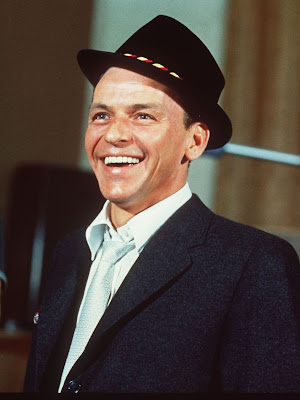
The Chairman of the Board will see you now.


Sheila O’Malley has a typically lovely post about Frank Sinatra, whose birthday is today. I started composing a comment on her site, but then I realized that my thoughts were getting away from me, so I decided to bring it over here. Sinatra has been a part of my universe for as long as I can remember; my parents owned a bunch of his records, which were on constant rotation in my childhood. I remember his distinctive sound, sometimes clear and sometimes with just a hint of rasp (depending on what he wanted to express), his sense of rhythm (he could make a song swing without any assisting percussion at all), his lyricism, and his unfailing sense of how to land the emotional beats of a song. This last gift is rare indeed, and it’s interesting to me that I’m featuring two singers so highly gifted in that regard on the same day (scroll down to today’s Daily Dose of Christmas post). And of course he wasn’t just a singer; Sinatra was also a very fine actor with a lot of range. He was in a lot of movies and he won an Oscar along the way and he still might be underrated as such.

The earliest of his roles that I’ve seen is Anchors Aweigh, in which he plays a Navy sailor who is very young and naive, who has to be instructed by his older buddy Gene Kelly in the ways of the world (meaning, how to flirt without seeming weird about it…in the late-1940s meaning of ‘flirting’). Somehow he pulls this off without getting blown off the screen by Kelly; in fact, the two men have a partnership in that movie that elevates it. Anchors Aweigh isn’t quite one of the immortal musicals–it’s no Singin’ in the Rain–but it’s damned close.

Just eight years later Sinatra put his dramatic skills on display in a dark turn as Private Maggio in From Here to Eternity, a movie that hit me between the eyes when I watched it in high school. I was channel-flipping lazily, and I happened to land on the opening credits; next thing I knew it was two hours later and the movie was over and I hadn’t touched the remote the entire time. Sinatra plays the cocky, arrogant young hothead whose actions end up costing him everything. There are some weird stories–legends, actually–about how Sinatra got the role in the first place, but it doesn’t really matter how he got it. The man ended up winning a Best Supporting Actor Oscar for it, and there’s a reason for that. Last time I watched From Here to Eternity I found it every bit as gripping as I did when I accidentally watched it as a sixteen-year-old.

Sinatra would bounce in and out of musicals a lot, and his dramatic turns always seemed to be in the crime genre. There was a teevee movie in the 70s called Contract on Cherry Street that I remember, and there’s his amazing performance in The Manchurian Candidate. He even turned up in the 1980s in an episode of Magnum PI, a show that often leavened its generally light-hearted tone with detours into espionage thrillers and, in the case of Sinatra’s episode, pure noir.

Maybe it’s easy to discount Frank Sinatra a little because of the genres in which he worked or the popular forms he pursued, but for my money, you can’t tell the story of American art in the 20th century without talking about Frank Sinatra.

Sheila starts her post with this quote (possibly aprocryphal) by Bing Crosby: “Frank is a singer who comes along once in a lifetime, but why did he have to come along in mine?” I can’t read that quote without thinking of High Society, a movie that was also a favorite of both my parents. It’s a musical remake of The Philadelphia Story, with Crosby as C.K. Dexter Haven (the romantic lead who is pining for Grace Kelly), and Sinatra as Mike Connor, the gossip rag reporter sent to cover Kelly’s impending nuptials. (Those roles were originated by Cary Grant and James Stewart, with Katherine Hepburn in the later-Grace Kelly part.) High Society is a fun movie, though this story is really better told in the original, as parts of the script had to be set aside to make room for the musical numbers, and…well, I have to agree with my sister, who once said on a Christmas Eve when one of Crosby’s Christmas movies was on and we’d all taken in a few beers, “Whoever thought to cast Bing Crosby as a romantic lead was out of their mind.”

Well, I don’t know about that, but it’s always struck me as very strange that this movie has Bing Crosby and Frank Sinatra together, and it gives them exactly one number together…and that number had to be added at the last minute when the producers suddenly realized that they had Crosby and Sinatra in the same movie with no shared numbers. Astonishing! Can you imagine such a thing? Almost making an entire movie with two of the 20th century’s greatest American singers in it and only realizing near the end that you’ve given them zero duets? That’s like having Babe Ruth and Mickey Mantle on the same team, but benching one of them at all times. Luckily for High Society, that one number is a hell of a number:

Of course, I can’t write about Sinatra without discussing his singing a little bit. Many years ago I read an interview with one of my personal musical heroes, the great Chicago Symphony orchestra trumpet player Adolph Herseht, in which among many other things he recommended that young trumpet players (among others) listen to great vocalists like Frank Sinatra, on the basis that all music, even for instrumentalists, starts with the human voice, and I remember Herseth citing Sinatra for always telling a story with his singing. That is absolutely true.

I’ll close this with my favorite track from my favorite Sinatra album, Frank Sinatra Sings for Only the Lonely. Just listen to Sinatra’s absolute control in this song! He fades away at the end, fading fading fading (“Answer, echoes, dying dying dying,” Tennyson might write), but his pitch never wavers, which is something that requires enormous technical skill: singing (or playing, if you’re on an instrument) a note correctly, and making it sound full, while also making it piano or pianissimo is a skill that many musicians don’t realize they need until well into their careers. And I’ll have to write sometime about my father’s favorite Sinatra song…but that needs a post of its own.


Share This Post

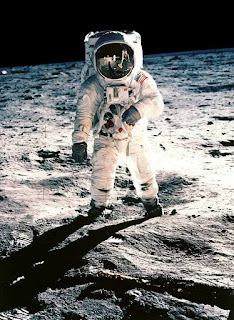
Apollo at Fifty (a repost)


Sam Seaborn: There are a lot of hungry people in the world, Mal, and none of them are hungry ‘cause we went to the moon. None of them are colder and certainly none of them are dumber ‘cause we went to the moon.

Mallory O’Brian: And we went to the moon. Do we really have to go to Mars?

Sam Seaborn: Yes.

Mallory O’Brian: Why?

Sam Seaborn: ‘Cause it’s next. ‘Cause we came out of the cave, and we looked over the hill and we saw fire; and we crossed the ocean and we pioneered the west, and we took to the sky. The history of man is hung on a timeline of exploration and this is what’s next.

–from “Galileo Five”, season two of The West Wing, written by Aaron Sorkin

Anniversaries are a good thing, even if they’re leavened with the weight of years of thwarted expectations and deferred dreams, as the First Lunar Landing’s is: Why have we never gone back? Why are we stuck in low-Earth orbit? Was it all just politics and none of it the call of the stars?

But such anniversaries are a bit of a balm in times such as these, when humanity seems bound and determined to roll back on itself like some kind of distended, drunken serpent consuming its own tail in a weird and awful version of an ouroboros. We can look back on the Apollo missions as a reminder of the kinds of things humanity can do when the primary motive isn’t necessarily profit.

I was born in September 1971, which means that I have never lived in a world where the Moon was not a place where humans have gone. I hope that I live to see a day when the Moon is no longer the only place other than Earth that we’ve gone.


From Pale Blue Dot by Carl Sagan:

It’s a sultry night in July. You’ve fallen asleep in the armchair. Abruptly, you startle awake, disoriented. The television set is on, but not the sound. You strain to understand what you’re seeing. Two ghostly white figures in coveralls and helmets are softly dancing under a pitch-black sky. They make strange little skipping motions, which propel them upward amid barely perceptible clouds of dust. But something is wrong. They take too long to come down. Encumbered as they are, they seem to be flying — a little. You rub your eyes, but the dreamlike tableau persists.

Of all the events surrounding Apollo 11‘s landing on the Moon on July 20, 1969, my most vivid recollection is its unreal quality. Neil Armstrong and Buzz Aldrin shuffled along the gray, dusty lunar surface, the Earth looming large in their sky, while Michael Collins, now the Moon’s own moon, orbited above them in lonely vigil. Yes, it was an astonishing technical achievement and a triumph for the United States. Yes, as Armstrong said as he first alighted, this was a historic step for the human species. But if you turned off the byplay between Mission Control and the Sea of Tranquility, with its deliberately mundane and routine chatter, you could glimpse that we humans had entered the realm of myth and legend.

We knew the Moon from our earliest days. It was there when our ancestors descended from the trees into the savannahs, when we learned to walk upright, when we first devised stone tools, when we domesticated fire, when we invented agriculture and built cities and set out to subdue the Earth. Folklore and popular songs celebrate a mysterious connection between the Moon and love. The word “month” and the second day of the week are both named after the Moon. Its waxing and waning — from crescent to full to crescent to new — was widely understood as a celestial metaphor of death and rebirth. It was connected with the ovulation cycle of women, which has nearly the same period — as the word “menstruation” (Latin mensis = month, from the word “to measure”) reminds us. Those who sleep in moonlight go mad; the connection is preserved in the English word “lunatic”. In the old Persian story, a vizier renowned for his wisdom is asked which is more useful, the Sun or the Moon. “The Moon,” he answers, “because the Sun shines in daytime, when it’s light out anyway.” Especially when we lived out-of-doors, it was a major — if oddly tangible — presence in our lives.

The Moon was a metaphor for the unattainable: “You might as well ask for the Moon,” they used to say. Or “You can no more do that than fly to the Moon.” For most of our history, we had no idea what it was. A spirit? A god? A thing? It didn’t look like something big far away, but more like something small nearby — something the size of a plate, maybe, hanging in the sky a little above our heads. Ancient Greek philosophers debated the propositon “that the Moon is exactly as large as it looks” (betraying a hopeless confusion between linear and angular size). Walking on the Moon would somehow have seemed a screwball idea; it made more sense to imagine somehow climbing up into the sky on a ladder or on the back of a giant bird, grabbing the Moon, and bringing it down to Earth. Nobody ever succeeded, although there were myths aplenty about heroes who had tried.

Not until a few centuries ago did the idea of the Moon as a place, a quarter-million miles away, gain wide currency. And in that brief flicker of time, we’ve gone from the earliest steps in understanding the Moon’s nature to walking and joy-riding on its surface. We calculated how objects move in space; liquefied oxygen from the air; invented big rockets, telemetry, reliable electronics, inertial guidance, and much else. Then we sailed out into the sky.

The Moon is no longer unattainable. A dozen humans, all Americans, have made those odd bouncing motions they called “moonwalks” on the crunchy, cratered, ancient gray lava — beginning on that July day in 1969. But since 1972, no one from any nation has ventured back. Indeed, none of us has gone anywhere since the glory days of Apollo except into low Earth orbit — like a toddler who takes a few tentative steps outward and then, breathless, retreats to the safety of his mother’s skirts.

Once upon a time, we soared into the Solar System. For a few years. Then we hurried back. Why? What happened? What was Apollo really about?

For me, the most ironic token of that moment in history is the plaque signed by President Richard M. Nixon that Apollo 11 took to the Moon. It reads: “We came in peace for all mankind.” As the United States was dropping 7.5 megatons of conventional explosives on small nations in Southeast Asia, we congratulated ourselves on our humanity: We would harm no one on a lifeless rock. That plaque is there still, attached to the base of the Apollo 11 Lunar Module, on the airless desolation of the Sea of Tranquility. If no one disturbs it, it will still be readable millions of years from now.

Six more missions followed Apollo 11, all but one of which successfully landed on the lunar surface. Apollo 17 was the first to carry a scientist. As soon as he got there, the program was canceled. The first scientist and the last human to land on the Moon were the same person. The program had already served its purpose that July night in 1969. The half-dozen subsequent missions were just momentum.

Apollo was not mainly about science. It was not even mainly about space. Apollo was about ideological confrontation and nuclear war — often described by such euphemisms as world “leadership” and national “prestige”. Nevertheless, good space science was done. We now know much more about the composition, age, and history of the Moon and the origin of the lunar landforms. We have made progress in understanding where the Moon came from. Some of us have used lunar cratering statistics to better understand the Earth at the time of the origin of life. But more important than any of this, Apollo provided an aegis, an umbrella under which brilliantly engineered robot spacecraft were dispatched throughout the Solar System, making that preliminary reconnaissance of dozens of worlds. The offspring of Apollo have now reached the planetary frontiers.

If not for Apollo — and, therefore, if not for the political purpose it served — I doubt whether the historic American expeditions of exploration and discovery throughout the Solar System would have occurred. The Mariners, Vikings, Pioneers, Voyagers, and Galileo are among the gifts of Apollo. Magellan and Cassini are more distant descendants. Something similar is true for the pioneering Soviet efforts in Solar System exploration, including the first soft landings of robot spacecraft — Luna 9, Mars 3, Venera 8 — on other worlds.

Apollo conveyed a confidence, energy, and breadth of vision that did capture the imagination of the world. That too was part of its purpose. It inspired an optimism about technology, an enthusiasm for the future. If we could fly to the Moon, as so many have asked, what else were we capable of? Even those who opposed the policies and actions of the United States — even those who thought the worst of us — acknowledged the genius and heroism of the Apollo program. With Apollo, the United States touched greatness.

When you pack your bags for a big trip, you never know what’s in store for you. The Apollo astronauts on their way to and from the Moon photographed their home planet. It was a natural thing to do, but it had consequences that few foresaw. For the first time, the inhabitants of Earth could see their world from above — the whole Earth, the Earth in color, the Earth as exquisite spinning white and blue ball set against the vast darkness of space. Those images helped awaken our slumbering planetary consciousness. They provide incontestable evidence that we all share the same vulnerable planet. They remind us of what is important and what is not. They were the harbingers of Voyager‘s pale blue dot.

We may have found that perspective just in time, just as our technology threatens the habitability of our world. Whatever the reason we first mustered the Apollo program, however mired it was in Cold War nationalism and the instruments of death, the inescapable recognition of the unity and fragility of the Earth is its clear and luminous dividend, the unexpected final gift of Apollo. What began in deadly competition has helped us to see that global cooperation is the essential precondition for our survival.

Travel is broadening.

It’s time to hit the road again.

Someday we’ll look up with wonder again. Someday we’ll go. I firmly believe that.


Footage of Walter Cronkite’s live broadcast of the lunar landing. Note his happy amazement at what he gets to report, at the 1:58 mark. He takes off his glasses, shakes his head, and smiles at the person next to him. I can’t help contrasting that with another moment when, while reporting on air, he had to remove his glasses and shake his head with disbelief, less than six years prior to this moment.


And I know it’s not the right mission, but for the movie Apollo 13, James Horner managed to really catch some of the unbridled optimism of the entire Apollo era.


Seriously, humans: when are we going back, and when are we going farther?


Share This Post

A Repost: “Whacking. I’m hell at whacking.”

I first wrote this post in 2008, back in the days of Byzantium’s Shores. I repost it now on the occasion of Harrison Ford’s 80th birthday.


Sheila waxes poetic on one of my favorite movies, Witness. (Yeah, I didn’t rank it highly enough.) Here’s Sheila:

Let’s look at how delicately things are set up in this film – so much so that you don’t notice them. John Book has recovered (somewhat) from his wound and Samuel Lapp takes him on a tour of the farm. He shows him the well. (“It goes … it makes … it goes …” so cute) He shows him the silo and tells him how it works. He shows him the trap door. All of this will become crucial in the final scenes, as John Book sneaks around, trying to evade the murderers. But what becomes clear, beautifully, in subsequent viewings – is that it is SAMUEL who showed Book the way. It is SAMUEL who, innocently, gave John Book the tools for survival in those crucial end moments. And so the title of the film takes on even more meaning, more depth. WITNESS. “What’s up there?” asks John Book. “Corn,” answers Samuel. Notice the grace and simplicity of how that information is imparted. You might not even notice it. A lesser film would have just had John Book figuring out how the silo worked while he was under the gun (which is how so many thrillers operate – they ARE their plots. That’s it.) … but in Witness we are introduced, via Samuel, to “the way things work”. And he’s excited to show John Book around and to show him the well and also to show him how much he knows. It isn’t until later that we realize what Samuel Lapp has done, in that innocent tour.

She’s absolutely right. The exposition there is handled so well. Problems can often arise with this kind of thing, in movies like this; they’ve got to get that gun onto the mantle in Act One so it can go off in Act Three, but so many times, the filmmakers go overboard, making it blindingly obvious that they’re setting up something for later. This quiet scene between Samuel and Book, where Sam’s just showing Book around the farm, helps us get our bearings, and we never realize that we’re being set up for the climax.

Done wrong, this sort of scene-setting stands out like a sore thumb. A perfect example is in James Cameron’s Aliens, where we have that early scene where the one female Marine is demonstrating the robotic forklift-you-can-wear thing: there’s never one iota of doubt that Ripley will be putting that thing on and using it as a weapon by film’s end. That’s just badly done. Of course, Cameron would later get it right in Titanic, where he knew that he would have to make clear to the audience what exactly was going on at each stage of the ship’s sinking, but he also know that he couldn’t stop the tension of Rose and Jack’s harrowing exploits in the ship’s water-filled lower decks to explain it all, so he gives us the computer simulation of the sinking early in the movie. We never have to stop the action so Jack can tell Rose something like “See, the ship is going down by the head, so the stern’s going to rise up. I just hope the ship’s hull can withstand that pressure, because if it can’t, the ship will break in two!” Likewise, in Witness, we’re spared John Book talking to himself (us), saying things like “This is a silo! I’ll bet there’s corn up there!”

Sheila’s post also gives an appreciation for Harrison Ford’s work in Witness, a performance that Ford has never since come close to equaling. His work in this film is as good an example of character creation as I’ve ever seen. There’s not one moment in the film where Ford in the slightest way echoes something he did as Han Solo or Indiana Jones. His performance is full of tiny little touches, moments it’s so easy to miss, that add up to John Book being a real person, and not just a guy on a screen. I commented over there as follows (fixing my own typos):

Every time I watch this film I get a little more sad that this appears to be the last time Harrison Ford really used his talent to great effect. His performance is full of so many little details. I love how, after Eli interrupts his dancing with Rachel, he heartbreakingly wipes the sweat of his forehead on his shoulder. I love how the first time he’s handed a glass of lemonade (by Rachel) he downs the whole thing in one gulp, but the next time (by Hochleitner) he takes a single small sip and hands it back. I love how at the end, after he’s beaten the bad guys and all the cops are there on the farm, he’s standing there, leaning exhaustedly against a police car, having a much needed cigarette, when we haven’t seen him smoke at all in the whole film to that point.

I think that a good test for people I meet is to see if they give me a knowing smile when I tell them to “Be careful out among them English.”

Of course, I could go on. I love the bashful smile that Rachel gives John Book when they’re in the workshop and Book’s working on fixing the birdhouse he’d earlier driven into. She’s smiled at him politely before, usually with her lips, but this is different; she shows her teeth here in a full smile that’s at once more revealing and yet more shy than she’s been to that point. I think that’s when she first starts realizing her attraction to Book, because of the line that accompanies that smile, a very simple observation on her part: “You know carpentry.” In that moment I think that Book stops being something alien to her, some being almost literally from another world she can never know. I think that’s where it starts. Witness really is full of tiny moments of magic that you don’t even realize are there until you think about them.

On another tangent, a recent thread over at FSM included speculation on the relative lack of eroticism in the scores of John Williams. While only a couple of readers make the obvious point that John Williams really hasn’t scored any movies much at all that would call for an erotic kind of tone, others bring up as an example of a “sexy” score Jerry Goldsmith’s Basic Instinct. Now, that is a terrific thriller score, but I’m not sure how sexy it is. Basic Instinct, for all its kinky subject matter, just isn’t sexy to me. In the whole of that film, with all its nudity and violent sex and infamous shots of Sharon Stone’s privates, there is nothing at all that is nearly as erotic and beautiful and sexy as in Witness when John Book and Rachel Lapp dance in the barn to a golden oldie, with no clothing being removed at all.

(One of my favorite bits of trivia about Witness is that the barn dance was filmed during daylight in the middle of summer. Since it had to be night, the crew basically draped tarps over every entrance to the barn, thus creating the necessary darkness, but also making it really really hot in there; hence the sweating that only highlights the emotion of the moment.)

For me, just about the only flaw in Witness is the film’s score, by Maurice Jarre. It was the mid-80s, and at the time Jarre was into heavy synthesizer use, and this score is just about entirely on synth, if not entirely outright. Some of the atmospheric music early on works nicely, but it’s all mostly long chords that set a tone, and of course, the barn-raising scene is a wonderfully scored sequence. (When watching it, there’s a bit early on where John Book introduces himself to a new group of Amish men he hasn’t met before. The first one whose hand he shakes, the one in the light green shirt? That’s a young Viggo Mortensen, there, fifteen years before he’d take up his role as Aragorn son of Arathorn, King of Gondor.) The score’s “suspense” material is all fairly routine and a bit repetitive; none of the music hurts the film, but I’ve always thought that the film would have been better served with a more strong touch of melody, excepting that great barn raising set piece.

ADDENDUM: At the risk of sounding like I’m damning Jarre’s work with faint praise, the afore-mentioned barn-raising scene really is something. Here it is in a full orchestral version, and it’s really quite something:

More than that, while I’m still not in love with much of Jarre’s work on this film–much of it is pretty much what you’d expect to hear in any 80s synth-driven police prcedural score–it’s better than what I describe above. Jarre avoids some of the obvious choices he could have made; he doesn’t try at all to echo a Coplandesque “Appalachian Spring” approach; instead he writes music that echoes the “plain” values of the Amish without resorting to obvious attempts to quote “Simple Gifts”, for example.

Anyway, you all be careful, out among them English.

Share This Post

National Poetry Month, day 18: JRRT

This is a repost, but I’m adding something at the end.

I’ve occasionally seen comment that JRR Tolkien’s poetry in The Lord of the Rings is generally weak, but from my perspective, it’s one of my favorite aspects of the book, and I find myself enjoying the verse in LOTR more each time I read it. My favorite poem in the book is almost certainly the “walking song” that is quoted a number of times throughout, and each time has a variation to reflect the events surrounding it and everything that has happened.

It begins like this, at the end of The Hobbit:

Roads go ever ever on,
Over rock and under tree,
By caves where never sun has shone,
By streams that never find the sea;
Over snow by winter sown,
And through the merry flowers of June,
Over grass and over stone,
And under mountains in the moon.

Roads go ever ever on
Under cloud and under star,
Yet feet that wandering have gone
Turn at last to home afar.
Eyes that fire and sword have seen
And horror in the halls of stone
Look at last on meadows green
And trees and hills they long have known.

This is when Bilbo is about to return home to his beloved Shire, but he is forever changed by the things he has seen beyond his home’s borders. The next time we encounter a version of this poem, Bilbo is striking out again, after giving up the Ring and heading for Rivendell:

The Road goes ever on and on
Down from the door where it began.
Now far ahead the Road has gone,
And I must follow, if I can,
Pursuing it with eager feet,
Until it joins some larger way
Where many paths and errands meet.
And whither then? I cannot say.

Much later we hear it again spoken by Bilbo, when he is starting to age quickly and after the entire adventure and the War of the Ring have ended. Bilbo is old and tired, and the walking song’s symbolism here is obvious:

The Road goes ever on and on
Out from the door where it began.
Now far ahead the Road has gone,
Let others follow it who can!
Let them a journey new begin,
But I at last with weary feet
Will turn towards the lighted inn,
My evening-rest and sleep to meet.

Finally there is a haunting variant that Frodo sings, not long before he boards the ship that will bear him, along with the last of the Elves, to the faraway land:

Still round the corner there may wait
A new road or a secret gate,
And though I oft have passed them by,
A day will come at last when I
Shall take the hidden paths that run
West of the Moon, East of the Sun.

Is Tolkien a great poet? I don’t know, and I’m prepared to allow the experts to have their say, but it does seem to me that there’s something to be said for the fact that his verse is still being read, recited, and set to music this many decades after it was written.

UPDATE 4/18/2022:

Just up above I say that I’m prepared to allow the experts to have their say as to Tolkien’s poetic abilities, but you know what? To hell with that!

There’s an odd thing I’ve noticed in my online life the last several years: every few months a whole new discussion of Tolkien arises, and it’s always a depressing one for me because it’s invariably a whole lot of people giving themselves permission to dump all over him and say “It’s OK to not read him! You can find him boring! Just watch the movies, they’re all you need!”

I’m not going to go into a full defense of Tolkien here, but I will note that it has lately occurred to me that Tolkien wasn’t just one of my gateway writers for the fantasy genre, but he was my gateway writer for poetry, as well. His books teem with poetry, and the way he uses that poetry is amazingly diverse. In the first chapters of The Hobbit you encounter humorous verse:

Chip the glasses and crack the plates!
Blunt the knives and bend the forks!
That’s what Bilbo Baggins hates—
Smash the bottles and burn the corks!

Cut the cloth and tread on the fat!
Pour the milk on the pantry floor!
Leave the bones on the bedroom mat!
Splash the wine on every door!

Dump the crocks in a boiling bowl;
Pound them up with a thumping pole;
And when you’ve finished if any are whole,
Send them down the hall to roll!

That’s what Bilbo Baggins hates!
So, carefully! carefully with the plates!

And epic poetry that helps to set the stage for the story to come.

Far over the misty mountains cold
To dungeons deep and caverns old
We must away ere break of day
To seek the pale enchanted gold.

The dwarves of yore made mighty spells,
While hammers fell like ringing bells
In places deep, where dark things sleep,
In hollow halls beneath the fells.

For ancient king and elvish lord
There many a gleaming golden hoard
They shaped and wrought, and light they caught
To hide in gems on hilt of sword.

On silver necklaces they strung
The flowering stars, on crowns they hung
The dragon-fire, in twisted wire
They meshed the light of moon and sun.

This use of poetry continues in The Lord of the Rings: there is sad poetry for the death of a companion, and there are tales of times gone by, and there is even a long song sung in a tavern that filled me with delight when I realized that Tolkien had actually incorporated into his epic book an enlarged version of the classic old nursery rhyme, “Hey Diddle Diddle”:

There is an inn, a merry old inn
beneath an old grey hill,
And there they brew a beer so brown
That the Man in the Moon himself came down
One night to drink his fill.

The ostler has a tipsy cat
that plays a five-stringed fiddle;
And up and down he runs his bow,
Now squeaking high, now purring low,
Now sawing in the middle.

The landlord keeps a little dog
that is mighty fond of jokes;
When there’s good cheer among the guests,
He cocks an ear at all the jests
and laughs until he chokes.

They also keep a hornéd cow
as proud as any queen;
But music turns her head like ale,
And makes her wave her tufted tail
and dance upon the green.

And O! the rows of silver dishes
and the store of silver spoons!
For Sunday there’s a special pair,
And these they polish up with care
on Saturday afternoons.

The Man in the Moon was drinking deep,
and the cat began to wail;
A dish and a spoon on the table danced,
The cow in the garden madly pranced,
and the little dog chased his tail.

The Man in the Moon took another mug,
and then rolled beneath his chair;
And there he dozed and dreamed of ale,
Till in the sky the stars were pale,
and dawn was in the air.

Then the ostler said to his tipsy cat;
‘The white horses of the Moon,
They neigh and champ their silver bits;
But their master’s been and drowned his wits,
and the Sun’ll be rising soon!’

So the cat on his fiddle played hey-diddle-diddle,
a jig that would wake the dead:
He squeaked and sawed and quickened the tune,
While the landlord shook the Man in the Moon:’
‘It’s after three!’ he said.

They rolled the Man slowly up the hill
and bundled him into the Moon,
While the horses galloped up in rear,
And the cow came capering like a deer,
and a dish ran up with a spoon.

Now quicker the fiddle went deedle-dum-diddle;
the dog began to roar,
The cow and the horses stood on their heads;
The guests all bounded from their beds
and danced upon the floor.

With a ping and a long the fiddle-strings broke!
the cow jumped over the Moon,
And the little dog laughed to see such fun,
And the Saturday dish went off at a run
with the silver Sunday spoon.

The round Moon rolled behind the hill,
as the Sun raised up her head.
She hardly believed her fiery eyes:
For though it was day, to her surprise
they all went back to bed!

My poetic life would be very different without JRR Tolkien. That’s not something I would expect of an unskilled poet.


Share This Post

Roger

Sheila O’Malley re-shared her post on the anniversary of Roger Ebert’s passing today, and I thought, why not do the same? Here’s what I posted the day he died. I still miss his writing. There’s something about those Chicago newspaper men….

I was trying to figure out something to write on the passing today of Roger Ebert, but nothing was leaping to mind, so I figured I’d just repost my original thoughts, from January 2012, on his book, Life Itself. I have loved and admired Ebert since I was nine, and his output of thoughtful writing even in the face of debilitating disease the last few years has been truly astonishing. It’s something of the ultimate motivator: When I think “I don’t really wanna write today”, I then thing, “Roger Ebert’s writing today, and that guy’s got some hardcore difficulties. So get in the chair and write.”

When I saw the news today — my first report came via Sheila O’Malley on Facebook, and she is frankly the exact person I would have wanted to hear this from — I commented thusly:

Amazing how something you totally expect and don’t find a surprise can still hit you between the eyes and make the world a little less shiny

Farewell, Mr. Ebert. If there is some realm beyond this one…well, whatever. At least on this side we’ll have your years and years and years of writings. I’ve come to see you as being to film what Carl Sagan was to science, and I mourn and salute you in the same manner. Congratulations on a life well-lived!

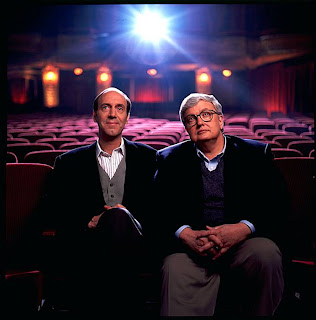
I was nine years old, and I wandered into the living room to find my mother watching some show on PBS. It was a show about movies – there would be a clip of a new movie that was out, and these two guys would then talk a bit about whether the movie was any good or not. One of these guys was a thin, lanky guy. The other was a squat, fat guy. The thin guy was named Gene. The fat guy was named Roger.

“What’s this?” I asked.

“It’s called Sneak Previews,” my mother answered. “Those two men are film critics. They tell us if movies are good or not.”

“Oh.”

And I watched the thing. I didn’t know anything about movies, but these two guys were interesting to watch. Another year or two later, their show was off PBS, which struck me as a bummer…but they turned up again, in a syndicated show that was on, like many syndicated shows, at whatever time some station or other felt like putting it on. No matter, it was fun seeing these two guys, Gene and Roger – who worked for newspapers in Chicago – talk about movies.

So I watched Gene Siskel and Roger Ebert for years, off and on, right up until Siskel’s deeply saddening death in 1998. Then I watched Ebert and Richard Roeper (a good enough fellow, but no substitute for Siskel) for a few more years, until we no longer had cable and thus the show was beyond my grasp. And then, a few years after that, Ebert himself started to have health issues, which eventually resulted in unsuccessful surgeries that have famously left him unable to speak or eat (he takes meals through a G-tube, which is something I understand all too well, thanks to Little Quinn).

Siskel and Ebert were, in my view, one of the great duos in the history of anything. Those two had such astonishing chemistry together, that it was a joy to watch them agree positively on a movie, an even bigger joy to see them agree negatively on a movie (seriously, watching the two of them tag-team on a bad movie was always great), and the biggest joy of all when they disagreed. Then you could see some fireworks. I remember Ebert being astonished at Siskel’s thumbs-down review of Scorsese’s Casino; “Thumbs down?!” Ebert yelped. And there was another time – I can’t remember the movie – where Ebert liked it and Siskel did not, and Ebert said something like “I don’t think you wanted to like this movie”, a suggestion that seemed to physically hurt the usually more acerbic Siskel. “I love to like pictures!” he protested.

One time on Late Night with David Letterman, there was a segment that had Mujibur and Sirajul, the two Indian owners of a local store, reporting to Dave from somewhere in the country. And Dave says, “If you two are out there, who’s watching the store? Can we send a cameraman to see who’s in charge at the store?” So a cameraman goes into the store, to reveal a very stern-looking Siskel and Ebert. OK, I guess you had to be there.

Anyway, Ebert has been writing about the movies for decades now, and he is, by nearly any measure, the critic whose work I find the most illuminating and the most evocative. I’ve been reading him nearly almost as long as I’ve been watching him on teevee, and for a number of years, his annual review collections were required book purchasing of mine. Now he has produced a memoir, which he has titled Life Itself.

Ebert’s health struggles in recent years are well-known, and it’s been truly fascinating to watch him take to blogging in the wake of the loss of his physical voice, a medium he had initially viewed with suspicion but which allowed his authorial voice to finally blossom to its greatest strength. Ebert has always been a fine writer, but oddly, his disability-due-to-cancer has, for many, made him even better. Maybe it’s similar to that old saw about how when you lose one sense, the others somehow make substantial gains in acuity.

Reading his blog, I’ve mostly been struck by Ebert’s ongoing zest for life, even when there were occasional posts that took an especially elegiac tone that made me wonder if he was preparing for his own departure from this world. Ebert is still with us, though, and now we have Life Itself.

The book is more a series of vignettes than a straight telling of Ebert’s life. The vignettes are more or less in chronological order, but Ebert seems to be more exploring various themes in his life than the chronology of events. The book is something of a memory album that gives an impression of a life, which seems to me a good way to structure a biography. Sometimes when I read biographies, I get a sense of “plot” that couldn’t possibly be there. Ebert is well aware that life is plotless, and that many of the things that shape the paths of our lives for good or ill are often accidental, a function of our coming into the circle of this person instead of that person, or even something so prosaic as taking this flight instead of that one.

It’s telling that the book gives more of a sense of his development as a writer than as a critic; I suspect that Ebert believes that he would have been a writer no matter what, and it was just an accident of various circumstances that led to him writing about movies for the last forty years. There’s no “Through all my life the cinema has grounded my being” or anything like that; Ebert grew up as a talented kid who liked going to movies with his buddies on Saturdays. I love when he recounts his first reviews of avant garde films; finding himself in confusion as to what the films were about, he took the approach of simply recounting his experience in watching the film. This is an approach that has gone on to inform his entire approach to movie reviewing and film criticism.

Sometimes, in the course of his blogging over the last few years, a tone has crept into Ebert’s writing – that he seems to deny whenever it is pointed out, but it is there – that he is, in long form, saying goodbye to his life. I deeply hope that this is not the case. Ebert is, for me, to film as Carl Sagan is to science, and he’ll be missed by me in equal measure when he is gone.

Here are some excerpts from Life Itself.

On Mike Royko:

At about six p.m. On New Year’s Day of 1967, only two lights on the fourth floor were burning – mine and Mike Royko’s. It was too early for the graveyard shift to come in. Royko walked over to the Sun-Times to see who else was working. A historic snowstorm was beginning. He asked me how I was getting home. I said I’d take the train. He said he had his old man’s Checker car and would drop me at the L station. He had to make a stop at a twenty-four hour drug store right where the L crossed North Avenue.

Royko at thirty-five was already the city’s most famous newspaperman, known for compelx emoitons evoked with unadorned prose in short paragraphs. Growing up as the son of a saloon keeper, he knew how the city worked from the precinct level up, and had first attracted attention while covering city hall. He was ten years older than me and had started at the old City News Bureau, the copperative supported by all the dailies that provided front-line coverage of the police and fire departments. Underpaid and overworked kids worked under the hand of its editor, Arnold Dornfeld, who sat beneath a sign reading: If your mother says she loves you, check it out. When I met him he’d been writing his Daily News column for two years. It was his writing about Mayor Richard J. Daley that took the city hall word clout and made it national. He chainsmoked Pall Malls and spoke in a gravelly poker player’s voice. He drank too much, which to me was an accomplishment.

That snowy night the all-night drugstore was crowded. “Come on, kid,” he said. “Let’s have a drink at the eye-opener place.” He told me what an eye-opener was. “This place opens early. The working guys around here, they stop in for a quick shot on their way to the L.” It was a bar under the tracks so tiny that the bartender could serve everyone without leaving his stool. “Two blackberry brandies and short beers,” he said. He told me, “Blackberry brandy is good for hangovers. You never get charged for a beer chaser.” I sipped the brandy, and a warm glow filled my stomach. It may have been the first straight shot of anything I’d ever tasted. I’d been in Chicago four months and I was sitting under the L tracks with Mike Royko in the eye-opener place. I was a newspaperman. A blackhawks game was playing on WGN radio. The team scored, and again, and again. This at last was life.

“Jeez, they’re scoring like crazy!” I said, after the third goal in less than a minute.

“Where you from, kid?”

“Urbana,” I said.

“Ever seen a hockey game?”

“No.”

“That’s what I thought, you asshole. Those are the game highlights.”

On books:

Chaz [Ebert’s wife] and I have lived for twenty years in a commodious Chicago town house. This house is not empty. Chaz and I have added, I dunno, maybe three or four thousand books, untold numbers of movies and albums, lots of art, rows of photographs, rooms full of comfortable furniture, a Buddha from Thailand, exercise equipment, carved elephants from India, African chairs and statues, and who knows what else. Of course I cannot do without a single one of these possessions, including more or less every book I have owned since I was seven, starting with Huckleberry Finn. I still have all the Penrod books, and every time I look at them, I’m reminded of Tarkington’s inventory of Penrod’s pants pockets. After reading it a third time, as a boy, I jammed my pockets with a pocketknife, a Yo-Yo, marbles, a compass, a stapler, an oddly-shaped rock, a hardball, a ball of rubber bands, and three jawbreakers. These, in an ostensible search for a nickel, I emptied out on the counter of Henry Rusk’s grocery, so that Harry Rusk could see that I was a Real Boy.

My books are a subject of much discussion. They pour from shelves onto tables, chairs, and the floor, and Chaz observes that I haven’t read many of them and I never will. You just never know. One day I may nee to read Finnegans Wake, the Icelandic sagas, Churchill’s history of the Second World War, the complete Tintin in French, forty-seven novels by Simenon, and By Love Possessed. That 1957 bestseller by James Gould Cozzens was eviscerated in a famous essay by Dwight Macdonald, who read through that year’s list of fiction bestsellers and surface with a scowl. I remember reading the novel late into the night when I was fourteen, stirring restlessly with the desire to be possessed by love.

I cannot throw out these books. Some are enchanted because I have personally turned all their pages and read every word. They’re shrines to my past hours. Perhaps half were new when they came to my life, but most were used, and I remember where I found every one. The set of Kipling at the Book Nook on Green Street in Champaign. The scandalous The English Governess in a shady bookstore on the Left Bank in 1965 (two dollars, today ninety-one). The Shaw plays from Cranford’s on Long Street in Cape Twon, where Irving Freeman claimed he had half a million books. Like an alcoholic trying to walk past a bar, you should see me trying to walk past a used bookstore. Other books I can’t throw away because, well, they’re books, and you can’t throw away a book. Not even a cookbook from which we have prepared only a single recipe, for it is a meal preserved, in printed form. The very sight of Quick and Easy Chinese Cooking by Kenneth H.C. Lo quickens my pulse. Its pages are stained by broth, sherry, soy sauce, and chicken fat, and so thoroughly did I master it that I once sought out Ken Lo’s Memories of China on Ebury Street in London and laid eyes on the great man himself, dining alone in a little room near the entrance. A book like that, you’re not gonna throw away.

On his wife:

I sense from the first that Chaz was the woman I would marry, and I know after twenty years that my feelings were true. She had been with me in sickness and in health, certainly far more sickness than we could have anticipated. I will be with her, strengthened by her example. She continues to make my life possible, and her presence fills me with love and a deep security. That’s what a marriage is for. Now I know.

On Siskel:

One of the things I miss about Gene Siskel is that he’s not around to make jokes about my current condition. He would instinctively know that at this point I wouldn’t be sensitive, having accepted and grown comfortable with my maimed appearance. He wouldn’t have started joking too soon. His jokes would have the saving grace of being funny. Here’s one I’m pretty sure he would have come up with: “Well, there’s one good thing about Roger’s surgery. At least he no longer needs a bookmark to find his chin.”

On movies:

I have seen untold numbers of movies and forgotten most of them, I hope, but I remember those worth remembering, and they are all on the same shelf in my mind. There is no such thing as an old film. There is a sense in which old movies are cut free from time. I look at silent movies sometimes and do not feel I am looking at old films; I feel I am looking at a Now that has been captured. Time in a bottle. When I first looked at silent films, the performers seemed quaint and dated. Now they seem more contemporary. The main thing wrong with a movie that is ten years old is that it isn’t thirty years old. After the hairstyles and the costumes stop being dated and start being history, we can tell if the movie itself is timeless.

What kinds of movies do I like the best? If I had to make a generalization, I would say that many of my favorite movies are about Good People. It doesn’t matter if the ending is happy or sad. It doesn’t matter if the characters win or lose. The only true ending is death. Any other movie ending is arbitrary. If a movie ends with a kiss, we’re supposed to be happy. But then if a piano falls on the kissing couple, or a taxi mows them down, we’re supposed to be sad. What difference does it make? The best movies aren’t about what happens to the characters. They’re about the example that they set.

Casablanca is about people who do the right thing. The Third Man is about two people who do the right thing and can never speak to each other as a result. The secret of The Silence of the Lambs is buried so deeply that you may have to give this some thought, but its secret is that Hannibal Lecter is a Good Person. He is the helpless victim of his unspeakable depravities, yes, but to the limited degree that he can act independently of them, he tries to do the right thing.

What I miss, though, is the wonder. People my age can remember walking into a movie palace where the ceiling was far overhead, and balconies and mezzanines reached away into the shadows. We remember the sound of a thousand people laughing all at once. And screens the size of billboards, so every seat in the house was a good seat. “I lost it at the movies,” Pauline Kael said, and we all knew just what she meant.

When you go to the movies every day, it sometimes seems as if the movies are more mediocre than ever, more craven and cowardly, more skilfully manufactured to pander to the lowest tastes instead of educating them. Then you see something absolutely miraculous, and on your way out you look distracted, as if you had just experienced some kind of a vision.

May Ebert’s spot in the balcony remain reserved for years to come.


Share This Post

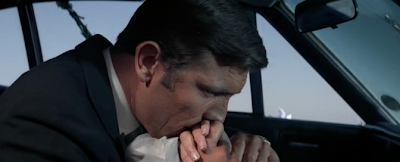
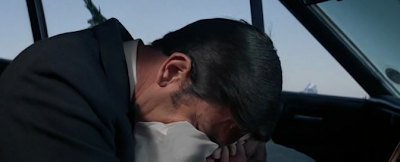
“Thy dawn, O master of the world, thy dawn….”

A repost, with some revisions and additions throughout, to accompany my review of NO TIME TO DIE, which is coming tomorrow. I wrote this more than ten years ago, and if anything, my esteem for ON HER MAJESTY’S SECRET SERVICE has only increased since then. I rewatched the film on one leg of our recent journey from Buffalo to Honolulu, and the film still holds up.

Here we go. Additions to the post’s original text will be in blockquoted offsets. Far up! Far out! Far more!!!
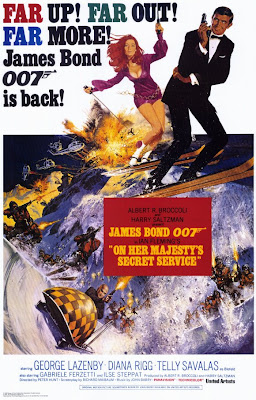
Sometimes I change my mind about movies. Sometimes I don’t. Some movies meant a lot to me, years ago, but have dropped away to the point that I’ve forgotten about them. Other movies, though, have stayed with me forever. One of those is On Her Majesty’s Secret Service, the sixth James Bond film, which I have regarded since I was a teenager as the best Bond film ever made. In fact, I consider it one of my favorite films of all time, in any genre.

OK, a story here: I cut my teeth as a Bond fan in the era when the films’ teevee rights were owned by the ABC network, in the early 80s. This was before home video was much of a thing–we didn’t even own a VCR until 1985, I think–so the only way to catch up on the Bond films was to catch them on ABC, which would run one every few months. Now, at the time I was aware that Sean Connery had played Bond in the first five or six films, while Roger Moore had taken over the role (and was still active at the time). However, when perusing Bond soundtracks at a record store in a mall one day, I found the soundtrack album for a flick called ON HER MAJESTY’S SECRET SERVICE, with “George Lazenby” as Ian Fleming’s James Bond 007. What was this? A parody? A one-off by some other studio? No, it said “Albert R. Broccoli presents” and “EON Productions” and the like, so it had to be official. I asked my mother, who knew about Bond and was guiding me through the movies as they came up, and she wrinkled her nose and said something like, “Oh, that one. There was a guy who did one Bond movie but apparently he was really bad and the movie bombed so they fired him.” Now, that’s not entirely accurate, but it sums it up, for the most part.

But within a year or two, ABC televised OHMSS, and we watched it. I wasn’t terribly excited, because I expected it to suck, but I remember getting into it more than I expected…and then, during a commercial break around the halfway mark, my mother observed, “You know, he’s really not bad as James Bond!”

When we got our VCR a few years later, I’d start recording the Bond movies when they aired, which is how I watched them obsessively for years. That’s how my appreciation for OHMSS started, and how it deepened. By the time I went to college in 1989, I already considered OHMSS the best Bond film.

Released in 1969, OHMSS came out when the Bond-mania of the 1960s was starting to wane. Films like Goldfinger and Thunderball had been enormous hits, but now, Sean Connery had left the role of Bond and a complete unknown named George Lazenby was cast as his replacement. All this is well known, and over the years, Lazenby’s performance in OHMSS has been reliably controversial. To this day, there are Bond fans who loathe his performance, and to this day, there are fans who not only think he did a fine job, but that he really doesn’t stand in Sean Connery’s shadow at all. (I am in the latter camp.)

Narratively speaking, OHMSS is one of the strongest films in the series. Its script, by Richard Maibaum, is outstanding, with lots of wit and fine dialogue that rarely seems as far-fetched as Bond dialogue can sometimes get. The story, though, does present problems for people who are interested in continuity.

The problem comes from the fact that Eon Productions (the producers of the Bond series) did not adapt the Ian Fleming novels to the screen in the order that they were written. The first Bond film is Dr. No; the first novel is Casino Royale. The Bond films of the 1960s, excepting Goldfinger, all feature Bond squaring off against the minions of SPECTRE, culminating in You Only Live Twice when he finally meets Ernst Stavro Blofeld face to face. However, in the novels, it’s in OHMSS that Bond meets Blofeld. The problem then is why Bond and Blofeld don’t recognize each other in the OHMSS film when they come face to face. There are lots of possible fictional explanations for this, and the original idea was to have Bond undergoing plastic surgery to explain his new resemblance to George Lazenby. The producers chose not to do this…and yet, in the next film, Diamonds are Forever, they would use the plastic surgery idea to explain why Blofeld in that film now looks like Charles Gray. (Without, of course, explaining why it is that Bond now no longer looks like George Lazenby but like Sean Connery again.)

(Having read recently a book about the history of the Bond movies, it turns out that Eon was going to make these movies in their correct order, with OHMSS coming before YOU ONLY LIVE TWICE, but it turned out that there was insufficient snow in the Alps when they would have been shooting OHMSS, so they did YOLT first.)

In watching OHMSS recently, I came to realize that the Bond films that are the best tend to be the ones that most deviate from the standard Bond “formula”. That certainly holds true with OHMSS. The film starts with Bond, already on assignment in Portugal. But, as M notes in the film’s very first scene, no one with MI6 has any idea where Bond is, and his current assignment is becoming politically problematic: “Number 10 is making ugly noises about Operation Bedlam.” Operation Bedlam, we later learn, is the search for Blofeld, who is presumably on the run following his failed scheme in You Only Live Twice. So already Bond is on thin ice with his superiors; he is failing at an assignment; he’s been on a single assignment for two years.

That last is important, because time is a recurring motif all through the film. Bond’s relationship with time is a constant underlying theme, made explicit in Maurice Binder’s typically-brilliant opening titles sequence. Clocks and hourglasses figure prominently in the title sequence. Now, timers and clocks are a constant trope of spy fiction and thriller films, what with heroes defusing bombs or whatnot as the digital timer ticks off the last few seconds before disaster is to strike. But there is something different about time in OHMSS: even as Bond is up against the same kinds of time constraints that he’s always faced before, we get a real sense that he’s weary of the whole thing and desires a different kind of relationship with time.

So Bond is in Portugal, driving along, when a woman in a red car passes him on a lonely seaside road. Bond, of course, gives chase, and comes to a beach where the woman parks her car and goes down to the water, where she starts to wade out. Bond spies her through the telescopic sight of his rifle, and it’s thus that we get our first close-up of Contessa Teresa di Vicenzo, better known as Tracy.

Tracy – played by Diana Rigg – already looks sad and lost in this shot, as Bond watches her wander into the water. He quickly realizes that she intends to let the tide carry her out; he is watching a suicide attempt, so he intercedes, bringing her back in from the water and introducing himself – “Good morning! My name’s Bond. James Bond.” Here we see Lazenby’s face for the first time; up until now, the film has teased us with shots of his head from behind, closeups of his lips as he lights a cigarette, and the like.
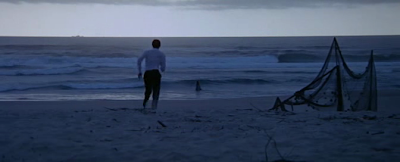
Two goons show up here, to take Tracy away. Of course, Bond has no idea who this girl is, or who her two “protectors” are, but the goons apparently intend to kill Bond, so there’s a fight. It’s a pretty kinetic fight, and all of the fights in OHMSS are pretty kinetic – and with good reason, as director Peter Hunt has literally sped them up in the editing room. I’m not sure why he chose to do this – some fans speculate that Lazenby was an awful screen fighter, and the sped-up fights are a ploy to conceal this – but it doesn’t matter. This is another facet of OHMSS that can divide fans. Some are distracted by the quickened fight scenes; others – myself included – simply accept it as a stylistic choice in a film that has a lot of style going for it.

Anyhow, Bond dispatches the goons, but the girl has already fled, jumping back in her car and driving away. Bond is left alone on the beach, holding her shoe, whereupon he breaks the fourth wall to tell us, “This never happened to the other fellow.” Cut to opening title sequence.

There appear to be two schools of thought as regards the breaking of the fourth wall here with the “This never happened to the other fellow” line. It doesn’t bother me. I like strategic breakings of the fourth wall, on occasion. This one seems to me a signal: “Yeah, it’s a new guy. Get over it.”

When we return, Bond is still in Portugal, and checks into a hotel, where he notices a red Cougar parked outside that he is informed belongs to a lady. He takes his room, and looks down on the pool, whereupon there’s a wonderful transition shot from day to night as this shot…
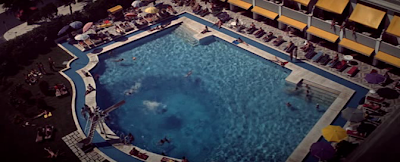
…fades into this one, while a slow tune for jazz flute plays in the background.

I love that second shot; the pool seems deserted but the reversed “Casino” logo is disrupted by ripples a couple of times. This isn’t the kind of shot one typically sees in a Bond film.

By the way, that jazz flute piece I mention there? On the score album this track is called “Try”, and it’s a very subtle and cool bit of subdued jazz. I really like its general feel, with brushes on the drums and the melody carried by vibraphone before the solo flute plays. There’s a world-weariness to the track that works well to set Bond’s mood.

Over the next twenty minutes or so, the film’s story continues to unfold slowly, and in a way that seemingly has absolutely nothing to do with spy intrigue. Bond goes to the casino to play baccarat (the traditional card game of the Bond films, until Casino Royale replaced it with poker). An elegantly-dressed woman enters the game, places a huge bet, and promptly loses – but she has no money. Bond recognizes her: she is the woman whom he saved on the beach the night before. Detecting her streak of self-destructive behavior, Bond bails her out for twenty thousand francs and then has a brief conversation with her over champagne, where she is quite blunt about how she is to repay her debt to him: she gives him her room number and says, “I hope it’ll be worth it.” She is cool and businesslike; when Bond calls her “Contessa Teresa”, she replies, “Teresa was a saint. I’m known as Tracy.”
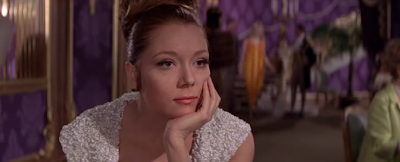
Bond is already intrigued by this woman who is proving somewhat resistant to his charms, by her mysterious background, and by the fact that she has goons following her around. One attacks him when he enters her room; after dispatching the goon, Bond figures that the tryst isn’t happening and goes back to his room, which is where she’s waiting. She pulls his own gun on him, but now he is having none of this: he demands to know who the men following her are, and when she claims ignorance, he slaps her and says, “I can be much more persuasive, Contessa.” Ahhh, the freewheeling sexism of the early Bond films – not a quality of the Bond series that I’ve missed, but it’s worth noting that Tracy proves equal to the moment, lifting her gaze to fiercely meet Bond’s as she says, “Whatever else I may be, I’m not a liar.”
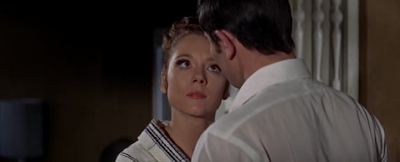
Here, at this moment, is when the film score gives us the first hint that this girl is different, because this is where we first hear the film’s love theme. After some more discussion during which Tracy still resists Bond’s efforts to figure out who she is and why she is acting the way she is (“The only thing you need know about me, Mr. Bond, is that I pay my debts”), Bond and Tracy do, in fact, sleep together, but when he awakes the next morning, he finds that she is gone not just from his room but from the hotel entirely…but not before leaving two chips for ten thousand francs in his bedstand. “Paid in full,” Bond notes – and we never learn just how she came up with that money.

OK, two notes here. First, about Lazenby himself: Since the precredit sequence is primarily mood and action, this is where we first get a sense of Lazenby ACTING as Bond, and aside from a few weird line readings–more on that in a minute–I honestly don’t see the problem people have with him. His entry into the casino is pretty Bondian, the way he casually glances at passing women and walks through the place with a laconic ease, like he’s totally in his element. He has more than enough physical presence, and for the most part his tone is excellent when he speaks.

But there are a couple of weird notes, one of which comes after Bond bails Tracy out at the chemin de fer table. He tells her to play it safe and stay with the cards she has (chemin is sort of like Blackjack, in that you are trying to not go over a certain number with your cards), and Tracy says, “People who want to stay alive play it safe.” Bond gives her a half-smile and says, “Please stay alive…at least for tonight.” But here’s the thing: the film cuts that line together out of two very obviously different takes, so Lazenby’s tone changes. He says “Please stay alive” just fine, but then there’s an odd cut to an admittedly very awkward take of “at least for tonight”. I have to assume this would have been very easily fixed in post, so I’ve always wondered why the weird reading was left in there.

A similar thing happens later when Bond is interrogating Tracy about who the man was who attacked him in her hotel room. He’s got her by the wrist, and she says, “You’re hurting me,” to which he responds, “I thought that was the idea tonight.” And then, in the same breath–very awkwardly–“Now, WHO WAS HE?” And again it sounds…weird, and again, I wonder why they just didn’t have Lazenby re-record the line and dub in a better version.

My other note? I point out above that in this scene we first hear the film’s love theme, a melody that will later be given a title and lyrics. Our first hearing is by the same solo flute we just heard minutes before in the bit of late-night soft-jazz, and then John Barry brings in the strings. But it’s not just a love theme, as Barry recasts it. We actually hear it twice: first as Bond is talking to Tracy, actually talking to her, before their extracurricular activities take place; and then we hear it again, in an almost jaunty arrangement, as Bond is very politely abducted by Draco’s men. (Seriously, what a polite abduction!) Barry’s use of this theme in different circumstances, with different arrangements, accentuates the film’s theme of time and Bond struggling against it. This is quite simply the best score John Barry ever wrote for a Bond film, and he brings the goods from the get go.

Here, Bond is again greeted by the goons following Tracy, who have him at gunpoint (with his own gun – Bond was a bit careless in not noticing that it was missing).

Another aside: Bond lost track of his gun twice! Tracy got a hold of it first, playfully pointing it at Bond, before Draco’s men got it. There’s something to be said for the fact that this movie gives us a James Bond who is not always firing on all cylinders.

The goons take him on a long drive to a shipping company headquarters, where Bond meets the man behind these guys. Is he a villain? Maybe, at first glance – he is Marc-Ange Draco, the head of a crime syndicate called the Union Corse – but more relevant, he is Tracy’s father. It is he who fills in some of the blanks, telling the story of Tracy’s birth and her sad life which has led her to behave self-destructively. Draco’s big idea, though, is that Tracy’s need can be filled by…a man. A man like Bond. This, too, is eerily sexist, and Bond seems to see through this whole notion, refusing Draco’s offer of a dowry of one million pounds in gold.

But here, about a half hour into the movie, is when the film finally steers its course back into the espionage arena, because Bond senses an opportunity here. He knows that Draco, as head of a huge crime syndicate, may well have information on the whereabouts of Ernst Stavro Blofeld; he implies to Draco that while he won’t take Draco’s money, he might consider marrying Tracy if Draco tells him where Blofeld is. Draco, for his part, says “If I did know [where Blofeld is], I would not tell Her Majesty’s secret service. But I might tell my future son-in-law.” Bond gets his first break in the case in years, returns to London to report to M on what he’s learned…and the formula reversals continue.

M takes Bond off the case without even hearing his new lead. “You’ve had two years to run him down,” M points out. “The license to kill is useless unless one can set up a target.”

Bond has been chasing Blofeld for two years, and the little bit we’ve seen of that chase has taken its time unfolding – but M has just decided that Bond is out of time, and Bond angrily decides that he’s had enough of the whole thing and decides to resign. He dictates his resignation letter to Moneypenny and goes to clean out his desk (allowing a few brief glimpses of gadgets from Bond-films past), before M calls him back to accept his request. Bond thinks he’s out of a job, but Moneypenny has changed the letter to a request for two weeks’ leave, so Bond heads out again…this time to return to Draco to get his information. Bond has been freed of his time constraint for finding Blofeld, since there really can’t be any doubt that he intends to continue the chase.

(In a charming bit, M expresses his gratitude to Moneypenny for changing Bond’s resignation letter as well, saying “What would I do without you, Miss Moneypenny? Thank you!”)

In previous films to this point, M has always been shown as Bond’s stern boss. In OHMSS we get a different sense of their relationship. M is frustrated with Bond’s lack of results, and Bond chafes at M’s direct criticism of that lack of results. Lazenby and Bernard Lee have several wonderful scenes together in this movie. Also of note is Lois Maxwell, who is allowed to give us a Miss Moneypenny who is more than just an occasional office flirt. This is a great sequence.

The film’s relaxed pace continues, as Bond returns to Portugal to meet with Draco at his country estate. Tracy is there as well, and is disgusted to find Bond there; she clearly regards him as just another in a long line of men who have come along who were interested in one thing alone from her. Funny thing is, we know Bond’s history, and this might well not be off the mark – only Tracy is, for the first time, different for Bond. Tracy susses out the crappy deal between Draco and Bond (“No woman would waste this excellent champagne discussing a business deal unless she herself happened to be part of the arrangement”), and basically forces her father to give Bond the information he wants without going through with the whole marriage idea. Draco relents, telling Bond that there may be a connection between Blofeld and a lawyer in Bern, Switzerland; then Tracy gets up from the table and storms away after saying, “And now Mr. Bond need have no further interest in me.”

Bond, however, disagrees, and goes after her. Meeting her by her car, he finds that Tracy is in tears. Why? I suppose it’s because she’s sick of this kind of thing. She doesn’t want to be someone’s prize or payment, and she doesn’t want to pay her own debts anymore, either. When Bond catches up to her, though, he does something interesting: he doesn’t crack wise, or make it obvious that his next goal is to make love to her. In the first real gesture of intimacy we have ever really seen from James Bond, he brushes the tears from her cheeks, and then takes Tracy into his arms.
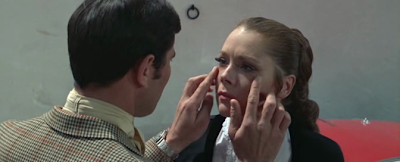
Our slow pacing continues, as what comes next is an honest-to-goodness love montage, complete with love song (“We Have All the Time In the World”, sung by Louis Armstrong), which at first might seem terribly out of place in a James Bond film, but which works here, because the film has taken its time in setting it up. We’re only vaguely aware that Bond is on the job at all; the whole first third of the film is given to him meeting this strange, wounded woman and finding himself under her spell. The title of the song used makes it all clear that Bond has finally found a woman with whom he wishes to relate outside of his job, because as a spy “on Her Majesty’s secret service”, Bond never has all the time in the world. His world is a world of ticking time bombs, of stopping villains before it’s too late, of passing moments of physical pleasure that must be set aside quickly so that he can move on to the next threat. Now, he’s getting his first hint of a world where one doesn’t have to worry about time.

On Her Majesty’s Secret Service is entirely about time. It’s evident right from the credits sequence, with its clocks and hourglass imagery. George Lazenby’s performance fits in with the film’s theme perfectly: his portrayal of Bond really does seem to convey a certain feeling of weariness about the whole business. Lazenby’s Bond is competent, skilled, brave, and witty – but he also seems just a bit tired of it all. It’s in little touches, really – would a Bond who is really invested in things fail to notice that his gun wasn’t where he’d left it? If he’s on assignment, would he really be heading out for a round of golf? It’s not that Bond is “phoning it in”, not at all, but it’s as if the thought is starting to form in the back of his mind that maybe, just maybe, he doesn’t want to be 007 for his entire life.

Also, is this the first Bond film that actually has a theme underlying all of its action? OHMSS is saying something about time and how Bond has to relate to it. In general, James Bond movies aren’t your prime destination if subtle subtext is your thing, but this one’s got it.

As the montage ends, though, Bond is back in the world of spying and being up against time. He has to infiltrate the office of a lawyer named Gumbold and search for any connection he can find to Blofeld, while Gumbold is off at lunch. For a simple office break-in, this scene is surprisingly tense, because of the time limit. (Again with time!) Gumbold emerges from his office and walks down the hall, curtly informing the desk attendant that “I’ll be back in an hour.” Gumbold’s shoes click on the marble floor of the office building with such precision (we’re in Switzerland, after all) that it sounds like the ticking of a clock. Bond arrives, and goes to work, using the only real gadget in the movie: a safe-cracker that also comes with a built-in photocopier. This is hoisted up to the balcony of Gumbold’s office from the construction site next door – Bond has a man there – and then Bond has to simply wait for the machine to do its job. Meanwhile, John Barry’s suspenseful music churns in the background, first slowly and then picking up steam as the hour ticks past. Here’s the scene; it’s like a thriller-within-a-thriller. I love the bit where Bond settles in, looking bored while he waits for the safe cracker to do its thing; it’s also hilarious the way Bond finds Gumbold’s issue of Playboy, tucked into a newspaper.

Only on my most recent rewatch did I notice that the crane from the construction site next door, which hoists the safecracker-photocopier machine up to Bond in Gumbold’s office, is owned by Draco Construction!

Of course, Bond finds something: letters from a “Count de Bleuchamp”, who is apparently seeking to establish himself as reigning Count of the Bleuchamp family. Bond takes this information to M – visiting him at his home – and indicates that “Bleuchamp” is the French form of “Blofeld”. The reversal here is interesting: Bond is briefing M, not the other way around.

Another lovely scene with Lazenby and Bernard Lee, starting with Bond’s smirk as he shows off his knowledge of butterflies, of all things. I love Lee’s shift in tone when Bond reveals what he’s discovered: a real clue as to where Blofeld is. Lee sighs and reminds Bond that he was relieved of that assignment, and Bond casually says, “I assumed you’d reassign me, sir,” and keeps right on talking.

The next scene, when Bond discusses the heraldry matter with Sir Hilary Bray, sets the stage for Lazenby’s voice being dubbed by George Baker for a lengthy sequence to come minutes later. This dubbing gets a lot of heat from fans, which is an objection that I’ve never understood, and I like the smirk Lazenby gives when Bond shows off his ability to mimic Sir Hilary. Also, there’s a really nice line delivery by Lazenby about Blofeld’s problematic location: “Yes, if he IS our man, I’d like to get him away from Switzerland.”

What unfolds next is more in traditional keeping with Bond films, as the intrigue takes over as Bond, posing as an expert in heraldry and genealogy, heads to Switzerland to find out if this “Bleuchamp” is Blofeld or not.

The Switzerland sequence is gorgeous, with sweeping panoramic shots of the Alpine landscape as Bond (masquerading as heraldry expert Sir Hilary Bray) is escorted by a woman named Irma Bunt up into the mountains. John Barry’s score soars here, and we even get some visual foreshadowing as Bunt points out avalanche damage to a forest and as the helicopter flies over a bobsled run. I’m glad OHMSS returned to Switzerland and really put some effort into showing off that land’s beauty, because GOLDFINGER really didn’t do much for Switzerland at all when it went there.

Of course, he is, with the whole works: a new scheme involving his posing as a doctor who cures allergies, the young women who are his patients (but who are really unwitting pawns of his, via mind control), and a fortress perched atop a Swiss Alp.

Of course, what commands Bond’s attention almost immediately is Blofeld’s allergy patients:
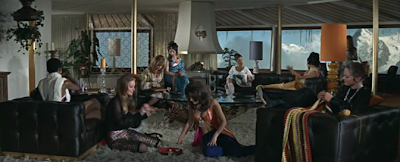
There’s a funny scene where Bond is trying to seduce one of the girls at the moment the mind-control stuff in her room starts up: swirling red lights, odd music, and Blofeld’s voice coming over the loudspeaker to address this girl who is mortally afraid of…chickens. Bond’s expression of “WTF?!” is perfect as we hear Blofeld’s voice intoning things like “You love chickens. You love their feathers.”
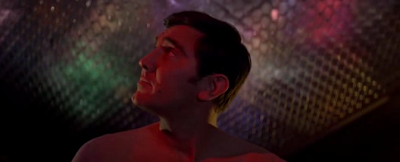
Even so, all of this continues to unfold quite slowly, and the film actually is free of action entirely from the fight in Tracy’s hotel room fifteen minutes into the picture until Bond’s capture by Blofeld over an hour in. OHMSS allows its story to unfold, and the slackening of the pace makes it all the more tense later on when Bond finds himself once again battling the clock. There is a fine scene, after Bond has been found out by Blofeld, where Bond must escape from the gear room of the cable cars that provide the only access to the mountain hideaway; then Bond lurks about as Blofeld’s “allergy patients” – beautiful girls, all of them – are given their final hypnotic briefing on how things will go now. The girls are each given an atomizer, theoretically filled with perfume, but which are actually filled with a toxin that, according to Blofeld, will cause widespread infertility in crops and livestock. The girls will be hypnotically instructed as to when to release the toxin.

A few things about the whole Piz Gloria sequence: First, even though Blofeld does have a Big Bond Villain Scheme, the movie doesn’t really make THAT big a deal about it. It’s there, it has to be stopped, but as far as what the movie gives us goes, it’s pretty bare-bones, a “just enough to get us by” kind of thing.

Second: Telly Savalas IS Blofeld. There’s a competent and cold malice to his performance that was absent from Donald Pleasance’s in YOU ONLY LIVE TWICE, and Charles Gray’s Blofeld in the next film, DIAMONDS ARE FOREVER, is its own thing entirely. (I like Gray enormously in that film, but as a topic for another day, that movie so downplays the notion of Blofeld as Bond’s ultimate enemy that he might as well be named something else entirely.)

Third: Yes, Bond’s cheerful seduction of Blofeld’s “Angels of Death” is (a) part of what he needs to do to figure out what’s going on, and (b) really kind of creepy. Especially the second night of it, when we have to wonder, What’s he hoping to get out of this? The reveal of Irma Bunt in the bed, instead of Ruby, is a pretty effective jump-scare, though.

Fourth: OHMSS gives us several scenes of Bond trying to figure things out and solve specific problems, like how to get out of his quarters and how to escape the cable-car engine room. Lazenby does very well with these rather physical scenes; he is able to convey Bond thinking things through as well as moving around with a casual economy of movement.

Fifth: the musical build-up to Bond’s escape is masterful stuff, especially when Bond has broken free, gotten out of the cable-car engine room, listened in on Blofeld’s hypnotic instructions to the Angels, and then taken out a guard or two on his way to the ski room. John Barry provides some suspense music with appropriate “stingers” through all this, but then, as Bond is putting on skis and preparing to get the hell out of Dodge, Barry gets down to serious business as we hear, for the first time since the opening credits, that descending line that leads us into the OHMSS main theme. This whole sequence ALWAYS gets my blood pumping.

Sixth: Any other Bond film would have sent Bond to Q to get outfitted with some useful gadgetry before setting out to potentially infiltrate the villain’s HQ. It’s interesting that this film does not.

Now, Bond is up against the clock, and makes his escape from Piz Gloria (the mountain hideaway), on skis. It’s surprising to note that, aside from a couple of brief fistfights, this is the first action set piece since the teaser sequence, and it comes well over an hour into what was for years the longest of all the Bond films. (Casino Royale was actually longer.) The ski chase in OHMSS is, for me, still the best ski chase ever filmed for a Bond movie (subsequent skiing scenes would appear in The Spy Who Loved Me, For Your Eyes Only, A View to a Kill, and The World Is Not Enough). It relies fairly heavily on rear projection during the closeups, but the entire sequence is edited together wonderfully, with the main theme from the film making its first reappearance since the title sequence.
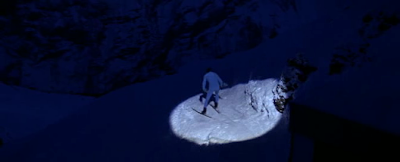
What’s great about the ski chase is that Bond has to work for it. So many Bond chases in other films make it look easy for him, but here, Bond is constantly having to re-escape. At one point, he loses one ski; at another, he has to lie in wait for his pursuers to come upon him, which results in a couple of fights atop a thousand-foot-high cliff.

OK, this ski chase is one of the best of all James Bond action sequences. It is almost perfectly edited, the way the tension builds from Bond putting on the skis to the guards realizing that he’s escaping, to Blofeld getting notified (his expression doesn’t even change as he picks up the phone, hears the report, and puts the cat aside to go give chase–though the cat protests!). The whole sequence marries together perfectly with the music, and at times the ski action times to the music, with the guards shifting almost in unison, as if we’re watching an action ballet.

Bond makes it down the mountain, to the charming Swiss village in the valley where there’s all manner of Christmas celebration and ice skating and happy people all over the place…and yet, the bad guys are there too, and Bond can’t get away. This is all pretty fascinating: many times in the series, we see Bond evade pursuers by putting a big crowd of people between them and himself. Here, though, it doesn’t work, and we become aware, through a series of quick cuts from the crowd to the pursuers to Bond back to the crowd and back again, that Bond is really, genuinely afraid. It’s not often at all in the 007 movies that we get to see Bond feel fear.
And, in keeping with the film’s reversal of quite a few formulas, Bond doesn’t escape on his own. He is rescued, by an unlikely heroine:
Tracy is there. She’s followed Bond to Switzerland, based on information from her father, and now she’s found him. She gets Bond out of that village, albeit not without being seen by the bad guys, who again give chase. With Tracy driving, Bond is the passenger in a high speed chase that takes us into a demolition derby.

And after that, they drive away, straight into a snowstorm that forces them to take shelter in someone’s barn. This scene is the emotional heart of the film, because Bond and Tracy don’t just do what Bond and any other girl would do when trapped in a barn during a snowstorm. They actually talk first, and they talk about something: their relationship with each other. Bond can’t tell her what really went on up at Piz Gloria, because he’s still an agent; Tracy says that they’ll just have to keep doing things the way they are. “Tracy, an agent shouldn’t be concerned with anyone but himself,” Bond says…and the way George Lazenby delivers the line makes absolutely clear that as true as it may be, Bond is sick of it. “I’ll find something else to do,” he says. This is as startling an admission as you’ll hear from James Bond. Tracy asks if he’s sure, and he is: “I love you, and I know I’ll never find another girl like you.” And thus does James Bond get engaged.
This scene is the scene in the film; if this scene doesn’t work, pretty much the entire film is sunk, because the entire subtext of the film is that James Bond is tired, he’s vulnerable, and he wants to do something else. Lazenby sells this scene so well that it’s almost heartbreaking, and as I’ve said for years, I defy any of Lazenby’s detractors to claim in seriousness that Sean Connery would have done this scene any better. (Frankly, as much as I love Sean Connery, I’m not sure he wouldn’t have done this seen worse. In his Bond films, he never presents a single hint of genuine vulnerability in his portrayal of 007. Which isn’t to say that Connery couldn’t do “vulnerable”, because clearly in his acting career we see that he could, but in playing Bond, he didn’t, and I’m not sure he would have done so here.)

Aside: again, no disrespect to Sean Connery is intended here at all. The man was a great actor, an Oscar-winner, who could do a lot of things. But the fact is that his boredom with James Bond was becoming obvious in THUNDERBALL and it stands out like a sore thumb in YOU ONLY LIVE TWICE. Maybe–maybe!–if they’d done OHMSS after GOLDFINGER he would have come invested in the project…but then, I’m not sure if Connery had been along for the ride that the entire rest of the production would have leveled up the way it did. Diana Rigg’s casting was partly because the lead was a total novice: they needed an experienced actress to draw out the performance they needed, which wouldn’t have been the case with Connery.

Ultimately, though, I find the whole wishful-thinking “If only Sean could have done this!” thinking not terribly useful. It’s the James Bond version of a Buffalo Bills fan imagining if Norwood hadn’t missed that kick. I also note that it’s always Connery who is mentally recast into this film; nobody ever wonders what if they’d brought in Roger Moore two films earlier than they did. And come to that, no one ever really wonders what if they’d brought Timothy Dalton in earlier–for A VIEW TO A KILL, say–or maybe kept Pierce Brosnan around for CASINO ROYALE. In the end, I honestly don’t see what it is that people see in Connery’s Bond that they want it here, or what they see in Lazenby’s Bond that they DON’T want. And I guess that’s all fine, “eye of the beholder” and all that, but it does vex me when I see or hear things in film or music that so many others do not.

The next morning, Blofeld and lackeys arrive at the barn, only to find that Bond and Tracy have already left, and are skiing away. There’s another ski chase – this one taking place by day instead of night – and again, it’s a close affair that ends when Blofeld uses a flare to set off an avalanche. Thus he captures Tracy, but assumes that Bond is dead (“A grave deep enough to prevent even 007 from escaping!”). Of course, Bond isn’t dead, but he is despondent that he has failed: Blofeld’s plan is alive, and the woman he loves is now his prisoner.
Back in London, Bond paces in M’s office as M is notified by his superiors that the United Nations plans to give Blofeld what he wants: a full pardon for all crimes as head of SPECTRE and full recognition of his title as “Count de Bleuchamp”. M seems oddly accepting of this, while Bond is thinking that if they can get to Piz Gloria before Blofeld’s deadline, they can destroy his center of communications and thus keep him from ever being able to psychologically order his patients all over the world to release his toxin. M refuses to go along with it, assuming that all Bond wants to do is save Tracy: “This department is not concerned with your personal problems.” Bond retorts, “This department owes her a debt. She saved my life.” Bond still fails to persuade M to allow an attack on Piz Gloria, so Bond organizes one anyway…using Draco and his men.

Again, Lazenby and Bernard Lee play brilliantly–yes, brilliantly–off one another. Lazenby’s angry, frustrated pacing; Lee’s quiet resignation and almost acceptance that they’ve lost. Returning to Connery versus Lazenby, I think it actually helps to have a different Bond in this film, to sell us on this very different relationship between M and James Bond.

This brings us to the film’s final action setpiece, the aerial attack led by Bond and Draco in helicopters against Blofeld’s headquarters. As the choppers approach, Draco has to convince the Swiss authorities that they are a Red Cross flight. As Blofeld and his men listen in on the radio transmissions, Tracy recognizes her father’s voice, realizes that the game is afoot, and starts using her feminine whiles to appeal to Blofeld, thus keeping him distracted and not realizing that he’s about to be attacked until the guns start shooting.

Seriously, does Tracy Bond get credit for being as smart as she is? Earlier in the film she sees right through her father’s creepy scheming, and here she recognizes his voice and puts together what’s happening, and then immediately shifts into distracting Blofeld just enough to keep him from putting his men on full alert until the gunships are upon them.

From here out, it’s pretty standard Bond film set-piece fare: explosions and gunfire, close fights, and so on. Bond slides on his stomach across the ice of a curling board, dispatching lots of bad guys in the process; meanwhile, Tracy has to fend off several goons on her own, further establishing her credentials as Bond’s genuine equal. At no point in the film, really, is Tracy ever a helpless damsel in distress, screaming “James!” as Bond tries to rescue her; instead, a number of times she rescues him. Anyhow, Draco’s men rout Blofeld’s, and plant explosives to destroy Piz Gloria. Bond manages to find Blofeld’s map of where his “angels of death” are all located, and is taking photos of the locations when Blofeld fires on him and then runs away. Bond gives chase, leading to a bobsled chase with Bond trying to catch Blofeld as Piz Gloria explodes behind him.

The chase ends with Blofeld being snagged by the neck in a tree; apparently Bond assumes that Blofeld is dead, which is ironic because that is the same mistake that Blofeld (and others) are always making about Bond, and this time it will have disastrous consequences.

If OHMSS had been somehow inserted into the timeline of Daniel Craig’s Bond, with the continuity between the films actually acknowledged rather than ignored, I have to assume that we would have eventually seen James Bond having to grapple with a bit of guilt on this particular point. Bond clearly assumes that Blofeld is dead, as do we, if we don’t know what is to come; no, we don’t see the body, but that shot of two feet swinging like that is a long-established cinematic way of depicting the result of a hanging.

Meanwhile, Bond goes off to live happily ever after: we see him purchasing Tracy’s wedding ring, and then putting it on her finger and wiping away her tears of happiness in a reprise of his gesture from the bullfight. Bond says his goodbyes to M and Q; he gives Draco back the one million pound dowry (“Her price is above rubies…or even, your million pounds!”, and then, after tossing his hat one last time to a crying Moneypenny, drives off into his new life with his bride.
It’s about here that I usually start to lose it, when watching this movie. There are lots of movies with sad endings, and I count among them many of my favorite movies. This one, as well. But when I stop and think on it a moment, On Her Majesty’s Secret Service is unique among movies with sad endings in that every time I watch the film, I desperately want the ending to not be sad. Just…this…once.

What happens is this: Bond pulls over on the side of a road that’s overlooking the sea, so he can pull some of the flowers off the car. He and Tracy enjoy some playful newlywed banter. Another car comes along…and it’s driven by Blofeld. In the backseat is Irma Bunt, his chief lackey; and in her hands is a machine gun. She sprays Bond’s car with bullets as he speeds past.
“It’s Blofeld!” Bond shouts, as he jumps back into the car. “It’s Blo–” he starts to say to Tracy, when he looks at her…and sees the single bullet wound in her forehead. Tracy is dead. Her body slumps into his lap as a policeman pulls up alongside on a motorcycle. Bond looks up at the policeman, and with the dazed calm of a person whose brain hasn’t yet caught up to what’s just happened, he says, “It’s all right, really, she’s just having a rest. We’ll be moving on soon…there’s no hurry, you see, we have all the time in the world.” Here Lazenby’s voice cracks as he leans down over her, kisses her forehead, and then buries his head as he begins to sob. John Barry’s instrumental arrangement of “We Have All the Time in the World” plays through these last few seconds. The music is heartbreaking, and reaches its final chord as we fade to the film’s final shot: the bullet hole in the windshield of James Bond’s Aston Martin.
Then, as the credits roll, the “James Bond Theme” smashes in, obliterating the mood from the beautiful melody of “We Have All…”. I’ve heard film music fans over the years argue that this is a mistake on the part of the filmmakers, and that the film should have used “We Have All…” as the end title, but I don’t agree – because it fits perfectly with the themes of the film. Time, Bond’s weariness as a secret agent, all of it is brutally illustrated by the drastic musical switch in moods at the end of OHMSS. As soon as the Bond theme starts, it is as if Bond is being told, “No, you don’t have all the time in the world. That was it. That was all the time you had.” Time is the relentless enemy of us all, and not even James Bond can stand in its way. No one has all the time in the world.

Even the arrangement of the Bond theme–using early synthesizers instead of the iconic guitar–lends to this movie’s cold, almost drone-like, rendition of the James Bond theme. There’s no other time in the entire series of Bond films where that theme sounds so bitter, so cold. The Bond Theme is a cultural icon, after nearly fifty years of these movies, that musically symbolizes thrills and coolness, but at the end of OHMSS, it’s anything but cool or thrilling. It’s angry, it’s sullen, and it’s unwelcome. We don’t want to hear it…and yet, the film forces it upon us, as it has forced cold, unblinking loneliness upon James Bond, at the moment when he thought himself to be free of it all.

I’ve occasionally wondered what might have been, had George Lazenby stuck around as Bond. I’m genuinely unsure, really. I think his performance in OHMSS is terribly underrated, and that he would have been just fine had he continued in the role. But also, the Bond films were about to undergo a significant transition into campy scripts and gonzo plots. Connery returned for the next one, Diamonds are Forever, in which Blofeld is again the villain – but that film doesn’t make a single mention of the fact that Blofeld killed Bond’s wife, and Bond never even seems angry with Blofeld, just mildly disgusted as he is with any other villain. And then Connery would leave, to have the role go to Roger Moore, who would then be saddled with the silliest scripts of all the Bonds (and yet, Moore, too, had his moments when he made Bond cold and ruthless, moments that are often forgotten or overlooked by people who tar the Moore era with the cloth of camp). It’s interesting, though, that Moore’s best Bond film, For Your Eyes Only, opens with Bond visiting Tracy’s grave.

Daniel Craig has just completed his run as James Bond, finally giving us a second version of James Bond who isn’t just a superspy but is also a human being who experiences genuine human emotions in addition to his normal duties of thwarting supervillains. It’s fitting that his final film bookends this one and takes it as inspiration. I’m glad to see the Bond series fully acknowledge On Her Majesty’s Secret Service as the great work that it is, and I’m also gratified to know that more and more Bond fans are seeing it that way, too.

We may not have all the time in the world, but we do have On Her Majesty’s Secret Service.

Share This Post

Happy Birthday, My Love (an Annual Repost)

 A few additions to this annual repost!
It’s time for my annual repost of Just Some Of The Ways The Wife Has Made Me Happy Over The Years, on the occasion of her birthday! Obviously this past year has been particularly memorable, as we worked to weather the current storm together. I wouldn’t have wanted any other person at my side through all this crap, and even if the past year hasn’t left us with a whole lot of new memories of things we did together, it at least taught me new lessons in how to be together.
 
Also, while we were married in 1997, we actually started dating in 1991, thirty years ago, just before her birthday that year! I’ve been looking back a lot at the journey from “Hey, that one oboe player is really cute, I wonder why I didn’t notice her until just now?” to “Hey, I think the dog wants out again, wasn’t he just outside?” and it’s been a hell of a journey indeed. I hope it goes on forever.
 
Happy Birthday, my love!
The Wife and the Dee-oh-gee at Taughannock Falls. Aren't they beautiful! 😍😍😍 #wife #Cane #DogsOfInstagram #greyhound #taughannockfalls

Today is The Wife’s birthday! Onward and upward, as always!

A brief slideshow of photos (some of which are already on this post, but I like them and it’s my blog, so there they are again!) follows. The song is “Live Forever” by Drew Holcomb and the Neighbors, a wonderful band.

Birthday video for The Wife

And now, my annual list of memories and things from our years together. (New items on the list are appended to Number 97, alphabetically. I do this because I’m too lazy to renumber all the stuff after that one every year.)

Happy Valentines Day to my beautiful wife! This was taken last summer. We probably need a photo of us with the dee-oh-gee....
Wife and Dee-oh-gee on a nice Christmas walk! #Cane #DogsOfInstagram #greyhound #ChestnutRidge #OrchardPark #wny #winter

Santa, the Wife, and the dee-oh-gee! #Cane #DogsOfInstagram #greyhound

We took the dee-oh-gee for his first ice cream. #Cane #DogsOfInstagram #greyhound

Posing with Patience (or is it Fortitude?)

The Wife and I at the Erie County Fair!

/PHOTO_20151129_213848
The Wife and the dee-oh-gee in Buffalo Creek, West Seneca. #wny #westseneca

I am reasonably sure that I was a placeholder all these years for the eventual dog.

Happy Birthday to Me! VI: The pies go in my face, Huzzah!

1. Her hand fits perfectly into mine, as though our hands were fit for each other.

1a. That said, there’s a good chance that she prefers the dog to me.

2. The first time she saw Star Wars was with me. And ET.

2a. The first time I saw Cinderella and Sleeping Beauty were with her.

3. She used to keep an aquarium before a bunch of moves made us give up the fish. Maybe we’ll do that again someday. But when we started dating, she had two fish, named Ken and Wanda, named after two memorable characters from A Fish Called Wanda. When Ken went belly-up, she called a friend and solemnly informed her, “K-k-k-ken d-d-d-died.” (One of the movie’s running gags is Ken’s stuttering.)

4. I don’t remember exactly when it happened, but I’ve converted her from someone who hated coffee into a regular coffee drinker.

5. For reasons passing understanding, she has always found Erik Estrada attractive. She and I used to have arguments over who could best the other in a fight: Agent Mulder from The X-Files or Ponch from Chips. (I think Mulder would have blinded Ponch with the beam from those giant blue-beamed flashlights he and Scully were always toting, and then beaten him into submission with his eternally-able-to-get-a-signal cell phone.)

6. One of the first things we cooked together was Spanish rice, which is to this day a comfort dish of ours. The first time we made it together was also the first time she’d ever cooked with actual bulb garlic, as opposed to garlic powder. The recipe called for a clove, but she thought the entire head was a clove, so into the rice the entire head of garlic went. That was the best Spanish rice ever.

7. A few years ago she baked a Bundt cake for The Daughter’s birthday, but the damned thing stuck in the pan, resulting not in a ring but a mound. So she just mounded it up, glopped the frosting right over the top, and called it a “Volcano Cake”. Now, every year at her birthday, The Daughter says, “Remember the Volcano Cake?”

8. Our first date was to see Edward Scissorhands. So, Johnny Depp’s been there since the beginning, from Edward all the way to Captain Jack Sparrow and beyond.

9. We used to go out for chicken wings and beer every Thursday night. We didn’t even miss our Thursday night wing night when The Daughter was born: her birth was on a Saturday, and we left the hospital on Tuesday, so at the tender age of five days, The Daughter entered a bar for the first time. This may have made us bad parents, but I don’t think so. A girl’s got to know how to handle herself in a bar, right?

9a. She’s not a huge fan of when I post photos of her sleeping.

Yes, I will get yelled at for this, but she's so cute when she sleeps...even when it's during her favorite teevee show!

10. She insisted on breastfeeding both The Daughter and Little Quinn, which in both cases required lots of pumping. Especially in Little Quinn’s case, since he was never able to eat by mouth. Every drop of breastmilk that entered his body went in via the G-tube, so for as long as her production held up, she pumped six times a day.

11. I’ll probably never completely understand how much of herself she sacrificed in fourteen months to keep Little Quinn alive and progressing. It seems, in retrospect, that every free day she had was given to him.

12. That same instinct in her kicked in again when Fiona was in danger. She didn’t question the necessity or possibility of spending months flat on her back with her feet inclined, if that was what it took. If commitment was all that was needed, Fiona would be here today. (Of course, if commitment was all that was needed, Little Quinn would be here and Fiona wouldn’t have happened.)

13. We used to associate certain teevee shows with the snack foods we’d eat while watching them. NYPDBlue was always chips-and-salsa. ER, when we still watched it, was often good ice cream. Now, good ice cream has been transposed to Grey’s Anatomy.

14. “Our” first teevee show was LA Law.

15. Subsequent teevee shows of “ours” included ER, Mad About You, The Pretender, Profiler, CSI, Firefly, and more.

16. On our first Internet account, we set up our combined e-mail identity after the two main characers on The Pretender. We were “Jarod and Miss Parker”. People familiar with the show wondered what that said about our relationship, since Jarod and Miss Parker aren’t allies. In fact, Miss Parker was initially a villain but as the show went on her character became much more complex.

17. She started roller blading, got me hooked, and then promptly stopped roller blading. Now she prefers biking.

18. It was almost without warning that I met her parents for the first time. We started dating late February 1991; a couple of weeks later was spring break, for a week, so I came home to Buffalo. At the end of that week I tried calling her, only to learn from the old lady she was renting a room from that she wasn’t home because of a death in her family. I remembered her saying something about a sick grandfather, and that’s what turned out to have happened; her grandfather had passed away from Lou Gehrig’s Disease. When I got back out to school, her entire family was there. So I met the future in-laws on the spot. Luckily, I seem to have made some kind of decent impression.

19. Our first long trip together was from Iowa to Idaho, to visit her family, a couple of weeks before school began in August of 1992. She had already graduated college, but I was in my senior year. While we were out there, the infamous Ruby Ridge Incident was taking place twenty miles down the road, so all week there were National Guard vehicles on the roads and helicopters overhead.

20. I am forever amazed at her ability to take some fabric and create a garment. This skill of hers looks like magic to me.

21. Her first pair of overalls were a gift from me. She thought the whole thing was goofy – maybe she still does! – but she wore them for years until at one point they became too small for her, and then a short while later they became too big for her. We didn’t start wearing overalls together until we’d been dating for about a year.

22. Back in the 90s, on two different occasions, we picked out Persian kittens. Both were wonderful cats, both are gone now, and we miss them both dearly. The first was a beautiful tortoiseshell Persian named Jasmine; the second was a red Persian named Simba. Both died in the year preceding this blog’s launch.

23. Adopting Lester and Julio was The Wife’s idea. I’m still unsold on these two giant lummox goofballs.

24. The Wife also took The Daughter to adopt Comet, when The Daughter was only two.

25. Shortly after The Wife moved to Western New York to be near me, she adopted a cat from the shelter she named Lilac. That cat never really liked me all that much. Lilac died a few months after Little Quinn passed.

25a. She is directly responsible for all the animals with whom we currently live.

Indulging Lester
Why they invented hotel rooms

Julio's favorite position

Cats and Wife. (And my left shoulder)

Snowmageddon '14, continued

Day 59: Clear wife, blurry dog. #100DaysOfHappiness #NewDog

The Wife is unimpressed with Julio's uninvited advances. (Notice Lester in the background.)
26. She loves to laugh, particularly at my expense. She is convinced I don’t think she’s funny, but that’s just not the case.

27. Things with which she has a deft touch include: a pair of scissors, a needle and thread, a kitchen knife, the mixer, bread dough, a screwdriver, a lug wrench, and a shot glass.

28. It irritates her that The Daughter has inherited my tolerance for sunlight — I tan, whereas The Wife burns.

29. The Wife likes to read, albeit not quite as much as I do. She always has a book going, and she reads every day.

30. She never used to use a bookmark, until I finally decided I was tired of watching her flip through a book looking for a passage that was familiar to her so she could find her place. I bought her a bookmark.

31. She loves nuts – except for walnuts and pecans, which I love. This makes it occasionally difficult find good brownies and similar items in bakeries, since many people default to putting pecans or walnuts in their brownies or other chocolate cookies.

32. When I first met her, she was a huge Anne Rice fan and read most of what Rice wrote until she decided that Rice’s output wasn’t interesting her much anymore. Since then she’s read a lot of other authors, including a lot of unfamiliar names whose books I’ve plucked from the stacks of offerings at library book sales over the years. Interesting how obscure even the bestsellers of yesteryear eventually become, huh? Currently she really loves Gregory Maguire, the Wicked guy.

33. When we first met, she was a Washington Redskins fan. So of course, the first Super Bowl we were together was the one where the Redskins knocked the Bills on their collective arse. Oh well, at least she hated the Cowboys.

34. She prefers her KFC “extra crispy”, where I’m an “Original Recipe” guy.

35. Movies that are particularly meaningful or nostalgic to us, in addition to Edward Scissorhands and Star Wars are Dances With Wolves, Titanic, The Lord of the Rings, Singin’ in the Rain, and the James Bond movies.

36. For some reason we didn’t take any pictures when we were on our honeymoon or when we were on our vacation to Disney a year later. I think we were between working cameras at those points…but lately I really wish we’d have addressed that at the time.

37. Things we did on our honeymoon to Cape Cod, Boston, and New Hampshire: road a boat out to sea to watch the whales; visited the New England Aquarium; ate dim sum in Boston’s Chinatown; bought lots of kitchenware at an outlet strip (don’t laugh, we still have some of that stuff); visited the Boston Science Museum. While doing two days in Boston we stayed at a hotel about forty miles out and road the train into town; on the second day, on the way back, we fell asleep on each other’s shoulders.

38. Our first argument as a couple resulted from a common misunderstanding between people when one is from Iowa and one is just living in Iowa for a while. I told her we’d meet for dinner, so she showed up at noon and got annoyed because I wasn’t there. Well, duh! I said “dinner”, not “lunch”. Except, remember, she’s a native Iowan, which means instead of eating breakfast, lunch and dinner like most (ahem) normal folks, she ate breakfast, dinner and supper. Thankfully, I’ve converted her since then. Whew!

39. Our first wedding anniversary saw us spending a week at Walt Disney World. What a wonderful time that was! Even if she managed to rip her toenail out two days into the trip, thus requiring me to push her around in a wheelchair the whole time after that.

40. She had long hair when we started dating, and I had short hair. Now we’ve reversed that.

41. Before we started dating, I had a beard. When I became interested in her, I shaved it so I’d look better. Then, I learned that she likes facial hair. So I grew the beard back a while later.

42. Foods I’ve tried because of her: asparagus, squash, rhubarb, grapefruit, and more that I don’t recall.

43. She loves George Carlin.

44. She bought me my first cell phone, and my second cell phone.

45. When we were at the Erie County Fair in 2001, she wandered off to look at the Bernina sewing machines. When I came by ten minutes or so later, she was in the process of buying a Bernina sewing machine. I didn’t complain; I just stood there, kind of looking shell-shocked.

46. Leading up to our wedding, she rigidly adhered to the notion that the groom should not see the bride in her wedding dress until she comes round the corner to walk down the aisle. So I didn’t see her until she came round the corner to walk down the aisle.

47. Starting a family was her idea. Not that I was against it; I figured we’d get there eventually. She just picked the “eventually”.

48. She picked The Daughter’s first name, so I got to pick her middle name.

48a. And now, this:

Old Photos of Little Quinn

49. Since Thanksgiving Break at college was only a four day weekend, I didn’t go home for T-giving my junior year; instead, I spent the weekend with her. We went to see her extended family out in Storm Lake, Iowa, which is on the other side of the state. Since she has family over there on both sides of the family, we ended up having two Thanksgiving dinners that day. Some part of me is still full from those two meals.

50. Iowa delicacies that The Wife and I share are pork tenderloin sandwiches and broasted chicken.

51. Some of our early dates were sufficiently cheap that we had to look for ATM machines that would dispense cash in five dollar denominations.

52. She bought Simba, the above-mentioned red Persian kitten, while we were on a shopping trip to Erie, PA. She fell in love with the kitten as soon as she saw him in the pet store; we then spent the rest of the day walking around the mall with me listening to her as she tried to talk herself out of buying him. (Persian kittens are pricey little buggers.) Finally, while we were at dinner at Red Lobster, she decided to pull the trigger.

53. Before Little Quinn, the most heartbroken I ever saw The Wife was the day we finally had to end Simba’s life. His kidneys were in failure.

54. Great gifts she’s bought me through the years: my current winter coat, a cupboard-full of drinking vessels of all types, candles, incense burners, the Star Wars original trilogy on DVD, my anniversary edition of The Lord of the Rings with paintings by Alan Lee, my star sapphire ring, my current wristwatch, and many more.

55. The first thing she ever gave me: a stuffed bear, around whose neck she tied a lavender ribbon. I think she doused it with perfume. I named that bear “Bertrand”, after philosopher Bertrand Russell.

56. The first thing I bought her: a little two-inch high figurine of a laughing Buddha. I think this confused her a bit.

57. Despite my best efforts for a while, she’s never much warmed to baseball. That used to bother me, but these days that doesn’t bug me much at all. I’m pretty cool to baseball myself now.

58. For a few years we went to Cedar Point each fall. We haven’t been there in a long time, but I always found being there with her in the fall, in the cool air, pretty romantic. I loved riding the Giant Wheel after dark, sitting up there with her hand in mine, looking out over Lake Erie.

59. At Cedar Point, she decided that she liked this one coaster that does loops, so I stayed on the ground while she rode it. I’m terrified of those things.

60. Why don’t we play mini golf more often? We both love mini golf. The Daughter loves mini golf. What gives?

61. One day in 1996, we were eating lunch in Buffalo when we had “The Discussion”. Any guy who’s ever been dating the same girl for a period of time measurable in years will know what “The Discussion” is. So I agreed, it was time for us to take the “next step”. Later on, while she was having her eyes examined at LensCrafters, I bopped over to Penney’s to buy her a ring. I chose a nice emerald one that looked really pretty. Sadly, they didn’t have it in her size, so they had to order it, which would take three weeks. So I figured, OK, I’ll get the ring in three weeks and make this thing official. Yay, Me!

62. The next day, she proposed to me.

63. Three weeks later I showed up to get the ring. They had it, but they couldn’t find the paperwork, so some poor guy at the pickup counter at Penney’s spent his entire lunch hour trying to find the paperwork so I could give my already-fiancee her engagement ring.

64. I don’t remember exactly when we picked out her wedding rings, but we each have an Irish wedding band, and each ring is set with the other person’s birthstone. So my ring is set with four amethysts, which is her birthstone; hers is set with four sapphires, which is mine.

65. For years I wore my ring incorrectly. Apparently there’s one way to wear an Irish wedding band that signifies being married, and another that signifies being single. I was wearing mine the “single” way. I was alerted to this by a guy I worked with at The Store; he said, “Yeah, you’re telling all the women that you’re available.” I replied, “Yeah, and I’m beating them off with a stick.”

66. On our honeymoon, it was important to her that she at least get to dip her toes in the Atlantic Ocean. So she did. The water was very cold, though.

66a. She replicated this moment years later when we took a trip to the Jersey Shore.

To the sea!

66b. We returned two years later.

The Wife enjoys a bit of quiet. #CapeMay

67. It always bugged her mother that she saw Niagara Falls before her mother did. Later we took her mother to Niagara when she was out for a visit.

68. During the summer of 1991, when I was at home and she was still in Iowa, she came to spend a week with me. I took her to Buffalo and to Toronto, on the way to which we stopped to see Niagara Falls for her first time.

69. She was really confused the first time a Japanese tourist asked her to take his picture in front of the Falls.

70. At the time our beer of choice was Labatt’s. It’s pronounced “la-BATS”, but we had a family friend at the time who liked to say it “LAB-uhts”, which is how I said it at college just for fun and habit. So when she visited me that summer, we went to the bar where this friend hung out, and he was so impressed when she ordered a “LAB-uhts”.

71. Our favorite mixed drink in college was the sloe gin fizz. A few years ago I tried making these again, discovering that her tastes had changed and she now found them sickeningly sweet. I like them still, but yeah, they’re sugary. (And pink. When I told a friend at work who knows everything about liquor that I’d bought some sloe gin, he laughed and said, “Oh good! Now you can make pink drinks!”)

72. She taught me the right way to do laundry.

73. I taught her the right way to crack open crab legs so as to not mangle the meat.

74. Our first major mistake of parenting was taking The Daughter to a fireworks display on the Fourth of July in 1999. The Daughter was all of fifteen days old. This was the big display in Lakewood, NY, which is right on the banks of Lake Chautauqua. The Daughter did not respond well to the fireworks detonating right over our heads; the sounds were bad and for years afterwards The Daughter was very scared of loud sounds.

75. We always say that we should go camping. We never actually do go camping. We need to do more camping.

76. Once for dinner I made some frozen cheese ravioli with sauce, a favorite meal of ours that we hadn’t had in a long time. She said that she was looking forward to “eating some cheesy goodness”. Unfortunately, the raviolis were a bit on the old and tough side, and the cheese never got nice and melty, so after the meal, she commented, “That wasn’t really cheesy goodness.”

77. She likes eggs over-easy. I’m not a big fan of those, but I try to make them for her when she’s getting over being sick.

78. She makes fun of my over-reliance on boxed mixes in the kitchen.

78a. I’m much better about this now. Her main kitchen complaint about me is that I make way too big a mess when I cook.

79. In 1993, when Cheers aired its final episode, she bought pizza for my roommate and I.

80. She only swears when she’s really annoyed.

81. She is not happy that her nine-year-old, fourth-grade daughter is now the same shoe size as she is.

82. A while back she had her hair colored a brighter shade of blond than is her natural color. It was awesome.

83. Before that she experimented with red. I’ve tried talking her into doing that again, but no dice.

84. When my aunt met her the night before our wedding, she made a comment to the effect that I was to be commended for adding blond hair and blue eyes to our gene pool.

85. The Daughter has blond hair and blue eyes. So did Little Quinn.

86. I’m not sure there’s a variety of seafood she dislikes.

87. I love the way she looks when she’s just come home from work and changed into her PJ’s.

88. Adopting Lester and Julio was her idea, but she claims the upper hand on that anyway because she was helping out my mother.

89. For some reason, The Daughter and I like to bring up at the dinner table the fact that The Wife, as a kid, had to help the family out on Chicken Butchering Day. I don’t know why.

90. She thinks Orlando Bloom is really attractive. I don’t see it, myself, but you can’t argue these things.

91. For my birthday in 1992 she drove me to Dyersville, IA so I could see the Field of Dreams.

92. If I want to spoil her, all I have to do is buy her blush wine, cashews, olives and chocolate. Cake helps, too.

93. She spoils me by looking the other way when I go to Borders; by making me waffles or French toast or Spanish rice; by cleaning the kitchen after I’ve messed it up; by indulging my love of pie; and a thousand other ways.

94. I’m always game for a pie in the face, but I’m pretty sure nobody pies me like she does. Or better.

If you can't be ridiculously silly with the person you love, you're doing it wrong! Happy Valentine's Day, everybody!! #ValentinesDay #pieintheface #overalls #splat #SillinessIsAwesome
Splat! The meeting of Pie and Face

Patrick Starfish is surprised by my fate. #PatrickStarfish #pieintheface #overalls #splat
95. I know I’ve found the perfect girl for me when she describes our Thanksgiving in 2006 as being perfect because, after dinner, we went to see Casino Royale. In her words: “We had a big turkey dinner, and then we watched James Bond kill people.”

96. We both love laughing at David Caruso on CSI Miami.

96a. Sadly, CSI Miami is long gone, but now we thrill to the adventures of Team Machine on Person of Interest, of Castle and Beckett on Castle, and we enjoy Alton Brown’s delicious brand of pure evil on Cutthroat Kitchen.

97. One time when we were working out at the Y, and she got so engrossed in what she was doing that when I approached her, she didn’t recognize me at first.

97a. She loves lilacs.

Rochester Lilac Festival. #LilacFestival #Rochester

97b. She loves sushi, so for a while our Saturday night dinner tradition was I’d buy her sushi at The Store, and she’d eat that while I had a “charcuterie” plate of my own. (I think we can all agree that “charcuterie” is the fancy-schmancy word for “cheese and crackers,” yes? Kind of like how “grits” turned into “polenta” at some point and started commanding $15 a plate?) But she’d eye my cheese and ask for a bite or two. Over time this morphed into her and I both having the cheese plate.

But she still loves the sushi, and I still have to buy it for her! It just becomes her lunch at work on Mondays. No escape!

97c. While driving once:

ME: Huh.
HER: What?
ME: I know I’ve heard this piece but I don’t know what it is.
HER: [into phone] What is this song? [holds phone to speaker, then looks at phone] It’s the fourth movement of Mozart’s Eine kleine nachtmusik.
ME: Wow, I didn’t know your phone could do that.
HER: I’m pretty sure it’s standard now! Your phone can do it too!
ME: Whoa….

See? She teaches me things.

97d. For years she worked in the restaurant biz, which meant working just about all of the major holidays and struggling just to use her allotted vacation time. Now, she’s in banking, so not only does she get the holidays off, she gets off all of them, including the ones I don’t! (I have to work MLK Day, Presidents Day, and the other “lesser” holidays that are still “No mail and no banks” days. She gets ’em off now.) She is not shy about gloating about this.

97e. She continues to make fun of my previous claims that I “am not a dog person”. To my recollection I never made any claims along those lines, just that I was unfamiliar with dogs, not that I disliked dogs. She just shakes her head and keeps on being amused at how much Cane and Carla like me. What can I say!

97f. Her, a few years ago: “Hey, there’s this event where people who own greyhounds all meet up in the Finger Lakes and then we all tour around to wineries and taste wine and have fun with our dogs! Wanna go?” We just got back from our fourth time on that trip the day before yesterday.

97g. This last year has been different, I’ll say that. We’re eating out a lot and staying home and watching movies in bed and so on. Aside from our not being able to go out to eat or to see movies, and the cancellation of several of our favorite festival events, this crisis really hasn’t impacted our lifestyles much at all. I’m glad she’s the one I’m enduring the pandemic with!

97h. Exploring Oahu with her at my side was wonderful. We both kept getting amazed by the same things!

97i. Sometimes it’s hard to find a teevee show that she likes, but when I do find one, it’s a blast as references from those shows will creep into our vernacular.

97j. We tend to get mutually weepy over the more emotional reveals on The Repair Shop.

97k. This last year has had some difficulties of its own, over and above the COVID struggles, but we’ve weathered all of it and continue to weather it all.

97l. Our opinions differed wildly on No Time To Die. Hey, it happens! Kinda like her distaste for coconut. (Which is weird, let’s be honest.)

98. Maybe this is a personal failing on my part, but I can’t bear it when she cries. It kills me inside. But I’m trying to get better at this, since as Gandalf said, “Not all tears are an evil.”

99. I wish we were living lives that didn’t include so many tears.

100. I love her more than I did last week at this time.

101. Number 100 on this list will be equally true next week at this time. And the week after. And so on.

102. She makes me happier than I thought possible.

103. She…oh, I guess that’s where I need to stop. I love you, honey!

Chilly morning at the Farmers Market. I had to buy The Wife a coffee. #wife #EastAurora #wny
Day 65: Tried taking a photo of my Beautiful Wife looking at Taughannock Falls, but she turned her head toward me at the last second! #100DaysOfHappiness

The Wife, with horse. #eriecountyfair #Wife

Pumpkinville: Happy wife, irritated Daughter

Erie County Fair: A couple

Share This Post
Godspeed, John Glenn!

(A repost from exactly ten years ago, because today is the SIXTIETH anniversary of John Glenn’s flight on Friendship 7! I’ve fixed a bit of wording and removed a dead link.)
Image credit: NASA

Sixty years ago today, astronaut John Glenn launched in a spacecraft called Friendship 7 and became the first American to orbit the Earth. Here’s a wonderful documentary, assembled by NASA after the mission’s end, detailing the events of Glenn’s mission, from pre-launch preparations to Glenn’s post-splashdown arrival on the aircraft carrier.
I watched this film way back in third grade, when our class was doing a research project on space; I remember Mrs. Grosbeck, our teacher, looking with some dismay at the two giant film reels for this movie and realizing that we’d have to watch it in two installments. (That’s something I recall from watching educational movies in school: seeing the teacher pick up the film reel, and noting its size which would therefore indicate its length. Big film reels, meaning longer films, made us happy. If it was a small one, someone in class would say something like, “Awww, a short one.” Good times!) I’ve looked for this film on YouTube and in other places a few times over the years, and I’m thrilled that it’s finally available. I could watch archival NASA footage for hours. It reminds me that there was a time when you could read about NASA and not see the phrase “budget cuts” in the next sentence.

I love the style of this film — listen to the portentous narration, loaded with patriotic fervor and the clear belief that space exploration is obviously what’s next. “Today, John Glenn and the Mercury team challenged space…and they won!” And while all this goes on, a stirring music score throbs away in the background. A documentary like this would be dismissed today as slavish propaganda, and I suppose, in a way, that it is…but you know what, I just don’t care. Our space program in the 1960s, even though we might wish it was less motivated by a desire to beat the Soviets, was a time of greatness that we achieved because we just plain wanted it. And it saddens me to think that our era of space exploration was so short that a landmark mission, fifty years ago, now seems almost quaint.

Come on, America! Why are we messing around? The stars are awaiting us!

Image credit: NASA


Share This Post