National Poetry Month, day 12: In which I experiment with the Spoken Word.

I’ve never liked the way my speaking voice presents on video, which is why my own explorations into video content don’t tend to be…much. However, I figure I should really work on getting over this, for various reasons. It all boils down to the fact that in this day and age, it’s probably best if one doesn’t rely on a single means of content-delivery. Plus, I’d like to be on a podcast someday! Those sound fun!

So, in that mode, here is me, with a brief poetry reading.


Share This Post

Tone Poem Tuesday

It’s Spring! Has been for several weeks! But actual signs of spring have been slow in coming, as they always are here in The 716. But we’ve had a few sunny and warm days of late–today is one of them!–and there are some flowers about, here and there, and I read someplace that just the other day was when we reach the point where our average temperature is above 50 degrees.

And as I’ve spent much of my life if not actually in the Appalachian Mountains, I’ve been mostly somewhere near the Appalachains, so here’s Aaron Copland with Appalachian Spring. This piece is such a delight, just pure verdant joy throughout.


Share This Post

National Poetry Month, day 11: Overalls!

For today’s selection I turned to Google, and I simply searched “Overalls poetry”. I figured somebody out there has to be waxing poetic about overalls! And I found more poetry so devoted than I expected, to be honest. Some of it is kids’ poetry, some of it is not…anyway, I especially liked this one, by writer Anne Maren-Hogan.

“Overalls”, by Anne Maren-Hogan

A new suit of overalls has among its beauties
those of a blueprint. –James Agee

In matching Osh-Kosh overalls,
straw hats,
and identical names of James,
father and son
lean on the horse-drawn rake.

Oats in March, corn in May,
beans last,
just in time to start cutting hay.
In his fresh indigo overalls,
the son steps
into planting time.

The father’s overalls, a subtle blue,
weather-worn by wind, sun, sweat,
like his face and arms.

The overalls cover the chest,
a protective shell.
Hips heavy with pockets,
room for pliers and handkerchiefs,
as their hands glide
to rest in front pockets.

Crossed straps lie flat
as a harness on their backs.
Baggy stove pipe
pantlegs allow
fence climbing then kneeling
to taste soil.

Mealtime, overalls bring
the outdoors in, grease smears
from fittings, pig manure,
fresh hay hanging from cuffs.

At day’s end overalls dangle on pegs,
distinct shapes,
after conforming to bodies,
submitting to all the daylight hours.

They drape the bedroom wall,
ready for dawn,
when again the men pour
themselves
into them, rousing them
back to the work
of desperate sky-watching,
sniffing the air, for clues of what’s to come.

I got the poem from The Great Smokies Review. Maren-Hogan, according to her bio there, “a poet-gardener, relishes farm life with her husband in the South Toe Valley beneath Mt. Mitchell. Her childhood on an Iowa farm, which her family still farms, provides material for her poetry, as deep and rich as the black earth from which she comes.”


Share This Post

National Poetry Month, day 10: Walt Whitman and the Learn’d Astronomer

During most of my college years, the Physics department was run by Dr. Don Roiseland, a guy who was frankly beloved on campus. He was a big, tall goofy guy, bald, with facial features that famously (at least to everyone in the student body) looked like Yoda. During the autumn, when the leaves fell, he would never stay on the sidewalks, preferring to scuff his feet in the leaves as he went; he would even castigate students for not doing the same. In his high-pitched yelp of a voice he’d exhort us to scuff leaves along with him. I had only a bit of direct contact with Dr. Roiseland, when he taught a few sessions of the Astronomy class I took as one of my science electives. He loved just winging it when he had an audience in the school’s planetarium, and his love of the universe was well-known around campus.

Sadly, Dr. Roiseland got sick with some kind of cancer and died during my senior year. I attended his memorial service, which was held in the school’s main auditorium; he packed the place, one last time. Various professors stepped up to give tribute, including one who read this poem by Walt Whitman.

“When I Heard the Learn’d Astronomer”, Walt Whitman

When I heard the learn’d astronomer,
When the proofs, the figures, were ranged in columns before me,
When I was shown the charts and diagrams, to add, divide, and measure them,
When I sitting heard the astronomer where he lectured with much applause in the lecture-room,
How soon unaccountable I became tired and sick,
Till rising and gliding out I wander’d off by myself,
In the mystical moist night-air, and from time to time,
Look’d up in perfect silence at the stars.

—

There’s a problem, though. I sat there that day, listening to those lines, and I thought, “I’m not sure that means what the prof seems to think it means.” Because the poem refers to a person listening to a boring lecture that is reducing the universe to numbers and equations and charts and diagrams, with no wonder that one feels when one simply goes out and looks in silence at the stars. I thought the prof who read that missed the meaning.

Now, I’m not so sure. I think that the prof read that as something of a cautionary warning to those following in Dr. Roiseland’s footsteps, because Dr. Roiseland never did lose sight of how wondrous it is to look in silence at the stars. No matter how brilliantly he could run down the equations and the numbers and the diagrams and the charts, he could also just talk with amazement about how big Betelgeuse is, or hold forth on the beauty of a comet in the night sky.

You don’t have to lose the wonder to be a learn’d astronomer.

Share This Post

That Old Twitchy Feeling…

…of having 50 open tabs.

Yes, 50.

I leave Chrome open all the time, and on the rare occasion that I do have to close it, or it closes during computer updates and restarts, I always restore to the most recent collection of open tabs, which grows over time to the point where when switching from one tab to another via the mouse, I run the very real risk of accidentally closing the tab, because the tab is so tiny it’s easy to hit that innocuous little ‘X’!

So, as a means of getting my tab situation under control for now, I present to you, ladies and gentlemen and everyone in between in the audience, a Grand Selection of Links!

Item the First! Here we have an article about the word decimate, which is a really vexing word in that the natural shifting of language has pushed it away from its original meaning (to reduce something by one-tenth), to a more general meaning (to destroy, with a usual connotation of pretty thorough and cataclysmic destruction). Decimate is one of those words that attracts word-pedants like a lamp outside attracts moths at night; use it in is present-day general meaning and you can almost set a stopwatch to someone stepping in with “Actually, that word really means….”

And I get it, I really do. Neil Gaiman (I think) once said something about shifting words, something along the lines of “When a word with an original specific meaning loses that meaning for something more general, as a writer I lose a tool.” And we have plenty of great words for “general destruction”, don’t we? I, for one, don’t really have a need for decimate to have a new meaning.

But, here’s the thing: I also don’t really have a need for decimate‘s original meaning, either. When’s the last time I needed to refer to something being reduced by a tenth? I have zero recollection of ever needing a word for precisely that, and I’m not really thinking up any likely future scenarios for the same, either. For me, decimate is most useful in a poetic way, if the word sounds best in the sentence I’m writing. So honestly, I don’t have a big dog in the decimate fight.

And more generally, I tend to be very meh on the idea that words should have precise meanings and that language shifting about is a bad thing. With exceptions, of course! It really grates on my ears and eyes when I encounter a “foodie” someplace saying that some restaurant’s dish or general food is “inedible”, when what they mean is “I don’t like it”. No, folks. Rocks are inedible. Little Caesar’s is not.

Item the Second! An article about the history of American coffee, from the coffee-and-chicory mix familiar to Civil War soldiers to the Robusta-bean dominance of the mid-20th century to coffee’s present-day high mark. The article is a summation of a podcast episode that I haven’t listened to, but I might! I do love my coffee, after all. I didn’t come around on coffee until my 20s, and it took ice cream to get there (I should see if I’ve told that story), but coffee’s an every-day thing for me now.

Interestingly the article ends by citing the rise of the light roast in contemporary coffee-making and brewing, because that’s where real flavor is. Here, I have to refer you to the wisdom of Detective Harry Callahan: “A man’s got to know his limitations.” I’ve tried many times, but I have to admit now that I really do prefer a dark roast.

Item the Third! It’s continually amazing to me how much of astronomy, much of the time, is just quietly going along learning stuff, but then something explodes someplace in the universe, and BOOM!, we suddenly learn a lot of new stuff. This article is a good case in point: a star’s explosion appears to be caused by a black hole literally consuming the star from the inside out. Wow!

Item the Fourth! An article about “Broadway Melody”, the 13-minute ballet that takes place in the last act of Singin’ in the Rain.

When I first saw Singin’, back when I was a kid in the mid-80s, I was confused by this strange and long number that takes place as the movie is heading toward its climax. If you haven’t seen the film, at this point our heroes, led by Gene Kelly’s Don Lockwood, are converting their disaster of a talkie into a musical, and Don goes to the producer to describe all that’s left to film: one number. The producer asks, “What number?” and Don says, “Here, I’ll describe it to you!” And then we go into a kind of dream sequence, which is the “Broadway Melody” ballet. Which, in a very meta way, is supposed to exist in a fictional movie…so it’s kind of doubly fictional! Strange!

Anyway, as noted, this entire ballet sequence confused me. I hadn’t seen a ton of musicals at this point but I’d seen enough to know that the musical numbers usually either advanced the story or expressed emotions felt by the characters. Not always, mind you, but most of the time that’s what the songs and dances are for. They establish character, show you what they’re feeling, and move the story along. “Broadway Melody” does none of those things! It’s an entirely self-contained entity, a musical story within a musical story, that has zero relevance to the larger film’s tale. Once it ends, thirteen minutes later, we’re back in that producer’s office, with Don grinning and saying, “So, what do you think?”

(In a real-life nod to a habit of actual producer Arthur Freed, the producer in the movie says, “I can’t quite visualize it!” Apparently Freed wasn’t a visualizer, either.)

The “Broadway Melody” sequence over time came to be one of my favorite parts of the film (though I’ll be honest, every minute of this movie is one of my favorite parts of the film). It’s a work of art all on its own, and despite the fact that it is clearly just plopped into the movie with a transition so bluntly awkward as to make you wonder how on Earth anyone ever thought they’d get away with doing it that way, it always works for me, because the song is great, the ballet’s story is a classic tale full of internal character development, and it features some of Singin’ in the Rain‘s most iconic dance imagery.

Item the Fifth! A neat post about the background of the legend of Dick Whittington and his cat. I owned a book as a kid about this story, and it stuck with me for years; in fact, the Whittington story is a partial inspiration for the fantasy novel I’ve been wrestling into shape for years. (Think Dick Whittington-meets-Alexandre Dumas, with a bunch of Renaissance-Faire stuff thrown in, and you’ve got it. Why something so simply conceived has been so hard to write, I honestly don’t know.)

Item the Sixth: Mary Oliver on how books saved her life. A quote:

I learned to build bookshelves and brought books to my room, gathering them around me thickly. I read by day and into the night. I thought about perfectibility, and deism, and adjectives, and clouds, and the foxes. I locked my door, from the inside, and leaped from the roof and went to the woods, by day or darkness.

[…]

I read my books with diligence, and mounting skill, and gathering certainty. I read the way a person might swim, to save his or her life. I wrote that way too.

Item the Seventh: Roxane Gay on the Will Smith-at-the-Oscars fiasco. I have offered no comment on this subject in any forum anywhere, on the assumption that my opinion on this is in no need of being aired. (And don’t ask, because not only will I not share my opinion, but I’m not even sure I have an opinion to be shared!) I do value Ms. Gay’s thoughts and views on many topics, though.

Item the Eighth: A Twitter thread delving into the awful nature of Florida’s new “Don’t Say ‘Gay'” law. What the American right is legislatively doing at all levels right now is absolutely and utterly appalling.

Item the Ninth: A sad article outlining the concerns about Bruce Willis’s mental decline over the last ten years or so. I knew none of this, having not paid much attention; I didn’t even know that Willis’s career the last several years has been an apparent assembly-line of one direct-to-video project after another. I’ve long been a fan of Willis, having been won over by Die Hard after my initial distaste because I really disliked Moonlighting, the 80s teevee series that first made him a star. In addition to the action work for which he became a huge star, Willis also did a lot of frankly underrated character work in movies like Mortal Thoughts, Nobody’s Fool, and his turn in Pulp Fiction.

Also, a brief note of appreciation here for what is probably the goofiest entry in Willis’s filmography, the action flop Hudson Hawk, in which Willis plays a thief who gets out of prison and immediately returns to thievery, eventually ending up in a gonzo scheme involving lost works of Leonardo da Vinci. It’s not a good movie, but it is one you can enjoy if sufficiently lubricated, and I love that Willis and his partner-in-crime (Danny Aiello) time their heists by singing old classic songs as they work. Just the fact that this movie resurrected “Swingin’ on a Star” from obscurity elevates it, for me.

Item the Tenth: A photograph that sums up rather a lot of one big part of my childhood. I didn’t own everything in this picture, but I had quite a lot of it!

Item the Eleventh: Roger on composer John Rutter’s Requiem. I haven’t heard Rutter’s Requiem, but I will have to give it a listen soon. Requiems are a category unto themselves, where great composers are concerned, from the Viennese classicism of Mozart’s to the awesome romantic bombast of Berlioz’s to the gentle introspection of Faure’s.

Item the Twelfth: Jim Wright on “When Fascism Comes to America”. I have nothing to add here.

That’s how it starts.

You see yourself as a victim.

You see The Other as terrorists, murderers, convicts, and rapists.

You paint The Other as the worst possible thing you can think of, Satan worshipers, pedophiles, criminals, subhuman, the Enemy.

You use that rhetoric, revenge, get even, and you tell those most privileged by your society that they are the real victims.

And when you gain power, you use the mailed fist of government and the military to crush your opponents — and to keep that power, you’ll need to carry through on your promise.

You’ll have no choice but to actually line up those you hate against the wall and put a bullet in their heads. The mob who raised you up to power will accept nothing less than blood.

That’s where it starts.

Item the Thirteenth: I don’t want to end on a bummer note, so here’s a comedy sketch someone shared with me online, when I briefly discussed what I call “the Jesus Pivot”. I’m sure you’ve seen this before, maybe when you’re doing some Internet research on some random thing, as I was doing last night. You do a search and you find an article someplace about that particular thing, on a site you’ve never visited; you read the article, which starts out by discussing the very thing you’re researching–only somehow the specific topic is simply being used by the author as a starting point, because you end up on the back half of the article talking about Jesus.

This isn’t new–honestly, I’d say that a majority of sermons I’ve heard from all the Christian pastors in my life follow this structure–and it’s not really even always confined to pivoting to Jesus. But still, when I’m not expecting it, the Jesus Pivot always kind of weirds me out a little, and I find myself stabbing for a “Back” button as quickly as I can.

The video oddly presents the sketch twice, and the second time appears to be silent, so when the sound cuts out, you’re done. (Also, the user has disabled embedding.)

OK, that’s all! With this post I managed to clear down to only 27 open tabs! Yay!


Share This Post

National Poetry Month, day 9: Tigers!

Minimalism is sometimes best, as the world learned four years ago when a poem by a then-six-year-old took the Internet by storm. Behold this bit of poetic genius:

“The Tiger”, by a kid named Nael

The tiger
He destroyed his cage
Yes
YES
The tiger is out

That’s even more minimalist than a haiku. Nicely done, Nael! The poem has narrative, and it conveys real emotion just by choosing words precisely (“He destroyed his cage”, rather than “He got out” or “He broke free“), and our narrator’s excitement just by changing case and capitalizing that second “YES”.

Nael is a poet for our times, I tell you what. He’s probably ten now. I hope he writes more.


Share This Post

National Poetry Month, day 8: A hat tip to Sheila O’Malley

Sheila O’Malley marks the occasion of Billie Holiday’s birth date with a poem by Frank O’Hara, “The Day Lady Died”. Like many of the people Sheila writes about, I know entirely too little about Mr. O’Hara, who was a prominent voice and presence in the New York literary and art worlds until his death at age 40, when he was hit by a jeep on a Long Island beach. I was just thumbing through my copy of The Music Lover’s Poetry Anthology, and there’s Mr. O’Hara, with a poem that would have been very useful a week ago, titled “Rachmaninoff’s Birthday”. Oh well, I’ll just use that one next year when I spend April 2023 honoring the composer’s 150th.

In the meantime, O’Hara wrote this poem on the occasion of Billie Holiday’s death, and what a vivid sense of time and place and mood O’Hara creates, a life bound by time and obligation and places to be and the time it takes to get there and the general discomfort with everything at all, a discomfort that fades–or is replaced–by something new, a remembrance of a single moment of song that he remembers, a moment that he had to squeeze himself into a gin joint to hear just a whisper.

Amazing.

“The Day Lady Died”, by Frank O’Hara

It is 12:20 in New York a Friday
three days after Bastille day, yes
it is 1959 and I go get a shoeshine
because I will get off the 4:19 in Easthampton
at 7:15 and then go straight to dinner
and I don’t know the people who will feed me

I walk up the muggy street beginning to sun
and have a hamburger and a malted and buy
an ugly NEW WORLD WRITING to see what the poets
in Ghana are doing these days
I go on to the bank
and Miss Stillwagon (first name Linda I once heard)
doesn’t even look up my balance for once in her life
and in the GOLDEN GRIFFIN I get a little Verlaine
for Patsy with drawings by Bonnard although I do
think of Hesiod, trans. Richmond Lattimore or
Brendan Behan’s new play or Le Balcon or Les Nègres
of Genet, but I don’t, I stick with Verlaine
after practically going to sleep with quandariness

and for Mike I just stroll into the PARK LANE
Liquor Store and ask for a bottle of Strega and
then I go back where I came from to 6th Avenue
and the tobacconist in the Ziegfeld Theatre and
casually ask for a carton of Gauloises and a carton
of Picayunes, and a NEW YORK POST with her face on it

and I am sweating a lot by now and thinking of
leaning on the john door in the 5 SPOT
while she whispered a song along the keyboard
to Mal Waldron and everyone and I stopped breathing


Share This Post

National Poetry Month, day 7: On Memorizing, Mrs. Havers, and Frost on Punkins

When I was in 7th grade, my English teacher, Mrs. Havers, required us to memorize and recite a poem.

That was bad enough. I’ve never really understood the pedagogical value of this exercise, but my teachers were all deeply conservative in their approaches to teaching that they literally handed out the same tests each and every year (which led to another teacher having to scramble one year when we protested that we hadn’t actually covered what was on the test she handed out).

Even worse was that Mrs. Havers required us all to memorize and recite the same poem. So there we were, spending an entire class session, maybe two, listening to the same damned poem, over and over again, twenty-five times or however many times it took to get through each kid in the class.

We did this twice, that I recall. The second time was “The Night Before Christmas”, but the first was…oh look, I’m not gonna be nice here, OK? I hate this poem. I hated from the first second Mrs. Havers recited it to us, and I hated it through all the time I spent learning it and the time I sat in class listening to it over and over again.

It’s a poem by James Whitcomb Riley, a prolific poet who apparently wrote a great deal of sentimental poetry that was usually cast in some kind of dialect. This poem is no different. It’s got a kind of cornpone charm, I suppose. I know, I’m not being fair to this poem. It’s probably perfectly fine, but the circumstances with which I came to it beat it into my head and I formed a dislike to it that deepened to the point of being instinctive. At least I’ve driven all of it from my mind since fall of 1983…except for the first line. That ain’t goin’ anywhere, and believe me, I’ve tried. Believe me, I’ve tried, and I’ve got the empty bottles to prove it.

Here it is: “When the Frost is On the Punkin”:

OK, wait a minute.

Obviously, I didn’t just copy-and-paste the poem here. I mean, I did do that, but I didn’t do it without reading the damned thing through once, just to see if I remembered anything other than the first line. And I honestly did not…but damned if I didn’t find this poem’s rhythm again. It’s very insistent, the rhythm here. You can’t avoid it.

I also found something else. I started hearing a voice as I read this thing. But it wasn’t my voice, and it wasn’t Mrs. Havers’s. It was…John Denver’s.

I’m serious.

As I read this, prepared to mock anew the bumpkin dialect Mr. Riley used, I found myself remembering a couple of John Denver songs in which he, too, sang in this kind of way: “Thank God I’m a Country Boy” and “Grandma’s Feather Bed”.

Thing is…I love those songs, partly because of their country wisdom, their illustration of a particular kind of life sketched perfectly in few words, and their infectious rhythm.

And I started to wonder if…maybe…this was another instance of my seventh-grade self having been full of crap, and my failure over all the years since then to really interrogate those beliefs.

Maybe.

Just maybe.

Here’s the poem, “When the Frost is On the Punkin”.

When the frost is on the punkin and the fodder’s in the shock,
And you hear the kyouck and gobble of the struttin’ turkey-cock,
And the clackin’ of the guineys, and the cluckin’ of the hens,
And the rooster’s hallylooyer as he tiptoes on the fence;
O, it’s then’s the times a feller is a-feelin’ at his best,
With the risin’ sun to greet him from a night of peaceful rest,
As he leaves the house, bareheaded, and goes out to feed the stock,

When the frost is on the punkin and the fodder’s in the shock.

They’s something kindo’ harty-like about the atmusfere
When the heat of summer’s over and the coolin’ fall is here—
Of course we miss the flowers, and the blossums on the trees,
And the mumble of the hummin’-birds and buzzin’ of the bees;
But the air’s so appetizin’; and the landscape through the haze
Of a crisp and sunny morning of the airly autumn days
Is a pictur’ that no painter has the colorin’ to mock—

When the frost is on the punkin and the fodder’s in the shock.

The husky, rusty russel of the tossels of the corn,
And the raspin’ of the tangled leaves, as golden as the morn;
The stubble in the furries—kindo’ lonesome-like, but still
A-preachin’ sermuns to us of the barns they growed to fill;
The strawstack in the medder, and the reaper in the shed;
The hosses in theyr stalls below—the clover over-head!—
O, it sets my hart a-clickin’ like the tickin’ of a clock,

When the frost is on the punkin and the fodder’s in the shock!

Then your apples all is gethered, and the ones a feller keeps
Is poured around the celler-floor in red and yeller heaps;
And your cider-makin’ ’s over, and your wimmern-folks is through
With their mince and apple-butter, and theyr souse and saussage, too! …
I don’t know how to tell it—but ef sich a thing could be
As the Angels wantin’ boardin’, and they’d call around on me—
I’d want to ’commodate ’em—all the whole-indurin’ flock—
When the frost is on the punkin and the fodder’s in the shock!

Sigh.

I may owe Mrs. Havers an apology on this one.

Maybe.

Share This Post

National Poetry Month, Day 6

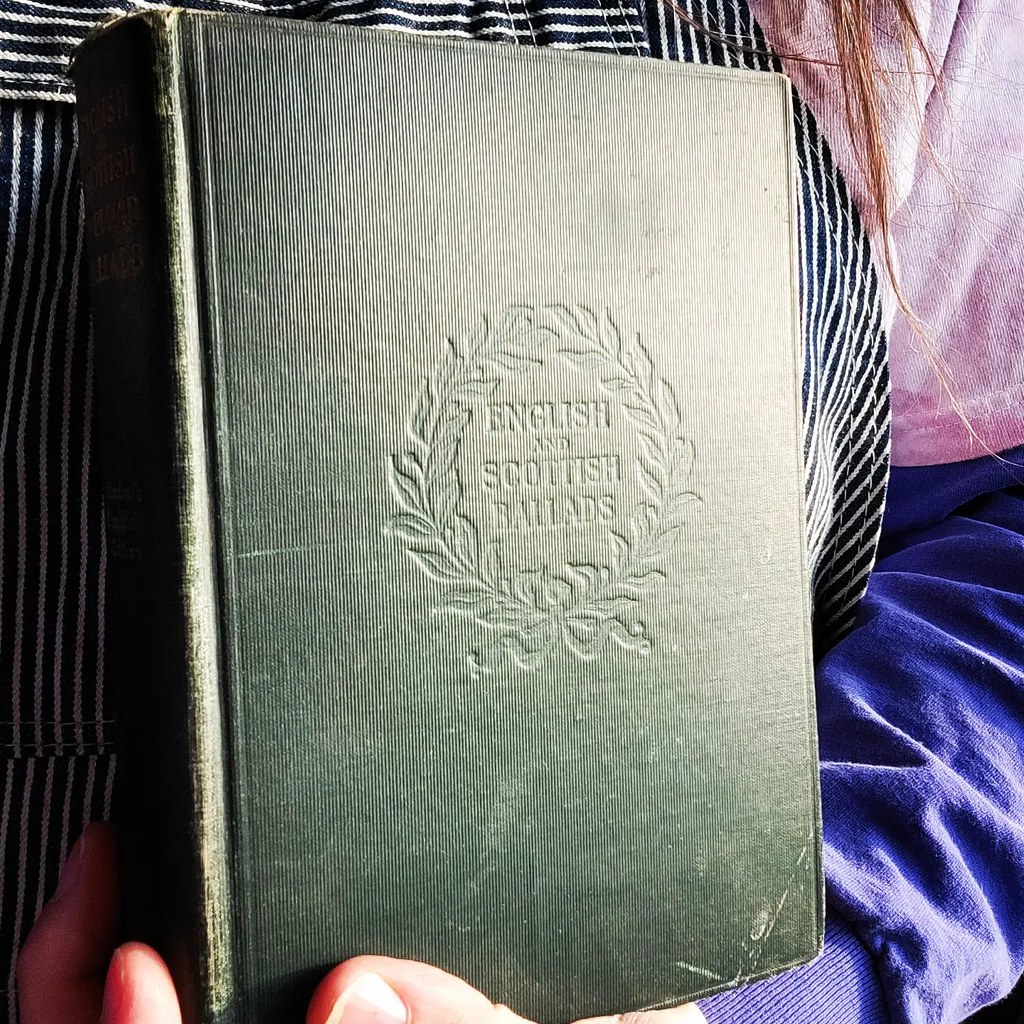
One of the best ways to build a poetry collection is to frequent used-book sales at local libraries. You can almost always find something good at those, and for my money, the real treasure is always the really old stuff, like this:

That’s a volume of English and Scottish ballads, printed in 1904. It’s in a bit of rough shape, but it’s still a joy to own. I’ve picked up a bunch of other old poetry collections in this way. Not only are books like this a pleasure since they just don’t make ’em like this anymore, they’re also nice because–in the case of collections like, say, old editions of The Oxford Book of English Verse–the contents will vary wildly with the contemporary editions, the farther back you go. Very old anthologies of poetry will include poets who are almost (or entirely) forgotten today, and I’m always a big fan of keeping artists of yesteryear from vanishing into total obscurity as much as I can.

Lots of times these old collections were schoolbooks, and the students of the past signed them. I looked this man up, and all I was able to find out was that he graduated high school in Abingdon, PA in 1921. A young man was reading from this book over a hundred years ago…and now it’s on my shelf.

And here’s the man who assembled this collection. This volume appears to be a reissue, and it notes that this editor had already died by this point.

This particular book obviously features ballads, the narrative poems of English and the Scottish tongues, which were a prime medium for storytelling several hundred years ago. As such, a lot of these ballads were kept alive in oral traditions and authorial information, to the extent there ever were any actual “authors”, is long gone. Many of the poems in this book unfold over quite a few pages, but here’s a single short one, with no author given. It’s a grim tale with a sad end…but there’s never any guarantee with these things, is there? I imagine this tale is sadly realistic for its time.

Additional information on this ballad, with one of many alternates, here.

Share This Post