The answer is “No.”

And the question is, Will you be watching the debate?

Even if this was any kind of “normal” election year, I wouldn’t watch debates, because I decided years ago–2000, in fact–that political debates are a complete and utter waste of time, and that if you as a citizen really need the theatrical experience of a debate to decide who gets your vote, then you are a bad citizen because you clearly have not done one ounce of work to figure out (a) what you believe the direction of the country should be, (b) what kind of government we should have, and therefore (c) which candidate(s) are obviously best suited to providing the results you have determined you want by processing items (a) and (b) above. I literally cannot fathom the idea of sitting down to watch a debate because you are genuinely undecided, and that’s in a normal year.

This year, if you’re undecided, I’d almost honestly rather you didn’t vote at all.

Since I reject debates as a tool for deciding between candidates, that reduces them to basically little more interest than a sporting event, and there are plenty of those around. Thus, no, I will not be watching any debates. At all. I don’t need to listen to two hours of 45 spouting complete and utter nonsense to figure this out.


Share This Post

The Discourse ™

I’m not generally one to get moved about The Discourse, and how people can’t talk to one another anymore and all that stuff…but this clip from The Daily Show, in which John Stewart talks to a former Republican Congressman with whom he has little in common, is certainly a good model for the way The Discourse probably would go more frequently, if we lived in a healthy country.


Share This Post

Memorial Day, 2024

Remembering this day those who lost their lives fighting in wars under the American flag. I make no attempt this day to adjudicate the justness of any of those wars; there are other days for that.

(image credit)

Every year on this date I listen to this song. It’s been done by many artists, so here it is by the Dropkick Murphys. This song is one of the best artistic meditations on the awful futility of war that I know, because those last words are so absolutely true: “It all happened again, and again, and again….” I don’t find a great deal of solace or even solemnity in Memorial Day, just a sadness that we keep coming back to this and that there will never, ever, be a Memorial Day when we can say, “Interesting, there are no new names to remember this time around.”

I’m also reminded of Lee Blessing’s play A Walk in the Woods, which dramatizes an event in the 1980s when two arms negotiators, one American and one Soviet, got frustrated with the lack of progress and wandered off to put together their own proposal, which was soundly rejected by both sides for being too realistic, I suppose. In that play, Blessing puts these words in the mouth of his Soviet negotiator:

“If mankind hated war, there would be millions of us, and only two soldiers.”

I fnd it hard to disagree with that sentiment.

Here are the Dropkick Murphys.


oh how do you do, young willy mcbridedo you mind if i sit here down by your gravesideand rest for a while in the warm summer suni’ve been walking all day, and im nearly doneand i see by your gravestone you were only nineteenwhen you joined the great fallen in 1916well i hope you died quickand i hope you died cleanoh willy mcbride, was is it slow and obscene

did they beat the drums slowlydid the play the fife lowlydid they sound the death march as they lowered you downdid the band play the last post and chorusdid the pipes play the flowers of the forest

and did you leave a wife or a sweetheart behindin some loyal heart is your memory enshrinedand though you died back in 1916to that loyal heart you’re forever nineteenor are you a stranger without even a nameforever enshrined behind some old glass panein an old photograph torn, tattered, and stainedand faded to yellow in a brown leather frame

did they beat the drums slowlydid the play the fife lowlydid they sound the death march as they lowered you downdid the band play the last post and chorusdid the pipes play the flowers of the forest

the sun shining down on these green fields of francethe warm wind blows gently and the red poppies dancethe trenches have vanished long under the plowno gas, no barbed wire, no guns firing downbut here in this graveyard that’s still no mans landthe countless white crosses in mute witness standtill’ man’s blind indifference to his fellow manand a whole generation were butchered and damned

did they beat the drums slowlydid the play the fife lowlydid they sound the death march as they lowered you downdid the band play the last post and chorusdid the pipes play the flowers of the forest

and i can’t help but wonder oh willy mcbridedo all those who lie here know why they dieddid you really believe them when they told you the causedid you really believe that this war would end warswell the suffering, the sorrow, the glory, the shamethe killing and dying it was all done in vainoh willy mcbride it all happened againand again, and again, and again, and again

did they beat the drums slowlydid the play the fife lowlydid they sound the death march as they lowered you downdid the band play the last post and chorusdid the pipes play the flowers of the forest

Share This Post

Today in Bookbanning

Let’s see what the bookbanners are up to, shall we? I know, it’s depressing work, but these people are relentless and they are finding more and more creative ways to tighten the noose around books, free expression, and those of us who value those things.

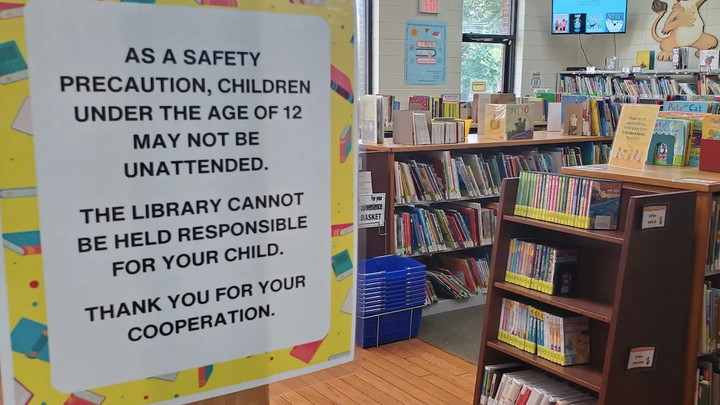
::  I saw this GoFundMe campaign to support a library whose board fired four employees who defied orders to remove books from the library. And that’s bad enough, but what caught my eye here was this sign:


The sign, in front of what is clearly the children’s section of the library, reads:

As a safety precaution, children under the age of 12 may not be unattended. The library cannot be held responsible for your child. Thank you for your cooperation.

And look, maybe that’s simply about the safety of children being left unsupervised; it may even be an advisable and wise policy. But I have to admit to being saddened by the loss to young people of a safe space that I enjoyed in my childhood. I spent many of my childhood hours hanging around in libraries, reading and looking through books, while my parents were off running this or that errand. We continue to send the ever more insidious message to our kids that the world is an inherently dangerous place and that they are not to be allowed to explore it at all until such time as they are, what? Of legal age to drive, or serve in the military? Both of which you can do years before you can vote, or drink alcohol.

Also, I can’t help thinking that this sign isn’t just about that. I can’t help thinking it’s a prophylactic measure. This way, it’s not the evil librarians’ fault if Little Johnny is (gasp!) exploring the shelves on his own and happens upon a copy of something dangerous! something that will warp and pervert him! I can’t help wondering if this “No unattended kids under 12” policy isn’t so much aimed at protecting kids but protecting the librarians from some busybody Mom-For-Liberty type who spends her toilet time watching LibsOfTIktok videos who is livid that her precious Little Johnny somehow managed to get his hands on a copy of Gender Queer and maybe actually read a few pages of it. To the fainting couch, Helen!

::  The library in the item above is in Alabama. Not to be outdone is Louisiana, whose state legislature is considering making it a literally jailable offense for any state employee to do business with the American Library Association. I won’t quote all the nauseating details here, but I will note the ongoing creativity our country’s right-wing has in finding ways to tighten the screws on whatever the hell it is they don’t want other people doing. They’re not going to violate any specific rights, you see; they’re simply making it harder and harder and harder to actually exercise those rights, or they’re making it easier and easier and easier for people who don’t want you exercising your rights to stop you from doing so. It’s Stealth Fascism, but it’s still Fascism.

Be aware, folks–especially if you’re at all inclined to dip your toes into the “Third Party” waters this November for whatever reason.


Share This Post

The Worst Shopping Center Ever Built

I’ve had this post in my head for years, and heck, it’s time to get it outta my head and into here. (Why haven’t I written it? No real reason.)

Anyway, a few miles from Casa Jaquandor is a big shopping plaza called Quaker Crossing. Here it is, via Google Earth:

Looks like any other big suburban plaza, right? And sure, because let’s be honest, suburban shopping plazas are always terrible. But this one is somehow especially terrible. Usually these plazas are terrible because they are relentlessly optimized for cars and are almost anti-pedestrian to the point they feel almost punitive if you’re trying to walk, but this one is somehow terrible for both cars and pedestrians.

OK, let’s get the pedestrian shittiness out of the way first, because it’s easy. Note the gargantuan parking lots, each of them in the middle of their clusters of stores and businesses, with large driveways bounding them. This means that if you plan to shop at multiple businesses at Quaker Crossing, you are extremely discouraged from parking in one place and walking to each business. Those large buildings across the top (north) contain a Target, a Dick’s Sporting Goods, a Kohl’s, a Premiere liquor and wine store, and a Regal Cinemas. Over in the east cluster, you have a large furniture store, a large pet store, and a bunch of smaller stores. The two clusters are separated by a four-lane driveway right up the middle, and this whole plaza sprawls out over a huge parcel, so if you need to go to both Kohl’s and the pet store, there’s no way you’re walking from one to the other. This plaza has virtually no walking infrastructure.

So there you are at Quaker Crossing and you have no choice: you’re driving to the place and then from one side of the plaza to the other. This experience is awful, too.

Here I need a marked-up diagram to illustrate the awfulness:

We start with the red circle, before we even enter the Quaker Crossing plaza. That’s the exit ramp from southbound US219, heading onto westbound Milestrip Road. This used to be a single-lane ramp that yields onto Milestrip, which is four lanes from here to its terminus at NY 5, a few miles west; that’s fine. They added a second lane at the foot of the ramp to merge into the new third lane on Milestrip when the plaza was built, to accommodate people who are coming off 219 for the purpose of entering Quaker Crossing. Again, fine!

But they put a traffic light at the end of the ramp!

So now, instead of a simple yield-and-merge situation, there’s a damned stop light to content with. Why they did this, I have no idea; I have literally seen zero other stop lights at the feet of exit ramps that are designed for merging. Now, if the ramp’s terminus was angled perpendicular to Milestrip, I would get it. But this light makes the entire exchange counterintuitive, and on busy days actually makes things a mess, because there are times when you have to start aggressively braking as soon as you exit 219S. This is nonsense. That light is stupid.

Then there’s the yellow circle, which is the main entrance to Quaker Crossing. This actually isn’t super-bad. It’s a standard 4-way intersection with lights and turn-arrows. Also, if you look closer, just west of the main entrance to Quaker Crossing is a second entrance, just one lane, basically an exit ramp from Milestrip into the western end of the plaza. We use this a lot if we’re going to the theater or to Red Robin, both of which are the westernmost businesses here. Back to the main entrance, though: it’s four lanes itself, since most people entering the plaza have to be able to turn into the left (western) portion of the plaza, or the right (eastern) portion. That makes sense…but one problem here is that for accessing Quaker Crossing via Milestrip, this is the only exit point. That means that just about everybody leaving Quaker Crossing will have to come to this one intersection. Is that horrible? Not entirely…and there is a back way out, which goes to Lake Avenue, but if you’re not going that way, that’s not a big help. Still, the exit isn’t the worst thing in the world…until you factor in the blue circle.

That’s the main intersection from which people leave the short entrance road to either turn left or right to go to wherever they mean to go in Quaker Crossing, or where people have to come if they’re leaving. The problem here is twofold: First, it’s quite close to Milestrip, so there is no time for traffic to funnel out from the main entrance on busy days; second, there are no signals there to manage the traffic. So you have four lanes each way, with turn lanes, and you have busy side driveways with people coming and going, and all of this is dependent on motorists doing right-of-way correctly. This is one of the most nerve-wracking intersections I know of, and I’m honestly surprised I don’t hear of more fender-benders there than I do.

What should they have done? My contention is that they shouldn’t have built that intersection at all. All traffic should go all the way to the northernmost point on that road, and then have people turn, maybe even using a roundabout to guide and filter the traffic through the plaza. That initial intersection is almost always a mess, and it didn’t have to be.

Now, that aqua-colored line? That’s the main driveway through the western side of Quaker Crossing. It, too, is terribly designed; curves a-plenty, entrances to side lots seemingly every hundred feet, and stop signs galore that stop traffic one way but not the other. Why didn’t they design the entire plaza with all the businesses centralized and a single driveway running around the perimeter, like a ring road? Or cluster all the businesses into one large walkable plaza? I have no idea. But this entire place is really a negative miracle of modern architectural design and planning: a giant retail plaza that is terrible to drive and impossible to walk. I honestly do not know how they pulled that off, but pull it off, they did.

Share This Post
History is not a feel-good story

This is a re-post that generally reflects my frustration with the American approach to teaching and thinking about its own history. It’s not specifically about Martin Luther King Jr., but I think it applies, particularly when MLK Jr. is treated by many on the right as a source of exactly one quote. For content specifically about Rev. King, see Roger’s post.

No subject is more eternally disappointing to see discussed in America than race, because a great many of us simply don’t have any inclination to engage in anything remotely resembling an honest discussion of race at all.

This is not the least bit new. All that’s changed, in recent months, is the wording. White people have been finding ways to dodge discussions of racism probably since the beginning of time, but the most prominent version in my personal experience has been simple dismissal of the subject as soon as it is brought up: some version of “There they go again, playing the Race Card,” usually accompanied by a rolling of the eyes.

What is signaled by saying “Playing the Race Card” is itself a rhetorical strategy that has several goals: it’s a granting of permission to oneself to ignore anything the other person is saying, as well as a signal to that person that their words are falling on ears that have been rendered deaf before the fact. It’s a neutering of conversation, and saying it is a metaphorical hanging of the “CLOSED” sign on the mind.

The racism-denialist side has become a bit more sophisticated of late, which you can see in the way they have cynically elevated something called “Critical Race Theory” to the status of Bogeyman Supreme in this country. For a good summation of this, I strongly recommend the summation John Oliver did on this season’s opening episode of Last Week Tonight:

Of special interest is the fact that not one of the people shrieking most loudly about “Critical Race Theory” can tell you the first factual thing about “Critical Race Theory”, and that the American right-wing has become so divorced from any factual basis for its constant drum-beating about nonexistent grievances that now their entire debate can be shaped by dishonest actors like Christopher Rufo, who will publicly and openly admit the dishonest nature of their rhetorical framing as they watch their preferred framing of the debate happen anyway. These people are deeply sophisticated in their knowledge of how American media will follow a bouncing ball to the end of the Earth, so long as the ball is set bouncing by the right wing.

I personally do not know much at all about Critical Race Theory, but I am at least aware that my willingness to admit this puts me in an unfortunate minority among white people. Weird irony, that.

What catches me so much about the rhetoric around the thing that right-wingers have crafted in their increasingly fever-minded, fact-deprived heads about “Critical Race Theory” is one objection I hear over and over and over again. You’ll hear it in the Oliver segment above, and I also saw it this past week in comments on a post to my local Nextdoor forum.

(Yes, I’m on Nextdoor, mainly because it’s useful for stuff like “Hey, anybody know what all those sirens were last night” and “Anybody know a good roofer?” But the site is very obnoxious in a lot of other ways, and I’ve imposed a personal rule of never posting at all on it. One good example is the thread from a few weeks ago–and I am not making this up–of a person breathlessly posting about the suspicious-looking ‘colored’ person in the pickup truck who was obviously casing local houses…until someone else on that same street said, “Yeah, that’s Bob. He’s a meter-reader for the power company.” If I had commented on that, I probably would have been banned.)

(UPDATE: Since I wrote this, I closed out my NextDoor account. It just got to be too much idiotic racism.)

A person posted about “Critical Race Theory” being taught! in the local elementary schools!!! Now, this is BS, obviously, and to their credit, a few folks did point out that this is total BS. But equally obviously, “Critical Race Theory” is just a catch-phrase for these people that has come to refer to any mention of race at all, in any context. (Which is what Rufo et al. intended the entire time–again, see Mr. Oliver.) And that framing leads to this specific talking point:

“I do not want my children being taught to feel bad about their country!”

Or:

“I do not want my child being made to feel BAD about their history!”

Or:

“I don’t want my kid being made to feel like they have to answer for things they didn’t do!”

And you know what? Maybe that’s a bit tempting. I never owned any slaves! Why do I have to feel bad about it? Why do have to atone for that? It was 150 years ago! Leave me alone! Lemme be! Get over it!

When you really start digging into this, you realize quickly that these people don’t want history taught as a factual discipline from which we can learn valuable lessons for the future and in which we come to see the flaws as well as the strengths in the generations that preceded us. No, these people want a feel-good story, a hegemonic tale whose purpose is to shape young minds so they get obediently tearful in the presence of a flag (and, maybe just maybe, the creepy politician literally hugging it). They want the Hero’s Epic version of history, with an honesty-obsessed George Washington admitting chopping down the tree years before he stood proud and tall in that boat as he crossed the Delaware. They want a tale of lantern-jawed heroes, always driven forward by God and goodness, with their women at their backs (always, always that) as they hew their destinies from the land itself.

These people want all the feel-good stuff from history, and that’s it. They want heroic inspiration from the brilliance of Thomas Jefferson’s diplomacy and writings, and none of the frankly horrific caution of Thomas Jefferson’s forced relations with his own slaves. It’s this feel-good cherrypicking approach to history that gives me particular pause, because it’s borne of the same lack of curiosity and honesty that leads these same people to embrace nonsense across the board, including rejecting vaccines in favor of some random medication pushed by some random doctor Joe Rogan had on the podcast this week.

“I don’t want my kid to feel bad about their history!”

Look, here’s the thing, for all those people who complain that they don’t want their children being made to feel bad about their history, or to feel like they are being blamed for awful things their ancestors did:

If you’re not going to let the evils in our past make you feel bad, then you don’t get to turn about and let the triumphs in that same past make you feel good.

If you don’t want to feel bad about slavery, or Jim Crow, or red-lining, or the KKK, or resistance to Civil Rights, then you also don’t get to feel good about defeating fascism in World War II, or triumphing over the East in the Cold War, or landing on the Moon. History is not a buffet where you can choose what things you like and which you don’t.

And this isn’t about “feeling bad” in the proper context to “feel good” about the good stuff, either. History isn’t about feeling bad or feeling good. History is about learning what we’ve done, the good and the bad, so we can make better decisions later.

But we don’t want that…or too few of us want that. We don’t want to talk or even hear about race. If we do, we want to pretend that ending officially-sanctioned slavery and quoting a single sentence from a single speech by Martin Luther King is all the discussion race ever needed. I don’t know how we get White America to even come to the table to have the discussion much less honestly engage it in the first place, but I do know that if something in history makes you feel bad, you shouldn’t avoid that topic but interrogate it even harder, because if something your ancestors did a few dozen or a few hundred years ago makes you feel bad, maybe it’s relevant to something going on now.

Maybe.

(Comments are closed on this post.)

Share This Post

Et tu, Ken???

You may remember several months ago when I was irate that a really good player on Jeopardy! lost because he misspelled the Final Jeopardy answer by one letter?

A refresher:

I don’t remember the numbers in play, but the game was not a runaway; Ben actually needed to be right on Final Jeopardy to win…or at least not wager so much that he’d lose on a wrong answer. The Final Jeopardy clue was this (paraphrased), in the category “Shakespeare Characters”:

“The names of these two lovers are taken from Latin words meaning ‘blessed’.”

Now, first off: I came up with the right answer, because isn’t that the most important thing about Jeopardy, anyway? For you, as a viewer, to feel as smart as, if not smarter, than the people on the teevee who know all this weird random stuff? Why yes! But still: the two challengers both answered “Romeo and Juliet”, and both of those answers were wrong, so both of them lost money. Again, the numbers aren’t important, but at least one of them still had some money left after their wager.

Ben, however, got the right characters: Beatrice and Benedick from Much Ado About Nothing. But wait! He spelled them Beatrice and Benedict, which was enough for the judges to rule him incorrect. His wager was big enough to drop him into second place, and off the show (until he comes back for the Tournament of Champions, so all isn’t lost for Ben).

Well, tonight it happened again! Only this time, they let the misspelling stand. I don’t recall the Final Jeopardy clue, but the answer as “Antony and Cleopatra”. One of the contestants spelled it Anthony and Cleopatra, though. There’s no ‘H’ there: He’s Mark Antony, not Mark Anthony. Ken Jennings actually said something like, “There’s no H in there, but we’ll give it to you anyway.”

WHAT???!!!

Why did spelling count for Ben back in May but not for some other guy tonight? Now, the answer didn’t end up mattering this time: he still came in second, so the game would not have been decided had his answer been correct or incorrect, but back then I was told that the rules are the rules! Spelling counts in Final Jeopardy! One imagines Mr. Goodman from The Big Lebowski:


Share This Post