I first wrote this on the old blog six years ago, on the 50th anniversary of STAR TREK’s first airing. Today that anniversary rolls around again, now the 56th, and all these words still apply, so here they are!
And you people, you’re all astronauts on…some kind of star trek?
–Zefram Cochrane, Star Trek First Contact
Wow. Star Trek made its official US debut fifty years ago today. That’s…amazing. (The show aired for the first time anywhere on September 6, 1966, in Canada.)
Star Trek came and went and was already in syndication when I was born, but my sister loved it, so I quite literally do not remember a time when Star Trek wasn’t a thing. One of my earliest teevee memories is, in fact, the brief bit at the end of the episode “Friday’s Child”, when Dr. McCoy is saying “Oochie woochie coochie coo” to a newborn baby, to Spock’s great confusion.
It’s often taken as an article of faith in the geek universe that one is either a Star Wars fan or a Star Trek fan, and I can kind of see why. It’s a Yankees-Red Sox kind of thing, I suppose. Or Bears-Packers. But for me, it’s complicated. I have to be honest: push me to answer, hold a gun to my head, and I will almost certainly choose Star Wars. But the margin of victory is not large, and in truth, there’s no way I’m the writer I am now without both of them.
“Let me help.” A hundred years or so from now, I believe, a famous novelist will write a classic using that theme. He’ll recommend those three words even over “I love you.”
–James T. Kirk, “The City on the Edge of Forever”
Star Trek shaped my view, in a lot of ways, of what the future can and should be. It should be a time when humans are not afraid to explore the universe and, in fact, do so with enthusiasm. It should be a time when the diversity of humanity should be celebrated and not resisted. It should be a time when beautiful ships fly the stars, instead of rusting dingy hulks. It should be a time of wonderful cities, not dystopic nightmares. It should not be a time of universal peace without conflict, because that’s almost certainly impossible, but it should be a time when we approach conflict from a much more mature standpoint than we do now.
Of course, when I was a kid, Star Trek was none of that. It was just a show about nifty adventures in space, a way for me to scratch that particular itch in the years between releases of Star Wars movies. It didn’t ever occur to me back then that I was supposed to like one over the other; they were different things, and I liked ‘em both. If Star Wars hit me like a bolt from the blue, Star Trek was the thing that was there, day in and day out. Star Trek was what was on during the afternoon hours after school. I’d get home and watch it and thrill to the adventures of Captain Kirk and crew on the black-and-white teevee set I had in my room. This was before the Internet, obviously, and I didn’t have any access to an episode guide, so the only way to learn the episodes was to watch and watch and rewatch them as they came. I got pretty good at recognizing the episodes by sight, usually within seconds. (Often I had to wait until the first shot after the obligatory opening shot of the Enterprise.)
I don’t know if the station had some kind of plan for airing the episodes in any particular order, but I recall that you could go upwards of a year without seeing “Mirror, Mirror” or “The Trouble with Tribbles”, but other episodes – “The Return of the Archons”, “Errand of Mercy” – would show up more frequently. A certain “This one again?!” factor crept in at times, especially with some of the crappier episodes. (I can live the rest of my life to a rich old age and never watch “The Alternative Factor” again.) But the great episodes? Those live on forever. I still laugh at “The Trouble with Tribbles”, and I live for a moment when someone near me uses the phrase “storage compartments”, so I can respond as Kirk does: “STORAGE compartments? STORAGE compartments?!” And I still feel that sense of doom slowly unfolding as “The City on the Edge of Forever” spins its tale, toward the awful moment when, in order to fix history after it has been changed, James Kirk must stand and watch as a 20th century woman with whom he has fallen in love is killed.
MCCOY: You deliberately stopped me, Jim! I could have saved her. Do you know what you just did?
SPOCK: He knows, Doctor. He knows.
–”The City on the Edge of Forever”
As a kid, I attended two Star Trek conventions with my older sister – or at least, one Trek convention and one general sci-fi convention. At the latter, “The Trouble with Tribbles” was aired, followed by 2001: A Space Odyssey. Those were fun. George Takei was the guest of honor at the first one, in 1977 or 1978. I was in first grade at the time. I remember Takei wearing a gleaming white suit. (Peter Mayhew was guest at the next one.)
I eventually lost track of daily Star Trek reruns by the mid-1980s, but also by this point, the movies were a thing. I remember being terribly excited for The Motion Picture, and even though I didn’t quite understand all of the plot, I have never – not once – disliked that often-maligned film. I recall being mildly disappointed that the Enterprise never fires its phasers once in that film, and in fact it only dispatches a single photon torpedo, and that’s at an errant asteroid that’s about to collide with the Great Bird. I didn’t realize it at the time, but I think The Motion Picture is the first real science fiction story I saw on the big screen that wasn’t about a galactic war or some other action-based adventure. I wasn’t thinking in those terms, but yes, the movie primed that particular pump.
I liked all of the movies that came, and I saw every one in the theater over the next decade. This was an odd time for Trek, when a movie every couple of years was all there was. Sure, every once in a while there would be a tidbit in Starlog (the late, great SF fandom magazine) about how somebody somewhere wanted to make a new Trek teevee series, but it never amounted to much until we learned that we were finally getting The Next Generation. This was for several reasons, not the least of which was that Paramount wanted to keep making money off Trek but the original cast was starting to show its age.
Through the 1980s, as Star Wars seemed to fade away, Trek was still there, churning out a movie every couple of years and then a new teevee show. That’s what Trek always was for me. It didn’t fuel my imagination in quite the same way that Star Wars has always moved me at a very basic level of storytelling taste, but Trek has always been around. Always, always there. In fact, it was always there to such an extent that in the late 1990s, I started letting Trek go…but I’m getting ahead. During this time I read a number of Trek novels, and there was a fanzine called Trek that would annually publish a paperback book filled with its best articles. These I read with zeal, and I’ve lately started regathering them all via eBay. Maybe this winter I’ll spend some time reliving some fine old fan writing.
I loved The Next Generation, and watching it religiously formed a tradition in college among my mates and I. TNG aired reruns every weeknight, and the new episodes ran every Sunday night after the 10:00 news. That station even went so far, as TNG’s popularity grew, of including a very brief astronomy segment in its 10:00 Sunday newscast – “Tonight you can see Mars in the eastern sky!”, that sort of thing – complete with an Enterprise fly-by animation. And then, in our senior year, the next show, Star Trek: Deep Space Nine, arrived. That premiere was an event, and I still think that premiere was an amazing episode.
Never trust ale from a god-fearing people, or a Starfleet Commander that has one of your relatives in jail.
–Quark, Star Trek: Deep Space Nine
It took a little while for TNG to really get going, but once the writers had the chemistry down, the show was more than ready to carry on the Trek tradition, with many a fine and thought-provoking story, about love and loss and what it means to be human even as we take to the stars.
If you can’t take a little bloody nose, maybe you ought to go back home and crawl under your bed. It’s not safe out here. It’s wondrous, with treasures to satiate desires both subtle and gross. But it’s not for the timid.
–Q, Star Trek: The Next Generation
And still the movies came. The Wrath of Khan and The Search for Spock, which I saw with school friends. The Voyage Home, with its goofy and infectious joy. Even the much-maligned (and mostly deservedly so) The Final Frontier had its charms for me. That poor movie may have failed, but I really give it credit for trying to be about something.
The Undiscovered Country came along in 1991, when TNG had hit its stride. We saw it in the theater the night it opened, which happened to be the same night as our annual Christmas concert performance at a big church in Cedar Falls, IA. We did the concert, quickly changed clothes, and bolted down the street to catch the show. I loved that movie, and in fact, to this day Star Trek VI is my favorite Trek film. I remember a lump in my throat at the closing scene, which boiled down to just the classic crew onscreen (minus Sulu, who finally got his promotion to Captain and got to fly away on his own ship, the Excelsior), followed by the animated signatures of the original cast. Their time was done. (Although, in classic Trek and science fiction fashion, not quite.)
CHEKOV: Course heading, Captain?
KIRK: (smiles) Second star to the right…and straight on ‘til morning.
—Star Trek VI: The Undiscovered Country
College ended and the real world began, and there was still Star Trek, even as Star Wars started making rumblings again. The TNG crew graduated to movies, and DS9 soared in quality. Another series began, Voyager…which is when I started to lose a bit of energy with respect to Trek. For one thing, I had a lot of other interests by this time, but for another, it was pretty clear as Voyager got going that the creative folks behind Trek were starting to lose steam. I stopped watching Voyager about the fourth season, and the next series? Well, to this day, I have never watched a single episode of Enterprise.
But now Trek is coming back. Three new movies, with varying degrees of success. A new series on the way, reimagined to seasons of thirteen episodes each. The Trek continues. (I haven’t seen Star Trek Beyond yet. It came and went from the theaters too quickly this summer, and it came out during our busiest time of the summer as well, so I simply was never able to squeeze it in. Beyond and Nemesis are, to date, the only Trek films I did not see in the theaters.) Will Trek eventually reach similar heights again? Are there more stories in the offing to match tales like “The Devil in the Dark,” “The Doomsday Machine,” “A Piece of the Action,” “The Best of Both Worlds,” “Yesterday’s Enterprise,” “Tapestry,” “The Visitor”? Who knows…but I look forward to finding out.
Star Trek is, was, and has been many things. It will continue to be many things, too. I don’t know that I’ll ever have the same old investment in it that I did in the late 70s and through the 80s. I don’t know that I’ll ever feel that same enthusiasm for Star Wars either, so the two tentpoles of my science fiction life have that much in common, don’t they? But I’ll always owe a debt to Star Trek. It shone a bright light on a future that doesn’t have to be awful, and it showed beautiful space ships. It put a new light on the idea of space adventure, and it showed a military organization that was devoted truly to peace. Star Trek did time travel better than just about anybody else. Star Trek gave us amazing characters, and it let those characters do amazing things.
They used to say if man could fly, he’d have wings, but he did fly. He discovered he had to. Do you wish that the first Apollo mission hadn’t reached the moon, or that we hadn’t gone on to Mars and then to the nearest star? That’s like saying you wish that you still operated with scalpels and sewed your patients up with catgut like your great-great-great-great grandfather used to. I’m in command. I could order this, but I’m not because Doctor McCoy is right in pointing out the enormous danger potential in any contact with life and intelligence as fantastically advanced as this, but I must point out that the possibilities – the potential for knowledge and advancement – is equally great. Risk! Risk is our business. That’s what this starship is all about. That’s why we’re aboard her.
–James T. Kirk, “Return to Tomorrow”
Star Trek is fifty. Amazing. Long live Star Trek.
Space: the final frontier. These are the voyages of the starship Enterprise. Her ongoing mission: to explore strange, new worlds; to seek out new life and new civilizations; to boldly go where no one has gone before.
The movie Contact, based on Carl Sagan’s one and only one novel, came out this month in 1997. Almost ten years ago I posted the following piece about the movie, a film that I’ve always liked and admired but not quite crossed over into loving. I’m not sure I totally agree anymore with what I write below, but thinking does shift and evolve, and I appreciate Contact more now than I used to; it remains one of the few major pop culture artifacts that endorses the Saganesque view that science should be our guiding philosophy as humans, and not spirituality. But I still think the movie hedges its bets too much, it drives its points home with too little subtlety (a fault often found in Robert Zemeckis films), and I think it undermines the feminist subplots by surrounding its main character with men without whose help and influence she would not succeed.
And yet…Contact is still a movie that says the right things about science and about the universe. It’s a movie that confirms that the proper response to this universe is curiosity and wonder, and my favorite moment is when Ellie Arroway (Jodie Foster) is discussing the voyage into the Cosmos that is at the heart of the movie’s narrative and she describes the required quality as “a sense of adventure”.
(Oh, Contact‘s score, by Alan Silvestri, is really good–for all the film’s lack of subtlety, Silvestri brings the goods here. Here’s one cue, called “The Primer”, scoring a scene in which the secret of an alien transmission is revealed. This is really good stuff, excellent suspense music, and it shows why Silvestri ended up being the composer for the recent sequels to the original Cosmos series.)
Here is my old post:
As much as I love Carl Sagan, I have to admit that I never warmed to his one and only novel, a science-fiction first contact story he called Contact. I tried reading it a couple of times, and each time I only got about a hundred pages in before I stopped. I just don’t think that Sagan was really cut out for novel writing, no matter how great his gifts may have been for science writing. But in 1997, a movie adaptation of the book arrived in theaters, starring Jodie Foster and Matthew McConnaughey and directed by Robert Zemeckis. The movie was six months too late for Sagan to have seen it, alas.
I’ve had a somewhat uneasy relationship with Contact ever since it came out. On balance I like it a lot…but I don’t love it, and in truth, I never really have. I’ve never been entirely successful in putting my finger on what it is about Contact that vexes me, but after recently watching the film again on NetFlix, I think I have it: the movie is too unfocused. When the film is concentrated on telling its story and attending to that central story, it is a fine, fine piece of work. But too often I get the impression that Robert Zemeckis got distracted, often by something shiny, and there are way too many times in the movie that the story gets lost so we can follow something shiny.
Contact tells the story of Ellie Arroway, an astronomer whom we meet as a young child, operating her HAM radio under the guidance of her father. They have a wall map of the United States, on which she marks her radio contacts with push pins; after talking to someone in Pensacola, Dad comments that it’s her farthest contact yet. Ellie asks if a radio could talk to the Moon, or to Mars…or to her mother, who is apparently dead. Dad responds, “I don’t think they’ll ever make a radio that can reach that far.”
Grown-up Ellie (Jodie Foster) turns out to be an astronomer, as noted, who is using her research time at the Arecibo Radio Telescope to look for, as she says, “little green men”: she is dedicating her career and scientific energies to SETI (Search for Extra-Terrestrial Intelligence). This leads to her meeting a former priest (Palmer Joss, played by Matthew McConnaughey), who despite being religious and spiritual where she is not, attracts her on a number of levels, and it also leads to run-ins with an older male scientist named David Drumlin (Tom Skeritt) who is snide and condescending to Ellie as he regards her chosen field of specialty as an utter waste of time. After a number of obstacles to her career – mostly owing to funding difficulties, as convincing people to part with money for something like SETI tends to be difficult – Ellie finally has a breakthrough when, while working at the Very Large Array in New Mexico, her radio telescopes detect an unmistakable alien signal. The rest of the film follows the implications of such a discovery.
Or, rather, the rest of the film should do that, and when it does, it’s incredibly effective and thought-provoking and loaded with the grand “sensawunda” of all the best science fiction. The problem with the movie is that it too often wanders into less interesting stuff, or its steps away from subtlety to drive its points home with a jackhammer, or it does things that forcibly eject me from the world of the film.
Taking the less interesting stuff first: Ellie Arroway is too often portrayed in the film as the feminine voice of reason in a crowd of over-bearing, pompous, or downright dim men. Science and engineering are male-dominated fields, and it’s a well-established fact that women in those fields tend to have a tougher going just to overcome gender biases. The problem with Contact‘s approach isn’t so much that it points this out, but that it’s about other things, and thus it can’t really delve too intelligently into those topics which really do deserve higher scrutiny. Thus we have Ellie being treated like an outsider on her own project, or Drumlin stepping up to claim ownership over a project he’s derided consistently up until the moment it proved fruitful. Ellie is constantly on the defensive in the movie, and I think it hurts the narrative because the film can’t just gear up and take us where it wants to go. Instead we have to keep talking about God.
And God is where subtlety just isn’t something that interests Robert Zemeckis. Contact is full of discussions of religion versus science, but the feeling is never that anything is really being debated; what happens is that opposite sides’ viewpoints are stated, and restated, and stated again. Ellie goes to a reception in Washington, where her first order of business upon approaching Palmer Joss is to immediately launch into a discussion on religion, without any preamble or preliminary; more than that, though, the script treats all such conversations – and many that aren’t on the topic of religion at all – as though Ellie has a sizable axe to grind, while everyone else (just about all of whom are male) is calm and collected in their disagreement. Coupling that with the several instances in the film where Ellie is betrayed by men – Drumlin’s taking of the credit, Joss’s posing of a question at the hearings when he knows that the answer is going to doom Ellie’s chances of being the one selected to go in ‘the machine’ – and the film seems to depict Ellie as someone who doesn’t so much achieve a lot but whom is given things, table-scrap like, by the men in her life. It’s an odd kind of feeling.
It also bothers me that the film ends right when it gets most interesting, and it feels to me like it takes the easy way out. To me, the most interesting thing is, What would human society be like once we know that we are not alone in this Universe? We may know next to nothing about who is out there, but surely knowing once and for all, without speculation, that there is someone or something living out there would be a staggering revelation for the human species. Unfortunately, the film doesn’t do much with this notion – in fact, it backs away from it. We get lots of intrigue involving the contents of the message that is received from space, and then the construction of the transport “machine”, and so on. And this is all very compelling and entertaining…but at the end, the film gives us the old “Did it really happen?” gambit, reducing a momentous scientific discovery to something that will appeal to some people and not to others. Not unlike, say, the belief in God.
(Again, I don’t know to what degree the film’s story tracks that of the novel.)
I always find that the film deflates in its last fifteen minutes or so, after Ellie returns from her journey only to learn that, so far as anyone here knows, she never went anywhere. This leads to a Congressional hearing (which really drives home the film’s theme of “one woman versus a whole bunch of mean men”), at the end of which one Representative says, “Are we supposed to take your story…on faith?” And yes, he really pauses and puts big emphasis on those last two words, just in case we missed the irony of a scientist committed to objective observation being forced to admit the necessity of faith. Again, subtle, this is not. The movie does try to have it both ways by showing two government folks discussion the fact that the machine’s video recorder recorded eighteen hours of static (had nothing happened at all, there would have been about two seconds’ worth). But this is to be kept secret, apparently. They might as well seal all this information in a crate and store it in the warehouse next to the Ark of the Covenant.
And the movie ends, on this state of affairs. What happens now, though? Does some kind of new religion start to accrete around Ellie and her scientific beliefs? Does Ellie somehow become an evangelist for a new blossoming of a scientific worldview? Does her experience have any effect on the human tension between science and religion? We never get any suggestions or speculations. All we get is the rolling of the credits. Contact tells a good story, but it stops just as its important story is just beginning.
Finally, I just have to note that all the cameos in the movie annoy the crap out of me. This was when Robert Zemeckis had just discovered that he could put people into lots of interesting situations, digitally; remember, he’d had Forrest Gump consorting with Presidents Kennedy, Johnson, and Nixon. So here we get loads of real-life CNN personalities, and even President Bill Clinton, with the film taking quotes from actual Clinton newscasts and editing them so that it sounds like he’s discussing the events of the movie. It’s incredibly distracting. Instead of being drawn further into the story, I find myself trying to think of what event Clinton was actually discussing in the speeches that were repurposed for this movie. Things like having Rob Lowe play a Christian conservative leader named “Richard Rank” are incredibly distracting, because of course it makes me think of Ralph Reed. Shoehorning in mention of the mass suicide of the Heaven’s Gate cult, which had happened just months before the movie came out, is another example. Zemeckis seems to want his movie to seem ‘real’ and relevant, but all this stuff has the exact opposite effect on me: it forces me to keep the story at arm’s length.
Ultimately, I want to love Contact, because of my love and admiration for Carl Sagan, for the subject matter of the story, and for the view of the Universe as a place of wonder and of science as humanity’s greatest achievement. And there really is a lot to love about Contact. But the movie spends so much time getting in its own way that I inevitably end up just admiring it a lot.
Warner was a very prolific actor; bring up his filmography and you’ll be scrolling for quite a while. While he was usually not a lead, he was more than a “character actor”. Warner brought gravity, precision, and seriousness to every role he undertook. He brought an air of dignity to the table whether he played a villain or an ally or something in between. Warner appeared in genre films a lot; the first thing I ever saw him in was 1982’s TRON in which he had the dual role of the oily businessman Ed Dillinger in the ‘real’ world and the sadistic henchman program Sark in the ‘computer’ world. From then on I would run into Warner pretty frequently, as he was the kind of actor who was always working.
Warner showed up on Star Trek several times, first as a human in Star Trek V: The Final Frontier, and then as the doomed Klingon Chancellor Gorkon in Star Trek VI: The Undiscovered Country. He would then be a Cardassian in the Star Trek: The Next Generation episode “Chain of Command”, a particularly memorable turn in which his character, Gul Madred, tortures a captive Captain Picard, taunting him to break and admit that there are five spotlights shining down on him when in reality there are only four.
Oddly, despite being such a prevalent English actor, Warner never appeared in any Star Wars property, except for some voice work in a game that came out in 2000. I consider that a missed opportunity for Star Wars.
David Warner was like Christopher Lee in his ability to elevate whatever material he was in. His characters, whether villainous or virtuous, always had an air of dignity and consideration about them, and there was always a careful precision in his acting. He was Billy Zane’s security-henchman guy in Titanic, a really nasty character named Lovejoy; at the end of the scene where Jack saves Rose from her suicide attempt and then helps her cover up that she attempted suicide at all, Warner fixes Leonardo DiCaprio with a pleasant expression as he says “It’s curious how she slipped and fell so suddenly, and yet you had time to remove your jacket and your shoes.” And the pleasantness leaves his eyes entirely, even as he gives DiCaprio a tight, controlled smile. You can see Lovejoy’s lethal nature in that tiny moment that Warner pulls off. There’s no question this guy is going to be bad news before the end.
The first time I saw David Warner in anything was a thriller called Time After Time, in which Warner played an 1890s London physician who turns out to be none other than Jack the Ripper. He commits one more murder but now the police are onto him…when he learns that his good friend, author and naive utopian H.G. Wells, has created a time machine. I wrote about this movie several years ago when I was still writing for The Geekiverse, and I discovered earlier that that site has been taken down (The Geekiverse‘s owner has been retooling, refocusing, and ultimately rebranding the site, which is absolutely fine!). Luckily, via the Wayback Machine, I was able to grab the text of what I wrote back then. I offer it below as tribute to David Warner, a wonderful actor who will be missed but whose body of work will endure.
What if H.G. Wells wrote The Time Machine out of direct experience with time travel? What if Wells actually built a time machine and used it to visit San Francisco in 1979? What if Wells came to 1979 chasing Jack the Ripper, who had also used Wells’s machine to flee certain capture in 1893? That’s the hook of the 1979 movie Time After Time, one of my favorite time travel stories of all…well, you know.
Time travel is one of speculative fiction’s warhorse tropes, and I very much doubt you can find a genre fan whose personal list of favorite stories doesn’t include at least one time travel tale, be it Back to the Future or Star Trek entries like “The City on the Edge of Forever” or ST IV: The Voyage Home or that weepiest of weepers, Somewhere in Time.
Time After Time opens in 1893, on a steamy gaslit street in London where we witness as Jack the Ripper (“My name is John, but my friends call me Jack….”) murders a prostitute.
Then we meet our hero, H.G. Wells (played by Malcolm McDowell), who is hosting a dinner party at which he unveils to his friends (including a physician named John Leslie Stevenson, played by David Warner) the time machine that he has built. Wells is planning to travel forward in time so he can witness what he assumes will be humanity’s Utopia, believing as he does that the dawn of the Socialist utopia is at hand.
The dinner party is cut short by a visit from Scotland Yard. It seems that “the Ripper has struck again,” after several years of inactivity, and he has done so quite nearby. Searching Wells’s home, the detectives find Dr. Stevenson’s medical bag containing the knife and the bloody gloves, revealing Wells’ own friend to be England’s most notorious murderer. Stevenson is not in the house, though, and Wells realizes that there is only one way Stevenson can have escaped: he has fled in the time machine to 1979. “I’ve turned that bloody maniac loose upon Utopia!” Wells says as he follows Stevenson into the future, where he discovers many things, including lunch at McDonald’s, that women have achieved a degree of professional mobility, and that the future is far from the Utopia he has envisioned.
When Wells confronts Stevenson in his hotel room, Stevenson shows Wells a television set and all the violent content available on it. Stevenson points out, to Wells’s horror, that their future is closer to his Utopia than Wells’s. “Ninety years ago I was a freak,” Stevenson says. “Today I’m an amateur…We don’t belong here? On the contrary, Herbert. I belong here, completely and utterly. I’m home.”
Luckily for the film, Time After Time doesn’t dwell much on this bit of social commentary, preferring to keeps its story moving, but it does make clear the viewpoint that violence is an eternal part of the human condition. Late in the film Wells says: “Every age is the same. It’s only love that makes any of them bearable.”
Love: that’s the other main part of Time After Time, because H.G. Wells also finds love while he is searching for the Ripper. He needs money and goes to convert some of his 1893 currency, where he meets banker Amy Robbins (Mary Steenburgen). They begin a romance in which Robbins is entranced by Wells’s quaint clothes and oddly out-of-touch prudishness. Wells keeps his secret as long as he can, but eventually he realizes that he has to come clean with her, and when he does he proves that he is telling the truth about having come from the past by using the time machine to take her four days into the future. This works…except that the newspaper they find, proving that they have indeed gone into the future again, has a headline story about the new Ripper’s latest murder: Amy herself. Wells must now stop Jack the Ripper entirely, and stop him from murdering the woman he loves.
Time After Time is a grand, old-fashioned entertainment, right from the very start when the film opens with the great old Warner Brothers fanfare that once opened films such as Casablanca. Director Nicholas Meyer, in his first feature film, keeps the story moving briskly along and lets his actors do the work. The “fish out of water” stuff, like Wells ordering at McDonalds and identifying himself to police as “Sherlock Holmes” (clearly never expecting a popular fictional character from his own day to endure for all time), works very well, and Meyer does not lean on that stuff too heavily at all, thus keeping the film from spinning off into pure comedy.
Best of all are the performances. McDowell depicts Wells’s wisdom and naivete, and it’s hardly a revelation that David Warner plays a very fine villain in his Jack the Ripper. Steenburgen’s Amy Robbins is smart and competent, clearly seeing through Wells but also being willing to go along with his weirdness for a while…until things get too weird, of course. By limiting the time travel to the future, Time After Time involves all the paradoxical time travel stuff like changing history and keeping parents from meeting and the like. Instead the film focuses on how the future invariably amazes and disappoints at the same time. The movie also holds up quite well, not being terribly dated at all (the period McDonald’s uniforms are a hoot, though).
Time After Time looks great, even after all these years. The machine itself is a great bit of Victorian steampunk, looking vaguely fishlike and studded with gems. Miklos Rozsa, one of the greatest composers of film music ever, turns in one of his last scores. Nicholas Meyer would make an even bigger mark in genre film three years later, with Star Trek II: The Wrath of Khan, and both McDowell and Warner would show up in Trek movies themselves (though not together). Looking for a great time travel story? Try Time After Time!
Harrison Ford is 80 years old today. He’s been one of my favorite actors–hell, for a lot of my youth he was my favorite actor–pretty much ever since I was aware of actors as actual people who had real names. Of course this was because of Star Wars! Han Solo was my favorite character early on, and I gravitated to Ford’s laconic and sarcastic portrayal of a space pirate whose heart was just waiting to be unlocked.
I would for years watch anything just because Harrison Ford was in it. I’d stay up late to watch a movie called The Frisco Kid, a Western in which Ford is an outlaw who ends up helping a wayward Rabbi (played by Gene Wilder) get to San Francisco. I remember Ford in a film called Heroes, starring Henry Winkler as a Vietnam vet who is struggling with PTSD. I badgered my mother into taking me, as an 11-year-old, to see Blade Runner, for which I was almost certainly too young. I was only vaguely interested in Raiders of the Lost Ark (what did I care if it was directed by the guy who did Jaws and written by the guy who wrote Star Wars?) until I learned that Harrison Ford was in it.
And there was Witness in 1985, still unequaled in Ford’s career.
I’ve seen most of Ford’s filmography, though not all of it. Ford’s been a constant presence in my moviegoing world for pretty much the entire time I’ve been seeing movies that weren’t kiddie-fare or animated features. He’s not the kind of chameleon actor who looks different each time out, like Daniel Day Lewis, but he has more range than I think a lot of people give him credit for. And there’s always that Harrison Fork twinkle in the eye, this reassuring gleam that tells us in the audience: “Hey, I’ve got this. Don’t worry.”
As an action star, I always get the feel that Harrison Ford is playing normal guys who wind up in action scenarios. He’s not a guy who knows what to do, but a guy who takes stock of what’s going on around him. Ford’s characters are always aware in a way that makes Ford a part of the scene, really in the movie’s world, and not just acting on a set. Few actors show their characters thinking their way through their struggles as well as Ford. You can always see his character thinking, processing, their wheels turning.
Mark Hamill described working with Harrison Ford in a late-night appearance a few years ago, and this is a great testimonial because he describe’s Ford’s awareness extending not just to the scene but to the project as a whole. Ford always knows what the job is, and what he has to do to get the job done. It’s probably an attitude born of his years as a carpenter, before he caught on as an actor; a carpenter’s work is completely defined, after all! You know what you’re building, you know what materials you’re working with, you know what you have to do in what order to get the job done. Ford seems to have a similar approach to acting, and what a good thing. (This may also be why Ford always seems so bemused and out of place in interviews; the guy looks at acting as a job, so what’s there to talk about? Who brings the carpenter on to a teevee show to talk about what it meant to build a table?)
Here’s Mark Hamill:
For a long time it was almost a cottage industry to complain about Harrison Ford’s approach to his own career. The narrative was that he was just taking jobs to stay busy, that he didn’t care about rising to a challenge, and that he’d probably never rise again to the level of his work in Witness because he just didn’t seem like he wanted to. I honestly don’t know what to make of that, but I will note that for me, Harrison Ford’s body of work stands in much better light than many think. And I hope he’s still got time and desire to do some more.
Happy birthday, Harrison Ford! You always get the job done.
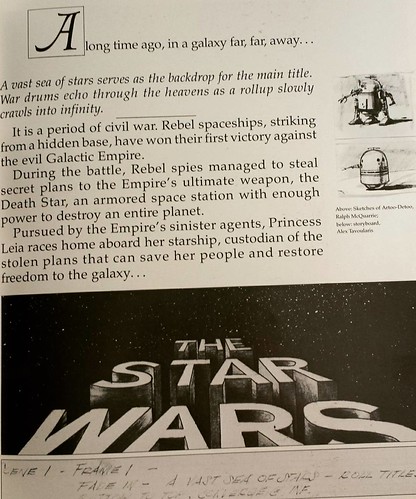
Forty-five years ago today, Star Wars opened in theaters. Here is a post I wrote in 2017 for the movie’s 40th anniversary.
I didn’t see Star Wars on opening day. In truth I don’t even remember exactly when I saw it, but it was later in the summer of 1977. We had just moved from Wisconsin to Oregon, and in that time I was not even aware of this enormous movie phenomenon whose popularity was sweeping the nation.
I finally saw it, though, with my sister, who is six years older than me.
I didn’t like it.
It was very loud. It opened with big words flying through space and then there was loud spaceships and talking robots (one of whom only talked in beeps and whistles). There was a girl in white and a bad guy in black whose breath sounded weird. There was a desert planet with weird dwarf-creatures and a kid named Luke who lived with his aunt and uncle. (The uncle could be pretty gruff if Luke was goofing off, to which I could relate.) There were more loud spaceships and one really really big spaceship shaped like a giant ball. There was a guy dressed in black and white who helped the farm kid, and this guy had a giant ape-man friend. There were swords made of light and even more spaceships and a big battle in space.
All of that, and I didn’t understand a lick of it.
In my defense, I was all of five years old at the time.
Until Star Wars, my movie experience was pretty much limited to stuff like Bugs Bunny Superstar and Disney live-actions like The Shaggy DA (which contained a hoot of a pie fight). Then there was this movie with loud spaceships and robots and a farm kid and a bad guy in black and…well, I had no idea what to make of this movie.
Luckily for me I had my sister, who is six years older than me.
She went all-in for Star Wars. She ate it, drank it, breathed it. She talked about it a lot, and gradually her enthusiasm began to win me over. She explained the story to me because I hadn’t understood it all that well, and I decided that I wanted a part of her enthusiasm for my own. So I went with her to see the movie a second time.
I have never ever ever recovered.
I’ve been thinking a lot about Star Wars as it nears and achieves 40 years, and I find myself relating to it most as a storyteller myself. As a writer I tend most to look at Star Wars through the prism of story. Many stories have had a deep effect on me, on the stories I want to tell, and the way I go about telling them, but none moreso than Star Wars, even as the Star Wars story itself has changed over the course of its four decades. Most of the core ideas are still there, though, as Star Wars is now no longer in the hands of its creator, George Lucas. Star Wars is still a tale of heroic adventure unfolding in the sky. It is still a tale not just of the wars but more well-focused on the people fighting that war. It is a tale of improbably redeemable villains, of the way our paths mirror those of our parents, and of finding love in the face of desperation. It is a tale of family.
I can’t help thinking in most, if not all, of these terms every time I write a story, no matter which genre it’s in. Star Wars made me want to be a storyteller (what is playing with action figures, if not storytelling?). It also taught me that stories can focus at times on more mystical matters, and it taught me that story is an excellent way of addressing the challenges people face in their hearts. Most importantly, though, Star Wars taught me about heroes and quests and the wise elders who try to guide the heroes on their way.
Other stories have come since Star Wars arrived, and many have come to places almost as near to my heart. It’s not only stories, either; it’s all of creative art, really:
Lloyd Alexander’s Prydain Chronicles The Lord of the Rings Casablanca On Her Majesty’s Secret Service My Fair Lady Cosmos Much Ado About Nothing The House with a Clock in its Walls The Lions of Al-Rassan
Mary Stewart’s Arthurian trilogy (plus The Wicked Day)
Berlioz’s Symphonie fantastique
Rachmaninov’s Symphony No. 2 in E minor Invisible Touch by Genesis Once and Again Princess Mononoke
These are all things — and there are more — that are at the center of my creative life, but none has ever quite dislodged Star Wars as my Prime Mover. Star Wars is, and continues to be, my Platonic Ideal of what story is.
Even so, I haven’t always kept as close an eye on Star Wars as a massive universe as many. I’ve read only a small handful of all the many novels and comics written over the years, and I haven’t played any of the video games. For me, my appreciation focuses pretty exclusively on the movies themselves, and not just the wonderful Original Trilogy but also the admittedly uneven — but still, in my eyes, uniquely compelling — Prequel Trilogy and even to a smaller extent the recent “Rebirth” movies, The Force Awakens and Rogue One. Those form the core.
Star Wars is as strong now as it ever was, and it is very likely even stronger. It has more fans than ever, and it is now in the hands of a corporate power whose pockets are deep enough to maintain it at a very high level for decades to come. More fans are created every day, it seems, and yet…I do have to admit to feeling a certain level of possibly grumpy oldsterism. Sure, you kids can love Star Wars and in fact I hope that you will, and that your love for Star Wars will lead you to other things. But I came in on the ground level. My memories may be hazy, but I do remember a time before Star Wars.
I believe that every story one writes — or rather, every story that I write — should be, in one way or another, a love letter, either to someone or something. The Song of Forgotten Stars has many influences, but it is ultimately my love letter to Star Wars. If not for Star Wars, there’s no way I would be writing this story. It’s not just about the internals of Star Wars, though: it’s about the way Star Wars impacted me and shaped my life and helped reflected certain relationships in my life. Put it this way: There’s a reason why the two main characters in my Forgotten Stars books are two Princesses, one of whom is six years older than the other. It’s a dynamic that makes sense to me on a lot of different levels.
I also know, from reading a lot about the making of Star Wars over the years and about the life of George Lucas in particular, that the way by which a creative work comes into existence is often a messy one. Lucas’s manner of creation is eerily similar to my own, or maybe vice versa. Lucas is someone who starts out by following ideas in any direction they might go, and only gradually whittles things down and discards this notion or that idea until a streamlined story starts to emerge. I work the same way, at least in part. My rough drafts are often very messy and they always contain entire ideas that I remove entirely, for one reason or another. Lucas has done so much mixing and matching of ideas over the decades (remember that for him, Star Wars is 47 or 48 years old, depending on where he dates The Beginning) that he at times seems to be misremembering his own history. I know how he feels. There are times when an idea seems so organic that it’s hard to claim it for my own. Even if it is.
So thank you for forty years, Star Wars! And may the Force be with you, forevermore.
Bull Durham has been my favorite baseball movie for pretty much forever (receipts!), so this particular promotion just makes me incredibly happy. It refers to one of the movie’s many “real-life of a minor-leaguer” jokes, in which our hero, eternal minor-league catcher Crash Davis (Kevin Costner), having been demoted in the minors so he can tutor Nuke LaLoosh, a young hotshot pitcher with tremendous talent who is also a slovenly doofus (Tim Robbins), looks with disdain on Nuke’s shower shoes (flip-flops one wears in the locker room showers):
Your shower shoes have fungus growing on them. You’ll never make it to The Show if you’ve got fungus growing on your shower shoes. Think classy, you’ll be classy. When you win twenty in The Show, you can let the fungus grow back all over your shower shoes and the press will think you’re colorful. Until you win twenty in The Show, however, it means you’re a slob.
This scene comes in the first act:
In the film’s last act, Nuke gets his inevitable call-up to the Majors after a whole season of learning and getting his ass kicked by Crash. There’s one last scene between the two of them, where Crash is giving Nuke a few last lessons before Nuke goes off to the big leagues and probably out of Crash’s life for good. Unfortunately, I can’t find this scene on YouTube, but it really is one of the best scenes in the movie as it shows that Nuke has grown over the course of this one minor-league season. You can watch a part of it here.
What makes this so great is that this scene has a purely visual call-back to the shower-shoes speech that flashes by; you might not even notice it. I didn’t until something like my eighth or ninth time watching the movie. You’re listening to Crash and Nuke talk while Nuke finishes packing, and you might not even notice that at one point Nuke takes his shower shoes out of his locker and puts them in his bag. You might not even notice that they’re clean. I just love that writer-director Red Shelton had enough confidence in his story and his script and his actors that he didn’t feel the need to underline this in any way. He left it purely as an Easter egg to be found by people who are willing to pay close attention to his movie.
And now it’s a promotion for the real-life Durham Bulls!
I’m not gonna lie: I’m not a ballcap guy, I never have been. I only ever wear one at work when I’m in a department that requires it, and it’s the one with The Store’s logo on it. But I can’t say I haven’t thought about buying one of the gross-shower-shoe caps when they hit the market. That’s a degree of next-level geekiness that I can respect!
A suite of film music today! We watched Avatar the other night, our first time watching it since we first saw it when the DVD came out after the movie’s initial release, way back in 2009 or 2010 or so. The movie was such a huge hit back then, but it oddly became that huge hit that somehow disappeared down the memory hole, never much being talked about except for when news about James Cameron’s more-than-a-decade of work on a bunch of sequels drips out. In fact, a kind of backlash has arisen around Avatar, for reasons that I might go into in another post. For now, though, here’s a suite culled from the film’s score, by James Horner.
I’ve always had a tough relationship with James Horner; some of his music is indispensable, but his strange habit of self-borrowing and self-repeating is often maddening (in this way Horner was the Aaron Sorkin of film music). For me, Horner’s work peaked in the mid-90s, and little of his work after that period really hit my sweet spot, with one exception: his score to Avatar. This music is evocative and exciting and it conveys the sense of wonder that I find when I look at the stunning visuals of the moon of Pandora.
It’s too bad that Horner died several years ago, and thus won’t be able to write the music for the sequels that are going to finally start coming out this December. I’m sure his work will be quoted, but still, his voice will be missed.
I suppose there’s an entire genre that can be summed up as “Young person meets the teacher who unlocks their potential”. It’s a type of story that I’ve always warmed to, from Luke Skywalker seeking the wisdom of Ben Kenobi to Bilbo Baggins (OK, not a young person, but still) learning from Gandalf…to the books of John Bellairs, which always paired a young person with an adult wisdom-figure.
One of my very favorite instances of such a story is the 1993 film The Man Without a Face, in which Mel Gibson plays a reclusive schoolteacher, Mr. McLeod who is not allowed to teach anymore. Young Nick Stahl is Chuck Norstadt, a kid who needs tutoring so he can pass the test to get into the military school he wants to attend, and he somehow convinces Mr. McLeod to teach him. Mr. McLeod is badly disfigured by an accident in his past, and the circumstances of that accident will come back to haunt him, and young Chuck Norstadt.
The movie covers some similar ground as Dead Poets Society from several years prior, but for me, The Man Without a Face tells its story with far greater respect for its characters and insight for the relationships between them. Chuck isn’t just a kid who needs tutoring; he has issues of his own, like a dysfunctional family (he is the middle sibling, all to the same mother and all to different fathers). McLeod wasn’t just disfigured in a car accident; a troubled student had been in the car with him, and the questions that incident rose have dogged Mr. McLeod ever since, leading to his reclusive existence in a giant lonely house on the coast of Maine. (By the way, that house? Swooooon. Of all the houses in movies that I’ve ever wanted to live in, that one is at the top of the list.)
Along the way–before the story’s inevitable sad, and yet somehow hopeful, conclusion (which The Man Without a Face earns far more convincingly than Dead Poets Society did)–Mr. McLeod tutors young Chuck in geometry and rhetoric and other subjects, including poetry. The film doesn’t dwell on this, choosing instead to focus on the human relationships in the story. It becomes clear that Chuck is really looking for more than just a tutor, and Mr. McLeod is looking for more than a student. Both are looking to heal, for very different reasons. The film’s central insights aren’t just shoved on the characters, but they actually have to work for them.
At one point Mr. McLeod, knowing that Chuck wants to be a pilot, chooses a specific poem for him to read, handing him a book and telling him the page number and saying, “It’s all of fourteen lines, surely you can handle that.”
Chuck later reads the poem, and the film gives us a voiceover of him doing so. The poem is “High Flight”, by John Gillesipie Magee Jr. Magee, a pilot in addition to a poet, was killed in a flight accident in December 1941, just four months after he wrote “High Flight”, which has become his most famous work. He wrote “High Flight” in August 1941, which means that this poem entered the world right around the same time as my own mother. That’s kind of neat!
“High Flight” has had a life of its own, with its soaring and aspirational lyricism and its concluding lines, which sound like flight is the way by which humans leave this world and enter something higher. President Ronald Reagan quoted the poem in his address to the nation on the night of the Challenger disaster, and President Jed Bartlet would also quote it on The West Wing. It has been set to music a number of times (see below), and of course, the quote in The Man Without a Face, in which “High Flight” is the gift of a teacher to a student, because like all good teachers, this one knows what this student needs.
“High Flight”, by John Gillespie Magee Jr.
“Oh! I have slipped the surly bonds of Earth And danced the skies on laughter-silvered wings; Sunward I’ve climbed, and joined the tumbling mirth of sun-split clouds, — and done a hundred things You have not dreamed of – wheeled and soared and swung High in the sunlit silence. Hov’ring there, I’ve chased the shouting wind along, and flung My eager craft through footless halls of air….
Up, up the long, delirious, burning blue I’ve topped the wind-swept heights with easy grace. Where never lark, or even eagle flew — And, while with silent, lifting mind I’ve trod The high untrespassed sanctity of space, – Put out my hand, and touched the face of God.”
—
In reading “High Flight” anew for this post, I noticed that the last stanza mentions that our high-flying human pilot has gone higher than eagles or larks. Higher, even, than The Lark Ascending.
Sometimes life connects the dots.
—
Original manuscript of “High Flight”. Photo courtesy Wikipedia.
(NOTE: As this review heavily references ON HER MAJESTY’S SECRET SERVICE, I have revised and reposted my long essay about that film as well.)
After a series of production false-starts, headaches, and then a global pandemic, No Time To Die, the twenty-fifth James Bond film and the last one featuring Daniel Craig as Agent 007, finally arrived in late 2021. For a while it seemed like the movie would never get here: Craig’s reluctance to return after the grueling SPECTRE shoot, and then a troubled development phase with scripts being reworked and writers and the original director coming and going, and then delays in filming when Craig himself got hurt on set.
And all of that happened before the COVID-19 pandemic pushed the film’s release…and then pushed it again…and again, to the point where for a time there was serious talk of the movie being issued directly to one of the streaming platforms instead of getting a theatrical release at all. This didn’t happen, obviously–but for a while, No Time To Die felt like some kind of mythical beast, often referenced but never actually seen. Six years elapsed between 2015’s SPECTRE and 2021’s at-long-last release of No Time To Die, a span only equaled by the gap between 1989’s Licence to Kill and 1995’s GoldenEye, when the Bond series as a whole was derailed by some legal issues.
Was the wait worth it?
It depends on who you ask. Some James Bond fans hate this movie, with some intensity. I know this because I am married to one of them.
On the flip side of that coin, some James Bond fans react to No Time To Die as if it were specifically crafted to hit the sweet spot on each and every one of their emotional buttons as James Bond fans. I know this because I am one of them.
The most common objection to No Time To Die that I’ve heard cited by the film’s detractors is that this movie just goes too far. While all of Daniel Craig’s Bond films deviate from the classic “Bond formula”, this one goes so far from the established tropes of Bond that it ceases to be a Bond movie at all. Here we get a Bond who is grappling with emotional issues, who has left MI6 entirely, he is in love, he has been hurt, he has history, he has demons, and he has a kid.
And, of course, there is the movie’s biggest deviation from Bond formula, and you don’t get bigger than this: No Time To Die tells us that James Bond is mortal.
For many fans, this is simply too much.
And I respect that. I don’t agree with it, but I do respect it.
All through the Craig run, I wondered–along with many others–when we’d get back to the “classic” kind of James Bond adventures. We had the reboot, but surely we’d eventually get Craig to the old formula: an adventure in the pre-credit sequence, followed by a villainous figure starting some nefarious stuff. Bond would get a briefing from M on what little info they had, and then he’d go out into the field–getting some gadgets from Q at some point in the first act–and he’d do actual spy stuff. He’d meet “the girl”, or maybe two, and he’d bed one or both, and he’d slowly put together the bad guy’s plot before finally thwarting it in a big action finale with explosions and cool fisticuffs and whatnot.
You know the drill. Point is, I think we all expected Daniel Craig’s James Bond to get to that kind of movie–and yet, all through Craig’s run, he always seemed to flirt with that formula but never quite get there.
Maybe we expected it after Casino Royale, but then Quantum of Solace picked up right where that film left off, with Bond still chasing that film’s threads and reeling from Vesper’s death. Then Skyfall started off that way, with a banger of a pre-credit sequence, but that film deviated too with Bond being shot and disappearing for a while and reappearing and so on, before the adventure unfolded that took him into his roots. When Skyfall ended with Bond standing in the new M’s office, with that leather-padded door and saying that he was ready to get to work, I thought, “OK, next time out, James get a briefing and sent out on a proper mission!”
And then…Spectre thwarted the expectations again, in a movie that is a lot more derided than I generally like, though I can understand some of the frustrations around it. And then Spectre had Bond turn away from MI6 and go away with “the girl”, leaving us with a starting point for No Time To Die. We were never going to get a “standard” Bond film with this one, either, and what was more, Spectre did some retconning of the three movies before it to tie it all together into a single story, which NTTD would then have to wrap up. So in five movies made over fifteen years or so, we never once got Daniel Craig in a “standard” James Bond movie.
In my recent series of posts ranking all the Bond movies, I noted that I tend to prefer the “outlier” Bond flicks over the “standard formula” ones: “I especially love the ones that acknowledge that James Bond really, truly does have an emotional life of his own and that he gets personally invested sometimes.”
Maybe five films in a row of this is a bit much, but it seems to me that to follow up four movies that really were all about James Bond as a human character, establishing his history and using a consistent theme across all of these films of the present being shaped by our previous choices (and those of our forebears), to ignore all of that and just give Bond an old-school formula adventure, would have been a crime of storytelling. This is for thematic reasons, as well as reasons of continuity.
A common thematic thread has wound its way through all of Daniel Craig’s Bond films: the actions of our families informs our own actions, and their actions influence our lives in ways we can barely appreciate, long after they are gone. It makes total sense to me that the last Craig film would tie all of that together. This is, of course, another break with Bond tradition, where one adventure has little, if anything, to do with the next. But here we don’t just have a final adventure, but a wrap-up, a summation, a capstone adventure that draws on what has gone before–all of what has gone before.
Consider the film’s opening: we see the traditional gunbarrel sequence, but instead of the stylized cartoon blood and the gunbarrel fading to the dot that eventually irises us into the scene, the gunbarrel itself irises us there, which uses established Bondian film language to tell us, before anything happens in the story, that this is different, that we’re seeing something new. And new it is: a flashback to a strange man in a ceramic mask, on his way to murder Madeleine Swann’s family. This sequence is scary and intense, and it establishes Madeleine’s connection to Saffin, this strange assassin who decides to rescue Madeleine after he has killed her mother. The visuals in this sequence are stark, cold, almost black-and-white, which makes our eventual cut to the present day all the more surprising. Adult Madeleine is on holiday with James Bond, who has left MI6.
We don’t know how much time has passed since the end of Spectre, but it can’t be too long. Bond and Madeleine are in the relationship, but they’re still feeling each other out, still trying to figure out where each one stands against the backdrop of tragedy in both their backstories. Madeleine has brought Bond to a town in Italy where the locals have a custom of writing their sins on slips of paper, setting them aflame, and tossing them into the air. (These visuals are gorgeous–if nothing else, No Time To Die is one of the most visually beautiful films I’ve ever seen.)
Madeleine has another motive for bringing James here: she knows that his first love, the one he lost, the one whose death haunts him and whose betrayal damaged him, is buried in the cemetery in this town. She wants James to visit her grave and put that part of his past behind him. The film is already deep into acknowledging the pain and history in this particular incarnation of James Bond. Imagine a James Bond film not just showing “the girl” from the last film, but also mentioning the importance of “the girl” from four movies ago! Imagine, say, Octopussy opening with Bond and Melina from For Your Eyes Only talking about Mary Goodnight from The Man With The Golden Gun. Absurd? Maybe, in that approach to James Bond.
The Craig films are different.
It turns out that SPECTRE has already anticipated Bond’s visit to Vesper Lynd’s grave, and they’ve planted a bomb there. It goes off, but doesn’t kill Bond; instead a group of SPECTRE goons attack, and Bond grabs Madeleine and makes a typically Bondian escape, although Bond is blaming Madeleine for the attack: remember, she is not ignorant of SPECTRE. Her own father was a major figure for them, and to Bond, she must be involved, because how else would they have known that Bond was there? As Bond says: “We all have our little secrets. We just haven’t gotten to yours yet.” They make their escape, but Bond, furious, puts Madeleine on a train and leaves her, disappearing into the crowd.
Now, consider that: at some point between each James Bond movie and the next one, there must be a scene where Bond breaks up with “the girl”. One time we actually got an acknoweldgement of this fact, in Tomorrow Never Dies, when Bond had to go seduce a former lover in hopes of gaining intel on an enemy. (Damn, how I wish that movie hadn’t killed Paris Carver off! She was a potentially interesting character and the idea of watching Bond try to win back over a former “Bond girl” was a great one. Alas! How extravagant Purvis and Wade are, tossing great ideas aside like that!)
Fade to the opening credits, the amazing Billie Eilish song, and a precredits sequence that visually calls back to Casino Royale, Dr. No, and…On Her Majesty’s Secret Service.
And that brings me to the heart of the matter.
Just after No Time To Die cuts from Madeleine Swann’s childhood to the present, but before SPECTRE’s attack at Vesper’s grave, there’s a brief scene where Bond and Madeleine are driving through the Italian mountains overlooking the Mediterranean, in the Aston Martin DB-V, and this exchange takes place:
MADELEINE: Can you go faster?
BOND: We don’t need to go faster. We have all the time in the world.
When Daniel Craig said those words as I watched No Time To Die the first time, I said audibly, “Oh no, don’t say that!”
But Bond did say that, and as if to accentuate the point, at this moment in the film we cut back to sweeping shots of the Aston-Martin on those soaring Italian roads–as Hans Zimmer’s score rises with nothing more than a full-on quote of John Barry’s original orchestral arrangement of the song “We Have All The Time In The World”, the love theme from On Her Majesty’s Secret Service.
As I watched No Time To Die, I realized that the film was almost a love letter to OHMSS, in a way that no Bond film has ever been. With its various call-backs to that film, with its structural similarities and tones, with its approach to Bond as a character…well, NTTD seems almost calibrated to hit the same emotional buttons that OHMSS pushes. I suspect that how well one responds to this film can be partly determined by how one responds to the earlier one. As I’m one record as considering OHMSS not just the best Bond movie by a significant margin but also one of the great movies of all time, it follows that NTTD felt like it was almost made for me.
And that’s a strange sensation, I have to admit.
NTTD doesn’t remake OHMSS or retell its story (though we’ve already seen elements of it in previous films–remember the health clinic high in the Alps, in Spectre? That alone had me wondering about how big an influence OHMSS has been on writers Purvis and Wade), but NTTD does allow OHMSS to echo throughout its own story. Like OHMSS, NTTD gives us a weary James Bond who is pretty tired of the whole business. This was one of the more interesting aspects of OHMSS, and it’s an aspect that doesn’t get commented on much, so I think a lot of people simply miss it, which is a shame. It certainly helps understand some of the acting choices George Lazenby makes when you consider that his Bond is tiring of the spy gig. But I digress….
The point is, James Bond has a very real emotional life in NTTD, a very real emotional journey. It begins with Bond trying to make peace with some personal demons, but that effort is thwarted by a SPECTRE attack, and Bond’s response it to pile more baggage on top of the old. So, when we rejoin the story after the opening credits and the passage of five years of story time, Bond has retired and is living in the Caribbean, not really doing much of anything at all. This echoes OHMSS‘s first act, in which Bond has been trying to track down Ernst Stavro Blofeld for two years, with little success, to the point that when we join Bond in that film, he’s not really trying all that hard to be a good spy (to the point of lazily losing track of his own gun twice).
Meanwhile, as NTTD gets rolling, a somewhat labyrinthine plot involving a nanotech-driven bioweapon unfolds, into which Bond will eventually get drawn, not at first by an MI6 in need of its best agent–because M has apparently made peace with Bond’s departure to the point of appointing a new Agent 007 (the quite wonderful Nomi, played by Lashana Lynch), but because his old friend Felix Leiter asks for his help. I actually like the twisting plot; my formative years in the spy genre were in the heyday of Robert Ludlum, Tom Clancy, Nelson DeMille, and other writers who cranked out 600-page doorstops with plot twists on every page, so I’m always on board with a spy story that’s just a bit too hard to follow at times. I will admit that NTTD could have benefitted from a more clear explanation of the bioweapon, but the info is there in the movie, and it made more sense on the rewatch. For these reasons, though–the complex plot and the dense emotional story unfolding around it–I have zero problem with NTTD‘s generous running time.
OHMSS echoes throughout NTTD in other ways, many of them not immediately obvious. Both films depict a complex relationship between Bond and M, with M’s frustration with Bond bubbling over a few times, but never at the cost of M’s respect for Bond’s abilities. In the earlier film Bond’s frustration drives him to the point of resignation (fortunately thwarted by a clever bit of failed dictation by Miss Moneypenny, an action that is praised by both Bond and M), whereas in NTTD Bond, having already resigned, is now being pulled back into the mess which is in no small part M’s fault for having pursued the development of the bioweapon in the first place. Late in OHMSS, Bond is forbidden to go after Blofeld; in NTTD, M is similarly reluctant to bring Bond back into the fold, for personal reasons. In both films Bond is committed to a moral view that he feels is being compromised by his superiors, leading to confrontational scenes in both films.
(By the way, OHMSS detractors really need to watch the scene between Bond and M after the adventures in the Alps and Tracy’s capture. Lazenby portrays Bond like a tightly-coiled spring ready to explode, and he’s perfect there. Again, I digress….)
There’s a scene toward the end of the third act in NTTD when Bond and M finally get themselves onto the same page again, and here Hans Zimmer makes another interesting musical choice that thrilled me when I realized it in the theater: he quotes, as underscore to this scene, the main theme from OHMSS. At that moment James Bond is officially back on Her Majesty’s Secret Service.
Of course, the most important parallel that NTTD shares with OHMSS is that it gives James Bond a love story. While OHMSS propels Bond into its love story by a chance encounter with a woman broken to the point of suicide, NTTD‘s continues a love story that began in the previous film by bringing Bond to the point of commitment and then yanking that away (partially his own fault, because he makes no effort to listen to Madeleine’s protestations of innocence after the attack at Vesper’s grave, protestations that would later be confirmed by Blofeld himself). Even though five years have passed, Bond is still carrying the torch for Madeleine, and even though he has sworn to never see her again, events push them together, and that’s when Bond meets Mathilde.
Madeleine’s daughter.
Whose eyes look very much like James Bond’s.
NTTD makes two story choices that Bond fans can either accept, and therefore like this movie, or reject, and therefore hate it. This is the first of the two: it makes James Bond a father.
Now, in itself, how surprising is this? With all of his sexual exploits through the years, you have to figure that James Bond, well, “slipped one past the goalie” at least once. Right? This is never admitted or granted or mentioned at all, until now. It’s kind of like finding out in Star Trek II that James T. Kirk has an adult son, which probably makes sense given how frequently Kirk “got the girl” in the Original Series. But here is James Bond, meeting his five-year-old daughter (though Madeleine won’t confirm this until the very end).
Is it right for James Bond to be a father? That turns out to be a bridge too far for a lot of fans. It doesn’t bother me, exactly, though it does take a bit of getting used to. Again I have to return to considering the nature of Daniel Craig’s entire run of Bond films, and not just think about this one in a vacuum. All of Craig’s run is informed by Bond being haunted by choices and actions of his ancestors, and by the secret lives of those around him. His becoming a father is probably the best distillation of this constant emotional undercurrent of these movies, and it gives Bond the very best motivation for wanting to succeed and then be done with it all.
This is another of the parallels with OHMSS: Bond’s coming to terms with the fact that he does want a normal life with love in it, and that his profession isn’t compatible with this. In OHMSS, Bond admits to Tracy that he’ll need to find a different living if he wants to be with her, and in NTTD, James Bond is deeply aware of this already.
In fact, Daniel Craig’s James Bond has always chafed against the constraints of the job, and he has always taken a fatalistic view of how it can all end. By the time NTTD rolls around, Bond has seen the possibility of something else…but then there was this exchange, way back in the first act of Casino Royale, that seemed at the time just a bit of pith, but now seems prescient:
M: I knew it was too early to promote you.
Bond: Well, I understand that Double-O’s have a very short life expectancy, so your mistake will be short-lived.
And that brings me to NTTD‘s other deal-breaking (for some) story choice: the acknowledgment that James Bond is, in fact, mortal.
There’s a thing about characters like James Bond: episodic characters who have lots of episodic, unrelated adventures. Eventually the constant drumbeat of one adventure after another, each unrelated to the last and to the next, gets a bit unsatisfying, so in nearly every case of such characters–think Sherlock Holmes, Tarzan, John Carter, Dr. House, et cetera–some kind of continuity creeps in. Old enemies and old flames resurface, and gradually a life, a larger story, emerges. The same thing happened with James Bond, particularly in Ian Fleming’s original novels. And if you acknowledge a character’s larger story, you eventually have to acknowledge, somehow, their mortality. You can get around this a little, by having killing their previous life in some way (see the ending of House MD for a good example; House doesn’t die, but his career is as dead as Old Marley), or you can actually kill the character.
NTTD takes the latter course.
And for some, again, this is an unforgivable move for a James Bond story. I’m not really sure why, because this type of story–the weary hero’s final adventure, after which they die–is not new at all. See Robin and Marian, or Logan, for good examples. Especially the latter film, which I remember being almost universally hailed, with no one sobbing that “You can’t kill Wolverine!”
NTTD takes the emotional course of OHMSS and reverses it, because it knows that James Bond simply cannot have a permanent happy ending. All he can have is moments of happiness that pass quickly: he can wrap up the mission and bed “the girl”, and then he’s off to the next mission, the next adventure. This is not a new thing with Bond; the “hero who can never find true happiness” is a trope as old as time. Sherlock Holmes is one, and this was used to good effect in the movie Young Sherlock Holmes; the afore-mentioned Captain Kirk from Star Trek may be another example. And James Bond is that kind of hero as well.
The few times that he does seem on the cusp of some kind of permanent happiness–with Vesper, with Tracy–it ends horribly. So it must here: he loves Madeleine and he has a daughter with her, and maybe he could even make it off Saffin’s island in the end before the missiles hit, but he’s infected with Saffin’s bioweapon, which Saffin has programmed to kill Madeleine and Mathilde, so Bond knows that even if he survives, he can never touch Madeleine or Mathilde again. It’s a perfect dilemma, leaving Bond with choosing either a life where he can never be with those he loves, or simply choosing death. So…he chooses.
It’s quite simple, really: if you have a hero who can’t have permanent happiness, and then you bring that hero to the brink of permanent happiness, there really are only two ways to go. OHMSS went one way. NTTD goes the other.
Bond’s actual death scene is exactly what I would have envisioned for a James Bond death scene: Agent 007 sacrificing himself to save the world. His demise is very quick, but he gets to say his goodbyes to Madeleine, almost heartbreakingly via radio–they tell each other they love each other, and Madeleine finally admits that yes, Mathilde “has your eyes,” meaning, Mathilde truly is Bond’s daughter–and then it goes full-circle in giving Bond one more time to say those most heartbreaking of words in Bond history, but this time with a more optimistic twist: he says to Madeleine, “You have all the time in the world.” He is looking up as he says it, slightly smiling, as if thinking of the weird beauty in the sky above him as the missiles deploy their warheads and then rain down upon him. He closes his eyes as the fireball hits…and that’s it.
NTTD doesn’t linger on this moment: Bond is consumed by the flames, then we see a few long shots of Saffin’s island installation being destroyed, and then a fade to London, to MI6, after the mission is over. M has gathered together Q, Miss Moneypenny, Nomi, and his assistant Bill Tanner for a quick remembrance of Bond via a Jack London quote and a shared whiskey (neither shaken nor stirred), and then we cut to Madeleine and Mathilde, driving along another mountainous coast–maybe the same one from the film’s beginning. Hans Zimmer quotes “We Have All The Time In The World” again, as Madeleine looks at Mathilde and says, “I’m going to tell you a story about a man. His name was Bond…James Bond.” Mathilde smiles, and then their car–the Aston Martin!–disappears into a tunnel, and as the camera pulls out in front, the car and the tunnel recede, in a cunning reversal of the traditional gun-barrel opening of these films.
And the credits roll, with Louis Armstrong’s original recording of “We Have All The Time In The World” bringing it all to a close. But where OHMSS ended with an instrumental of that song being cut off by an almost unpleasant-sounding rendition of The James Bond Theme, reinforcing the fact that Bond and Tracy did not have all the time in the world, no such cut-off happens now. Bond is gone, but he has made good his promise. Madeleine and Mathilde really do have all the time in the world.
So ultiamtely No Time To Die echoes On Her Majesty’s Secret Service all the way to the end, and it does so with love and respect. I can’t not love this movie, because I value its craft, its storytelling choices, its pacing, all of it. It doesn’t stop at calling back to OHMSS, either: Felix Leiter’s betrayal and fate call back to Fleming’s original book of Live and Let Die as well as the film Licence to Kill, and Bond’s dispatching of Leiter’s assassin is reminscent of Roger Moore’s most ruthless moment, when he confronts an assassin in a similarly precarious position in For Your Eyes Only.
In terms of the villains, NTTD has an impressive Rogue’s Gallery going on, led by Rami Malek’s Lyutsifer Saffin, who is as coldly cunning as Bond villains get. (I don’t think he necessarily needed to be depicted as being disfigured, though.) With Saffin, Craig’s Bond gets his first real shot at a bad guy with a “Destroy the World” plot and a secret base built in a remote location. The evil scientist who invented Heracles, the nanotech bioweapon, is a wonderfully slimy toad of a character, and Christoph Waltz’s one scene as Blofeld is an excellent scene. I wondered during the film’s making if it would be weird, having Blofeld around but with a new “main” villain; NTTD makes this work pretty well.
As for allies, Jeffrey Wright’s Felix Leiter has pretty much become the iconic version of that character (apologies to the great Jack Lord). Lashana Lynch’s Agent 007 is slick and professionally capable, Ben Whishaw and Naomie Harris are excellent again as Q and Miss Moneypenny. Ralph Fiennes can be M for as long as he wants the role, as far as I’m concerned; Lea Seydoux sells me on the idea of another woman who James Bond loves. And there’s the joyous turn by Ana de Armas as Paloma, the CIA agent sent to help Bond in a sequence that is far too short.
Ultimately, though, No Time To Die rests on Daniel Craig’s shoulders, and he picks the film up and carries it. At no point does he feel like he’s mailing it in; I buy his weariness, his desire for closure, his humor, and his acceptance of the end at the end. He even gets to joke around a bit in this movie, getting a Roger Moore-esque quip after dispatching one bad guy in a delightfully gruesome Bondian way, and mugging for the camera when Paloma grabs him by the hand and pulls him out of frame when they first meet. All of Daniel Craig’s films have to convince us that James Bond is a man who feels things, and Daniel Craig brings those goods, each and every time.
On the technical side, No Time To Die is a triumph. It is loaded with beautiful compostions, even during action sequences, and the action sequences are always easy to follow, no matter how much mayhem is happening onscreen. (Craig’s second outing, Quantum of Solace, is much criticized for the downright incomprehensibility of its action scenes.) The score is by Hans Zimmer, a composer whose work I tend to love or dislike in equal measure, and he is mostly up to the task here, especially in the film’s moments of drama. I’m not as big a fan of his action music, but that’s always been the case with Zimmer’s work for me. I was glad to hear a more prominent use of melody in Zimmer’s score, since Zimmer has largely been eschewing melody in favor of stacked chords and soundscapes in his film music over the last decade or so.
I loved No Time To Die, even if I understand why a lot of people do not. After all, this movie literally kills James Bond…and then, at its very end, the last thing onscreen after the credits is the traditional promise:
Well…how is that going to work?
There are a few choices that I can see. Either the next Bond incarnation will acknowledge the Craig run, or it won’t. If the latter, there will likely be a reboot of some nature: maybe a full reboot where everything is done brand-new again from the ground up, like Casino Royale did, or maybe a “light” reboot where, say, Fiennes and Harris return with a new Bond without mentioning these adventures. I’ve also seen suggestions of making Bond into a series of period films, setting James Bond back in the milieu of the 1960s. In all honesty, I’m not sure I want that…or any reboot, partial or full. The Craig run represents a complete body of work, in a way that no other previous Bonds do with their respective runs (Lazenby excepted, since his run was one film, admittedly great). To simply plug in a new Bond and return to episodic adventures of the traditional sort would feel, at least to me, a bit cheap.
Maybe the best way is to acknowledge the Craig run…but then, how do you have a new James Bond at all, if you admit to having killed the last one? Well, there’s an old fan theory that all the movies up to Casino Royale weren’t telling the adventures of a single character, but rather the adventures of five different characters, each of whom assumes the name of James Bond and the number 007 at some point. In other words, James Bond is a code name assigned to an agent upon promotion to that level.
So…maybe they recruit a new agent, promote him, and give him a code name inspired by a real agent, now deceased, who served with distinction. Now you have a new “James Bond” with a new backstory, a new history, and none of the old baggage. Maybe the new “Bond” can develop a crush on Moneypenny, and maybe she hates him and only tolerates him, in a reversal of their old flirtatious relationship. (And there’s nothing here that even insists that the new “James Bond” be white, or a man!)
Maybe, maybe, maybe. How would fans embrace this? I don’t know. A lot might bail, to be honest, in the same way that a lot of Sherlock Holmes purists reject utterly the recent Benedict Cumberbatch or Jonny Lee Miller modern-day versions of the character. But speaking for myself, I just don’t see a return to the Bond formula of old, a formula that we haven’t even really seen executed on screen in more than twenty years, as if nothing in the interim has happened. In addition to the Craig run, there are the Mission: Impossible films to look to, with their format of new adventures for Ethan Hunt and his team, but also admissions with each mission of the cumulative effects of the previous missions.
I don’t have any idea what’s coming, obviously. But I do know that when Daniel Craig took over as James Bond, Barbara Broccoli and Eon Productions seized an opportunity to rethink James Bond fromt he ground up. They now have the chance to do it again. Let’s see what they do.
But in the meantime…thank you, Daniel Craig. Your James Bond was something special.