From the Books, for International Women’s Day

This is a repost from a couple of years ago. I chose to repost this, about a book by astronomer Sara Seager, because it has lodged in my brain since I read it.

I generally try to avoid reading grief memoirs, for various reasons that mainly boil down to…well, I’ve had enough grief in my life already and I know that more is on the way someday*, and it’s a subject I don’t much enjoy plumbing any more than I have to. But sometimes I find a grief memoir that piques my interest and I read it anyway. Smallest Lights is such a book, and I am very glad that I read it. It’s so much more than a grief memoir, really. It’s about science and love and life and death and love again and parenthood and dealing with autism.

The Smallest Lights in the Universe, Sara Seager
It’s also beautifully written.

Not every planet has a star. Some aren’t part of a solar system. They are alone. We call them rogue planets.

Because rogue planets aren’t the subjects of stars, they aren’t anchored in space. They don’t orbit. Rogue planets waner, drifting in the current of an endless ocean. They have neither the light nor the heat that stars provide. We know of one rogue planet, PSO J318.5-22–right now, it’s up there, it’s out there–lurching across the galaxy like a rudderless ship, wrapped in perpetual darkness. Its surface is swept by constant storms. It likely rains on PSO J318.5-22, but it wouldn’t rain water there. Its black skies would more likely unleash bands of molten iron.

It can be hard to picture, a planet where it rains liquid metal in the dark, but rogue planets aren’t science fiction. We haven’t imagined them or dreamed them. Astrophysicists like me have found them. They are real places on our celestial maps. There might be thousands of billions of more conventional exoplanets–planets that orbit stars other than the sun–in the Milky Way alone, circling our galaxy’s hundreds of billions of stars. But amid that nearly infinite, perfect order, in the emptiness between countless pushes and pulls, there are also the lost ones: rogue planets. PSO J318.5-22 is as real as Earth.

There were days when I woke up and couldn’t see much difference between there and here.

Sara Seager is an astrophysicist at MIT whose main body of work involves exoplanets, their discovery around other stars, and analyzing them for signs of life. Among other things, if you wonder how on Earth (literally!) we can look for life on planets lightyears away that nobody in our lifetime (or, likely, in our great-grandchildrens’ lifetimes) will ever see directly, this book will give you some hints as to how that search is currently going. (It involves ingenious analysis of light coming from those planets. It really is amazing, when you think about it, the degree to which light energy is the main carrier of information in this universe of ours.)

In her book, Seager discusses her own work and the degree to which her work has shaped her personal life, and how her personal life has shaped her work in return. Her first husband was a man of considerable energy, whom she met on a canoeing trip; their courtship progressed on more canoeing trips all over the place. But he developed cancer, which eventually killed him at a terribly and unfairly young age. Thus this brilliant astrophysicist, whose work is an important part of the current growth of human knowledge of our universe, finds herself a single parent attending meetings of the local widow’s club, figuring out the nature of this new world she’s been thrust into. It’s the cruelest of ironies, I suppose, that this woman whose life’s work is understanding the universe and seeking other worlds suddenly finds herself in a new world, one that’s familiar to people who have known deep grief, where everything is the same and yet everything is deeply different.

Throughout Seager’s book, I found myself frequently hit in the heart by some of her observations:

:: Everybody dies instantly. It’s the dying that happens either quickly or over a long period of time. Mike spent a long time dying: eighteen months separated his diagnosis and his death.

:: There have been lessons I have chosen not to teach. Not all knowledge is power; not all things are worth knowing. Max and Alex [her sons] never saw Mike’s body. They did not see him leave the house.

:: [On the Widow’s club] All of our children had become friends. They didn’t gather because their fathers had died; they gathered because it was fun. There is a reason every children’s book is written from the perspective of the child. Children don’t care about adult concerns. We think of children as helpless when they are the embodiment of resilience, more impervious to outside forces than we could ever be again. Despite their suffering, our kids still knew pure joy.

:: Sometimes you need darkness to see. Sometimes you need light.

:: I don’t think it’s an accident that there’s a mirror at the heart of every telescope. If we want to find another Earth, that means we want to find another us. We think we’re worth knowing. We want to be a light in somebody else’s sky. And so long as we keep looking for each other, we will never be alone.

I love that last one (which actually closes the book, so apologies for the ‘spoiler’). Seager casts loneliness not in terms of presence but in terms of action: we’re only truly lonely when we accept that we are alone and stop seeking others to enrich our lives. True loneliness, really being alone, comes of a permanent turning inward, of looking down and not up. And really, how else would someone who loves the stars see things?

The Smallest Lights in the Universe is a wonderful book that stands in stark contrast, it seems to me, to the view of science as cold and mechanical and mathematical, an enterprise that somehow forgets about emotion and wonder. No less a genius than Walt Whitman expressed this view, in “When I Heard the Learn’d Astronomer”. But the numbers and the proofs surely don’t have to get in the way of the wonder; rather they inform it and give it focus. Science is not an impediment to love and life. Science is a part of those things. Sara Seager’s book shows us how.

Share This Post

Speaking of STAR TREK…

…check this out. If you remember the episode “Metamorphosis”, this looks a lot like the Companion!

What is it, actually? NASA explains:

Using data from NASA’s Imaging X-ray Polarimetry Explorer (IXPE), international researchers have uncovered new information about the Tycho supernova remnant, an exploded star in the constellation Cassiopeia, the light from which was first seen on Earth in 1572. The results offer new clues about how shock waves created by these titanic stellar explosions accelerate particles to nearly the speed of light, and reveal, for the first time, the geometry of the magnetic fields close to the supernova’s blast wave, which forms a boundary around the ejected material, as seen in this composite image. IXPE data (dark purple and white) have been combined with data from NASA’s Chandra X-ray Observatory (red and blue) and overlaid with the stars in the field of view as captured by the Digitized Sky Survey.

I really do love our universe, even if it is a place that is constantly trying to kill us.


Share This Post

“Godspeed, John Glenn!”

(A repost…today is the 61st anniversary of John Glenn’s orbital flight aboard Friendship 7.)

Image credit: NASA

Sixty years ago today, astronaut John Glenn launched in a spacecraft called Friendship 7 and became the first American to orbit the Earth. Here’s a wonderful documentary, assembled by NASA after the mission’s end, detailing the events of Glenn’s mission, from pre-launch preparations to Glenn’s post-splashdown arrival on the aircraft carrier.

I watched this film way back in third grade, when our class was doing a research project on space; I remember Mrs. Grosbeck, our teacher, looking with some dismay at the two giant film reels for this movie and realizing that we’d have to watch it in two installments. (That’s something I recall from watching educational movies in school: seeing the teacher pick up the film reel, and noting its size which would therefore indicate its length. Big film reels, meaning longer films, made us happy. If it was a small one, someone in class would say something like, “Awww, a short one.” Good times!) I’ve looked for this film on YouTube and in other places a few times over the years, and I’m thrilled that it’s finally available. I could watch archival NASA footage for hours. It reminds me that there was a time when you could read about NASA and not see the phrase “budget cuts” in the next sentence.

I love the style of this film — listen to the portentous narration, loaded with patriotic fervor and the clear belief that space exploration is obviously what’s next. “Today, John Glenn and the Mercury team challenged space…and they won!” And while all this goes on, a stirring music score throbs away in the background. A documentary like this would be dismissed today as slavish propaganda, and I suppose, in a way, that it is…but you know what, I just don’t care. Our space program in the 1960s, even though we might wish it was less motivated by a desire to beat the Soviets, was a time of greatness that we achieved because we just plain wanted it. And it saddens me to think that our era of space exploration was so short that a landmark mission, fifty years ago, now seems almost quaint.

Come on, America! Why are we messing around? The stars are awaiting us!

Image credit: NASA


Share This Post

Starry Night

We’ve had a relative rarity the last few nights: clear skies. This area has been abnormally cloudy the last six weeks or so; we went an absurdly large number of days without seeing the sun, and of course, seeing the moon and stars was also a no-go.

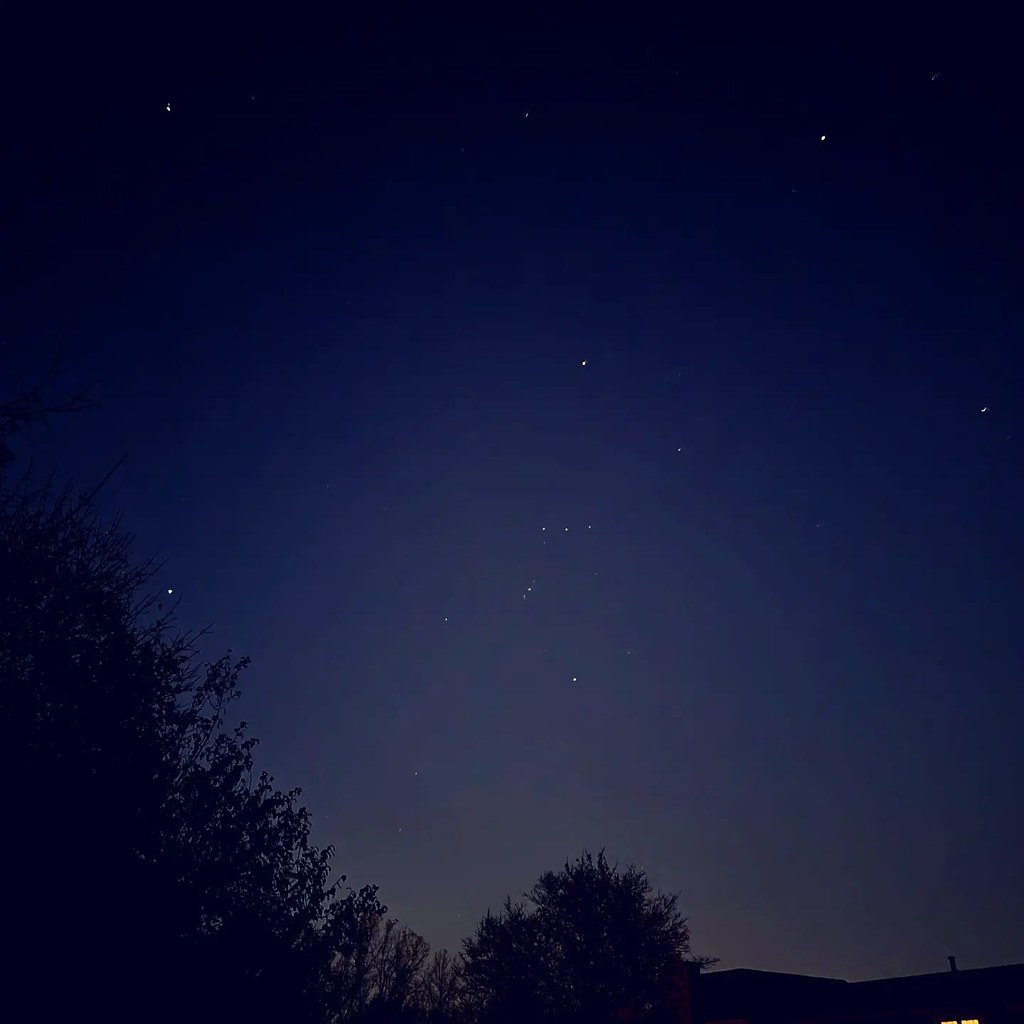
But the clouds have moved on at last–as I write this the sun is setting now–and the other night I got these two photos of the night sky, with my phone. First is my beloved Orion the Hunter, with Canis Major and Sirius visible to his left:

Next I was able to get a shot of the Pleiades star cluster. This photo didn’t turn out super well, but it’s still cool that I walk around with a gizmo that can capture a shot of a star cluster that isn’t very well visible to the naked eye. The Pleiades are the small blob of five stars in the center of the photo.

Here’s what the Pleiades look like in all their glory:

(via)


Share This Post

When in doubt, space

Wow:

Via:

An international team of astronomers using NASA’s James Webb Space Telescope has obtained an in-depth inventory of the deepest, coldest ices measured to date in a molecular cloud. In addition to simple ices like water, the team was able to identify frozen forms of a wide range of molecules, from carbonyl sulfide, ammonia, and methane, to the simplest complex organic molecule, methanol. This is the most comprehensive census to date of the icy ingredients available to make future generations of stars and planets, before they are heated during the formation of young stars.

This image from the telescope’s Near-Infrared Camera (NIRCam) features the central region of the Chamaeleon I dark molecular cloud, which resides 630 light-years away. The cold, wispy cloud material (blue, center) is illuminated in the infrared by the glow of the young, outflowing protostar Ced 110 IRS 4 (orange, upper left). The light from numerous background stars, seen as orange dots behind the cloud, can be used to detect ices in the cloud, which absorb the starlight passing through them.

Share This Post

Launch

What an amazing photo:

An external high-definition camera on the International Space Station captured the launch plume of the SpaceX Falcon Heavy rocket after it had ascended to Earth orbit following its liftoff on Sunday, Jan. 15, 2023, from NASA’s Kennedy Space Center in Florida. The space station was flying 262 miles above the Atlantic Ocean just after an orbital sunset at the time of this photograph.

Via.


Share This Post

The Snowflake Cluster

I saw this photo the other day on the NASA Marshall Space Flight Center’s Flickr stream, and my jaw dropped:

What is this? Here:

Newborn stars, hidden behind thick dust, are revealed in this image of a section of the so-called Christmas Tree Cluster from NASA’s Spitzer Space Telescope. The newly revealed infant stars appear as pink and red specks toward the center and appear to have formed in regularly spaced intervals along linear structures in a configuration that resembles the spokes of a wheel or the pattern of a snowflake. Hence, astronomers have nicknamed this the “Snowflake Cluster.”

Star-forming clouds like this one are dynamic and evolving structures. Since the stars trace the straight line pattern of spokes of a wheel, scientists believe that these are newborn stars, or “protostars.” At a mere 100,000 years old, these infant structures have yet to “crawl” away from their location of birth. Over time, the natural drifting motions of each star will break this order, and the snowflake design will be no more.

Our universe will never cease to amaze me with its gigantic and massive beauty.


Share This Post

The Hunter rises!

My favorite constellation has almost always been Orion the Hunter–and I only hedge on this just a bit, because maybe there was a point when I was in first grade and just starting to learn about constellations that I preferred the Big Dipper or some such thing.

Orion is a winter constellation, and it always starts showing up in my sky around the mid-point of autumn–that is to say, it shows up at a time when I can see it around that time. It’s possible that Orion rises first at midnight or something…I don’t really know. All I do know is that the other morning I left for work and it was early enough that the stars were still visible. I glanced southward…and there was the Hunter.

And here he is, in all his glory!

By the way, I hope that once in a while you take time to stop and reflect on the fact that most of us now carry around a device on a mundane basis that is capable of astrophotography. That’s kind of amazing, isn’t it?


Share This Post

Artemis

Had things gone according to plan, today would have seen the launch of Artemis I, the first rocket in a series of missions intended to return humans to the Moon. Sadly, Artemis did not launch. This is not a bad thing. There is a reason why we say something is not difficult via the pithy metaphor, “Hey, this ain’t rocket science.”

So, no launch…but there is still something amazing and beautiful about a rocket being readied for its flight.

Best of luck next time, Artemis!

Images via NASA HQ’s Flickr page.


Share This Post