

On the off chance you need something atmospherically calming, in the best way that looking up at the stars is atmospherically calming, here is some Vangelis. This selection was one of many used by Carl Sagan and company in the soundtrack to Cosmos. It’s called “Creation du Monde”.
A Bit of Rosa
Tone Poem Tuesday
Today was annoying and obnoxious, so I’m just declaring today done. Feh.
(No, nothing bad, just one of those days where the planned work not only doesn’t go as easily as it should, but it also keeps getting interrupted by people who think that their new work outranks my planned work. And yes, in a couple cases, they were right, but still…Feh! Feh, indeed.)
Anyway, on days like this I resort to stuff I can just toss up here without a whole lot of commentary. Here’s Tchaikovsky, with cannons. Because hey: cannons.
Share This Post
Orange Soda
A favorite treat of mine is orange soda, but it’s on my list of tastes that I rarely indulge because it’s just not super-healthy. (OK, it’s not really healthy at all, but you know what I mean.)
But now…orange soda is back on the menu! Behold!

I saw this product at The Store a couple weeks back and tried it first in a two-liter bottle, in case I didn’t like it. And now, we are finishing our first twelve-pack.
The whole “Zero Sugar” thing is really something to behold the last few years. So-called “diet sodas” have been pretty dodgy for years, but now they’re really starting to get the flavors close to the real thing. Coke Zero is more Coke-like than any diet incarnation of the stuff ever, and Sunkist Zero is incredibly close to the sugar-laden original.
Not that artificial sweeteners are super for you either, so it’s not like I’m going to be indulging this stuff by the boatload either (my go-to these days for fizzy is sparkling water), but damn, am I happy to be able to enjoy orange soda again!
Share This Post
An Extremely Short Post about Roots
The other day I casually joked about my Icelandic-patterned sweater reflecting my “Icelandic roots”, to which Roger responded, “So, what are your roots, anyway?”
Well…as far as I know, it’s mainly German on my father’s side and Irish on my mother’s, and that’s about the extent of my knowledge on the subject. I have to admit that I simply have never had a great deal of interest in the whole genealogy thing, which does make me feel slightly guilty at times, but the whole thing of being able to trace one’s family tree back to Ye Olde Worlde and to the tiny village in East Glumpferjonton where one’s great-great-great-great-grand-blah-blah was a seven-fingered cobbler who fathered eleven children before succumbing to cholera at 36 has never really been an activity that much appealed to me. Which is weird, I admit, because I also have a lifelong love of history and the deeds of the people that populate it.
I know that Americans tend to be very interested in such things–maybe that’s because our country is still relatively young, and in almost all cases you don’t have to go too many generations back to get to people living in Germany or wherever, and I know that this sort of thing commands tremendous interest for members of the Mormon church (I’m not really sure why, but I suspect it has something to do with their doctrine of being able to “save” people, i.e., baptizing them into the Mormon church, after they’re dead). For me, though…I can take or leave it, and I usually end up leaving it. Go figure!
How about you, readers? Are you interested in your genealogies?
Share This Post
Of Arm Jabs and Soup Memories
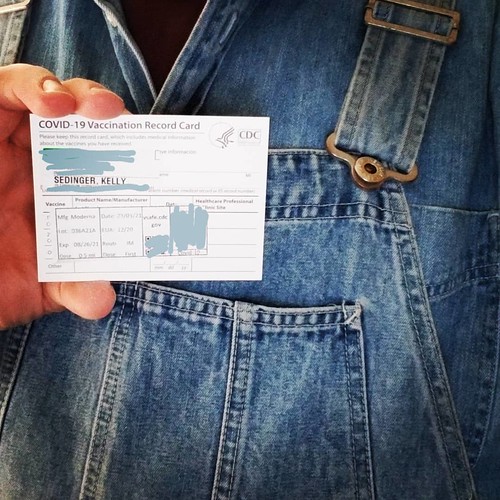
Yesterday I got my second injection of the Moderna COVID-19 vaccine, which means that in about two weeks, when my immune system has had time to do all the processing work it has to do, I’ll be fully vaccinated against this fecking pathogen. Get your vaccinations, folks. The sooner we all get it done, the sooner this thing can be pushed to the area of “annoying problem” and not “all-consuming threat”.
My experience was pretty mild, compared to most. The first shot left me with a sore shoulder, and it wasn’t even sore all the time, just when I moved it in certain ways or exerted it. It felt roughly like the soreness that follows a tetanus shot (my memory of which was pretty fresh, having received that particular booster back in January). I had heard that the second shot tended to provoke stronger reactions in people, ranging from more persistent shoulder soreness to the body enduring what is essentially a simulated bout of influenza for a day or two.
Well, my shoulder did get more sore than last time. Last night, I could lift my left arm (where I got both shots) about this far before I got a nice stiff bolt of pain that made me wince:
I took today off from work (at work’s strong encouragement to do just that) just in case I had it rough. Luckily, I did not have it rough. The shoulder is still sore, though that is slowly fading, and as I write this I can lift my left arm without wincing, though not without a bit of pain. I didn’t suffer much by way of accompanying aches or pains, nor did I have any nausea or fever or other flu symptoms. What I did have can be described as a persistent fatigue that left me with not a great deal of enthusiasm for daily tasks. It was comparable to two feelings: one is the fatigue I feel two days later after a really bad night’s sleep. When I sleep really badly–say, only getting three hours of sleep in total–it doesn’t usually affect me much the next day, but the day after that is usually grim. If my sleep Sunday night into Monday is godawful, then I’ll get through Monday just fine, but Tuesday will be a brain-fog of a day, no matter how well I sleep Monday night into that Tuesday. That’s how it kind of feels today.
The other thing I’d compare this feeling to? A light hangover. Not a rip-snortin’ hangover where I want to wear sunglasses and massage my own temples all day someplace in the silence of a Buddhist monastery, but just that general sense, again, of brain-fog and lack of enthusiasm, focus, motivation, or anything like that.
As I write this, it’s mid-afternoon and that feeling is mostly gone, too. Yay!
Did I prepare for this whole ordeal at all? Well, a little. I made sure to sleep really well each day the last several nights, and yesterday I drank three cups of green tea and doubled up my daily doses of Vitamins C and D. I also doubled up my daily low-dose aspirin, but I did not take any ibuprofen or acetaminophen prior to the fact. I try to avoid those until I’m really hurting. Oh, and I drank more water than usual yesterday, and I generally am very good about staying hydrated.
I have no idea if those things helped, in all honesty, but here I am, coming out of the fog.
The feeling of a light hangover, though, had another effect: it hit my appetite in a big way. I expected this, too, so the other day I stocked up on my favorite salty soup of choice for such moments: Ramen noodles!
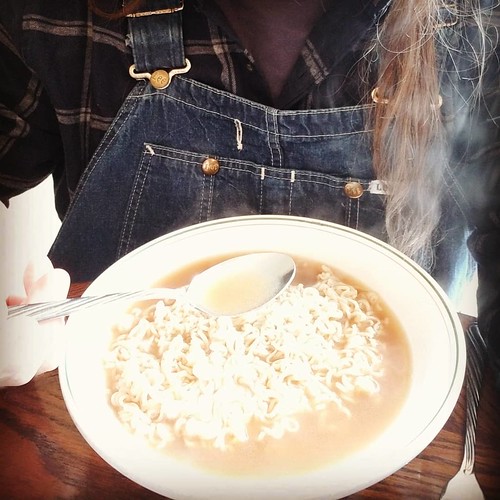
It’s funny how some people get through their Ramen-fed college years never wanting to touch Ramen again, while some, like me, never lose their taste for the stuff. I indulge my Ramen fondness relatively rarely (look at the sodium content on the label and you’ll see why), generally only having Ramen maybe three or four times in a year. But there’s just something about a really salty and hot soup that always helps me recover from the low-grade arse-kicking of a mild hangover.
And that brings me (in very long-winded fashion, I admit) to the “Soup Memories” part of the title of this post. The beef flavored Ramen was great! I’ve loved Ramen since I was very young, when my parents would serve it up with buttered rye crisp on the side. (And it had to be the rye crisp that came in big circles with a hole in the middle, from which you would break an uneven piece. The nice square stuff of today, in neat rectangular packages? I’m sorry, but it’s fine and it’s very not right.) And sometimes I’ll make chicken-flavored Ramen and add a fried egg to it. I was skeptical of that at first but then I tried it one day, and when you break the yolk into the soup, you get this wonderful creaminess that’s pretty great.
Yes, Ramen is good for the light hangover. But sadly, the greatest light hangover treatment in soup form is no longer available, because in 2010 the folks at Campbell’s discontinued it.
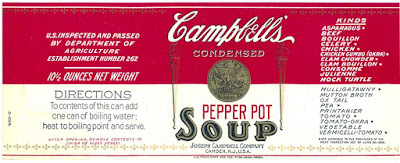
I’m talking about this:

Pepper Pot soup.
Ahhh, this stuff. Another flavor of my youth that’s likely gone forever, at least as I remember it. I should make my own sometime–recipes abound, you know!–and obviously, homemade will be better than some condensed canned soup. But, well…as Jeff Smith (I know, I know) told us many times, food and memory are inextricably bound together. I remember many a time, as a kid and later in college and beyond, opening the can and dumping the congealed contents into the sauce pan, adding the can of water, stirring the thing as it heated and the congealed contents…um…uncongealed.
Pepper Pot soup is a regional thing, in the Campbell’s incarnation based on a soup that was popular for many years in Philadelphia. As one of its main ingredients is beef tripe, I assume that it was basically a stew or soup that originally rose as a peasant dish whose main grace was using up bits of the cow that were generally last to be consumed. The local Philly lore has Pepper Pot soup having been a significant part of the diet that got General Washington’s soldiers through that winter at Valley Forge. Other food historians I’ve perused believe that Pepper Pot was the inevitable result of the mixing of cultures–including the slave cultures–in the original colonies. Note the branding in this old advertisement, with the tricorn-wearing men (I’m assuming women found Pepper Pot equally nourishing, but we couldn’t really advertise that back when, could we?):

What does it taste like? In the Campbell’s version, it was basically a beefy broth with some vegetables, little bits of tripe (usually cut very small, I didn’t even know what they were until many years into my regular eating of the stuff), a pleasing dose of salt, and a very pleasing–and warming–dose of pepper. It’s one of those soups that intensely satisfies, not just when you’re having soup because soup sounds good or because it’s one of the courses, but when you’re in that kind of place when your body is saying Give me SOUP.
Unfortunately, Pepper Pot soup’s fortunes have declined badly in the last twenty years:
By the late twentieth and early twenty-first centuries, Philadelphia pepper pot fell out of favor, although it continued to be made by home cooks. Many institutions that had served it as a staple dish, such as the Four Seasons Hotel and the Union League of Philadelphia, removed it from their menus. Campbell’s and Old Original Bookbinder’s, a food division created by a restaurant of the same name in Philadelphia to sell packaged versions of their soups, condiments, and sauces, also stopped selling canned pepper pot by 2018.
This seems to me a pity. Food is memory, remember…and I’m going to have to figure out how to make it on my own, because I’m wanting to taste it again, and now it’s because I miss the flavor, and not because I’m getting hung over on any kind of regular basis!
Share This Post

Something for Thursday (National Poetry Month Edition)
Today is April 1, which means that it’s another National Poetry Month! This month, each of my Thursday music posts will involve poetry, either by direct setting or…something else. (What “something else” may be, I’m not really sure. It might just be settings.)
This is a gorgeous setting of a slightly revised version of one of my favorite poems by one of my very favorite poets, Alfred, Lord Tennyson. The poem is “The Lady of Shalott”, and the musician is the great Loreena McKennitt.

This poem has appealed to me ever since I read in high school, either my junior or senior year. Its lyricism and its capture of the sadness of one of the tales that takes place at the periphery of the Arthurian legend (which is ultimately a collection of very sad stories). Tennyson’s work continues to move me greatly; no matter how poetry changes or what has come after, I always find myself responding to his sense of rhyme and meter, as well as his content. Reading Tennyson is like coming home.
“The Lady of Shalott” begins thusly:
On either side the river lieLong fields of barley and of rye,That clothe the wold and meet the sky;And thro’ the field the road runs byTo many-tower’d Camelot;The yellow-leaved waterlilyThe green-sheathed daffodillyTremble in the water chillyRound about Shalott.
As it’s lengthy, I won’t quote it here in its entirety. But you can read it here.
And here is Loreena McKennitt’s setting.
Share This Post
My Icelandic roots!
One of my requests last Christmas was a new sweater or two, in a lighter color to counteract the general dark tone of my existing sweater collection (some of which are also getting a bit old). The Wife gave me a wonderful light-blue sweater with a neat pattern around the top, and a cowl neck that zips up. It’s similar to an Icelandic Lopapeysa sweater, but it’s not made of wool. This has quickly become one of my very favorite sweaters, and as a bonus, it seems to go really well with overalls!
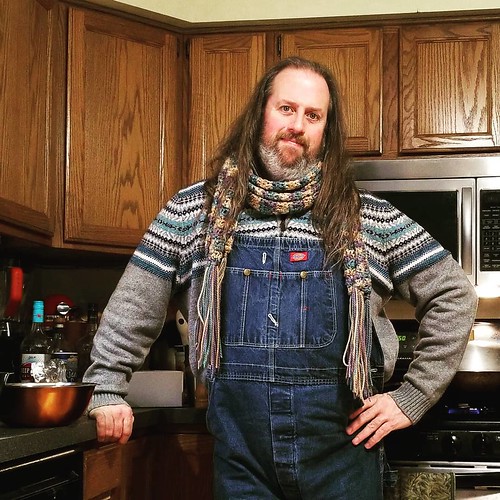


Here’s a suitably dramatic pose, taken in an alley in Hamburg, NY. The Dee-oh-gee and I were killing time outside while The Wife went into our favorite local bakery to buy stuff. I like the color contrasts here, between the sweater, the overalls, the scarf, the doggo, and the wall behind us:

The color and pattern (apparently called a yoke design) go well with either solid blue overalls or with hickory stripes. I assume it will go well with the herringbone overalls as well, but I haven’t worn the sweater with those yet.
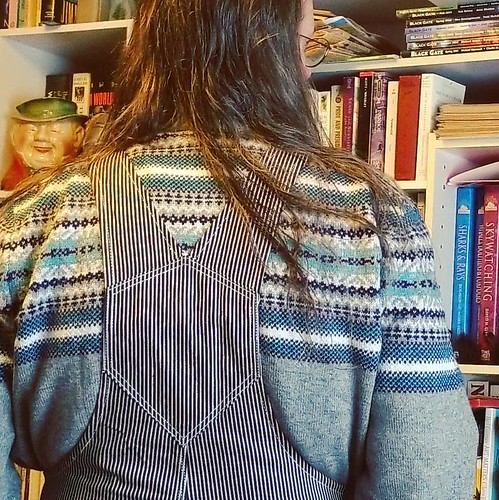

As always, I make few (if any) apologies for the fact that my main criteria for judging whether or not I want to add a top to my wardrobe is, “Do I think this will look good under a pair of overalls?” I mean, it’s my thing, y’know?
Oh, and the title of this post constitutes a little joke. I have no Icelandic roots at all.
Share This Post
Tone Poem Tuesday
Caroline Shaw is a composer, singer, and violinist who has emerged as one of the bright new voices in classical music. She has already won the Pulitzer Prize for one of her works, and she has composed a lot of music already in her 39 years. And I had never heard of her until last week, when I found her name after Googling “21st century classical composers”. I read a bit about Shaw, whose career has taken her from the Baltimore Symphony Orchestra to recording with Kanye West. That sort of eclecticism appeals to me; I have always responded well to artists with as wide a view of their artistic expression as possible.
As of my writing this, I’ve only heard one work by Shaw in its entirety, and it’s the one featured here today. It’s called The Observatory and it was commissioned (and premiered) by the Los Angeles Philharmonic, where apparently it opened a program that ended with Beethoven’s Ninth Symphony. That’s gotta be a hell of a thing for a composer, right? “We want you to write a new work for us, you’ll be filling out the program with Beethoven’s Ninth. You can do that, right?”
Well, Shaw most certainly could. The work is a grand-scaled tour de force, opening with huge chords reminiscent of those that open Brahms’s First Symphony, and then taking a 16-minute stream-of-consciousness tour of wonder. The work’s inspiration was apparently LA’s Griffith Observatory and Shaw’s own love of science fiction and the Cosmos. Obviously these themes drew my attention almost immediately. As Shaw herself writes, describing the compositional process of this piece, on the Hollywood Bowl website:
It was a wild ride, and I remember feeling like an observer of a mysterious workshop that somehow churned beauty out of chaos. There is also something about writing an orchestral work for a summer evening in Hollywood that got me thinking about my favorite genre of film and storytelling — sci-fi. I love the way epic tales of the beyond can zoom in and out, using grand imagined alternate universes to tell stories about ourselves. And I love how music in these films carves and colors our attention to those worlds (in their various scales).
While writing music, I often imagine some kind of visual (usually abstract, sometimes figural, rarely narrative), as a guide for myself and sometimes as a thing to write against. There’s an invisible counterpoint here, but I’d rather someone simply listen and create their own contrapuntal narrative adventure than read an account of mine — to leave space for one’s own observation and reflection, whether it be of the music or their neighbor’s t-shirt or cosmology or tomorrow’s grocery list. (The grand story arcs of our lives sometimes play out in minutiae and the mundane.) And often the imagined visuals that I write to are nothing more than shifts in color or a quick cut between undefined scenes. (Sometimes the juxtapositions and transitions [and parentheticals] are where the stories are.)
I greatly enjoyed this work and I will certainly be exploring more of Caroline Shaw’s music! I wonder if she’s given any thought to film scoring…since the inevitable screen adaptations of my Song of Forgotten Stars books are going to need a composer, eh?
Here is The Observatory by Caroline Shaw.
Share This Post
Recent reading: Space wizards, zombie apocalypses, reflections of Paris, universes ending, and a LOTR-but-not-LOTR fantasy
A few more books I’ve read of late:
:: I can’t possibly keep up with the eternal flood of new books that is Star Wars publishing, but I do try to pick and choose the ones that sound good or come with good referrals. Last year, Lucasfilm announced a new project in their Star Wars publishing empire: a new series within the larger overall tale that focuses on life in our favorite galaxy far, far away two hundred years before the rise of the Sith, the fall of the Republic, and the arrival on the scene of a couple generations of Skywalkers. This series is called The High Republic, and it depicts the Republic at is height and the affairs of the Jedi as they act as the guardians of peace and justice and all that.

The High Republic is going to play out in books, comics, and who knows what else (no filmed entertainment set thusly has been announced yet, but who knows what the future may bring, as currently Star Wars is changing directions on an almost monthly basis). It all starts with Light of the Jedi by Charles Soule, and…well, it’s not bad, but it’s got a lot of room to get better.
Light of the Jedi has to do a lot of heavy lifting: it has to establish the time period we’re in, which means that it has to show all the ways this time period contrasts with the one with which we’re most familiar. It also has to establish the new threat that the Jedi are going to be facing through all this, which can’t be the traditional Sith because canon has already established that the Sith have been gone for centuries and they stay gone until Darth Sidious steps into the open around the time of The Phantom Menace. Light also gives us a lot of viewpoint characters, probably too many, all having adventures that play out over relatively short chapters.
The sad result is that Light of the Jedi ends up feeling overstuffed and underfocused, so that in its attempt to be really exciting it ends up under-engaging. I have to admit that I came close to DNFing this book halfway through, and ended up skimming a lot of the last act. It’s a shame, because there is interesting stuff here and it does set up some possibly exciting story possibilities to come. The book does the job of getting The High Republic out of the gate, but it’s not the galloping start it should have been.
:: I’m reading more indie books of late, which I should do because I’m an indie author myself, and which everybody should do because there’s a lot of great writing out there beyond the world of the standard publishers. I’ve been following author Anna Vera on social media for a while, and I finally got around to reading her book When Stars Burn Out, a dystopian science fiction novel about the zombie apocalypse and the human response to it.

I freely admit that this genre is not generally my cup of tea, which is to say, it’s almost never my cup of tea. But I do enjoy it on a selective basis when it’s handled well, and Vera is one of the ones who handles it well. There is darkness and grim death here, because how could there not be, but for once it’s not wildly overdone with spectacular deaths just for the sake of deaths (like in, say, The Walking Dead). There are intriguing mysteries and an interesting society of people trying to live without becoming zombies themselves, and the character work is particularly good. Heroine Eos Europa is a fascinating person, and I hope to read more of her adventures soon.
:: I’ve had Paris to the Moon by Adam Gopnik on my shelf for years, and I finally got around to it. I have to admit to finding it slightly disappointing. I was expecting a travel book, but it’s really not that; it’s a collection of essays Gopnik wrote in the 1990s for The New Yorker about his and his family’s experiences in Paris when they packed up and moved there. It’s all well-written and all, but unlike the best travel writing, Paris to the Moon‘s essays feel distinctly rooted in a particular time and place, and from a particular vantage point. I felt an odd disconnect while reading it, like perusing the mundane dispatches from someone’s life decades ago.

It’s not bad, though! Not at all, and if life in Paris interests, there’s much here that’s interesting. I cite one passage, which I found particularly amusing:
Late last year the French government assembled a committee to choose a name for the vast new stadium that’s being built in a Paris suburb. The committee included an actor, and “artiste”, some functionaries, and even a few athletes. It took a long time deliberating over its choice. Names were submitted: Some people liked the idea of naming the stadium after Verlaine or Saint-Exupery, and lots of others liked the idea of calling it Le Stade Platini, after Michel Platini, the great French soccer player. At last, late in December, the committee announced that it had come to a decision, and the government decided to broadcast the verdict on television. The scene was a little like the end of the Simpson trial: the worried-looking jurors filing to their seats, the pause as the envelope was handed to the minister of youth and sports, the minister clearing his throat to read the decision to the nation. The stadium that would represent France to the world, he announced, would be called (long, dramatic pause) Le Stade de France. The French Stadium. “Banal and beautiful at the same time,” one journalist wrote. “Obvious and seductive. Timeless and unalterable.”
I suppose there is something oddly comforting, albeit in a kind of depressing way, in learning that the bureaucratic way of spending a lot of time and money coming to a perfectly boring decision isn’t something unique to the United States.
:: Katie Mack’s The End of Everything (Astrophysically Speaking) is a book about the end of our universe.

Apparently the current state of science has a handful of scenarios by which our brightest minds think our universe will end, and Dr. Mack has written this helpful, clearly-written, and humorous (given the subject matter) book summing it all up. If you like a bit of science to help back up your low-level existential dread, The End of Everything is the book for you! Yes, there are passages that I didn’t entirely understand, but Mack does a very good job of explaining how we came to our current theories of how the universe began, and given our understanding thereof and of how the universe works now, how we might expect it to end. Her ultimate takes aren’t terribly optimistic (for ideas on what the end of the universe might look like from the standpoint of sentient starfaring civilizations, Michiu Kaku is the author to seek out), and there’s something particularly chilling about what’s called the “Heat Death” of the universe, as ultimately the unending expansion of space results in our skies growing ever, ever darker as the stars become too far from us for light to ever arrive. But, as Dr. Mack writes:
In fact, the one thing that all the universe-ending scenarios we’ve already discussed have in common is that they definitely aren’t coming around anytime soon. As far as we can tell from our best understanding of physics, we have at least tens of billions of years before even the most extreme version of a sudden Big Crunch reversal could occur, and no Big Rip could be less than a hundred billion years off. A Heat Death, considered by most to be even more likely, would be so far into the cosmic depths of the future that we hardly have terms to describe it.
So there’s that. Of course, she writes this just before sequeing into a chapter about a “Vacuum Decay”, in which a bubble of true vacuum forms someplace and expands at the speed of light, destroying everything it takes in as it expands. This, apparently, is a thing that can happen at any time, and since the horizon of the destructo-bubble’s edge moves at the speed of light, we’d never know it was coming. For all we know, there could be a universe-destroying bubble right now someplace, expanding toward us at the the speed of light…and depending on where it is, that’s how much time we’d have left. So…sleep tight, I guess!
:: Finally, a re-read of a book I liked a lot as a kid. Between 7th and, I think, 9th grades, I went on a huge epic fantasy reading kick. I read a lot of epic fantasy back then, between roughly 1982 and 1986. (After that I fell into spy and espionage fiction in a big way.) In those years, epic fantasy was far more dominated by the JRR Tolkien model than it is now, thankfully. I love JRRT, but wow, did the genre need some new thinking for a long time. Luckily that new thinking has long since arrived and the genre is healthier for it…but for years fantasy novels seemed really stuck in the same trope wonderland, and the biggest title in the post-JRRT swords-and-dwarves-and-elves type of fantasy was Terry Brooks’s The Sword of Shannara. I read Sword once, back in my junior-high days (along with its two immediate sequels, The Elfstones of Shannara and The Wishsong of Shannara), but I’ve never revisited them since…until now. A while back I was shopping at my local Savers store and I found the original three Shannara books in the Used Books section*, so I picked them all up. Last week I finally re-read Sword, and…well, it was like dipping my toes in Heraclitus’s river. It’s not the same river it was when I was thirteen.

It’s close to forty years since I read Sword all the way through, so I don’t remember much of it at all from back then, except that I do remember finding it kind of padded back then. Nothing specific, but I definitely recall skimming through chapters I didn’t really care that much about. And lo and behold…that happened again.
In Sword you have the Tolkien model almost in its entirety: a malevolent Dark Lord is threatening the existence of everything, while the races of Man (it was the 70s, so yes, it’s called “Man”), Dwarves, and Elves don’t really get along terribly well. There’s a single magical weapon, though, that can prove the Dark Lord’s undoing, and it can only be wielded by a specific individual who happens to be a member of a peaceful, pastoral people who live about as far away from the Dark Lord’s palace as you can get. A wizard-like figure who is known all over the world for his strange comings and goings arrives to send our young hero on his quest, which after many dangers leads him to a single quest to find the magic weapon. On this quest he is joined by a…what should we call it? A “fellowship”?…helpful team comprising men, Elves, Dwarves, and our hero and his pastoral buddy.
Off they go to deal with the weapon and the Dark Lord, but eventually their “fellowship” is forced to break apart, and the others go off to deal with specific wars and stuff while Our Hero proceeds to his ultimate journey into the Dark Lord’s realm, which is a barren desolate wasteland of dust and sharp mountains.
I don’t want to sound dismissive, but Sword really really does read like a Tolkien clone for people who wanted more Tolkien but who didn’t want to re-read Tolkien for the 80th time. All the tropes are here, with just about all the story beats; what Sword seems most to accomplish is reducing the Lord of the Rings from its 576,000 words down to about 226,000. This isn’t always a good thing, as I found it very hard to care about some of the “side adventures” that Brooks takes us on in the back half of the book. We meet a guy named Balinor early on, but we get little of his backstory until much later, which we get right before the book diverts us to his struggles against his crazy jealous brother. I found it nearly impossible to care about any of that.
Ultimately I found Sword a slog to get through this time. Brooks overwrites and overdescribes to an amazing degree, and from a stylistic standpoint, his paragraphs are way too long, sometimes lasting entire pages. And look, I know he wrote this in the 1970s, but still: it’s a 726 page book, and our first (and only) female character doesn’t show up until we’re well past page 400.
I do plan to read the other two books in the trilogy at some point. I remember liking Wishsong most of all from these, and I’ve also heard that Brooks’s various explorations in the Shannara universe after these initial volumes perk up quite a bit. I don’t know if I’ll go any farther past Wishsong, but…you never know.
* I don’t know about anybody else’s Savers location, but the Used Books section at my local one almost always has something worth grabbing. I never leave that place without a book or two. Not huge hauls, but there’s always something!