Something’s afoot, aye!

 Apparently they made a movie about Sherlock Holmes’s younger sister Enola, featuring Mille Bobbie Brown in the title role. The movie drops on Netflix just a few days before my birthday.

If it’s good, this might be one of 2020’s stopped-clock moments (even a stopped clock is right twice a day)!

Share This Post

Tone Poem Tuesday

 I had a piece picked out for this week, but it’s a pretty complex work that I want to hear a couple more times before I actually feature it, so this week I’ll take an “easy” route. This is a short track called “Anthem” by composer Michael Abels, featured in the score he wrote for the Jordan Peele film Us. I haven’t seen any of Peele’s movies yet (and yes, I know this is a big gap in my media consumption), but I like what I’ve heard of Abels’s music (previously featured in this space).

Here is “Anthem”. It’s atmospherically creepy, and reminiscent of Jerry Goldsmith’s “Ave Satani” from The Omen.

Share This Post

Testing the new gizmo!

I’m writing this on my new tablet, because my backordered keyboard folio finally came in. Huzzah! Now to begin my plan for World Domination…or, on a smaller scale, using this tablet as a content-creation device (blog posts, essays, maybe short fiction here and there). In terms of long form writing, I will almost certainly be a laptop guy until they literally stop making laptops, but I hope this little keyboard and tablet will yield dividends as well.

However…I am just now discovering that the Blogger app for Android devices doesn’t reorient to landscape format when the tablet is rotated, so as I type this post, the words are appearing vertically on my screen. I have a pretty good ability to get used to change, but even this might–just might!–be a bridge too far. We’ll see.
Anyway, Excelsior!

Share This Post

The Moment

 Obviously there is zero chance that I will vote for anybody other than Joe Biden this November (or October, really–early voting, here I come!), but I do want to highlight this segment of his acceptance speech last night. How strange a time it is, that we have to celebrate the very notion of electing a President of the United States who can feel genuine human emotions.

Let’s go, Joe. I’m ready.

Share This Post

Something for Thursday

 It’s funny about “one-hit wonders”: sometimes the hit is a genuinely enduring song, but other times the hit somehow endures despite being a very clear time-capsule piece that could only have come at a certain point in time. “Come On Eileen” by Dexys Midnight Runners is clearly an 80s song, but there’s nothing about it other than its general sound that ties it to the 80s. But is there any other time than 1974 when “Kung Fu Fighting” by Carl Douglas could have come out? I very much doubt it.

Here’s “Kung Fu Fighting”. Such a catchy tune that you couldn’t begin to get past the culturally-aware producers of today!

Share This Post

On Car Repair and Duct Tape

 It’s always struck me as strange that a lot of folks will, when they learn that my day job involves fixing stuff, make some remark about how I must use a lot of duct tape. I also get a particular Internet meme shared with me: It’s a guide to fixes of all kinds, consisting of two questions:

1. Does it GO and it’s supposed to stay put? (Answer: Use duct tape!)

2. Does it STAY PUT and it needs to go? (Answer: Use WD-40!)

Now, I do use WD-40 and other penetrating greases on occasion, but I have to admit: I hate using duct tape for general repairs, and I generally refuse to use it at work for any purpose other than taping thick rugs down over spots where our tile floor breaks. As a means of fastening things together, I personally feel that if I resort to duct tape, I’ve failed as a professional. Yeah, it’s one of those weird “honor” things. We’ve all got an honor thing about something, and duct tape is one of mine. (Another? Papermate and Bic pens. Yuck!)

But there is one repair for which I used duct tape without regret. It was a repair–you know what, let’s put quotes on that, because even I can’t call this a genuine repair–there’s one “repair” I made using duct tape. One time my car door wasn’t closing all the way. It would feel closed, but it wouldn’t be registering as closed. The “Door Ajar” warning light would come on, and even more annoyingly, the dome light would come on as well. I find the dome light enormously distracting when I’m driving in darkness, so this was a frustration. This went on for a few days until I realized what the problem was. It was related to…the seatbelt.

There’s this weird thing that tends to happen to me in cars: the seat belt doesn’t retract all the way, like it’s supposed to. This happens to me a lot. I don’t know if it’s something about the shape of my body or something, if the belt twists in such a way when I use it that it doesn’t snap all the way back, or if it’s a thing that happens to everybody. But once in a while, the seat belt will stop retracting and just kind of hang loose. More often than not, then, the belt hangs into the damned door frame, so when I go to shut the door I close it on the seat belt itself, sometimes catching the entire buckle between the door and the frame. This in turn results in the door not closing properly, but latching enough that I have to unlock the door to fix things.

So: I turn the car off, unlatch the seatbelt and flick it to my left, from where its spring-loaded mechanism is supposed to retract it. Then I pay no attention as I grab whatever I need and get out of the car. Most times I shut the door and go about things normally…but once in a while, I hear an obnoxious metallic CRUNCH sound and notice that the door is not closed. The damned seatbelt has caught in the door frame again! I swear a few times, take care of business by opening the door and untwisting the belt so it can do its thing correctly, and then close the door again.

But.

One time, the buckle managed to get in between the door and the frame at the exact spot where the door’s shape is supposed to depress the door switch that tells the car that the door ain’t open. And of course the damned buckle dented the door at that exact spot. It’s a tiny dent, so tiny you can’t even see it unless you’re poring over the door itself trying to figure out why the door-close switch isn’t working. The switch itself is working just fine, see! With the car turned on and the door open, you can press it with your finger and make the car think the door is shut!

Yup. That tiny dent, barely a fingernail’s thickness in depth? That was sufficient to make the door not click the switch. I couldn’t see any feasible way of repairing the door to make the switch work myself, and I sure as hell wasn’t taking the car to the shop for this dumb repair, which I could see resulting in a whole new door. Screw that.

So…enter the duct tape.

A disposable wipe cloth, folded up and taped to the door at that spot? That worked wonders.

Stupid duct tape.
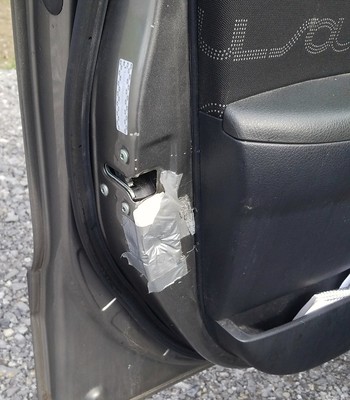
Damnable Duct Tape!

I hope this doesn’t come up too much when I’m sitting around the fires in the halls of Repair Valhalla.

Share This Post
Tone Poem Tuesday

 While doing a bit of research for this post, I learned something that is actually a correction of something I’ve believed for years. Remember in the 70s when the ragtime piece “The Entertainer” was all the rage, because of its use in the popular movie The Sting? I don’t know why, but for pretty much all the time I’ve been aware of that piece’s existence, I thought that it was an original piece of ragtime music written by Marvin Hamlisch as a pastiche of the kind of thing that Scott Joplin wrote back in the late 1800s.

Well, as the kids say these days, “I was today years old” when I learned that no, what’s heard in The Sting is an arrangement composed by Hamlisch, and Mr. Joplin actually did write “The Entertainer” in 1902. Joplin (1868-1917) himself was known as “the King of Ragtime”, and ragtime music comprises almost all of his compositional output. He was trying to move beyond his ragtime reputation in his later years, but syphilis and dementia cut his voice short.

I know virtually nothing about ragtime, to be honest. My main impression of it is likely the same as many people: it’s mainly kept alive not through active performance but by being the kind of music used by piano teachers to help young students develop rhythm skills. “Here’s a piece that’s fun to play!” is the likely selling point when a teacher is helping a kid choose the next thing they work on, and…well, in a lot of cases, ragtime actually is fun to play, especially if you’ve been spending months struggling with the chaste classicism of, say, a sonatina by Muzio Clementi.

Obviously, though, ragtime–a musical form that springs from Black culture and artistry–deserves better than to be reduced to a common teaching tool for young piano students, especially when the music’s cultural context is virtually never discussed. “This is a piece by Scott Joplin, who wrote more than a hundred of these!” is about all you learn. At least, that’s about all I learned when it came time to try my hand at a ragtime piece. Which one was it? Almost certainly “The Maple Leaf Rag”, of course. Joplin wrote over a hundred rags, didn’t he? And yet, every year at piano recital time, someone played “Maple Leaf Rag” and no other.

I don’t mean to sound irritated at my piano teacher or at piano teachers nationwide, who can’t always be true to the music at the same time they’re trying to get little Billy interested in actually practicing for once. They can’t teach the basics and try to keep some kid motivated enough to put in their half-hour a day of boring Czerny exercises while also doing anything more than the bare minimum in terms of music appreciation, but…well, anyway. Ragtime, an adaptation of the popular march form of the day coupled with the syncopated rhythms of African music, would help pave the way for the rise of jazz, so its place in music history is secure. But ragtime shouldn’t be seen as merely a popular form for just a few decades that’s important for blazing a trail for the extremely important work that came afterward. Ragtime is a musical moment that somehow captures a certain air of sadness at the same time that it’s doing its “bouncy happy” thing, and while maybe it has its limitations, it should still be seen as more than just a thing to be viewed through a sepia veil.

Here is not “The Entertainer”, or “The Maple Leaf Rag”. This is “Solace: A Mexican Serenade”, in which Joplin takes a slower tempo and incorporates tango rhythms into his normal ragtime language.

Joplin eventually wrote a ballet and two operas to go along with his ragtime work. As with many composers, I wonder what he might have accomplished if not for his illnesses and early death. The idea of Scott Joplin writing at the same time as George Gershwin is enticing, to say the least.

Share This Post

Memories of Maliboo

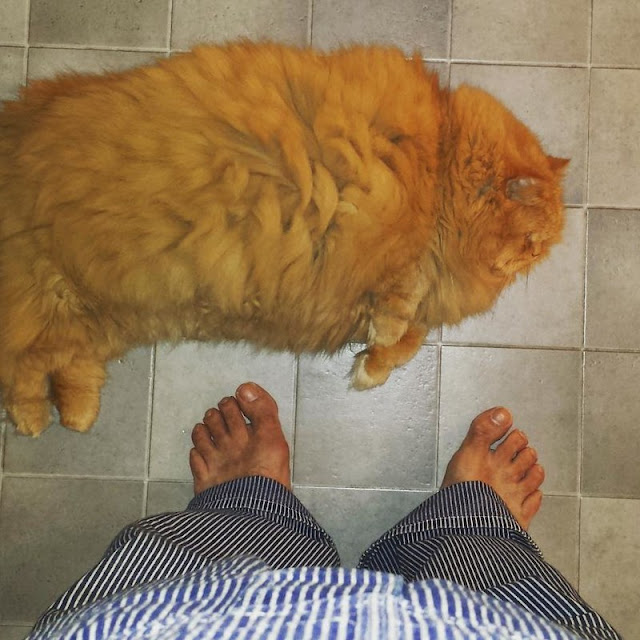
 My mother’s cat, a beautiful red Persian named “Maliboo”, died today at the fine age of 17. He had a fantastic life, truly winning the Cat Lottery. Oddly, Maliboo hated me until several years ago when he had no choice but to warm up to me while Mom took a 17-day trip to Wales. After that, he was fine with me.

Farewell, Maliboo. You were a good cat.

Share This Post

Tone Poem Tuesday

 William Grant Still is not new to this series, but the goal is to highlight music as well as composers, and to just hear one work by a composer and then move on forever seems…well, weird, doesn’t it? So let’s get back to Still, one of the most notable Black composers in the repertoire. Still (1895-1978) had a lush, Romantic style that nevertheless displays a lot of influences, among them the Negro spirituals of his ancestors.

This piece is a string quartet (although I have discovered that it can also be performed by a quartet of clarinets or saxiphones), called the Lyric Quartette. In this work, which in my ears summons up hints of Copland and Debussy, Still depicts three of his friends in descriptive terms: the first movement is “The Sentimental One”, the second is “The Quiet One”, and the concluding third movement is “The Jovial One”. All those descriptors do apply to the music, which is introspective and at times meditative. This is a beautiful work. Enjoy!

Here is the Lyric Quartette by William Grant Still.

Share This Post