Tone Poem Tuesday

 A native of Buffalo who later moved to San Francisco to pursue her music career, Pamela Z is a composer and performer who works extensively with electronic sounds, vocal sampling, and other sonic augmentations to create works with an intriguing meditative quality. This particular piece puts her techniques on full display, as she augments a string quartet with electronica and recorded effects (much of which the listener will recognize) to create a piece that is at once meditative and disjointed, as the piece is continually interrupting itself.

Here is Attention by Pamela Z.

Share This Post

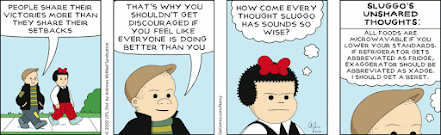
In which a daily newspaper comic strip delivers the greatest single sentence in the history of the English language

 I thought I had blogged about the current incarnation of the venerable comic strip Nancy at some point, but apparently I haven’t! Or if I have, I can’t find the post in the archives. Anyway, today’s installment contains one sentence that almost made me literally squeal with delight when I read it. See if you can guess which sentence it was!

(I’ll still write about Nancy sometime, but for right now, suffice it to say that its current incarnation is one of my favorite things. It has a very gonzo and off-kilter sense of humor right now that really does feel like Ernie Bushmiller’s unique brand of zany, updated for 2020.)

Share This Post

Apropos

RICHARD: He’s here. He’ll get no satisfaction out of me. He isn’t going to see me beg.

GEOFFREY: My you chivalric fool… as if the way one fell down mattered.

RICHARD: When the fall is all there is, it matters.

(From The Lion In Winter)

Share This Post

Something for Thursday (Diana Rigg edition)

 Actress Diana Rigg has died. She lived a long life (82 years) and did a lot of amazing work, but for me, she will always be Contessa Teresa di Vicenzo, also known as Tracy…who would, very briefly, be Mrs. James Bond. Rigg was the greatest Bond Woman in the long history of Bond Women, and she is a huge reason why On Her Majesty’s Secret Service is the greatest Bond movie ever made.

Thank you for the wonderful work, Diana Rigg! Here’s Louis Armstrong with his signature ballad from OHMSS.

Share This Post

Tone Poem Tuesday

 I haven’t posted any Beethoven in a while, which is strange since it’s supposed to be a focus, given that 2020 is Beethoven’s 250th birth year. But here’s an interesting tidbit: even though it’s Beethoven, we’re not completely taking a break from my recent delving into the history of Black figures in classical music history.

This is not a tone poem by any definition, so I shouldn’t even be using it here, but my house, my rules. It’s a sonata for solo violin and piano. Beethoven wrote ten violin sonatas, which are among the greatest works ever written for the instrument. Beethoven’s compositional mastery of the violin is astounding (as I’ll discuss more when I finally get around to writing about his Concerto for violin and orchestra), and it shines forth here, in the Violin Sonata No. 9 in A Major. This piece is often called the “Kreutzer Sonata”, after violinist Rodolphe Kreutzer, to whom Beethoven dedicated the work.

But that’s where things get a little interesting, because Kreutzer took one look at the score, decided the piece was unplayable, and rejected it. But the dedication stood, which seems weird, doesn’t it? If I dedicated a piece to a specific musician who then insulted it, I’m not sure I’d let the dedication stand. And Beethoven was no stranger to removing dedications from his works, as we know from the Eroica symphony and…this very violin sonata.

For Rodolphe Kreutzer was not Beethoven’s first choice of dedication. That honor went to violinist George Bridgetower, a Black violin virtuoso who had already disproved Kreutzer’s notion that the sonata was “unplayable” by not only playing it, but by sightreading it. Bridgetower was one of the greatest violinists of his day, and he lived a long life mostly in England. He also did some composing of his own, but it’s as the original honoree of Beethoven’s Ninth Violin Sonata that he caught my attention.

Bridgetower’s falling out with Beethoven is also a rather odd story. Apparently Bridgetower was out on the town with the great composer, when he made some insulting comments toward a woman, without knowing that the woman was a personal friend of Beethoven’s. This was the impetus for Beethoven to rip off his original dedication and instead gift the work to a musician who didn’t even like it and refused to play it. Isn’t it weird how often the world of great art is as subject to human pettiness as everything else?

The sonata itself is a spellbinding listen as the mood shifts from moody darkness to the kind of joyful light that so often turns up in Beethoven’s music. Is it a tone poem? Of course not…but it was first played by a Black man, and had that same man not made some inopportune comments one night, this piece would be carrying that Black man’s name into history instead of some other guy who didn’t even play it.

Share This Post

Something for Thursday (Wakanda Forever edition)

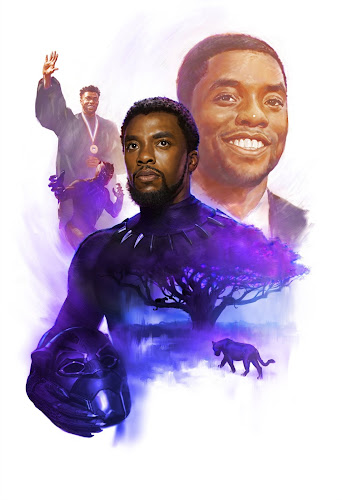
 It’s strange about comets. Except for a few notable exceptions, the vast majority of comets come quickly, brighten our sky, and then disappear forever (or for so long it’s functionally forever). For the brief time they are in the sky, they are a wonder…and then they are gone, leaving us with only the memory of this wonderful thing that blazed amongst the stars for a short time.

That is how I keep thinking of Chadwick Boseman, a man of incandescent talent who blazed across movies and teevee for a few years…and now is gone.

Here is the End Credits suite from Black Panther, written by Swedish composer Ludwig Goransson.

Farewell, Mr. Boseman. You won’t be forgotten. How could you be? You shone too bright in the sky to be forgotten.

(image credit)

Share This Post

The Unsuspecting

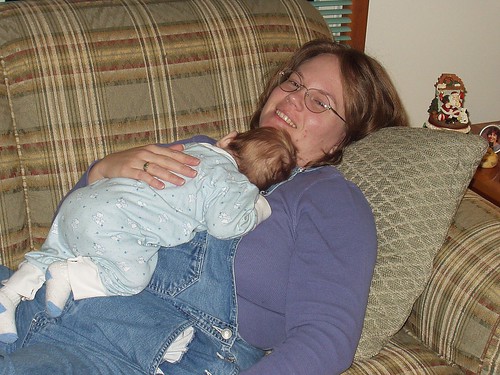
 There was a game going around Twitter the other day in which you post a photo of yourself from January of this year, when you were blissfully unaware of the jaw-dropping frightfest of a shitshow that 2020 had in store for us all. Here’s the one I chose:

It's #LibraryShelfieDay! I don't get these books into many shots here in my own home library, so here they are! #libraryshelfie #books #bookstagram #overalls #dungarees #biboveralls #dickiesworkwear #hickorystripe #denimoveralls #overallsarelife

This was taken on January 22. How optimistic that guy looks! How hopeful!

Here’s hoping that I can capture a similar mood on this coming January 22….

Share This Post

Tone Poem Tuesday

 Born in Lexington, Kentucky in 1924, Julia Perry was a Black composer who studied widely, attending the Berkshire Music Centre and working with the great teacher Nadia Boulanger in Paris and then relocating to Florence for further study before returning home to the United States. She eventually settled into a life as a teacher and as a composer, working hard to integrate her African musical heritage with the Western musical language she had grown up with. She was apparently quite prolific, writing a dozen symphonies and a couple of operas in addition to her other works, until a series of strokes incapacitated her on the right side of her body. Undeterred, Perry taught herself to use her left hand to write, thus furthering her compositional career until she died in 1979, when she was only 55.

All that, and until last week I had never heard of her or her music [oops: this, it turns out, isn’t entirely correct! I need to search my own archives before saying things like this]. I think that’s the most sobering thing about this project I’ve been on in this space these past few months: realizing how all of these composers, who all wrote interesting pieces that should be heard, have never been on my radar before. There are a lot of reasons for that, of course. I, like many, tend to more easily gravitate to what I know than what I don’t. But there’s another, deeper, more insidious reason why these Black musical voices have been largely drowned out, and it’s pretty obvious what that reason is.

Here is a sacred work by Julia Perry, her setting of the Stabat mater. Many composers have written the Stabat mater over the centuries, adapting the hymn and text to new musical language each time out. Perry’s is a contemplative and modernist setting for string orchestra and contralto. The sound strikes me as somewhere between Black spiritual and Catholic chant, with the hypnotic qualities of each. Fascinating piece.

Share This Post

“Let’s go to The Roxy”

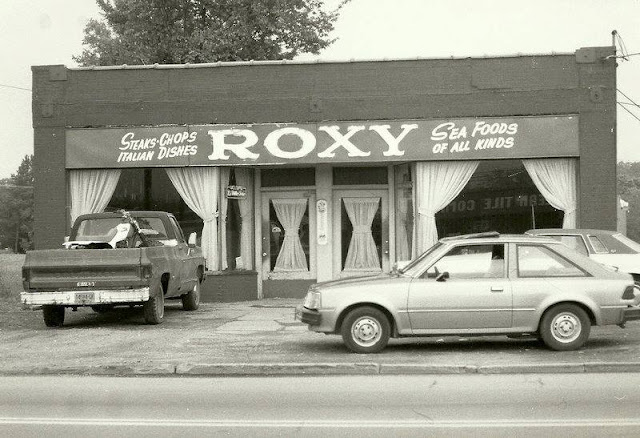
I may not remember the first place I ate a lot of my favorite foods, but I remember a lot of early favorites. Pizza? The ones I remember are Pizza Caboose in Hillsboro, OR and Rocky Rococo’s in La Crosse, WI. I have no clue at all when or where I tried my first cheeseburger, but it was probably McDonald’s or a chain in the northwest called Burgerville USA. I do, however, recall my first chicken wing (other than as part of a KFC bucket). It was this place:

That’s The Roxy, an old dive bar in Olean, NY.
The other day I was scrolling through a Facebook group I had found dedicated to old photos and memories of one of my hometowns, Olean, NY. It’s fascinating to look at the town’s history, even if I haven’t lived there in almost twenty years. Olean is a city in New York State’s “Southern Tier”, although it really isn’t much of a city anymore, as decades of population drain have taken their toll. While I grew up as a child in the town of Allegany, a smaller town just west of Olean, I eventually lived and worked in Olean when The Wife and I got married, and Olean was my home from 1997 to the end of 2000.

By the time my family and I moved to the Olean area in 1981, the region’s decline had begun, though maybe at that time it wasn’t quite obvious yet. Olean still had several factories and lots of shops and even its own shopping mall, though it was on the smallish side. There were three supermarkets and a well-regarded university, and there were a lot of bars. Lots of bars. I remember that a lot of those bars were not “possessively” named, meaning, a bunch weren’t named as a person’s name in the possessive. There was a place called Sullivan’s, and another dive bar called Buzzy’s, but mostly the bars in Olean as I recall were “The Something”. The Burton. The Village Inn. The Other Place. The Royal Ednor (not to be confused with The Royal). The Edgewood. The Birdcage. And, The Roxy.

As I scrolled through that Facebook group, suddenly I stopped dead because I saw that photo. The Roxy.

When I say that I ate my first chicken wing at The Roxy, it was my first chicken wing in the “split-wing” way, with the wings cut at the joints and the wing tips discarded, so what you end up with are a little drumstick and a “flat” (which is basically the forearm of the wing). I knew none of this wing-prep lore when we were preparing to move from Oregon to Western New York in 1981; all I knew was that my father said cryptic things about how we’d be eating chicken wings soon. My father actually lived in Olean on his own for one full semester in spring 1981, while my mother, sister, and I finished out the school year in Hillsboro, OR. So by the time we came along, my father already knew Olean pretty well, and he’d found this bar where I’d have my first chicken wings.

Now, I don’t really know how or why that first wing experience ended up happening at The Roxy. It didn’t make a whole lot of sense, really; we lived in Allegany, west of Olean, where The Roxy was on Olean’s East side. Now, in 1981, wings weren’t quite as ubiquitous as they are now, but still, lots of places had decent wings. Why that bar, all the way on Olean’s east side? No idea, then or now. But that place was pretty cool, and in all honesty, I do kind of miss it.

The Roxy had two rooms: a dining room to the right when you went in, and the bar on the left. It was a blue-collar type of joint, which makes sense since it was right across the street from one of the local factories (a tile factory, if I remember right). Sometimes we’d sit in the dining area, other times in the bar, and I think they had other food there–maybe they even had a menu!–but for me, The Roxy was all about the wings.

And yet…I would soon discover, when I tried wings at other places, that what The Roxy served weren’t actual “Buffalo” wings at all.

There are a great many ways to prepare chicken wings, but only one way to prepare Buffalo wings: They are fried unbreaded and then tossed in a sauce that is made of hot sauce and melted butter. To serve them, you dump them into a bowl or bucket or basket lined with wax paper. The Roxy’s wings were breaded, though, and they came with the sauce on the side, not smothered on the wings themselves. And they were arranged nicely on a plate, like wheel spokes, around the little paper ramekin that had the sauce in it. You dipped the wings in the sauce to taste as you went. I want to say that a regular order of wings had fifteen in it, but I might be misremembering on that point.

When I discovered actual Buffalo wings later that same summer, I actually didn’t like them as much as The Roxy’s. At some point we stopped going out all that far for wings; maybe the place changed ownership or even closed. The bartender was a crusty old woman with a three-packs-a-day voice who had a wicked sense of humor, as I recall. Good times!

I looked at Google Earth the other day to see if the building still existed. I knew that it stopped being The Roxy at some point in the 1980s, and as of the last time the Google Mobile rolled through there, at least the building itself was still standing. It’s a Hibernian Lodge now, though. I have no idea what the Hibernians are or what their thing is.

If anyone affiliated with The Roxy ever reads this, thanks for the wings! Oh, and for the pinball machine that gave out free games like candy. That was fun, too.


Share This Post