
Nuphone, whodis!

 The most exciting development at Casa Jaquandor of late is this: I got a new phone! Yay!

There it is, on the right: my brand-spanking new Samsung Galaxy S21 Ultra, with 512gb internal storage and 5G capacity (which will go along well with the microchip I got from m COVID vaccine*). Yes, I went big. Yes, I went expensive. Yes, I’ve been saving shekels and quatloos** for quite a while to pay for this. Yes, I usually am more frugal than this, but yes, this one time I wanted the best shiniest thing that’s out there.

My previous phone was a Samsung Galaxy S8 that I had been using for three years. Its performance was still holding up, but I have noticed that the battery life has started suffering in the last six months or so. I used to be able to get through an entire day without having to charge, but more and more I’d been needing to plug it in mid-afternoon or risk dying at night. More pressing was that Samsung had announced earlier in the year that it would be ceasing support for this model phone later this year, which meant no more security updates. The S8 model had been out for a year when I got that phone, so four years of support really seems reasonable to me. My goal with each smartphone I get is at least three years of use, which I got with the S8; my phone before that was an S4, which lasted me four years until it got to the point where apps couldn’t even update anymore because it was out of date. The S21 is now my third smartphone in seven years. I’ll take that. (I know folks who upgrade their phones yearly, which seems frankly insane to me.)

So I knew earlier this year that I would be switching to a new phone, and I did some waffling between staying with Samsung, whose products I’ve used almost exclusively in the “mobile gizmo” area (my three tablets have also been Samsungs), Samsung isn’t perfect, by any means. Their devices do tend to get bundled with a lot of extra crap that you may not really want, which can be a bit frustrating–especially when the apps the thing comes with can’t always even be removed. I do not need a Netflix app on my phone, for example–I would never stream something I really want to watch on a screen this small, even if by phone standards the screen is actually pretty big. Also, Samsung’s digital assistant, “Bixby”, takes up space that I’d rather use for something else. As digital assistants go I’m fine with Google’s, which is pretty much on there anyway, since Android and Google go hand-in-hand. There tends to be a lot of duplication with Samsung devices: Samsung Pay and Google Pay, for example.

I can live with all of that, to be honest. I like the ease of transferring stuff from one phone to the next, and since I already have a Samsung account it’s easier to just keep using a Samsung account than port stuff from one platform to another completely different platform.

But the final factor that really got me to buy this phone was the cameras. Now, even that was not a slam-dunk, because Google’s Pixel phones are also possessed of fantastic photo-taking ability. Their cameras may not have the biggest or best sensors out there, but Google’s camera software somehow does magic stuff that takes up a lot of that slack. This S21 has a giant set of lenses: there’s a wide lens, an ultra-wide lens, and two telephoto lenses. I’m not going to get into the nuts and bolts of it all here, because I’m not that knowledgeable about it all and because I still have a lot of playing with this phone to do. Articles reviewing this phone’s camera performance abound online. I’ll just say that the 108 megapixel main lens is pretty amazing, and I love that the front-facing “selfie” camera is better, all by itself, than the main camera on my old S8.

Here are a couple of selfies I took using the front-facing camera:

And here are a couple of “general” photos, using the main camera:

Now here’s where it gets interesting: zooming. Phone cameras have historically not been able to do much in the way of optical zoom; there’s just not room in the phone’s casing for the mechanics needed to make a lens zoom. Phones have relied on digital zoom, which is OK at low-levels but at higher zoom multipliers results in photos that start to take on a Claude Monet kind of look.

This phone has a lens set at a 3x zoom, and one more at a 10x zoom, so I can stand in one place and take photos with multiple grades of zooming. Note the following trios of photos: in each case I was standing in the exact same place to take each shot!

Night photography is also fascinating with this phone. I’m not sure how this works, but I think it’s a combination of long exposure and overlaying of multiple images to composite one image. I might be wrong, though. These photos were taken at night, when things were considerably darker than they appear:

And all of this is just scratching the surface! I haven’t even attempted anything with video yet on this phone, after belatedly discovering that my old S8 was pretty damned good for video. I’ve also read that astrophotography is possible on this phone, by manipulating the Pro settings in the camera. That’s an exciting prospect.

Not everything is rosy: apparently the newest version of Android limits the use of the phone’s cameras to the native camera app, which is kind of a bummer because I’ve been using the CameraMX app as my default camera app all the way back to my S4. I was used to it and to its interface, and it had a pretty solid on-board editor. I suspect it’s hard to make a third-party app that takes proper advantage of all the various lenses that are available from one phone to the next, and I read that there are some other technical reasons for this as well, though I didn’t quite understand them. Also, this phone is my first of the post-headphone jack era. Now, I’m on board with Bluetooth earbuds, but I do still want that functionality, particularly for plugging in an outboard microphone for video making. I’ll need to get a USB-C adaptor for that, at some point.

All in all, though, I am quite happy with this phone and I look forward to getting several years out of it. I can’t imagine right now how the S24 or S25 will blow my mind, but hey, I’ve got time to get there.

* Yeah, I made the joke. Deal with it.

** Quatloo: a Star Trek reference.

Share This Post

Something for Thursday

 In recent times we’ve made various classic rock and 1970s and 1980s hits stations our regular listening when we’re at home hanging out, or when we’re driving about. This is a song I don’t think I’d ever heard much growing up, for whatever reason; I remember hearing it once in a while but it doesn’t seem to have ever been a big enough hit to show up regularly on commercial classic rock stations (with their increasingly boring playlists).

Stevie Nicks is a singer that I’ve never disliked for any reason, but I was never all that big a fan, really…until now. It’s amazing how long it takes you to behold the beauty in what earlier seems, well, not that beautiful. Nicks’s voice is…I’m honestly not sure how to describe Stevie Nicks’s voice. It’s like it’s nasal and sultry at the same time.

Stevie Nicks apparently wrote this song as a duet vehicle for Waylon Jennings, but for some reason Jennings didn’t use the song on the album that has this title, so Nicks recorded it with Don Henley of The Eagles.

Here is “Leather and Lace”.

Share This Post

Tone Poem Tuesday

 A strange and small subgenre popped up in the middle of the 20th century, called the “Tabloid Concerto”. These were entire classical works composed specifically for use in film. Not film music per se, with individual tracks written specifically to hew to the rhythm and length of specific scenes, but entire works to be used in the films themselves. The first, and probably best known example of this, is Richard Addinsell’s Warsaw Concerto, written for the 1941 film Dangerous Moonlight, which is about a concert pianist and composer who must fight in World War II. Needing a classical work to tie the film together musically, but wanting to avoid the specific associations of pre-existing (and well known) classical works, the producers decided to have composer Addinsell write a single movement, which has gone on to be known as the Warsaw Concerto (the composer in the film is a Pole) and has made the leap to the concert repertoire.

I’ll return to the Warsaw Concerto later on (maybe next week!), but this business of writing concert works for use in a film became a small genre in its own right, and a number of the great composers of the “Golden Age” of film music produced works like this, including Miklos Rozsa’s Spellbound Concerto, written for the Hitchcock film Spellbound. Unlike the Addinsell work, the Rozsa Concerto wasn’t written for specific use in Spellbound but was crafted from the film’s themes and cues later on, but it still falls into that same category: a single-movement work of throbbing romanticism in the great Hollywood style.

This performance is a dated one, but it is thrilling and vibrant, featuring the Hollywood Bowl Orchestra conducted by the composer, and with great pianist (and native Buffalonian!) Leonard Pennario as soloist. Enjoy!

Share This Post

How many coffee-brewing methods does one geek need, anyway?!


So, let’s talk about coffee!


I was slow to arrive at coffee, though I think I was always going to get there. I’ve loved the smell of coffee ever since I was very young; I remember making my mother let me take a nice, deep whiff from the Folger’s can every time she went to make a pot, even if I didn’t like the taste initially. It takes time to come around on a lot of flavors, especially the bitter ones, and I didn’t really start shifting toward drinking coffee until college, when the flavor of coffee finally enticed me by way of Coffee Haagen-Dasz ice cream.

And now, years later, I’m a nut about coffee, which means that I have no fewer than four methods of brewing in regular use at Casa Jaquandor, and I’m intrigued enough by several others that I might, just might, look into them someday. But for now, here are the means of coffee prep in my house!

Automatic Drip

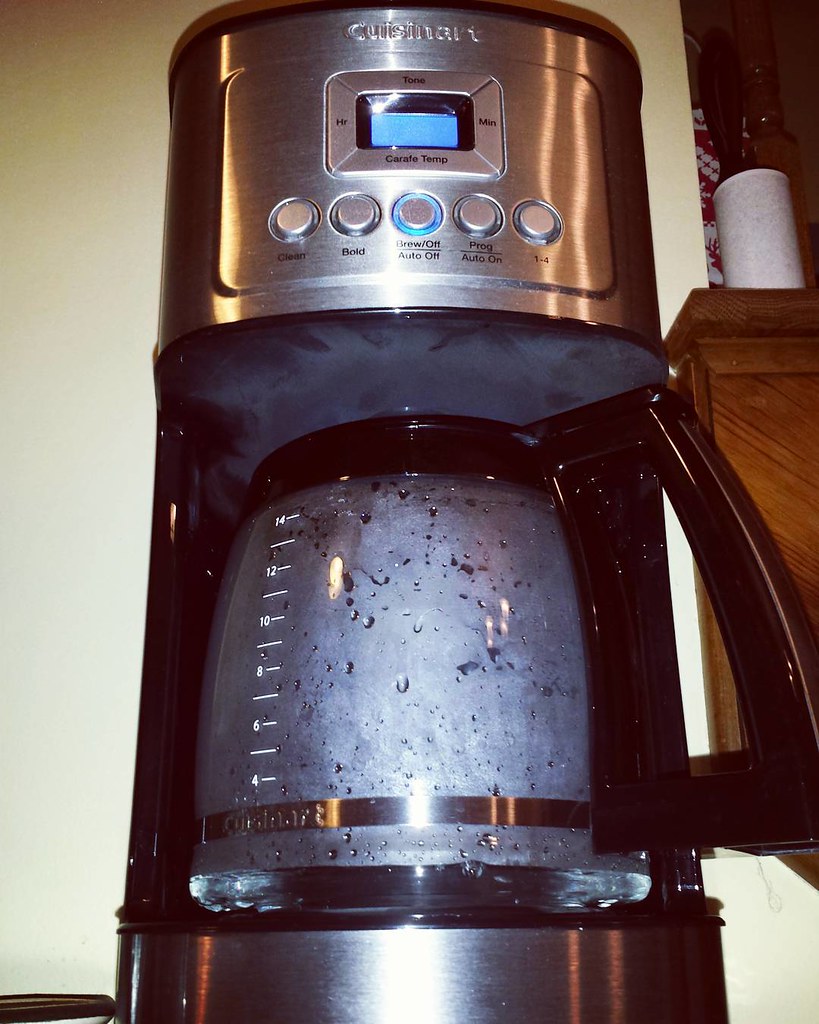
Now, I personally don’t drink a lot of coffee from this machine (it’s the source of The Wife’s daily coffee), but it does make a nice cup. Ours is a Cuisinart with reusable gold mesh filter, a programmable timer, and several temperature settings. Lots of coffee partisans look down on the drip machine, but I honestly think they do just fine for day-to-day coffee.


Pourover

This is the method I use most frequently for my own personal daily coffee. I have two devices for the pourover method: a small brew basket for single cup brewing, and a larger pot for if I need more than a single cup at once. I’ll brew the coffee into the big pot and then pour it into a thermal carafe for hotkeeping. (If ‘safekeeping’ is a word, why not ‘hotkeeping’? Anyway….) This is all very simple. You put a filter in place, measure in your ground coffee, and then you pour boiling water over the grounds. It’s basically the drip machine method, but executed manually. It also works better than most drip machines because you get to properly control the water temperature; many drip machines just don’t get the water hot enough.

If you’ve heard of a “Chemex pot”, my larger pot is pretty much that, only it’s not the Chemex brand. You don’t need to pay a lot for a specific brand name all the time!

French Press

I don’t use this as often, but it makes delicious coffee with quite a different mouthfeel than the pourover. French press coffee isn’t filtered, so a lot more of the oils from the bean end up in the final product, and all that direct contact between the water and the grounds makes for a stronger flavored brew. I own two French presses, one for whole pots and one for individual servings. Admittedly, I don’t use the smaller one very often at all, but I love the larger one. (And that reminds me: as I write this I need to clean my French press, since I used it yesterday morning and didn’t get around to cleaning it! The biggest drawback of the French press is likely that it’s harder to clean than the other methods here.)

Moka pot

And then there’s this gadget, which uses steam pressure to make very concentrated, strong coffee that’s quite similar to espresso in flavor. In fact, some folks refer to this pot as a “stovetop espresso maker”, which some other folks claim is inaccurate because of some stuff involving the proper levels of pressure under which the steam is forced through the coffee. I had to do a bit of research before I used this pot (how-to videos on YouTube are great!), and it’s not hard at all! The most counterintuitive thing about the Moka pot is that you don’t want to put cold water in the boiling chamber; the time it takes to heat the water to boiling ends up heating the grounds, which can make your brew taste burnt. You’re actually instructed to boil the water first in a kettle before adding it to the boiling chamber, and then you put the whole kaboodle on the burner! It’s neat the watch the coffee bubble up and out of the little tower in the pouring chamber, and I quite like the resulting coffee. (And I do get lazy on the whole ‘boiling the water first’ thing, sometimes using hot water from the tap.)

I only use the Moka pot for an afternoon cup of coffee during the cooler months. It doesn’t make a big enough cup for “morning coffee”, at least not for me. But it delivers a nice strong cup of espresso-style coffee!

So that’s all I have right now for hot coffee-brewing methods. I do have a countertop espresso brewer someplace, but it’s in the garage as it never really made it to my normal-use coffee rotation. I’m also intrigued by a gadget called the “Aero Press”, and there’s a thing called “Vietnamese coffee” that also intrigues (from what I understand, it’s basically a drip filter of a special make). I wouldn’t mind trying these, but space for kitchen gadgets is a concern, as is expense. (Not that these things are super expensive, but my desire to try each of these has not yet overridden my “Do I really wanna spend $20 or $30 on another coffee method just now?” thinking.)


I have, to my knowledge, never tried coffee brewed in a percolator. And honestly, from what I’ve read, I don’t particularly plan to. I’m told that you can make good coffee in one, but honestly–I have all these other ways of making good coffee.


“But wait! What about cold brew coffee?


I’m glad you asked!


I do like cold-brew coffee, which I keep on hand during the warmer months so I can enjoy a cold coffee beverage on occasion. I used to make my cold-brew in a large glass carafe that I have and use for several applications, because it’s really easy. You don’t need a special contraption for making cold-brew coffee; you just need a vessel for ground coffee and enough water for brewing (recipes containing amounts abound online). The issue that I ran into was draining and filtering the coffee out: this can become a pain that takes a long time, as you run the coffee through a strainer or a coffee filter. I’m not sure if it’s a temperature thing or some other factor, but cold-brew coffee does not filter out nearly as quickly as hot coffee will.

So, I bought a cold-brew coffee pot. It’s a simple concept, really: it’s just a glass carafe with a lid, but there’s also a wire-mesh basket that goes inside. You fill the basket with your coffee, put that in the carafe, and then pour in enough water to cover. You do this slowly, giving the coffee basket a quick spin a few times to make sure the water saturates the grounds, and then you just let it sit on the counter for 18-24 hours. (I always go 24.) Then you just lift out the mesh strainer-basket and hold it up to drip out for a minute or two, and what’s left in the carafe is your cold-brew coffee concentrate.


I like to mix this stuff with milk and maybe a bit of chocolate syrup. Sometimes I also shake in one scoop of protein powder, but not always.


And finally, a shout-out to the unsung hero of all this: my electric kettle, which I use for boiling water quickly. Stove-top kettles used to be my jam, but not anymore. I am all about the speed and ease of the electric kettle, which makes my coffee and tea adventures an absolute breeze. I used to use a stove-top kettle for boiling water, but it takes way longer than an electric one to get the water to a boil.

So there it is: Coffee at Casa Jaquandor! Note that I do not own a Keurig machine, and nor do I have any intentions of owning one of those. They seem like a wasteful pain to me, a unitasker that just takes up a constant supply of counter space and involves waste in the form of all those little cups. Also, as brewing is cooking, I prefer to have as much control over things as I can.

So that’s how I make my coffee. How do I take it? Most of the time, with cream (half-and-half, really) or black. While I used to put quite a bit of sugar into my coffee, I no longer use any sweetener at all. Coffee is one of the few areas of my culinary life where I’ve pretty much conquered my sweet tooth.


Now…what about mugs? And what about the other great hot beverage, tea?


Those are other posts. For now….


Share This Post

Twenty Years

 I thought about writing a long remembrance of that horrible day, a walk-through of the weird mix of terror and business-as-usual that played out in the office where I was working at the time. I just…don’t want to do that.

I remember that for several days after I tried listening to music, and I just…couldn’t. It took, I think, until Friday when I was finally ready to listen to something. I chose one of the most emotional pieces of music I know, a work I played in my freshman year of college. It seemed, in terms of mood and title, appropriate: Elegy, by composer Mark Camphouse.

It was the saddest day I can remember as an American, and it’s even sadder now in retrospect as we went forth from that day and proceeded to learn all the wrong lessons and undertake all the wrong responses.

We went to New York City in 2015 for Thanksgiving, and we did go to “Ground Zero”. We weren’t there long, but we did want to see the place where this thing happened. It was a damp, cloudy, cold day…and for the location, somehow very beautiful.

There is always beauty to be found, eventually. I wish America would remember that more. Americans, myself included, are too quick to respond with anger and rage to the ugliness of the world.

I eventually wrote a short story in response to the emotions I was feeling at the time, called “The City of Dead Works”, and I used to post it annually here. I don’t do that anymore, but you can read it here. And please do read Sheila O’Malley’s post about one life that was lost that day.

Share This Post

Tone Poem Tuesday

 In honor of Labor Day, and therefore of the labor movement and the fact that the single biggest contributor to the America that exists is the American worker, here’s a piece that pays tribute to one of the fruits of all that labor: the automobile.

Frederick Shepherd Converse was an American composer who lived from 1871 to 1940, spanning the shift from Romanticism to Modernism. As such, he is known for a handful of works, the best known is the tone poem The Mystic Trumpeter.

The piece before us today is Converse’s tone poem Flivver Ten Million. The word “flivver” was a slang term for Ford automobiles back in the days of the Model T and shortly afterward, and Converse gave his piece the subtitle A Joyous Epic Inspired by the Familiar Legend “The Ten Millionth Ford is Now Serving Its Owner. Quite a long title for such a short work (it’s only twelve minutes!), but there it is. The work does seem redolent of the enthusiasm of 1930s America for the coming of the automobile, and as we all know, the shift to being an automobile culture shifted America in ways that we are still grappling with to this day.

Even though the work is a single movement, Converse divided Flivver Ten Million into sections:

1. Dawn in Detroit (sunrise over the city)

2. The Call to Labor (the auto workers report to work)

3. The Din of the Builders (factory workers)

4. The Birth of the Hero – He Tries His Metal (the car wanders off into the great world in
search of an adventure)

5. May Night by the Roadside – America’s Romance (love music via solo violin)

6. The Joy Rider’s – America’s Frolic (happy have a great time music)

7. The Collision – America’s Tragedy (poignant, sad intonations)

8. Phoenix Americans – The hero, righted and shaken, proceeds on his way with
redoubled energy, typical of the indomitable spirit of America (great fun) 

As an added bonus of civic pride, this performance is a recording of the Buffalo Philharmonic, conducted by JoAnn Falletta. Here is Flivver Ten Million by Frederick Shepherd Converse.

Share This Post

A Proposed AMENDMENT, addressing certain ISSUES pertaining to the SUPREME COURT of these UNITED STATES.

Here’s something I’ve been thinking about for quite a while: how I would fix the Supreme Court. Obviously, I’m not an expert and am quite possibly wrong in many ways, but you have to start SOMEWHERE, right? Here’s my proposed Amendment which would fix the Court, with interspersed commentary.

This is long, so it’s after the fold.


WHEREAS it is sufficiently clear in 2021 that the current structure of the United States Supreme Court has proven too easily forced by concerted effort by various factions to extended periods of ideological extremity, I propose the following alterations in how the Court is structured.

While I’m sure American conservatives are all kinds of gleeful that they have finally, after years of focus and hard work, managed to create a Court majority that will favor their ideological goals for quite possibly decades to come, I hope most Americans will agree that this is not a desirable state of affairs.

1. The Supreme Court shall consist of 9 seats, with each Seat being held by one Justice.

Why 9? Why not engage in the current liberal wishlist of bumping it up to 13, thus allowing President Biden to name four liberals and immediately grab the balance of the Court back? Well, as much as I’d be on board with that concept in my angrier moments, I’m trying for a more nuanced approach right here. Currently the number of Justices is set by Congress, and there’s no reason to believe that even if the Democrats in Congress pulled this off right now that a future President Hawley (God help us all) and a Republican Congress to come wouldn’t just do the same thing right back, and somehow find a weaselly way to make it worse. Remember, they were quite content to engage in reverse Court-packing by holding the number of Justices at 8 until they could control the nominee. I’d hardwire the 9 into the Constitution at this point. Also, there’s math involved. And why am I referring to nine seats, instead of nine Justices? Read on! We’re getting to the meat of it now:

2. One Seat on the Supreme Court shall be vacated on July 5 of each year numbered Oddly, to be filled by an individual named by the sitting President of the United States, with the nominated Justice taking the vacant Seat upon confirmation by a simple Majority vote in the United States Senate.

3. The Senate shall bring any nomination of a Supreme Court Justice to its Floor for a full Confirmation vote within TWO WEEKS of the President’s official Nomination of said Justice, regardless of whether the Senate has concluded its Business in the course of Advising and Consenting. In the event that the Senate fails to confirm a nominated Justice or Judge on three consecutive Votes, the President shall name an APPOINTED JUSTICE to serve on that Seat until either the swearing-in of the Next Senate or the beginning of that Seat’s next term, whichever comes first. No Nominee for the Court, having been rejected by full vote of the Senate, shall be eligible for Renomination before the beginning of a new Senate. 

4. Upon confirmation and installation, a Justice shall hold their Seat for a single term of EIGHTEEN years, at the conclusion of which their Seat shall become again vacant and the sitting President shall name their Successor.

OK. Let’s unpack. What am I getting at here?

First: No more lifetime tenure to the Court for judges. That shit is OVER. No more nominating young judges who will then sit for thirty or forty years or longer. Yes, I’m quite annoyed at the fact that I may well need to adjust my diet to include large amounts of broccoli at this point if I have any hope of seeing a liberal court in my lifetime. Moreover, I don’t think a President, any President, should be able to extend their legacy so far into the future, either through chicanery or by accident of timing or some combination thereof.

It is utterly absurd to me that our 45th President, in his one disastrous term, was able to name three Supreme Court Justice while Presidents Carter, Clinton, and Obama combined for four in their twenty combined years in office. That 45’s nominations came respectively via Mitch McConnell’s gaming of the rules, Anthony Kennedy’s oddly convenient decision to step down, and Ruth Bader Ginsburg’s passing (which gave McConnell a chance to demonstrate just how low his actual commitment was to his previous deeply held principle of not voting on Judicial nominees in election years) isn’t relevant, but we should make sure that this kind of gamesmanship is much harder to pull off, moving forward.

However, while I do favor eliminating lifetime tenure, I do think it’s important to remove the Court as much as we can from the normal cycles of political life in Washington. So I have Justices serving eighteen years: a good long term that gives them political independence that lasts well beyond the reahc of a single Presidential term. As of this writing, eighteen years has spanned four Presidents, two from each party.

Next: Well, since we already know the Mitch McConnells of the world will simply change rules any which way they need to in order to make sure that Republicans are the ones controlling the judiciary (and not just the Supreme Court–look at the ways they changed rules for Federal judicial appointments constantly starting in 1995 and then with each subsequent time they either had the Senate, the Presidency, or both), I suppose we need to hard-wire into the Constitution that the Senate will vote on Supreme Court nominees. As a writer whose work involves occasional villains, I have to admit that McConnell’s simple tactic of just not voting at all on Merrick Garland was some Class-A villainy in its ruthless cunning. So, that shot having been fired once, I’d like to take that one permanently out of circulation.

But! Here’s the thing: since 1981–the last forty years–only 22 of those years, barely more than half the time, has seen a President and the Majority of the United States Senate serving from the same party at the same time. It’s easy to see a Republican Senate saying to a Democratic President: “OK, we’re required to give your nominee an up or down vote, so we’re just gonna keep voting your nominees down and run out the clock that way.”

Well…no dice there, either. Three times in a row and the President gets to fill the seat on the Court temporarily, until either the Seat’s term ends (i.e., the 18 years ends) or a Congressional election happens and a new Senate is seated. Then the whole thing starts up again, and the President can nominate the person he or she chose in the first place. Also, note the required time frame: just two weeks, and the Senate is required to vote. If they can’t figure out if they’re on board with a Justice or not within two weeks, they shouldn’t be in that job, and obviously the possibility of any filibustering has to be neutered right in the Constitution. (But ixnay on the President just nominating the same person three times and then seating that person anyway. We still need to take the Senate’s “advise and consent” thing a little seriously.)

Oh, and I said up above that there’s math involved in picking nine judges? Well, assuming an 18-year-term, if you have more than nine judges, then eventually you get to a situation where multiple seats are opening up in odd years. This system guarantees that every President will make some mark on the Supreme Court, as every President will name at least two Justices. But I don’t want a President naming as many as eight. Of course, you could get around this by extending the term of a Justice’s service to twice the number of years as there are sitting Justices, but then terms start getting uncomfortably long again.

All right. We’ve got our Justices serving one eighteen year term on the Supreme Court. Also note that they’re ineligible to hold any other judicial position in the country after they leave! I’m not sure if that would be a big deal or not, but you wouldn’t get to have a Republican President give us a bitter pill like Brett Kavanaugh and then, if his term happens to end during another Republican presidency, just get re-nominated for another 18 years. Also, the eighteen-year-term refers to the seat on the Court, not the specific Justice holding it. In this respect it would be like the Presidency: the term is four years, but if the sitting President dies and the Vice President becomes President, they don’t get four new years: the Presidential term ends at noon on January 20 every four years, no matter what. Likewise, if a Justice dies fifteen years in, obviously you need a replacement–but you do not get to reset the clock with someone to your ideological liking. No getting around it: eighteen years. That’s it. So we would have this provision:

5. In the event that a Seat on the Supreme Court becomes vacant sooner than the conclusion of its Eighteen Year Term, the sitting President shall name a Justice to that seat, also pending Senate majority confirmation, to serve only the remaining time in that Seat’s term, at the end of which that Justice shall leave the Court.

Now, we well know that for all the “the Courts are apolitical!” talk we hear a lot, the fact is that the Courts and people on them are as much a part of the political life in this country as anyone else. But to help foster as much political independence as we possibly can, I’d add this:

6. No person, having held any portion of a Seat on the United States Supreme Court, shall be eligible for any Senate-confirmable position upon leaving said Seat, or for any Judicial position in the United States; also, no member of that Justice’s family shall be eligible for any Senate-confirmable position for a period beginning with their assumption of that Seat until five years after their departure from it.

In short, no “Hey Judge, I’ll make your kid or your wife Ambassador to the Bahamas”, and no “Hey Judge, if you’re looking to retire early, I might need a new Ambassador to Sweden”. Also, once you leave the Supreme Court, that’s it for your legal career. And really, there’s nowhere else to go after that but write your books and be on a corporate board or two, right? No, I’m not worried about what our Justices will do in their now-much-longer retirements. They’ll make out just fine, I suspect.

Of course, if you’re going to limit the terms, then you have to schedule the terms as well. If we just wait for the existing judges to die or retire and then start the eighteen year thing, then you’d have nominations clustering at eighteen year intervals from whenever those passings happen. So, one seat will open on the Supreme Court every two years, during the odd-numbered years to minimize the degree to which federal-level elections play a role in the politics.

7. The transition to this prescription for Supreme Court tenure shall begin on July 5 of the first odd-numbered year following Ratification of this Amendment, with pre-existing terms ending in reverse order of service on the Court.

You have to make your transition some way, right? For my purposes, if I could wave my magic wand and instantly ratify this amendment, then Clarence Thomas would get the boot on July 5, 2023.

As noted above, I’m sure I’ve missed something, and I’m sure there are ways this system would work badly, but…we’ve got to start somewhere, right? And while I yield to no one in my anger at the way Republicans have been gaming our democracy against us (and are still doing so, to what I expect may be our eternal regret, and sooner than we think), I do not want to just shift the gaming-of-the-system to the Democrats just because I’m currently on their side. If there’s one thing the post-2016 era has shown me, it’s that our Constitutional systems are nowhere near as robust as they need to be to withstand the threats confronting them now.

Share This Post

Something for Thursday

 Here is a selection from John Williams’s score to JFK that seems to match my mood regarding the present and future of America.

I don’t know, folks. I just don’t know. There is no law of nature that says we have to remain on the course we’re on, or that we can’t change it. I just don’t know if we realize the course we’re on or if we even want to change it.

Share This Post

For the Record

 I support the right to abortion. Moreover, I do not think that anyone who gets an abortion has done anything the least bit morally wrong. I believe that conservatives in America, for all their blather about “freedom”, will keep chipping away at real freedoms until there aren’t any left.

If this is a problem for you, the “Back” button is to your upper left.

And no, I am not interested in debating this.

Share This Post