Sunshine Blogger Award!!!

Oh wow, it’s actually been an entire month since I posted here last, hasn’t it? That’s terrible. Anyway, I’ll have a proper report up on how June went in terms of writing (short version: mixed bag) early next week, but for now, check this out: A fellow writer, Rebecca Chase, nominated me for the Sunshine Blogger Award! Huzzah!!

The rules are as follows:

The Sunshine Blogger Award is a “get to know the writer better” type of blogging exercise, with a couple of rules attached:

1. Answer all 11 questions asked by the blogger who nominated you.

2. Nominate eleven bloggers in return and write eleven (possibly fiendish) questions for them to answer.

You know, it’s funny — over on Byzantium’s Shores (my personal blog, for those who only know me through here), I’ve been blogging for so long that I remember when these types of blog-quiz awards were quite common. They’ve really fallen by the wayside with the rise of Facebook and Twitter and the like, but they’re still fun, so I’ll go ahead and answer these, pose my own, and nominate. Here we go!

1. What is your favourite song? Do you have a significant memory attached to a time you listened to it?

Oh heavens, it’s this question. Don’t you just hate when you ask someone this question and they get all dewy-eyed and say something like “Gosh, I just love music so much that I couldn’t possibly pick a favorite song!”

Well, guess what? Gosh, I just love music so much that I couldn’t possibly pick a favorite song! Although…I can pick a favorite song, just so long as we acknowledge that there are hundreds of others. For now, I’ll note the song “Last Dance” by Donna Summer. Here’s what I wrote on my personal blog about that song on the occasion of Donna Summer’s passing.

2. Where do you love to blog/write the most?

Upstairs, in my library, surrounded by my books.

But I do love writing elsewhere. I can write in cafes and in public libraries perfectly well, and I like to do so once a week, if possible, for the change of pace. I also want to try writing in a public park or something like that, but as of this writing my laptop’s battery is too old to live up to a sustained writing session without a cord. Luckily, though, also as of this writing, I’ve ordered a new battery! I don’t want to buy a new computer for at least another year if I can help it.

3. If you could make up a fear of something what would it be of and what would it be called?

Huh. Interesting. How about Pronunciphobia, which is the fear that you badly mangle a word in spoken conversation because you’ve only ever read it and therefore you don’t know how it’s said? Or Scrabble Expectations Syndrome. This is when people assume that you’re a great word-game player because you’re a writer.

And as a pie-in-the-face fan, I admit to barbasolaphobia. This is an unreasoning hatred of shaving cream. That stuff is terrible, folks!

4. Italian or French? (in whatever context you decide)

French! (We’re going with opera here. I love me some French composers. Hector Berlioz is my favorite composer of all time, and he wrote three wonderful operas. Then you have Bizet, composer of Carmen. Not that the Italians are any slouches, though. Verdi and Puccini are enough to ensure the Italian star in the operatic heavens.)

Oh, and salad dressing? Italian all the way. I’ve never been a big fan of French dressing.

5. What do you think killed the dinosaurs? (can be as creative an answer as you like)

Nothing. There never were any dinosaurs. Their bones were artificially created and seeded around the world by the aliens who put us here. Why? Because they’re jerks.

6. What is the strangest thing you’ve ever had to research for your writing/blogging?

Huh. I’m not really sure! I recently looked up how boiler explosions happen, because my current WIP features someone who died in one.

7. What can you hear right now? What would you prefer to be listening to?

Right now? Crickets and birds; the wind in the trees; traffic on the big highway that’s a quarter-mile thataway; the clackety-clack of the dog’s feet as he wanders about trying to signal us that he wants to go out for his walk!

8. What do you do when you feel you should be writing but are lacking in inspiration?

I usually grit my teeth and force myself to write. I’m a “Get the job done” kind of person. I don’t have a great deal of use for waiting for The Muse to show up.

9. What is your greatest achievement?

Raising the Daughter; staying married (no, we never came close to breaking, but we did have some pretty serious tests about ten years ago); finishing a book; learning how to use Scrivener (yes, this counts); learning how to format e-books in various formats!

10. If you could only eat one meal for the rest of your life what would it be?

As long as I can change the toppings in any way I want? Pizza. Or waffles. Or sandwiches, with as broad a definition as possible! I also can’t rule out nachos or burritos. Damn, this question is hard!

11. Who is your favourite author and why?

My favorite living author is Guy Gavriel Kay, whose historical fantasies are deeply emotional and filled with characters who are incredibly real. My favorite nonliving author is JRR Tolkien, because The Lord of the Rings is quite frankly a miracle of a book.

OK, time to tag a few people! And my eleven questions follow. Wheeeee!

Roger
Calvin
SamuraiFrog
Lynn
Briana
Brianna
Sara
AB Keuser
Rae
Faith


Questions:

1. What do you value more in a story: dialog or plot?
2. Describe the home planet of Lin-Manuel Miranda. (Come on, that dude ain’t human.)
3. If you enjoy watching any sports at all, which ones would you at least like to try just once?
4. Describe the most recent book to which you gave (or would have given) five stars.
5. Do you finish bad books? Why or why not?
6. How vexed are you when movies don’t match the books?
7. Describe your perfect hot beverage. In detail. I’m talking roast of bean or variety of leaves, additives like spices or squirts of citrus, vessel from which the drink is sipped, where you are sitting as you sip it, who is next to you, what music is playing.
8. Do you watch cooking shows? If so, describe your favorite.
9. Name a place you’ve visited that you thought you’d hate but you didn’t.
10. You know that hobby you had as a younger person that you miss dearly but you know you’ll never do it again? Describe it!
11. On January 20, 2017, the newly inaugurated President of the United States signs a law requiring all Americans to display a coffee-table book prominently in their home. Which one do you put out?

And thanks again, Rebecca, for the award!
Share This Post

GUEST POST!!! On the Tracking of Progress, by A.B. Keuser

Hey, folks! It’s me. Below we have a first for this site: a guest post! This entry is by A.B. Keuser, a speculative fiction author who, by her own words, “spends a lot of time making things up and figuring fun ways to kill people.” Here she discusses her methods of tracking her writing progress. Enjoy!!!

——-

I track my writing by day. It’s a practice I took up in 2013 when I decided to write 1,000,000-words in one year, and I’ve kept with it since because it gives me some really great feedback.

Much like Kelly, I keep track of my writing on a spreadsheet. Unlike Kelly, I record my numbers up in a calendar like set-up.

This allows me to pull day counts, week counts, and keep a running total.

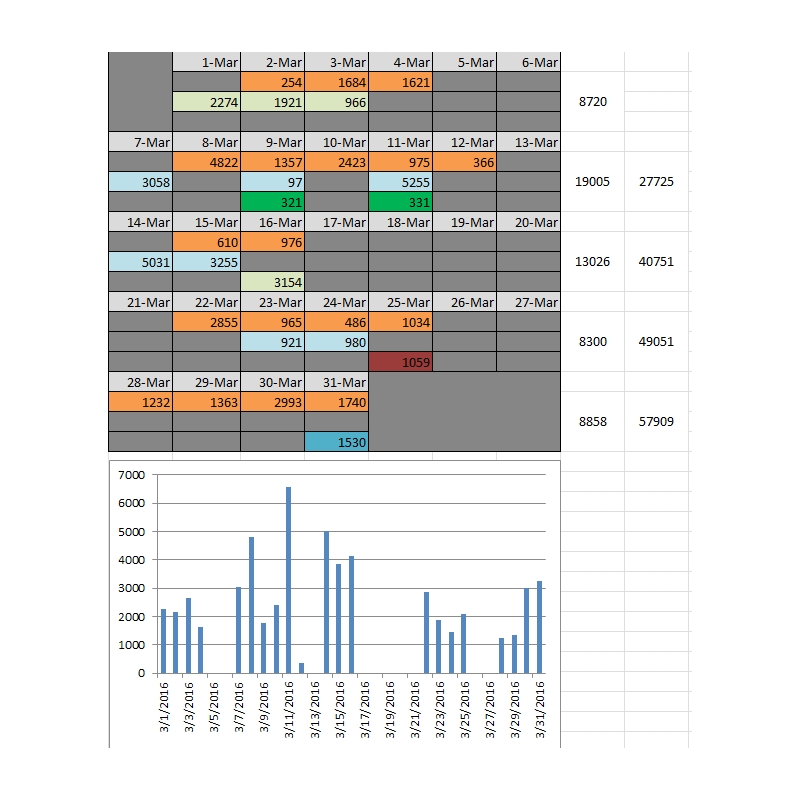
Let’s look at March of this year:

This is what my monthly spreadsheet looks like.

The bulk of the sheet is the calendar where I record the actual numbers. I keep 3 lines for each date because I have a main item scheduled and then I’m usually juggling two other back-burner projects that I write on when I’ve met certain goals. This is why I color code them. With one quick glance, I can look at March and tell you what I worked on.

I like to keep track of my weekly w/c and my running total alongside this just to make sure I’m getting on with my bigger goals.

Below the calendar, I keep a running bar graph (At the beginning of the month, I set up the formula to collect the day’s totals and add it to the chart so I don’t have to worry about it later.) This is one of the most visual representations I have of my monthly writing. It’s quick, it’s tidy, and it gets the point across.

Why this works for me

My eyes get bored pretty easily when it comes to numbers. We’ve never really gotten along, so I use this method of spreadsheeting with colors and charts to keep me interested in said numbers.

I’m also a very self-competitive person. This year one of my bigger goals is to beat my totals from 2014 & 2015. It’s going well enough.

But one of the main things it allows me to do is know when I write, and when I should focus on other things and give my brain a break.

Honestly though, the main reason I do this is to hold myself accountable. As Kelly mentioned at the beginning of April, I post my counts every month. I’m not sure anyone really cares to see them outside of myself, but having them out there, in the open really helps me keep from slacking off.

The Big Picture Numbers

ab sheet 2

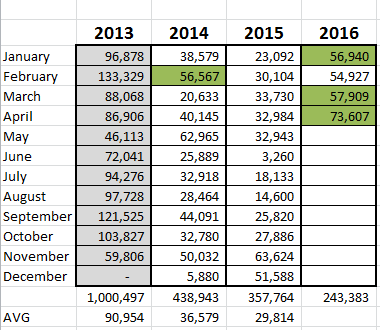
2013: 1,000,497
Average: 83k words per month.
Best month: February – 133,329 words
Worst month: December – 0 words

In theory, this sounds awesome, right? So much productivity! But I managed that by ignoring all but two editing projects. Which means I’ve still got some back burner projects from that year that are waiting around to be finished.

If you’re just looking to get words down on paper—maybe you need to empty out your brain because it’s gotten too cluttered—the way I approached 2013 is great. You just write. If something isn’t working, you shove it aside and work on something that does flow. You worry about the rest of the writing stuff later.

2014: 438,943
Average: 36,578
Best month: May 62,965
Worst month: December 5,880

This year was all around tamer. I was working on things with the intention of finishing them and getting them right. That meant I couldn’t shove them to the side until my brain sorted through their issues later. I had to get things done, and I had to get them done when I scheduled them.

I learned, from looking through this year’s records, that I can’t rely on myself to do any writing on Thursdays. For whatever reason, they’re my own personal Mondays, and that day just sucks the life out of me, writing wise. Sure I can force it, but the writing is pretty awful in edits, so I usually just don’t schedule myself any req words that day. I use it for admin things now, like finishing up blog posts and doing marketing backlogs, or outlining etc.

2015: 361,949
Average: 30,162
Best month: November – 63,624
Worst month: June – 3,260

Now, those numbers look okay, but when you look at what happened throughout the year as a whole, you get a different picture. 1/3 of the words from last year were written in the last 2 months of the year. This has a very specific reason. While the first 5 months of the year were incredibly consistent, June through October were weak sauce on the writing.

June has its own excuse, my sister got married in our home state so I spent a lot of time traveling and with everything going on, I didn’t get a chance to write outside of 4 days.

July-Oct shows a different sort of recording. It shows how badly medication can affect your writing. Make sure you’re on the right meds, kids!

What this tells me on the whole

When I look at the numbers I have saved in my yearly spreadsheets, I can see patterns, like the fact that Thursdays just do not work for me. Decembers are (usually) pits of non-writing hell. Weekends are lucky to average 1000-words/day, and usually I just shouldn’t expect myself to get there.

—fin—

And there you have it! Great stuff. How do you track your progress, fellow writers?

And check out A.B. Keuser’s books!

Share This Post

Updates and What Some Other Folk Are Up To

Greetings, programs!

It’s been a while since I updated my progress and/or linked some other stuff around the Writersphere, so…I’m now going to update my progress and link some stuff around the Writersphere. Wow-za!

:: I think I have a title for Lighthouse Boy. I’m not sure yet; I like to live with titles a bit before I decide if they’re right for the books. Kind of like breaking in new shoes, I guess.

As for actually writing the book, I’m closing in on the end. I think I’m two or three chapters away — more likely three, but you never know with these things. I’ve been promising a long book, and this one is certainly that. The manuscript currently stands at just under 200,000 words, and this is only Book One! (Never fear; this is going to be a duology, not an extended series of doorstops. Just two doorstops.)

::  Editing Forgotten Stars III has been a real task. A lot of heavy lifting, with some wholesale rewriting of entire chapters. Part of the problem was that I had to literally insert an entire subplot from the get-go (which has to be there, because it solves a lot of the book’s original problems), and there are other things I did in the first draft that were problematic and had to be either reworked or jettisoned entirely. I’m well behind where I wanted to be on this book by now, but it simply couldn’t be helped.

::  I don’t know what was in my coffee this week, but I found myself entertaining a lot of new story ideas. Weird.

But enough about me! What are other folks up to?

::  Dawn Kurtagich went to Spain.

::  Briana Mae Morgan updated her editing services. Check her out!

::  Amanda Fairchild posted a short story. I wonder what’s in that freezer….

::  Friend and beta-reader Jason Bennion eulogizes Prince. Jason is a terrific writer.

::  How Jen Fulmer got her agent.

That’s about it for now. Cheerio, chaps, and we’ll see you around the Galaxy!


Share This Post

March Productivity!

I saw that writer A B Keuser writes a monthly post highlighting the previous month’s productivity, and that struck me as a good idea, so here’s how my month of March went! Some of this has been covered by my update post from the other day, but here are some actual numbers:

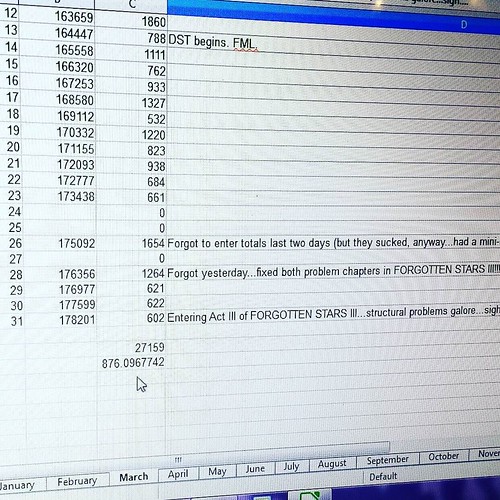
Final March tallies: over 27000 new words on LIGHTHOUSE BOY, and I'm up to Act III of FORGOTTEN STARS III. Unfortunately there are some structural issues ahead...the rough draft was pretty bloated. Still, here we go! Big things planned in April and May! T
This spreadsheet is where I track my daily writing output on whatever it is that I’m drafting at the time, and then I leave notes in the next field on editing progress on other projects. So in March I wrote just over 27,000 words in Lighthouse Boy, whilst getting to the start of Act III in editing Forgotten Stars III. I averaged 876 words a day on Lighthouse, which is above my quota of 500 words a day. (I bump that quota up to 1000 words on weekends and when I’m not doing any editing, which moving forward is not likely to be terribly often, as my projects start to pile up.) Since making 500 words while also editing is obviously no problem, I’ll likely bump that up to 750 a day.

Note that when I forget to enter a day’s total, those words get added up anyway the next time I remember to update the spreadsheet, so the average is always accurate. None of those zeroes indicates a day in which I wrote nothing. Aside from wrapping February up with the flu, I haven’t failed to write at all in quite a few months. Yay, me!

On the editing front: Forgotten Stars III has been harder to edit than the previous two, because I’m finding some glaring character issues and some structural problems with the third act that all require some heavy lifting. The bad character stuff (basically, I had a character act very “not himself” in the original draft, trying to create a “Has he switched sides for real?” suspense, but when re-reading the draft, I realized that not only did it not work, it was conceptually awful, so out it came) is gone, but now I’m face-to-face with the troublesome stuff in Act III. I want to have this book to beta readers this month, so I’ve got some real work to do.

Also, I spent the first two months of this year being very sporadic on the blogging front, and I’m trying to get back in the habit of blogging regularly. I want to post something here at least once a week, and I’ve been posting a lot of stuff to Byzantium’s Shores and to Driftwood Upon the Bosporus, so I’m getting better there.

It’s also looking increasingly like I will attempt vlogging soon, so I’ve been writing notes for that and doing some tech testing. And I even wrote a little comedy sketch about the dangers of procrastination for writers that a friend and I will be filming when the weather here in Buffalo Niagara actually improves (we’ll be shooting outside and the sketch involves me getting a pie in the face), so there’s that. Busy month!

Let’s see what April brings!

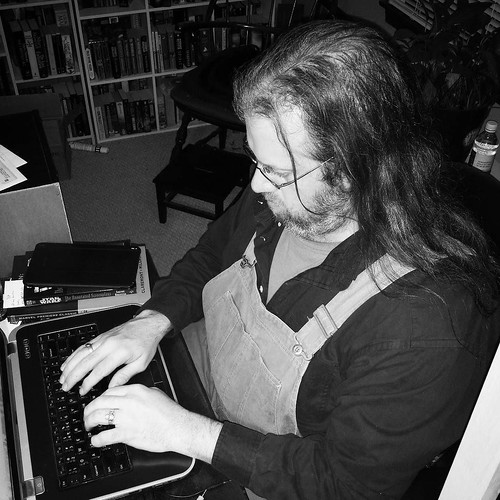
Good morning, world! It's April Fools Day, so celebrate laughter! #aprilfools #overalls #pieintheface

(I posted that photo in various social media on April Fools Day, and it makes me happy, so it’s here, too.)

Share This Post

What happens when you’re done?

So what do you do when you finish writing a novel? What happens after you publish it?

I can’t speak for every writer out there, but for me, the answer is clear: I start the next one.

There was a teevee show about ten years ago, called Studio 60 on the Sunset Strip. It was created by Aaron Sorkin, and was his first big project after The West Wing. In all honesty, it wasn’t very good, for a lot of reasons, and it only lasted a single season. But there were some wonderful moments in it, including one that’s my favorite.

If you didn’t see the show, it was about two men, a writer and a director who are creative partners, who are brought in to basically reboot a late-night teevee comedy sketch show (basically a fictional Saturday Night Live) that has gone off the rails and whose former showrunner had to be fired after a spectacular on-air meltdown. As they start work, the writer guy (played by Matthew Perry) sets up shop in the old showrunner’s office, and he discovers a digital clock on the wall that counts down the days, hours, minutes, and seconds to the next episode’s airing. It’s a constant reminder, in big red electronic digits, of the next deadline and the constant pace of time draining away toward that deadline. “Oh man,” Matthew Perry says. “No wonder he went crazy.”

The rest of the episode focuses on the production of that first new episode, with lots of struggles along the way, but in the end, the episode airs successfully despite the production difficulties. In the episode’s final shot, Matthew Perry is in his office, watching the show go on, and he’s smiling with his sense of accomplishment…until he glances at the big red digital clock, which is already ticking down to next week’s show.

That’s a little like how it feels to me when a project gets finished. I’m not really one to take long breaks from writing, so usually when I finish one phase of a novel’s life – first draft, first edits, second edits, proofing, design, publishing – I shift immediately into the next one. As soon as I finish something, I can feel the big red digital clock in my head, already ticking down on the next thing. Now, I don’t have a specific deadline in mind most times, but I do move on, sometimes within minutes.

Writing for me is almost compulsive. When I have a rare day on which I don’t write at all, I feel really weird about it – even during the bout of the flu I had this past February, during which I lost two days and felt well and truly awful about it. I suppose, in this regard, I’m wired like Anthony Trollope, whose writing regimen Stephen King describes thusly (in On Writing):

At the other end of the spectrum, there are writers like Anthony Trollope. He wrote humongous novels (Can You Forgive Her? is a fair enough example; for modern audiences it might be retitled Can You Possibly Finish It?), and he pumped them out with amazing regularity. His day job was as a clerk in the British Postal Department (the red public mailboxes all over Britan were Anthony Trollope’s invention); he wrote for two and a half hours each morning before leaving for work. The schedule was ironclad. If he was in mid-sentence when the two and a half hours expired, he left that sentence unfinished until the next morning. And if he happed to finish one of his six-hundred-page heavyweights with fifteen minutes of the session remaining, he wrote The End, set the manuscript aside, and began work on the next book.

Once in a while I think that maybe I should take a vacation from writing, but…well, how could I? I’ve got stories to tell! Some days I find the work harder than others, and some days I do procrastinate a little (I recently skipped an entire day on editing Forgotten Stars III just to finally catch up on some blog posts, so I could have something to post for once). But I do, pretty much, work each and every day, even if just to get 500 words written. Forward progress is forward progress, after all. And like I said, I’ve got stories to tell.

How about you all? How do you handle the “I’ve just finished” blues?

Share This Post

How I do Social Media!!

Wrote into the wee hours last night. Momentum is a fickle mistress. #amwriting #writersofinstagram #overalls

If you’re a writer these days, you pretty much have to engage in social media in some way or other, unless you are a sufficiently big name that maybe you don’t have to but it’s fun to do so (see King, Stephen and Rowling, JK). But there are a lot of social media options out there, and each one has its own “lay of the land”, so I figured I’d break down each one that I use a lot and describe how I use them.

An opening proviso: While different aspects of my personality tend to show up on each various platform that I use, that’s more by virtue of the nature of the social media things in themselves than some conscious decision I make. I know folks who are active on a number of platforms who expend serious effort in making sure that never the twain meet; folks who are open about their use of, say, Tumblr while uber-secretive of their Twitter handle. And hey, to each their own, but in all honesty, this degree of self-separation always strikes me as more effort than it’s worth. So if you check out what I do on any particular platform and compare it to what I do on another, and you come away thinking, “Geez, that doesn’t seem like the same guy!”, well, it is. It’s just that various platforms are good for different approaches, and therefore different aspects of my personality.

So. First, and for me foremost, we have blogging. I now have two blogs: this one, and my personal blog at Byzantium’s Shores. Why two? Well, when I launched this site, the blog format seemed to be the easiest way of maintaining a site whose content would change over time; I didn’t just want a page hanging out there for no apparent reason. Hence the blog format here. But I also didn’t want to ditch Byzantium’s Shores, because I’m kind-of invested over there: I’ve been posting on that blog for just about 14 years now! It’s got its own life. So I’ve settled on this as a division of content: this site and its internal blog is for content pertaining to writing in general and my books in particular, and that’s it (I mean, within reason). Everything else I might want to blog about goes to Byzantium’s Shores, so that’s where I’ll geek out about Star Wars and post music videos and photos of the cats and the dog and pie-in-the-face stuff and all that sort of thing.

I love blogging, and maybe two blogs is a bit excessive, but I think I’ve got it broken out by “focus” in a way that works for me. And if you’re worried about politics (of which mine are distinctly left-of-center), I post no political content on this site at all, and only rarely on Byzantium’s Shores. (Full disclosure: I’m a staunch liberal in my politics.)

I do have a Facebook page, which you can certainly ‘like’ and I’ll thank you if you do, but in reality, all I use that for is to post links to stuff here! By making pages into a source of monetary flow, Facebook has made its Pages not very useful at all, unless you literally pay Facebook to show your posts to followers. I have little to no intention of doing that, so Facebook is just kind of “there” for me as a social media thing. (My page is distinct from my personal Facebook account. I’m pretty selective about from whom I accept friend requests there; basically I have to already have some notion of who you are and have already interacted with you in some way.)

Then there’s Twitter. I hated the idea of Twitter for years, but then I came around, and now I think it’s indispensable. I honestly love hanging out on Twitter (probably a little too much), and I love followers and whatnot, so feel free to follow me there! I can get a bit ranty at times, but in general I try to keep my snarky side to a minimum there. Politics? Yes, sometimes, but not all that often – maybe 15 percent of the time, tops. I don’t really enjoy political argument, and I’ll usually only tweet about politics when something in the news really gets my dander up. I retweet more political stuff than I generate myself, and even that I don’t do very often. I like talking about writing on Twitter, and various geeky observations. Sometimes I feel like I’m missing out on the “conversational” aspect of Twitter, which is mainly because I can really only check Twitter a few times a day, and usually just for a minute or two. It’s only when I’m off-duty and can have a browser running for a while that I can do any real-time conversing. I am starting to explore the world of Twitter chats, though!

In terms of following people on Twitter: I follow folks I find interesting, and I find them by generic use of the medium. I check what people are like if someone I’m already following retweets something I like, or if I see an interesting conversation going on, or that sort of thing. I don’t blanket-follow people, and I don’t use any “follower management” apps of any sort. I do try to follow people back who have already followed me, but I can be kind of slow about getting this done.

I will also mute people who get on my nerves, as opposed to blocking. Like John Scalzi, I enjoy the idea of people who annoy me basically shouting at the wall behind which I am sitting in my room with my earphones on.

Instagram is my “happy” place. I don’t get political there at all, and I tend to get irritated when other people do. I like sharing photos from my daily life, whether I’m trying to take “good” photos or just snapshotting stuff to provide a sort of pictorial commentary on things. I’m generally good-natured on Instagram, which is why my avatar photo there is almost always me with my face covered with pie. For me, photography is an entertaining diversion. I try to take photos that are as interesting as possible, but I’m hardly a trained pro. I take most photos with my phone, although I do have a nicer point-and-shoot camera that I got last fall before our trip to NYC. Who knows? Someday I’ll be able to afford a nice DSLR camera, at which point I could really see photography becoming a big hobby for me!

What’s especially fun is that there are a lot of ways to post word-based content to Instagram, which is also something I do on a fairly regular basis. But even there, the interplay between visual design and the words used is a fun consideration. I find Instagram a lot of fun! (I’d love it if they would enable HTML links in the photo captions, though, just to make IG a little easier to integrate into the rest of my online life.)

Flickr used to be my primary photo-sharing service, and I still use it a lot, but nowadays, it mainly mirrors my Instagram content. This isn’t all I use Flickr for, but as I began adapting to mobile devices several years ago, Instagram took over because Flickr at the time was not nearly as well designed for mobile use. It’s significantly better now, but there’s a sense to which Flickr is a bit late to the party. Still, I like Flickr’s service and have no intention of abandoning it. I do need to spend some time organizing my photos, though…and that sounds like about as much fun as a long drive on I-80 through Nebraska. (This is not a comment on Nebraska. It is, though, a comment on the I-80 corridor through Nebraska.)

I enjoy Tumblr quite a bit, after being rather confused by it at first. Tumblr is built to make it easy to share content, and it’s quite easy to just sit there, hitting the “reblog” button over and over again. It’s also relatively easy to create new stuff, although Tumblr seems to be a much more visually-oriented service than other blogging platforms. Likewise, Tumblr’s mechanisms for interacting with other users is a bit unwieldy at times. Still Tumblr is fun and offers a lot of flexibility for creative use of the service. I do tend to be more political there than in any other social media platform. If I get a rant in my head about some issue or other, Tumblr’s where I go to let it out. Keep that in mind if you really really really want to avoid my politics. Even there, though, I’d say that my political content is no more than about twenty percent of what I normally post, and at times of slow political news, even that ratio drops.

Let’s see…that about covers them all, doesn’t it? I do have accounts on Pinterest and Linked In, but in all honesty I don’t use them very much at all. I’ve actually started using my Pinterest account more, lately, but I’m still not entirely sure I understand it! Meanwhile, LinkedIn is still the odd thing out. Once in a great while, maybe twice a year, I’ll log on to see what’s going on, but that’s about it. I apologize if I seem like I’m ignoring your attempted interaction on LinkedIn for months at a time, but I just don’t understand LinkedIn and I can’t see where I’m missing out much, and I just can’t be on everything at all times. Likewise, I use YouTube a little, but while I’ve occasionally considered ‘vlogging,’ the fact is…I don’t like the way my speaking voice sounds, and I haven’t figured out yet how to do silent vlogging. So for now, my forays into video will be sporadic at best. However, I do hope and expect that as I get better at self-marketing, I may have to do some video stuff and appear on podcasts occasionally (which is totally a troll for invitations, podcasters of the world!), so I’m just gonna have to get over my speaking-voice hangup.

So those are all of my hangouts and how I use them. How do you use yours?

And feel free to connect! Connection is great. I love connections!

Share This Post

“We don’t have time to do one thing at a time!”

In a comments thread on another writer’s Instagram feed the other day, the question of how to multi-task as a writer came up. Here is my approach:

Sooner or later in anything written by Aaron Sorkin, somebody will say: “We don’t have time to do one thing at a time!” It’s always uttered in a time of a big flurry of activity, usually by one of Our Heroes, as they gear up for several conflicts at once.

What does this have to do with writing? Well, I have first drafts to write and I have existing drafts to edit. I don’t have time to do one thing at a time!

I used to try, of course. I’ve been drafting an Alexandre Dumas-inspired fantasy novel for nearly three years now, which I code-name (for lack of an actual title) The Adventures of Lighthouse Boy (because it deals with the adventures of a young man who, at the beginning of the book, helps his father maintain a lighthouse). I ran into problems with it, because it was taking a long time to write, and I ran into the point when I really needed to work on edits for Stardancer.

So I shelved Lighthouse Boy (also in part because at the time I was having trouble with its story). Then I edited Stardancer and wrote the first draft of Ghostcop (again, not the actual title). Then I returned to Lighthouse Boy. Then I put Lighthouse Boy aside again because I needed to edit The Wisdomfold Path and start writing Forgotten Stars III and edit Ghostcop and so on. Now, I’m back to drafting Lighthouse Boy.

Oh, and another problem: all those times I shelved Lighthouse Boy, I lost touch with the story, so that both times I returned to it, I ended up starting it over.

Now it’s time to edit Forgotten Stars III, do final revisions on Ghostcop, and…well, it doesn’t really matter.

I don’t have time to do one thing at a time.

So, do I shelve Lighthouse Boy yet again? Knowing that I’m going to have to probably restart it yet again if I return to it? Knowing also that the book is my Big Doorstop Fantasy (seriously, this thing is going to be in excess of 200,000 words), my choices are to either keep on drafting it even while I work on other projects, or let all those other projects sit on the back burner until I get this one job done.

Neither of those appeals to me, because I’m also thinking in terms of my career here. I want to release at least one book a year for a while, which means continuing the Forgotten Stars series (with a probable break of two years between Books III and IV), launch the Ghostcop series, launch another space opera series that I haven’t even started yet, and eventually, release Lighthouse Boy, in what format, I’m not sure. (I’ve been thinking about serializing, but that’s for a much later time.)

I simply do not have time to one thing at a time!

So, then: since I have to multitask by working on projects at the same time, how do I do it? Well, I’ve set up a few rules:

1. Only ONE first-draft book at any time.

This is important because I don’t want any co-mingling of voices from one book to the other. The Forgotten Stars books have a tone that’s different from Ghostcop, and I fear that if I try writing a first draft of two books at once, it will be hard to maintain voice. (It may also be hard to maintain consistency, as I think I would almost certainly wind up favoring one book over the other, and that will simply not do.)

2. In a day’s work, the first-draft book gets precedence.

So far, I’ve been pretty good about drafting every day and also editing every day. But if the choice comes up — and occasionally it does, because this is Life and not just Writing — then I have to do the first-draft work first, before I write anything else. This means that my early-morning writing sessions — the 40 minutes or so I write before I get ready for work, from 6:10 to 6:50 am — are exclusively for drafting.

3. When I have to work on two projects per day, I lower the quota on the drafting project to 500 words a day.

This may sound like too much, but for me, it isn’t. Maintaining a daily quota is very important to me. Without one, I end up slacking too much. Usually my quota is 1500 words a day, if I don’t have anything else going on. But for me, 1500 words takes up a nice chunk of time, and it’s too much time if I also need to do some serious editing. Thus I lower it to 500 words, which hey, isn’t that bad anyway! It’s about one page of text in a mass-market paperback, so if you keep that pace for long enough, you can write an entire novel in a year. (Depending on how long your novel is, of course.)

4. Once I achieve the drafting project’s quota for the day, I don’t touch it again until the next day.

I like doing this because it really guards against burnout and keeps me energized on this book. I find that by not allowing myself to go very far beyond the quota (I often wind up around 650-700 words), it’s easier to jump back in the next day. It’s the “keep plugging away” approach: “Slow and steady wins the race”, or should I say, “gets the book written”.

I do raise the quota on weekends to 1000 words each day, and when I get to a point when I’m still drafting this book but the other projects are either caught up or on hold, I’ll up the quota again until things change.

5. Try not to have both projects be in the same genre.

This is important to me. I firmly believe in genre-hopping to keep fresh and interested and engaged, which is why I will never edit one Forgotten Stars book while drafting another.

6. Do first-round edits on a hard copy of the manuscript.

This is because I think it’s good to get the writing away from the computer and the same desk as always and everything. Whenever I finish a first draft, I print it out and put it in a binder; when it’s time to edit (at least three months later), out comes the red pen and I edit the thing. I do this because I think it’s good to get away from the screen once in a while, and there’s still nice tactile senses to working on paper. Now, I don’t know for how many more years this particular approach will be feasible, but we’ll see.

I can probably come up with more rules, but these are my big ones for when I have to maximize the time I have for the more-than-one-job that I have. It’s all about breaking the jobs down, so I can keep moving the ball forward, and it’s about keeping my writing-brain fresh and not tired from all the work I’m doing. Writing can be very tiring on the mental front, but there are hacks to get around that, and these are mine. I firmly believe that you can work on multiple projects at once (well, not exactly at once, but you take my meaning), so long as you plan things out and take a consistent approach.

What do you think, folks? Any other multi-taskers out there?


Share This Post

It’s #AuthorLifeMonth!

There’s quite a wonderful thing going on in the Instagram world this month! It’s one of those daily photo challenges, but this one — hashtagged #AuthorLifeMonth — is geared specifically to writers, as a way of showing off a little of who they are and what they do. And of course I’m participating! I’ll feature my photos for that tag here, throughout the month.

Day 1: Your Books. Here are mine, on my own shelf! How cool is that.

Day 1, #AuthorLifeMonth: My books! If all goes according to plan, there will be four this time next year!

Day 2: Author Pic. I’ve used a different author pic on each book thus far; this is the one I used on the back of The Wisdomfold Path.

Day 2: My author photo. #AuthorLifeMonth (This is my second author photo, used most recently on THE WISDOMFOLD PATH. Thus far I've chickened out on using a pie-in-the-face photo as an author pic!)

Day 3: Your Last Five-Star Read. This one was a little trouble, because I don’t give five stars very often at all. (I’m talking Goodreads ratings here.) For me, five stars is for those few, rare books that are life-changers; books that would be on the list for books I hope I have with me when my ship crashes on that lonely island. I only have a few five-star entries on my Goodreads roster, and of those, none are ones that I’ve read recently. So I went with my most recent addition of a five-star book:

Day 3 of #AuthorLifeMonth: Last 5-star read. I reserve 5 stars for those books that become part of me. I read this many years ago, but I return to it often. Richard Halliburton was an adventurer and writer from the first decades of the 20th century, and h

That is a wonderful book! It’s perfect for a lazy Sunday afternoon of reading.

Day Four: Your WIP. Heh! I have two WIPs right now, one that I’m editing (Forgotten Stars III), and one I’m drafting (Lighthouse Boy). One’s a physical copy, and the other exists as a Scrivener project.

Day 4 of #AuthorLifeMonth: My WIPs. Top is the manuscript to FORGOTTEN STARS III, which I'm editing. Bottom is the Scrivener corkboard view of THE ADVENTURES OF LIGHTHOUSE BOY (not the actual title), which I am still drafting (and likely will be for years

More of these to come throughout the month!

Share This Post

I Am No Writer

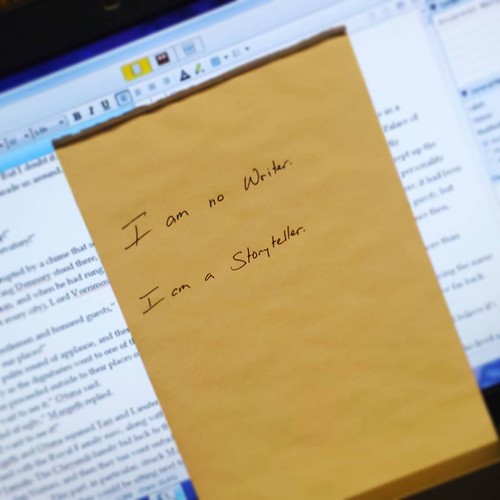
I posted this image last week to Instagram, and someone asked about it:

An important distinction. #amwriting
 

What do I mean by this? Why would I claim to not be a writer, but rather a storyteller?

What I mean is simply this: I am more focused on the final product than I am the process. Writing is the job; writing is the work. There’s nothing at all wrong with that, because the writing is necessary. But sticking with my metaphor from my post about first drafts, I find it helpful to maintain my focus not on the laying of the pipe or the pouring of the foundation or the running of the wires, but on the final product: the house. Or, in my case, the story.

It’s the story that’s why I’m doing all this. It’s the story whose needs I have to service. It’s the story that I have to do well. It’s the story that readers will hopefully care about, and it’s the story that I hope will bring them back for the next one.

One can write a lot of things without being a storyteller. Writing is a skill with a lot of possible end goals, and the process can lead in a lot of different directions. And I do think about process a lot — in fact, I’ve yet to meet a writer who doesn’t! But in terms of defining who I am, I choose to focus on the goal and not the process.

Mine is storytelling.

What’s yours?


Share This Post

Confessions of a Writer

So I saw this little quiz-thing on another writer’s blog (Julia Grantham‘s, to be precise), and though I haven’t been tagged with it, I’m not going to wait. So here’s a bit about me as a writer, for anyone who might be new to my particular…idiom!

When did you first start writing? Was being a writer something you always aspired to be?

I’ve loved writing and telling stories for as long as I can remember. I didn’t decide to start taking writing really seriously, though, until the late 1990s, when I started working heavily on a fantasy novel and writing short fiction. Before that, I played around with fan-fiction, but never really decided to get serious until later.

I didn’t decide “Writer or Bust!” until 2009 or 2010, when the idea for The Song of Forgotten Stars started to really heat up in my head.

What genre do you write?

Science fiction, fantasy, and horror. Mainly the first two. In terms of sci-fi, I really gravitate to space opera.

Can you tell us a little about your current work in progress. When did you start working on this project?

I have two projects going on right now. First is initial edits on the third book in the Forgotten Stars series, in which we explore the mysteries of the planet Xonareth even more deeply. Among other things, in this book we learn why Xonareth was quarantined from the rest of the Galaxy. More importantly, in terms of character, I add Lieutenant Penda Rasharri to the roster of viewpoint characters.

Interestingly — to me, anyway — I realized halfway through this novel that for the duration of this series, every single viewpoint character will be female. Also, the scope of the story seems to be getting bigger with each volume. I’m a bit scared by this; my original dream-goal was a nine-book series, but if this keeps up, my scale by Book IX will be absolutely galactic.

My other project is my long on-again, off-again fantasy novel not-titled The Adventures of Lighthouse Boy, which is a Dumas-inspired adventure tale with sword fights and court intrigue and thieves meeting in the forest and sea battles and lost Kings and hidden treasures and nefarious priests and all that good stuff. There is actually no magic at all in this book; it’s fantasy because it takes place in a realm that never existed, not unlike Lloyd Alexander’s Westmark books. I’m writing some of this every day; my quota is 500 words while I’m working on other stuff at the same time, but if the decks are ever clear, the quota will go up to 1000 words or more.

When I’m done editing Forgotten Stars III, then it will be time to start prepping my supernatural thriller for publishing sometime this summer. I think I may have a title for it, but I’m not sure yet. I’m still kicking it around in my head.

What was your first piece that you remember writing? What was it about?

How far do we want to go back? I remember writing a play in fifth grade called How the Elves Saved Christmas (a concept which I still think could make for a fun family flick); around then I wrote a lot of crappy fan-fiction. As in, really crappy fan-fiction. Mashups that had James Bond teaming up with Indiana Jones in outer space. Yeah.

Before that? Well, I wrote stories in second grade about a superhero cat named Little Bootie. I have no idea why he was called that, or why he went around in a costume with a big K on the front. When you’re in second grade, shit don’t have to make sense, yo.

Serious stuff? As in, when I decided to take writing really seriously? I wrote a fantasy novel about King Arthur’s return called The Promised King, and I actually posted half of it online for some years before I decided to re-trunk it, because it wasn’t all that great.

The first story I ever submitted someplace was a vampire tale called “Graveyard Waltz” (name taken from a song by the Hooters). It was rejected, of course, but the rejection got a nice not scrawled in the margin by the editor.

What’s the best part about writing?

When I think my characters are going to do something, and then they go and do something else that’s way cooler than the original thing I’d intended for them to do. I like that.

What’s the worst part about writing?

Well…look, I’m not going to lie here. I’m an indie writer, which means that my job is even harder. It means that I’ve seen entire months go by with no one buying either of my books. It means watching my second book languish with a single Amazon review, when I know it’s better than the first one. It means seeing my stories not being read, and that kills me, because stories should be read. A story told to no one isn’t really worth a lot, in my mind. At least, for me it isn’t, at this point in my life.

I’ve really been struggling with this lately. I’ve been told that I should write first for myself, but lately I’m trying to find the difference between writing first for myself and writing only for myself.

Oh, and titles. I take forever to come up with titles, which is why I have all those weird working titles. I’m not being coy. I genuinely don’t often know what the title is.

What’s the name of your favorite character and why? (This can be from a book by another author or from your own work.)

My personal favorite character? Oh wow, I couldn’t really name one. But for purposes of this question, I do like writing the character Zeyke in the Forgotten Stars books. He’s a pilot who is very, very good at what he does, but he’s also a nervous worry-wart who is always convinced that utter disaster is seconds away and that he will bear the brunt of it. I’ve given him a very sarcastic tone, and he has managed to make me laugh with some of the fatalistic sarcasm he brings to bear. He’s fun to write.

How much time a day/week do you get to write? When is the best time for you to write (morning or night)?

There is no “best” time. There is only the time that there is, and I use it as best I can. Weekdays, that means I get up at 5:30, so that after coffee and making lunch and getting dressed and all that, checking to make sure the Internet is still there, and such, I get half an hour in before work. Then, later on, I like to use my lunch break at work to write another half hour, and then I cram in a bit more time later on at night. You have to fit the writing in. It’s not hard to do so, but it does involve some choice-making.

Weekends, I can get more done. I like to go to the grocery store where I shop and work in their cafe for two hours before I shop, and I usually get in some time on Sunday afternoons after Nature Walk with the dog.

Did you go to college for writing?

No. I majored in Philosophy. I’m really unsure if that was a mistake or not.

What bothers you more: spelling errors, punctuation errors, or grammar errors?

It depends. Grammar, I can usually deal with, especially if it’s clear to me that the author has made a stylistic choice, and frankly, I’m not always up on all the particulars of grammar, anyway. I’m not likely to notice if you use ‘laid’ when you should have used ‘lain’, for example.

Spelling or punctuation? If it’s clear that it’s just a typo or odd goof, I’m fine. It takes a pattern of such behavior to make me start to notice and distract me from the story. Today I read an author refer to a character’s “jealous”. It’s obvious to me that she meant “jealousy” and for whatever reason, the ‘y’ is MIA. I’m fine with that.

What is the best writing advice that anyone has given you?

Read a lot, write a lot, and write the book that you want to read.

What advice would you give to another writer?

Don’t.

OK, I’m kidding. Seriously: read a lot, write a lot, and write the book that you want to read.

And get your ass out of the chair once in a while and go walk. Take pictures, do…something other than writing.

What are your favorite writing sites or blogs that you turn to for help, tips, or encouragement?

Mostly the sites of fellow writers.

Besides writing, what else do you enjoy doing? What are your hobbies?

Reading, listening to music, and walking in the woods. Hiking is peaceful and energizing and restorative to me. I also enjoy cooking, and movies, and comics.

What is the best book you’ve read this year?

Carrie Morgan’s The Road Back from Broken is really good. (My Goodreads review here.)

What is the best movie you’ve seen this year?

Probably The Force Awakens? Not really sure, actually. My reaction to that movie was pretty schizophrenic. There are a lot of things I love in it, and a lot of things that set my teeth on edge. I have yet to write my full review of it.

What is your favorite book or series of all time?

Living author, fiction: The Lions of Al-Rassan by Guy Gavriel Kay
Deceased author, fiction: The Hobbit and The Lord of the Rings by JRR Tolkien (I consider these one large work; I never re-read LOTR without also reading The Hobbit.)
Living author, nonfiction: Little Chapel on the River, Gwendolyn Bounds
Deceased author, nonfiction: Cosmos, Carl Sagan

Who is your favorite author?

Oh, I’ll give a list: Tolkien, Guy Gavriel Kay, Carl Sagan, Neil De Grasse Tyson, Bill Bryson, Christopher Moore, Stephen King, Alexandre Dumas, Mary Stewart, Jacqueline Carey, and more.

What are your plans for the rest of the year in terms of your writing?

Pedal to the metal on the afore-mentioned projects! I hope to have Forgotten Stars III out in November and GhostCop (not actual title) in summer, either July or August. I want to finish Lighthouse Boy, but that one is a splurging doorstop of a book, so who knows. I may well take a year-long sabbatical from the Forgotten Stars books, once number III is out. I also have another idea for a second set of stories set in the same universe (it’s a big galaxy, after all), and I’m hoping that GhostCop is the start of a series, but where it goes from there, I’ve no idea just yet!

I’ve got a lot of stories to tell, and intentions to tell all of them. The hard part is finding readers, but I’ll keep plugging. It’s all I know how to do, really.

Where else can we find you online?

Right here! And on most of the Social Media Usual Suspect sites — links are in the sidebar, over there. (Right now I’m on a brief social media hiatus, but I doubt very much I’ll abandon anything; I just needed a break.) Oh, and that reminds me: I’ve started using Pinterest again, although I’m still not entirely sure how Pinterest really ‘works’.

OK, that’s all for this…have a great weekend, read my books, and yada yada yada!

Share This Post