“They’re called ‘quotation marks’.”

Diving a bit deep into the weeds of the writer brain, I’m always thinking about…quotation marks. Because my way of using them is, for most Americans, incorrect. This drives my poor friend and editor, Jason Bennion, to distraction each and every time I send a manuscript his way. And I am always sympathetic, apologetic, and…unwilling to change.

What’s the issue?

The problem isn’t quotation marks in passages of dialogue; those I deploy correctly (or when I mess up, it’s a genuine typo). My problem comes when using quotation marks when denoting words or phrases specifically, at the end of a sentence. Because now the question becomes, Where does the punctuation go?

In American usage, punctuation always goes inside the quotation marks, no matter what:

“Surely you’re joking,” he said. “You cannot seriously think we’re going to let Mr. Bond live.”

Now, that example I get right. But here’s an example where I differ with many:

He passed her a slip of paper on which he had written a single word: “Monopoly”.

See the difference? In American usage that should be:

He passed her a slip of paper on which he had written a single word: “Monopoly.”

To me, though, that looks wrong. And it always has looked wrong to me. In my brain, what’s in the quotes is itself a single unit, and I honestly don’t get why the period should be inside. This holds even for phrases in quotes:

We were playing Hearts, and as I looked at my hand, I realized I could take all the tricks in this hand. This is called “Shooting the Moon”.

But, if that phrase where in a sentence that is itself a quote? I get even messier:

I looked at my hand and I thought to myself, “Look at this hand! I might try…’Shooting the Moon’!”

Again, this drives my editor friend crazy.

To my great delight, though, a while back I did some searching to see just how badly incorrect I am on this–not that I had any intention of correcting my habit, because at this point in my life the die is cast, I can budge no farther on this, and it will have to be my way of things, one of my authorial and personal editorial quirks, not unlike how The New Yorker always employs a diaresis in words containing diphthongs (not to be confused with the umlaut)–I found an article that makes the point very nicely. It turns out that my preferred usage of quotation marks aligns with the British:

Since a period marks the end of a sentence, it should not be placed before marking the end of the quotation. You can compare this with nested or hierarchical structures, or with stacks, or even with first in, first out methods of computing, systems theory or asset management. Under any comparison, the British style will seem preferable to the American. You resolve the nested item first, before resolving the parent.

While I certainly do not align with the British in all such matters, in this one, their approach seems much more logical and sensible, as well as more consistent. But reading this post, I suddenly realize where my tendency on this comes from: way back when I was a computer nerd (in another universe I’m something of a computer programmer), I learned that in programming, parentheses must always be closed, and if you closed them incorrectly, bad things would happen to your program. If you had a program section or line with multiple parentheses-usages inside each other, you had to close them out. This results oddly (in passages that (might look kind of (if you’re not used to it) strange)). This also made debugging programs a lot of fun, if the bug that was killing your program was that somewhere in Line 63 you had three left-parentheses but only two right-ones.

So I treat quote-marks as programmers do parentheses: You close one out before doing anything else, and that includes any punctuation that does not specifically belong to the word or words in the quotation marks.

I shall therefore continue using my quotation marks in the British manner, and I shall continue to “eschew the American”.

i have spoken


Share This Post

Advice for Pantsers

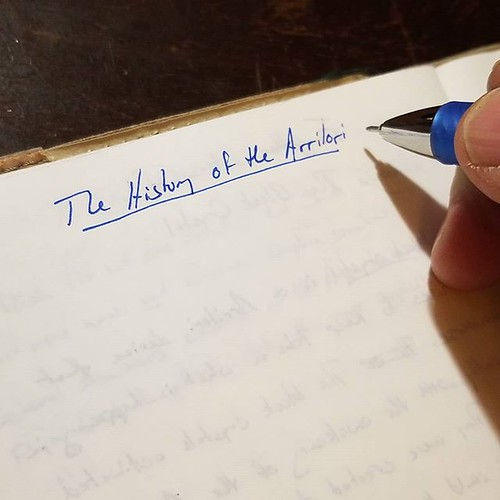
Writing longhand with a fountain pen, in a puffy shirt and vintage overalls. If this picture only included a dog and/or a cat, this would be my ideal.

I have recently finally started to unravel the plot of Forgotten Stars V: The Final Frontier (not the actual title), much to my pleasure. This one has been giving me fits, to the point that I’ve been seriously considering making the shift from Pantser to Plotter. This is because the key turns out to have been…plotting.

OK, an aside if you’re not familiar with the terms ‘pantser’ and ‘plotter’. Some writers plot everything out, writing extensive story outlines of varying degrees of complexity from writer to writer, in order to get the story shaped before they ever start drafting. The idea then is that the drafting can go quickly, according to plan.

‘Pantsers’, on the other hand, don’t do this. They write ‘by the seat of their pants’, basically starting at Chapter One with some characters and maybe a situation and charging full speed ahead. Such writers feel constrained or even handcuffed by the use of outlines, preferring to discover organically what happens along the way.

I’ve always been mostly a pantser, with the proviso that I eventually get to a point in many of my novels (OK, all of them) when I’m not able to figure out the story’s development beyond a certain point. This usually comes up sometime between halfway through Act II and the beginning of Act III. At this point…I turn plotter, because by this point I’ve got my story started and revved up to the point where a plot is actually going to help. In the past, when I’ve plotted before drafting, I’ve always run into a much better story idea sometime along the way, so why waste my time plotting a story that I know will deviate wildly from the original plot?

Lately I’ve been plotting the last 2/5, roughly, of Forgotten Stars V, and I’ve really managed to hack open the plot to the point where at last I’m getting it all to work out nicely. In the future I probably need to react a bit more quickly, recognizing faster when I’ve reached the point where I need to step away from Scrivener and instead pick up the pen and paper for plotting. (I plot best using pen and paper; it slows my process down enough that I can think it through.)

But that’s not the only thing I do in these cases. There’s something else, and even though I’ve done it on each thing I’ve written on which I’ve eventually blocked up a bit–including stuff y’all haven’t even read yet!–I never really recognized this step in the process until this time through it. So this is my big advice for pantsers, if they find themselves oddly blocked:

The key probably lies in what you’ve already written, so go back and re-read the book to that point. You very well might have the answer staring you in the face.

If you’ve read any science fiction or fantasy, you’ve probably noticed that those genres can seem like dense piles of almost random stuff mentioned in the beginning chapters, as ancient heroes and cities and empires and wizards and historical figures and other things get mentioned, name-checked, hinted around, and so on. Think of all the name-dropping that happens at the beginning of The Lord of the Rings, or even in Star Wars. I do the same kind of thing, sticking all kinds of weird details in my stuff, because weird background stuff that never gets mentioned much again is a great way of making your world seem larger.

But here’s the thing: there may be a detail you’ve tossed in there for no other reason than it sounds cool, that ends up being the key to unlocking your plot and giving it the conclusion it deserves. I call this “The Usual Suspects” syndrome, from the classic story of how Casablanca got one of the great endings of all time.

(Spoilers for Casablanca, by the way.)

Casablanca famously went into production without the script really being quite finished, so as the film got closer and closer to having to shoot the ending, the pressure amped up on Julius and Philip Epstein, the film’s writers. The question was: How can they get Rick off the hook for killing Major Strasser, with Captain Renault just standing there, watching the whole thing? What’s Rick’s “out”? It turns out that they had already given themselves that out in the film’s first minutes, in which they established that in Vichy-controlled Casablanca, Captain Renault didn’t always take his duties very seriously; in response to various Resistance activities, Renault simply orders his men to “round up the usual suspects”. In short, his whole job is largely theater. Renault isn’t anti-Nazi at first, but he’s not particularly for them, either. As he notes, “I have no conviction, if that’s what you mean. I blow with the wind, and for now, the prevailing wind happens to be from Vichy.”

But the Epsteins still needed a way for Rick to get out of trouble for killing the villainous Major Strasser. The classic story is that they were out for a drive in LA one night when suddenly they both had the same epiphany, looking at each other and saying at the same time, “Round up the usual suspects!” And that’s what happens: Major Strasser is killed, only Rick and Captain Renault are present, tension abides…Renault’s men arrive, and Renault says, “Major Strasser’s been shot!” Looks are exchanged–Rick to Renault and back again–and we wonder what Renault will do. Will he say, “Arrest Rick, he killed the major”? No. He says, “Round up the usual suspects.”

And just like that, the story is resolved. Because the writers remembered a small detail they had thrown into their script early on, probably for character and humor reasons. It turns out to be the key to the film’s satisfying ending.

So go back and re-read your draft if you’re stuck, folks. Because the key to getting yourself unstuck may well be in there. As it was with the current book! Maybe someday when it’s been released I’ll flesh it out a bit in this space….


Share This Post

“Oh, so THAT’s what happens!” (A writing update)

“Good writers borrow from other writers. Great writers steal from them outright.”

–Sam Seaborn, “Twenty Hours In America (part two)”, THE WEST WING

I don’t know if I’m a great writer, but if that’s one of the qualities they need I’m well on my way, because I steal left and right from my betters and I don’t feel the slightest ethical qualm in doing so. The latest? I’m swiping an event and repurposing it from one of my most foundational fantasy texts. No, I’m not going to spell it out, because it’s a spoiler, and I’m just setting up in Book Five something that’s going to pay out in Book Nine.

I haven’t done an update on my fiction writing lately, so here’s just such a thing! It’s…going. It’s not going super well, but it’s not going badly, either. Sometimes progress comes in bug chunks of yardage; other times it comes just by moving forward a few inches.

I started drafting Book Five of The Song of Forgotten Stars in January of 2021. My goal (which I knew was unlikely) was to finish drafting it before we left for Hawaii. That was more than eleven months away at the time, and I’ve never finished a Forgotten Stars novel in anything less than a year, so I knew that was a stretch goal. But I got more than halfway there, so…yay! But I did bog down, unfortunately.

This happens pretty much every time, probably because of the spit-and-chewing-gum seat-of-my-pants method of writing. I’m not a plotter by nature. I have done the plot thing before, where I put together an extensive outline for the entire story before I draft…but what inevitably happens is that better story choices occur to me while drafting, so out the window the outline goes. My logic is thus to just cut out that middle-man and start drafting with little more than knowing who my characters are.

However, this usually gets me to a place where I have a complex situation set up but I don’t know how it ends, or I do know how my complex situation ends but I don’t know how to get there from here, i.e., where I am at the particular point in the story. These moments are the toughest for me, and they can trip me up for long periods at a time. I don’t really worry about this too much, because I know that all I need to do is think it through, slowly, until I realize either where I’m going or how to get there.

Now I’m in the process of figuring out the connective tissue between the spot I’m in with this book now and the ending.

In such moments, out comes the pen and paper.

Maybe it’s strange, but I find that I don’t like drafting in longhand…for fiction. But writing outlines and story notes? And drafting essays for this blog? That, I love doing in longhand! I find that the tactile difference in the process kicks my brain a bit, and the story starts to unknot itself. That’s what’s happening now.

Another issue with this particular book is that the structure is complex, so everything has to line up. Like George RR Martin’s Song of Ice and Fire books, each chapter in the Forgotten Stars books is from a different character’s point of view*, though unlike Martin I am very religious about limiting the number of characters who get POV chapters. (It’s only three, though the Interludes are a different animal entirely.) What does this mean for me? It means that I’m telling multiple stories in the same book, stories that are parallel and intersect each other, but which are also independent as well.

All of this requires some mental juggling, which is again where pen and paper come into play. As of now, I am still plotting out the last act of the entire book. I hope to return to drafting by the end of next week, and then…maybe by Memorial Day for completing drafting? That would be nice, because I still need to get The Jaws of Cerberus ready for publication, and then I really need to take a look at the long-completed first draft of the sequel to The Chilling Killing Wind.

And then, in 2023 (or sooner!), I start writing Forgotten Stars 6.

Whew.

These are the times that I do sympathize a little with Prince Humperdinck, evil cad though he may have been!

*Though the series did not start out this way! All of Stardancer is from Tariana’s POV; The Wisdomfold Path adds Margeth’s, and then with Amongst the Stars we get Penda Rasharri’s POV. The structure got even more complex in The Savior Worlds with the addition of a parallel story that’s told in a prelude, two interludes, and the postlude…but now I’ve settled on the structure that will see this story to its ultimate conclusion.

Share This Post

Writing (and a cheeseburger) in Paradise

To justify the Jimmy Buffet reference, here’s the cheeseburger I had the other night.

Thanks, Maui Brewing Company! To paraphrase Mr. Samuel L. Jackson, “Mmmm! This WAS a tasty burger!”

And here I am, writing.

It turns out that Hawaii is not a cure for RBF, sadly….

Both of these things happened in Paradise.

Some writers are insistent about doing their work in their preferred environments–their home offices or libraries–but I’ve always been able to write just about anywhere I can plunk down with my computer for a while. I actually like having a bit of hubbub around me, and when I write at home I don’t like it to be too quiet: I’ll almost always have music going, and nowadays there is the wonderful world of soundscape videos on YouTube where you can actually pick some ambient sound to play in the background while you do stuff.

Of course, for ambient writing noise you can’t really beat the cries of sea birds, the lapping of the waves, and the voices of happy people on Hawaiian holiday.

I didn’t bring my laptop on this vacation because I just didn’t want to be that encumbered, which means a forced two-week break from drafting Forgotten Stars V: Spacecapades (not the actual title). I draft the new novels in Scrivener, and the laptop is the only device I have that can run Scrivener (until they come up with an Android version, that is), so for now, that book is out. I suppose I could write new material for that book in Google Docs and import it after the fact, but the formatting would be all screwed up and I don’t have the book in Google Docs to begin with. Plus, it’s my experience that at the lengths of book I tend to write, Google Docs tends to bog down.

So, what am I working on? I’m making a pass through an older manuscript that I haven’t looked at in a while: the supernatural thriller about a haunted kayaking expedition, that I had once dubbed Deliverance, eh? (Deliverance being an obvious reference to a canoe trip gone bad, and the eh? because the story takes place in Canada.) As part of my “Release a book every year” plan for as long as I can manage to pull that level of production off, this one’s set to be my 2022 release.

This book is definitely on the short side, for me: it tips the scales at roughly 85,000 words. Even so I can tell that this length makes Google Docs a bit sluggish. But the good part is that I don’t need my laptop for this! Using Google Docs for shorter work is a big reason why, last time I was in the market for a new tablet, I bought one with a Bluetooth keyboard:

Obligatory “pie in the face” wallpaper!
It is a challenge scaling one’s position to a smaller keyboard, and at times I miss the keypad, and I have to remind myself that mouse functionality isn’t there. As always, overalls are the best uniform for writing.

(Those are older pics, by the way.)

I’m enjoying using this tablet a great deal! It’s a Samsung Galaxy Tab A, which I bought about a year and a half ago. Samsung devices do have their quirks, but I like the ecosystem and the easy connectivity of devices, and I love the cameras on their phones, so a Samsung fan I remain. (In fact, my next laptop will likely be a Samsung too! This after what will likely have been fifteen years as a Dell user.) Typing with the Blluetooth keyboard is a breeze, and blogging-on-the-go is very easy. I do have the WordPress app installed, but I prefer to use the actual site in my browser; a while back WordPress updated to a new content-management system that uses something called “blocks”, and I find it generally confusing to use so I’ve got a plug-in installed on the main WordPress site that lets me use the old interface. I can use the app, and I do on occasion, but I prefer this way of doing things.

Oddly, when I was still on Byzantium’s Shores, I had to use the Blogger site in the browser too, as opposed to the Blogger app, for a completely different reason: for whatever rationale the engineers chose, the Blogger app will only render in portrait mode, which makes blogging on the app while using the keyboard (and therefore landscape orientation) nearly impossible. This is likely under the assumption that the Blogger app would be used more on phones than tablets, but even so! Bluetooth keyboards are not that uncommon a tool, and and design choice that makes use more difficult is a bad choice indeed. I believe there are workarounds–maybe third-party apps that force reorientation–but I don’t want or need more stuff cluttering up my gizmos just so I can do the work I want to do. Of course, it’s not even an issue anymore since I’ve left Blogger behind, but still!

I know that the tech gods really want to get to a point where full-sized laptops are a thing of the past, but I wonder if they’re not slowly giving up on that dream and are instead blurring the line more and more between old-school laptop and tablet, with touchscreens that fold all the way around and the like. I’ll probably get to experience that myself with my next laptop (which will likely come sometime next year), but for now I don’t mind having multiple devices for different tasks. This tablet suits me nicely for smaller needs, and also for travel. And who knows? Now that I’m being bitten by the travel bug….

And as always, one doesn’t even need a nifty electronic device to get some work done! I may not be directly drafting Forgotten Stars V while on this trip, but I am getting some plotting done the old-fashioned way:

Pen and paper will never die!

Oh, and the actual title of Deliverance, eh? is–tentatively–The Jaws of Cerberus. The more you know!

And now, I wrap this up because as I write this I have to catch a bus to make a boat ride. It’s a tough life, I tell you!

I’m not saying this is my ideal writing set-up, but it is, as the kids say, “In the conversation”.


Share This Post

It really is like this (a writing update)

“Dickens’s Dream” by Robert William Buss. The Charles Dickens Museum, London.

Since I rededicated this space as my primary home online and the center of my blogging universe, I haven’t discussed my writing progress much!

But first, a diversion. Someone shared this painting on Twitter the other day, and I found it captivating. It’s called “Dickens’s Dream”, by Robert William Buss, and the conceit is simple: Charles Dickens is dozing in his chair, and the air around him is full of his dreams of all his characters. Note that the ones nearest him, the ones most present in his mind, are the ones in color, while others are uncolored, hazy, and more and more dreamlike. That really is how it feels: the characters in what you’re working on are sharpest in your mind, even when you’re away from your desk or your table or wherever it is that you usually write.

At least that’s how it is with me.

As for how it’s been going? Well, it’s been a mixed bag. This year’s focus has been Forgotten Stars V, and after charging nicely out of the gate the first few months, everything bogged down a couple of months back as the story elements I put in place in the first act stubbornly refused to go anywhere in the second, and that’s where I am right now. I had wanted to get this draft finished by the end of October, and that hopeful deadline has long since come and gone. So now, maybe by spring? Sigh. These books are not getting easier as I go.

But I at least have started to unravel the threads, which is a hopeful sign!

This took my usual approach, inspired by Bugs Bunny: figuring out that I should have taken that “left toin in Albuquerque”, I backtracked to the last point where I felt like I was heading in the right direction, and rewrote everything from that point. Some things became clear as I did so, and now I definitely have the sense that I’m on the right track. I really hope these books don’t keep getting harder and slower to write…I have four more of these to do after this one!

Yesterday I had my first 1000+ word day in a LONG time. Onward and upward! Zap! Pow!!

Share This Post

Four-month Check In

I'm trying to break out of a miniature writing rut. Not sure how well it's working, but.... #amwriting #writersofinstagram #writerinoveralls #overalls #dungarees #biboveralls #vintage #washingtondeecee #washingtondeeceeoveralls #hickorystripe #denimoveral

So, here we are, four months since my last check in! And so much and so little has changed. The pandemic continues, and for a while it seemed as if things might be slowly getting better…and then, for a lot of reasons, they stopped getting better and started getting worse again.

Anyhow…life goes on for me. I’m still writing and still reading, and I now have Book II of Seaflame! over 60,000 words, which is a roughly-projected one-quarter of the way done. This one is not progressing swiftly, and I’m pretty confident that after I’m done with this project, I’ll never tackle anything this long again. I have too many stories that I want to write to get bogged down in doorstops of this magnitude! But it is fun to write this one, and I will miss these characters when I’m done, so there’s that.

By way of announcement, I am planning to get The Savior Worlds released sometime this fall, most likely in late November, so work will be ramping up for that pretty soon. I will definitely have more to say about that as we progress toward that particular finish line.

Finally, I have a quote to offer on the subject of how one should treat one’s own writing. This comes from author Samira Ahmed, young adult writer of the brilliant novel Love, Hate, and Other Filters as well as several others that I haven’t read yet. She appeared on 88 Cups of Tea, one of my favorite podcasts, and one point she kept driving home was the need of storytellers to “say yes to themselves,” because creative life is hard enough as it is that we don’t need to be putting up our own roadblocks to our own work, in addition to the roadblocks the rest of the world erects. You should definitely listen to her entire episode, but for now, just this one bit absolutely floored me when I heard it:

SAMIRA AHMED: One piece of that kindness to myself–and I say that this is just for me, but I hope maybe it can speak to just one of the other storytellers out there–which is, I am gentle with the language that I use about my writing. So what that means is, I never say to myself that my first draft is ‘trash’. This is something for me; maybe this is OK with everybody else, your mileage may vary, but for me, when I was little one of those racist experiences that I had was a grown-ass man telling me, a kid, that I was ‘trash that America needed to take out.’ Words can be weapons, and I’m not going to use weaponized language against myself. So I don’t say that my first draft is ‘trash.’ I don’t say it’s ‘garbage’. I say it needs improvement. I say it needs work. I say I could make it better…but I don’t say that it’s trash.

That is, in my opinion, utterly correct. I’ve actually written about that before in this space, but Ahmed frames it in a way that I hadn’t thought of: you should not use weaponized language against yourself. I could not agree more.

With that I’ll wrap up this check-in, but do keep looking in! And you can always find me on Twitter, Instagram, and my personal blog, Byzantium’s Shores. See you ’round the galaxy, folks!

Share This Post

April is here, and so am I

Greetings, programs! Last time I checked in I was gearing up to do a burst of edits for The Savior Worlds, as part of my effort to get it release-worthy for launch in May.

Well.

As I’m sure you’re all well aware, a month later…the world happened.

The plan was to release at Buffalo’s Nickel City Con in May, but now, because of Covid-19, Nickel City Con isn’t happening this year. And that’s not the only hiccup in the works. My wonderful cover artist got her work done and we were just starting to talk about when we could meet up to make the transfer of the art, when the world locked down.

A friend and editor at The Geekiverse, who provided one of my big sets of edits for the book, was going to meet with me to discuss plans for a whole relaunch of The Song of Forgotten Stars along with the release of Savior Worlds, but that hasn’t happened yet, either.

So, when will any of this stuff happen? I have no idea. When it does, I want it to be right. I’ll be revising the existing editions of StardancerThe Wisdomfold Path, and Amongst the Stars; among other things, I will be adding character lists to each book and synopses of the previous volumes in each book after Stardancer. I’ll also be tweaking the book covers, fixing font and color issues to make them “pop” more.

And let’s not forget, The Savior Worlds needs to come out, taking the story into a new era! So exciting! And so very, very frustrating to have a world-wide pandemic basically force me to slam on the brakes.

But, slam them I must. Everything will be fine, eventually, and if I take an optimistic view, I’ve been given the gift of more time to get everything done right. That’s big.

So what am I doing in the meantime? Well, my plan was to get the Forgotten Stars books revised and Savior Worlds launched, and then move on to finally drafting Seaflame! Book II (actual title TBD). Instead, I’ve moved that drafting process onto the front burner. I did a round of edits on Seaflame! Book I last fall and winter, so that story is fresh on my mind and I’m looking forward to completing that adventure.

And that’s where things lie right now, writing-wise. (As for personal observations from our Coronavirus-ridden world, I’ll save those for Byzantium’s Shores at some point. For now, we’re fine here. We are, it turns out, deeply cut out for social distancing.)

Until later, see you ’round the Galaxy!

Share This Post

February: Into the Manuscript I go

It begins. May will be here before I know it! #amwriting #writersofinstagram #editing #sciencefiction #spaceopera #forgottenstars #thesaviorworlds


Greetings, Programs!

I haven’t posted in a couple weeks–sorry!–but the reasons, as ever, are good (I hope). Having received feedback on the manuscript of The Savior Worlds (The Song of Forgotten Stars, book 4) from several trusted voices, it’s time for another heavy dose of revision work before I send the thing out for proofreading in March. I’ve got kind of a hard deadline going here: I need to have this draft (Draft 3.0) ready to go by the end of this month. The ultimate goal is to release Book 4 at Nickel City Con in May, and that’s a lot closer than it feels!

As I write this post, I’m about a third of the way through the book, and I’m a little more than a third of the way through the month (and The Wife and I have a weekend getaway coming up at the end of next week that will not be a great time for writing), so I’ve really got my work cut out. I do want to keep this space alive a lot more than I have in the past, so…as always, here’s hoping!

Until next time, see you around the Galaxy!

Write write write #amwriting #writersofinstagram #writerinoveralls #editing #sciencefiction #spaceopera #forgottenstars #thesaviorworlds #overalls #dungarees #biboveralls #vintage #gap #gapoveralls #bluedenim #denimoveralls #overallsarelife #vintageoveral

Share This Post

Plannie McPlannerson

Now that I've written four books of a nine-book series, I should probably nail down the backstory! #amwriting #writersofinstagram


So last week I wrote about the various issues that arise when writing not just one novel but a series of novels, and wouldn’t you know it! I am running up against those issues right now.

In just a couple of weeks I start doing my next round of revisions for The Savior Worlds (The Song of Forgotten Stars, book 4), which is the volume in the series that kicks the larger story into real motion. That being the case, it’s suddenly clear to me that I need to really codify, if only for my own use right now, the backstory of this saga.

If you’ve read the three currently-published Forgotten Stars books (and why on Earth would you not have read them! They’re terrific, even in my biased opinion!), you know that I drop a lot of small and not-so-small hints and tidbits about the nature and history of the long-lost, long-fallen Arrilori Star Empire. I did this because the main planet of the first three books, Xonareth, was once a member of that empire but was banished and forbidden to travel to the stars until the Arrilori returned to set them free…and there they waited, and waited, and waited, while the Arrilori fell completely and utterly into ruin. Xonareth is, as I’ve mentioned before, the planetary society equivalent of those fabled Japanese soldiers who spent decades on deserted islands in the Pacific, never knowing that World War II ended.

But as the second act of The Song of Forgotten Stars dawns and is now taking shape, it’s starting to become important to hand out more and more information about the Arrilori Star Empire. It’s time to flesh out the backstory.

And all I have of that backstory right now is…hints and tidbits. I have a very “big picture” version of what I know befell the Arrilori and their galactic empire, but I need more than that. This is what I meant in the post about series writing, in that you need to do more ground work when you’re doing a series that tells a single, large story.

You may now be asking, “Hey dummy, shouldn’t you have already done all that work?” Well…maybe, maybe not. That’s where the whole “plotter versus pantser” thing comes into play, after all. But also in this case I knew that I could get away with the first three books in the series without a complete picture of who the Arrilori were and how everything they built came to ruin. I had the luxury of being able to throw in some cool stuff here, a few hints there, a couple of juicy tidbits sprinkled throughout. I was leaving puzzle pieces for myself as a storyteller, and now it’s time to put the pieces together for myself before I go on to do it for the readers.

At least, that’s the plan. Plans can go awry, of course….

See you ’round the Galaxy,

-K.

Share This Post

Series? Can I write them in parallel, instead?

Day 5: Most re-reads. Here's my LORD OF THE RINGS collection! #bookchallenge #Tolkien #lordoftherings

Greetings, Programs!

The other day, the ever-fantastic Briana Mae Morgan asked on Twitter:


Naturally, I responded, because I have committed or am in the process of committing several crimes of Serial Fiction, and now I’m going to extend my thoughts a bit as to how to write a series.

I tend to think of storytelling, at its most basic, in terms of structure, so naturally my thoughts on writing a series would turn to structure. That means that if you’re considering committing an act of series, you have to ask yourself this question first:

What kind of series am I writing?

The answer to this question will affect how you write your series. So, what kind of series are there? The options, as I see them, are these:

TYPE 1. A single-story series, told serially.

Examples here are many of the long fantasy series out there: The Wheel of Time, The Belgariad, The Expanse, and A Song of Ice and Fire are good examples. Each book tells a part of the larger story, and reading the books out of order can be disorienting or downright confusing for readers who are jumping into the middle of the story.

At first glance, The Lord of the Rings might be thought an example of this, but I don’t think it is. LOTR is better thought of as a single huge book that for publishing reasons was broken down into a trilogy. There is no functional break between The Fellowship of the Ring and The Two Towers and The Return of the King, and each volume is only a part of the larger whole.

I would also file the Harry Potter books here, but they’re a bit of a special case in that each book tells a piece of the larger story while also serving as a self-contained unit. The later volumes have less stand-alone appeal than the earlier ones, but they still have internal structure. Can you read them in any order? Not really–but there’s enough internal structure to each book that it wouldn’t be as disorienting as trying to jump into A Song of Ice and Fire with A Feast for Crows.

TYPE 2. An open-ended series with larger story elements, but not a single larger story.

In a series like this, each novel is mostly independent, but there is character development and larger story development along the way. Events of earlier books have impact on the later ones, but there’s generally less danger in starting such a series somewhere in the middle. The James Bond books are a good example here, or Lois McMaster Bujold’s Miles Vorkosigan books.

TYPE 3. A series of independent stories featuring a starring character or a group of characters.

With this kind of series you can start at any point, because the books (or movies) are for the most part completely unrelated and self-contained from one to the next. The James Bond movies apply here (Ian Fleming’s books have more continuity than the movies, at least up until the Daniel Craig era, which have more continuity than any other sequence of Bond films to date), as do Agatha Christie’s Miss Marple and Hercule Poirot books. I’m not sure if Conan Doyle’s Sherlock Holmes stories work under this definition.

So, once you know what kind of series you have on your hands as a writer, your next course becomes clear. If you’re writing that last kind, you’re golden because you don’t have to do any planning of any kind beyond what you would plan for a single novel. Just finish the current adventure or story, and then move on to the next one. Lather, rinse, repeat for as long as you’re comfortable tracking the adventures of a single character.

Now, with a series like that, you might want to have some continuity as you go: recurring villains, perhaps. Holmes had his Moriarty and Bond his Blofeld, after all. But you don’t have to do that: I don’t recall that John Bellairs had Lewis Barnavelt or Johnny Dixon square off against the same dastardly supernatural baddie more than once (though I may be wrong). 

It seems to me that the difficulties with series writing creep in with a Type One or a Type Two series. With these types of series, more planning is needed.

With a Type Two series, in which there are ongoing serial elements but no real larger “story”, a degree of planning is still needed for two reasons. First, all installments must reflect what has come before. If you shatter your protagonist’s heart at the end of one installment, you can’t have them bounce right back into a new relationship in the next. You have to be able to accommodate the changes in your characters over time, and what’s more, you have to let them change over time. In a Type Two series, your character can’t be the same person in the tenth installment that they are in the first.

Second, while leaving room for surprise and discovery is great, you’re better served if you know beforehand what kind of larger arc your characters or your story are going to follow. You need to have at least a partial idea of how you expect your characters to change and grow and what kinds of things are going to change in their world. A series of stories following, say, a sword-wielding warrior for hire as she journeys through various kingdoms and realms, should see the world change as she roams through it. Wars begin, perhaps; or maybe the cities are visited by plagues…whatever. The world should change, and your character should change along with it. And if that happens, you should have a bit of an idea of what kinds of changes might happen.

(Again, none of this should rule out the serendipity of a sudden burst of insightful inspiration that leads you to do something you hadn’t expected!)

This leaves us with the Type One series: the series that tells a single story, beginning to end, but writ large over the course of several individual stories or books. For one of these, you’d better do some planning, or you’ll end up really bogged down once you’re in the thick of it.

The bigger a story is, the more moving parts it has, and these all have to work together. Your cast of characters is likely much larger if you have a big story to tell, and they all have to develop along the way and their actions and choices have to affect the story, or else it feels like the characters are just cogs in a big machine of plot. But here’s the thing: with a big series it can likely be very tempting to just start out and figure out the big plot later, but if you do this, pitfalls await.

Your early books might not end up sufficiently supporting or establishing the larger plot to follow, or crucial things about your characters. If you find yourself needing Mary in Book Four to have a very specific talent that requires years of training to master, and you’ve never hinted in Books One through Three that she has this talent, it can be jarring for the reader or eject them outright from your book.

More importantly, telling a very large story without planning can lead you to losing the story entirely. You can find yourself wandering down tangents, or finding that farther on down the line your entire notion of how the story works has changed, or you might change your mind as to what happens. On the other hand, though, as with any story I feel strongly that outlines or plans should not be constrictive to the point of being a straitjacket, crushing spontaneity. You never know when the next great idea is going to come along, but if you’ve done the groundwork for your series, the great ideas are likely to supplement the work rather than supplant it.

So, those are my thoughts on writing series. Of course, my thoughts might change as I get farther into my own respective series!

Thoughts?

See you ’round the Galaxy,

-K.


Share This Post