T-shirts, sandals, walking in the sand…. (Something for Thursday)

I had two t-shirts way back in high school and college. I wore them to death. The label was “Caribbean Soul”, and they featured nautical art and some words that were evocative, even if I honestly didn’t know where they were from. It took me a few years but I wore those poor shirts to the point of unwearability.

Then, in 1998, while shopping in Disney World while celebrating our first anniversary, I found new versions of those same shirts. The art was slightly different, but somehow better. I bought them both, and I have kept those shirts in very good condition ever since. I only wear them a handful of times a year and am careful about washing them. That’s how it works, you see.

Here’s the back of one of the shirts.

I don’t know when I realized that those words are actually lyrics from a Jimmy Buffett song, but that did come as rather a shock.

I wasn’t a big Jimmy Buffett fan for a long time. I didn’t have anything against him, really–it was just that he didn’t really speak to me directly. Or so I thought. It’s easy to think that of an artist when they have a huge body of work that somehow only ever gets reduced down to one or two songs. In a way, Jimmy Buffett was rather like Van Morrison for me, in reverse: I knew that Van Morrison is a genius song-writer and singer with a huge and rich body of work, that somehow gets reduced down to “Brown Eyed Girl”. Ditto Mr. Buffett and “Margaritaville”, which is a good song–but that’s not all he did. Not by a long shot.

The lyrics on that shirt are from “A Pirate Looks At Forty”, which is actually now my favorite Buffett song. Of course, I still haven’t heard enough of Buffett’s work to say that “A Pirate Looks At Forty” will remain my favorite, if I listen to more of him, but for now…this is it.

Of course, Jimmy Buffett died just the other day. The outpouring of grief in my community, online and off, was as large as it was touching; Buffett is a man whose music has moved a lot of hearts and offered balm to a lot of souls, whether weary or not. Apparently Buffett had been ill for some time, but he also passed in the company of his family and his dogs. I assume the ocean was near. He lived in Sag Harbor, New York. I would have thought that he lived somewhere nearer warmer waters…but the ocean is the ocean, isn’t it? You can hear Mother Ocean’s call in any port.

Some people pointed out Buffett’s earlier work, written before he landed on the “Beachcomber” lifestyle as his brand, as speaking to them most directly. I gave one such song a listen, for the first time, and I was quite surprised by what I heard in “Come Monday”. This is almost a pure country song, from a wonderful little subgenre that seems to have reached its height in country music of the 1970s: a man wanting nothing more than to go home and be with his lover, and more often than not, knowing that he can’t. “Come Monday” lives in the same heartspace as Eddie Rabbit’s “Every Which Way But Loose”, Charlie Rich’s “I’ll Wake You Up When I Get Home”, and Ray Price’s “For the Good Times”.

For all of Jimmy Buffett’s air of “Grab a rum drink, pull up a chair, and let’s sing a while on the sand”, he really does seem to have been able to capture the most wistful sides of life along the way. The sea often feels like home, but you can’t always go back, can you?

Anyway, thanks for the music, Jimmy Buffett. I think the cannons have a little thunder left, personally….

Share This Post

Kites at Wilkeson Pointe

On Labor Day, The Wife and I went down to Canalside in downtown Buffalo to hang out a bit, and afterwards we stopped at Wilkeson Pointe on the Outer Harbor. We hadn’t planned on the second stop, but we wanted to see more closely the big kites that were flying there. They were like giant airborne cephalopods, brightly colored and vibrant.

What a great show this was!

Share This Post

Tone Poem Tuesday

First, a quote from Evenings with the Orchestra by Hector Berlioz:

In a certain opera house of northern Europe, it is the custom among the members of the orchestra, several of whom are cultivated men, to spend their time reading books–or even discussing matters literary and musical–whenever they perform second-rate operas. This is to say that they read and talk a good deal. Next to the score on every music-stand, some book or other is generally to be found, and a performer apparently most absorbed in scanning his part, or most earnestly counting his rests while watching for his cue, may actually be giving all his attention to Balzac’s marvelous scenes, to Dickens’s enchanting pictures of social life, or even to the study of one of the sciences. I know one who, during the first fifteen performances of a well-known opera, read, re-read, pondered, and mastered the three volumes of Humboldt’s Cosmos. Another, during the long run of a silly score now forgotten, managed to learn English; while a third, thanks to his exceptional memory, retailed to his neighbors the substance of some ten volumes of tales, romances, anecdotes, and risque stories.

One man only in this orchestra does not allow himself any such diversion. Wholly intent upon his task, all energy, indefatigable, his eye glued to his notes and his arm in perpetual motion, he would feel dishonored if he were to miss an eighth note or incur censure for his tone quality. By the end of each act he is flushed, perspiring, exhausted; he can hardly breathe, yet he does not take advantage of the respite offered by the cessation of musical hostilities to go for a glass of beer at the nearest bar. The fear of missing the first measures of the next act keeps him rooted at his post. Touched by so much zeal, the manager of the opera house once sent him six bottles of wine, “by way of encouragement”. But the artist, “conscious of his responsibilities”, was so far from grateful for the gift that he returned it with the proud words: “I have no need of encouragement.” The reader will have guessed that I am speaking of the man who plays the bass drum.

That’s been a favorite passage of music writing of mine for years. Berlioz’s mind was supremely literary, and had he not been a great composer he might well still be remembered for his writings on music instead of his writings of music.

But what’s the relevance? I turn now to one of my favorite Substack publications, the Daily Classical Music Post by musicologist Laura Lawrie. On this publication, Lawrie does exactly what the title says: she shares a piece of classical music every day. Her range is very wide, which makes her Substack a fantastic resource for people who are curious about classical music in all its varieties. Last week she shared this piece: the Concerto for Bass Drum and Orchestra by Gabriel Prokofiev. Lawrie writes:

Some instruments spend just about all of their time at the back of the orchestra or band, supplying vitally important support but never shining on their own. Today’s selection features one of those instruments, the bass drum.

The Russian-British composer Gabriel Prokofiev (born 1975) wrote his Concerto for Bass Drum and Orchestra in 2012. He said, “It produces the lowest frequencies of the Orchestra, and is used to create some of the most thunderous climaxes, but it’s never been considered as a ‘solo’ instrument or been given a Concerto. As it’s un-pitched, and on the surface seems quite a limited instrument, that’s not surprising; but back in 2011 I perversely thought it would be interesting to attempt to compose a Concerto for Bass Drum.”

Gabriel Prokofiev is the grandson of the great Russian composer Sergei Prokofiev, so the musical tradition is continuing there. The work itself is a challenging listen, but it makes some deeply creative use of the sounds that the bass drum can make, and they go far, far beyond simply whacking it with a mallet. Creative use of percussion is always a joy to behold (witness, for example, Nielsen’s Fifth Symphony), and this particular performance embraces the unique nature of the piece. One imagines M. Berlioz’s much-admired bass drummer taking to this work with relish!

Here is the Concerto for Bass Drum and Orchestra by Gabriel Prokofiev.

Share This Post

Scenes from Hunter’s Creek Park

Yesterday’s photography location was Hunter’s Creek Park. Officially named “Sergeant Mark A. Rademacher Memorial Park”, the location is more generally referred to by its original, and now informal, name, which comes from the creek that runs through it. Hunter’s Creek Park is one of the most rugged parks in the Erie County Park System, with its most dominant feature being the gorge through which Hunter’s Creek runs. This being the case, the park is a “conservation” park, which means that aside from the two small gravel parking lots at either end (the park roughly runs north-south), there are no facilities at all. No shelters, no rest-rooms, nothing. Just trails, some of which are very popular with mountain bikers. The larger Conservation Trail, which is a part of the even larger Finger Lakes Trail System, partially runs through Hunter’s Creek Park.

Here are a few of the photos I took yesterday. More in this Flickr album.

As soon as you enter the trail you’re enclosed by vegetation that feels like a tunnel. It’s an amazing feeling: there’s no transition at all. One step down the trailhead and BAM, you’re in the wilderness.

The gorge’s walls are loaded with temporary waterfalls like this. I imagine this only runs in spring, with snowmelt, or for a few hours after a heavy summer rain. There are also many gullies for feeder-streams, just all of which are as dry as this, which run into Hunter’s Creek. You have to be careful when hiking here. Steep drops abound.

A study in shadows. I like this shot a lot. I thought about flicking that dead leaf aside, but I chose not to. I’m generally averse to modifying the scene that nature provides for me.
This is new since I was last here, a few years ago! That’s a launch platform for mountain bikers. You can see the steep drop to the right, and at the bottom of that someone made a ramp to jump over a big log, and farther on a smaller ramp for another jump. I actually set up at the bottom, shifting my camera to Shutter Priority mode and dialing up the ISO so I could attempt a biker-in-midair shot if an opportunity presented itself, but no bikers came along in the few minutes I waited. Alas! Maybe next time.

I love how this turned out. Ditto the previous shot. It only took me a few months of owning this camera to learn that it has a Macro Focus setting for close-ups of small objects like this!

This is not a pose! I’m actually taking the preceding shot here. I just decided that, needing a self-portrait here, I should set up my phone to take my picture while I took the intended picture with the main camera. Two birds, one stone, you know the drill!

Even though it’s now September and everyone is mentally filing away Summer 2023 into the memory bank–and in a way they’re right, as “Meteorological Fall” has already begun–the summer isn’t showing signs of giving up just yet, as The 716 is in for a stiff dose of very hot weather this week, and yesterday was pretty warm for hiking purposes. If I wasn’t carrying along my good camera I might well have dipped myself in one of the creek’s deeper pools! I’m better at managing high heat than I used to be, but I’m unlikely to ever really love the heat, and I welcome the return of the cooler temps we enjoyed last week. Fall will come, after all, and I tend to file “Temps above 80 after Labor Day” along with “Snow after St. Patrick’s Day” in my head: even though they happen every year, I find them annoying.

But photography is about the light, after all, and the light is most definitely taking on a more autumnal feel now. It won’t be long before the trees do, as well.


Share This Post

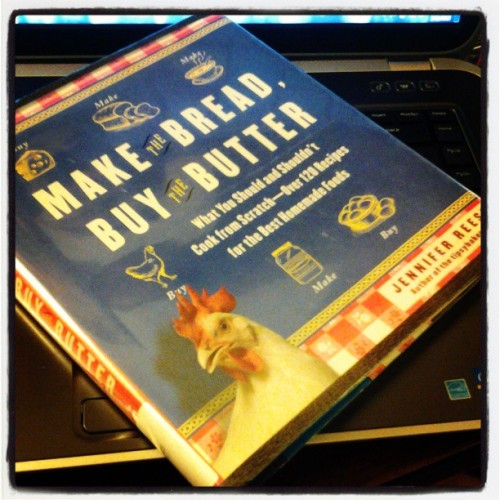
From the Books: “Make the Bread, Buy the Butter” (a repost)

From the archives:

I don’t own this book yet. But I’ve had it checked out of the library a majority of the weeks it’s been in the collection, which means that it’s well past time for me to get off my ass and buy a copy, innit? Anyway, Jennifer Reese‘s Make the Bread, Buy the Butter (subtitled What You Should and Shouldn’t Cook From Scratch) is a terrific cookbook. Not just a collection of recipes, it’s a chronicle of one woman’s quest to take more of a do-it-yourself (DIY) approach to her family’s food preparation, and the discoveries she made along the way that there are some things that you certainly should make for yourself (either because it’s easier, or cheaper, or just plain better, or all three), and that there are other things that you’re just fine buying for yourself at the store.

I haven’t done a whole lot of cooking out of the book yet (one new wrinkle is The Wife’s adoption of a gluten-free diet, which has us going in other food directions currently), but there are a lot of good insights here on food and making it yourself and the fact that sometimes it’s just fine to not do things from scratch. The book is full of frank observations, like this:

If bay leaf didn’t exist, would anyone miss it? I’ve never tasted anything and thought, This stew is just crying out for bay leaf. But I keep buying and using it nonetheless.

And Reese’s explorations are hard-core. This isn’t just about making your own breads or spice mixes or your own peanut butter. She writes about keeping — and killing — her own chickens, and keeping goats. She writes about making her own hot dogs (her conclusion? Just buy ’em.). And she writes thusly about a dish that’s wonderful when made at home, but may or may not be worth all the effort: fried chicken.

One rainy Sunday a few years ago, Isabel, Owen, and I decided to pass the afternoon by watching a DVD of The Fellowship of the Ring, that movie about hobbits and elves and Orcs that we’d been hearing about. One hundred and seventy-eight minutes later, during which we neither moved nor spoke, we looked at each other, eyes glazed. We walked straight to the car, drove to the video store, and rented The Two Towers and The Return of the King. It was getting on dusk when I pulled into the Kentucky Fried Chicken down the hill and bought dinner.

My kids were shocked. Happy, but shocked. What was going on with Mom? KFC? I wondered that myself. But we were hungry and the chicken was hot and we had five more hours of Viggo Mortensen to watch. Fifteen minutes after I pulled into the KFC, we were back on the sofa with the bucket on the coffee table, eating mediocre chicken and mashed potatoes and biscuits and watching The Two Towers. It was one of the happiest nights of my adult life and my children still get dreamy and nostalgic talking about it.

Not long ago, I cooked a grand fried chicken dinner out of Ad Hoc At Home by Thomas Keller. I bought the book based on rave reviews of Keller’s chicken, which is brined and air-dried before it is dipped in multiple coatings and fried. The effort paid off; the recipe did not disappoint. TO go with that incredible chicken — because you can’t serve fried chicken without fixins — I mashed potatoes and baked biscuits. There was a salad in there somewhere, too. Frying chicken is messy and nerve-racking because oil spatters and spits and stings your forearms and you have to do it at the last minute, which is also when you’re mashing potatoes and pulling biscuits out of the oven and pouring glasses of water and calling to everyone that dinner is ready. Leave it in the pan too long, and the chicken is ruined; take it out too soon and it’s a health hazard. You really have to be up for the logistical challenge.

And fried chicken comes with baggage: You expect fried chicken to be so good that people lick their fingers. Literally. You expect people to linger at the table and loosen their belts, lean back in their chairs, tell stories, pull out a bottle of corn likker. You expect people to somehow recognize that this isn’t a meal like all other meals.

Sometimes all of that will happen.

Sometimes it will not.

By the time we sat down, I was bleak with exhaustion, everyone was ravenous, and we put away that chicken in about ten minutes flat. The coating formed a crispy sheath around meat that, thanks to brining, was juicy and flavorful through to the bone. The potatoes were a celestial cloud of starch and butter; the biscuits, perfection. But I don’t remember a thing anyone said; I don’t remember anyone lingering at the table or thanking me or recognizing that the meal was special or iconic or hanging around afterward to drink corn likker. One of these days I will forget the evening ever happened. I suspect Mark and the children already have. But that night we ate KFC on the sofa and watched The Two Towers? That, we will never forget.

Sometimes I have to remind myself that the symbols of wholesome domestic happiness — hot biscuits, a platter of home-fried free-range chicken, a family sitting around a table — are not domestic happiness. The family sitting in front of the TV with the bucket may be experiencing more joy and grace and love. Or, of course, they may not be.

Should you make your own fried chicken or buy KFC? Reese says there’s no easy answer to that, and I tend to agree. I’ve made my own fried chicken, and had a good time doing it. And you can probably tell by my self-photos that I’ve had my share of KFC.

I need to buy this book…and even after I do, I’ll probably keep checking it out periodically, just to keep its circulation numbers up.

Share This Post

Something for Thursday

I’m guessing this would fall under the category of “cultural appropriation” in some way, right? This is movie music by English composer John Barry, which he wrote for the James Bond film You Only Live Twice. The film takes place in Japan, so Barry tried to incorporate an “Oriental sound” into his score, which was the practice in 1967 but which now seems oddly disrespectful.

And yet, it’s John Barry, so the result is unquestionably beautiful. This cue underscores a false “wedding” in which Bond, disguised as a Japanese fisherman, takes a local “wife”, who is really an undercover agent working with him. The cue is lovely and delicate in a way not usually associated with Bond.


Share This Post

A metamorphosis, in progress

When we moved to WNY way back in 1981, my grandmother visited and noticed that our new backyard had a lot of milkweed in it. She told me that milkweed is a preferred plant for Monarch butterfly caterpillars, and we should go out and see if we could find any. And we did! Quite a few, even. She helped me modify a jar (by punching holes in the lid), and after picking a few milkweed leaves and stalks, we had ourselves a habitat for a caterpillar. In this way she showed me how to nurture a caterpillar all the way to the formation of its chrysalis, and then to monitor the chrysalis for the shifts in color at the end that indicate that a butterfly will soon be emerging. At that point we would open the jar and put it outside so the butterfly could escape when the time came. I never did get to actually witness the moment of emergence, but it was still an amazing bit of participation in the natural world. It was also, I imagine, the kind of participatory lesson that is passed on from generation to generation, not unlike catching fireflies in a jar for a bit or learning to fish. (I never learned to fish, by the way. Not every lesson gets learned by everyone. And no, that’s not a complaint. Fishing looks like a lovely pastime, but it’s not one where I feel like I’ve missed out.)

Why do I bring any of this up? Well, a few years back a milkweed plant managed to seed itself in the mulch bed right outside our front door. We’ve let the milkweed grow each year, and this year it finally happened. This past Saturday we met this individual:

And then our friend disappeared. We wondered where the beastie got to…and then, yesterday when I got home from work, I found the beastie’s new digs. Right on the siding. I wonder why (s)he built there and not in the safety of the milkweed…but I suppose it’s fine.

The wheel turns.


Share This Post

Tone Poem Tuesday

The things you learn on the radio! This morning I heard this piece, and after it was done I learned why they played it: on this date in 1962, the lower deck of the George Washington Bridge, which connects Manhattan and New Jersey, opened. American composer William Schuman later wrote this piece for concert band, inspired by the span of this great bridge. Schuman, one of the most important American composers of the 20th century, wrote of this piece:

There are a few days in the year when I do not see George Washington Bridge. I pass it on my way to work as I drive along the Henry Hudson Parkway on the New York shore. Ever since my student days when I watched the progress of its construction, this bridge has had for me an almost human personality, and this personality is astonishingly varied, assuming different moods depending on the time of day or night, the weather, the traffic and, of course, my own mood as I pass by.

I have walked across it late at night when it was shrouded in fog, and during the brilliant sunshine hours of midday. I have driven over it countless times and passed under it on boats. Coming to New York City by air, sometimes I have been lucky enough to fly right over it. It is difficult to imagine a more gracious welcome or dramatic entry to the great metropolis.

(credit)

Here is George Washington Bridge by William Schuman.

Share This Post

ForgottenStars.net

The official site of Kelly Sedinger: Reader, writer, photographer, and dreamer

Skip to content ↓