The Final Answers!

OK, I’m finally getting around to finishing off Ask Me Anything! 2010. It was, as usual, a lot of fun, and maybe I’ll start doing this twice a year instead of just once. Every six months seems good, so maybe we’ll play again in August.

Anyway, to finish up the queries, we have a question on writing from “Quince”: Some “how to” books on writing think the idea of keeping notes is pointless as this time is better spent on writing. I thought keeping a file of possible characters and plot lines for future writing would be helpful. What is your opinion? How do you organize your writing?

There’s more than one way to skin a cat. Ultimately, the best answer is to do what works best for you. Unfortunately, figuring out what works best for you can be a chore in itself. If the writing’s easy and the stories pour out, and yet you never make a professional sale (if selling your work is a goal in the first place), then maybe one thing to re-evaluate is the approach. But then, maybe not. There’s just no way of knowing.

The caution against keeping notes can be well taken, as some folks will spend all of their time creating notes and character sketches and plot outlines and backstories and all the rest, and never actually tell the tale they want to tell. It’s the writing equivalent of the “Just one more source!” malady that can afflict graduate students, who put off starting their dissertations until they read just one more source. If you’re an outliner or a character-sketcher or both, you have to be able to step back at some point and say, “OK, time to actually start writing.”

As for me…I’m incredibly unorganized. I make no outlines whatsoever. None. I also make no character sketches at all. None. I don’t make a list of each character’s physical appearances, likes, dislikes, personal histories, and so on. I’ve tried going this route, and it just never feels like writing to me. I always find the whole exercise a little humdrum; I’d much rather see what my characters are doing.

Part of that comes from viewing my characters as beings in themselves: I don’t want to know them as well as possible before I ever write because I view my writing as the vehicle in which I get to know my characters. The benefit here is that they often end up surprising me and that I always learn things about them that I didn’t know when I started.

So I’ll go into a new story with only a few vague notions to mind about what the characters are like, and then I’ll make up the rest as I go, finding out new things along the way. I have a story right now involving a married couple whose big hobby is big white water kayaking; their marriage isn’t in the best shape because she tends to dominate him and disrespects his motivation for kayaking because of his love of nature, where she kayaks purely for the challenge and competition of it. That’s all I know as I start. I don’t know what things they’ll tell me along the way. And that’s the way I like it.

Now, with regard to the space opera project I’ve been working on of late, I’m not making notes beforehand — but I am keeping notes as I go, both names of characters mentioned or introduced and locations mentioned or introduced. Otherwise, the thing will get away from me and I’ll end up with continuity gaffes galore. But that’s after-the-fact note taking, not generating notes before.

But again: this is all my approach. There’s nothing that says it’s the right one, except that it’s right for me.

Roger has two questions in waiting:

You have a nom de plume. But now your Facebook page, with your real name, shows up on your blog. So Jaquandor wasn’t an attempt at some pseudonym-driven privacy?

It was, initially, years ago. “Jaquandor” was created in 1998 or thereabouts for me to use on Usenet, which was the main way of discussing stuff back in the day. I’m not sure if people who posted pseudonymously constituted a majority or not, but many folks on the old newsgroups used noms de plume. So when blogging came along and I jumped aboard in February of 2002, I brought the “Jaquandor” name (or “brand”) along for the ride. The plan was to continue being pseudonymous, but over time I felt that staying strictly pseudonymous was proving an obstacle to the kind of posting that I wanted to do. The “official” end of my pseudonymous posting came when I joined Green Man Review as a reviewer. I wanted to link my reviews from the blog, but they were under my real name, so I decided, hey, what’s the difference.

I still use the name “Jaquandor” because…well, I just like the name and figured I’d keep using it. There was never any “moment” where I decided to “come out”; it was just a process over time. One interesting thing I’ve discovered is that as I reveal more and more stuff about myself, just how much of it gets no reaction at all. I think a lot of people get freaked out by “putting themselves out there for the whole world to see”, and they never really consider that maybe the world will look, say “Huh”, and move on to something else. I mean, there’s stuff I’ve said in this space that I thought would surely have someone asking, “Hey, what’s up with that?” And aside from the whole overalls thing, nobody has. That interests me.

By the way, I’ve indicated a number of times that I got the name “Jaquandor” from a comic book, an SF comic from Marvel Comics’s “Epic” line, that came out in the mid-1980s, called Six From Sirius. The book was written by Doug Moench and had art by Paul Gulacy. I really would love to see more of those characters, but there were only two four-issue limited series featuring them, sadly enough. But anyway, I suddenly thought, “Hey, I can take a picture of the comic in which Jaquandor appears!” So here he is, the fat bearded gent in green:
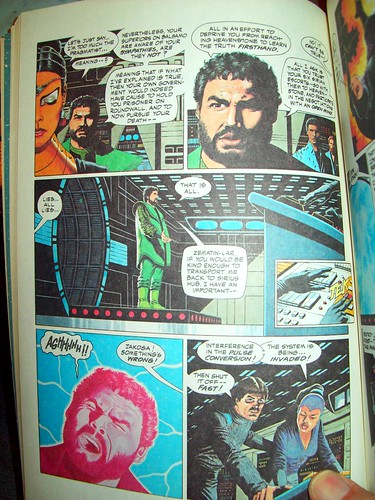
The fate of "Jaquandor"!

He only appears in one scene, during which he briefs our secret-agent heroes as to their mission (which is basically the Cuban Missile Crisis in space). That lower-left panel is Jaquandor’s last hurrah, as he is “beaming” out on their transporter thing at the same moment that something evil decides to beam in. So yes, I named myself online after a comic book character who appeared in one scene and then suffered a grisly death. Huzzah!

Roger also asks:

I’m interested in your development of faith, or lack of same. Did you grow up in a church-going family? Do you attend religious services currently? How do your current values/faith diverge from your former or current religious tradition? How has faith and/or belief in a supreme being helped or hindered you in times of personal difficulties?

Well now…there’s a tough bunch of questions. In order, no, I did not grow up in a church-going family. I saw this, and continue to see it, as a wonderful gift given my by my parents; I was allowed to develop my own worldview, and to see that worldviews will continue developing all our lives. What I believe now is different from what I believed when I was in college, and what I believe now is different from what I suspect I’ll believe twenty years from now. Or forty years, if I’m still around.

I do now attend church services regularly, but here’s the thing: my faith is so weak that I’m not sure it can be called faith at all. It’s more of a yearning, I suppose. I go to church because I love the story of it all, but I’m not sure I believe the story. I have a lot of points that trip me up on the whole thing: the omnipotent and good God who creates a world containing evil, the idea of humans as inherently flawed before we’re ever born, the fact that the Old Testament openly depicts a God in whom I’m surprised anyone would want to worship, and so on. I’m just not sure that I really believe. Maybe I don’t.

See, for me, the problem with saying “I am a Christian” means that I’m also saying “I am not a Buddhist”, or “I am not a Taoist”, or “I am not a Muslim”, and so on. Any “I am X” statement implies “I am not Y”. And I see too many things in other religions that speak to me deeply for me to rule them out completely. Putting it another way, the single part of the Bible that gives me the most trouble is John 14:6. The most common interpretation I’ve heard of this is that only those who believe in Christ will reach Heaven; everyone else does not. That passage bothers me, has always bothered me, and likely always will bother me. I cannot in my heart endorse the “Only Christians go to Heaven” view. If I get to Heaven and the Dalai Lama has been sent elsewhere, I’m going to wonder what God’s priorities are.

One can probably tell that belief in the supreme being hasn’t been terribly helpful to me in times of need. I just don’t know that God is there, listening. What is always helpful is people.

This answer probably hasn’t been terribly satisfying.

Roger also asked my thoughts on this interview with former Canadian figure skater Elvis Stojko.

From the introduction:

But some members of the skating community believe the sport’s effeminate image is increasingly a problem. Last year, Skate Canada told athletes and officials to talk up the sport’s toughness in order to attract more of a “hockey crowd,” and three-time world champion Elvis Stojko, the first man to land a quadruple-triple combination jump in competition (in 1997) and a skater known for his butch style, has spoken out on the issue. The sport really needs to start emphasizing “masculinity, strength and power,” Stojko has argued, if it wants to be taken more seriously. His remarks infuriated some gay groups, who perceived them as a slap in the face to the sport’s traditional fans.

Skating does tend to seem a bit effeminate, I suppose. At times. Not always, but right now, the effeminate stuff seems to be pretty dominant (except for the Russians, who seem utterly sexless — if there’s a more robotic skater than Evgeni Plushenko, I haven’t seen him). But there’s always been a healthy mix of that, so I’m not really sure. Saying that men’s skating should be more about masculinity and power seems possibly correct at first glimpse, but I fear that it would lead farther and farther into the dominance of jumping.

I confess that I haven’t much thought about these kinds of issues within skating. I do know that I’ve lost touch with the sport in general the last couple of years, because for whatever reason, it doesn’t seem to be as big a deal as it was ten years or so ago. I remember the World Figure Skating Championships being a big deal, always televised in prime time (at least the big events). The last couple of years, World’s has been hard to find. Why is this? I’m not sure. Has the sport waned a bit? Is it “too effeminate”? I don’t know. I do think that some of the personalities in the sport have become pretty outlandish, but…you know, I just don’t have a big opinion on this right now. I do think there’s a degree to which the sport is kind of homogenized these days; everybody kind of looks the same, which wasn’t the case during the 1990s when you had wildly different types of skaters in Stojko, Philippe Candeloro, Todd Eldridge (perhaps my favorite skater ever — I loved the guy) and, yes, the sexless Russians (Alexei Yagudin excepted — I thought he was amazing).

I’m not sure if the problem is too little butch as too little personality.

Finally, Charlie actually reminded me that I never answered a question that he had e-mailed last year. Basically, he was wondering about a falling-out I had with a professor in college. I was reticent to answer this one, and over time I pretty much put it out of my mind until I’d forgotten it completely, but I think it does deserve something of an answer, even if the story…well, I didn’t really present the best side of myself on this one, and the “Hey, I was only 20!” excuse rings hollow at this point.

It had to do with the band director, a guy named, believe it or not, Robert E. Lee. Dr. Lee was beloved of band members and alumni, but from the outside, he was seen as a highly quirky individual. He was pretty eccentric, even by tenured college music professor standards. One time, when the band was on tour, we stopped to get lunch at a McDonalds, and Dr. Lee bought a Happy Meal. When someone asked why he’d bought a Happy Meal instead of one of the other combo meals, he replied in his typically booming voice, “Because I’m happy!” His conducting could be hard to follow at times, when he really got into a piece, because he’d dispense with the traditional beat pattern and just start windmilling his arms a lot. He’d stop a rehearsal in its tracks to suddenly give the band a lecture on why they shouldn’t take up the offers of the prostitutes in the cities in Europe, never minding that the band wasn’t slated to go to Europe for another year and a half. He would talk to wind players about the need, when playing their instruments, to have a “wall of teeth”. (Not one person ever understood what he meant by this or why it was good.)

He had some maddening habits as well; the one that drove me batty was his tendency to cut pieces of music if certain passages were proving troublesome. He would just say “We’re not going to play that part, so when you get to two measures before point D, jump to five measures after point G.” I hated that. My view was that if a part of a piece was hard, you worked on it until it wasn’t, and that cutting music was basically denying what the composer had written. (Obviously, my attitude on this has not changed.) He became obsessed with a modern composer whose work I didn’t much like, so starting with my sophomore year, this composer’s newest work was always on our program.

Of course, it was always easier to see the negative than the positive. Yes, the music cutting was maddening and yes, Dr. Lee seemed in my eyes to waste a lot of good rehearsal time talking about odd topics. But I would only realize later on other things, such as the fact that for an old guy who’d been in the band business for more than thirty years by the time I came under his baton, he was constantly looking for new pieces and new works to learn, and his general enthusiastic approach to music — all music was singing, to him — was, I later realized, utterly correct.

But at the time I was pretty clueless, and Dr. Lee, for all his usual warmth and gregariousness, could, at times, be amazingly tone deaf at times in dealing with people. There were times when he would say something that was so insensitive that one almost couldn’t believe he’d say them. Lots of people had stories about things he’d said in that vein.

My own story, which is pretty brief, involves the European tours. The major music ensembles at college (at the time, the band and choir) would go on a European tour every four years. The way that broke out for me was that the European tour would be my senior year. However, the tour cost each student a couple of thousand dollars, if I remember correctly. I didn’t have a job, and I wasn’t about to try to ask my parents to foot that bill — they were already spending enough just to send me to school in the first place — so I decided that, regrettably, I wouldn’t be able to be in band my senior year.

So on audition day, I was walking through the music building, and Dr. Lee stopped me in the hall and asked if I was going to be in band. I replied, “Do you want me to be?” He thought for a moment and said, “Well, you’re not going to Europe, so…no.” And away he walked. It was very blunt and, I felt at the time, very dismissive of a person who’d been part of his band for three years prior. In short, it really pissed me off, and I made little effort to keep my ire secret. Of course, what I didn’t see then was that his position, however bluntly phrased, was the correct one: the entire year, for the band, would be preparation for Europe, so what use would I be if I wasn’t going?

I filed that under “Live and learn” and pretty much forgot about it until just a couple of years ago, when I got home from work, opened the mailbox, and took out an envelope that was addressed with handwriting I hadn’t seen since college. Dr. Lee had distinctive handwriting, and even after not seeing it for thirteen or fourteen years (whatever it had been at the time), I recognized it immediately. Inside the envelope was a brief note of apology from Dr. Lee for “what he had done to hurt me”. It couldn’t have possibly been more unexpected. I’d had no idea that he’d ever even been aware of how I’d felt at the time.

So yes, I wrote back, telling him basically what I admit above: that I’d overreacted to a perceived slight and never really considered, until much later, the correctness of his position. I said some things about music, told him about my life since college, and signed off. I also inquired as to his health, since it’s not unusual for people who are in bad health to seek to make redress for things they’ve done earlier in life. Dr. Lee wrote back one more time, to indicate that he was doing just fine and planned on many more years of life (he’s been retired for some time now, and I think that 1993 tour ended up being his last European tour) and that he was glad the hatchet was buried. It all felt very surreal; when I read his first letter, I remember having to stop and think a minute to remember why I’d been so pissed at him in the first place. Once I did remember, I almost immediately thought, “Oh, you 20-year-old dumb ass, he was right, even if he was kind of a dick in the way he went about it.” So, chalk another ass-kicking my younger self is going to receive if I ever get hold of Doc Brown’s DeLorean.

You know what keeps me up at night? Wondering what my fifty-eight year old self is going to want to come back in time and kick my ass for when he gets hold of Doc Brown’s DeLorean.

And that brings Ask Me Anything! 2010 to a close. Thanks for asking, everybody!
Share This Post

Continuing to Answer

Pushing through the inquiries posed on Ask Me Anything! 2010. These are all from Roger, who always asks the most (and usually best) questions.

OK. How the heck could you dislike the entire ouevre of The Beatles for so long? I can see if one doesn’t like the more avant garde stuff, or thought the early material wasn’t as as good as the later tunes. But to reject the whole eclectic eight years? And how did you finally become enlightened?

The flip answer is, “Tastes change”.

The more serious answer is…”Tastes change.”

The thing with the Beatles is that I’ve always liked a lot of their songs, even loved a small number of them, but with one proviso: I liked or loved them done by other artists. My main problem was that I just never cared for the Beatles’ sound as a band.

I’m not sure it was an “epiphany”, really, but the movie Across the Universe made me love the songs I already loved even more and gave me a greater appreciation of other songs I didn’t know so well, so I decided to investigate the Beatles themselves, to hear what songs I didn’t know that well. And that was when I noticed — or realized, or recognized, whatever you want to call it — that the Beatles don’t have just one sound. Their sound not only changes from album to album, but from song to song. And in general, I found myself liking, for once, even their singing voices, the slightly nasal quality of which I had never much liked before.

Mostly, yeah: my tastes changed. I’d put my liking of the Beatles in the same general category as my coming to like eating squash. (My newfound Fab Four fandom isn’t all-inclusive, though: I’m still not that fond of the song “Yesterday”.)

Why isn’t there a punter in the Football Hall of Fame? Should there be, and if so, who would you choose?

Because nobody likes punting. Seriously. Punting sucks. It’s openly admitting, “We didn’t get the job now so we’re gonna give you the ball.” The punter’s job is basically to attempt to allow the team punting to save a little face. I think that’s a big part of it. Football tends to be a game of narrative, and punters just don’t fit into the narrative well. They’re the period at the end of the sentence.

Now, people who really know the game know that punting, while ending one offensive series, can be a strong factor in winning what’s called the “Field Position battle”. If your punts leave the other team starting drives from their own ten yard line, then that’s better than just turning the ball over on downs at mid-field. Or so the theory goes. Going for it on fourth down is getting more and more popular.

Should a punter be in the Hall of Fame? Sure. I’d probably start with finding out what punter had the best statistics — punting average, average opponent drive start, percentage punts not returned, that sort of thing. Now, stats aren’t everything, and it’s called the Hall of Fame, not the Hall of Stats; but as I note above, there’s never been a punter who was a strong figure in the narrative of the game. Punters are a major part of the game, like it or not, and if the Hall is going to reflect the entire game, then there should be punters there.

Should any of the following be in the Baseball Hall of Fame: Mark McGwire, Sammy Sosa, Barry Bonds, Roger Clemens, Rafael Palmiero. Why or why not?

I think so. All of them, probably. The whole steroid era is problematic, but ultimately, I just don’t find the case for ignoring an entire era of baseball all that compelling. If we’re going to say that the Hall of Fame shouldn’t reflect the steroid, how far should we take that? Should the standings from those years be set aside? Should pennants and World Series titles be revoked?

To me, the most glaring fact about the steroid era is that baseball had no policy about it. I don’t see how, given that fact, we can retroactively decide to hold these players responsible for the sullying of an entire era. And besides, why is the steroid era generally considered “soiled”, while other eras weren’t? Matthew Yglesias addressed this point the other day:

There was no time “before” people tried to get an edge by ingesting useful substances (I drink a lot of coffee while writing blog posts in a rush in the morning) and there never will be. Sports have rules for a reason, and rules that aim to restrict consumption of potentially dangerous drugs seem like a good idea to me. And players shouldn’t break the rules. But the idea that some vast moral transformation occurred circa 1995 to which the great ones of yore were immune is silly.

Ultimately, though, for me, the steroid thing is one more instance of something ugly in the history of baseball, which for all the beauty of the game, has an awful lot of ugliness within it.

(Now, if we want to put asterisks on the players from the Steroid Era, and supplement the Hall with plaques explaining what happened and why, then that might be fine. But I’m not even sure about that.)

More answers to come!

(And gee whiz, I still haven’t shut off comments on the original post soliciting questions. You’d think I was enjoying this or something!)

Share This Post

A couple more answers!

Knocking off two more questions on Ask Me Anything! 2010.

LC Scotty asks, easily enough: What is lemon curd? It sounds like something I should be eating.

Actually, I’m not sure if it’s something Scotty should be eating, if he’s asking from a health standpoint. Not that it’s necessarily bad for you, either, but it’s definitely something that you should be eating if you like things that taste good and if you file lemon under your personal label of “Things That Taste Good”.

But what is lemon curd? It’s a lemon-flavored spread that is made with eggs, sugar, and flavorings whipped together. The lemon flavor is pleasantly intense, but with enough sweetness to offset the lemon just enough. I spread mine on toast and English muffins. The flavor is strong enough that one doesn’t need a giant amount on the bread to make it taste good. It’s a very pleasant change of pace from jelly or jam. (I can’t get behind marmalade. Never liked the stuff.)

Here’s a recipe, but I’ll buying the stuff in a jar just the same. I’ve read that fruit curds don’t have to be lemon, but lemon’s what I see all the time.

Kerry asks: Why has no one ever discovered a Bigfoot (or a carcass thereof), when the creature has been written about and spoken of in native American culture for thousands of years??

Probably for the same reasons that no one’s ever found a mermaid at sea or discovered the Loch Ness Monster, and probably for the same reason that no one has ever captured or photographed one of the “Hidden Folk” or Iceland…the legends behind these beasts almost surely have roots in something real from way back when, but what it was? No one now knows, and it was also almost surely something not akin to what legendary creature would later accrue around it.

In the case of mermaids, the prevailing theory is that what was originally taken to be a mermaid was actually a manatee. In the case of Sasquatch, I suspect something similar. Maybe a particularly enormous bear, seen rearing onto its back legs. But thinking about it more, the notion of a giant human lurking somewhere “out there” is not limited to the Native Americans of the Pacific Northwest; virtually every human culture on Earth has at one time had some kind of similar legend. (The Yeti of the Himalayas is a good example.) They are among the most enduring of all legends.

Paul has a lengthy query about my favorite book, Guy Gavriel Kay’s The Lions of Al-Rassan. Part one: You mentioned the historical underpinnings of Kay’s novel The Lions of Al Rassan. Were you familiar with the historical facts before you read Lions the first time, or did you research that after? How did that knowledge affect your understanding and enjoyment of the novel?

The first time I read the book, I knew quite little about the period. Upon later re-reads…I don’t know a whole lot more about the period, aside from the broad strokes of the era. I certainly am not in any kind of position to evaluate GGK’s fidelity to the historical record, but as he is writing fantasy, to make such an evaluation would surely miss the point entirely.

I do know that history has rarely been driven by “larger than life” events and “larger than life” people as GGK depicts, but he has always admitted that he is not writing history after all. I find that GGK’s historical works tend to affect my understanding and enjoyment of the real history, rather than the other way around.

Back to Paul:

My biggest beef with Lions (I’m sure you’ve heard me say this before) is that I felt manipulated by the author at two specific points in the narrative. Kay sets us up to believe one thing has occurred, and then, much later, reveals that something entirely different actually happened. His protestations that he did it consciously and intentionally to provoke a specific reaction in the reader notwithstanding, I found it disturbing to my willing suspension of disbelief. It distracted me from the narrative, and made the author very apparent to me. A cardinal sin in writing we are told. What was your reaction to the events in the book I am talking about? how did it affect you differently from me?

Hmmmm. Firstly, I’m honestly not sure of what events in the book Paul is referencing, although I suspect he’s referring in part to the final duel of the novel? Without spoiling things, the conflicts come, in the end, to a single duel between the two principal men of the book. Which one wins? I won’t tell…but GGK writes the duel in such a way that we don’t even know which man is doing what in the fighting. I find it fascinating.

“Being aware of the author” isn’t something that’s ever much bothered me; in nearly every book I’ve ever read, I’ve been aware of the author at some point or other. Complete immersion in a story is something that rarely happens to me, and I almost always find myself aware of the author to one extent or another.

Not much of an answer, but without knowing specifically which events we’re discussing, I can’t go much farther into it.

Share This Post

Answering a few more!

OK, this round of answers will be a bit more positively toned than yesterday’s. But hey, someone asked a question about a topic guaranteed to set me a-rantin’ — kind of like the year someone basically gave me an engraved invitation to rip on the New England Patriots. Nobody did that this year! (And nobody asked any questions about overalls, either — I think that’s a first.)

Anyway, Charlie asks: What movie would you say is most soundtrack dependent (in other words, which movie would you most lose enjoyment of if you watched a soundtrack-free version)?

This is…a very hard question. The Star Wars and Lord of the Rings movies would be terribly different with different scores, and if they were music-free, both franchises might well be disastrously unemotional. But the same can be said of many, many films with fine scores — a musicless Ben Hur would be staggeringly silly, no?

To say that a film would be “soundtrack dependent” would be to say that without the music, the film would collapse like a house of cards. Obviously this would be true of any musical, so we’ll just set those aside for the purposes of this discussion.

Lots of movies don’t even have scores, but just collections of pop songs used in various places throughout the films. Sometimes these are of the “lather rinse repeat” variety; virtually any teen comedy suffices for mention here, where you could just switch out songs at random and the movie wouldn’t suffer at all. But other films, where the pop songs are chosen by the filmmakers for specific reasons? Those obviously would suffer. Pulp Fiction, Love Actually, When Harry Met Sally…, and Sleepless in Seattle would all be laughable without their music, precisely because those films feature songs that are chosen with extreme care.

To return to traditional filmscores for a moment, when I was active in various fora online in discussing film music, there was one kind of topic that cropped up fairly often that always annoyed me, which generally took the form of “Who would you have liked to have scored [Film XXX]?” This always annoyed me a lot, because it would invariably devolve into various expressions of hero worship, especially from the Jerry Goldsmith fans, who tend to be keenly aware that their hero scored more than his fair share of crappy movies. So, in those threads you’d hear a lot of “What if Goldsmith had done the Indiana Jones movies!” or “What if Jerry had done Lord of the Rings!” To me, this always seemed about as useful a line of discussion as a bunch of football players discussing what the Bills might have been like if they’d managed to draft Drew Brees. Who cares? They didn’t. Why talk about what might have happened?

All this is basically my way of admitting that I just don’t have a good answer for Charlie’s question. Truthfully, a movie without music would just be weird. Any movie. I found it unsettling when the Mimi Rogers film The Rapture closed with credits scrolling over no music at all. Which, I suppose, was entirely the point.

(Roger posted about movie music the other day and seeks comments.)

Speaking of Roger and speaking of film music, Roger asks: How do respond to people who think all of John Williams’ scores sound alike?

Generally, I either roll my eyes, or say something pithy like “Get back to me when you get cochlear implants.” It’s a frankly idiotic thing to say. For a brief demonstration, one could just listen to the clips in this post of mine from earlier in the month.

Now, there are similarities in sound from one work to the next. How could there not be? Williams is an artist, and of course there will be stylistic similarities to be found. I do hear them, same as I hear stylistic similarities amongst the works of Berlioz, and Wagner, and, heck, the Beatles. But the idea that all Williams scores sound alike is one of those notions that just doesn’t stand up to any serious scrutiny whatsoever.

The clips I chose in that post linked above are from different eras in Williams’s work, but one doesn’t even have to do that. One can listen to Williams scores from the same era and not hear anything more than superficial stylistic similarities. It would take a pretty sophisticated listener to recognize the main theme of Star Wars and the main theme of Dracula as coming from the pen of the same composer, and only two years separate those scores.

More answers to come!

Share This Post

Answering some more!

More queries to answer from Ask Me Anything! 2010. Hooray!!!

Mark asks: Given a choice between Yes or the Who for a Super Bowl halftime show, who would you say yes to?

Huh?

Roger asks: You have a nom de plume. But now your Facebook page, with your real name, shows up on your blog. So Jaquandor wasn’t an attempt at some pseudonym-driven privacy?

It was, originally. I “came of age” on the Internet during the 90s, when pseudonym use was a lot more prevalent. When I launched the blog, I planned to write about a fairly narrow range of topics — books, movies, and the occasional sports-related item if the whim struck. Problem was, that felt a bit limiting, so I started writing about more and more personal stuff, and over time, the need for pseudonymity and that type of privacy felt less and less important.

Additionally, in 2003 I started writing reviews for Green Man Review under my real name, and I wanted to specifically link my reviews there from my stuff on the blog and vice versa, so that’s when I “officially” ditched “Jaquandor” as a permanent pseudonym, or as the only way I identified myself online.

I didn’t ditch the name entirely, though, mainly because I liked the name, and plenty of other folks online — in Blogistan and outside of it — have done pretty much the same thing. So, basically, at this point it’s pretty much of an affectation, although I have just now realized that by putting that Facebook widget on the blog, this is the first time my name has directly appeared here. (But it’s always been present on The Promised King, demonstrating the somewhat ephemeral nature of this sort of thing.)

LC Scotty tempts me with a query about Ayn Rand: I know you have little but contempt for Ayn Rand. I’d be curious to hear your take on this criticism of her work?

It’s an interesting article, I thought. Basically I read it as “Rand was on something of a right track, but she takes it way too far.” A sampling:

While she was hardly the first philosopher to advocate a morality of individualism and rational self-interest, she formulated it in a uniquely accessible way and a uniquely passionate one, not as a dry economic construct but as a bold vision of struggle, creative achievement and romanticism.

All this accounts for much of Rand’s appeal. But that appeal is severely limited by the flaws of her world-view.

One of those flaws is Rand’s unwillingness to consider the possibility that the values of the free market can coexist with other, non-individualistic and non-market-based virtues–those of family and community, for example. Instead, Rand frames even human relations in terms of trade (our concern for loved ones is based on the positive things they bring to our lives) and offered at best lukewarm support for charitable aid. When charity is mentioned in Rand’s fiction, it is nearly always in a negative context. In Atlas Shrugged, a club providing shelter to needy young women is ridiculed for offering help to alcoholics, drug users, and unwed mothers-to-be.

Family fares even worse in Rand’s universe. In her 1964 Playboy interview Rand flatly declared that it was “immoral” to place family ties and friendship above productive work; in her fiction, family life is depicted as a stifling swamp.

Saying, as Scotty does, that I have “little but contempt” for Rand is something of an understatement. I consider Rand’s philosophy to be utterly loathsome; I find Rand’s writing to be appallingly bad both from a technical standpoint and from her nauseating view of human nature; and from what I’ve read of Rand as a person, she was a spectacularly horrible human being. (I’m not sure what word would best categorize her fascination with child murderer William Edward Hickman, but were I to learn that a living author today exhibited the same feelings for a criminal of today, that writer’s books would almost immediately find their way off my bookshelves, were I to own any.)

More irritating — or, I used to find them more irritating, before I just decided they were laughable — are Rand’s accolytes, most of whom I’ve encountered cite Rand in much the same way that certain fundamentalist Christians will ask “Have you spoken to Jesus today?” To hear Randites tell the tale, Western Philosophy can be reduced to a line connecting Plato, Aristotle, and then Rand. If Godwin’s Law holds that as any Internet discussion gets longer the probability of Hitler or the Nazis being mentioned approaches one, a similar law could be made of Objectivists: as any discussion with an Objectivist progresses, the probability of the Objectivist saying “A can not be not-A!” approaches one. This always amuses me, as it nearly always demonstrates that at the heart of Objectivism lies a particularly childlike notion of duality. A or not-A are the only choices; the idea that a thing can embody qualities of A and not-A at the same time is not to be entertained at all. Randians, or “Randroids” as I like to think of them, simply pronounce themselves adherents to Pure Reason, and therefore, all their conclusions are automatically logical, valid, and informed by reason. Sure. Whatever.

The writer’s take here seems to be that Rand is admirable in some way, but she goes too far. I suspect it’s pretty obvious that I wouldn’t credit Rand with even that much; I find in Rand a general contempt for humanity and a stunning lack of concern for human well-being that couldn’t be more at odds with my own worldview. I also find in her a childlike faith in the notion that where a person ends up in life is a function of their own efforts. We Americans love to adhere to varying degrees of this notion, but the older I get, the more terrifying I find the degree to which pure, dumb luck dominates our lives. (Example: I have a good job now where I’m learning a lot of new skills. Yes, I work hard both to get my jobs done and to learn those skills, but had I not been lucky enough to put in my application at a time when my predecessor was someone who sucked, I’d be doing something else right now.)

The writer of the piece lauds Rand’s status “as a promoter of the ideas of individual liberty, reason, and the free market”. I find nothing admirable in Rand in any of those categories; her concept if individual liberty is infantile, “reason” for her is nothing more than a blunt instrument that leads to predetermined conclusions, and I can’t see where anything good has ever come of worshiping the free market as a good inherent in itself.

Ultimately, I would respond to the RealClearPolitics article by quoting two others. First:

We all live every day with the victory of this fifth-rate Nietzsche of the mini-malls. Alan Greenspan was one of her strongest cult followers and even invited her to the Oval Office to witness his swearing-in when he joined the Ford administration. You can see how he carried this philosophy into the 1990s: Why should the Supermen of Wall Street be regulated to protected the lice of Main Street?

The figure Ayn Rand most resembles in American life is L. Ron Hubbard, another crazed, pitiable charlatan who used trashy potboilers to whip up a cult. Unfortunately, Rand’s cult isn’t confined to Tom Cruise and a rash of Hollywood dimwits. No, its ideas and its impulses have, by drilling into the basest human instincts, captured one of America’s major political parties.

And second:

Rand’s particular intellectual contribution, the thing that makes her so popular and so American, is the way she managed to mass market elitism — to convince so many people, especially young people, that they could be geniuses without being in any concrete way distinguished. Or, rather, that they could distinguish themselves by the ardor of their commitment to Rand’s teaching. The very form of her novels makes the same point: they are as cartoonish and sexed-up as any best seller, yet they are constantly suggesting that the reader who appreciates them is one of the elect.

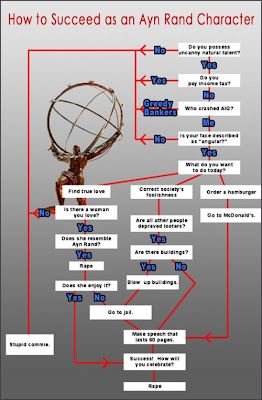
And I saw this just recently:

Unfair? Maybe…but it seems to me that the main freedom Rand symbolizes is nothing more than the freedom to be a boorish asshole. Sure, you have the freedom to be just that, but if you exercise that freedom, well…you’re a boorish asshole. As for the Randroids, as I once responded to someone who told me that I shouldn’t judge the book (Atlas Shrugged) by its cult, I’m not — I’m judging the cult by its book.

Share This Post

Answering….

Time for a few more answers to questions poses in Ask Me Anything! 2010.

Longtime reader DavidS asks: What do you think about that guy who did the 70 minute youtube rant on Star Wars Phantom Menace do you agree or disagree?

I mentioned this in brief in a Fixing the Prequels: AOTC post, but to answer it here: I know it’s out there, and I have little intention or inclination to watch the whole thing. Why?

Well, I’ve seen this thing discussed a lot in the various haunts I frequent around Blogistan, and I’ve even seen it discussed in places I didn’t particularly expect to see it. To me, that last is the more interesting phenomenon here; there are folks out there who apparently just love it when they get a new reason to bitch about George Lucas. Here’s a good example of what I’m talking about, from a post by one of my favorite political bloggers, Kevin Drum, in which he briefly decides to talk about LOST:

From Carlton Cuse, co-creator of Lost, explaining why they’re going to leave a few things still mysterious when the show ends this season:

To sort of demystify that by trying to literally explain everything down to the last little sort of midi-chlorian of it all would be a mistake in our view.

It all sounded like a cop-out until he put it that way. Now I totally approve!

Ha ha! See, it’s funny because it’s a shot at George Lucas! See, if you want to tell a good story, just do the opposite of what George Lucas would do! Heh indeed!

Of course, never mind that the Prequels actually leave tons of stuff unexplained. Things are implied, but not stated outright, and even the hated midichlorians aren’t really an explanation for anything. I’m always amazed by the tendency for people who hate the Prequel Trilogy to critique it on grounds that are simply wrong.

But back to the 70-minute review guy. As I note in the earlier post, I did watch a few minutes of it, and I found it terribly off-putting. The guy’s voice is grossly unpleasant, and he lost me as soon as he made a joke about his son having committed suicide. From the commentary I’ve seen ’round the Interweb, it seems that grim stuff like that tends to form the backbone of this guy’s sense of humor. Fine, I guess, but my understanding is that part of the video has the guy pretending to be a serial killer who keeps women prisoner in his basement? Huh?!

Also, the commentary I’ve read about the review is odd in that everyone cites as pure genius the way this guy makes criticisms that somehow they have never considered before — and yet, with every cited example, I realize that I’ve heard these criticisms many times. There are no emotional stakes in the final battle! There’s no main character! There’s no Han Solo-esque character to root for! And so on.

The Phantom Menace is nearly eleven years old. I see no reason to view a 70-minute cavalcade of all the complaints about the movie that I’ve heard before, and rejected. Especially if there are jokes about child suicide and serial murder. I realize this sounds dismissive, and in all honesty, I suppose it is.

(Plus, there’s my general jealousy and bitterness inherent in this guy’s review shooting all over the Web while my own “Fixing the Prequels” series languishes in total obscurity! Why yes, I would like some cheese with my whine!)

Dave in Rocha asks: What’s causing the noise coming from the right-side rear wheel of my car when I take a right turn?

Something is rubbing on something it shouldn’t be rubbing on; or maybe, something that is supposed to be rubbing on something else has ceased to rub, thereby causing inappropriate rubbing someplace else.

The proper course of action is, of course, to take your car out back and shoot it.

(One thing to check, if you haven’t already, is your mud flap. If it’s loose, it may be making contact with your tire in certain situations or wheel configurations, such as a right turn. I actually had this problem myself a month or so back: my driver’s side front mudflap lost all but one of its screws, so sometimes it would actually get twisted outward and stuck with its back surface against my tire. The sound this made was awful, until I just removed the flap entirely. But this probably isn’t the problem on a rear wheel, since those don’t turn. Hmmmm. Maybe a bad bearing or joint between the wheel and the drive shaft. Forget the mud flap thing and just shoot your car. It’s the humanitarian thing to do.)

More answers to come! Good questions this year. Thanks, folks!

(Hmmmm…must remember to close off comments on the Submissions post, lest new questions keep showing up….)

Share This Post

The Answers!

OK, folks, it’s time to start providing answers to the questions submitted for this year’s version of Ask Me Anything! Some short and easy ones to start with.

“Quince” asks: Since the housing market is becoming very buyer friendly do you think you will buy a house anytime soon?

I don’t know. I’d like to eventually, but we live in a pricier town, real estate-wise, and I’m loathe to move somewhere we can get a cheaper house because The Daughter is going to a wonderful school district and has a lot of friends. I’m not big on the idea of uprooting her just to get a house more cheaply. We’ll see.

Mark wonders: Will the Bills’ uniforms ever look good? Not just no teal, therefore good, but cohesive, distinctive and low on eyestrain good?

They do already, twice a year at least: their current “throwback” uniforms look pretty sweet:

Now, I’ve never been as down on their current “regular” uniform as many, but I never saw any rationale for change, except for the usual one: money, as in, getting fans to buy new jerseys.

(By the way, on the topic of fans buying jerseys, it really bugs me when people get their own names put on the back of a team jersey. Especially if it’s a number long associated with a well-known player. So if you’re a Bills fan named Schmidt, you don’t get to put “Schmidt” on the back of a jersey whose number is 12. That doesn’t work at all.)

LC Scotty asks: I’ve never read any Heinlein, and you being the skiffy expert around these parts I was wondering if you had a suggested order for diving in.

Sadly…I have no idea. I haven’t read much Heinlein at all. I tried several of his novels several years ago and bounced off them all. Now, I was trying to read his more “serious”, “adult” SF, and not the “juveniles” he was known for (like Starship Troopers), so maybe those would be a good place to start. Sorry!

(I have read some Heinlein short fiction, though, and liked it well enough, although I can’t recall any titles.)

Glenn asks: If the average American family size is 3.14 people, and the average American consumes 0.73 gallons of ethanol from distilled spirituous beverages per year, and my favorite bourbon contains 45% alcohol by volume, what is is the combined cubic capacity of household freezers in any given 100 kilometer block, and should I serve it over ice?

This seems like a trick question, one of those questions my physics teacher used to put on exams that he would load up with what he called “confusion factors” — i.e., numbers tossed into the question to act as red herrings for the students. In my opinion, bourbon should always be served over ice. I think it goes down better.

I prefer my rum at room temperature if straight, although cold rum is just fine, too.

More answers to come! Good questions this time out. (And if anyone tried to sneak in another question after I’ve already declared the submission period over, well, I might not notice until after I answered it….)

Share This Post

Ask Me Anything!


Ask Me Anything!, originally uploaded by Jaquandor.

Just a reminder, folks: I’m taking queries on Ask Me Anything! 2010. I’ll probably be taking questions up until this coming Friday, so get ’em in! Leave questions here (or via e-mail or Facebook, if you prefer). Serious questions, silly questions, questions that can’t be answered, anything goes! Ask Me Anything!!!

Share This Post