

Answers, the Tenth (and maybe the last?)

All right, let’s get our nose off this particular grindstone, shall we?

Here’s the final question of the ones that were posed by various anonymous readers:

Is the middle class terminal? Assuming it is how do we convince people to strive if opportunity is not there? If we are not striving aren’t we just, well, breathing?

This is a question that I think about a lot. I honestly am not really sure, but I do wonder from time to time if the pace of technological improvement is going to render large parts of our economy obsolete. And then, what?

Manufacturing is going to become more and more automatic. I think most folks believe that our kids will live to see cars that drive themselves, and in fact, in a hundred years, our descendants may look back on us, shaking their heads, and say, “Can you believe they used to take control of two-ton vehicles and maneuver them in tight quarters at high speeds?!”

Putting the problem bluntly: What do we do if and when we reach a point where there simply isn’t enough work for people to do? Our entire economy is built on the idea: Someone with money determines that work needs done, and pays someone some of their money to do it. There really could be a time when there isn’t enough work for people. The natural question then is, then what? Can people be trusted to find things to do to occupy their time? Will they make work for themselves, as the growing artisal movements have? And will we (meaning, we as a species) be able to do enough of this sort of thing to keep our idleness from being a breeding ground for all of our usual hatreds and resentments?

I also worry a great deal about the current economic climate in the United States, which has been more and more tilted in the favor of funneling the nation’s wealth upward. So I don’t know if the middle-class is in “terminal” shape, but…there are some enormous challenges, and current policy seems to me utterly unlikely to meet them.

And then, we have…Roger. Roger, Roger, Roger!

what TV shows, movies, books, comic books, et al. have affected you in terms of your politics/geopolitical world view?

It’s interesting: I’m not entirely sure that a lot of the fiction I’ve experienced has affected my worldview all that much. I suppose it would have to, but I’m not readily coming up with any great examples of books or movies or whatever that made me think, “Wow! What a wonderful expression of liberalism!”

I know, I know: The West Wing. But in a recent re-watch of the first 3.5 seasons of the show (I petered out right about when the slow-leak in Sorkin’s balloon, which started in Season Three, finally let all the air out completely in Season Four), I found that the show isn’t quite as liberal as most think. Sure, the administration and most of the main characters are Democrats, but many of the Republicans in the show are not depicted as fire-breathing demons, and it’s actually pretty surprising how often it’s the conservative argument that ends up winning the day. Liberalism is mostly depicted on The West Wing as an idealistic world view, and many times, a character will give a full throated expression of some liberal idea only to have to concede that it’s just impossible or unwieldy or unaffordable or something similar.

It’s not so much my liberalism that’s informed about my approach to fictional properties, then…but my more general sense of right and wrong, and my feel of optimism for our future as a species. That is influenced hugely by a lot of science fiction, such as Star Trek and, yes, Star Wars, even though the latter is more mythic in approach and doesn’t depict a “future” at all. But I like tales that suggest that we do have a bright future as a species, that we’re not just doomed to do our thing on this planet until something happens and we all die, leaving only a few space probes in the dark as evidence of the things we once did. Peter F. Hamilton is an author who is good at this; so was Iain Banks. I get a bit of this from John Scalzi, too, although his future tends to be more violent.

Have you ever participated in a buycott, rather the opposite of a boycott, in which you buy some product or service to support someone whose values you admire?

I have to confess that I try to do this, but it’s not always the easiest thing to do in the world. Often the businesses that are really admirable are hard to access (lots of driving), or they’re more expensive (luckily, this is becoming a bit less of a concern for me these days), or…well, that sort of thing. I do feel the need to do more of that, especially since it’s so often very easy to not do business with companies whose values I find ugly or abhorrent.

If I’m to believe what I watch on FOX News, the white man feel mighty oppressed in America! Why is that?

Well, by way of a short answer, the world they’ve always known is changing, and that can be scary. Things are getting difficult that weren’t always difficult, and things are getting easy for “The Other” — whomever your particular “other” happens to be — in a way that they have not been. Simplistic answer, I know, but I really think that covers it.

What is your opinion of the Presidential Medal of Freedom nominees?

Hmmmm. First, by way of definition (via Wikipedia):

The Presidential Medal of Freedom is an award bestowed by the President of the United States and is—along with the comparable Congressional Gold Medal bestowed by an act of U.S. Congress—the highest civilian award in the United States. It recognizes those individuals who have made “an especially meritorious contribution to the security or national interests of the United States, world peace, cultural or other significant public or private endeavors”.[3] The award is not limited to U.S. citizens and, while it is a civilian award, it can also be awarded to military personnel and worn on the uniform.

Here is the roster of this year’s honorees:

Ernie Banks
Ben Bradlee
Bill Clinton
Daniel Inouye
Daniel Kahneman
Richard Lugar
Loretta Lynn
Mario Molina
Sally Ride
Bayard Rustin
Arturo Sandoval
Dean Smith
Gloria Steinem
Cordy Tindell “C.T.” Vivian
Patricia Wald
Oprah Winfrey

I don’t really have a problem with any of these, to be honest. All are important figures (even if I wasn’t familiar with a few of the names — more info on each at WhiteHouse.gov) I don’t see anyone on the list whose contributions I consider trite or silly. It’s tempting, maybe, to think so of the sports figures, but sport is such a central part of American culture and identity, for better or worse, that to ignore it for things like this would seem odd. It’s always hard with awards like this, because frankly, for every person out there, there’s another person who can tell you either why they should or should not receive an award like this. These are all remarkable, important Americans, though, as far as I’m concerned.

This is less question than request: could you write a verse of song/poetry about the end of you finishing writing something. The thing I had in mind was for you to write something called “Put a Fork in It” to Beyonce’s “Put a Ring on It”, but you can pick another title as long as it’s to a widely recognizable song.

OK…well, this is weird…huh…well, here goes. And before any of you rip me to pieces over this, I’m coming up with this right now, as I write this, off the top of my head. So yeah, it probably sucks.

(To the tune of the Discovery Channel song)

The book is finished,
The manuscript is done,
The plot is wrapped up,
And man, I had some fun!

I love to write books,
It’s what I’m here to do,
Boom de yada, boom de yada,
Boom de yada, boom de yada!

I think the book is good,
And so will all the world,
When it’s on the bookshelves
And my flag’s unfurled!

All folks will read it,
And fortune will be mine,
Boom de yada, boom de yada
Boom…

sound of needle being dragged across record player. Music stops.

MAN WITH VOICE OF JAMES EARL JONES: Stop singing and write the next book, dumbass.

And with that, folks, I think we’re done with Ask Me Anything August 2013! Thanks for playing and being patient, and we’ll play again in February!
Share This Post

Answers the Ninth!

Wow, looks like I may end up dragging this thing out into October, which is a new record for personal futility. Oh well!

Roger had a bunch, as always, so his constitute the bulk of the outstanding answers. So let’s get going:

How do you feel about casting folks who aren’t the category they portray? I was thinking about Johnny Depp as Tonto, but there are tons of other examples. Should only a gay man play a gay man, e.g. Related question: how do you feel about casting a character that had been traditionally white differently? I’m thinking about making Kingpin, the white villain in the Daredevil comic books as a black man, or the black Asgardian in the Thor movie that made parts of fandom apoplectic.”

I think it can vary from character to character, in a lot of ways. Generally speaking, if a character has a specific ethnicity or ethnic makeup, then surely you can find someone of that ethnicity to do the part. This is why it rankled me a bit to have Benedict Cumberbatch, a white Brit, playing Khan Noonien Singh, an Asian villain, in Star Trek Into Darkness. (And yes, it does kind of bug me after-the-fact that they had a Latino actor, Ricardo Montalban, originate the role — but that was in 1967, when views on such things were depressingly different.) I could go on and on about that particular casting choice, because it felt like (a) the producers just had to have Khan in their movie, and (b) the producers also just had to have the Flavor of the Month actor in their movie, so there it is. No, I don’t think it worked. (And I’m not being dismissive of Cumberbatch’s talent in describing him as the Flavor of the Month; he’s been a hardworking actor for a while who is now EXPLODING in popularity. That’s all.)

Perhaps the worst example of this is, of course, Mickey Rooney in Breakfast at Tiffany’s, in which he plays the Japanese Mr. Yunioshi in a racial-stereotype performance that has to be seen to be truly appreciated in all its awfulness. Another example that leaps to mind is Louis Jourdan, a French actor, playing “exiled Afghan prince” Kamal Khan in Octopussy. And if you really want to get right down to it, you could even make a case against Patrick Stewart, a Brit who played a Frenchman in Star Trek: The Next Generation, although with that one, the ethnic differences are lessened, and the showrunners oddly completely ignored Jean-Luc Picard’s French heritage most of the time after the first season.

On the flip side, I like it when ethnic actors show up in roles that make zero reference to ethnicity at all. I’m thinking of Native American actors Graham Greene and Wes Studi, in Die Hard With a Vengeance and Heat, respectively, for example. But making the Kingpin a black man in Daredevil? Well…I don’t know that that’s so much of a big deal. Changing the race of a fictional character for a movie doesn’t really bug me all that much. Denzel Washington cuts a nice figure in Much Ado About Nothing as Don Pedro, whom I’m sure Shakespeare didn’t envision as black. But then, in Shakespeare’s time, a man would have played Beatrice.

Where’s the line, then? Is it OK for a Japanese actor to play a Chinese character? I’m not sure. I can sure tell when the line is crossed, though.

I’m going to lump the next questions together, because they’re all shared topics:

Who will be the first woman President in the US, and when?

When will the first Hispanic be elected President? Any idea on who?

When will the SECOND black person be elected President?

Spitzer and Weiner are running for office. Why shouldn’t they, with former SC gov Sanford now a member of Congress?

I wouldn’t want to even begin to try picking future Presidents. I know that Washington media loves to talk about who wants to be President and all, but ten years ago I had never even heard of Barack Obama, and ten years before that, the idea that we’d give the keys to another member of the Bush family would have struck me as deeply silly. And just five years before that, you had the Governor of Arkansas giving a disastrously bad speech at the Democratic National Convention in 1988, which I would have thought would pretty much doom him from national politics forevermore.

Right now, I’d think that Hillary Clinton would be the most likely First Female President. I think we’ll have a Hispanic President within twenty years. The second black President? No idea whatsoever. Sorry, but these particular tea leaves are impossible for me to read!

As for Eliot Spitzer and Anthony Weiner, well…that shows how long it’s taken me to answer all these questions, because since Roger asked, both have been defeated! In terms of issues and views, I am actually pretty simpatico with both of those fellows, but their personal lives sure brought them down in a hurry. It does strike me as funny that marriage-based peccadilloes only seem to be politically fatal to Democrats. I do follow a couple of Republicans on Twitter who were endlessly crowing about how Democrats could POSSIBLY vote for anyone so VILE as these admitted adulterers — but when Mark Sanford got elected to Congress, one of them praised South Carolina voters for their “common sense”. So who knows.

(By the way, here’s my reminder to you all that the phrase “common sense” is one that you should never, ever use.)

Generally speaking, I try to never base voting decisions on candidates’ personal lives, unless they involve actual criminal activity. I didn’t marry these people, and I’ve read enough history to know the truth behind the great line of Captain Malcolm Reynolds in Firefly: “Seems to me that every man who’s ever had a statue built of him was one kind of sumbitch or another.”

Relatedly, though, I am starting to believe in term limits. But that’s for another time!

A few more to come, I think!

Share This Post

Answers, the Eighth!

Good Lord, this really got away from me, didn’t it? What a strange month, September was. I figured to get ahead, but instead I fell behind! Oops. Anyway, we march on, with the remaining questions posed by a constant (and patient!) anonymous reader:

Do you have “comfort books”, that you read when life is tough?

I’ve actually had to think a bit about this, and it turns out…no, not really. There are quotes from books that I recall in times of stress, but even then, not too many. The words of Gandalf the Grey tend to be very meaningful to me, when he says, in reply to Frodo’s wish that the Ring had never come to him, “So do all who live to see such times, but that is not for them to decide.”

I’ve known people who pick up the Bible or the Qu’ran or other such books when their lives are going through dark periods, but I’ve honestly never much been one to do that. I also don’t very often use my writing as a way of processing the demons, although I have done so in the past (here is an example). I’m not really sure if my reading really reflects the mood of my life’s “current events”, whatever those may be. Hmmmm…maybe it should.

How does the music you listen to vary with mood or stress?

Would you believe…kinda sorta the same way? Weird, huh?

Although, there are times when I do try to use music as a mood-enhancer, something to shake me out of my inner doldrums. Songs along this line include:

“Hello Goodbye”, “Octopus’s Garden” — The Beatles
“Dreams”, Van Halen
“Land of Make Believe”, Chuck Mangione (the 12-minute liver version, though)
“Human”, the Killers (no, the lyrics do not make any sense, but what an infectious song anyway)
“Dancin’ in the Street”, the cover by David Bowie and Mick Jagger (Shut up, I like it.)

And so on.

When I listen to music while writing, I find that nearly anything works. I don’t try to match music to the mood of the work in progress, although sometimes I do that. I might listen to Star Wars or Star Trek music while writing one of the Princesses books, or perhaps some horror music while writing GhostCop, but not always. I like to use music as a way of shutting out the world a bit while I work, but I don’t always try to match the music’s mood to the writing’s mood.

Sometimes, if I’m writing a scary scene, the music’s mood can actually create a nifty feeling of incongruity. I like when this happens. It reminds me of Johnny Mathis’s “Chances Are”, a song which forever creeps me out because of its brilliant use in the abduction-of-Barry scene in Close Encounters of the Third Kind.

More answers to come, I promise!

Share This Post

Answers, the seventh!

Continuing the answers!

Andy asked: Have you ever thought about self publishing your novel and bypassing all the rejections the clowns at the publishing companies give ya??????

Oh, yes, I have indeed. And yes, I will self-publish…but only when I am satisfied that it’s just not going to happen the traditional route.

Self-publishing has been around forever, but technology is really driving it into acceptability nowadays, which is a very fascinating development. The growth of new paths around the traditional gatekeepers may become one of the most important developments in the literary history of this century. So, what are my thoughts about it?

Well, first off, I want to go the traditional route, if I can. The reason is that the infrastructure already exists, and there are people – agents, editors – who help you navigate that infrastructure. Marketing, book design, all those kinds of things are already in place, so all the writer has to do is write. (I know, this is an oversimplification, but we’re just riffing in a blog post here.) I’m not sure how good I’d be at the whole marketing area, for example, but if the time comes, I’ll get myself up to speed pretty quickly.

However, the plain likelihood is that Princesses In SPACE!!! isn’t going to sell, for various reasons. The odds are just against it. I’m an unpublished author, so the bar gets set even higher; the book is on the long side, at roughly 160,000 words. (In ballpark terms, that’s a roughly 400 to 450 page mass-market paperback novel.) Now, I’m biased, but I think that I wrote a book that moves those pages along pretty quickly, but still – newbie authors don’t often get to break in with long books. It does happen, though – witness Patrick Rothfuss and his doorstop debut, The Name of the Wind. (Not that I’m comparing myself to Patrick Rothfuss.)

Used to be that a new writer would write a book, shop it around, and if it didn’t sell, well, that was just one of every author’s “practice novels”, their training camp, so to speak. The idea is that every writer has to produce a few clunkers just to learn what it is they’re doing, so that when they do break through, it’s with a book that’s as good as they can make it. With the rise of Indie publishing, that’s not so much the case anymore.

Is this a good thing? Don’t we need the gatekeepers to keep the marketplace from filling up with crap?

Well, maybe…but then, I’m not entirely sure. It seems to me that gatekeeping may take a different form, and the literary community may become something like, oh, Trip Advisor or Urban Spoon or some of those sites. My mother has become quite a traveler in recent years, and she relies heavily on Trip Advisor to find out things like where to stay and eat, what to do and how to do it, how to get around, and that sort of thing. A restaurant in a town that gets terrible reviews on Trip Advisor is at a substantial disadvantage, and the same may apply in the future to writers who put poor books into the marketplace. And besides, let’s be honest: it’s not as if the gatekeepers aren’t an impenetrable bulwark against the tides of crap. Lots of crap gets through, for various reasons: one person doesn’t think it’s crap, or their crap detector malfunctions at a key point, or that crap is what’s selling so they’d better get some of their own similarly-scented crap out there on the shelves, too. Who knows. I return to William Goldman’s statement, which I think should be known as Goldman’s Law: “Nobody knows anything”.

So, yes, I will self-publish Princesses In SPACE!!! when the time comes. I suspect that won’t be for at least another year, if not longer, which kind of frustrates me, because I really want this story to be out there as soon as possible. I want people reading it and hopefully liking it and telling other people that they like it and so on…but the wheels of publishing turn slowly, and I don’t want to jump the gun. Maybe I just haven’t put the book in front of the right agent yet; you never know, and there are a LOT of fish in that particular sea.

There is one benefit to waiting that long, though. My current plan is to edit the first draft of Princesses II in December and get it to beta readers no later than the Super Bowl, which means that I’d be able to generate a third draft sometime next spring or early summer; by next fall, I hope to be writing Princesses III: The World Crime League (not the actual title). The upshot here is that, if I end up self-publishing, I should be able to – at least as the series starts – issue one novel per year in the Princesses In SPACE!!! Saga. If and when I have fans, I don’t want to subject them to any George RR Martin-style waits between books!

Ultimately, I’ll self-publish when the time comes because while I’m a newbie unknown in the eyes of the publishing world, I’m not a newbie unknown to me. I’m not content to let this be one of my “practice books”. I believe in this story, I know it’s good, and one way or another, as long as I’m drawing breath, it will get out there.

(Not that anyone asked, but I’m hoping to complete the first draft of GhostCop by December – using its back half as my NaNoWriMo project for this year – and then move back into Lighthouse Boy, a project which is starting to recrystalize a bit in my head.)

OK! Next up, an anonymous reader asked: How did you put together/find the people who review and edit your book?

I had six people beta-read Princesses, and I’ll likely go with a similar number for Princesses II. I didn’t want a large number of beta readers, so I went for diversity, which really paid off. There was my friend Matt Jones, whom I’ve known since fifth grade and who has been reading my drivel for exactly that long. (Interestingly, he liked the book least, but that’s what I expected, since his literary tastes have developed along lines of terse and economical prose, Hemingway-esque, if you will, while my own tastes run toward long and poetic sentences that have their own rhythm and frequently go on way too long but I don’t care because that’s how I like it and I enjoy reading sentences like that, sentences you can lose yourself in. Hmmmm.) Only one other is someone I know in real life, a friend from work who reads quite a bit but who doesn’t know SF very well. That was important to me, because I’m trying to write a book (or sequence of books) that don’t assume a good deal of familiarity with a genre that can be offputting to people entering it. Ditto an online friend who is one of the writers I respect most; she’s an experienced writer and spinner-of-tales, but SF ain’t her thing, either. The other three are all online friends who are familiar with SF, but whom I know to have different tastes within SF.

Everyone had interesting commentary to offer, from a genre standpoint or from a “Hmmm, the story seems to slow down a bit through this” standpoint, or a “I’m not sure it makes sense for this character to do that right then” standpoint, or from the extremely helpful standpoint of “Hey dummy, you’ve spelled the same made-up word five different ways. Make up thy mind!”

These folks all have standing invitations to beta-read my stuff in the future, and I may add one or two, but in general I intend to keep that group fairly small. (There were a couple folks I asked who had to decline on the basis that they had too much to read already. Gotta respect the “To read’ pile.)

Finally, Roger asks: Your feeling about ebooks v physical books, both from a reading experience and all that complexity of who owns the items when one wants to pass on the book.

There’s always been a tough divide to find between physical property and intellectual property. I once knew an artist who sold an original work to someone, who later decided that they didn’t want it anymore and put it on eBay. Was that person out of line? I’m not sure, but I can see how it could be viewed as such. Owning books is a pleasure, and I’m less thrilled with the idea of not “owning” anything when I buy something; we’re moving toward a model where our money buys us a license to enjoy something, rather than owning it. I’m not wild about that, but I can only shout at the rain for so long, too.

As for the actual reading of e-books versus physical books, I do definitely prefer the physical book. But as a matter of convenience, the e-book is just undeniable. Carrying around a little tablet that is loaded with dozens of books and comics is just too cool for words, and it’s a fabulous way to get hold of great literature…with certain concerns. Reading an e-book is, in terms of experiencing the content, pretty much exactly the same as reading a physical book.

There are differences, though. The screens have come far enough that reading on a screen doesn’t bother me at all, which is cool. The apps I use all have different ways of navigating, though; my favorite, Perfect Viewer, I use for reading comics, and it advances the page by tapping on the left side of the screen. This seems slightly counterintuitive, but I hold the tablet in my left hand, which means that tapping the left side of the screen requires a simple flick of my left thumb. The Kindle and other e-book apps I use all use a tap on the right side, however. (I find that Kindle’s “sweet spot” is easy to miss, too, so I usually just swipe the page to turn.)

Some e-books use too large a font or have too much spacing, so I end up having to swipe quite frequently. Also, there’s no physical sense to progressing through the book, which takes some getting used to. You don’t get the physical shift in the weight of the book over time, as the weight of flipped pages moves from right to left; you don’t get the feel of the book’s right-hand side dwindling. All you get is a little page counter at the bottom, or a progress bar, or a number indicating what percentage of the book you’ve read. That’s a bummer – part of the tactile feel of reading a book isn’t there. But I don’t miss that enough to consider e-book reading a ‘lesser’ reading experience.

Somewhat more problematic for me is that I like to dip into books I’ve read, or refer back to passages as I progress through a book. This is much easier in a physical book, where I can roughly recall how far back a given thing I’m looking for is, and I can land on a certain page, jog my memory a bit (“OK, that happened before the bit I’m looking for”), and then act accordingly. With e-books, all you have is that sliding bar at the bottom to move back and forth in the book, so tracking down memorable bits is difficult.

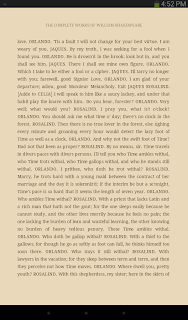
Also, I’ve noticed that the formatting still hasn’t become standardized enough. For the most part, books you buy on the Kindle store are pretty solid, but not always. You can get Kindle editions of classic literature pretty cheaply; many are even free. But you lose something in formatting, which can often be messy or buggy. This applies to books provided by other sites, too, in Kindle format. Here’s a screengrab from a page of the Project Gutenberg Complete Works of William Shakespeare:

See, that doesn’t work at all. The entire play isn’t like that, but still, that’s a bummer. I do have another edition that was just a couple bucks on the Kindle store; that one has excellent formatting, but it has a totally different flaw: none of the plays includes the Dramatis personae. That’s a headscratcher of an omission, and for me, it keeps me searching for a better edition. The Gutenberg one has the character lists, but you can see the formatting issues there. PDF files tend to work well, but the problem there is that you can’t change the color of the background, so every PDF is black text on bright white. I prefer not-quite-black text on a not-quite-white background. Not an option on a PDF.

So, in terms of content, I find e-reading a different experience, with its own problems that I expect will get better over time. My biggest problem with e-reading on my tablet? It’s not even reading. It’s the fact that I can do all these other things on the tablet. Like checking e-mail. Flipping through Instagram. Websurfing. Reading blogs via RSS on Feedly (which I highly recommend as a successor to Google Reader, by the way). I can even watch Netflix on the thing.

But I can also read comics! That’s pretty awesome.

More answers to come!

Share This Post

Answers, the sixth!

A couple answers to questions from e-mail! (Anonymity requested.)

Do you know car makes and models? Do you feel strongly about what vehicle you have (or would like to have), or are you more indifferent?

I’m not terribly knowledgeable about cars, no. I do like the looks of Subaru Outbacks, and some of the various SUV-type vehicles out on the road these days, and that will likely be the direction I go if and when I’m in the market for a car again (the added size will be nice for transporting a string bass around). Other than that, I’d like a decent stereo to which I can connect my phone or other music players, and one day I would love to own a car with working A/C. And mileage will have to be at least 30 mpg. That’s about it, though — as for the rest (aesthetics, color, styling of the interior), I’ll have to look around and see what catches my eye.

My current car is a 2003 Buick Century that I acquired from my unbelievably generous parents. I like it a lot, and my current plan is to drive it until it dies and/or falls apart. A car payment is a pretty large regular expense that I want to avoid having for as long as possible. (This is, of course, a changeable attitude based on when the royalty checks and movie offers for Princesses In SPACE!!! start pouring in. Heh!)

What pets would you ideally like to have? 42 cats? Cats and dogs? Exotic pets? Fish tank? Lizards? Hamster?

I’m fine with just cats, but I have a feeling that a dog is inevitable at some point or other. I’m not a dog person, but I don’t rule it out. The Wife and The Daughter want a dog, though. It’s gotta be a nice-sized dog, though. Not some annoying yippy thing that can fit in a purse. You know what dog I’d like, though? Verdell from As Good As It Gets. That was a cool dog.

I have a friend on Facebook (and Flickr and Instagram) who has a love-hate thing going on with her insane chihuahua. I want no part of that breed, as much as I love watching her dog’s bizarre psychoses from afar!

Exotic pets? Nah, no interest, although a fish tank would be nifty. We had a hermit crab for a while and I wouldn’t mind going that route again, as those are really low-maintenance. I don’t know if I’d want any kind of rodent, and I have zero interest in reptiles of any sort. I like to look at ’em, but owning one and being responsible for it? Nah.

From a different questioner: You seem less enthusiastic about sports every year. With the Pirates on the verge of winning and your Bills at least with new coaches and a rookie QB, do you find yourself getting into it again?

Meh. Next question comes from…oh, OK, I’ll revise and extend.

First, the Pirates: well, it’s nice that they’re winning. But it’s not like I’m watching games; my following of their fortunes consists of checking scores and standings. I can’t even name all the guys on their roster, and my sum total time spent each day checking baseball stuff is less than I spend reading the daily comics, and I read only four comic strips on a daily basis. (Five, on the three days a week that xkcd runs.)

As for the Bills…well, I’ve been thinking a lot about sports fandom in general over the last couple of years. It seems to me that any conversation on the degree to which we, as a culture, are wasting our time (here’s an example of just such a conversation) that doesn’t take sports into account as probably our single greatest societal time-waster, is likely missing a very big part of the point. In Buffalo, you cannot escape talk about the Bills and, perhaps even more, the NHL Sabres. I’d bet the a great percentage of the Buffalo area can name more members of either team’s roster than, say, the members of the Erie County legislature.

But anyway, as for my own personal feelings on sports fandom, I look at the Bills and their recent fortunes and I generally shrug. Now that NFL teams are winding down training camps, and getting ready for the regular season which starts next weekend, I’m reminded of a conversation I had with a guy at work toward the end of last season (or maybe the season before):

HE: Watch the Bills the other day?

ME: Nah. They’re terrible.

HE: Yeah, but I still gotta watch ’em, you know?

ME: Why? I mean, really – they stink. Watching them is no fun at all.

HE: No, it sure isn’t!

ME: Yeah! So I figure, if it’s no fun to watch them, why bother at all?

HE: So you don’t watch them at all?

ME: Nope. Watched a movie instead. Call me when they start winning.

HE: Oh…so you’re a fair-weather fan.

And he said that last a little derisively. I had to admit that yes, I have become a fair-weather fan. I’m not interested in watching every game of a 6-10 season. I’m not interested in watching a team that’s been bad for years add another bad year to its already double-digit list of losing years. So yeah, I’m a fair-weather fan. I’ll like ’em when they win.

My question now is, what’s wrong with that?

And the answer is: Nothing, as far as I can see.

The idea of a ‘fair-weather fan’ is obviously derived from a ‘fair-weather friend’. That’s a friend who is only a real friend when it’s easy to be one. A fair-weather friend is with you when you have weddings or births or new jobs to celebrate, but they disappear when you have deaths in the family or you divorce or get fired or whatever. There’s an old saying that “When times get bad, you find out who your real friends are.” I suppose sports teams can say the same thing: “When times get bad – when we start losing a lot – we find out who out real fans are.”

But here’s the thing: fandom isn’t friendship. Never has been, never will be. There is true virtue in friendship, and there is special virtue in the kind of friendship that endures trials and stalwartly marks the bad times as well as the good. That’s just not the case with fandom, because with fandom, the personal emotional investment only goes in one direction. There is no virtue in being a fan, of anything, and by extension, there is no moral expectation in what one does in being a fan.

Another conversation I remember:

HE: I have tickets to the Sabres game tonight. Thank god it’s the end of the season and I don’t have to go to any more of their crappy games. I hate watching this team.

ME: Why go at all?

HE: [looks at me like I’ve just insisted that Earth is round and that Milton Berle was once President of the United States] They’re my team. When you’re a fan, you go support your team.

Erm…what?

The logic here, as best I can follow, is that if and when one’s bad team actually gets good and wins a championship, it’s going to feel so much sweeter for fans if they grudgingly stuck it out through the crappy years. It’s an odd kind of puritanical thought that pleasure must be purchased through voluntary pain. It’s of the same kind of mindset that I used to see when I worked in the restaurant business and people I knew to be regulars would come in and say things like, “Every time I come in here it’s a little worse.” I’m thinking, “Why come back?”

Why do we continue to force things upon ourselves that we have a strong reason to believe will be really unpleasant, in the name of “being a good fan”? Who the hell wants to be on their deathbed and say, “Well, my team still sucks, but I watched them suck each and every week?”

Yes, I’ve put in my time watching by football team stink for 13 years (a number which is likely to grow). I watched this team lose a game, at home, 6-3 whilst allowing the opposing quarterback to complete two passes. I’ve sat through well more than my fair share of crappy football games, and have finally come to this conclusion: if, four or five years from now, the Buffalo Bills actually win the Super Bowl, I will not feel the slightest bit of regret for having stopped watching them entirely for large segments of their Era of Suck. There will no Fan Cops on the streets that night, making sure that the revelers dancing beneath the streetlights are only those ones who have put in the correct amount of suffering through bad games. And when I die, there will be no Sports Fan Valhalla into whose golden halls I will be denied entry because I failed to watch each and every game when the Bills went 4-12 one year or because I didn’t tune in to every single Sabres game down the stretch in a year where they missed the playoffs and finished thirteenth in the conference.

At this point in my life, I’m pretty much done with the figurative wearing of hair shirts.

One last one: Do you always use a real pie? Why not whipped cream in a can, or Cool-whip?

Because I’m all about authenticity, man. Go big or go home. A thing worth doing is a thing worth doing right. And it doesn’t happen to me all that often, so when it does, it needs to be an event. Or something. The presence of a crust ensures most of the pie comes out of the pan, which means more stuff is on the face, which makes it look funnier, and it’s all about looking ridiculous. I mean, really — it sure ain’t about dignity, and as Star Trek‘s Ferengi have taught us, “Dignity and an empty sack is worth the sack.” Might as well go for pie-faced absurdity.

More to come!

Share This Post

Answers, the fifth!

Might as well nail a few more Answers, huh? Fair warning: one of these is to a pretty odd question that I received via e-mail from someone who apparently wants to remain anonymous (and not the one who usually e-mails me good questions like that, either).

Andy asks (shortening a bit): Am I the only person that doesn’t trust anyone with a hyphenated name?

Probably not, but I’m not one of them. I’ve never much seen the big deal of this practice, but I did once know a guy who was really offended by the occasional practice, on some kind of odd Biblical justification that struck me as being a bit odd. Taking a man’s last name when one marries is one of those practices that I think might make the best sense when seen in terms of avoiding confusion, as we expect surnames to denote family units. When you have a different one, it requires more verbiage to convey the existence of the family unit. “We’re the Joneses!” becomes “Hi, I’m Ted Jones, and this is my wife, Alice Rambaldi.”

But then I think, well, is it really that big a deal if one then can’t think of that family as “the Joneses”? Or is it just something we expect because that’s the way we’ve always done it? Ultimately, I guess I file this under “whatever the family wants to do is fine with me”. And I say “the family” as opposed to “the woman” because I did know a couple once where, upon marriage, they both took on a completely new last name, different from what they’d each had before. I’ve never known anyone else who did that, but they took a creative tack, so who am I to judge? It’s their family, their name. OK? OK!

Roger has a ton of questions, as always. Here’s an interesting one:

I was reading Mark Evanier’s column and he wrote recently: “The other e-mail was from someone who seems pretty happy Trayvon Martin is dead because, you know, he was a druggy gang member who probably deserved it. Martin may not have been guilty of something at that moment but he was foolish enough to go up against an armed man so he brought his death on himself. Or so this guy believes. I don’t think I’m going to consider him a friend any longer.”
Did someone’s politics/values/thoughtlessness ever end a friendship with you?

Yes, but not all that often. In fact, I can only think of one time, really, and it happened just this past winter, and it was the other person who jettisoned me, not vice versa. Go figure.

This person is an individual I knew in grade school. We weren’t good friends then, but we weren’t enemies either, although as kids can sometimes be, on occasion we strayed into adversarial territory. Nothing really major, if I recall correctly. But then, a couple years back, he friended me on Facebook, and I reciprocated.

One thing I discovered, that I didn’t remember from high school, was that this fellow is Republican. In all-caps. It was kind of strange, I thought – not his conservatism, but the degree to which he seemed, based on his use of Facebook, to define himself by his politics, because that’s virtually all he ever posted: Republican stuff, links to articles in very conservative media outlets, Republican photo memes, and so on. For a while he used as his profile pic a cartoon that had a cow’s arse in close-up, and instead of cow-patties, the orifice in question was emitting the famous Obama ‘O’ logo. That’s the kind of thing we’re talking about here, and he was a pretty prolific poster, too. Lots and lots and lots of dispatches from Republicanland, each and every day, including global warming denialism and all manner of histrionics over the looming likelihood of “government completely taking over healthcare”, and so on and so forth. Basically, he made himself a one-stop shop on Facebook for Republican talking points.

Now, on Facebook, I’m pretty much the same as I am on this blog: rarely political, and only when something really out-of-the-ordinary jolts me into a political mood. I think about issues a lot, but I just don’t define myself that way. If you have one minute to get to know me, and I’m choosing the things I hope you walk away from that minute knowing about me, I’m fine if you only get a vague sense of my personal politics. Not so this other fellow: You will know what he believes. I mostly tended to scroll right past all the stuff he posted (and I have similar friends on the liberal side whose stuff I also tend to scroll right past, because I just don’t think Facebook is at all useful for delving into political issues), choosing to interact instead with his occasional post about a teevee show or music or football or whatever. And all was well.

Until last Decemeber, and the Sandy Hook shootings.

That was one of my moments, one of my times when I just couldn’t stay silent. I posted a few times that day, indicating that the awful event in Connecticut was my breaking point and that I was pretty much permanently moving my position on guns from “Not my thing, but rock on if you want” to “The hell with these damned tools for killing and our fetishization of them”. (I only make that point here to illustrate the tale, not to invite a debate in comments. Not interested. At all.) Well, my friend decided to post a response that wasn’t rude in any way. But still, it seems to me that there are times when you have to see how raw a person is and, well, maybe err on the side of not saying anything at all. So I responded back, fairly harshly, noting that I was not in any mood to hear from the gun-nut crowd and that when I wanted to hear his side’s talking points, I knew quite well where to go and find them for myself.

That did not please him, and after a bit of back-and-forth – which really, in retrospect, was not all that heated – he took his ball and went home. I was unfriended within the hour. I think what really set him off was my casual comment that I see lots and lots and lots of Republican stuff on my Facebook timeline each and every day (he was far from my only friend on that side of the aisle), and yet when I post a single thing advancing my political view on a day of extreme hardship, I was suddenly confronted by a massive case of the vapors. It was really odd. He wasn’t the only one to express dismay at what I said that day, but when I pointed out that apparently I’m supposed to listen to “All Republican all the time” without ever raising my hand to say something liberal, well, that was the end of that.

Since then I’ve become a lot more freehanded in my use of hiding stuff on Facebook. I still have only unfriended a handful of persons, and none of those were for politics. I like to think I have a good ability to get along with people on differing sides of the fence, although I do suspect that I, like most folks, may well gravitate more toward people of similar mindset to my own. For whatever reason, my classmate decided that we were too fundamentally unlike to interact in any way. That’s his call, and from my readings of political history, I’m honestly not sure that “the tone” right now is really any worse than it’s always been before, although there are troubling signs that give me pause, and I’m especially bothered by the fact that our political institutions really aren’t built well for the kind of strict political polarization that we have now. And yes, I do think that the Right in this country needs to come back to Earth at some point. But that’s for another day.

All right, that was awfully serious. So here’s the really strange question posed to me via e-mail:

How do you pee in overalls???

Erm…OK. I’m going to assume that we’re talking about, well, dealing with overalls in the bathroom, and not a more literal reading of that question. I’ve actually heard and read women complain over the years about overalls in the bathroom, to the point of actually dropping the shoulder straps in the toilet. Yeah…ewwww.

Well, the question’s there, so…well, here it is. Don’t unfasten the shoulder straps.

Huh? How does that make sense? Well, unless your overalls are super-tight – and they really shouldn’t be – this should work. You leave the straps fastened, but unbutton the sides, those buttons at the hips. Usually there are two or three of them, and once you undo all those, the overalls will be super loose. At that point, just lower the straps down the shoulders and shrug your way out of them, much as you would a jumpsuit or a pair of coveralls. Then just lower them like any pants. You can tuck the extra material from the straps into the legs or something, if you wish.

Yes, this does work. I’ve had to execute this maneuver myself when the facilities were, shall we say, not well-endowed for space. And in general, I find mucking about with a belt and all that other jazz on normal pants to be just as big a pain in the butt in cramped restroom quarters as bib overalls.

Annnnnnd, we’re done here. More answers to come!

(And if you still want to ask, feel free! Just not about bodily functions and how they relate to overalls. I think I’m done writing about that. Forever.)

Share This Post

Answers, the fourth!

The answering of the questions continues. As Samuel L. Jackson said in Jurassic Park, “Hold onto your butts!”

Local activist Christopher Byrd asks:

Barring a cataclysmic event, would you be interested in being a judge at next year’s Buffalo’s Best Pierogi Contest?

Wow, that sounds fun! I know next to nothing about pierogi, so I hope I don’t have to talk like some pompous-arsed foodie — “I find the flavor profile of this one particularly fine, the interplay between the duck spleen and the Jamaican garlic.” Let me know how this works!

Reader Josh asks:

What’s your opinion of the work of T. H. White?

I only know White by one book, The Once and Future King. I love that book dearly and am probably due for a re-read. It’s one of the finest treatments of the Arthurian legend ever written, and it is full of wonderful, beautifully poetic prose, with what may be the most gorgeous closing paragraphs I’ve ever read in any book. Other than that book, though, I’m entirely unfamiliar with White. Any recommendations?

Roger, who always asks a ton of questions, has one very pressing one among all the rest (to which I’ll get in posts to come):

Who is going to win the NL Central? And will the Pirates, who have the best record in baseball at this moment, FINALLY have a winning season, first since 1992?

Longtime readers know that when I was a much more of an active baseball fan than I am now (my baseball interest is basically on life-support), my team was the Pittsburgh Pirates. I inherited this fandom from my father, and during their last run of success — 1990 to 1992 — he and I had some pretty nice bonding experiences watching Pirates games at local taverns. Alas, after 1992 and a money-induced purging of the roster, the Pirates went into a period of rebuilding, which failed. So they started rebuilding again in 1996 or so, and that one failed. And so on and so on, to the point where the Pirates have literally not had a team finish the season with a winning record — minimum, 82 wins — since 1992. Twenty years. That’s not only a baseball record, it might well be a record for all sports.

The last couple years, the Pirates have started out well each year, giving the impression that maybe that was the year, but each time, they faltered badly down the back half of the season to still end up losing more than they won. This year, however, they’ve been consistently good for just about the entire year (after a slow couple weeks to start out). So, as of right now, this writing, their record is 74-52. They are 22 games over .500, and more importantly, in order for them to finish this year with a losing record, they would have to lose 30 games before they manage to win 8. (Well, technically 7, since a record of 81-81 is neither winning nor losing.) That would be a collapse for the ages. The sports poets would sing of that for generations to come. So, I feel somewhat confident in saying Yes, the Pittsburgh Pirates will finish the year with a winning record.

Now, as for their division…that’s tougher. The Pirates currently own a one-game lead in the NL Central, over the St. Louis Cardinals. That’s mostly on the strength of their pitching, which has been excellent this year. But I always have a hard time picking against experienced teams like the Cardinals. They’ve been in the playoffs nine times since 2000, and they were World Series champions just two years ago. I’d love to pick the Pirates, but I tend to be of the mindset that you don’t pick against the defending champ until someone beats ’em. So my pick has to be the Cardinals.

I have a Twitter bet with a Braves fan, by the way: if the Braves and Pirates meet in the postseason, the fan of the team that loses has to post ten positive tweets about the team that wins. I’ll have to say ten nice things about the Braves, who were, once upon a time, my baseball equivalent of the New England Patriots. Wow. How do I get myself into this stuff?

All for now! The answers shall continue!

Share This Post

Answers, the third!

Just one today! But first a little backstory. Someone arrived upon my blog today by way of a search string that…well, here’s what I tweeted about it:

That awkward moment when someone finds your blog using a search string that could only be used by someone searching for pr0n….

I refused to divulge the exact and icky search string (but I did admit that it had nothing to do with Star Wars, power tools, cats, overalls, or pies-in-faces). This led a friend of mine, Scotty, to get clever:

So, for my ask me anything question-if I ask what they searched for will you answer?

Well, this is Ask Me Anything!, so I must answer the question, just as Scotty asked it. So here’s the answer to the question, exactly as he asked it:

NO.

OK, more answers to come! Feel free to ask stuff, too! (Except questions about that. I think we’ve killed that topic pretty nicely.)

And thanks, Scotty, for the loophole!

Share This Post

Answers, the second!

UPDATE: Grammer fixed to make a sentence say what I meant!

Continuing the answering cavalcade! (And you can still ask stuff!)

Earl has a couple:

Which Do you find more offensive to pledge; one nation under God” or “with liberty and justice for all”?

That’s an interesting and challenging question. In truth, I don’t find either concept particularly offensive at all, although I am always struck by the way the Pledge was co-opted by conservative evangelicals in this country some years ago. I’m still astonished at the way George HW Bush managed to somehow hang the freaking Pledge of Allegiance around Michael Dukakis’s neck like a damned dead albatross. Wasn’t that weird?

I like the idea that we are one nation, and I like the idea of liberty and justice for all. Now, we can differ on what “liberty” means; one of the big reasons I reject libertarianism is because I think the notion of “liberty” that they hold dear is deeply suspect. But that’s a whole ‘nother kettle of fish, innit? I also have trouble with “under God”, mainly because the days of Americans being able to go through life assuming that everybody around them was Christian are pretty much over. Arguing over whether the Founding Fathers intended America as a Christian nation or not strikes me as generically unproductive, since I’m increasingly of the view that what the Founding Fathers wanted really shouldn’t be terribly relevant to us today. Besides, there’s the fact that the original version of the Pledge didn’t even have “under God” in it; that was added later by Congresscritters who didn’t want to appear too Red.

Ultimately, though, I find the idea of a pledge a bit daft in the first place. What’s the point? Why do we bother making kids recite this thing each and every morning? My love of my country has nothing at all to do with the Pledge of Allegiance, and I generically find oaths of allegiance to be generally a waste of time.

Would you consider switching genres in your writing? Why or why not?

I fear that last night’s post may have dampened this question a little, but I hope not. The answer is, obviously, yes. Or no. Ha!

It all depends on how we draw the lines of genre. Science fiction seems quite different from fantasy, although where the dividing line between the two lies has been an eternal source of debate for fans of either and both genres for decades. One of my beta readers for Princesses In SPACE!!! (not the actual title) indicated her belief that the book is actually a fantasy rather than SF, and I can see the argument; for me, it’s SF but it’s pretty solidly in the Star Wars end of the pool. So, did I write SF or fantasy?

Now, The Adventures of Lighthouse Boy (not the actual title), the book I started but set aside because I hadn’t thought through the backstory enough, is most certainly fantasy. Or is it? The world and history are completely imaginary, but there is no magic in that world at all. None. Zero. So is it still fantasy? Hmmm!

And then there’s GhostCop (not the actual title), which is, as I indicated, a supernatural thriller. Or, it’s horror. Thing is, many folks put horror in with SF and fantasy! I’ve read quite a few horror books that are definitely horror but which are also quite proper SF. (The Stand is one good example.) So, what genre is that? I don’t know.

Historical fiction is a genre that interests me, but I don’t know if I’ll ever have the patience to do the necessary research. There are topics that could work, though…the romance of Robert and Clara Schumann, for example, or the life of Hector Berlioz, which is a wildly cinematic life, indeed.

Last night on Facebook, a friend of mine named Mark said this:

After I saw your rewrites of movie dialogues, I thought that you might try writing a script or a play sometime.

Screenplays or plays? That’s interesting. My first creative writings that I took seriously were scripts, written in grade school. They were also fan fiction. I haven’t written in script format in years, though; I made the switch to prose in the late 1990s when I finally decided it was time to leave fanfic behind for good, and I’ve never looked back.

Well, almost.

I wrote a script a few years ago, which I often consider deleting entirely. I wrote it in an attempt to exorcise some personal demons, and…well, I’m not going to elaborate much on that. I think I could be a decent screenwriter, but my sense of things is that screenwriters have even less general chance of seeing their work produced correctly than novelists. I respect screenwriters and playwrights immensely and I like to read and study their work for storytelling insights, but I doubt I’ll ever count myself among them.

OK, that’s it for tonight! More answers to come!

Share This Post

Answers, the first!

All right, people, let’s get this ball rolling! And remember, you can still ask stuff!

A longtime reader who prefers anonymity gets us off:

Would you like to be a writer full time, or is a mix of writing and some other job ideal for you?

I desperately want to write full-time. Writing is the thing I’m best at, and if I have one major regret in life — under the general notion that I don’t really do ‘regrets’, as I think that most of my screw-ups have taught me something I needed to know — it’s that I spent an awful lot of time not really attacking writing all that seriously. Or when I was, I was doing it wrong. I spent too much time focusing on wrong projects, or sitting with Princesses In SPACE!!! (not the actual title) in my head on the notion that “I wasn’t ready” yet for that one. Princesses is an idea that came to me in two parts, the first coming in 1999 and the second coming in 2001. I wasted ten years dragging that story around in my head. Now, maybe if I’d written it back then it wouldn’t have turned out like it did…but heck, I don’t know that.

I’ve also wondered if I spent too much time fiddling around with short fiction, which tended to dominate my writing life back in the early 2000s. My short stories tended to be long, and I remember one time I posted something to a writing-based newsgroup on USENET, along the lines of, “I can’t seem to write genuine short stories! Every one I write ends up being well over 10000 words!” To which one woman, a published writer, responded, “Sounds to me like you’re a novelist at heart. Write books.” Did I listen to that advice? Well…not so much.

I believe that we should figure out what we’re best at, and then focus like a laser on being that. I’m late to the party on this philosophy, and now I’m paying the price in terms of not being published yet. I’ll get there, though.

I don’t know if I’ll ever get to a point where I can write full-time. But that’s the goal I’m going to move toward until the day I can’t write anymore. The incentives are too great. I want to do what I’m best at; I want to tell the stories that are in my head; and I want a job where I can wear overalls every single day (and let’s be honest, farming and construction are unlikely at this point in my life, as much respect as I have for both).

Do you read non-fiction (e.g., history, science and nature, biographies)? If so, what do you read? Do you wish you read more?

I always wish I read more! Always always always. In fact, I’m planning to start setting limits on my Internet time and start turning off the Wifi when I need to be working — and I’m planning to include reading time as working. It’s the only sensible thing to do. No, I’m not planning to drop offline entirely, because I like the social networking stuff too much, and I also tend to think that by the time I get a book out there in one form or another, I’ll have a built-in audience to start with!

As for the non-fiction I read: I always try to have some kind of nonfiction going. I like all of it, but I especially like writing that is narrative based: nonfictional storytelling that gets the factual stuff in by way of other tales taking place in and around the history. Good travel writing is wonderful for this. Reading nonfiction is essential because it gives me ideas for stories, and it gives me details from the real world that I can incorporate into my stories. Quite a lot of stuff I’ve read has gone into the two Princesses books already.

You know what I really don’t do enough of, either? Blogging about what I read. I need to do more of that, too.

Bonnie asks:

Did you ever finish your “Battlestar Galactica” rewatch? I was wondering what you thought of the series as a whole, especially the ending.

I’m sorry to report that…no, I have’t finished it. I took a break from the show, and then way lead on to way, as it does. I absolutely intend to return to it, though! I was about halfway through Season Two, I believe; they had just recovered the Arrow of Apollo and used it to find the way to Earth. I didn’t stop for any reason other than I wanted a break — I’d been watching two or three episodes a week, and I generally don’t do intensive rewatches where I do marathons. I did not intend the break to get this long, though.

More answers to come! And feel free to ask more, if you like!

Share This Post