It’s crunch time for Mercado!

I wrote a couple of weeks ago about a new project coming to Buffalo, Mercado Revolution, which is to be a marketplace and dining establishment featuring all things local and artisanal in Buffalo, as well as also featuring young and rising chefs who will be working to bring to Buffalo some of the new techniques and thought processes regarding food that have been thrilling the culinary world but have been oddly slow in coming here. The Mercado project is being funded by Kickstarter, and the funding window has just over two days left as of this writing, so if by chance you’re a local who hasn’t already heard of this project, please consider backing it!

In my earlier post I mentioned some questions I had about the project, questions which have now at least partially been answered. The Mercado folks have really done a masterful job at being able to make sure they have something new to get out, information-wise, nearly every day, mainly in terms of people and vendors who will be involved. There is a lot of exciting stuff slated for Mercado: a test kitchen for Lloyd’s Taco trucks (a food-truck business whose quality is so high that in just a handful of years it’s become an almost beloved feature in Buffalo and WNY food circles), a Lake Effect Ice Cream shop (this excites me, as their main location is in Lockport, which is just too far for normal trekking for us — it’s about 35 miles one way), and the Bavarian Nut Company (how nice to not have to wait until the County Fair to buy their products!). And many others.

The Mercado drivers have also been very much engaged in the social media scene, engaging people and answering questions almost immediately on Twitter or Facebook. Last Saturday afternoon I asked two questions and both were answered within minutes. (The first had to do with food allergies, as gluten is an issue at Casa Jaquandor — Mercado will be cognizant of food allergies and accommodating, although obviously they can’t make every single item comply — and the second was whether Mercado would be more geared to dining-in or carrying ingredients for home cooking. The focus will generally be on eating there, which makes sense.) There’s just so much about the way they’ve been going about this thing that feels right.

Another person asked why they are using Kickstarter, and it seems to me that doing it this way creates a sense of community ownership before the place ever chooses a location, breaks ground, or even opens. You can virtually guarantee that a person who has donated is going to visit, just to see what they were supporting; given that it’s a food place, they’re likely not coming alone; and then after that, the word-of-mouth will spread. It’s a unique approach that demonstrates that there’s hopefully a critical mass already in place in this region, waiting to support something like this. I’m no expert, but I imagine that would be a big factor in helping the Mercado founders to secure funding later on through more traditional means.

Anyway, I personally find this project deeply exciting. It’s interesting that it happens when my own family is on the cusp of moving into a home with a kitchen that is actually conducive to a lot more cooking than we’ve ever had before. I’m looking forward to being able to do more with food, and do it with higher-quality products and techniques that I haven’t been able to do for lack of decent space.

It’s time for Mercado. Please consider supporting!

UPDATE: Forgot this: local teevee station WGRZ did a feature on Mercado the other day; you can watch it here. Just ignore the fact that the anchor mispronounces “Mercado” at the beginning, and all the stock footage taken from the Taste of Buffalo festival, which I don’t entirely think is what Mercado is aiming for!

Share This Post

On Mr. Wilson

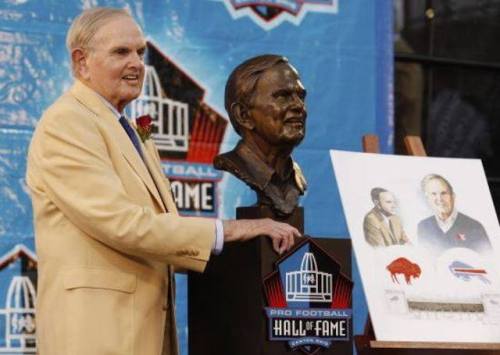
Ralph Wilson, owner of the Buffalo Bills, died yesterday at the age of 95. He was the only owner the team ever had, and, like seemingly everything else around these parts, Buffalo’s relationship with him was…complicated.

Wilson brought football to Buffalo when he decided he wanted to own a football team but the NFL wasn’t playing along, so he joined some other rich guys and launched the AFL. Somehow the new league got off the ground — even with Wilson having to loan some money to another of the owners, a guy named Al Davis, so he could get his franchise, which he dubbed “the Raiders”, off the ground — and eventually flourished to the point that the NFL just merged with the AFL, thus paving the way for the NFL as it exists today.

There would be no football in Buffalo today if not for the efforts of Ralph Wilson, and it’s entirely possible that without him, the NFL itself might not be what it is today. In the annals of football Ralph Wilson’s name might not loom so large as, say, a Paul Brown or a George Halas, but he’s no mere footnote, either.

But Wilson had his troublesome qualities as well, which were often balanced with the good. He could be difficult to work for, as evidenced by his tendency to buck heads with his own underlings. He wasn’t George Steinbrenner in this regard, but Wilson did burn more than a few bridges with good people (most famously former GM Bill Polian, who built the Bills of the early 90s and who then went on to a short stint with the expansion Carolina Panthers and then to the Indianapolis Colts, who Polian then built into one of the best teams of the 2000s). It’s generally been an article of faith that one major factor that’s kept the Bills from ever becoming a championship team was Wilson’s level of discomfort with people he didn’t know well, which kept him from ever really exploring other possibilities as far as people running the team. Thus Wilson rarely went looking outside his organization for bright, motivated people whose trajectories were on the way up.

Wilson also was one to rattle the “relocation” saber every so often, when the team’s stadium lease was coming up. He never outright said, as far as I can recall, that the team would have to move if he didn’t get his way, but the message was always pretty clear that the county-owned (and therefore taxpayer-funded) stadium would need some new stuff done to it every seven or eight years, if the team was to “remain viable in this market”. The whole NFL racket of shaking down municipalities for stadiums or stadium improvements is pretty nauseating, especially in light of the NFL’s non-profit status as it wallows in as much money as anybody has in this world. Ralph Wilson played this game to the hilt, but…he never did move the team, or even come close to doing so, and over the last twenty or thirty years, that hasn’t been the case around the NFL. Al Davis moved his Raiders twice. Georgia Frontiere moved the Rams, Art Modell moved the Browns, and of course, thirty years ago the Irsays brought in moving vans at midnight to haul the Colts away from Baltimore. It happens, but Ralph Wilson resisted the siren call of richer markets.

But on the other hand — and there’s always an “other hand” with Ralph Wilson — he also staunchly refused to publicly consider any kind of ownership succession plan that would guarantee the team’s future in Buffalo after his death. It’s become almost an article-of-faith around here that Wilson must have had some kind of “secret plan” ready to go for after his death, but…well, I guess we’ll find out now, won’t we? If he did, great. But if not…well, as radio play-by-play guy Van Miller used to say, “Fasten your seatbelts!”

Ralph Wilson never moved the team or even came close, but he did extort the county for as much money as he could. Ralph Wilson seemed cheap at times, never being mentioned at all as a guy who would spend top dollar to get the best executives or coaches, but he did shower money on a lot of players in attempts to make the team better. Ralph Wilson was one of the most important figures in the sporting history of this town, but he lived in Detroit. Like I said, it was complicated. Hey, that’s Buffalo. It’s never easy, for us.

Thanks for the football memories, Mr. Wilson. I hope you had one final trick up your sleeve, though.

Share This Post

The revolution will be incentivized.

(I’ve changed the wording below a little since my first posting.)


I actually donated to a Kickstarter project recently: Mercado Revolution, a new venture in Buffalo that will…well, here’s how Mercado’s visionaries describe it:

Mercado will kickstart the Buffalo/Niagara region by assembling 15 different, excellent restaurants under one “market” roof – a centralized hub where anyone can sample products from Western New York’s top food artisans, watching from counter seating as dishes are made. The market will also serve as an incubator and lab for the next generation of Buffalo culinary success stories. Thanks to culinary director Scott Kollig, Mercado will bring the latest techniques and world-class ingredients to WNY from Washington, D.C., where Scott has worked for celebrity chefs as a chef de partie and sommelier. Working together, we will create an incredible culinary bazaar – a one-stop shop to experience the future of food and drinking.

When it comes to food, I’ve always felt of two minds in this region. I’ve never been down on the food that’s here, but at the same time, it’s impossible to not realize that there’s a great deal of exciting things happening in the food world that just don’t make their way here for years and years and years. The Buffalo Niagara region tends to be oddly resistant to new things, but the time just may be right for something like this, as a lot of small and independently-driven projects are underway in this region that seem to signify a terminal frustration with business-as-usual. I suspect a lot of it is the younger generation, which has had the chance to go elsewhere and see different things and come back with new ideas.

So what is Mercado? I was a bit fuzzy at first as to how this project will be different from, say, the wonderful St. Lawrence Market in Toronto (one of my favorite places on Earth). The Mercado people have been releasing little bits of information here and small tidbits of their vision there since they announced their project, and it seems that Mercado will be something halfway between a market and a restaurant, with the best features of both. Their focus will be on locally-sourced (as much as possible) and locally-prepared foods, as well as (I believe) foods that have never been seen here before. They are also pledging to be as affordable as possible (a major consideration for my family and I, as we aren’t generally in a position to spend more than $100 on meal very often). My general sense is of a hybrid between a restaurant and a fine public market. Either way, it’s exciting stuff, and I look forward to visiting once they’re up and running. There will be many options under one roof, with — it is to be hoped — the kind of vitality that the best such places in the world offer.

I don’t consider myself a “foodie”, but I am curious about food and while I enjoy a cheap meal from Mighty Taco or a pizza from Imperial as much as anyone, I do also want more variety and international flavor to choose from in this region. There’s room here for a lot of different approaches to food, after all, and a locally funded business like this seems to me an idea so obviously good that I’m not sure why more people aren’t rushing to fund it.

Heck, I’m looking forward to the coffee.

Follow Mercado on Twitter, if you’re so inclined. They’re not backing off their ideas of community engagement.

Share This Post

A night with the orchestra

The other night, The Wife and I enjoyed a too-infrequent opportunity to attend a performance of the Buffalo Philharmonic Orchestra. We count going to the BPO as one of our favorite things about living in this region, and it’s a shame that we haven’t been able to attend in a couple of years. But the stars aligned, in the form of a marketing person with the orchestra offering tickets in exchange for a blog post. So here’s the blog post!

Kleinhans Music Hall is one of Buffalo’s most iconic buildings, and it really stands apart from just about every other place in the area. There’s nothing else like it. Kleinhans soars with curves that invite and pull you in. I always feel that there’s something almost femininely seductive about Kleinhans. The place radiates warmth, and the sense that it exists solely to enshrine something beautiful.

The beautiful something Kleinhans enshrines is, of course, the BPO itself. The orchestra’s sound is lush and luxurious. Sonically, the orchestra seems to me – if I might draw what may be a very bad metaphor – rather like dark chocolate, deeply rich and complex, built on a foundational bass that rises up and through all the other voices, into the sopranos of the violins. The orchestra’s sound is particularly suited to the larger-scale orchestral works of the late Romantic period and beyond, which comprised the main portion of the program.

Attending an orchestral concert in person is always thrilling, and there are no aspects of it that I don’t enjoy immensely, even the pre-concert warming-up by the musicians, during which the entire orchestra gradually filters onto the stage. In this way you get to hear tiny “previews” of the music to come as the musicians riff on portions of the scores that they either like to play a lot (or, perhaps, have slight difficulty with), and the entire room fills with more and more sound as the musicians arrive. It’s also lovely to watch the camaraderie amongst the BPO members; hands are shaken, shoulders are slapped, grins are exchanged, and laughter is heard. There’s always a keen sense that these aren’t just professionals doing a job, but friends coming together to work their magic.

The concert led off with Georges Enescu’s Romanian Rhapsody #1, which long-time readers may recall as one of my very favorite classical works ever. The Rhapsody is little more than a collection of folk tunes and drinking songs, colored by a Gypsy-feel; it’s a work that contrasts lyrical song with rhythmic dance, and Maestro JoAnn Falletta conducted the work with all the vigor I expected. In truth, I was given a choice of concerts to attend, and this work’s presence on the program led me to choose this one. (Last week was Vivaldi’s The Four Seasons. That was not going to happen.)

The Eastern European feel of the program continued with the next two works, both composed by Hungarian composer Bela Bartok. Now, Bartok is one of the big “gaping holes” in my personal musical knowledge. Fact is, beyond the fact that he was Hungarian, I know nothing about Bartok much at all, and I have heard very little of his music – his famous Concerto for Orchestra, to name one. I’ve also heard several of the pieces from his Mikrokosmos for solo piano, mainly because that work was one of the prime fascinations of one of my college professors, back in the day. Here we had two works: a two-movement piece called Two Portraits (apparently written in the aftermath of a failed love affair), and a twenty-minute tone poem called Kossuth (inspired by the life of a Hungarian revolutionary and folk-hero).

For me, these works were the highlight of the program. I honestly don’t know of any real reason why the music of Bartok has evaded me; certainly I haven’t made any particular conscious decision to avoid Bartok. Somehow my own musical explorations have never led to him, though, and on the basis of these two dramatic and emotional works, I see that this is something I should address. Bartok does not wear his lyricism on his sleeve, but he does infuse his work with a great deal of drama, heightening the tension at key points in his scores. I’m reminded of the close of the first of the Two Portraits, a slow work featuring solo violin and the orchestra. At the end, the soloist soars to a pianissimo leading tone, almost refusing to finally settle into the resolving tonic, before ultimately doing so. The music felt like a sigh.

Kossuth, the tone poem about the revolutionary leader, is full of military clangor and sounds of march and battle. As the revolution itself – in 1848 – was unsuccessful, the work ends on a solemn tone. But this was nevertheless a sharply dramatic work that put the entire orchestra on display, particularly the low brass. As always, the orchestra’s lower registers are always powerful and sonorous.

After the intermission, it was time for a complete change of pace, and I must admit that I found this programming a bit odd. After an hour of nationalistic music from Eastern Europe, our attentions turn to…Ludwig van Beethoven. This change in mood, from complex post-Romantic orchestral writing to pure Classicism, didn’t really work for me – especially since the work in question, the Piano Concerto #2 (which, as the program notes indicate, is actually the first piano concerto Beethoven composed), springs from his early years, when he was still in the process of shaking off his Mozartean roots. I suppose a case can be made that the Beethoven is there to contrast with the earlier music, but in all honesty, I so enjoyed the mood of the program’s first portion that to step back into classical music’s mainest of mainstreams felt…I don’t know. Safe, perhaps. I don’t want to sound too disappointed here — Beethoven is Beethoven, after all, even if it’s from his generally less-familiar-to-casual-audiences earlier period, before he was the Beethoven of lore, the deaf composer defiantly shaking his fist at the heavens even as he sets Schiller’s Ode to Joy — but for me, the mood of this concerto clashed with the mood of the earlier works. Perhaps a Shostakovich concerto, perhaps?

Of course, the concerto was played wonderfully. The soloist was pianist Simone Dinnerstein, whose touch in this elegant concerto (yes, Beethoven could be elegant, mainly in his youth) was also elegant, classical, and restrained. I love watching pianists perform, with all their different mannerisms and ways of physically approaching the music. Vladimir Horowitz, for example, barely moved at all, and I’ve seen other pianists who rock and sway back and forth, and who approach the louder and more raucous parts of the scores with percussive force. Not Ms. Dinnerstein, whose motions were supple and caress-like, as though she was enticing the keyboard to sound rather than playing it. Even in the larger passages, she never seems to dominate the instrument, but exist in a kind of partnership with it. I found her absolutely fascinating to watch, as well as hear. And JoAnn Falletta’s accompaniment was able and well-considered; at no point did the orchestra overpower the soloist, and instead the music formed the kind of partnership one hopes for in a concerted work.

Ms. Dinnerstein did play a short encore afterwards, in acknowledgment of her standing ovation. I have no idea what the piece was, but it was perfectly offered: a short, melodic, bravura piece that put her considerable technical skills on display.

And with that, the evening was over. Sigh.

A few random notes:

:: As a former trumpet player, I wanted to hear that section more. There are places in the Enescu when I think they can be brought forward, but I’m assuming that Maestro Falletta prefers her trumpets on the more restrained side of the ledger. Bummer, that.

:: The BPO’s woodwinds play with amazing precision, especially in ensemble passages that put them on display. We’re talking “Swiss clock” precision here.

:: In the “watching musicians” department, concertmaster Michael Ludwig has a way of leaning his entire body into what he’s playing at key moments. Watching a great musician at work is really one of life’s better pleasures.

:: College flashback: I used to be one of the guys responsible for wheeling the piano out onto the stage, and back again, during concerts. I always feel a bit of brotherhood with those fellows. I wonder if they ever find themselves suddenly gripped with the fear that they’ve wheeled the old Steinway too close to the edge….

:: Maestro Falletta’s blouse had a glittered collar, all the way around the back. She was literally sparkling the entire time.

:: The orchestra wore black and white. Maestro Falletta wore black. The featured soloist, however – Ms. Dinnerstein – wore a stunning, brilliant gown of red and purple.

:: More musician-watching: Ms. Dinnerstein has a habit of re-tucking her hair behind her ears after each passage she plays.

:: More musician-watching: Looking at the double bass players, I am secure in my conviction that my daughter’s height was a prime factor in her fourth grade music teacher’s strong suggestion that she play the bass. Goodness, those fellows are tall.

:: During the intermission, with his work done for the night, the tubist remained on stage to noodle about some of his passages in Kossuth. I wonder if he really liked playing them and knew that this work could very well never turn up on a program he performs again.

:: My opinion about the Beethoven not quite fitting the earlier part of the program, which I loved? Not shared by the elderly folks seated behind me! As they returned to their seats for the Beethoven, one said, “Now the good part!” Another agreed: “I might have fallen asleep during that last thing.” Too modern for their ears? Really? Kossuth was written in 1903!

:: Driving home: Downtown Buffalo is still way too dark. But that’s for another post.

In short, ’twas a wonderful night with the BPO. May there be many more to come!

Share This Post
Back Roads of WNY

US 20A, my favorite road. What's yours?

I’m pretty sure that I inherited from my father a general sense of antipathy for expressways. When we’d take long roadtrips, when I was a kid, such as going from our home in Allegany, NY to New Jersey (near Philadelphia) to visit my grandmother, we would often take some route through Pennsylvania that was almost entirely 2-lane roads, sometimes feeling like a lot of over-hill-and-over-dale. A lot of times back then I’d wonder why we just didn’t take the Interstates and get there faster, and it wasn’t until much later that I realized that Interstates are boring. Except for freeways in cities, which are cool, expressways are just a whole lot of dull. So it’s come that I, too, look for alternate routes that might make a trip take a bit longer, but also makes the drive more pleasant, more adventurous. Expressways are designed to take you past places, which is why they’re always built in the really boring stretches of land. It’s always amazing to me that some roads can spend a great deal of their length within just a few miles of the thruway, and yet the driving experience is so starkly different.

The main routes out of Buffalo, for just about any location, are either Interstate 90 (going east or west) or US 219 (going south). Both of these routes are really boring drives. US 219 is only a thruway for about twenty miles; just south of Springville it’s two-lane all the way to PA. And that two-lane stretch can be very nice in a few spots, but that road has become such a main route south that I just find the whole thing rather boring. As for I-90, well…it’s I-90. Mile after mile after mile of boring, flat road. (Which is also a toll road, another reason why I avoid it like the plague.) So here are some of my favorite roads!

US 20A: Orchard Park to Canandaigua. This is, by far, my favorite road just about anywhere. (The main road through Yellowstone may outrank it.) It’s a hilly road through mostly rural areas, and in the space of about ninety minutes driving it you go from the longer rises and falls in Erie County to the much hillier terrain of the Finger Lakes region. In fall, this drive is amazing. We take this road most times on our annual fall getaway, since the road ends near Canandaigua, NY, southwest of Rochester and a few miles from Victor, NY, where we like to stay overnight. Notable feature: the steep descent into, and ascent out of, Warsaw, NY. The road is so steep here that trucks are required to exit the road and take an alternate route.

NY 39: Springville to Geneseo. Route 39 actually runs from US 20 near Dunkirk all the way to Avon, NY (a small town about fifteen miles outside of Rochester), but I’m only familiar with the part between Springville and Geneseo. It’s another hilly, gorgeous ride, especially between Springville and Yorkshire, when it closely tracks Cattaraugus Creek. I don’t take this road often as we’re rarely in a position to go east or west from Springville. But this is another wonderful trek through rural NY. We just drove this the other day, and it was refreshing to see new stuff! Notable feature: NY 39 parallels Letchworth State Park, and runs with US 20A for a short while near Geneseo.

NY 354: Buffalo to Attica. Also known as Clinton Street. I love this road in winter, because it runs along a lot of high ridges that give nice, long views of snowy fields with the lights of Buffalo in the distance. I drove this often when The Wife worked in Batavia. Not as often now, but I like to incorporate this road into return trips from Rochester. Notable feature: Nothing stands out, except the views. On a clear, cold winter night, particularly with a bright moon, this road is tops.

NY 98: Franklinville to Batavia. This road actually starts outside Great Valley in the Southern Tier and runs all the way to Lake Ontario, but the part I’m mostly familiar with is between Franklinville and Batavia. We mostly would end up on this road when traveling to Arcade, NY for a pancake breakfast every year during maple season. Another hilly rural route that goes more through farmland than forest, which makes for a different kind of drive. Also, as a north-south route, ascents and descents tend to be much longer, and there are a few spots where, on a really clear day, you can probably see the Buffalo skyline from the farthest possible vantage point short of being on a boat on Lake Erie. Notable feature: spectacular views of the huge wind farm along the north-south ridges, if you like wind turbines. (I do.)

NY 240: Orchard Park to Ashford. The roads I’ve described thus far are hilly routes; NY 240 is almost exclusively a valley road, and it’s a nice alternative to the “usual” routes from Buffalo to the Southern Tier, US 219 and NY 16. Route 240 runs through a fairly narrow series of valleys, past a couple of Erie County’s main ski resorts, and follows the rushing waters of Cazenovia Creek’s West Branch. There is an abandoned rail line along the route that is the focus of a possible rails-to-trails project. It’s also a surprisingly twisting road, so if curves are your thing, this may be the road for you. South of Springville, if memory serves, the road is notably rougher than its northern half. NY 240 actually comprises all of Harlem Road in Buffalo, so it actually connects Amherst to Ashford. Additionally, 240 is the main drag through Orchard Park, and The Store lies on 240. So this is one of the roads my life centers around! But the part south of OP is a very nice drive. Notable feature: Mill Rd, between 240 and East Aurora, is a nice short drive that includes the wonderful Mill Rd. Overlook, a spot where the road is at the top of a bare hill facing north. The view is only spoiled by, ironically enough, a big sign exhorting people to “Save this view!” (They want to prevent someone from buying the large field there and turning it into yet another development clogged with McMansions.)

NY 16: Buffalo to the PA State line, south of Olean. This is actually one of the main routes from Buffalo to the Southern Tier, but I’m listing it anyway because it has a pretty unique character all its own. The road actually goes all the way to downtown Buffalo, but for my purposes, it’s notable for being the main drag through East Aurora and a decent connector to the Olean area (where The Parents still reside). It’s also a fairly pretty drive, too, especially in fall when you start getting into the hilly regions. Most notable for me about NY 16, though, is that of all these roads, it’s on 16 that I get the strongest sense of New York on the wane. All the other roads have old stuff along their ways, but for some reason, everything along NY 16 feels older, and much more distant from the days when some of these places were a going concern. I just drove this road the other day, and I noticed at one point a building whose business had long-since closed, and at the road there was a onetime illuminated sign. The signage itself was gone, but the frame of the sign was intact, with the lightbulbs still there. There’s an old surplus store in a town called Machias that’s been closed for a while, but the huge banners advertising Carhartt apparel are still stapled to the storefront. All of these roads have, to some degree, a “days gone by” feel, but NY 16 is the road that most feels like Time has won the battle.

Obviously this has been Southtowns-centric and mainly focused on roads going either south or east from this region, because those are the directions we mostly find ourselves traveling. But what others are out there? What roads do you folks like?

Share This Post

Merton’s Heart

The Buffalo News ran this fascinating article about Thomas Merton, who lived for a time in Olean, NY and worked at St. Bonaventure University, from where my father has recently retired. My first part-time job was in that school’s library, and I have seen and handled some of the very books referenced in the article. St. Bonaventure really does take pride in its place in Merton’s life, and there’s a lot of lore about it.

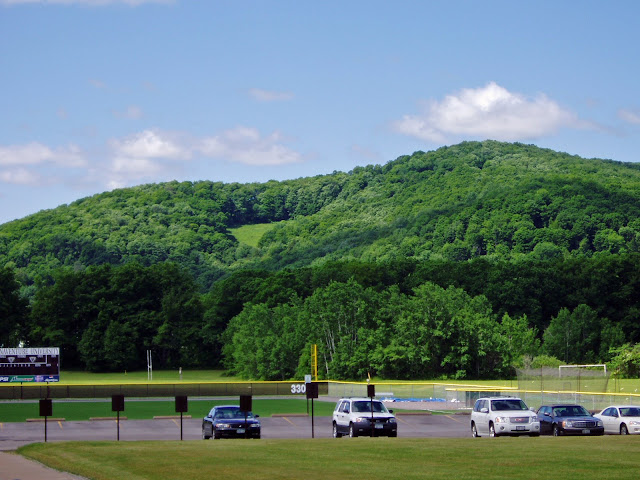
According to an old story, Merton used to love to walk in the woods around campus, where a clearing in the forest – shaped like a heart – remains.

It is visible from a great distance. Those who know of it call it “Merton’s Heart.”

Official sources at St. Bonaventure concur that the story is likely not true – that it’s just a bit of colorful embroidery on the legacy of a famous man.

But there it is. The name remains. It’s even on the walking tour.

“If you come to campus,” said Coughlin, the brother, “you get introduced to Merton’s heart.”

I wanted to post a photo of Merton’s Heart, the clearing mentioned here, but there are only a few online that I could find, which surprises me. This photo is pretty much the exact view from the SBU library’s rear windows (which are gigantic — I really love that building and miss working there sometimes). I often thought about walking up there, but I was never sure where to go or park or if it was even allowed.

Anyway, it’s a really good article, and it quotes a few folks I worked for back in the day. Check it out!

Share This Post

You’re not a special snowflake, Buffalo.

One thing I’ve been thinking of late, with regard to Buffalo’s eternal quest to reinvigorate itself (or just stop the bleeding), is that folks in this area are too convinced of Buffalo’s inherent unique and wonderful nature, and that all we need to do is keep shining the already-existing facets of our little diamond and one day the rest of the world will see how shiny we are.

This seems to me…complete nonsense.

Buffalo has loads of notable architecture. But what city doesn’t?

Buffalo has a vibrant arts scene. But what city doesn’t?

Buffalo has potential for waterfront development. But what city doesn’t?

Buffalo has lots of local colleges turning out fine students. But what city doesn’t?

Buffalo has a long industrial tradition. But what city doesn’t?

About the only thing that Buffalo has that is genuinely unique among American cities — minus a handful — is its proximity to an international border. But Detroit has one, too, and it’s not really helping there, either.

There are a lot of cities in America. Quite a few of them are doing very well, and some, like Buffalo, are not. If all the things we always cite as reasons we should be doing better aren’t getting it done, what does that tell us?

Share This Post

Remember, Buffalo!

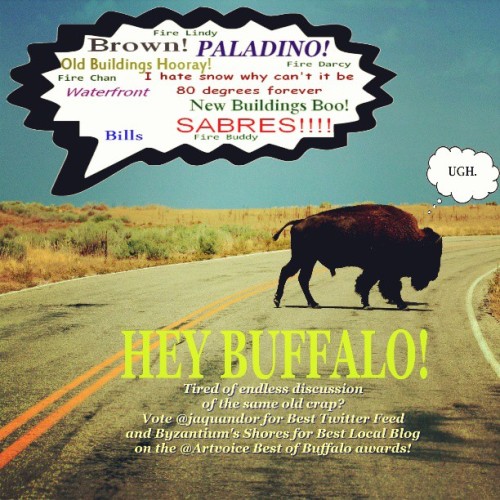
This city seems to have a fetish for old things. Well, Byzantium’s Shores is one of Buffalo’s oldest blogs, dating back to February 2002! In blogging terms, that’s like a house that Tom Jefferson might have walked by on his way to sleeping someplace. Vote for something old, Buffalo! THIS BLOG MATTERS!

(Yes, this is a capricious exercise — but hey, somebody’s gotta try to stand up for personal blogs that aren’t about the Same Old Buffalo Niagara BS!)

Share This Post

PEROT IN ’92!!!

Psst! Hey! Wanna waste your vote?

As far as Buffalo’s recognition of blogs goes, ‘personal’ blogs such as this one might as well not even exist, but hey, a fellow can dream! Or he can pout. Or he can have pouty dreams. Yeah, that’s it! Anyway, go to Artvoice.com for details on how to either join the rest of the sheep or throw your ballot away.

Share This Post