
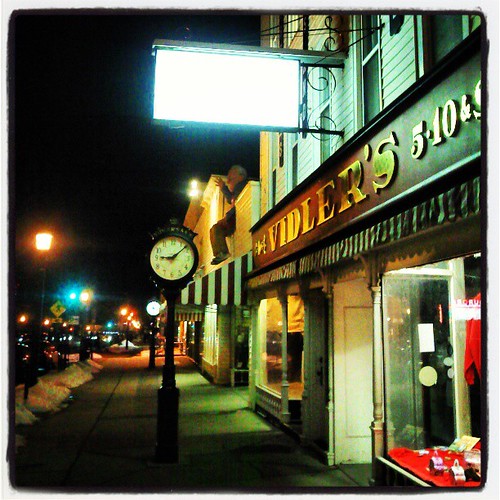
Here’s Vidler’s in East Aurora, NY, after dark. We’d just come out of Firefly Cupcakes, which is right next door. Note the giant statue-golem of Mr. Vidler, looming over all!
A Day at the Farm
Well, it was really cold. So it was really only about 45 minutes.
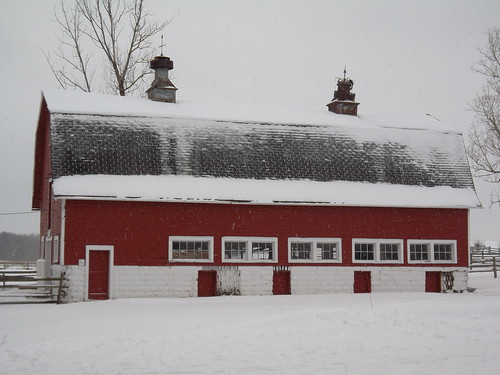
But anyway, the other day I had some time to myself, so I decided to go to Knox Farm in East Aurora to take some pictures. I knew it was cold, but I didn’t figure on how biting the wind was, so I didn’t do nearly as much walking around as I had intended. Mostly I stuck around the farm buildings themselves.
Knox Farm is a former New York State Park that was once the estate of the Knox family, a rich clan that once lived here but has since dispersed. The state never really figured out what to do with the place, park-wise, and then the budgetary disasters that unfolded during the Great Recession gave the state the opportunity to eliminate the farm as a state park. (This despite that they didn’t even have to close State Parks during the Great Depression, but that was then, when America was more willing to levy taxes in order to pay for things we collectively wanted, as opposed to a country that seemingly wants low taxes and not much else. But I digress.)
Anyhow, here are a few of the photos from that day:


Note the cross-country skiers:


These next two turned out cool, because I placed the camera in a dark place, relative to where I was standing. It was not this bright! But it makes me look all science-fictiony or something.


I also drove up to the Mill Road Overlook, which is simply where the road passes by the top of a wide field on a hill, allowing a wonderful view. Some activists are currently trying to secure this property so that it remains a wonderful view, as opposed to the site of yet another boring development of ugly McMansions. The view that day from up there was wonderfully stark, since it was getting on late afternoon by this point.


I really do love this area!
Share This Post
Good morning, Internets!
Winter in the Southern Tier
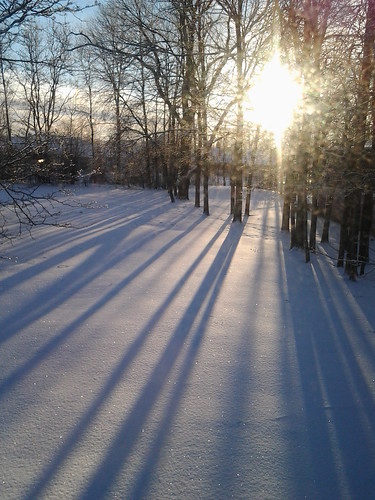
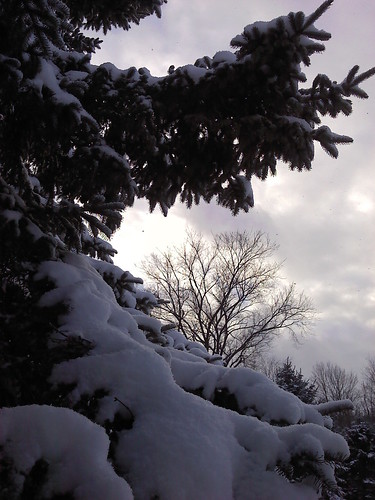
Last week the Family Unit and I were at my parents’ house for several hours, in the Southern Tier of Western New York. There really isn’t much going on down there to live for, but it is a beautiful place, especially in winter. That day it hadn’t yet snowed in the Buffalo region, but down there, they had a pleasant covering. Here are some photos from that day.


Note the snow in my hair.
As I write this, it’s in the 50s and rainy. It’s forecast to hit 60 on Tuesday. Ugh! I like December to be snowy!
Share This Post
“Until that one day, the day I went Crazy, I was fine.”
I finished reading a new book, The Long Walk: A Story of War and the Life That Follows, by Brian Castner, the other day. Since then I’ve been thinking about one question: What good comes from war?
This is one of the great all-time questions, because like all such questions, it doesn’t yield any easy answers. There are many aspects of our world today which can be traced back to this war or that war, this conflict or that one. Some of those aspects are a net positive, while others are not. Our own country sprang into being as a result of a war, it put itself on solid footing as one of the world’s nations in a war, it nearly tore itself asunder and ultimately put itself together as a result of a war. Our country fought a war that led to our becoming an imperial power; our country joined a war that was raging an ocean and a continent away and brought it to a swift end, but was unable to prevent the seeds of the next war from being sown.
L. Fletcher Prouty once wrote, “The organizing principle of any society is for war. The basic authority of a modern state over its people resides in its war powers.” I wouldn’t put it that strongly, but there is something about the fact that so much of our human narrative is the story of war.
So, what good comes from war? One good, from my perspective – although not, perhaps, a good worth spilling rivers of blood to achieve – lies in literature. War inspires great writers to great thoughts and great works. It just does. No matter how sad a statement that may be on our species, it’s a simple fact. The Red Badge of Courage, All Quiet on the Western Front, A Farewell to Arms…there is a long history of great books from war. And not just novels: from World War II, we saw the brilliant work of Ernie Pyle and Bill Mauldin. From the Vietnam era, there were Born on the Fourth of July by Ron Kovic and We Were Soldiers Once…and Young by Harold G. Moore and Joseph Galloway.
What books will our most recent wars inspire? Castner’s is one. I don’t know where it will rank among the great war narratives, but it wouldn’t surprise me if it takes a place among them. This is a searing, brutal, sad, thrilling, visceral, and ultimately saddening memoir of one soldier’s time during the Iraq war.
Castner is a Buffalonian. I’ve never yet met him personally, but I have interacted with him online for a couple of years now, during which he has always struck me as an interesting and intelligent commenter on a lot of topics. He had a blog with WNYMedia.net in which he wrote a lot about the offerings Western New York provides for outdoor enthusiasts; now he blogs at briancastner.com. I didn’t know that he was military man at first, although his original headshot in his WNYM blog made me wonder, looking as it did like a standard military headshot. Over time I realized that he’d served, although he didn’t really discuss the details too much. Only gradually, in that way one does when one interacts in little bits here and there with someone online over a period of time, did I put some details together. Castner served as an EOD specialist. EOD: Explosive Ordnance Disposal.
The EOD is the ‘bomb squad’ of the military. Consisting of members of all four branches of the military, the EODs are the guys who show up to investigate explosions of bombs and to defuse or dispose of active ones. Castner indicates that in other wars, the EOD men are something of a ‘clean up’ crew for after the major combat operations are complete and the country (or some territory of it) has been secured; the EODs are charged with destroying the stockpiles of explosive weaponry left behind by the retreating enemy forces. In Iraq, however, this mission – dangerous enough, but manageable – became much more terrifying once the war shifted from ‘major combat operations’ to ‘counter-insurgency’. The job now requires coming to dispose of active IEDs (Improvised Explosive Device) that have been discovered roadside or in the cities, and also to investigate the ones that have been detonated. This involves sifting through debris, shrapnel, and shredded human remains. In one such episode, they smell the unmistakably strong scent of human excrement, and trace the source to an intact colon, lying in the middle of the street. I’m not sure how long I would have to stare at a colon before I realized what it even was.
This work is staggeringly dangerous, and death does loom over this book, as it must. Castner discusses at length some of the men with whom he serves who never returned. Not all of them are killed by IEDs; the stories of their deaths are heartbreaking tales of things that go wrong in war. Castner tells these tales with a keen sense that, in some cases, there were numerous times when it could have very well been him dying. Speculating on what it must be like to be in an overloaded helicopter that is going down, to know that the bird you’re in is about to crash and that with all your gear on it would take you minutes to get free to save yourself at the same time that you know you only have seconds…Castner’s visceral descriptions bring home as much of the horror of hot, dusty, explosive Iraq as it would be possible for someone who was never there to understand.
My rifle means it’s time to do a job. It’s time to focus, to observe, to stalk, to prepare, to react, to be ready for that constant song: incoming fire. If gunshots per IED call were a batting average, we’d win the Major League title every year. Potshots while driving through town ringing off the side of your truck. Zips and pings while crouched behind your Humvee, building an explosive charge with a cigarette hanging from your mouth and the robot ready to tear downrange. Single shots from a sniper in the center of Hawija. A sustained firefight while clearing a bridge. The soft breath of a stripper blowing on your neck, on the edge of your ear, a tingle across the very surface of your skin, then an answering shout from the .50-cal machine gun mounted on the security Humvee next to you. Gunfire in the distance. Gunfire in ambush. Gunfire to sing you to sleep.
…
Every moment you are being shot at you are blissfully, consciously, wonderfully, tangibly alive in the most basic visceral way imaginable.
Castner structures his book not as a straight-line narrative, but as a series of memories, which at first seem distinct and separate, but which gradually take on an appearance of mosaic. He writes in his Author’s Note:
Everything in this book feels true. It’s as correct as a story can be from someone with blast-induced memory lapses. Nothing was changed to create a moral or to ease discomfort. It’s as real as I can make it, though reality and objectivity sometimes have little to do with one another.
Castner juxtaposes his memories of the war and his service there with equally searing reflections on what his life was like when he returned from war to try and resume the life he had left on hold, only to realize at length that this would not be possible. The war is a constant companion for him, a constant presence that always stalks him. He calls it ‘the Crazy’:
The first thing you should know about me is that I’m Crazy.
…
The second thing you should know about me is that I don’t know how to fix it. Or control it. Or endure from one moment to the next. The Crazy is winning.
What increasingly scares me about war is that it’s only now that we’re really starting to get some kind of notion of the effect that war has on the people who fight it, and the effects that can have on society when we bring those soldiers home and expect them to live and contribute and do all the ‘normal’ things that one does. How much societal strife after past wars might have been traceable to shell shock, or PTSD, or Castner’s ‘the Crazy’? At one point, Castner describes the way a bomb blast physically jolts the brain, the pathology of how a bomb blast speeds up and slows down through whatever medium it traverses, be it air, followed by body armor, followed by flesh, followed by the air inside the body, followed by more flesh on the other side of that air. The mental is the physical, and the physical the mental. It can’t be separated, it can’t be pulled apart. There’s a reason that Brian Castner’s chosen method for beating back ‘the Crazy’ is to run.
The title The Long Walk refers to the walk a EOD man must make when there is no other choice, and it’s time to put on the extremely heavy armored suit and take on the bomb by himself. There is no either-or in this scenario. It’s the ultimate military version of Russian Roulette. It’s the real-life equivalent of all those somewhat clicheed scenes from movies and cop shows where the bomb squad guy has to decide which wire to cut, the red one or the green one. But Brian Castner is on another Long Walk, a longer one, one that doesn’t have a definite end of either an unexploded pile of bomb parts or a detonated IED that’s just taken a soldier with it. There’s a much larger metaphor here that Castner explores, and unfortunately, he can’t really give any definite conclusions, because he hasn’t reached them yet – and there really is no guarantee that he ever will.
I died in Iraq. The old me left for Iraq and never came home. The man my wife married never came home. The father of my oldest three children never came home. If I didn’t die, I don’t know what else to call it.
I liked the old me, the one who played guitar, and laughed at dumb movies, and loved to read for days on end. That me died from a thousand blasts. Died covered in children’s blood. Died staring down my rifle barrel, a helpless woman in the crosshairs and my finger on the trigger. That me is gone.
The new me is frantic and can’t sit still. The new me didn’t laugh for a year. The new me cries while reading bedtime stories to my children. The new me plans to die tomorrow. The new me runs almost every day, runs till knees buckle and fail. The new me takes his rifle everywhere. The new me is on fast-forward. The new me is Crazy.
The new me has a blown-up Swiss-cheese brain, and doesn’t remember all of the old me. But he remembers enough. Enough to be ashamed. Enough to miss the old me. Enough to resent the old me. Resent the way everyone mourns him, while I am standing right in front of them.
Do you remember when Daddy used to? That daddy is gone. He doesn’t do those things anymore. Do you remember when we used to be happy? Husband isn’t happy anymore.
Maybe my wife should pull out the letter I left for my sons and read it to them. Maybe it would explain why Daddy didn’t come home.
When you go to war, and die, and come home Crazy and with a ragged brain, you get to watch your family carry on without you.
Everyone longs for the old me. No one particularly wants to be with the new me. Especially me.
These scenes, in which Castner grapples with his inability to reconcile his new life with the fact of his old one, are deeply saddening, and deeply real. As sharply drawn and visceral as the war parts of the book are, it’s the story of his life at home that I found the most deeply emotional. There is grief in his writing, and his marriage is fraying and he sees one counselor and then another, one shrink and then another. The PTSD diagnosis is not a surprise…but it doesn’t stop there.
Through the book, Brian Castner reveals no easy answers, he doesn’t indicate any particular faith that he will make it through. The book is ultimately haunting because there’s something deeply affecting about seeing a skilled writer penning an elegy, not just to brothers in arms who went with him and never returned except in a box, but to himself.
The Long Walk is an engrossing and heartbreaking read. Castner’s story is not without its hopeful moments, but he’s clear that there really aren’t any answers; there is only life and its sad opposite. I honestly can’t recommend his book highly enough. I sometimes think it’s become something of a cliché in our country to remind others to ‘Thank the troops’. Brian Castner has written a deeply moving and powerful reminder of just part of what it is that we should be thanking those troops for.
(Incidentally, I read The Long Walk in its Kindle edition, via the Kindle app for my new seven inch Samsung Galaxy Tab. It’s the first e-book edition of a full-length book I’ve ever read, so in a way, Brian Castner has served as my inauguration into yet another facet of the twenty-first century.)
Share This Post
The family that fiddles together….
I’ve been forgetting to link this wonderful Mary Kunz Goldman article from the Buffalo News about the Buffalo Philharmonic Orchestra’s newest member of the violin section, but I forget no more!
An audition with the Buffalo Philharmonic Orchestra is always dramatic. But the recent audition the Philharmonic held for a first violinist was more than dramatic. It was historic.
The final round featured only a single anonymous candidate, who played behind a screen, as protocol dictates, while a committee listened closely.
At last, the candidate was approved and could step from behind the screen.
The audition committee gasped.
The mystery violinist was Megan Prokes, the 28-year-old daughter of longtime BPO violinist Robert Prokes. Hired by the BPO’s great former music director Julius Rudel, Robert Prokes recently celebrated 30 years with the orchestra.
Read the whole thing. It’s a lovely story of music in a family.
UPDATE: Wow, talk about timing — I link the original story and Goldman provides an update, on a few other family pairings in the history of the orchestra.
Share This Post
Every building’s sacred….
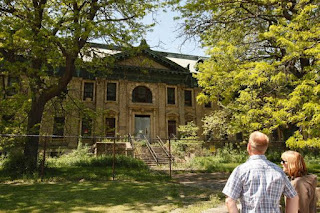
So they want to tear down this building:

That’s the old Bethlehem Steel headquarters building in Buffalo. It’s quite an attractive structure. The problem is that it’s been unoccupied for more than thirty years. And what’s more, it’s not exactly in a great location.

That’s the building, way up in the upper right hand corner. Note that it’s not surrounded by a larger business district or neighborhood; no, this building basically sits on an enormous brownfield that takes up a huge portion of the Buffalo and Lackawanna waterfronts. Bethlehem Steel closed up shop here more than three decades ago, and this building has been empty, unused, and unmaintained in all that time. Now, the city of Lackwanna wants to demolish it.
Enter…as always…the Preservationists.
Here in Buffalo-Niagara, we have a large and vocal contingent of people who are awfully well-meaning, but their main goal seems to be to mobilize anew each time some old building is ‘threatened’. The refrain always comes: Save the building, it’s a part of our heritage, re-use it, et cetera. The odd thing is that this ‘mobilize for the newly threatened building’ approach seems to be the main way of operating; you don’t hear much about pursuing public policies that might make preservation preferable to demolition.
The main problem is that all this preserving ends up contributing to the already uphill battle this region tends to face every time it courts a new business or entertains the growth of an old one, and for me, it’s come to the point where the mobilization of the preservationists just makes me wince every single time. The last few years, my family and I have taken brief trips to other cities in the spring, and it’s always eye-popping to me to see the degree to which other cities are rebuilding and reenergizing and reinventing, even in this economy. But not us. Not Buffalo. Here, we treat every building as though it’s the very place in which George Washington took the oath of office while baptizing Abraham Lincoln and punching Adolf Hitler in the jaw. So much of the ‘historical significance’ seems to often boil down to ‘A successful business stood here for a long time before it either died or went away and nobody since then has had enough money to do something with this building so here it sits, beloved for simply existing.’
Here’s a good example of the foolishness that the preservation instinct around here can lead to. This is the Blue Cross/Blue Shield building in downtown Buffalo. It was erected just a few years ago.

See that odd-looking stone facade at the front of the building? For many years, this entire lot was completely vacant, except for that facade. That was it. Just the facade, no building behind it: a stone facade and a big empty lot, right at downtown’s front door. So when local health insurance company Blue Cross-Blue Shield bought the lot and built their building there, they for some unfathomable reason incorporated that facade into their building in a way that doesn’t ‘incorporate’ at all — it just basically duct-tapes the facade to the building. Every time I drive by there, I think, “That is one of the dumbest looking buildings anywhere.”
Are there great old buildings worth keeping in Buffalo? Sure…but I’m sick of the way we go about it. Just as I’m generally sick of the way Buffalo goes about everything. While other cities rebuild and grow and keep a little bit of heritage while they move into the century we’re living in, Buffalo remains the cruddy hovel in a Monty Python sketch.
Which brings me to this. It’s to be sung to the tune of…well, any Monty Python fan ought to be able to figure it out.
We’ve got tons of old buildings in Buffalo,
Brick buildings, stone buildings and more;
And almost all of those buildings were
built back in days of yore!Yup, we got lots of old places,
they’ve been empty since before you were born,
but we still think that they’re pretty awesome,
like empty towers once full of corn!It might bug you that they are crumbling,
and you might want to build something new,
but don’t even think about demo,
‘cause if you try it we’ll sue!Be-cause….
Every brick is sacred,
Every building’s grand;
We’ll fight to keep them standing,
‘Til they turn to sand!We love old Greek ruins,
crumbling on fields brown;
And we want that look for
our aging, rusting town!Let Milwaukee build things;
Pittsburgh, itself renew;
We’ll stick with closed fact’ries,
And warehouses too.Shuttered buildings thrill us,
new ones make us mad!
Though they’re forever empty,
the old ones make us glad!So stop the demolitions;
our plan, we must endorse!
Though soon, no one will live here,
And things will take their course.Every building’s sacred,
and hist’ry makes them great;
And if you try to wreck one,
we’ll all be quite irate!
(Apologies to Cleese, Chapman, Gillian, Jones, Palin, and Idle.)
Share This Post
Buffalo? Not fashionable? Whoda thunkit!
Some outfit has decided that Buffalo is the ‘least fashionable’ large city in the United States.
I wonder what made them come to that conclusion….
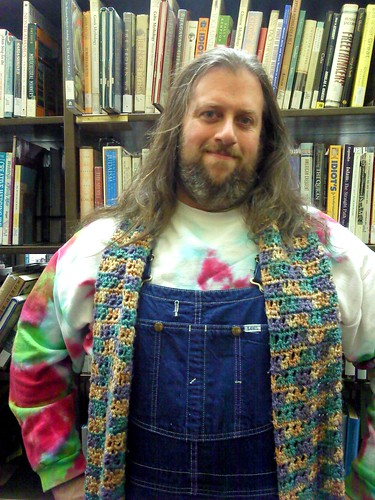
Sorry, Buffalo. I’ll try better.*
* No, I won’t.
Share This Post
Local blogger to Buffalo: Drop Dead!
Chris Smith on the logical end of his years of Buffalo activism:
For the small percentage of people who don’t fit into the above, haven’t moved and aren’t currently planning an escape? You’re a special and unique little snowflake in this town. Try to remain sane as you swim upstream against the ferocious power of the status quo. But here’s a bit of unsolicited advice, stop trying to “save” Buffalo. It doesn’t want to be saved. This city is like an alcoholic, abusive boyfriend. The more you try to save him, the more he drags you down with him. I know, we don’t “know” how sweet he can be when you’re alone together, right? If you just try hard enough, he’ll change.
I wonder occasionally how the onward march of demographics might force change in Buffalo…but that’s the long game, and I’ve never been much of an activist, anyway. Buffalo is where I live, because I have a job here and I’m generally happy already and…well, that’s about it. I have zero interest in running for office, I have zero interest in working in politics in any real way, I don’t plan to be an entrepreneur and start a local business. I think Buffalo will eventually change because nothing stays the way it is forever. That’s not to say that it will change for the better, but other than that…I reached the same point Chris did a long time ago.
Share This Post
Shea's Buffalo at night
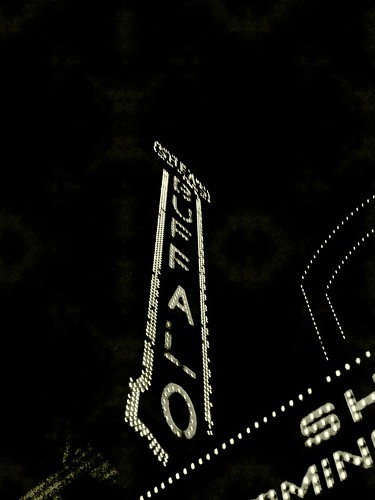

I took this while standing outside the theater, waiting for the doors to open for Les Miserables. I insisted on getting there good and early, which didn’t go over well with The Family, as we ended up standing outside in the wind for fifteen minutes until the doors opened. Not sure why I did that…going to an event at Shea’s isn’t like going to the movies, where you pick your seats when you get there. Oh well…I just chalk it up to being over-excited for Les Miz.
I altered this shot a bit to make it brighter and changed it to B&W and all that…those weird shadow-features just kind of emerged as I did the altering, and I thought they looked kind of cool, so I made no effort to get rid of them.
There are times when I wish I wasn’t a maintenance man by trade…I look at this photo, and the first thing I see is several dozen light bulbs that need changing!