
In the “I should really pay more attention to my surroundings” department, I’ve just spent 45 minutes scrolling backward through the archives of Buffalo Eats, a blog devoted to food in the Western NY region. I had no idea this blog existed. Huzzah!
Snooze
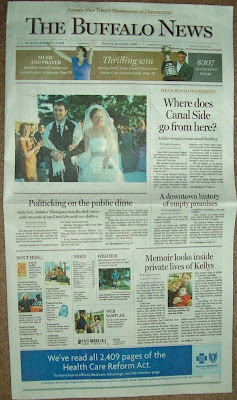
We all know that newspapers are slowly dying away, their readership and functions taken over by new modes of media and news propagation. But it’s always interesting to behold the physical manifestation of newspaper decay. Case in point: the front page of today’s Buffalo News. Here it is:

What’s wrong with this? Well, here’s a list of stuff I spotted off the top of my head when I opened up the paper this morning:
1. The upper half of the above-the-fold section is taken up by the paper’s logo, a giant banner indicating the locations of other stories, and the self-congratulatory “Paper of Distinction” thing at the top.
2. Below the fold, we have an Index to the paper’s sections that takes up, oh, one-fifth of the front page’s entire space. Below that, we have an enormous footer ad for a local health insurance company. I haven’t measured things out, but I’d say that there is almost one-half of the entire front page devoted to stuff that isn’t the news.
3. There are only four stories on the front page. Two deal with the same topic — an important local topic, to be sure, but do both related stories require front page real estate? Of the other two stories present on our front page, one covers some shenanigans by a local politician, and the other previews a book soon to come out by a prominent local citizen (who is only prominent because of who she is married to — Jim Kelly, the guy who retired thirteen years ago as the quarterback of our football team).
Four stories on the front page. That’s it. Four stories, covering three topics. Each topic is of local concern only, and one of those is a human interest story, not news.
National or world stories on the front page today? Zero.
(I am not saying that the News shouldn’t be covering those stories. I’m saying that not one of these seems to me important enough to be a front page story.)
4. Above the fold, we have just a single story. It’s pushed over to the right by a surprisingly large photograph which is almost certainly the first thing you’re looking at when you pick up the paper.
5. That photograph? Well, if you’re paying attention to current events, you know that’s Chelsea Clinton getting married. And you’d have to be paying attention to current events to know that, because the photo is not captioned. At all.
I could probably gripe some more — I find the News‘s regular habit of putting the total dollar amount of the coupons enclosed in all the advertising, right up there above the banner, highly odd — but that all is pretty illustrative, I think. We have a paper that focuses on pretty graphics, lots of colors, white space galore, and not a whole lot of news.
How fare your papers, readers?
Share This Post
Breakfast — the Meal of the Gods
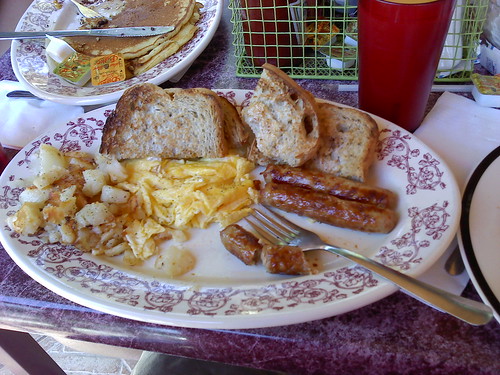
I love food of nearly all varieties, but like a lot of folks, there’s a special place in my heart for breakfast. There’s something awfully nice about a day that starts off with a nice, big, filling breakfast. I’m not partial to any particular item for breakfast: I’ll have my beloved waffles or pancakes with pure maple syrup and a side of some kind of meat, or I’ll have an omelet and homefries, or I’ll go big and get one of those combo breakfast meals that every good breakfast joint has.
The photo above is one of those meals, from one of my absolute favorite breakfast joints: Charlie’s Diner in East Aurora, NY. It’s exactly what it sounds like: a diner, with typical diner grub. Inside there’s seating at a cramped counter and a few tables in the first room, but the place has become so popular over the years that it’s obviously expanded greatly, with additional dining room areas. And best of all is the seating area on the porch out front, where one can sit in shaded fresh air and eat. It’s just a fantastic place. My meal above consisted of two eggs, three sausage links, home fries, toast on homemade bread, and a stack of three pancakes that I couldn’t squeeze into the frame. (The pancakes at the upper left are The Daughter’s.)
I love breakfast because it tends to be the most value-packed of meals. You can get a huge meal, with coffee and OJ, at most places like this for around $10. That’s great, especially when you eat late enough in the morning and you eat enough food to make lunch expendable.
We ate there on a Saturday morning two weeks ago before attending the East Aurora Farmers Market. Farmers markets are some of my favorite things; just wandering around, looking at all the fresh produce and vegetables and plants and flowers and other items is fantastic, and I love being able to hand my money for a head of lettuce to the person who grew it.
Back on the subject of breakfasts, we discovered quite by accident last week a great show on PBS called Breakfast Special. This show spends an hour profiling different kinds of breakfast joints throughout the country, from one of Western New York’s own pancake houses (the Maple Tree Inn, which is only open during maple syrup harvesting season) across the country to a couple of places in Portland, OR. Watching this show made us terribly hungry. If you can find the show on your PBS station, check it out.
Wow, I want to eat some breakfast now…and as I’m writing this, I’ve just finished dinner!
Share This Post
Thoughts on the Taste
This weekend was Buffalo’s annual food festival, A Taste of Buffalo, wherein fifty or sixty area restaurants set up booths in downtown Buffalo and sell sample-sized portions of their menu items. It’s always a fun time; we’ve been going for over ten years now.
The prices have gone up a bit over the years. The way Taste works is this: you never pay the restaurants directly. Instead, you buy tickets at $.50 each (in sheets of ten), and then you “pay” the restaurants in tickets. Small items tend to go for 3 tickets each, mid-items will for for 4, 5, or even 6; most places have a “big” item that goes for 8 tickets. When we first started going, ticket prices at the booths topped out at 6 tickets, so items that were once $3.00 are now $4.00. No big deal, really, but we do budget for it.
Typically we spend between $40 and $60 down there, which isn’t awful, for a family of three. And that’s all food: we take our own drinks, packing a cooler bag with some Pepsis and a lot of water bottles. We also never drop by the beer tents or the wine places — one joint was doing “wine slushies” for fifteen tickets each. We were quite full when we left, even though we got “burned” at one place whose 8-ticket item turned out to be very small indeed. (Oddly enough, it was one of our favorite local restaurants! It was doing barbecue ribs for 8 tickets. I like their ribs, so I plunked down my tickets — and was handed a little paper basket with two ribs in it. Harumph.)
Anyway, we had several slices of pizza from various places, two different versions of Caribbean Jerk chicken, a cup of chicken wing soup, a pulled pork sandwich and some mac-and-cheese from a barbecue joint, as well as some ice cream and a few other goodies along the way. I have noted that there doesn’t seem to be enough “new blood” every year, and we’ve been going to the Taste long enough that we have “old favorites”. The addition of a second place offering Jerk Chicken was pretty cool, though!
We left when the crowds started getting too thick, which usually happens around 3:00 in the afternoon. (There was an awful bottleneck in the street at one point, which turned out to be because Senator Charles Schumer chose the worst possible spot to set up camp for his day of handshaking. It’s always nice to see one’s Senator, but he sure picked a lousy spot to stand!)
There was one other way that the Taste of Buffalo cost us a chunk of money on Saturday. After walking around downtown eating for three-and-a-half hours, we were all pretty tired when we got home. So when dinner time rolled ’round…we decided to get a pizza and some wings instead. There went another thirty bucks! Oh well. It was a great food day, though.
Share This Post
Honey, would you call the color of the sky right now “Marmalade”?
Last Saturday night, The Wife and I attended another concert by the Buffalo Philharmonic Orchestra. This one, however, did not feature classical music; we actually attended a Pops concert. It was called “Classical Mystery Tour”, and it featured the BPO doing songs of the Beatles. I expected orchestral arrangements of Beatles songs, maybe a few singers along the way, and generally a “Beatles turned into classical music” kind of thing.
That’s not what happened, though. It turns out that “Classical Mystery Tour” is the name of a Beatles tribute band that tours around performing with symphony orchestras around the world. This I figured out when we entered the hall to take our seats and saw, at the front of the stage and in front of the orchestra, a rock-band type set-up. “Ooooh, there’s a band!”, I said. And after the BPO warmed things up with a concert overture that was pretty much exactly what I expected the concert to be — Beatles melodies arranged for orchestra — the band came out.
And you know what? They were pretty good. Very good, in fact.
It probably helped us that we were far enough up in the balcony that we could see that the four guys in the band had the general “look” down (four guys in dark suits and mop haircuts), but not their specific facial features that would make it obvious that hey, that dude on the left doesn’t look anything like Paul McCartney at all.
The group’s sound was excellent, for the most part. I liked that they sounded very similar to the Beatles, but they didn’t strive for sounding identical to the Beatles. They did a basic rundown of a lot of the Beatles’ greatest hits, and they used the Philharmonic to great effect, achieving sonic effects from the stage that the Beatles themselves only achieved in the studio.
It was a grand evening, even if I have to cry foul that “Live and Let Die” is not a Beatles song!
Share This Post
Where we’re going
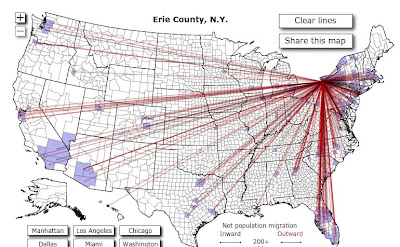
Here’s an interesting little tool that lets you visualize where Americans are moving to. Literally: where they’re moving. According to the site, 10,000,000 Americans moved from one county to another in 2008. This tool lets you visualize the destinations. Red lines indicate outward movement, black ones indicate inward movement.
So, of course, I checked Buffalo. And man, is it depressing. Look at this:

By contrast, I also looked at a place that seems to attract a whole lot of former Buffalonians. Here’s Charlotte, NC:

Of course, no one ’round these parts needs to be told that nobody wants to move here, but seeing it laid out so bare is a hell of a downer.
Share This Post
Rossini, Ravel, and eighty percent of Rachmaninov
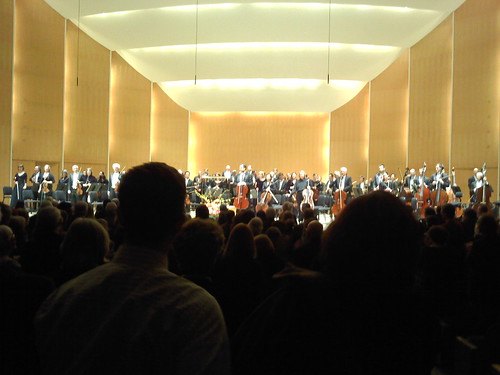


Last night, for the first time in more years than I like to admit, The Wife and I attended a Classics concert by the Buffalo Philharmonic Orchestra. How long has it been? Well…a while. Maximiano Valdes was the music director; the concert we attended back then was conducted by Arie Lipsky, and it wasn’t even at Kleinhans. It was in the auditorium of the high school in Olean, before we were even married.
Yeah, it’s been a while.
Since then, the orchestra has gone through the financial hard times that every orchestra has gone through, but it’s also gone through an artistic revitalization that began when Valdes left and JoAnn Falletta took over. Since then the visibility of the orchestra in cultural circles has gone up dramatically, with new recordings on Naxos and the orchestra’s private label, concerts broadcast on national radio, performances at Carnegie Hall, and so on. This week the orchestra embarks on its first tour — of Florida — since it traveled on a month-long journey to Europe in 1989. Heady, heady times for the BPO!
And yet, we didn’t attend until last night. (We did attend a “Family” program a couple of years back and are going to another in two weeks.) We were gifted some time back by my sister with a gift certificate for orchestra tickets, and the first of the concerts we chose for ourselves was last night’s program. Why that one? Well, because the major work on the program was one of the biggies in my life, a work I’ve referenced many a time in this space over the years. They were playing Rachmaninov’s Symphony No. 2 in E minor, a work without which I could not live, and a work that I know so well that I can quite literally “play” it in my head. More on that later, though.
The first half of the program was utterly wonderful, starting with Rossini’s overture to Semiramide. I confess that I’m not totally up to snuff on my Rossini; aside from William Tell and Barber of Seville, I can’t readily discuss his music much. But this overture was scintillatingly played, featuring some wonderfully deft work by the woodwinds and the horns. I was terrifically impressed with the orchestra’s level of unison playing; Maestro Falletta’s work has clearly made the orchestra play with more precision than I ever remember hearing from them before.
The Ravel Piano Concerto came next. Our soloist was an Italian pianist named Fabio Bidini. I’d never heard of him before, but in my experience, that doesn’t matter one whit. Along with the BPO. he turned in an amazing performance of the Ravel Concerto, a work of many influences: French impressionism mixed with jazz motifs. I’d never heard this work before (in fact, until a few days ago, I thought the orchestra was performing the more famous Ravel Piano Concerto for Left Hand), but I enjoyed it a great deal. It has all the “big Ravel moments” one could ask for, in addition to many quieter, meditative moments, such as the way the second movement is seemingly played halfway through by the solo piano alone, in an effect so captivating that it was almost a surprise when I saw the string players lift their instruments at last. It felt almost like a reverse of Beethoven’s Emperor Concerto, in which the symphonic exposition is so good and so long that when the soloist finally reappears, it almost comes as a surprise.
Mr. Bidini made it very easy to tell that the Ravel had ended, when he exploded out of his seat and was pumping Falletta’s hand even before the clapping had swept through half the hall. Bidini eventually offered an encore, which he did not identify (I believe it was a nocturne or etude by Chopin).
Intermission came, and we had already had a memorable night of music making. And the Rachmaninov Second Symphony was still to come. And sadly, this is where things got a bit problematic.
My first intimation came before the concert even started, when I read the program notes for the piece. The Philharmonic likes to print running times for pieces in the programs, and they indicated that the Rach 2 would take 46 minutes. That made my brow furrow a bit. As I’ve noted, I’ve lived with this piece for over twenty years now, more than half my life, and I’ve heard it performed live once before as well (in college, by the Shanghai Symphony Orchestra). I’ve never once seen a recording of this work that took less than 55 minutes, and some go over an hour, if the conductor’s tempi are particularly broad. To bring this piece in, in 46 minutes? Unless Maestro Falletta was about to set some very quick tempi indeed, there was only one way I knew of that the Rach 2 could be that short.
It goes back to the history of the piece in question. Rachmaninov was the “next in line” in Russian Romanticism in music to Tchaikovsky. Rachmaninov’s problem was that his brand of brooding Russian Romanticism was quickly going out of style. The Second Symphony premiered in 1908; Stravinsky’s game-changing ballet Le sacre du printemps would premiere just five years later. While the Rach 2 was initially a success, over the course of the 20th century Rachmaninov’s music tended to be viewed as anachronistic, especially the poor Second Symphony, whose 60-minute average length seemed to mid-century modernist ears as bloated self-indulgence.
So it was that through most of the 20th century, the Rach 2 was only performed in editions that removed up to twenty minutes of music. Many of these cuts were sanctioned by Rachmaninov himself, although I would be very surprised if these cuts were not somewhat coercive in nature — it was either cut the piece, or never get it played. The era of long symphonic works was, for the most part, over. It wasn’t until the 1970s that conductors started exercising fidelity to Rachmaninov’s original score, starting with Andre Previn in the very 1973 recording that was my eventual introduction to the work. Every recording of the Rach 2 I have ever heard has been made since Previn’s, and every one has been of the complete symphony. In truth, I had simply assumed that the edited version was no more, and that forevermore the Second Symphony would be known in the way that Rachmaninov himself originally conceived and composed it.
Alas, it turns out that the edited version is alive and well and in the hands of the Buffalo Philharmonic.
For me, it was literally like hearing eighty percent of the work. Not a huge amount was cut — they didn’t take an hour work and make it into a 35 minute work — but enough was cut that every time I started to lose myself in the piece, there would be a cut, which would eject me from the piece. I just can’t fathom why Maestro Falletta would have chosen to perform the edited version, except for one possible reason: that the length of concerts is mandated by musician’s union by-laws, and the program simply could not have accommodated the entire piece. If that’s the case, then…well, they should have performed Rachmaninov’s Third Symphony instead, as that one actually is about 45 minutes long.
The orchestra’s sound is amazing — it’s almost as if the orchestra was built to play this kind of repertoire. The winds and the brass complement the strings so wonderfully, and the strings’ sound is so lush, that the Rach 2, at times last night, sounded almost perfect. So why not play the entire piece? Especially to cut the third movement, eliminating the amazing passage where the violins reprise the long melody that had first been sounded by the solo clarinet?
Rachmaninov’s Second is an epic work. That’s the only way I can describe it. It’s the musical equivalent of a long Russian novel. By cutting it, the epic is made smaller, and I don’t understand why. An hour is not abnormally long for a symphony — it’s long, to be sure, but not abnormally so. Beethoven’s Ninth takes 65 to 70 minutes. Berlioz’s Symphonie fantastique tends to clock in at around 55 minutes. I don’t think that Bruckner or Mahler ever wrote a symphony between them that took less than an hour.
The Buffalo Philharmonic played most of the Rachmaninov Second about as well as the piece can be played. I just wish they had played all of it.
Share This Post
Now boarding….

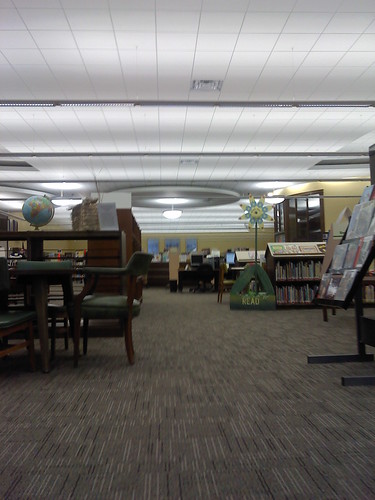
I’ve waxed poetic about the library in my town a bit over the years. Truth to tell, one of my favorite places in any town is the library, and whenever I’ve moved, finding the local library has always been something I do very early on. So the Orchard Park Library has been a major part of my life — our lives, I should say — for all of the seven years we’ve lived here.
That photo, above, is the view I had a couple of weeks ago when I packed up the laptop and went to the library for an afternoon of writing and whatnot. I hadn’t planned to take the photo, actually, but I did when I realized that I’d never seen the library from that vantage point before. Because the library doesn’t have a ton of seating places that are in close proximity to power outlets, I had to sit way over on the far wall, by the fire exit. That’s over in the Children’s section, actually, which is another reason why I don’t spend much time over there. (The Daughter does, but I don’t.) Anyway, the vantage point struck me, the way the carpet pattern seems to mirror the grid of the new drop ceiling. (Our library was remodeled a year ago.)
After I left, when the library closed for the day, I decided to spend a few minutes exploring a place that I’ve often noticed but never really investigated. The library building is directly adjacent the old Orchard Park railroad station, which was pretty rundown when we moved here but has since received a lot of volunteer-based restoration work.

Behind me there is the library itself (and farther behind that, if I weren’t in the way, is my church). If I’d had more foresight that day, maybe I’d have worn the more railroad-appropriate hickory-striped overalls over there, but we can’t have everything, right? To the station itself:

Walking around the corner there, I found myself standing on the boarding platform, looking southeast:

And, of course, the trains running the other way would go toward Buffalo, because all roads lead to Buffalo:

Here’s the front of the station:

The station has a second, smaller building, which is now the permanent home of an old passenger car and a box car. I assume this was a freight depot:

I love the way the light is, on a late wintry afternoon when it’s snowing so that the air looks like it has bits of starlight in it:

By this point I was cold enough, and decided to go warm up with some soup at Panera Bread. But I kept thinking about the old trains that ran through here, so when I got home, to see where the trains ran, so I pulled up Google Maps. The first view is here, but here’s a grab:

It’s a bit hard to see from this resolution, but I wanted to give a hint of a few miles of train route here. On the screen grab, find South Buffalo St; the library and train station are located just up and left of the ‘St.’ label. You can see the train route very clearly, then, tacking off to the southeast, forming, for a short time, the northern boundary of the Orchard Park Country Club.
Tracing the train route from there, using Google Maps’s satellite view, turned out to be a pretty interesting exercise, as the rail route is clearly not in use today. This means that as the route heads into the rural country south and east of the Buffalo-Niagara region, the rail route shows up as a line tracing thinly through forests and at the border of farm fields and so on. At times it seems to disappear altogether, such as where it comes into the small town of Colden. More than a few times I found that I was no longer following a train route and had instead found a stream or some other land feature, and had to double back.
The trick became obvious, once I thought of it: trains can’t turn sharply, so train routes tend to make their curves very widely. This means that when the train route seems to vanish, all one really has to do to find it again is look in a straight line from where it disappeared. Then, finding a faint feature that might be the straight line of an old railroad right-of-way, all you do is follow that feature until you confirm it. Here’s a good spot: note how the automobile road, Route 24, sticks close to the stream there, forming almost a right angle, while our railroad route makes the hypotenuse through the sudden forest there!
The train line stays easy to follow, for the most part, through much of the countryside. I love the way it looks in this spot, a few miles north of Springville, a town at the very southern edge of Erie County, where the Southern Tier begins (if you’re heading south, that is; coming north, Springville is where the Southern Tier ends and Buffalo-Niagara begins). The route is marked by a double line of trees on each side of the rail line. Were those trees planted along the line like that? Or was that just natural tree-growth by virtue of farmers obeying limits on their fields bounded by the trains?
Exiting Springville, I lost the line again, because the terrain down there is hillier and because there are more distractions like roads and rights-of-way for power lines. I almost assumed the train there ended at Springville, but that just seemed odd to me — surely a southbound train wouldn’t stop there, for no apparent reason, and sure enough, it didn’t. Part of my error was again assuming the trains would have run somewhat along the route traced by US Route 219, which it actually doesn’t; a mile or two south of Springville, 219 jigs west a bit while our train route turns east, and crosses the Cattaraugus Creek gorge on a trestle that I never knew was there, even though I’ve driven Route 219 through that area more times than the best hypnotist could get me to remember:

I’ve always tended to assume that when the automobile arose, the roads tended to follow train routes pretty closely; I’d never really considered what now seems pretty obvious, that train routes would often wind through regions now almost never frequented by car. When I started following this route online, I figured the route would likely trace one of the two main southward routes out of the Buffalo-Niagara region, US 219 or NY 16 (which runs about ten miles east of 219). It turns out that the trains ran roughly between them, through towns I have rarely visited in nearly thirty years of living in this area.
Continuing south, I puzzled over the odd fixture here, just south of a town called West Valley. In addition to our railroad right-of-way, it appears that there used to be a couple of spurs that came off the line and back onto it. Those curving interchange-like lines must be artificial; they’re too perfect to be natural. But I can’t see any evidence of what must have once existed at that spot for trains to enter and exit the main line. Was there a factory here? A big granary? A mine? Who knows? If anyone in my readership is familiar with the history of West Valley, NY, let me know!
Anyway, our railroad line continues south until it “ends”, not in a town, but at a junction of a larger rail line, which runs southwest into Ellicottville or northeast to…well, I didn’t follow it that far. But again my assumptions were thwarted; I assumed that this train route out of Orchard Park might lead all the way to Olean in the Southern Tier, but it doesn’t. It just goes to a spot in between, ending in another rail line somewhere in the middle of the hills of the Southern Tier.
I wish the trains still ran.
Share This Post

Connections….
When horrible things happen, after we hear the initial news of the event and the enormity starts to sink in, what happens next is the local connection: what people around here are affected directly, either by their actually being there or having relatives there and the like. It’s very natural, and it always illustrates how closely intertwined this world really is. The earthquake in Haiti seems far away at first, but as always, there are a number of local connections.
The one getting the most coverage here in Buffalo is a woman from West Seneca, a Buffalo suburb just across the street from Casa Jaquandor, who was in Haiti when the earthquake struck. She was there to complete the paperwork on adopting a child from that country. She is safe, as is the child; however, she had to return to Buffalo yesterday without her adoptive son, because there is no functioning government in Haiti right now to issue the kid a passport.
The news is possibly worse for another former Buffalonian, a college professor who used to teach here and who was inside a Port-au-Prince hotel when it collapsed in the quake.
The narratives from Haiti are very sad right now. Here’s hoping they turn the corner as quickly as possible…but this is a country that has almost no infrastructure to handle anything even remotely of this magnitude. It’s unimaginable.
Share This Post
A Walk in the Woods
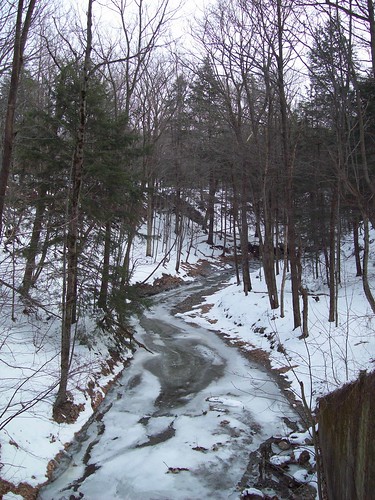
Yesterday I had several hours in the afternoon during which I was alone: The Daughter was elsewhere, and The Wife was at work. So I decided to go back to Chestnut Ridge Park, where we spent some time last week. It’s a place that deserves to be nearer and dearer to my heart than it is, because it’s so beautiful and close and yet I don’t get there all that often.
Chestnut Ridge is a park run by Erie County in the “Southtowns” region, where the terrain starts becoming more hilly as one moves away from the flatlands that surround Lake Erie. The most famous feature of Chestnut Ridge is its giant sledding hill, but it’s a very beautiful natural place, with lots of hiking, riding, Nordic skiing, and snowmobiling trails. Somewhere within its boundaries there is a natural “eternal flame”; that’s high on my list of things to see next year when it starts getting warmer.
Yesterday, I went to a part of the park I’d never been in before. The road follows a ravine to the left, although the ravine is behind a ridge and can’t really be seen from the road. I came to a parking area, where another road split off to the left and went down toward that ravine. The road was gated shut, although quite a few folks were walking past the barries anyway; I suppose the road was only closed to motor vehicles so that the park people could save money by not having to plow it.
That road dropped down to a steel-deck bridge that spanned the ravine. The view above is the upstream side of the bridge; here’s the downstream view.

One thing that always amazes are the signs of life, even in the midst of a wintry forest. Such as this sapling:

I was only out there for about an hour, but what a wonderful hour it was!
