I do not believe that any Bible verse has ever, or shall ever, be given a finer reading than this one, delivered by a child actor named Christopher Shea, who was only seven years old when he did the voice of Linus Van Pelt in A Charlie Brown Christmas.
I’m saddened to learn that Mr. Shea died in 2010, but I truly believe that his voice work as Linus in several of the earliest Peanuts specials is as iconic as anything any actor has ever done.
And with that, we arrive, at last, at Christmas itself. May all of you enjoy the most blessed of Christmases! (The final act of Shiny in the Black: A “Firefly” Christmas will appear sometime later today.)
Walter Cronkite and the Mormon Tabernacle Choir tell the story of the 1914 impromptu Christmas truce between British and German troops on a cold battlefield in World War I. This is one of the saddest, most remarkable tales of our species.
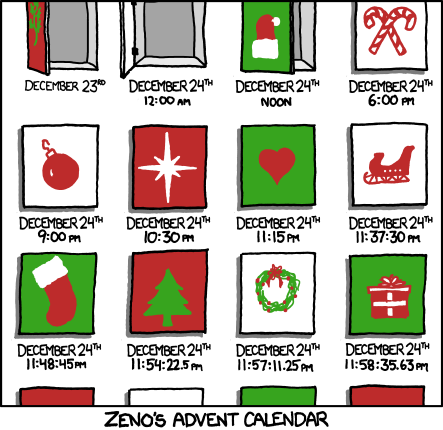
Of course, with typical xkcd brilliance, you must click to the original and read the mouseover text. What made me happy about this comic is that, as a philosophy major in college, I got the joke!
As a shout-out to one of my very favorite people in all Blogistan, Sheila O’Malley, here is the great Mr. Presley.
(It suddenly occurs to me that, with the constant playing of Christmas music this time of year, I almost never hear this song. If it’s Elvis at Christmas, it’s “Blue Christmas”. Which isn’t a bad thing in itself, but Ye Gods, I hate it when artists with wonderful bodies of work get reduced by pop culture to just one or two things.)
There’s little doubt that the work of classical music most closely and obviously associated with Christmas is Tchaikovsky’s ballet The Nutcracker. I’ve long loved the music of this glorious score, and one of my fondest memories of my musical performing life — now long over — is our yearly Christmas concerts with the college symphony, at which we always played the Suite that Tchaikovksy edited down from the complete ballet. This is one of a relatively few pieces of music that is so strongly associated in my mind with a certain time and place that when I hear it, I am transported back to there and then. I close my eyes and envision Dr. Janice Wade, conducting away, and yelling at us at the very end of the “Waltz of the Flowers” when we would invariably try to ritardando in the last couple of bars, a ritardando that was not in the score. Oh well. You’re not a real orchestral musician until you piss off your conductor.
(A ritardando is when the music slows down, either briefly or a gradual slowing to a new tempo. The last bars of the “Waltz of the Flowers” scream out instinctively for a ritard, and some conductors do indeed employ one on that basis — the music seems to inherently call for it. Problem is, Tchaikovsky did not indicate one in the score, and just as many conductors, if not more, nowadays take the view that if the composer wants a given musical effect they will darned well write it, and if they didn’t, then one is to ignore all the ‘instinctive’ stuff and just play the piece as written. Now, when I was a going concern as a musician, I tended to fall into the latter camp, with certain exceptions. A musical effect here and there that might not be written in the score is OK with me, but I had another conductor who would casually make wholesale cuts in pieces we were playing, a practice which infuriated me then and still bugs me now. Take liberties with the tempi, if you must, but damned well play all the notes the composer wrote!)
Here, then, are the composite parts of the Nutcracker suite. (These are not all taken from the same production of the ballet. It’s a mix-and-match.) Incidentally, another reason I loved playing this piece is that it has a lot of neat stuff for the trumpets to do. Many musicians judge a work on the basis of how it treats their particular instrument, so the Nutcracker suite was A-OK in my book. But from my trumpet playing perspective, an all-Mozart program? Fuhgeddaboudit!
This Christmas tribute to Calvin and Hobbes was making the rounds of Facebookland and the Twitterverse over the weekend, and now I bring it to the increasingly forgotten old-world nation of Blogistan.
Cats make everything better. Even Christmas. Well, maybe. Actually, if you met our cats, you might well wonder if any of the pro-cat propaganda out there was founded in any sort of reality whatsoever…but I digress.
Unfortunately, the embedding of the video has been disabled, so you’ll have to follow the link below to see it, but here’s a clip from Love Actually. What’s happening here is that Harry (Alan Rickman) is buying an expensive necklace for a woman in his office. He’s trying to do this quickly and quietly, because the woman is not his wife, who is shopping in the same store with him. But the jewelry counter man (Rowan Atkinson) will not be rushed with the increasingly insane gift-wrapping process.
Watch it here. It’s a great comedic moment, and it’s an interesting one because you’re not sure who you should be rooting for here!