Two hundred forty two

It’s the Fourth of July.

I knew that it would be this way, but damn, America is really making me work for it right now. I keep thinking, not of American things, but of this moment in a movie made by New Zealanders adapting a nearly 80-year-old fantasy novel written by an Englishman:

Frodo: I can’t do this, Sam.

Sam: I know. It’s all wrong. By rights we shouldn’t even be here, but we are.

It’s like in the great stories Mr. Frodo. The ones that really mattered. Full of darkness and danger they were, and sometimes you didn’t want to know the end, because how could the end be happy? How could the world go back to the way it was when so much bad happened?

But in the end, it’s only a passing thing, this shadow. Even darkness must pass. A new day will come. And when the sun shines it will shine out the clearer.

Those were the stories that stayed with you. That meant something. Even if you were too small to understand why. But I think, Mr. Frodo, I do understand. I know now. Folk in those stories had lots of chances of turning back only they didn’t. Because they were holding on to something.

Frodo: What are we holding on to, Sam?

Sam: That there’s some good in this world, Mr. Frodo. And it’s worth fighting for.

I’m not done with America. I’m not giving up.

Another movie moment I keep thinking about:


Share This Post

Larry Havers, and other Memorial Day thoughts

An annual reposting of some things pertaining to Memorial Day. First, a remembrance of a soldier I never knew.

Fifteen years ago I wrote the following on Memorial Day, and I wanted to revisit it. It’s about the Vietnam Veteran whose name I remember, despite the fact that I had no relation to him and clearly never knew him, because he was killed four years before I was born.

Memorial Day, for all its solemnity, has for me always been something of a distant holiday, because no one close to me has ever fallen in war, and in fact I have to look pretty far for relatives who have even served in wartime. Both of my grandfathers fought in World War I, but both had been dead for years when I was born. I know that an uncle of mine served during World War II, but I also know that he saw no action (not to belittle his service, but Memorial Day is generally set aside to remember those who paid the “last full price of devotion”). My father-in-law served in Viet Nam, but my own father did not (he had college deferments for the first half of the war, and was above draft age during the second). So there is little in my family history to personalize Memorial Day; for me, it really is a day to remember “all the men and women who have died in service to the United States”.

One personal remembrance, though, does creep up for me each Memorial Day. It has nothing at all to do with my family; in fact, I have no connection with the young man in question.

When I was in grade school, during the fall and spring, when the weather was nice, we would have gym class outdoors, at the athletic field. On good days we’d play softball or flag football or soccer; on not-so-good days we’d run around the quarter-mile track. But the walk to the athletic field involved crossing the street in front of the school and walking a tenth of a mile or so down the street, past the town cemetery. I remember that at the corner of the cemetery we passed, behind the wrought-iron fence, the grave of a man named Larry Havers was visible. His stone was decorated with a photograph of him, in military uniform. I don’t recall what branch in which he served, nor do I recall his date-of-birth as given on the stone, but I do recall the year of his death: 1967. I even think the stone specified the specific battle in which he was killed in action, but I’m not sure about that, either.

That’s what I remember each Memorial Day: the grave of a man I never knew, who died four years before I was born in a place across the world to which I doubt I’ll ever go. And in the absence of anyone from my own family, Mr. Havers’s name will probably be the one I look for if I ever visit that memorial in Washington. I hope his family wouldn’t mind.

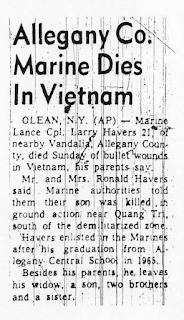
I looked online and found these images, first of Mr. Havers’s obituary and then of Mr. Havers himself. The things you remember. I wonder what kind of man he was. This year he has been gone for half a century. His name is not forgotten.

Mr. Havers’s service information can be found on the Virtual Vietnam Wall here. He was born 14 October 1946 and died 29 October 1967, in Thua Thien.

Next, my annual repost for Memorial Day.

Tomb of Unknown Soldier


Know, all who see these lines,
That this man, by his appetite for honor,
By his steadfastness,
By his love for his country,
By his courage,
Was one of the miracles of the God.

— Guy Gavriel Kay

“The Green Field of France”, by Eric Bogle

Well, how do you do, young Willie McBride,
Do you mind if I sit down here by your graveside?
And rest for awhile ‘neath the warm summer sun,
I’ve been walking all day, and I’m nearly done.
I see by your gravestone you were only 19
When you joined the great fallen in 1916,
I hope you died quick and I hope you died clean
Or, Willie McBride, was it slow and obscene?

Did they Beat the drum slowly, did they play the fife lowly?
Did they sound the death-march as they lowered you down?
Did the band play The Last Post in chorus?
Did the pipes play the Flowers of the Forest?

Did you leave a wife or a sweetheart behind
In some faithful heart is your memory enshrined?
And, though you died back in 1916,
To that faithful heart are you forever 19?
Or are you a stranger without even a name,
Enshrined then, forever, behind a glass pane,
In an old photograph, torn and tattered and stained,
And faded to yellow in a brown leather frame?

Did they Beat the drum slowly, did they play the fife lowly?
Did they sound the death-march as they lowered you down?
Did the band play The Last Post in chorus?
Did the pipes play the Flowers of the Forest?

The sun’s shining down on these green fields of France;
The warm wind blows gently, and the red poppies dance.
The trenches have vanished long under the plow;
No gas and no barbed wire, no guns firing now.
But here in this graveyard that’s still No Man’s Land
The countless white crosses in stand mute in the sand
To man’s blind indifference to his fellow man,
And a whole generation who were butchered and damned.

Did they Beat the drum slowly, did they play the fife lowly?
Did they sound the death-march as they lowered you down?
Did the band play The Last Post in chorus?
Did the pipes play the Flowers of the Forest?

And I can’t help but wonder, no Willie McBride,
Do all those who lie here know why they died?
Did they really believe when they answered the call,
Did they really believe that this war would end wars?
Well the sorrow, the suffering, the glory, the pain
The killing and dying, was all done in vain,
For young Willie McBride, it all happened again,
And again, and again, and again, and again.

Did they Beat the drum slowly, did they play the fife lowly?
Did they sound the death-march as they lowered you down?
Did the band play The Last Post in chorus?
Did the pipes play the Flowers of the Forest?

Share This Post

Three One Four

It’s Pi Day, everyone!

It is also Albert Einstein’s birthday and, sadly, this year’s edition marks the passing of Stephen Hawking, about which I’ll have more to say later. But for now, let’s celebrate Pi!

Calculate Pi yourself!

NASA’s Pi in the Sky Challenge

A few videos:

(That one’s titled “Pi Day” but the video has nothing to do with Pi so far as I can see, but it’s a cool video anyway, so there it is.)

And finally:


Happy Pi Day, everyone!

Share This Post

Thankfulness 2017

I remember it being very difficult to summon up true thankfulness a year ago as it seemed as if a darkness was settling over everything. And it has, to be honest–but it’s not an all-encompassing darkness. There have been encouraging signs, though. People are showing up with lanterns to fight the darkness. After all….


Here’s a list of things for which I am thankful this year:

Carla, the new dee-oh-gee
Cane, the not-as-new dee-oh-gee
Lester and Julio, the really-not-new cats
Rum
Bourbon
Scotch
Gin
Sparkling wine
Paula’s Donuts
Ithaca, NY
Autumn Leaves Books
The Rochester Lilac Festival
Knowing where a bunch of gluten-free restaurants are between here and the Finger Lakes
The Finger Lakes
Letchworth State Park
Taughannock Falls
The Ontario County Antique Mall
Fountain pens
Fountain pen ink
Making waffles
Popcorn with butter
Kettlecorn
Corn dogs
Chiavetta’s chicken barbecue
The Erie County Fair
Hot dogs at Taffy’s
Hot dogs at Ted’s
Hot dogs at home, on the grill
Star Wars
Casablanca
Hayao Miyazaki and the rest of Studio Ghibli
The Scarlet Pimpernel
88 Cups of Tea (podcast)
Functional Nerds (podcast)
Sword and Laser (podcast)
Our backyard firepit
All my various methods of making coffee (pourover, French press, Moka pot)
Mississippi Roast
The Instant Pot (which I still don’t even use as much as I should)
Art and craft shows where I can buy gifts right from the person that made them
Picking out jewelry for The Wife
The Great Lakes region
Pittsburgh, PA (honorary Great Lakes city in my heart)
New York City
The two friends of mine who are finding a lot of new purpose in their lives of late
Chestnut Ridge Park
Sprague Brook Park
Emery Park
Canalside and the Outer Harbor
Knox Farm State Park
The Mill Road Overlook in East Aurora
Roads: US 20A, NY 240, NY 39, Girdle Road, Two Rod Road
Fried chicken
Chicken and waffles
Hot sauce
John Oliver and Last Week Tonight
The Resistance
Hector Berlioz
Sergei Rachmaninov
Alexander Borodin
JS Bach
Ludwig von Beethoven
John Williams
Jerry Goldsmith
Max Steiner
Erich Wolfgang Korngold
Howard Shore
James Horner
All the new authors on my shelf whose works I an thrilled to read
The emergence of so many authors of color and the opportunity to read them and learn from their experiences and perspectives
Goodreads
Twitter (the parts without Nazis)
Harry Potter
My Fair Lady
The Chilling Killing Wind
The Song of Forgotten Stars
Princesses Tariana and Margeth Osono
Lieutenant Penda Rasharri
The characters you haven’t met yet
The characters I haven’t met yet
The days when the writing is easy
The days when the writing is hard
Pies on the table
Pies in my face
Well-worn bib overalls
Stiff raw-denim bib overalls
Vintage bib overalls
The Daughter
The Wife
The world
Our universe

That’s not so bad, is it?

Happy Thanksgiving, everyone!

Share This Post

The Final Victory of JR Ewing, and other thoughts on one year of Trump

One year ago today the American people, by virtue of the country’s very odd system of voting for President, committed what might wind up being known as the greatest act of electoral malpractice in the country’s history.

I.

Donald Trump ran a cynical, mean-spirited campaign that was almost perfectly designed to appeal to the id of every angry white voter in this country. He was the perfect candidate at the perfect time for a party that had been trending this way for decades. Many prominent Republicans have started to notice the rot at the heart of their party, but even now those same prominent Republicans are not coming to any kind of grips with the fact that Trump’s emergence (or the emergence of someone like Trump) is something that many on my side of the political fence have been expecting for years. This past weekend, former President George HW Bush went on record as not approving of Trump or what he represents, but for anyone who has paid attention for years, there’s a line to be drawn connecting Trump to the Lee Atwater-run campaign that got Bush the Elder elected twenty-nine years ago.

I’m reminded of a line from Aaron Sorkin’s script to A Few Good Men, when toward the end of the movie Lt. Kaffee (Tom Cruise) is putting Col. Jessup (Jack Nicholson) on the stand in something of a Hail Mary move:

Lt. Weinberg: And now you think you can get him to just say it?

Kaffee: I think he wants to say it. I think he’s pissed off that he’s gotta hide from this. I think he wants to say that he made a command decision and that’s the end of it.

[Starts imitating Jessup]

Kaffee: He eats breakfast 300 yards away from 4000 Cubans that are trained to kill him. And nobody’s going to tell him how to run his unit least of all the Harvard mouth in his faggoty white uniform. I need to shake him, put him on the defensive and lead him right where he’s dying to go.

That’s what Trump did to the Republican field, and then to the Republican party, and then to a lot of Americans. It’s hard escaping that conclusion, given the sheer glee with which so many people are embracing the ugliest strains of thought that have been bubbling beneath the surface of American society pretty much since the beginning. Trump shook them, put them on the defensive, and then he led them right where they were dying to go.

II. 

Donald Trump knows nothing at all. Nearly every time he opens his mouth about policy, one of three things becomes clear: he knows nothing about it, or he doesn’t give a shit about it, or both. And that’s it. Any policy discussion coming from this man is a nonstarter, and he is enabled in Congress by both houses in control of his own party that has been more and more firmly embracing ignorance across the board for years. It’s clear to me that we’re witnessing a slow unraveling of a lot of what Americans have spent the better part of the last century building. How far this process gets is a matter of concern, but things will be worse before they get better, and all Democrats can hope to do is contain some of the damage. But having one of the two main political parties in the most powerful and richest nation on Earth in the total grip of pure ignorance is a deeply dangerous state of affairs. Right now the main reason that things haven’t fallen off a cliff is that in addition to being a know-nothing, Donald Trump is not especially competent. But this poses dangers of its own. Just looking at the averages, we are due for a recession any year now. When things start going south to a degree that genuinely affects Americans’ livelihoods in a big way, look out.

III.

No, it’s not Hillary Clinton’s fault, either. We’re the ones who make the decision. We’re the ones who cast the ballots. We’re the ones who call the shots, in the end. It’s our fault. Saying anything else reduces elections to the political equivalent of Olympic figure skating, with us as the East German judges: “Sure, she’s more qualified, but she didn’t campaign in Wisconsin enough and she fell on that very last triple Salchow, so what can we do?”

Voting is an action, and actions have consequences. The consequences of America’s vote in 2016 will be felt for decades, and there’s no getting around it.

We screwed up. Everything that happens as a result is our fault.

IV.

As a writer I look at the world through the prism of fiction much of the time, and I can’t help thinking that the rise of a Donald Trump figure is predictable in a country whose popular culture thirty years ago–when today’s adults-in-the-prime-of-life were kids–was so deeply dedicated to celebrating the rich, the powerful, and the businesslike. I can’t help thinking that Donald Trump’s every move should be accompanied by a voiceover by Robin Leach, and I also keep thinking about JR Ewing.

I was a huge fan of DALLAS back in the 80s, and let me tell you, even as you winced at some of the shit JR Ewing pulled, it was really hard not to like the guy. For one thing, Larry Hagman’s portrayal of JR is one of the great marriages of character and actor in teevee history, and for another thing, JR was often the focus of some really good writing. If you’re a writer and you want tips on creating a delicious villain, you could do a lot worse than study JR Ewing (during the show’s first seven or eight seasons, anyway).

But JR Ewing also seems to me redolent of the kind of “businessman” Donald Trump seems to portray himself as, which is the kind of person a lot of Americans seem to think is the way a real businessman is. Business in this view is all about maximizing one’s money, and it doesn’t much matter who gets hurt along the way. Business isn’t about making a thing and selling it, so much as about buying things for no other reason than to sell them again sometime down the line. JR Ewing would cheat and swindle. He would do unethical things, make shady deals, and trick partners into giving him money only to wind up with nothing. And he was a womanizer who repeatedly cheated on his wife.

Did we elect Donald Trump because we loved watching JR Ewing on teevee thirty years ago? I’m not saying that, but it is illustrative to note that Americans have, for most of my lifetime, tended to equate money, and the having of lots of it, as a gauge of intelligence. At one of last year’s debates, Hillary Clinton noted with disdain Trump’s apparent success at avoiding paying taxes decades ago. One would expect that people would find that sickening; I know that I did, since I pay all my taxes. Trump’s caustic reply, though? “That makes me smart.” A lot of people approve of that.

For an awful lot of people, it was not a mark against Trump that he bankrupted a casino, or that his roster of utter failures in business far outstrips his roster of successes, or that his retail brands involved products made in China, or any of that. I suspect this is because of how we view money: we all want it, and in America we seem to inherently respect anyone who has it. We view money as a measure of success, and the lack thereof as a measure of failure. And if Donald Trump has ever done anything, it’s convince lots of people that he has worked himself to the bone in order to pile up gobs of money.

But for all that, Trump has always been playing a part. Yes, he has all that money, but he started off rich, and he has always been adept at failing upwards, using various oddities in US bankruptcy and tax laws to make sure that even when his ventures implode he comes away with more money than with which he went in. I suppose there’s some kind of perverse competence at work there, but for an awful lot of Americans none of that matters. All they see is a filthy rich man who has failed a lot and is still filthy rich, and they think that merely being filthy rich is a qualification in itself for office. It’s the same impulse that drove a lot of people to support Ross Perot in 1992, despite his lack of policy knowledge (and he seemed like a total wonk in comparison to Trump). It’s what led to Mitt Romney’s odd stint at the top of Republican circles — yes, he was a governor for a single term, but he won that by virtue of being a rich guy with a lot of money. This is why the pledge to “run government like a business” seems to carry so much weight with Americans, despite it being pretty much utter nonsense.

My own representative in Congress, Chris Collins, is pretty much worthless from a policy standpoint. He ran for Erie County Executive some years ago, literally entirely on the basis of “I’m a successful businessman,” and he pledged after winning to do some weird business thing called “Six Sigma” in Erie County government, which was going to make everything better. Exactly how was never clear, but hey, he was a businessman! He must know a lot and be really good at running things! Except he wasn’t, and he was defeated after a single term of not getting much done at all except pissing people off.

Of course, this being America where lots of people are impressed by businessmen, Collins was able to turn his failure as County Executive into several terms thus far in Congress (with, I am sure, more to come because his seat is incredibly safe, unless it gets redistricted out of existence).

JR Ewing (and other depictions of business people in the 1980s) shaped our idea of what business looks like and what kind of person is successful at business. This, couple with our idea that business is in itself the finest of callings (remember all the talk of George W. Bush being our “first MBA president”? Remember how well that turned out?). We see being successful at business as having the necessary skillset for anything, and since we also view our government as largely sluggish and incompetent, well then, what better sort of person to cut through all the nonsense and make it all better? Why, a businessperson! That is what we need. Businesspeople are all about getting shit done. They take no crap. Screw up and you’re fired. There’s no time for bureaucracy. (Which will come as news to anyone who has ever tried to cancel cable service.)

Thus we get President Donald Trump, a president who acts like he is the fictional head of a Texas oil company. We don’t expect thoughtful, deliberate process; we expect quick and decisive action of the type that only a businessperson can provide. President Donald Trump is not just the unfortunate (and, it is to be hoped, ultimate) expression of our nation’s sometimes-latent, sometimes-overt racism, sexism, homophobia, and general authoritarianism. He is also the expression of a nation that worships wealth and forgives nearly any sin committed to get it.

Share This Post

Something for Friday: Farewell, Cassini

The Cassini mission has ended with the space probe’s final plunge into the Saturnian atmosphere. We learned a great deal from Cassini — and we will continue to do so as more and more analysis of its data is done — and I find it somewhat of a bright moment in a world where science itself is being deeply undervalued at precisely the time when we need good science most.

Thank you, Cassini.

Share This Post

Sixteen years….

IMG_20170911_111405_683

IMG_20170911_111405_776

IMG_20170911_111405_684


I wrote this story not long after the events of 9-11-01. It is not the story I would write today. How could it be? I was on the cusp of turning thirty, and at that point the scope of an attack of that magnitude was nearly impossible to process.

The City of Dead Works

There is never any rest for me, the Ferryman of the Dead.

I pole my barge across the black waters and up to the pier. So many wait this time, many more than usual. I wonder what has happened, what event has sent me this many. “Come aboard,” I say. “I will take your coin for passage.” One by one they file past me, each handing to me the coin that they never knew they had. It is the coin which determines where they shall be taken to rest, its metal shaped and determined by life. The coins of these dead are gold, every one of them purest gold. Six thousand come aboard my barge, and each has passage for the farthest and greatest of destinations. In that moment I know that something truly dark has happened; the gold coins are always forged in moments of darkness. I am the Ferryman. I can give them no answers to what lies behind their haunted, questioning eyes. I can only take them on this, the last of all journeys.

When they are all aboard I take up the pole and push away from the pier. The barge always feels the same, no matter how many stand upon its decks. Whether six or six thousand, it is all the same to me. I guide us out onto the River Styx. Some of the people look worried, but there is no need for fear. This river can do them no harm. They are already dead.

This is to be a long journey, I know – it always is, to this destination. As I guide the barge through the black waters, I look on the faces of those who have come to me. As different as these people all look, they all have the same expressions of shock, disbelief, and withering sadness. Here is a man of business, talking into a cell phone. He is trying to call someone, anyone, who will tell him that it’s all a dream, that it didn’t happen, that he didn’t die in a blast of fire, smoke, glass and steel. There is a mother who is explaining to her daughter that they won’t be going to Disneyland after all. And there, a group of firemen stand together, realizing that soon they will meet all their brothers-in-arms who have gone into the infernos before them. So many now – colleagues once in business and now colleagues in death, people who have never before met but now have the gravest thing in common. As the current takes hold, I look back at the pier. There are more gathering there. There are always more. They will wait. Time does not exist for the dead.

“Please,” a young man says as he turns to me, “I have to go home to my daughters.”

“You are going home now,” I reply. “To the home where all eventually return.” Two black rocks slide past on either side, the rocks that mark the passage of the circling Styx.

“This can’t be,” a woman cries out. “My mother needs me.”

“She will be with you soon enough.”

“When?” Her voice pleads, and yet there is no solace that is mine to give.

“I cannot say,” I reply. “The Ferryman has no hand in Fate.”

The tears come then, tears from the six thousand that run over the gunwales and into the river which has been fed by tears for centuries. All tears are born in the River Styx.

“Where will you take us?” someone asks.

“To the place you are promised,” I answer. I recall the words of a poet: Will there be beds for all who seek? Yea, beds for all who come.

One our left we approach the Hills of the Damned, an endless stretch of shattered lands which reach away into the blackness. The waters echo with the cries of all those who have been taken to the Hills for the agony they have brought on the living. I consider the bag of six thousand gold coins, and I realize that I will have to journey to the Hills this day. There will be a person, perhaps more, who will pay me with a coin of black tin; but not on this journey. As the hills recede behind us, the unending cries of the damned become fainter and fainter until they are drowned out by the lapping of the waters upon the sides of the boat and the marker stones that we pass. The six thousand fall silent, each realizing that it is not a dream. I would offer solace, but as ever I cannot. I am the Ferryman.

We come around a particularly dark bend, and before us lies a very wide expanse of water, as if the Styx has become an ocean – which in some sense it probably has. And beyond that expanse are the thousands of twinkling lights that I have come to know so well. One man, a fireman, sees them too. “What is that?” he asks.

“It is the City of Dead Works,” I reply. The lights of the city glow on the horizon, and every one of the six thousand turns toward them as the Styx impels us onward. As we come ever closer to the city, the glittering lights reflect off the black water.

“I don’t understand,” someone else says. “The City of Dead Works?”

“Aye,” I reply. “Behold!”

From behind us, golden light: the Sun of the Dead is rising as it always does when the dead come near the City. Above us the firmament is turning purple, then blue; soon the light of the Sun will illuminate the City of Dead Works. As the sky lightens, the true scope of that city becomes plain: it stretches away into the land, farther than any eye could see. Not even the highest-soaring raven, cavorting in the breezes and zephyrs of the dead, could take it all in. It is bigger by far than any one city ever built by the hand of men, because it encompasses some part of all of them. Perhaps it is bigger than all of the cities ever built. Now the sun’s first rays come up behind us, and the first buildings can be seen down by the water.

“That one looks Egyptian,” a woman says.

“The Great Library of Alexandria,” I tell her. “Once the greatest repository of learning the world had ever seen, now only a memory to the living and a reality only to the dead.”

A man points to a building high upon a rock. I nod.

“The Temple of Solomon,” I say.

“There are ships in the harbor,” says another. Thus for him I name the ships: Arizona, Indianapolis, Lusitania, Bismarck, Wilhelm Gustloff, Cap Arcona. And many, many others. I scan over the impossibly vast city and spot Dresden, as it was; and beside it the cities of Hiroshima and Nagasaki. And how many smaller villages, tucked into the hills beyond the City? None can say. The Sun of the Dead shines upon those hills now, and the great stone statues in the likeness of Siddhartha Gautama.

“I don’t understand,” a young man says. “Why this City? Why here?”

I only shake my head as we continue to float by the City. I do not point out the fairly small, nondescript office building that sits near the water. It is not a particularly remarkable building; nor was it, really, until the fuse was lit. The six thousand almost don’t recognize it.

Almost.

Not one word is uttered as we slide past the Alfred Murrah Federal Building. Then we turn away from the City of Dead Works, and head again down the waters of the Styx toward distant hills and the place where these people will join their brethren.

“Who lives in that city?” It is a priest in a fireman’s coat.

“No one lives there,” I tell him. “The City of Dead Works is not for people. It is for the buildings and the ships. It is for the books and the music, the sculptures and the paintings which are gone forever. It is for everything destroyed by craven people in the name of foolish wars, for everything judged forfeit in the face of transitory desires.”

The Styx takes us into the Golden Hills. Soon we will be there, and the six thousand will go where they belong. And then the Styx will complete its circle, taking me back to the pier where more dead await.

“We will be there soon,” I say. “Soon we will be at the Elysian Fields, where all heroes go – for that is what you all are. It is what you have bought with your lives, with the shaping of your coins into gold.” No one replies. We near the last bend now, and before us lie the Elysian Fields, where peace reigns and where heroes dwell; where all is light and voices are always raised in song. The Sun of the Dead shines warmly on Elysium.

But they do not see it. They, the six thousand, all gaze back behind us upon the City of Dead Works. It will soon be behind us forever as we round the last bend of the River Styx into Elysium. I know they all need one last look upon that City, and I do not grudge them that. For myself, I do not look back; the eyes of the Ferryman are ever forward. But I know. I know that the City of Dead Works is different now. I know that it has changed. I know that the people who come with me now to Elysium, the dead around me, look back on the two soaring towers of steel that now rise above the City where there had been no towers before.

I know these things.

I am the Ferryman of the Dead.

Share This Post

On Immigration

As His Malevlonece, Mr. Trump, the President, is preparing to enforce an immigration policy that only a person who thinks that America is at its best a “Whites Only” club could love, here are my thoughts on immigration.

I believe that our nation’s immigration policy should make it easier, not harder, for the peoples of the world to come here.
To work here.
To learn here.
To raise families here.
To find safety and shelter here.
To live here.
To practice their religions here.
To continue to do as immigrants have always done: enrich the country and make it wiser and better.

This I believe.

Share This Post