National Pie Day!

Today is National Pie Day, huzzah!


Sadly, this is also the day that the Captain and Tennille announced that they are divorcing, which I find quite a bummer. But I can tie that into National Pie Day, too:


Happy National Pie Day, folks!

Share This Post

Pursuing Capital

A bit of politics here, after the break. Keep scrolling if you don’t want one of my rare bursts of liberalism in this space!

On we go….

I’ve seen three articles online in the last week that have really expressed well my increasing trouble with the idea that we need to rely on free-market capitalism, and only free-market capitalism, to solve all of our various problems.

First, this by Henry Blodgett, speaking against the notion of rich people as “job creators”:

As America struggles with high unemployment and record inequality, everyone is offering competing solutions to the problem.

In this war of words (and classes), one thing has been repeated so often that many people now regard it as fact.

“Rich people create the jobs.”

Specifically, by starting and directing America’s companies, entrepreneurs and rich investors create the jobs that sustain everyone else.

This statement is usually invoked to justify cutting taxes on entrepreneurs and investors. If only we reduce those taxes and regulations, the story goes, entrepreneurs and investors can be incented to build more companies and create more jobs.

This argument ignores the fact that taxes on entrepreneurs and investors are already historically low, even after this year’s modest increases. And it ignores the assertions of many investors and entrepreneurs (like me) that they would work just as hard to build companies even if taxes were higher.

But, more importantly, this argument perpetuates a myth that some well-off Americans use to justify today’s record inequality — the idea that rich people create the jobs.

[snip]

The prevailing story that justifies tax cuts for America’s entrepreneurs and investors is that the huge pots of gold they take home are supposed to “trickle down” to the middle class and thus benefit everyone.

Unfortunately, that’s not the way it actually works.

First, America’s companies are currently being managed to share the least possible amount of their income with the employees who help create it. Corporate profit margins are at all-time highs, while wages are at an all-time low.

Second, as Hanauer observes, America’s richest entrepreneurs, investors, and companies now have so much money that they can’t possibly spend it all. So instead of getting pumped back into the economy, thus creating revenue and wages, this cash just remains in investment accounts.

Read the whole thing.

Second, this by David Simon, creator of the highly-regarded teevee series The Wire (which I have not seen). This article is a nearly pitch-perfect summation of what I believe.

Labour doesn’t get to win all its arguments, capital doesn’t get to. But it’s in the tension, it’s in the actual fight between the two, that capitalism actually becomes functional, that it becomes something that every stratum in society has a stake in, that they all share.

The unions actually mattered. The unions were part of the equation. It didn’t matter that they won all the time, it didn’t matter that they lost all the time, it just mattered that they had to win some of the time and they had to put up a fight and they had to argue for the demand and the equation and for the idea that workers were not worth less, they were worth more.

Ultimately we abandoned that and believed in the idea of trickle-down and the idea of the market economy and the market knows best, to the point where now libertarianism in my country is actually being taken seriously as an intelligent mode of political thought. It’s astonishing to me. But it is. People are saying I don’t need anything but my own ability to earn a profit. I’m not connected to society. I don’t care how the road got built, I don’t care where the firefighter comes from, I don’t care who educates the kids other than my kids. I am me. It’s the triumph of the self. I am me, hear me roar.

That we’ve gotten to this point is astonishing to me because basically in winning its victory, in seeing that Wall come down and seeing the former Stalinist state’s journey towards our way of thinking in terms of markets or being vulnerable, you would have thought that we would have learned what works. Instead we’ve descended into what can only be described as greed. This is just greed. This is an inability to see that we’re all connected, that the idea of two Americas is implausible, or two Australias, or two Spains or two Frances.

[snip]

We have become something other than what we claim for the American dream and all because of our inability to basically share, to even contemplate a socialist impulse.

Socialism is a dirty word in my country. I have to give that disclaimer at the beginning of every speech, “Oh by the way I’m not a Marxist you know”. I lived through the 20th century. I don’t believe that a state-run economy can be as viable as market capitalism in producing mass wealth. I don’t.

I’m utterly committed to the idea that capitalism has to be the way we generate mass wealth in the coming century. That argument’s over. But the idea that it’s not going to be married to a social compact, that how you distribute the benefits of capitalism isn’t going to include everyone in the society to a reasonable extent, that’s astonishing to me.

And so capitalism is about to seize defeat from the jaws of victory all by its own hand. That’s the astonishing end of this story, unless we reverse course. Unless we take into consideration, if not the remedies of Marx then the diagnosis, because he saw what would happen if capital triumphed unequivocally, if it got everything it wanted.

And one of the things that capital would want unequivocally and for certain is the diminishment of labour. They would want labour to be diminished because labour’s a cost. And if labour is diminished, let’s translate that: in human terms, it means human beings are worth less.

[snip]

Mistaking capitalism for a blueprint as to how to build a society strikes me as a really dangerous idea in a bad way. Capitalism is a remarkable engine again for producing wealth. It’s a great tool to have in your toolbox if you’re trying to build a society and have that society advance. You wouldn’t want to go forward at this point without it. But it’s not a blueprint for how to build the just society. There are other metrics besides that quarterly profit report.

The idea that the market will solve such things as environmental concerns, as our racial divides, as our class distinctions, our problems with educating and incorporating one generation of workers into the economy after the other when that economy is changing; the idea that the market is going to heed all of the human concerns and still maximise profit is juvenile. It’s a juvenile notion and it’s still being argued in my country passionately and we’re going down the tubes. And it terrifies me because I’m astonished at how comfortable we are in absolving ourselves of what is basically a moral choice. Are we all in this together or are we all not?

Read that whole thing, too.

Finally, local blogger and friend Alan Bedenko provided a bit of graphical information yesterday demonstrating pretty conclusively that America’s thirty-plus year experiment with supply-side economics has simply not produced the kind of overall economic prosperity that’s been promised. What has happened instead is a relentless upflow of money that is causing less social mobility than ever before.

The libertarian response would be one of two answers: first, we just haven’t made the markets free enough yet and only by remaining the final shackles will we create a tide that really lifts all boats, or second, the freedom of the markets is so inherently good and important that they actually supersede the real economic problems they create. Quite the bit of doublethink there: “Our prescription will solve a problem that in our hearts we don’t really believe is a problem at all.”

The worst thing is that there is now an entire generation of Americans who have grown up and internalized this bullshit and who think that this is the natural order of things, the way it’s supposed to run. Huge amounts of economic inequality and instability? Features, not bugs.

Will it ever change? Of course it will. The pendulum always swings. I just hope I get to see it start to swing back in my lifetime.

Share This Post

Thankfulness: I has it!

Mosaic of Thanks

Here, with my usual additions sprinkled throughout, is my updated list of things for which I am thankful. It is not exhaustive!

Cape May, Lucky Bones (restaurant in Cape May), Cheddar cheese so sharp it makes you pucker, Sesame crackers, Our azalea plant, Our ivy plant, Cats, Get Fuzzy, blogs, George Lucas, Star Wars, our dining room table, Klein screwdrivers, flashlights, William Shatner, Sela Ward, Mary Stewart’s Arthurian trilogy, Miles Vorkosigan by Lois McMater Bujold, Stephen King, the Kushiel series by Jacqueline Carey, the hardware store in my old hometown, angle grinders, Dremel rotary tool, Star Trek, Sergei Rachmaninov, The Beatles, Van Halen, glass growler bottles for beer, baked pasta dishes, pizza (thin, Buffalo-thick or deep dish, it’s all great!), cookies, Harry Potter, Guy Gavriel Kay, Space opera, Planetary Romance, Chestnut Ridge Park, big thick poetry collections, Jerry Sullivan (Buffalo News sports columnist), Instagram, my drill, Schopp and the Bulldog (Buffalo sports talk radio guys), Fried chicken, Italian sausage, that I have finally seen Les Miserables on stage and screen, that Star Wars is coming back, Harrison Ford, Canada and Canadians, the poetry of Tennyson, the Buffalo Philharmonic Orchestra, Brian and Stewie on The Family Guy, Everyone who ever acted in a Harry Potter movie at all ever, Joss Whedon, steak, chess, comics, big breakfasts that leave me full until mid-afternoon, light breakfasts that take the edge off until a nice lunch, Firefly, Battlestar Galactica, The Mentalist, Tasting something good at a restaurant and figuring out how to make it at home, Ice cream at the roadside place down the road, The County Fair, the farm exchange thing we joined this year, Libraries, JRR Tolkien, Route 20-A in the fall, Sandals, the scissor jack at work, Locke Lamora and Jean Tannen, Once Upon a Time, Lana Parilla, Monty Python, aquariums, science museums, The Origin of Species, Cosmos, Carl Sagan, complete collections of Shakespeare (I own six, plus the one on my tablet!), thick fuzzy socks in winter, eggs, watching the Super Bowl, watching figure skating, the Olympic games, Person of Interest, Autumn Leaves Used Books in Ithaca, the Ithaca Apple Harvest Festival, white peaches, getaways with The Wife, holding The Wife’s hand, the second chapter of Luke, Asian Star restaurant in West Seneca (they do gluten-free really well), Chipotle Mexican Grill, Arriba Tortilla in East Aurora, Edgar Allan Poe, Firefly Cupcakes in East Aurora, discovering new authors, Liking books on the re-read that I didn’t like the first time, Sherlock, Benedict Cumberbatch, Martin Freeman, Daniel Craig as James Bond, George Lazenby as James Bond, Sean Connery as James Bond, Roger Moore as James Bond, Timothy Dalton as James Bond, Pierce Brosnan as James Bond, my cell phone, my new tablet, embracing brighter colors in my wardrobe, the Burchfield Nature and Art Center, The Daughter getting better each year on her string bass, John Williams, Hector Berlioz, Toronto, Pittsburgh, Having no idea what to get The Wife for Christmas, Castle and Beckett, Nathan Fillion, Stana Katic, Kat Dennings, Melissa Rauch, The Big Bang Theory, Dr. Sheldon Cooper, “[knock knock knock] Penny? [knock knock knock] Penny? [knock knock knock] Penny?”, A Tale of Two Cities, Thin-mint Girl Scout Cookies, Roast turkey, Chicken wings, Rum (particularly spiced), Coke, Anthony Bourdain, Rachel Maddow, Cake Boss, Nate Silver, George Carlin, Hayao Miyazaki, President Obama (on balance), Zooey Deschanel, my wok, pies in the face, pies in my face, bib overalls, Carhartt overalls, dollops of whipped cream on my overalls after getting hit in the face with a pie, cooking, Lester, Julio, Comet, writing, Princesses In SPACE!!! (not the actual title), Princesses II: Princesses Boogaloo (not the actual title), GhostCop (not the actual title), Lighthouse Boy (not the actual title), NaNoWriMo, connecting with other writers via social networks, friends willing to read my writing, people who don’t mind associating with me even with all the weirdness I bring to the table, All who read this blog, a future that feels bright, Baby Fiona, Little Quinn, The Daughter, The Wife, and this whole wild and wacky Cosmos from which we spring.

May you all, each and every single one of you, enjoy a happy Thanksgiving and may the coming year bring more things of Thankfulness than the last!

Share This Post

“Don’t forget your dying King.”

I was born a little less than eight years after President Kennedy’s assassination, so I don’t have any direct memories of that event. But the shockwaves that event has sent through time are truly amazing to behold, even to this day. I don’t know where those shockwaves lead, but it occurs to me that our country is now run by people who grew up with the knowledge that a President could be violently removed from office. That’s the kind of thing that colors the world in a way that we don’t often realize.

Who do I think killed President Kennedy? Does it really matter?

Share This Post

All good things must end…even local breakfast joints

Terrific article about the closing of a beloved local restaurant in Indiana:

On the last morning, before the waffle irons went cold and the pictures came down, before the lock refused to lock, before the claw crashed through the roof, the old man paced.

Tap, tap, tap. Bud Powell’s aluminum cane led the way as he circled the floor of Bloomington’s Waffle House. His Waffle House.

That Wednesday in September, the owner didn’t know what to do with himself. The smell of frying oil, the same greasy perfume that had greeted customers for 46 years, wafted into his nose as he wandered past the vinyl booths. He sat down, then stood
up again.

Bud — everyone called him Bud — checked on the dwindling supply of breakfast sausage, peered into the nearly empty freezers, tried to explain to his regulars why it had to be this way.

“It’s time,” he said over and over.

Do read the whole thing. It’s a very good piece of writing. It seems to me that there needs to be a name for this mini-genre of writing, in which writers make you miss places you’ve never been.

Share This Post

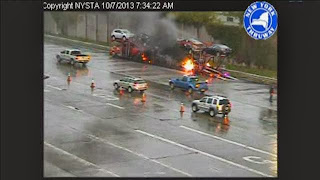
You think YOUR Monday sucks?

I wonder how long it took this truckdriver to figure out what to say in his phone call to his employers.

I’ve been fond, for a couple of years, of the metaphor of a “tire fire” for something that’s going incredibly poorly. This driver, though, gets to use that phrase literally. That’s a bad day, folks.

Share This Post

The City of Dead Works (a repost)

I wrote this not long after the awful events of 9-11-01, and I repost it every year on that date, marking the time as one of America’s worst days makes its inevitable transition from Memory into History.

“The City of Dead Works”

There is never any rest for me, the Ferryman of the Dead.

I pole my barge across the black waters and up to the pier. So many wait this time, many more than usual. I wonder what has happened, what event has sent me this many. “Come aboard,” I say. “I will take your coin for passage.” One by one they file past me, each handing to me the coin that they never knew they had. It is the coin which determines where they shall be taken to rest, its metal shaped and determined by life. The coins of these dead are gold, every one of them purest gold. Six thousand come aboard my barge, and each has passage for the farthest and greatest of destinations. In that moment I know that something truly dark has happened; the gold coins are always forged in moments of darkness. I am the Ferryman. I can give them no answers to what lies behind their haunted, questioning eyes. I can only take them on this, the last of all journeys.

When they are all aboard I take up the pole and push away from the pier. The barge always feels the same, no matter how many stand upon its decks. Whether six or six thousand, it is all the same to me. I guide us out onto the River Styx. Some of the people look worried, but there is no need for fear. This river can do them no harm. They are already dead.

This is to be a long journey, I know – it always is, to this destination. As I guide the barge through the black waters, I look on the faces of those who have come to me. As different as these people all look, they all have the same expressions of shock, disbelief, and withering sadness. Here is a man of business, talking into a cell phone. He is trying to call someone, anyone, who will tell him that it’s all a dream, that it didn’t happen, that he didn’t die in a blast of fire, smoke, glass and steel. There is a mother who is explaining to her daughter that they won’t be going to Disneyland after all. And there, a group of firemen stand together, realizing that soon they will meet all their brothers-in-arms who have gone into the infernos before them. So many now – colleagues once in business and now colleagues in death, people who have never before met but now have the gravest thing in common. As the current takes hold, I look back at the pier. There are more gathering there. There are always more. They will wait. Time does not exist for the dead.

“Please,” a young man says as he turns to me, “I have to go home to my daughters.”

“You are going home now,” I reply. “To the home where all eventually return.” Two black rocks slide past on either side, the rocks that mark the passage of the circling Styx.

“This can’t be,” a woman cries out. “My mother needs me.”

“She will be with you soon enough.”

“When?” Her voice pleads, and yet there is no solace that is mine to give.

“I cannot say,” I reply. “The Ferryman has no hand in Fate.”

The tears come then, tears from the six thousand that run over the gunwales and into the river which has been fed by tears for centuries. All tears are born in the River Styx.

“Where will you take us?” someone asks.

“To the place you are promised,” I answer. I recall the words of a poet: Will there be beds for all who seek? Yea, beds for all who come.

One our left we approach the Hills of the Damned, an endless stretch of shattered lands which reach away into the blackness. The waters echo with the cries of all those who have been taken to the Hills for the agony they have brought on the living. I consider the bag of six thousand gold coins, and I realize that I will have to journey to the Hills this day. There will be a person, perhaps more, who will pay me with a coin of black tin; but not on this journey. As the hills recede behind us, the unending cries of the damned become fainter and fainter until they are drowned out by the lapping of the waters upon the sides of the boat and the marker stones that we pass. The six thousand fall silent, each realizing that it is not a dream. I would offer solace, but as ever I cannot. I am the Ferryman.

We come around a particularly dark bend, and before us lies a very wide expanse of water, as if the Styx has become an ocean – which in some sense it probably has. And beyond that expanse are the thousands of twinkling lights that I have come to know so well. One man, a fireman, sees them too. “What is that?” he asks.

“It is the City of Dead Works,” I reply. The lights of the city glow on the horizon, and every one of the six thousand turns toward them as the Styx impels us onward. As we come ever closer to the city, the glittering lights reflect off the black water.

“I don’t understand,” someone else says. “The City of Dead Works?”

“Aye,” I reply. “Behold!”

From behind us, golden light: the Sun of the Dead is rising as it always does when the dead come near the City. Above us the firmament is turning purple, then blue; soon the light of the Sun will illuminate the City of Dead Works. As the sky lightens, the true scope of that city becomes plain: it stretches away into the land, farther than any eye could see. Not even the highest-soaring raven, cavorting in the breezes and zephyrs of the dead, could take it all in. It is bigger by far than any one city ever built by the hand of men, because it encompasses some part of all of them. Perhaps it is bigger than all of the cities ever built. Now the sun’s first rays come up behind us, and the first buildings can be seen down by the water.

“That one looks Egyptian,” a woman says.

“The Great Library of Alexandria,” I tell her. “Once the greatest repository of learning the world had ever seen, now only a memory to the living and a reality only to the dead.”

A man points to a building high upon a rock. I nod.

“The Temple of Solomon,” I say.

“There are ships in the harbor,” says another. Thus for him I name the ships: Arizona, Indianapolis, Lusitania, Bismarck, Wilhelm Gustloff, Cap Arcona. And many, many others. I scan over the impossibly vast city and spot Dresden, as it was; and beside it the cities of Hiroshima and Nagasaki. And how many smaller villages, tucked into the hills beyond the City? None can say. The Sun of the Dead shines upon those hills now, and the great stone statues in the likeness of Siddhartha Gautama.

“I don’t understand,” a young man says. “Why this City? Why here?”

I only shake my head as we continue to float by the City. I do not point out the fairly small, nondescript office building that sits near the water. It is not a particularly remarkable building; nor was it, really, until the fuse was lit. The six thousand almost don’t recognize it.

Almost.

Not one word is uttered as we slide past the Alfred Murrah Federal Building. Then we turn away from the City of Dead Works, and head again down the waters of the Styx toward distant hills and the place where these people will join their brethren.

“Who lives in that city?” It is a priest in a fireman’s coat.

“No one lives there,” I tell him. “The City of Dead Works is not for people. It is for the buildings and the ships. It is for the books and the music, the sculptures and the paintings which are gone forever. It is for everything destroyed by craven people in the name of foolish wars, for everything judged forfeit in the face of transitory desires.”

The Styx takes us into the Golden Hills. Soon we will be there, and the six thousand will go where they belong. And then the Styx will complete its circle, taking me back to the pier where more dead await.

“We will be there soon,” I say. “Soon we will be at the Elysian Fields, where all heroes go – for that is what you all are. It is what you have bought with your lives, with the shaping of your coins into gold.” No one replies. We near the last bend now, and before us lie the Elysian Fields, where peace reigns and where heroes dwell; where all is light and voices are always raised in song. The Sun of the Dead shines warmly on Elysium.

But they do not see it. They, the six thousand, all gaze back behind us upon the City of Dead Works. It will soon be behind us forever as we round the last bend of the River Styx into Elysium. I know they all need one last look upon that City, and I do not grudge them that. For myself, I do not look back; the eyes of the Ferryman are ever forward. But I know. I know that the City of Dead Works is different now. I know that it has changed. I know that the people who come with me now to Elysium, the dead around me, look back on the two soaring towers of steel that now rise above the City where there had been no towers before.

I know these things.

I am the Ferryman of the Dead.

Finis.

Share This Post