The Odd Pathology of the Politician’s Mind

Here’s something that I’ve been thinking about all day. It’s a video of Senator Ted Cruz cheerfully walking up the aisle at Yankee Stadium, as Yankee fans make their opinions of him loudly known, right to his face.

There’s a LOT of very salty language here, so be careful…but what gets me here is Cruz’s demeanor here. He looks like he’s having the time of his life and that he’s surrounded by loved ones and supporters who can’t get enough of him or his presence…and nobody, not one single solitary soul, is the least bit happy to see him. At all.

I get that politicians have to cultivate a thick skin and all, and that this sort of thing is probably par for the course sometimes. But there’s just something about Cruz here that…how can I put this…it’s like he has a mental ability to simply remove it from his perception. He’s acting as if he genuinely doesn’t even notice this reaction. It’s not the mean enjoyment of it that wafts from Mitch McConnell’s body like a putrid death-stench; Cruz doesn’t strike me as enjoying being this hated. He strikes me as being completely unaware of it.

I guess this isn’t terribly surprising, given his history of sycophantic groveling and his cheerfulness as he spouts complete and utter nonsense that is so redolent of bullshit it often stuns other people in their tracks as they try to parse together enough of his absurdities to amount to something easily refuted. But this just really puts it front and center. He’s looking around, grinning and waving when the only people around are the ones shouting obscenities at him; he looks like he’s trying to shake hands with nobody who is offering their hand in return.

Someday, when the historians chronicle this period we’re being dragged through like prisoners in a chain gang, there will be entire chapters dedicated to attempting an explanation of Ted Cruz. If I were writing such a history, the entire chapter would simply be this:

CHAPTER 22: SENATOR TED CRUZ

That was some weird shit and there is no explanation for any of it.

Moving on….


Share This Post

A long time ago, in a Queue far, far away….

Credit: npr.org. Mourners in the queue to pay respects to Queen Elizabeth II.

Respect the Queue.

You may only enter the Queue at the end. Attempt no other point of entry.

Do not stop moving along the Queue, for any reason.

Do not allow anyone to join you in the Queue.

Do not question the Queue.

Do not make eye contact with the Queue.

The Queue, as long as you are in it, is your world.

The Queue is your life.

This is my Queue. There are many like it, but this one is mine. My Queue is my best friend. It is my life. I must master it, as I master my life.

Queue: the final frontier.

The Queue is all that is, or ever was, or ever will be.

In the beginning was the Queue, and the Queue was with God, and the Queue was God.

It was the best of Queues, it was the worst of Queues.

It is a truth universally acknowledged, that a single man in a Queue, must be in the Queue.

People will come, Ray. They’ll come to The Queue, for reasons they can’t even fathom.

The Queue is inevitable.

They say the Queue is cold, but the Queue contains the hottest blood of all.

Come my friends, ’tis not too late to seek a newer Queue.

No man steps in same Queue twice, for it is not the same Queue and he is not the same man.

The finger pointing at the Queue is not the Queue itself.

Eventually all things merge into one, and a Queue runs through it.

May the Queue be with you.

Share This Post

Someone’s gonna be re-taking “Knots 101”

Imagine you’re in charge of piloting a tug boat, pulling a barge, from Erie, PA to Buffalo, NY. At 4:30am or so you finally make port in Buffalo, pleasantly cheered by the good time you’ve made on a breezy night on Lake Erie.

That’s when you realize that you don’t have your barge anymore.

Luckily, it’s easily found, as it washed up on the shore near Dunkirk, about halfway from Erie to Buffalo.

Well, maybe “luckily” doesn’t apply. I’m sure there’s a tugboat crew that’s going to be seeing some unfortunate entries on their next performance reviews.

“Uh, Bob?” “Yes, Cap’n?” “I have a question….”


Share This Post

“And there was evening, and there was morning—the fifth day”

Yeah, I’m pretty much back to normal this morning. I’m not planning on testing myself again until tomorrow, but it’s really looking like I’ve weathered my own personal COVID storm pretty well. I’m one of the lucky ones for whom it was “just a cold”. Since the worst of my cold passed on Monday, I’ve basically been enjoying what is turning out to be a lovely August week–albeit, a week when I can’t interact with anyone except my immediate family. It’s like house arrest, but without the ankle monitor. Oh well! Writing is also starting to go passingly well again, but more on that in another post.

Meanwhile, the open tabs are starting to pile up, so let’s clear out some stuff. That’s right, folks, it’s a GRAB-BAG POST! Yay!!!!

Pitter patter, let’s get at ‘er:

::  The value of owning more books than you can ever read.

I love articles like this, because they justify this book-buying lifestyle of mine. I make no apologies. None! Give me all the books! (I do need to do some weeding soon, though. That’s a project for my annual Autumn Vacation.) This article justifies large numbers of unread books in a way that I’d not thought of before in quite this way, however:

These selves of unexplored ideas propel us to continue reading, continue learning, and never be comfortable that we know enough. Jessica Stillman calls this realization intellectual humility.

People who lack this intellectual humility — those without a yearning to acquire new books or visit their local library — may enjoy a sense of pride at having conquered their personal collection, but such a library provides all the use of a wall-mounted trophy. It becomes an “ego-booting appendage” for decoration alone. Not a living, growing resource we can learn from until we are 80 — and, if we are lucky, a few years beyond.

A large personal library as an expression of acknowledgment of our own ignorance? I like that.

::  On lesbians and overalls. (“Dungarees” in the article; I believe the author is British and that’s the word they use over there.) I don’t have much of anything to add, but I did note during the 2000s and the 2010s–when overalls almost completely disappeared after a solid three decades of their being somewhat common, and downright ubiquitous in the 90s–that the only people really keeping them alive were the gays. I thank them for that! I couldn’t do all the heavy lifting myself, after all.

::  Loose lips sink ships. A typically superb essay by Jim Wright, a former Naval intelligence officer who now writes about politics and current events on his own.

What did Trump take?

I don’t know. But the very fact that he could walk out of the White House with classified material shows you that we as a nation need much better oversight and control of this process.

Trump’s own supporters often talk about “our way of life.”

And that’s ironic, because the very foundation of our way of life is that the president is not a king and he can’t just wave his hand and make it so.

This material does not belong to him, it belongs to us.

The president is not above the law.

Shortly after the 2016 election–and by “shortly”, I mean, minutes later–I started believing that that single election might well turn out to be the biggest self-inflicted wound in American history. The ripples from 2016 will be echoing through history long after I’ve joined the Choir Invisible, and I see to this day a reluctance on the part of Americans to admit that in a democracy, the blame always should go to us.

::  The real home run record is 73, not 61.

I’ve been paying more attention to baseball the last few years than I had basically from 2000 to, oh, 2015 or thereabouts. In the 90s I loved baseball and I almost always had a game on the teevee if there wasn’t something else we were watching (and it was baseball season, of course). While I’m not much for televised sport anymore, I’ve found it appealing to follow sport the way people probably back in the days before television: they read about it! You can do this, after all. I find that I can know just as much about what happens without spending three hours watching various sporting events by reading the work of all the fine people out there who write about sport. And then there are the box scores! I’ll let Fox Mulder explain:

 It’s like the Pythagorean Theorem for jocks. It distills all the chaos and action of any game in the history of all baseball games into one tiny, perfect, rectangular sequence of numbers. I can look at this box and I can recreate exactly what happened on some sunny summer day back in 1947.

Of course, no box score is perfect; sometimes you just have to see the weirdness that the box score can’t capture. Like this moment, which I just saw this morning: a minor league batter takes a swing at the ball, makes contact, and the ball goes…nowhere.

Well.

Back to the link above, this year there’s a player named Aaron Judge who plays right field for the Yankees. He’s already been known as a good power hitter, having hit 52 home runs in his rookie season in 2017. But this year he’s on an even more torrid (“torrider”?) pace. As of this writing he has 46 home runs already, which roughly translates to 64 home runs if he maintains that pace for the balance of the season. The famous single-season home run record for many years was Roger Maris’s 60 home runs in 1960, a record which stood until the late 1990s, when it was first broken by Mark McGwire and then also superseded by Sammy Sosa and Barry Bonds, who set the current record at 73.

But.

Those players were all implicated in the steroid scandals that swamped baseball in the early 2000s, and therefore, a whole lot of people view their accomplishments and records as being tainted. None of those players has been elected to the Hall of Fame, despite near-universal acceptance that Bonds was one of the very greatest players in the entire history of Major League Baseball. This has led many to simply set aside the numbers Bonds and the others put up, and re-establish Maris’s mark as the real record to beat.

The linked writer, Will Leitch, disagrees. Strenuously.

You could make a plausible argument that Judge is having the best home-run-hitting season of all time. McGwire, Sosa, and Bonds all accomplished their feats during an age of unprecedented home-run and scoring rates. And in 2022, nearly every pitcher in the game is throwing 95 mph cutters with late movement, and ultra-specialized relievers mean your final at-bat of the night is usually against some 23-year-old kid who throws 102. Pitching right now is as good as it has ever been. The leaguewide batting average this year is .243, the lowest since 1968, a.k.a. the “Year of the Pitcher” — making Judge’s mammoth blasts all the more impressive. If Bonds and company had to face the caliber of pitchers standard in today’s game, would they have broken Maris’s record? I doubt it.

The thing is, though: They did. The record is not 61: It is 73. Unlike in Maris’s case, there is no asterisk. There is no footnote in the record book reading, “Sure, Barry Bonds is technically the man to beat, but a lot of people didn’t like him and he probably took cow tranquilizers and had a huge head, so not really.” If Judge doesn’t get to 73, he doesn’t get the record. It’s pretty cut-and-dried.

I tend to agree with Leitch. I always found MLB’s tippy-tap dance around PEDs rather disingenuous–“There’s a thing we’d like you to not do, but we’re not going to actually make it a rule that you not do it, nor are we going to undergo any procedures to verify that you’re not doing it, and if you happen to enjoy spectacular success that brings good teevee ratings to us in a time when wow, we could really use some good teevee ratings, well, what’s the harm!”–and I find the resulting annual moralizing bullshit by Hall of Fame voters really cloying and ultimately nauseating. Every year we’re subjected to thinkpieces about “Why I’m not voting for the steroid guys again“, and every year–even moreso, really, with the passage of time–this crap reads more and more like the protest nonsense of self-appointed gatekeepers and guardians whose mission in life is to make sure that baseball’s history is always and forever whitewashed with just the right shade of sepia.

(I also have some suspicions as to the degree to which the public’s distaste for honoring Barry Bonds’s accomplishments stems from his being a black man who, let’s be honest, never put much effort at all into being what white people consider “pleasant”.)

(Oh, by the way, the X-Files episode I reference above, “The Un-natural”, is one of my favorite episodes of any teevee show, ever. If you can track down just that episode, watch it. It’s a stand-alone that requires zero knowledge of that show’s weighty mythology.)

::  OK, I gotta talk about this a little.

I’m not going to get into all the many ways this “I am TOO a man of the people!” Dr. Oz moment is a campaign gaffe for the ages (but seriously, it reminds me of the 2000 Senate NY senate race when that nitwit Rick Lazio thought that storming across the debate stage to force a pen into Hillary Clinton’s hand to sign his bullshit compaign-tone pledge was a great idea). You can read about his failure to even know what store he’s in (resulting in his mashing together the names of two real stores into one name of a store that doesn’t exist), and his absurd notions of what constitutes a veggie tray, and his goofy ideas about prices and how to shop, in lots of other places. You can also dig elsewhere into the current Republican trend of ignoring that inflation is a global trend because they want to blame whatever they can on Joe Biden.

I just want to focus on…Oz’s shirt.

Who the hell wears a Henley shirt with all the collar buttons done up?!

The whole point of a Henley is that the collar opens! It’s why you wear one! There is literally zero point to wearing a Henley shirt if you’re going to button up the collar. At that point you’re better served wearing a long-sleeve tee or a sweater. Just go with a friggin’ button-up shirt, you weirdo–or, if you must, a polo or a golf shirt. (My own personal suspicion of men increases directly with the number of golf shirts in their wardrobes, but that’s just me.) It’s just one more detail in a campaign video in which every detail screams out, “OK, guys, I gotta go where and do what, now? OK, how do I dress for that? Fine, is that my size? Does this look OK? It does? OK, let’s go!”

After this, Oz said something about his bungling of the store’s name along the lines of “Getting the names right doesn’t say anything about my ability to lead the Commonwealth.” This shows that he doesn’t even understand what he’s running for. Senators don’t lead their states, Doc. They represent them.

Seriously, at some point Oprah Winfrey has to account for giving this clown the public life he’s enjoying now.

::  Finally, here are two cats being jerks.

That’s Carla’s bed.

Share This Post
A learned hatred in service of a small god

I, like many others, am disturbed and horrified by the attack on author Salman Rushdie that took place at the Chautauqua Institution, a place I’ve been to a few times, which is just an hour’s drive away on the lovely shores of Lake Chautauqua. Hatred and religious extremism no know boundaries and can flourish anywhere, though this wasn’t a local hatred; from what I can tell, some guy checked where Rushdie was going to be, went there, and attacked.

I haven’t read any of Rushdie’s novels, but I’ve read a few of his essays and other pieces over the years. He has always struck me as a nuanced thinker and a fine writer, and that he could be attacked in this way is appalling…as is, quite frankly, the entire “fatwa” placed on him in the first place. The whole concept of blasphemy has always struck me as deeply, deeply weird. I have never been able to wrap my head around the idea of God–a being so vast and powerful as to be able to create the entire Universe–nevertheless being apparently so thin-skinned as to be offendable by anything some being says, thinks, writes, or does down here on Earth. It just doesn’t make sense to me, and I can’t understand why anybody would even want to believe in a God like that in the first place. It seems to me we should ask more of our supreme beings.

There’s a cartoon online that sums up this point in pithy fashion. I tend to agree. If you think blasphemy is even possible, and that it’s something that needs to be enforced in God’s name here on earth, something is wrong with both your religion, for its small and limiting view of God, and with you, for having chosen that religion.

One final thing strikes me about this whole affair: the fatwa against Rushdie was pronounced by Ayatollah Khomeini in 1989, 43 years ago. The man who drove a few hundred miles to execute the fatwa yesterday is 24 years old. He was taught this hatred. He was taught it, and he took it into his heart willingly.

Many people tend to think that such religious extremism is bound to die out just by a kind of atrophy. And maybe it will, in some inevitable course. But it’s clear that this will be a very long process, and in the meantime, there are plenty of self-minted extremists rising to do evil in the name of their small-minded God who commands it.


Share This Post

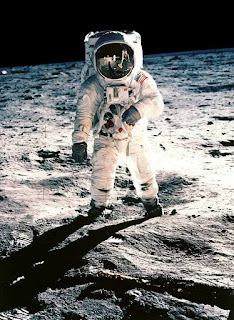
Apollo at Fifty (a repost)


Sam Seaborn: There are a lot of hungry people in the world, Mal, and none of them are hungry ‘cause we went to the moon. None of them are colder and certainly none of them are dumber ‘cause we went to the moon.

Mallory O’Brian: And we went to the moon. Do we really have to go to Mars?

Sam Seaborn: Yes.

Mallory O’Brian: Why?

Sam Seaborn: ‘Cause it’s next. ‘Cause we came out of the cave, and we looked over the hill and we saw fire; and we crossed the ocean and we pioneered the west, and we took to the sky. The history of man is hung on a timeline of exploration and this is what’s next.

–from “Galileo Five”, season two of The West Wing, written by Aaron Sorkin

Anniversaries are a good thing, even if they’re leavened with the weight of years of thwarted expectations and deferred dreams, as the First Lunar Landing’s is: Why have we never gone back? Why are we stuck in low-Earth orbit? Was it all just politics and none of it the call of the stars?

But such anniversaries are a bit of a balm in times such as these, when humanity seems bound and determined to roll back on itself like some kind of distended, drunken serpent consuming its own tail in a weird and awful version of an ouroboros. We can look back on the Apollo missions as a reminder of the kinds of things humanity can do when the primary motive isn’t necessarily profit.

I was born in September 1971, which means that I have never lived in a world where the Moon was not a place where humans have gone. I hope that I live to see a day when the Moon is no longer the only place other than Earth that we’ve gone.


From Pale Blue Dot by Carl Sagan:

It’s a sultry night in July. You’ve fallen asleep in the armchair. Abruptly, you startle awake, disoriented. The television set is on, but not the sound. You strain to understand what you’re seeing. Two ghostly white figures in coveralls and helmets are softly dancing under a pitch-black sky. They make strange little skipping motions, which propel them upward amid barely perceptible clouds of dust. But something is wrong. They take too long to come down. Encumbered as they are, they seem to be flying — a little. You rub your eyes, but the dreamlike tableau persists.

Of all the events surrounding Apollo 11‘s landing on the Moon on July 20, 1969, my most vivid recollection is its unreal quality. Neil Armstrong and Buzz Aldrin shuffled along the gray, dusty lunar surface, the Earth looming large in their sky, while Michael Collins, now the Moon’s own moon, orbited above them in lonely vigil. Yes, it was an astonishing technical achievement and a triumph for the United States. Yes, as Armstrong said as he first alighted, this was a historic step for the human species. But if you turned off the byplay between Mission Control and the Sea of Tranquility, with its deliberately mundane and routine chatter, you could glimpse that we humans had entered the realm of myth and legend.

We knew the Moon from our earliest days. It was there when our ancestors descended from the trees into the savannahs, when we learned to walk upright, when we first devised stone tools, when we domesticated fire, when we invented agriculture and built cities and set out to subdue the Earth. Folklore and popular songs celebrate a mysterious connection between the Moon and love. The word “month” and the second day of the week are both named after the Moon. Its waxing and waning — from crescent to full to crescent to new — was widely understood as a celestial metaphor of death and rebirth. It was connected with the ovulation cycle of women, which has nearly the same period — as the word “menstruation” (Latin mensis = month, from the word “to measure”) reminds us. Those who sleep in moonlight go mad; the connection is preserved in the English word “lunatic”. In the old Persian story, a vizier renowned for his wisdom is asked which is more useful, the Sun or the Moon. “The Moon,” he answers, “because the Sun shines in daytime, when it’s light out anyway.” Especially when we lived out-of-doors, it was a major — if oddly tangible — presence in our lives.

The Moon was a metaphor for the unattainable: “You might as well ask for the Moon,” they used to say. Or “You can no more do that than fly to the Moon.” For most of our history, we had no idea what it was. A spirit? A god? A thing? It didn’t look like something big far away, but more like something small nearby — something the size of a plate, maybe, hanging in the sky a little above our heads. Ancient Greek philosophers debated the propositon “that the Moon is exactly as large as it looks” (betraying a hopeless confusion between linear and angular size). Walking on the Moon would somehow have seemed a screwball idea; it made more sense to imagine somehow climbing up into the sky on a ladder or on the back of a giant bird, grabbing the Moon, and bringing it down to Earth. Nobody ever succeeded, although there were myths aplenty about heroes who had tried.

Not until a few centuries ago did the idea of the Moon as a place, a quarter-million miles away, gain wide currency. And in that brief flicker of time, we’ve gone from the earliest steps in understanding the Moon’s nature to walking and joy-riding on its surface. We calculated how objects move in space; liquefied oxygen from the air; invented big rockets, telemetry, reliable electronics, inertial guidance, and much else. Then we sailed out into the sky.

The Moon is no longer unattainable. A dozen humans, all Americans, have made those odd bouncing motions they called “moonwalks” on the crunchy, cratered, ancient gray lava — beginning on that July day in 1969. But since 1972, no one from any nation has ventured back. Indeed, none of us has gone anywhere since the glory days of Apollo except into low Earth orbit — like a toddler who takes a few tentative steps outward and then, breathless, retreats to the safety of his mother’s skirts.

Once upon a time, we soared into the Solar System. For a few years. Then we hurried back. Why? What happened? What was Apollo really about?

For me, the most ironic token of that moment in history is the plaque signed by President Richard M. Nixon that Apollo 11 took to the Moon. It reads: “We came in peace for all mankind.” As the United States was dropping 7.5 megatons of conventional explosives on small nations in Southeast Asia, we congratulated ourselves on our humanity: We would harm no one on a lifeless rock. That plaque is there still, attached to the base of the Apollo 11 Lunar Module, on the airless desolation of the Sea of Tranquility. If no one disturbs it, it will still be readable millions of years from now.

Six more missions followed Apollo 11, all but one of which successfully landed on the lunar surface. Apollo 17 was the first to carry a scientist. As soon as he got there, the program was canceled. The first scientist and the last human to land on the Moon were the same person. The program had already served its purpose that July night in 1969. The half-dozen subsequent missions were just momentum.

Apollo was not mainly about science. It was not even mainly about space. Apollo was about ideological confrontation and nuclear war — often described by such euphemisms as world “leadership” and national “prestige”. Nevertheless, good space science was done. We now know much more about the composition, age, and history of the Moon and the origin of the lunar landforms. We have made progress in understanding where the Moon came from. Some of us have used lunar cratering statistics to better understand the Earth at the time of the origin of life. But more important than any of this, Apollo provided an aegis, an umbrella under which brilliantly engineered robot spacecraft were dispatched throughout the Solar System, making that preliminary reconnaissance of dozens of worlds. The offspring of Apollo have now reached the planetary frontiers.

If not for Apollo — and, therefore, if not for the political purpose it served — I doubt whether the historic American expeditions of exploration and discovery throughout the Solar System would have occurred. The Mariners, Vikings, Pioneers, Voyagers, and Galileo are among the gifts of Apollo. Magellan and Cassini are more distant descendants. Something similar is true for the pioneering Soviet efforts in Solar System exploration, including the first soft landings of robot spacecraft — Luna 9, Mars 3, Venera 8 — on other worlds.

Apollo conveyed a confidence, energy, and breadth of vision that did capture the imagination of the world. That too was part of its purpose. It inspired an optimism about technology, an enthusiasm for the future. If we could fly to the Moon, as so many have asked, what else were we capable of? Even those who opposed the policies and actions of the United States — even those who thought the worst of us — acknowledged the genius and heroism of the Apollo program. With Apollo, the United States touched greatness.

When you pack your bags for a big trip, you never know what’s in store for you. The Apollo astronauts on their way to and from the Moon photographed their home planet. It was a natural thing to do, but it had consequences that few foresaw. For the first time, the inhabitants of Earth could see their world from above — the whole Earth, the Earth in color, the Earth as exquisite spinning white and blue ball set against the vast darkness of space. Those images helped awaken our slumbering planetary consciousness. They provide incontestable evidence that we all share the same vulnerable planet. They remind us of what is important and what is not. They were the harbingers of Voyager‘s pale blue dot.

We may have found that perspective just in time, just as our technology threatens the habitability of our world. Whatever the reason we first mustered the Apollo program, however mired it was in Cold War nationalism and the instruments of death, the inescapable recognition of the unity and fragility of the Earth is its clear and luminous dividend, the unexpected final gift of Apollo. What began in deadly competition has helped us to see that global cooperation is the essential precondition for our survival.

Travel is broadening.

It’s time to hit the road again.

Someday we’ll look up with wonder again. Someday we’ll go. I firmly believe that.


Footage of Walter Cronkite’s live broadcast of the lunar landing. Note his happy amazement at what he gets to report, at the 1:58 mark. He takes off his glasses, shakes his head, and smiles at the person next to him. I can’t help contrasting that with another moment when, while reporting on air, he had to remove his glasses and shake his head with disbelief, less than six years prior to this moment.


And I know it’s not the right mission, but for the movie Apollo 13, James Horner managed to really catch some of the unbridled optimism of the entire Apollo era.


Seriously, humans: when are we going back, and when are we going farther?


Share This Post

What a, very strange, piece of writing

Setting aside all the various issues with its interpretation–and honestly, I’ve pretty much conclusively come to the conclusion that it should simply be repealed entirely–I realized anew that other day just how weird the Second Amendment to the United States Constitution is. It’s just a strange piece of writing, even for its time.

I came to this when I read news of an unfortunate encounter with a police officer that took place in Rochester. (I know, a bad police story, big shocker there.) Summing it up: a cop parked his cop car in a space outside a hospital’s Emergency entrance that is marked for ambulances and EMT vehicles only, because…it doesn’t matter. I’ve long observed that cops take it as a given that they get to park wherever the hell they want, for any reason. But now an ambulance comes in with a patient, and in parking, bumps the cop’s car. This pisses off the cop, who can’t think the actual thing he should have thought: “Yikes, I shouldn’t be parked here, my bad.” No, the cop jumped out and started being all “KNEEL BEFORE COP!!!” while the EMT was all “I really gotta get this person into the hospital for treatment.” And since the EMT did not KNEEL BEFORE COP!!!, the cop put the EMT in cuffs. (The cop is now on desk duty. Personally, I think he should be on laundry duty, but that’s just me.)

As I have always noticed how cops tend to view themselves as somehow above the laws they’re supposedly enforcing, I looked up the Second Amendment and recast it as follows:

“A cowed populace, being necessary to the security of a police State, the right of the constabulary to do whatever it wishes, shall not be infringed.”

I wanted to make sure I got the wording exactly the way I wanted it, complete with the Amendment’s phrasing and punctuation. And that’s when I realized, typing it out, how strange a piece of actual writing the Second Amendment is. I mean, look at it:

“A well regulated Militia, being necessary to the security of a free State, the right of the people to keep and bear Arms, shall not be infringed.”

There is, quite famously, no helpful text to explain just how the first clause relates to the second, which has naturally caused all manner of unfortunate shenanigans in American history. And what is with all those commas? There are three commas in this single sentence, separating this thing into four distinct language clauses. Just on its own, the Second Amendment is a linguistic calamity. I can’t believe anyone at the Convention didn’t look at this thing and say, “Guys, this makes no sense as written and we need to clarify it.” That was a room full of good writers (as well as drunkards and nitwits), and yet, this terribly-written Amendment was allowed to stand. Why? Well, maybe they thought the meaning they intended was so clear and unlikely to change that it would never be an issue. Or maybe they figured, given the general ambivalence to the Constitution at the time, that it would be fixed on revision anyway. Or maybe…well, who cares. Fact is, we’re saddled with it. As is. Which is itself absurd, but hey, 21st Century America is, if nothing else, a great national monument to absurdity.

I also glanced at the other Amendments surrounding the Second. Were they all this badly written? Why…no! Here’s the First:

Congress shall make no law respecting an establishment of religion, or prohibiting the free exercise thereof; or abridging the freedom of speech, or of the press; or the right of the people peaceably to assemble, and to petition the Government for a redress of grievances.

That’s pretty damned clear. The commas are used logically, and the clauses clearly relate as part of the same sentence. Odd capitalization abounds, but that was just a Thing back then. (I assume there was some Rule by which those writing chose which words to Capitalize.) But the First reads very clearly: Congress is forbidden to do this.

The other Amendments are all pretty specific in the way they limit government, except for the Ninth and Tenth, which are clearly intended to forestall arguments down the road of the “Well, the Constitution doesn’t specifically SAY you can’t do this, so you CAN!” or vice-versa. (Pssst, Messrs Jefferson et al: It didn’t work.) So then I look back at the Second, aghast anew at is appalling lack of specificity, its foggy language, and its unique phrasing (nowhere else is the construct “shall not be infringed” used).

Bad writing has consequences, folks. Especially when a big part of your country’s population has decided to treat a certain piece of bad writing as if it was handed down by God on a third tablet.

(For an amusing bit of Constitutional comedy, here is John Mulaney in one of his SNL monologues. The relevant bit is at the 3:52 mark:

I love the line, “They knew how to make a pen, they were just being jerks.”)


Share This Post

Do you remember America?

“Do you remember America?” the curious person will ask one night, in a darkened tavern as they nurse their second or third drink. “The country tried to codify freedom and democracy? I mean, sure, at first it was only for a few of their citizens, but it was a start, right? They got better at it. And sure, getting better took a whole lot of spilled blood over a couple hundred years, and even when they said ‘Sure, fine, you’re free now,’ they came up with ways to keep you from really being free…but really, do you remember America? That country that tamed an entire wilderness! I mean, sure, they seized that wilderness from people already living there, but still. Do you remember America? The country that made polio a memory? I mean, sure, less than a hundred years later they tried to ignore a new disease, but that was pretty neat, right? And they went to the Moon! I mean, sure, that was so they could feel better about getting there first against a country that doesn’t exist anymore, and they never went again or did much about that, but still. Do you remember America?”

“I remember,” a voice will say, probably from the back of the tavern. A raspy voice, an old voice, unable to speak loudly much at all anymore. A hat drawn down over a haunted face, scarred and weathered by time. “I remember America.” And they will lift their whiskey to their mouth.

“What happened to it?” the curious person will ask.

And the person at the end of the bar will swallow their whiskey and look off into the distance, what little distance there is, and eventually they will shrug. “We did,” they’ll say. “We happened to America.”

And the person will drain their whiskey and leave out the back door. Those remaining who heard this exchange will puzzle over it for a bit, but eventually they’ll return their attention to whatever else is going on–a sporting event on the television, perhaps, or some story about what happened at work that day. You don’t often talk about fallen nations and collapsed empires at the tavern after work, you see.

But maybe the curious person won’t turn all their attention back to the dull conversation going on around them. Maybe some part of their imagination will linger there on the memory of a nation, born in fire and too much blood, a nation that aspired but fell short, a nation that rose higher and fell lower than it should have.

And they’ll wonder. Maybe.


Share This Post

History is not a feel-good story.

I wrote this in February 2022, but I’m re-upping it now as I see a news item this morning about how parents in Wisconsin challenged a book about the interment of Japanese-American citizens during World War II, on the basis that “the government’s perspective wasn’t shared” or some such thing. Of course that’s a bullshit excuse; these people simply think that nothing negative in our history should be taught, ever.

No subject is more eternally disappointing to see discussed in America than race, because a great many of us simply don’t have any inclination to engage in anything remotely resembling an honest discussion of race at all.

This is not the least bit new. All that’s changed, in recent months, is the wording. White people have been finding ways to dodge discussions of racism probably since the beginning of time, but the most prominent version in my personal experience has been simple dismissal of the subject as soon as it is brought up: some version of “There they go again, playing the Race Card,” usually accompanied by a rolling of the eyes.

What is signaled by saying “Playing the Race Card” is itself a rhetorical strategy that has several goals: it’s a granting of permission to oneself to ignore anything the other person is saying, as well as a signal to that person that their words are falling on ears that have been rendered deaf before the fact. It’s a neutering of conversation, and saying it is a metaphorical hanging of the “CLOSED” sign on the mind.

The racism-denialist side has become a bit more sophisticated of late, which you can see in the way they have cynically elevated something called “Critical Race Theory” to the status of Bogeyman Supreme in this country. For a good summation of this, I strongly recommend the summation John Oliver did on this season’s opening episode of Last Week Tonight:

Of special interest is the fact that not one of the people shrieking most loudly about “Critical Race Theory” can tell you the first factual thing about “Critical Race Theory”, and that the American right-wing has become so divorced from any factual basis for its constant drum-beating about nonexistent grievances that now their entire debate can be shaped by dishonest actors like Christopher Rufo, who will publicly and openly admit the dishonest nature of their rhetorical framing as they watch their preferred framing of the debate happen anyway. These people are deeply sophisticated in their knowledge of how American media will follow a bouncing ball to the end of the Earth, so long as the ball is set bouncing by the right wing.

I personally do not know much at all about Critical Race Theory, but I am at least aware that my willingness to admit this puts me in an unfortunate minority among white people. Weird irony, that.

What catches me so much about the rhetoric around the thing that right-wingers have crafted in their increasingly fever-minded, fact-deprived heads about “Critical Race Theory” is one objection I hear over and over and over again. You’ll hear it in the Oliver segment above, and I also saw it this past week in comments on a post to my local Nextdoor forum.

(Yes, I’m on Nextdoor, mainly because it’s useful for stuff like “Hey, anybody know what all those sirens were last night” and “Anybody know a good roofer?” But the site is very obnoxious in a lot of other ways, and I’ve imposed a personal rule of never posting at all on it. One good example is the thread from a few weeks ago–and I am not making this up–of a person breathlessly posting about the suspicious-looking ‘colored’ person in the pickup truck who was obviously casing local houses…until someone else on that same street said, “Yeah, that’s Bob. He’s a meter-reader for the power company.” If I had commented on that, I probably would have been banned.)

(UPDATE: Since I wrote this, I closed out my NextDoor account. It just got to be too much idiotic racism.)

A person posted about “Critical Race Theory” being taught! in the local elementary schools!!! Now, this is BS, obviously, and to their credit, a few folks did point out that this is total BS. But equally obviously, “Critical Race Theory” is just a catch-phrase for these people that has come to refer to any mention of race at all, in any context. (Which is what Rufo et al. intended the entire time–again, see Mr. Oliver.) And that framing leads to this specific talking point:

“I do not want my children being taught to feel bad about their country!”

Or:

“I do not want my child being made to feel BAD about their history!”

Or:

“I don’t want my kid being made to feel like they have to answer for things they didn’t do!”

And you know what? Maybe that’s a bit tempting. I never owned any slaves! Why do I have to feel bad about it? Why do have to atone for that? It was 150 years ago! Leave me alone! Lemme be! Get over it!

When you really start digging into this, you realize quickly that these people don’t want history taught as a factual discipline from which we can learn valuable lessons for the future and in which we come to see the flaws as well as the strengths in the generations that preceded us. No, these people want a feel-good story, a hegemonic tale whose purpose is to shape young minds so they get obediently tearful in the presence of a flag (and, maybe just maybe, the creepy politician literally hugging it). They want the Hero’s Epic version of history, with an honesty-obsessed George Washington admitting chopping down the tree years before he stood proud and tall in that boat as he crossed the Delaware. They want a tale of lantern-jawed heroes, always driven forward by God and goodness, with their women at their backs (always, always that) as they hew their destinies from the land itself.

These people want all the feel-good stuff from history, and that’s it. They want heroic inspiration from the brilliance of Thomas Jefferson’s diplomacy and writings, and none of the frankly horrific caution of Thomas Jefferson’s forced relations with his own slaves. It’s this feel-good cherrypicking approach to history that gives me particular pause, because it’s borne of the same lack of curiosity and honesty that leads these same people to embrace nonsense across the board, including rejecting vaccines in favor of some random medication pushed by some random doctor Joe Rogan had on the podcast this week.

“I don’t want my kid to feel bad about their history!”

Look, here’s the thing, for all those people who complain that they don’t want their children being made to feel bad about their history, or to feel like they are being blamed for awful things their ancestors did:

If you’re not going to let the evils in our past make you feel bad, then you don’t get to turn about and let the triumphs in that same past make you feel good.

If you don’t want to feel bad about slavery, or Jim Crow, or red-lining, or the KKK, or resistance to Civil Rights, then you also don’t get to feel good about defeating fascism in World War II, or triumphing over the East in the Cold War, or landing on the Moon. History is not a buffet where you can choose what things you like and which you don’t.

And this isn’t about “feeling bad” in the proper context to “feel good” about the good stuff, either. History isn’t about feeling bad or feeling good. History is about learning what we’ve done, the good and the bad, so we can make better decisions later.

But we don’t want that…or too few of us want that. We don’t want to talk or even hear about race. If we do, we want to pretend that ending officially-sanctioned slavery and quoting a single sentence from a single speech by Martin Luther King is all the discussion race ever needed. I don’t know how we get White America to even come to the table to have the discussion much less honestly engage it in the first place, but I do know that if something in history makes you feel bad, you shouldn’t avoid that topic but interrogate it even harder, because if something your ancestors did a few dozen or a few hundred years ago makes you feel bad, maybe it’s relevant to something going on now.

Maybe.

(Comments are closed on this post.)

Share This Post