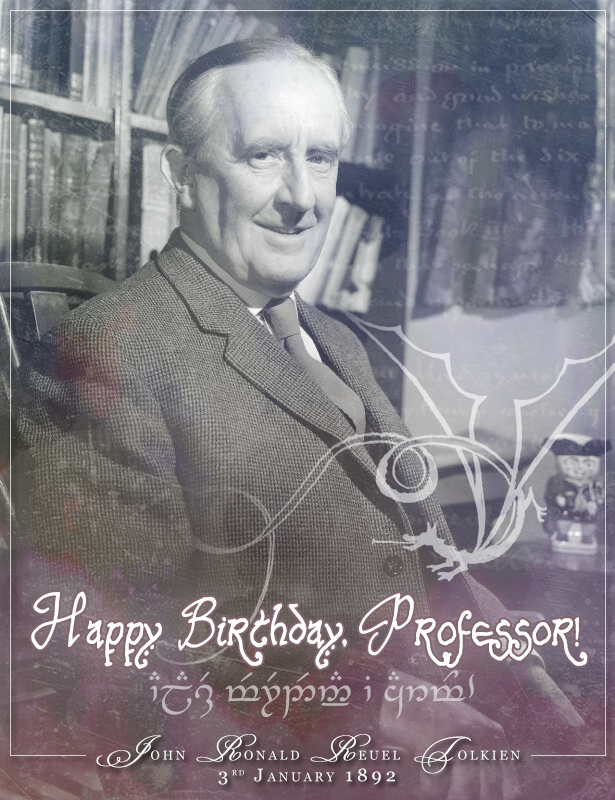
Tolkien is, naturally, one of my favorite of all authors. He wasn’t my first foray into epic fantasy–that would be Lloyd Alexander–but Tolkien cemented my love of that genre for keeps. He is, for me, as profound an influence on my own storytelling as George Lucas.
Here is one my very favorite passages in a book chock-full of favorite passages. This is from The Return of the King, the chapter titled “The Siege of Gondor”.
In rode the Lord of the Nazgul. A great black shape against the fires beyond he loomed up, grown to a vast menace of despair. In rode the Lord of the Nazgul, under the archway that no enemy ever yet had passed, and all fled before his face.
All save one. There waiting, silent and still in the space before the Gate, sat Gandalf upon Shadowfax: Shadowfax who alone among the free horses of the earth endured the terror, unmoving, streadfast as a graven image in Rath Dinen.
‘You cannot enter here,’ said Gandalf, and the huge shadow halted. ‘Go back to the abyss prepared for you! Go back! Fall into the nothingness that awaits you and your Master. Go!’
The Black Rider flung back his hood, and behold! he had a kingly crown; and yet upon no head visible was it set. The red fires shone between it and the mantled shoulders vast and dark. From a mouth unseen there came a deadly laughter.
‘Old fool!’ he said. ‘Old fool! This is my hour. Do you not know Death when you see it? Die now and curse in vain!’ And with that he lifted high his sword and flames ran down the blade.
Gandalf did not move. And in that very moment, away in some courtyard of the City, a cock crowed. Shrill and clear he crowed, recking nothing of wizardry or war, welcoming only the morning that in the sky far above the shadows of death was coming with the dawn.
And as if in answer there came from far away another note. Horns, horns, horns. In dark Mindolluin’s sides they dimly echoed. Great horns of the North wildly blowing. Rohan had come at last.
That is one of those passages that, every time I read it, I pray to whatever powers there are that one day I might write something half so wonderful.
Happy birthday, Professor Tolkien! Long may your stories shine, into the next Age and beyond!
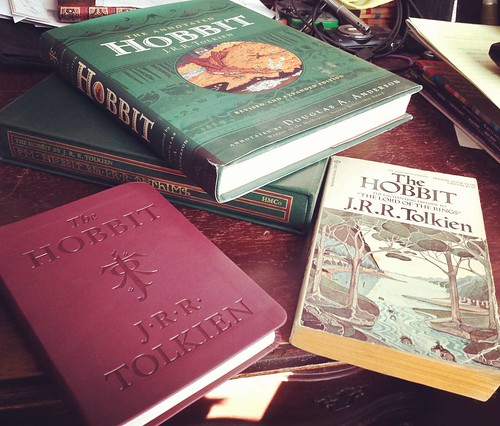
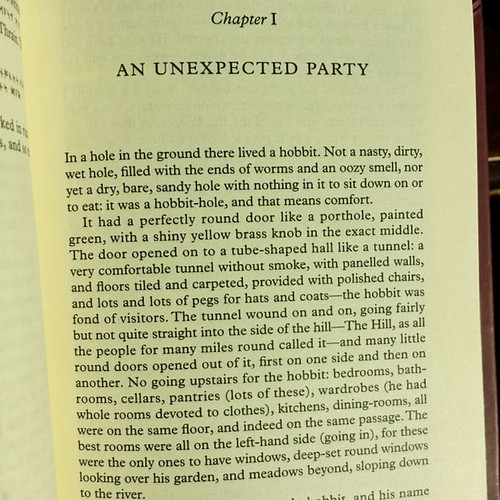
I didn’t know this until I saw it online today, but The Hobbit was first published 80 years ago today.
At no point have I not loved this story (except for the handful of years I was unaware of it), and I don’t expect that I will ever not love it. The Hobbit and its more noted follow-up, The Lord of the Rings, are on my shortlist of the stories that have shaped me the most: we’re talking Star Wars territory here, to be honest.
I knew the story of The Hobbit — well, most of it, anyway — several years before I actually read the book. That’s because my first encounter with this story was via the Rankin-Bass animated version that first aired in 1977. I don’t recall if I saw it then or on a subsequent re-run, but it didn’t matter: I loved this story quite intensely, and when I read the book a few years later, I was done for.
The Hobbit is often seen as a children’s tale, inessential to the greater work that followed it, but I’ve never viewed it that way. Reading The Hobbit is as essential to the experience as anything, and I never ever re-read The Lord of the Rings without reading The Hobbit first. There is so much in The Lord of the Rings that simply doesn’t make sense, or at least has the impact blunted, if one hasn’t read The Hobbit. The eagles arriving at the Black Gate; the tonal shift about halfway through Fellowship into a more heroic mode; the history behind Sting and the mithril coat.
More than that, though, the adventure story that comprises The Hobbit contrasts greatly with the world-wide import of the events to come. The focus in The Hobbit is intimate, and the focus never wavers from this little hobbit named Bilbo who is ensnared in events larger than he can comprehend, and his efforts to make his way in a world he doesn’t understand and barely wants to. The Hobbit is an adventure story, but it’s an adventure story that ends somewhat ambiguously with the treasure won but one of its seekers dead. This anticipates the moral direction of what is to come, when the fundamental quest is not to find something but rather to lose something that is already found.
And it is, really, one hell of an adventure story.
Long live The Hobbit! It’s been a few years since my last re-read, so…I think that I may be quite ready for another adventure!
First off, a stipulation: lists like this are mainly meant to inspire discussion and debate and, being that this is the Internet, rock-throwing and name-calling and aspersion-casting-upon-one’s-children-and-parentage. OK? OK!
Second: Well, Martin actually has a pretty good list here. You’ll have to click through to see his comments on each film (worth doing, also for the honorable mentions), but here’s the Top Ten by itself:
1. The Lord of the Rings (complete)
2. The Princess Bride
3. The Wizard of Oz
4. Ladyhawke
5. Dragonslayer
6. Monty Python and the Holy Grail
7. Dark City
8. Pan’s Labyrinth
9. Beauty and the Beast (1946, dir. Cocteau)
10. Raiders of the Lost Ark
Martin’s “honorable mentions” include some Disney movies (more on that below), Dracula, Frankenstein, Legend, Labyrinth, and Excalibur.
So. Discussion!
As noted, Martin generates a pretty decent list. I’ve seen seven of his ten (Dark City, Pan’s Labyrinth, and the 1946 Beauty and the Beast are the ones I’ve missed). I personally quibble a bit with Raiders: even though it has supernatural elements (as do all the Indiana Jones movies), I see them as primarily adventure films rather than fantasies. But that’s quibbling, and the fact remains that if you’ve never seen fantasy on film, watching all of the movies on Martin’s list is a great start. Also, I do not quibble at all with his Number One pick, which is as good as filmed fantasy gets.
Ladyhawke and Dragonslayer? Hmmmm. I like both, but I’m not sure I’d rank them this highly on my Filmed Fantasy Pantheon. In fairness, though, it’s probably twenty-five years since last time I saw Ladyhawke, and not too much shorter than that since my last viewing of Dragonslayer. I remember the latter being a well-made and exciting fantasy, if a bit dour in tone. I owe both a rewatch, though.
My biggest quibble with Martin’s list is that in his latter commentary he notes that for this list he adopted a “No animation” rule:
Going into this, I decided I had better exclude all animated films. Otherwise the list might well have been dominated by Disney’s classic retellings of time-honored fairy tales: Snow White, Sleeping Beauty, Pinocchio, and The Little Mermaid.
See, the problem here is that animated films are still films and animated fantasy films are still fantasy films. Likewise, there’s no reason to assume that the animated films will dominate the list, or that those animated films that will be doing the dominating are Disney films. A Top Ten list is often going to be exclusionary to the point of absurdity to begin with, but this is particularly bizarre, like making a Top Ten Restaurants of New York City list, but excluding those restaurants that focus on French or Italian cuisine. And in mentioning Disney, Martin makes a telling omission: he omits the masterpieces of Studio Ghibli. Looking at the list above, I would quite willingly trade Ladyhawke and Dragonslayer for Princess Mononoke and Spirited Away.
Then there’s Martin’s dismissal of Willow:
Then there’s Willow. Sorry, no. Yes, I liked Val Kilmer as Mad Martigan, but that’s about it. Willow set filmed fantasy back 20 years.
Look. Taste is taste and if you don’t like a movie, so be it. I don’t think Willow is a classic either, and I wouldn’t put it on my Top Ten Fantasy Movies list either. But yeesh, it ain’t that bad. I genuinely think that Willow has received a bum rap over the years. It’s an OK, fun, swashbuckling Sunday-afternoon-on-a-winters-day movie, and there’s a lot more in it that’s good than Val Kilmer.
And “Willow set back filmed fantasy by 20 years”? That’s a very silly statement to make, and Martin has to know better. Look at all the fantasy movies that came out in the 1990s, within just the first ten years after Willow (which came out in 1988). And just ten years after Willow, The Lord of the Rings was in pre-production. No, Willow did not hurt filmed fantasy. It’s a dumb thing for Martin to have said.
Let’s see, what else? Well, Martin doesn’t mention any of the Harry Potter movies, which seems odd, because they’re giants in the filmed-fantasy world, and they are a highly underrated achievement. They got the same cast together for eight movies over about ten years and told a big story. A little more respect for Potter, please!
And finally, Martin has this to say about Excalibur, which is probably the best version of the King Arthur story filmed yet:
I mentioned Excalibur earlier. There’s much to admire about John Boorman’s film. The visuals are a feast for the eyes, and the movie includes some wonderful performances. But Nigel Terry has to be the least charismatic King Arthur in film history, pouting his way from start to finish, and the film tries to cram in too many different aspects of Arthurian legend, and does justice to none of them. Some studio really needs to step up and film the definitive modern treatment of the Matter of Britain, T.H. White’s The Once and Future King. And not as a cartoon (Disney’s The Sword in the Stone) or a musical (Camelot) either. White’s trilogy deserves to be done as three films, the way Peter Jackson did Lord of the Rings.
OK. If you use the word “cartoon”, that tells me that you don’t really respect animation. Not really. Maybe the Disney film of Sword in the Stone wasn’t particularly good, but to dismiss the effort entirely makes me think there’s a little more to Martin’s stacking-of-the-deck against animation. As for a musical, well–no, Camelot isn’t great. That’s not why the “definitive” version of the Arthurian story hasn’t been filmed, though.
I think it’s because the Matter of Britain’s very nature is stacked against a film or even a tetralogy of films (The Once and Future King is a gathering of four previous books, not three, as Martin should know). The Arthur story isn’t one story but rather a whole bunch of them clustered together under one banner. I don’t know how one film or even several films could make that all work without significant re-casting of the story and removal of some of its key parts. Gillian Bradshaw’s trilogy of Arthurian novels, perhaps, or Mary Stewart’s wonderful trilogy of Merlin novels. Any telling of the Arthurian story is going to leave something behind, because it can’t possibly all be squeezed in there. I doubt very much if we’ll ever see a massive filmed trilogy of the King Arthur story, to be honest. That’s a bummer, but I think that’s the way it is.
So, what would be my Top Ten Fantasy Films list? Well….
1. The Lord of the Rings (complete)
2. Princess Mononoke
3. The Princess Bride
4. Conan the Barbarian
5. The Thief of Baghdad
6. Time Bandits
7. Who Framed Roger Rabbit
8. Harry Potter and the Prisoner of Azkaban
9. Excalibur
10. Monty Python and the Holy Grail
The other day marked the twentieth anniversary of the initial publication of Harry Potter and the Sorcerer’s Stone (or Philosopher’s Stone, if you live in Britain–and I guess I should link that first since that’s where the book came first). I could wax poetic for quite a long post about Harry Potter and the enormous effects on culture those books had, but others have weighed in more intelligently than I could on those points. I, like many others, have had my own “personal journey” with Harry Potter, starting with sometime in what must have been 1999 when I started noticing these books with the unusual cover art and title font on the front displays at Borders, and very prominently placed in the childrens’ section. By the time I was aware of the growing Harry Potter phenomenon, there were already three books out, and I bought the first one out of curiosity.
And I loved it, right from the get go–right from the opening paragraph. I mean, that first book’s opening paragraph is some seriously wonderful stuff! Don’t take my word for it, either: look what this fan did with it:
A post shared by Meredith McCardle (@meredithmcp) on
I never looked back, eagerly snatching up each book as it came out and squeezing it into my reading time. By the release of Deathly Hallows, the last book, I was in as much a fever-pitch as anyone, and I remember a kind of Devil’s bargain I made with The Daughter at the time, who was about eight years old: on a Sunday afternoon I told her that she could play videogames for as long as she wanted. Then I went out on the balcony of our apartment and plowed through the last four hundred or so pages of that book.
I’ve been meaning to reread the Potter books for some time now, and perhaps this winter it will finally be time to do so. (In honesty, I associate the books–as I do most fantasy–with the cooler months. I’ve never been sure why that is, because fantasy is not an inherently autumnal genre.) I also need to rewatch the movies, which are, for the most part, excellent adaptations and retellings of the story.
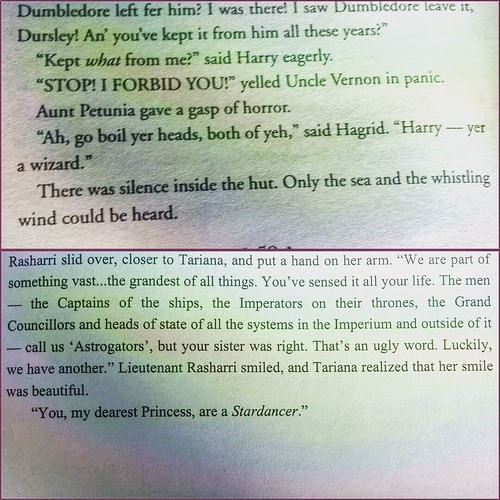
One final note: I included a call-back to Harry in Stardancer. How could I not? While the situation involving Lt. Rasharri’s revelation to Tariana Osono of her powers isn’t so confrontational as when Hagrid tells Harry that he’s a wizard, it was hard not to see this moment in my story as a reflection of the earlier one.
And now, since this is Something for Thursday and all, some music!
I like this show a lot. We watch it every week. But it’s a really maddening show, because there are times it’s so wonderfully written (thank God they’ve got Jane Espenson on the staff), and other when it is so…not (too bad they can’t clone Jane Espenson).
:: Snow White / Mary Margaret is kind of irritating. She reminds me of the way Mary Ingalls was always depicted in the Little House books: insufferably good. The current storyline, of forcing her to do evil, could be interesting, but so far all they can figure out what to do is have her roll around in bed as she processes her existential crisis.
:: Regina / The Evil Queen is, by far, the most interesting character on the show. And Lana Parrilla plays her magnificently. She’s the most three-dimensional character on the show, and Parrilla captures that beautifully.
:: The next most interesting character on the show? Robert Carlyle’s Mr. Gold / Rumpelstiltskin. He seems to get the best lines, and so far, the writers have managed to keep him treading the line between good and evil in exactly the way a good Trickster character is supposed to do.
:: Come to think of it: Lana Parrilla will sadly be too old to play one of the Princesses when the totally inevitable movie of Princesses In SPACE!!! (not the actual title) gets made, which gives me a sad, because frankly, she’d be perfect for the older of the two. She has a very expressive face and a lot of range as an actress. (As opposed to Ginnifer Goodwin, who as Mary Margaret / Snow White seems to only have two expressions: happy smile and sad smile.) Robert Carlyle has a part waiting for him, too.
:: The worst character, by far, no competition, is Captain Hook. He is awful. The guy exudes zero menace, his sexual innuendos are embarrassing since he has no charisma or chemistry at all with anybody, he only serves to show up at inopportune moments to do something evil, and then he invariably gets his ass kicked. Hook isn’t a character, he’s a plot device, and a badly-acted one at that; every single time he shows up, any energy the show has gets sucked right out. The sooner the writers come to their senses and jettison this guy, the better.
:: I hope they never show August / Pinocchio as an adult wooden guy again. That was one of the creepiest damn things I’ve ever seen. Made that episode nearly impossible to watch.
:: I like the guy who plays David / Prince Charming, but his lips are distractingly red. Seriously, I’ve never seen a guy with lips that red before. Every time he’s onscreen, at some point during the scene I find myself staring at his lips. And I won’t lie — that makes me feel a little strange.
:: Some of the mining of old stories and folklore is pretty creative. Some of it, though…I don’t really know about. The last episode seemed to be going toward some kind of Asian lore, in a Big Trouble in Little China kind of way. I’m not sure where they’re going with that.
:: I’m honestly not sure how much longer this show can last — maybe one more season? My problem is that the worldbuilding feels increasingly tenuous. The town of Storybrooke can’t interact with the ‘outside’ world? Well, OK…but it’s a modern town, with all the modern trappings, so how do they get stuff? Where does the food at the store come from? How do they get gas for the vehicles they drive? It’s a town, not a separate world.
That’s about it. The second season starts winding down tonight…I think there are only three or four episodes left. I wonder how they’ll leave things hanging?
I have to admit to feeling somewhat nervous about the prospects for the movie version of The Hobbit over the last few years. It’s a much more ‘filmable’ story than The Lord of the Rings, much more straight-forward in its tale, and I figured that, if anything, it would make a nice single movie. But then stuff started leaking out about Peter Jackson and company adding stuff to it, from the various appendices, notes, and other materials JRR Tolkien left lying about, indicating what generally went on during the more than fifty years that take place between The Hobbit and LOTR.
This struck me as potentially interesting, if they could find ways to make it all work into a coherent movie, but for the most part it sounded like a way for the filmmakers to justify expanding a story that would fit into one movie into an announced two. And then came the news that they were going to expand it out further, into three movies. The Hobbit, which is a relatively short book that tells a fairly light-hearted (until the end) adventure story, was going to be a cinematic trilogy. Initial reviews of the movie indicated that the film’s flaws are basically those that many had expected from this treatment of the source material: bloated, padded, and disjointed.
But when I saw the movie, I saw none of those things. All I saw was a gloriously entertaining return to Middle-earth, seen through different eyes than before, in the earlier telling of the great trilogy.
Is The Hobbit too long? Maybe, just a bit. Some of the action sequences probably do go on just a tad longer than they should, but ultimately, I didn’t really care. Did the film take its time in getting things moving? Yes…but again, ultimately, I didn’t really care. I guess what it ultimately comes down to is this: where this movie wanted to take me, I wanted to go.
A review at AICN — don’t recall which one — called The Hobbit a ‘homecoming’, in the sense that I mean here: that he wanted to go back to Middle-earth, and this movie accomplished that. Treating this movie as a ‘homecoming’ is an interesting metaphor, as ‘homecoming’ is the entire theme of The Hobbit: Bilbo Baggins must leave home to help the Dwarves get theirs back, and he must leave home in order to find the truest part of himself. In a lot of ways, Bilbo’s adventure causes him to lose his home, and not just in the real way, either (assuming that Jackson ends things the way Tolkien did, with Bilbo returning to find himself presumed dead and the auctioning off of his stuff already in progress). Forevermore Bilbo dreams of adventures, of leaving home and wandering afield. Of the Road that goes ever on and on.
Jackson shoots The Hobbit with a much more vibrant color palette than he used in Lord of the Rings, where everything had a slightly washed-out, muted look that got more and more pronounced as the ultimate confrontation with Sauron approached. Here, that look only really shows up twice: in the scenes where Radagast approaches Dol Guldur to investigate the evil presence there, and in the caverns deep beneath the goblin kingdom, where a wayward Bilbo finds a gold ring and its slimy, enigmatic keeper.
I found that the addition of material not in The Hobbit was actually very well executed indeed. It felt like a logical extension of the story, and I think it may end up giving more credence to later in the story, when Gandalf gets the company to the edge of Mirkwood and then suddenly says “Well, go on, down that path. I’m off. Don’t do anything stupid, now!” I always found that the least convincing part of the book. I know why Tolkien did it — it’s a bit hard to put the company through hell if there’s a super-powerful wizard always there to bail them out — but when reading it, that part always sticks out like a sore thumb. By showing us the ‘Important business to the south’ up front, well before it really rears its ugly head, I think Jackson is softening the blow.
I also had little problem with the extended delvings into the personal history between Thorin Oakenshield and Azog the orc-king, or goblin king, or whatever he really is. And I had little problem with…well, I just had little problem with anything in this movie. Maybe I need to see it again to try and figure out the flaws, but…well, look. Part of my love of Peter Jackson’s Middle-earth movies, this one included, is in the way they allow me a certain level of immersion in Tolkien’s world that’s different from that of reading the books. Not better, mind you, but different. I want to be there. Why should I be upset about being there that long?
And frankly, what’s wrong with a story taking its time to unfold, anyway? Do we always have to be, in to quote Brooks from The Shawshank Redemption, ‘in a big damn hurry’? So yeah, Peter Jackson, you go right ahead and give me a nice, long prologue in which Ian Holm voiceovers the coming of Smaug to Dale. You go right ahead and take your time with the Dwarves showing up on Bilbo’s doorstep, which is as wonderful a sequence as I recall. You go right ahead and give me villainous creatures with loud Cockney accents, and you go right ahead and wallow in the “Wow, look at that!” stuff with the stone giants throwing parts of their own bodies at each other.
(And speaking of Dale, I love how Jackson gives us another Middle-earth location that doesn’t look just like the others. The diversity in the way various places looked in the Lord of the Rings movies is an underappreciated aspect of those movies, in my opinion.)
Howard Shore returned to score this movie, coming back to his Middle-earth soundworld in particularly triumphant fashion. He isn’t very heavy handed in his use of themes from the earlier trilogy; mainly we hear snippets of the Shire music, in some wonderful new settings, and the haunting Ring motif is heard when Bilbo picks it up — the musical fingerprint in these movies of the One Ring officially changing hands from one bearer to the next. His most impressive achievement here is in a motif for the Dwarves, which is cut from the same cloth as a remarkable passage of music from ten years ago in Fellowship. In the earlier film, when the Fellowship is in Moria, Gandalf takes them into the great hall of Dwarrowdelf, the Dwarven city, and the music swells with sad, epic emptiness that seems to be building to a grand statement of a melody — but the melody never comes. It’s a musical passage that always causes me to hold my breath when I hear it, and now, in The Hobbit, Shore crafts a theme that seems to possibly be the very theme that passage in Fellowship was striving for. The theme is first heard when the Dwarves chant their “Far over Misty Mountains cold….” liturgy, but then the theme forms the virtual backbone of the entire score — and I’ve got to note that this particular theme is an earworm of the highest order.
In terms of acting, well, there’s little to be found by way of a weak link in The Hobbit. Sir Ian McKellen can, of course, play Gandalf in his sleep, but he brings an interesting tone to the old wizard here, portraying him as being a bit more doddy than in the first trilogy. That’s in keeping with the book, which doesn’t present Gandalf as being quite so much as ‘One of the Great Powers of the world’, as much as a really good wizard who doesn’t always know what’s going on. Gandalf here also seems warmer, more mischievous, and less plotting-and-scheming. We only get glimpses occasionally of the Gandalf of the earlier trilogy, because the evil of Sauron hasn’t yet started to rise. (And I’m tickled that they managed to get Tolkien’s joke about a severed head leading to the invention of golf into the movie.)
Richard Armitage, as Thorin Oakenshield, captures Thorin’s sense of almost messianic devotion to his quest quite strongly, and he makes a powerful impression, sometimes almost going too far and making Thorin into, well, for lack of a better word…a douche. He presents a Thorin who is a man of singular focus, but also driven by very human concerns and a deep longing to return home, where the Thorin of the book often seems more driven by a desire to get the big pile of gold that Smaug sleeps on than anything else. (Until the Arkenstone turns up, of course.)
And then there is Bilbo himself, played by Martin Freeman. I’m only familiar with Freeman’s acting from one film, and that’s Love Actually. Now, he is utterly perfect in that movie (as is everyone else, but I can wax poetic about Love Actually another time), but the association isn’t quite to his benefit, as in that movie he plays a stand-in for the nude scenes in some movie that’s got a ton of sex in it, because every time we see him, he’s miming various sex acts with a female stand-in. (A unit director helpfully tells him, “All right, now, if you could just, ah, massage the nipples….”)
Freeman creates an absolutely pitch-perfect Bilbo Baggins: a proper hobbit who is going about his own business at his own leisure, but who is a bit odd and who has some desires and wishes buried deep within him that he doesn’t even realize are there until a wizard and thirteen dwarves show up and threaten to crack his dishes and bend his forks (without doing either, it must be noted). Freeman isn’t just the awkward Brit pushed into weird doings and deeds. He shows us that there’s always something going on in Bilbo’s head, and that even though he has a steep learning curve for this sort of thing, he’s got some good ideas, and as the story goes on, he’ll get to use them to greater and greater effect. Freeman puts Bilbo’s intelligence on display, which is extremely important, because the time is coming when he’ll be matching wits with a dragon.
It really does remain to be seen how Jackson and company will handle the continued mix of the book of The Hobbit with their new material. For me, they’re off to a very promising start. All the criticisms and complaints about this movie don’t add up to anything. I feel like this movie was made for me. And I’m damned glad to have it!
That’s the title of Guy Gavriel Kay’s next novel: River of Stars. As I noted before, it is set in the same fictional China as his last book, the amazing Under Heaven, albeit several hundred years later, so it’s not really a sequel at all.
And now we have the cover art:
I never finished re-reading my way through GGK’s output prior to Under Heaven‘s release, so this winter should be my chance….
Oh my good Lord. I tried, folks. I really tried. I’ve wanted so much to love A Song of Ice and Fire as much as everybody else does. And after the fairly soul-crushing experience that was slogging my way through A Feast for Crows, I thought that A Dance with Dragons was off to a fairly decent start. But I wasn’t even halfway through before that old familiar feeling started to settle in, and by the time I was two-thirds of the way through (with more than 300 pages left at that point), I had pretty firmly reached this point:
Will I finish reading the series? I suppose I will, if George RR Martin finishes writing it. But now it’s a certain pig-headedness that’s keeping me going, and not much else. It’s that sense of “Well, I’ve got this far”, and I have the added comforting thought that the sixth book is probably unlikely to appear any time before 2014. So I have a good, long recovery time ahead of me. Maybe reading the entire series in the space of six months or so was just too much, but rather than the wonderful immersive quality I was hoping for, I instead found myself thinking, “GAHHH get me out of here!”
After finishing Dance last week, I went and read some reviews that came out when the book did, and I’m wondering if those folks read a different book. One reviewer promised that with this book you start to see the signs of where GRRM is going with his story; others are enraptured by GRRM’s amazingly poetic prose. I evidently missed the boat on both counts, because I don’t yet see this overarching story that’s taking shape and aside from a few passages, GRRM’s prose does not thrill me nearly as much as, say, Guy Gavriel Kay’s. Aside from a few good moments, and one great one, that were all too few and far between, just about all I got from this book was frustration and, eventually, irritation.
The rest of this will be spoilerish, so I’ll stick it below the fold.
The good stuff? Jon Snow, Tyrion Lannister, and Daenerys Stormborn are back after not being seen at all in Feast. The bad stuff? Just about everything else…and Daenerys’s story is sadly a lot less interesting than it should have been. Every time a Daenerys chapter shows up, we would get another ten or fifteen pages of her being incredibly indecisive in the face of all manner of individuals who want nothing more than to control her and, through her, control the dragons. The story generally went a whole lot of nowhere, until toward the end of the book, when the book’s one indisputable moment of awesome transpired…and then, things became dull again. Drogon’s return and Dany’s long-awaited moment of flying on her dragon progeny’s back was just a wonderful moment, almost well-worth the price of a lot of the other stuff in this book that I didn’t care about. But instead of being a game-changing moment in which Dany uses her dragon destiny to begin to take utter control of all those around her, instead she just…flies away. Most people don’t even think she survived, and when we learn that she did, all she’s done is fly away into the Dothraki lands, where she meets some of them…and then her story ends. That’s it.
I think this is part of what bothers me so much about this series: moments that feel like climaxes are never actual climaxes. They are, instead, just moments of high action that end up not meaning much. And that means that we’re right back into soap opera land.
The book suffers structurally as well, owing to GRRM’s decision as to how to split the larger work into two books. Remember, he told ‘all the story’ for some of the characters in Feast, and then went back in Dance and told ‘all the story’ for the other ones. At first this might not be the worst thing, since we’re back with our favorite characters, but it quickly bogs down again. Worse, when the book reaches about 250 pages to go, the remaining characters from Feast start showing up again. Now, in an author’s note at the beginning of the book, GRRM indicates that this is going to happen, and it indicates that all the various threads have reached the same point in the story, and we’re moving forward. The effect, though, is incredibly disjointed. Out of the blue we get a Jaime Lannister chapter…and only one Jaime Lannister chapter that does almost nothing to advance his story. Cersei shows up again after seven hundred pages of absence. But not everyone returns: Samwell Tarly? Sansa Stark? They are both ‘Sir Not Appearing In This Film’. But then, after being absent for two whole books, Theon Greyjoy returns. But not so Rickon Stark…where the hell is he? Who knows? He’s not ever mentioned, even.
Theon’s story is pretty interesting, actually, and ultimately he’s revealed to be a pretty pathetic individual, a bully wannabe who just doesn’t have the stones for it, even though he’s got some skills. But a bit of resolution here would have helped. Instead, he’s just a cliffhanger. Who knows, maybe he doesn’t even appear in the next one.
And then there are the scads of new characters or returning ones just introduced in the last book. Try as I might I just cannot get emotionally involved in the struggles of Dorne, and I did not care at all about any of it, last book or this one. And yet more players are thrust onto the stage: Ramsay Bolton is apparently now a hugely important figure, after being just a vague “Who’s he? Gotta look him up in the appendix” guy for the last four books. (Bolton may be the most purely malevolent villain in the entire series thus far, which is certainly saying something, but as a character he’s nowhere as interesting as the already-disposed-of Tywin Lannister, or as Lord Peter Baelish, who never appears in this book at all.) Another character, a young boy, is revealed to be another lost Targaryen claimant to the throne of Westeros. Tyrion makes a friend of a dwarf actress, after he gets captured when, in a large city, he just happens to choose to do business at the same brothel where Ser Jorah Mormont has been soothing his savage breast. And that’s another problem I have with these books: the degree to which things just happen to take place.
Ultimately I got this very odd feeling, while reading this book, that GRRM had both lost control of his story but was still trying mightily to force things in a certain direction. What that direction might be, I couldn’t hazard a guess, but things like Tyrion’s chance encounter with Mormont and Daenerys’s unyielding cluelessness until it came time to ride the dragon made me constantly feel the hand of the author, moving his playpieces this way and that. Never did I feel this more than late in the book, the last hundred or so pages, when GRRM started leaving us with one cliffhanger after another. Is Ramsay Bolton’s letter telling the truth, and has he defeated Stannis Baratheon? Will Cersei’s new champion (gee, I wonder who he might be…more properly, I wonder if he’s still got all of his body parts, or if that great helmet of his that he never returns is actually empty) save her from her trial? Is Jon dead after being stabbed repeatedly by his brothers of the Night’s Watch? What the hell is going on with Bran Stark, anyway?And what is Arya trying to accomplish, anyway? Tune in next time!
About the only thing about the ending of the book that I liked was that Varys’s loyalties were finally revealed: he’s been working to reestablish the Targaryens to the throne the entire time. That was deeply effective, and a satisfying revelation. Everything else felt to me like a ratcheting up of the cliffhangers, the way the old soap operas used to do (and again, I end up thinking of these books as fantasy soap operas). Shooting JR Ewing was OK once, but you had to outdo yourself each time, right? So we’d shoot Bobby, too! Have a fire at Southfork with multiple people trapped inside! Or on Dynasty, have an entire wedding party riddled with bullets!
Finally, I know I keep harping on this each time out, but my God, the single facet of these books that I find the most tiresome is GRRM’s writing of sex scenes. Sex in this world is so unpleasant that one wonders how kids ever get born in the first place. Now, there’s not as much of it in this book, and thankfully we’re not subjected to Brienne of Tarth being told constantly how ugly she is and how she really needs to be raped (which did happen in Feast), but GRRM makes up for the scant quantity of the Awful Sexity Sex in Dance with what is, to my mind, the single most disgusting sex scene anywhere in the series to date. It’s so bad that I…well, hell, what’s Fair Use for if I can’t use it once in a while? Here, dear Readers, is Asha Greyjoy getting her groove on. (I’m going to Inviso-text this. This is solidly in NSFW territory, and let me be clear, this is verbatim from the book.)
Qarl followed her [Asha] up to Galbart Glover’s bedchamber. “Get out,” she told him. I want to be alone.”
“What you want is me.” He tried to kiss her.
Asha pushed him away. “Touch me again and I’ll–“
“What?” He drew his dagger. “Undress yourself, girl.”
“Fuck yourself, you beardless boy.”
“I’d sooner fuck you.” One quick slash unlaced her jerkin. Asha reached for her axe, but Qarl dropped his knife and caught her wrist, twisting back her arm until the weapon fell from her fingers. He pushed her back onto Glover’s bed, kissed her hard, and tore off her tunic to let her breasts spill out. When she tried to knee him in the groin, he twisted away and forced her legs apart with his knees. “I’ll have you now.”
“Do it,” she spat, “and I’ll kill you in your sleep.”
She was sopping wet when he entered her. “Damn you,” she said. “Damn you damn you damn you.” He sucked her nipples till she cried out half in pain and half in pleasure. Her cunt became the world. She forgot Moat Cailin and Ramsay Bolton and his little piece of skin, forgot the kingsmoot, forgot her failure, forgot her exile and her enemies and her husband. Only his hands mattered, only his mouth, only his arms around her, his cock inside her. He fucked her till she screamed, and then again until she wept, before he finally spent his seed inside her womb.
“I am a woman wed,” she reminded him, afterward. “You’ve despoiled me, you beardless boy. My lord husband will cut your balls off and put you in a dress.”
Qarl rolled off her. “If he can get out of his chair.”
The room was cold. Asha rose from Galbart Glover’s bed and took off her torn clothes. The jerkin would need fresh laces, but her tunic was ruined. I never liked it anyway. She tossed it on the flames. The rest she left in a puddle by the bed. Her breasts were sore, and Qarl’s seed was trickling down her thigh. She would need to brew some moon tea [a birth control potion] or risk bringing another kraken [the Greyjoy sigil is the kraken] into the world. What does it matter? My father’s dead, my mother’s dying, my brother’s being flayed, and there’s naught that I can do about any of it. And I’m married. Wedded and bedded…though not by the same man.
When she slipped back beneath the furs, Qarl was asleep. “Now your life is mine. Where did I put my dagger?” Asha pressed herself against his back and slid her arms about him…They called at Fair Isle and Lannisport and a score of smaller ports before reaching the Arbor, where the peaches were always huge and sweet. “You see,” she’d said, the first time she’d held one up against Qarl’s cheek. When she made him try a bite, the juice ran down his chin, and she had to kiss it clean.
That night they’d spent devouring peaches and each other, and by the time daylight returned Asha was sated and sticky and as happy as she’d ever been. Was that six years ago, or seven? Summer was a fading memory, and it had been three years since Asha last enjoyed a peach. She still enjoyed Qarl, though. The captains and the kings might not have wanted her, but he did.
Asha had known other lovers; some shared her bed for half a year, some for half a night. Qarl pleased her more than all the rest together. He might shave but once a fortnight, but a shaggy beard does not make a man. She liked the feel of his smooth, soft skin beneath her fingers. She liked the way his long, straight hair brushed against his shoulders. She liked the way he kissed. She liked how he grinned when she brushed her thumbs across his nipples. The hair between his legs was a darker shade of sand than the hair on his head, but fine as down compared to the coarse black bush around her own sex. She liked that too. He had a swimmer’s body, long and lean, with not a scar upon him.
A shy smile, strong arms, clever fingers, and two sure swords. What more could any woman want? She would have married Qarl, and gladly, but she was Lord Balon’s daughter and he was common-born, the grandson of a thrall. Too lowborn for me to wed, but not too low for me to suck his cock. Drunk, smiling, she crawled beneath the furs and took him in her mouth. Qarl stirred in his sleep, and after a moment he began to stiffen. By the time she had him hard again, he was awake and she was wet. Asha draped the furs across her bare shoulders and mounted him, drawing him so deep inside her that she could not tell who had the cock and who the cunt. This time the two of them reached their peak together.
“My sweet lady,” he murmured after, in a voice still thick with sleep. “My sweet queen.”
No, Asha thought, I am no queen, nor shall I ever be.
After I read that I felt like I needed to shower. And scrub myself with a pumice stone. And then put on a hair shirt afterwards. It’s kind of rape, but not really, because after a while she gives in and enjoys it, and then, just to show there’s no hard feelings, she instigates another round of the festivities. All of it described in gory detail. This may be a matter of taste, but scenes like that don’t just push me out of the story. They evict me from it, at gunpoint. I don’t know why exactly GRRM feels the need to make most of his sex scenes read like that, but I can’t worry about other readers; I can only worry about this reader, and scenes like that made me give serious thought to quitting the series right then and there.
Will I read the remaining volumes in the series, assuming they come out at some point? Sure. But I doubt I’ll be buying them; I’ll just get them from the library to see what happens. The reason why is simple: there’s just entirely too much of this saga that I just don’t care about. My hope for this book was that GRRM would start to bring things together a bit, start stitching all these threads of his into an actual tapestry. Unfortunately, he hasn’t done that, nor has he even begun to hint that he might soon start doing that.
Past all the scheming, the fighting, the warring, the whoring, the raping, the japing, the dragonflight, the ocean-going, the gods of old and the gods of new, just where the hell is the story here?
And with that, I’m thankfully done until the next book comes along, which I personally doubt that we’ll see any time before 2014. And I’m fine with that. I need a nice, long break from Westeros and its surrounding environs of unpleasantness.
Hey, I made it! It’s the end of the A-to-Z Challenge. Let’s look at some Zaniness, shall we?
According to this site, the word ‘zany’ was first used in English by none other than William Shakespeare, although its origins are apparently Italian:
Somebody zany is amusingly crazy or clownish. If you object to my definition, then you may be in the company of the compilers of several current dictionaries. It’s a hard word to pin down — we all think we know what we mean by it, but we may find describing it in plain English surprisingly hard.
That may have something to do with the way the word has evolved. It was first a noun, to describe a performer in the commedia dell’arte, an improvised Italian comic form of the sixteenth to eighteenth centuries. The zany was a foolish servant, a buffoon, who attempted to mimic the actions of his master, himself a clown. The servant was given the generic name Giovanni (the Italian equivalent of John), much as English servants of the same period were frequently called Andrew (indeed, one English equivalent to the zany was a merry-andrew), or as a Glaswegian might call someone Jimmy as an all-purpose name. In time Giovanni turned into zannie and we imported it in that form.
. We tend to think of zany as meaning a special kind of madcap comedy, one in which questions of sanity are best left at the door. Here’s Merriam Webster on the case:
1: being or having the characteristics of a zany
2: fantastically or absurdly ludicrous (a zany movie)
However, looking at definition number one under zany as adjective, I see that zany can also be a noun. This, I did not know! y interesting word, actually. Merriam-Webster defines it thusly (same link as above, toggle a link there to switch from noun to adjective):
1: a subordinate clown or acrobat in old comedies who mimics ludicrously the tricks of the principal
2: a slavish follower
3a : one who acts the buffoon to amuse others
The noun use of zany seems to have dropped out of usage, in favor of the adjective. I’ve never, to my knowledge, heard of someone refer to a ‘zany’, but I have heard, many times, someone or something described as ‘zany’. So how about some zaniness in fantasy and SF?
Well, there’s quite a lot of comedy to be found in both genres. Fantasy isn’t all long, wordy, and ponderous tales involving plucky rural heroes making their way across a vast continent to the very stronghold of evil; there’s plenty of funny stuff be found. But not everything that is funny is also zany. I’d definitely file the books of Christopher Moore in the ‘zany’ category, and they are cheerfully zany, full of wild leaps in logic and loaded with highly eccentric characters; his books are, in the words of Merriam-Webster, “fantastically or absurdly ludicrous”. That’s part of their charm. Moore writes the kinds of books where two women in a rubber raft at sea find themselves in between two whales who are about to engage in the physical act of whale-love, or where a six-year-old Jesus causes a stir in his hometown when he makes his own face appear in the Passover bread.
Interestingly, Moore has also written a book that fits the noun use of zany, the wonderful Foole, in which Moore tells the story of King Lear from the viewpoint of the Fool…the zany, you might call it.
Lois McMaster Bujold’s “Miles Vorkosigan” books aren’t really zany, per se, but they do have moments when the humor rises to a certain level that’s almost zany. Ditto Scott Lynch’s Gentleman Bastard Sequence (comprising The Lies of Locke Lamora and Red Seas Under Red Skies. I suspect that the Hitchhiker’s Guide to the Galaxy series is pretty zany…but I wouldn’t know. I haven’t read them. (I’ll hang my head in shame.)
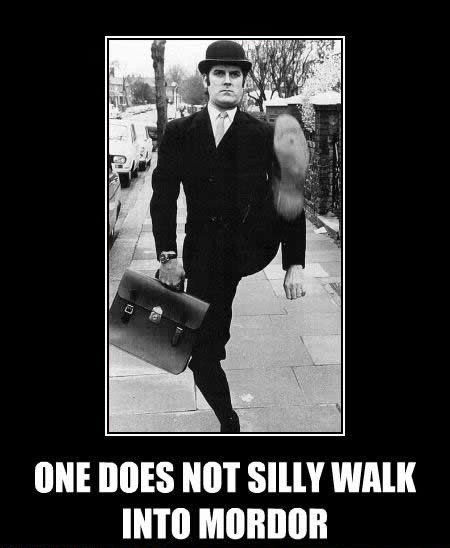
Fantasy and SF in the movies? There, it’s easier to find zaniness on display. Ghostbusters is pure zaniness, through and through. So is Back to the Future, Galaxy Quest, and most of Star Trek IV. Men in Black is zany, and amongst animated films, The Emperor’s New Groove is as zany a film as I can remember. And you have to include the films of Monty Python, which are as zany as it gets and which are often filled with fantastical content.
I’m sure it comes as no surprise that I’m a fan of zaniness, both in life and in fiction. Serious things are good, but zaniness is a part of life, is it not? Life should be a little bit zany…or a lot zany, if you can manage it. The trick is to find your preferred versions of it and incorporate them into your life. Don’t be afraid to, as Merriam-Webster defines it, “act the buffoon to amuse others”…even if it means the occasional pie in the face.
And with that, I come to a successful close of the A to Z Challenge for 2012, Huzzah! Maybe I’ll do this again next year….
Well, it’s a rough transliteration of the final death shriek of Red Leader at the Battle of Yavin in Star Wars Episode IV: A New Hope. He’s just led an unsuccessful attack run on the two-meter-wide thermal exhaust port, failing to get his proton torpedoes to go down the shaft to the reactor (“Negative! It didn’t go it. Just impacted on the surface.”). He orders Red Five (Luke) to gather the remaining pilots (Wedge and Biggs) for one last shot at the exhaust port, before his ship is struck by blaster fire from Darth Vader’s TIE Fighter. Red Leader’s ship sinks toward the surface of the Death Star, and just before he goes up in a ball of flames, he screams, “YAAAHHHHH!”.
So what are we on about here? Acts of self-sacrifice or going-bravely-into-the-night in fantasy and science fiction.
Few things in fiction are more inspiring, frankly, than some person choosing, with their full faculties about them, to undertake an action or series of actions that will result in their deaths but will also result in someone else’s survival. In fact, it’s not even in fiction that this is inspiring, because such actions are typically seen as among the very highest things one can do, and it’s the act of self-sacrifice that makes the Jesus story what it is. Noble acts of self-sacrifice, and their cousins – bravery in the face of certain death – stir our emotions like nothing else. It’s the soldier who throws himself onto the grenade that’s about to explode; it’s the person who gives up their seat in the lifeboat for someone else as the ship sinks.
It’s the man who, bearing an extremely close resemblance to a man who has been falsely imprisoned and sentenced to death, conspires to take his place in prison so that the convicted might rightly go free.
It’s the woman who offers her seat on the last helicopter to the deep underground shelter, as the asteroid nears its humanity-killing collision with Earth, to a desperate woman and her child who weren’t originally offered spots in the survival lottery.
It’s the First Officer who knows that his starship will be destroyed if he doesn’t brave the lethal radiation of the engine chamber and personally mix the matter and antimatter by hand to make the final warp jump to safety possible.
It’s the woman superhero who has realized that her powers are out of control and that she will soon forever lose her command over them, to the ill of all, unless she gives up her own life.
It’s the musicians who, knowing that their escape from the sinking ship is impossible, decide to do what they do best as the waters near: keep playing.
It’s the patriot who, with his head in the noose, states quite clearly that he wishes he could live, just so that he might do it all again.
It’s the freedom fighter on his execution table, refusing to pledge fealty to the despotic King against whom he has struggled for years, just to get the execution over with.
Self-sacrifice and courage in the face of certain death are impulses cut from the same cloth, and when such a moment is captured well in a story, it’s always a moment of power and high emotion. It need not even involve death, really; the final scene of Casablanca is pure self-sacrifice, all the way; Rick is choosing to go to a concentration camp so that Ilsa and Victor can go free. (He can’t foresee that it doesn’t quite work out that way, thanks to the ever-unknowable convictions of Captain Louis Renault.)
Having a character make a choice that brings about doom for themselves, no matter what form that doom might take, so that someone else might prosper, is about the most fool-proof way I can think of to make a character into a hero. You can have a flawed hero, as much as you want, but a true hero, deeply flawed or not, will make that choice each time.
Above I allude to Spock’s self-sacrifice in Star Trek II: The Wrath of Khan. The rest of the crew reciprocates with acts of self-sacrifice in the next film, Star Trek III: The Search for Spock, so that Spock might live. Their sacrifices are real and painful. Near the end of the film, when Kirk and crew have brought Spock back to Vulcan so that his katra (his living essence, just go with it) can be reintroduced to his regenerated body (again, just go with it), they are waiting to see how it went. Sarek (Spock’s father) comes to Kirk, and this exchange takes place:
SAREK: Kirk, I thank you. What you have done–
KIRK: What I have done…I had to do.
SAREK: But at what cost? Your ship. Your son.
[Kirk’s son, David Marcus, had been killed in the course of the film, and Kirk had to put the beloved Enterprise on self-destruct to defeat some Klingons.]
KIRK: If I hadn’t tried, the cost would have been my soul.
Trek III is often derided, and yes, it has its flaws, but it also has this amazingly succinct and wonderful statement of what heroism is all about. And for a virtual meditation on the entire theme of self-sacrifice, Guy Gavriel Kay’s Fionavar Tapestry fills the bill, with so many such acts — including a good number in the last hundred pages — that the trilogy can, for some (myself included), be emotionally overwhelming in spots.
In the end, these kinds of scenes and characters make us ask, does it matter how one falls down? And the answer, as given in The Lion in Winter, is simply this: