.png)
two
And…we’re back! And in a lot less than ten months, too. Huzzah! In the ‘Credit Where Due’ department, for the purposes of this series I’m referring to the film’s script here.
When we left off last time, our Jedi Heroes had been caught, with Chancellor Palpatine and R2-D2, whilst trying to escape the ship of General Grievous. The space battle is raging on, but our heroes are brought to the bridge of the ship, where they come face to face with Grievous, a fairly bizarre individual who seems to be mostly robot, but with some kind of biological parts, who is hunchbacked, and who is constantly afflicted by a hacking cough. (This cough is actually explained by the final installment of a series of animated shorts called, appropriately enough, The Clone Wars, which aired on one of the cable networks between AotC and RotS, but it’s not really important here…unless one wants to know why a person who is something like ninety percent droid is coughing. I personally, did not.)
As Grievous confronts the Jedi, he refers to Obi Wan as ‘the Negotiator’, a touch that I like because it implies that Kenobi has a kind of reputation that he’s picked up in the course of the Clone Wars, not unlike Erwin Rommel’s ‘nom de war’, ‘the Desert Fox’. When Grievous meets Anakin, he notes that he expected someone of his reputation to be a bit older; Anakin replies: “General Grievous. You’re shorter than I expected.” I’ve always liked this line.
The rest of this plays out pretty much by numbers: R2-D2 creates a diversion, long enough for Obi Wan and Anakin to recover their lightsabers and free themselves from their bonds, at which point they go on yet another Jedi rampage against battle droids. There’s nothing particularly major here that we haven’t seen before in the Prequels, and it flashes by pretty quickly (albeit with an entertaining bit that comes when Obi Wan realizes that a particular model of battle droid can keep right on fighting even after decapitation). Grievous manages to escape yet again, this time by smashing one of the windows open and letting himself get blown out into space; he then uses a grappling hook to get himself to an escape pod while Obi Wan and Anakin have to take the controls of the ship, which is starting a death plunge into the atmosphere.
This whole sequence is really well done:
OBI-WAN and ANAKIN go over to the navigator’s chair.
ANAKIN: All the escape pods have been launched.
OBI-WAN: Grievous. Can you fly a cruiser like this?
ANAKIN: You mean, do I know how to land what’s left of this thing?
ANAKIN sits in the pilot’s chair and sees on a screen the back half of the ship break away. There is a great jolt, and the ship tilts forward.
OBI-WAN: Well?
ANAKIN: Under the circumstances, I’d say the ability to pilot this thing is irrelevant. Strap yourselves in.
OBI-WAN and PALPATINE strap themselves into chairs. ANAKIN struggles with the controls of the ship. The ship starts to glow, and pieces break off. ARTOO moves in on Palpatine ‘s controls and assists in flying the cruiser.
OBI-WAN: Steady . . . Attitude . . . eighteen degrees.
ARTOO beeps.
ANAKIN: Pressure rising. We’ve got to slow this wreck down. Open all hatches, extend all flaps, and drag fins.
OBI-WAN: Temp steady. Hatches open, flaps extended, drag fins . . .
A large part of the ship breaks away.
ANAKIN: We lost something.
OBI-WAN: Not to worry, we’re still flying half the ship.
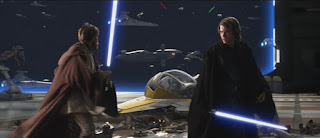
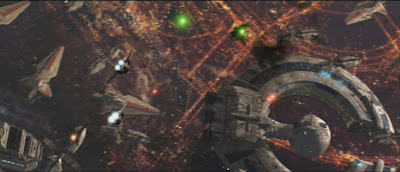
I love that last line of Obi Wan’s. This whole sequence is fun, tense, and the effects are amazing. This brief shot is one of my favorite sights in all the Star Wars movies:
.png)
And all the other visual details are terrific here: the flames of reentry outside the bridge windows, the fireships that come alongside to smother the burning ship in fire retardant, the way the ship flies through a thick cluster of clouds to suddenly emerge above the capital city of the Republic. The ship’s bridge is dominated by yellow and green lighting, which is a color scheme we haven’t seen before. I also like how well-conceived this sequence is, in terms of details. Yeah, they may actually be scientifically implausible, but within the rules of his universe, George Lucas has thought out some stuff. The cruiser has ‘drag fins’, big metal flaps that extend out and provide increased air resistance to slow the ship down when it’s in the atmosphere (and remember, we’ve already established that cruisers of this size can land planetside), and the afore-mentioned firefighting ships.
Of course, Anakin brings the ship in for an impressive crash landing (taking out a control tower in the process…I always wonder if that tower was full of space traffic controllers, maybe one declaring this to be the wrong week to be giving up Death Sticks). The dust is settling, everyone is breathing a sigh of relief, and Obi Wan sums it all up: “Another happy landing!”
At this point, we’re finally done with an action sequence that has taken over twenty minutes of the film’s opening. It’s almost a short film in itself, complete with three acts, and it was an exhilarating way for George Lucas to start the film. Now comes quite a bit of talking and politics. Not that a lot of this bothers me, but the pace slows down quite a bit now.
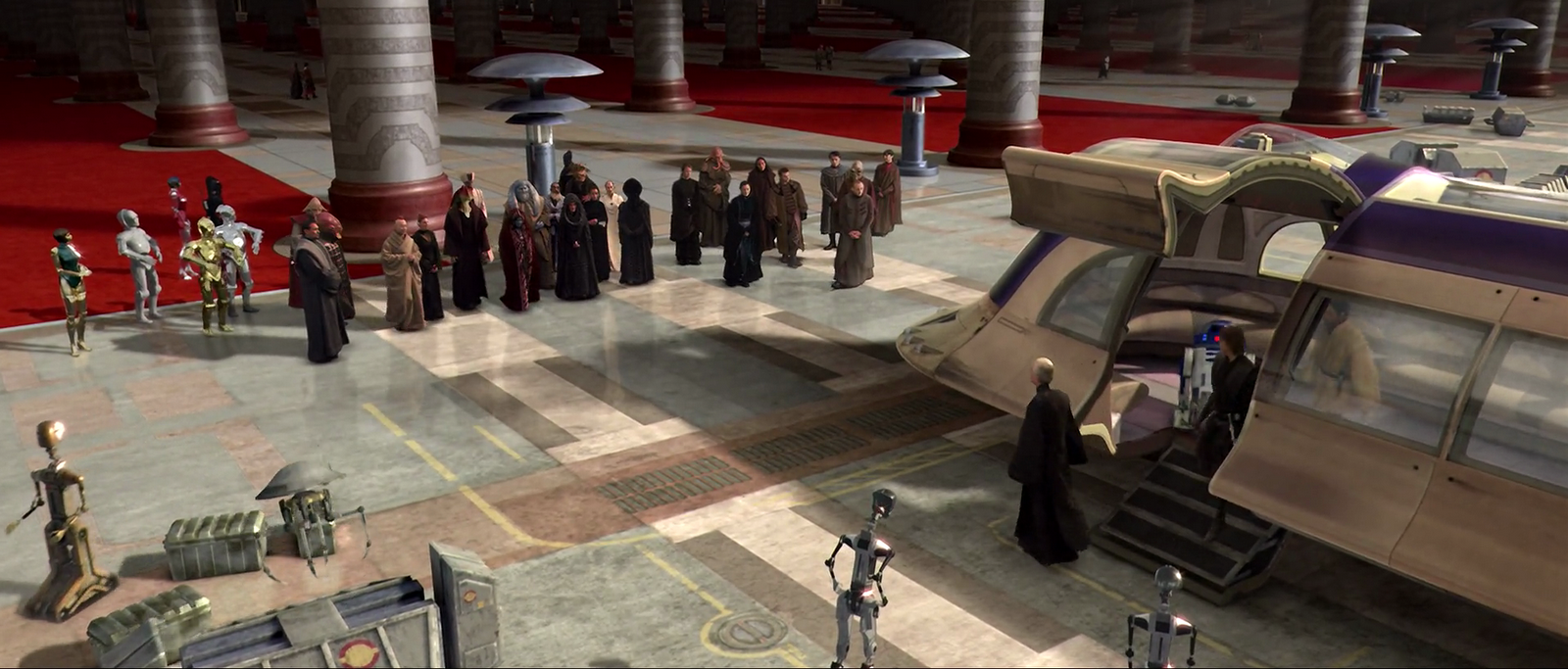
A shuttle brings the Chancellor, along with his Jedi rescuers, back to the Capital, where Obi Wan and Anakin have another bit of repartee:
ANAKIN: (to Obi-Wan) Are you coming, Master?
OBI-WAN: Oh no. I’m not brave enough for politics. I have to report to the Council. Besides, someone needs to be the poster boy.
ANAKIN: Hold on, this whole operation was your idea. You planned it. You led the rescue operation. You have to be the one to take the bows this time.
OBI-WAN: Sorry, old friend. Let us not forget that you rescued me from the Buzz Droids. And you killed Count Dooku. And you rescued the Chancellor, carrying me unconscious on your back, and you managed to land that bucket of bolts safely . . .
ANAKIN: All because of your training, Master.
OBI-WAN: Anakin, let’s be fair. Today, you are the hero and you deserve your glorious day with the politicians.
ANAKIN: All right. But you owe me . . . and not for saving your skin for the tenth time . . .
OBI-WAN: Ninth time . . . that business on Cato Nemoidia doesn’t count. I’ll see you at the briefing.
I like the bit about keeping score – it’s reminscent of the Original Trilogy, and the friendly rivalry between Luke Skywalker and Han Solo. Next there’s a brief bit as Palpatine assures Mace Windu that the Senate will insist on continuing the war as long as General Grievous is at large; with Count Dooku dead, Grievous is now the leader of the droid armies. Not much is made of the fact that Dooku wasn’t just a military leader, but a political leader as well – who will rise to lead the Separatist movement?
Of note here is that Palpatine has managed to create an environment of perpetual war in the Republic, a war that has the support of the Senate and is being led by the Jedi. And yet we know there is tension between the Chancellor and the Jedi, so the question arises – never really addressed by the films – as to just what the relationship is between the Jedi and the Chancellor and the Senate. The Jedi seem to be a somewhat independent body, governing themselves, but taking input from the Senate. But they’re starting to not like what they are being required to do; as Mace Windu basically stated in AotC, they are basically policemen, not soldiers or military leaders. And yet that is their new role. Interesting, then, that a key facet of all of Palpatine’s machinations is to manipulate the Jedi into serving a role that they are not well-suited to serve.
Anyway, back to the movie. The Chancellor and the Jedi and the rest of a group of Senators walk off. (In this bunch is one Jar Jar Binks, who is almost unnoticed except that he has his one line of dialogue in the movie, “Excuse me”. What was funny about this is that when I saw the film in the theater back in 2005, as soon as people noticed Jar Jar, there was no booing or hissing – just several people in the theater exclaiming, “Hey, it’s Jar Jar!” and some murmurs of recognition, not all of which sounded angry. Make of that what you will…but sometimes I wonder if Jar Jar isn’t quite as hated as most people think he’s hated. Or maybe I’m just delusional….) Anakin exchanges words with Senator Bail Organa (Jimmy Smits, who had quite the political acting life in the mid-2000s, appearing as a Star Wars Senator and as the successor to President Josiah Bartlet in The West Wing), and then he notices someone in the shadows of one of the great pillars. It’s Padme.
.png)
Now, why isn’t Padme in the group of dignitaries meeting the Chancellor upon his return? She is one of the most influential political figures in the Senate. Clearly it’s because she needs to meet Anakin in somewhat private. They embrace, and this exchange takes place (material not actually in the final film in red):
ANAKIN: I missed you, Padme.
PADME: There were whispers . . . that you’d been killed.
ANAKIN: I’m all right. It feels like we’ve been apart for a lifetime. And it might have been … If the Chancellor hadn’t been kidnapped. I don’t think they would have ever brought us back from the Outer Rim sieges.
ANAKIN starts to give her another kiss. She steps back.
PADME: Wait, not here . . .
He grabs her again.
ANAKIN: Yes, here! I’m tired of all this deception. I don’t care if they know we’re married.
PADME: Anakin, don’t say things like that. You’re important to the Republic … to ending this war. I love you more than anything, but I won’t let you give up your life as a Jedi for me . . .
ANAKIN: I’ve given my life to the Jedi order, but I’d only give up my life, for you.
PADME: (playfully) I wouldn’t like that. I wouldn’t like that one bit. Patience, my handsome Jedi . . . Come to me later.
ANAKIN embraces her, then looks at her.
ANAKIN: Are you all right? You’re trembling. What’s going on?
PADME: I’m just excited to see you.
ANAKIN: That’s not it. I sense more . . . what is it?
PADME: Nothing . . . nothing . . .
ANAKIN: You’re frightened. (a little angry) Tell me what’s going on!
PADME begins to cry.
PADME: You’ve been gone five months . . . it’s been very hard for me. I’ve never felt so alone. There’s . . .
ANAKIN: . . . Is there someone else?
PADME: (peeved, angry) No! Why do you think that? Your jealousy upsets me so much, Anakin. I do nothing to betray you, yet you still don’t trust me. Nothing has changed.
ANAKIN: (sheepish) I’m afraid of losing you, Padme . . . that’s all.
PADME: I will never stop loving you, Anakin. My only fear is losing you.
ANAKIN: It’s just that I’ve never seen you like this . . .
PADME: Something wonderful has happened.
They look at each other for a long moment.
PADME: (continuing) I’m . . . Annie, I’m pregnant.
ANAKIN is stunned. He thinks through all of the ramifications of this. He takes her in his arms.
ANAKIN: That’s . . . that’s wonderful.
PADME: What are we going to do?
ANAKIN: We’re not going to worry about anything right now, all right? This is a happy moment. The happiest moment of my life.
So: Padme’s pregnant, and judging by her clothes, she’s somewhat far along. That’s probably why she’s staying the shadows, then; this is not a condition she wants to become common knowledge, for obvious reasons. Someone will ask who the father is, and someone else will figure it out, to the doom of Anakin’s career as a Jedi, even though he says that he wants to just come out with it and let the chips fall where they may. I like Anakin’s reaction to the news of her pregnancy: he’s shocked at first, a bit overwhelmed, and then he manages to return to happiness. So, is he really happy that he’s about to be a father? Or is this something he neither expected nor wanted? I think that the evidence in the film supports both possibilities, and I like the ambiguity of his response to being told and the way he covers it up almost immediately. At the point of the revelation, John Williams’s music does not become lovely or plaintive; instead it churns in the basses, underscoring nicely Anakin’s conflicted emotions about becoming a father.
I do think that Lucas made a wise choice in eliminating the bit about Anakin suspecting Padme of having another suitor. While his loss of trust in Padme will be the final straw in his march toward the Dark Side, it’s much too early to plant that seed. Nevertheless, here is where I would make my first actual change in the film: as they embrace on final time, I’d have someone from the Jedi council see them embracing. The obvious choice here is Mace Windu. Why? Because I think a few seeds need to be planted here for later in the film, and because I think that the film needed to get a reminder in earlier on that Mace Windu has never really been in Anakin’s fan club. He wouldn’t say anything to Anakin and Padme; not now, anyway. But he’d look back and see their embrace and start to recognize it for what it is: a Jedi indulging forbidden love.
Now we cut to General Grievous and his arrival on the planet Utapau. For longtime Star Wars fans, the name of the planet Utapau is exciting (although we don’t hear it for a while yet), as it is one of the very earliest planet names George Lucas tossed around way back in the early 1970s when he was originally cobbling together his notions for a big space adventure epic movie. After Grievous lands, he makes contact with Darth Sidious, who is behind everything; Sidious orders him to move the Separatist leaders to Mustafar and then answers Grievous’s concern about Count Dooku’s death with the revelation that he’s already got his eye on a new apprentice, “one who is far more powerful”. Uh oh….
And then we are whisked back to Coruscant, for a nice quiet scene between Anakin and Padme at night on the balcony of their 800th-floor apartment. Or what’s supposed to be a nice quiet scene, because…well, this is what happens.
PADME: Annie, I want to have our baby back home on Naboo. We could go to the lake country where no one would know . . . where we would be safe. I could go early-and fix up the baby’s room. I know the perfect spot, right by the gardens.
ANAKIN: You are so beautiful!
PADME: It’s only because I’m so in love . . .
ANAKIN: No, it’s because I’m so in love with you.
PADME: So love has blinded you?
ANAKIN: Well, that’s not exactly what I meant . . .
PADME: But it’s probably true!
Yeah…I know. There’s just no way for me to sugarcoat this one, folks: this scene is a stinker. In a movie that so far has been hitting all the right notes, this scene comes along and reminds everyone of their biggest complaints about the last two movies, what with lines about how Padme’s not like sand and how Anakin is tortured by his love for her and so on. I tend to roll my eyes whenever I hear someone trot out the “George Lucas needs someone to tell him when his ideas suck” meme (otherwise known as the “Gary Kurtz Conjecture”, under the notion that it was Gary Kurtz’s steady hand that kept Lucas from doing stupid things that ruined the only two Star Wars movies that anybody likes, or so the story goes), but this scene unfortunately provides some ammunition for that camp. It’s not quite as bad as the Single Worst Scene In Star Wars History, but…well, it’s right up there. I hate hate hate the way this scene ended up.
So, let’s fix it. Here’s what should have happened here:
PADME: Annie, I want to have our baby back home on Naboo. We could go to the lake country where no one would know . . . where we would be safe. I could go early-and fix up the baby’s room. I know the perfect spot, right by the gardens.
ANAKIN: You are so beautiful….
PADME: It’s only because I’m so in love . . .
ANAKIN: No, it’s because I’m so in love with you.
PADME: So love has blinded you?
ANAKIN: No! I mean…uh….
He sees that she is grinning at him.
ANAKIN: You got me again.
PADME: Only because you make it so easy.
ANAKIN: You know that I’m not good at talking about my feelings.
PADME: You’re not so bad at it, when you stop trying to talk like a poet. There aren’t many famous Jedi poets, are there?
ANAKIN: (laughs) No. I tried reading some Jedi poetry, once…hundreds of lines about the Force. An entire book that sounded like Master Yoda…I didn’t understand any of it.
He comes to her side.
PADME: What are we going to do? When the war is over and the baby is born? You can’t be a Jedi and a father.
ANAKIN: I know. So I’ll be a father.
PADME looks at him.
PADME: You’ll give up being a Jedi?
ANAKIN: (smiling) For what I’d be getting in return? Yes.
They embrace.
Something like that…something which would show that Anakin is thinking ahead a bit, and that he has a happy ending right there for the taking, if he just doesn’t screw it up…which we know he’s going to. It would heighten the tragedy of his fall, and like I did in fixing AotC, I’d fix some bad dialogue by actually calling attention to it.
This scene is followed by a brief dream sequence, in which Anakin sees Padme giving birth, but it’s a horrible, painful experience in which she is shrieking in agony. That’s about all we see, before Anakin snaps awake and walks out to the living room. We don’t really see it in his dream, but he interprets it as meaning that Padme is doing to die in childbirth, and the script bears this out by indicating that in the dream, Padme actually dies. Cut to the living room, then:
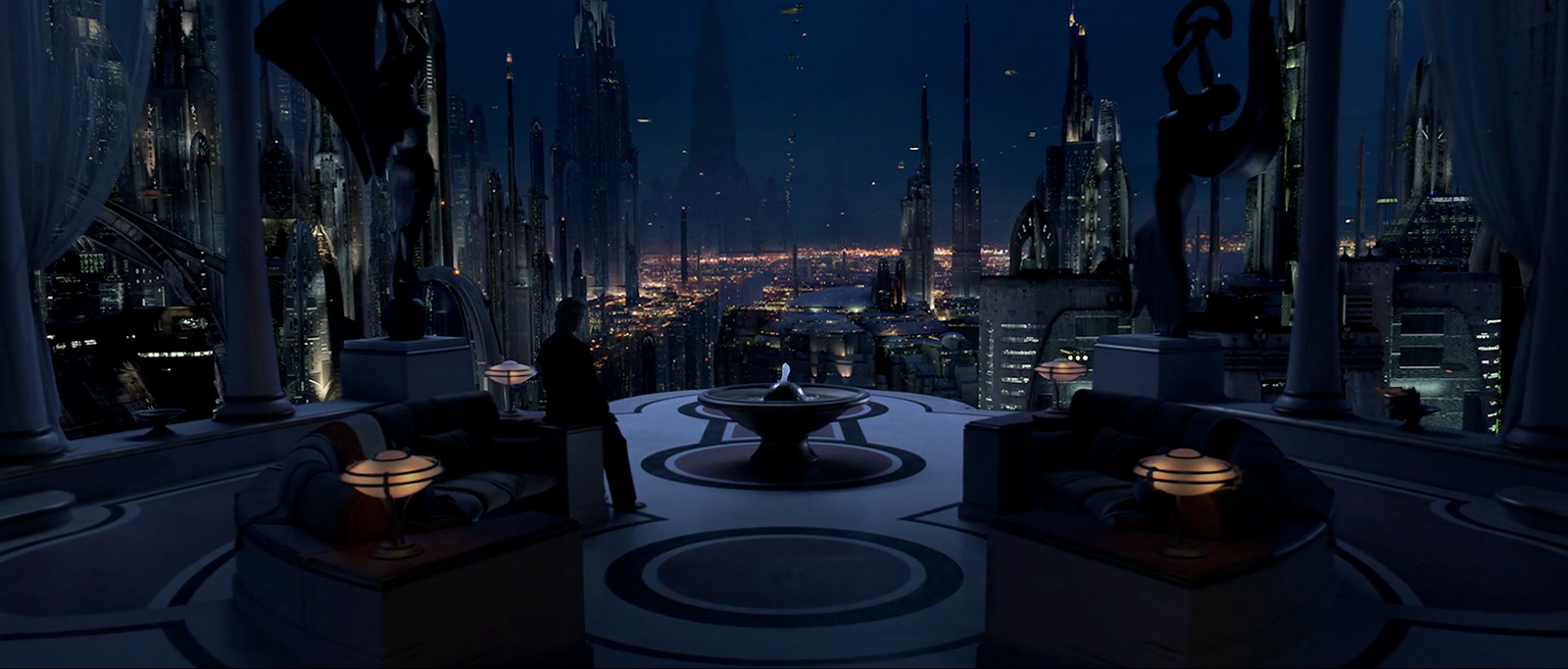
ANAKIN walks down a flight of stairs onto a large veranda. The vast city planet of Coruscant, smoldering from the battle, is spread out before him. He is distraught. PADME descends the stairs and joins ANAKIN on the veranda. She takes his hand. He doesn’t look at her.
PADME: What’s bothering you?
ANAKIN: Nothing . . .
ANAKIN touches the japor snippet around PADME’S neck, that Anakin gave her when he was a small boy.
ANAKIN: (continuing) I remember when I gave this to you.
PADME: How long is it going to take for us to be honest with each other?
ANAKIN: It was a dream.
PADME: Bad?
ANAKIN: Like the ones I used to have about my mother just before she died.
PADME: And?
ANAKIN: It was about you.
They look at each other. A moment of concern passes between them.
PADME: Tell me.
ANAKIN: It was only a dream.
PADME gives him a long, worried look. ANAKIN takes a deep breath.
ANAKIN: (continuing) You die in childbirth . . .
PADME: And the baby?
ANAKIN: I don’t know.
PADME: It was only a dream.
ANAKIN takes PADME in his arms.
ANAKIN: . . . I won’t let this one become real, Padme.
They embrace, then part.
PADME: Anakin, this baby will change our lives. I doubt the Queen will continue to allow me to serve in the Senate, and if the Council discovers you are the father, you will be expelled from the Jedi Order.
ANAKIN: I know ….
PADME: Anakin, do you think Obi-Wan might be able to help us?
ANAKIN: I don’t need his help . . . Our baby is a blessing.
Obviously, I would have eliminated the bit about Padme worrying about Anakin’s future once the baby is born; I’ve relocated that to the earlier scene. It doesn’t seem to fit naturally in the scene where Anakin is dealing with a new dream about his wife’s death.
The shooting script has a bit of dialogue in there in which Anakin angrily asks if Padme has told Obi Wan anything; I’m glad this is left out, as I still think it’s too early for the jealousy angle to show up. I’ve always liked this, though – that Anakin isn’t just afraid of losing Padme, but that he’s having dreams and visions about it, and he’s already had a similar experience with his dreams of the future dolorous fate of someone he loved – his mother – coming true. He desperately wants to prevent this future, but even though he vows that he won’t let it happen, he is already suspecting that he doesn’t have the power he will need to do so.
And since Palpatine knows about Anakin’s actions against the Sandpeople in AotC, it’s reasonable to assume he knows about the dreams then, too. The wedge is already there, waiting to be driven in.
Oh, and that bit with Padme wearing the Japor snippet around her neck, the one Anakin gave her as a boy way back in TPM? That’s fantastic. It’s a great touch by Lucas, one which will pay off with a gorgeously sad visual late in the film.
Anakin doesn’t want to go to Obi Wan for help, but he does go to someone: he goes to Yoda. In the next scene, Anakin is talking to Yoda and gets some helpful advice:
INT. CORUSCANT-JEDI TEMPLE-YODAS QUARTERS-DAY
YODA and ANAKIN sit in Yoda ‘s room, deep in thought.
YODA: Premonitions . . . premonitions . . . Hmmmm . . . these visions you have . . .
ANAKIN: They are of pain, suffering, death . . .
YODA: Yourself you speak of, or someone you know?
ANAKIN: Someone . . .
YODA: . . . close to you?
ANAKIN: Yes.
YODA: Careful you must be when sensing the future, Anakin. The fear of loss is a path to the dark side.
ANAKIN: I won’t let these visions come true, Master Yoda.
YODA: Death is a natural part of life. Rejoice for those around you who transform into the Force. Mourn them, do not. Miss them, do not. Attachment leads to jealousy. The shadow of greed, that is.
ANAKIN: What must I do, Master Yoda?
YODA: Train yourself to let go of everything you fear to lose.
And by the look on Anakin’s face, we see that boy, is that ever not what he’s looking to hear.
This leads to one of the more interesting things about Jedi philosophy, as we hear it from Yoda throughout the Star Wars saga. Anakin is worried about his loved one, but Yoda tells him that the way to deal with his fears for her fate is to let her fate unfold and, basically, ignore it. This is virtually the same advice Yoda will give Luke Skywalker twenty years later, in TESB, when Luke has visions about Han and Leia suffering greatly:
LUKE: And sacrifice Han and Leia?
YODA: If you honor what they fight for…yes!
The advice goes about as well then as it does for Anakin, although Luke’s doesn’t end nearly as badly. The question is: why is this?
I think it’s because Luke is able to do something that Anakin tends to find extremely difficult: he is able to trust his friends, where Anakin only looks inward, to himself, to his own powers and his own abilities. And why is this? Well, I suspect it’s partly because Luke doesn’t grow up – even partially, as Anakin does – inside the sequestered and sheltered bubble that the Jedi put themselves in. The Prequel Trilogy depicts the Jedi as an almost ascetic group who are supposed to be denying their emotional lives in favor of devotion to the Force. Luke later demonstrates that fealty to the Force is not at all incompatible with having love and friendship in one’s life. I wonder if this isn’t part of why the Jedi fall – because they’ve turned so far inward that they genuinely believe that attachment is bad, friendship is bad, love is bad…because under certain circumstances, they can lead to the Dark Side.
From Yoda’s perspective, though, it’s Anakin’s love for Padme that leads him straight to the Dark Side, straight to joining the Sith, and straight to playing a role in the final fall of the Jedi. So when Luke comes along and wants to be trained and then has his own visions of horrible things happening to his loved ones and rushes off to save them, Yoda must clearly be seeing that as “And here we go again.” He thinks everything is about to be undone by the passions of the Skywalkers, again. Once again, I end up admiring the way Lucas has events from the Original Trilogy having echoes and parallels in the Prequel Trilogy.
And there we will stop. Next time, Anakin is drawn into the political world, and his desires for power start to get stroked as well as his fears for Padme. Tune in!