A nifty paragraph

I’ve been reading The Count of Monte Cristo of late, and I just really liked this particular paragraph. I know I’m reading a translation, but I am greatly enjoying what I’m getting of Dumas’s style. It’s hard to explain, I must admit…it’s like he uses a lot of words, fairly poetically, to state something bluntly.

I am now up to where Edmund Dantes has recovered the treasure and is investigating what has become of the shards of the life that was exploded years ago, when he was unjustly imprisoned. Good stuff!

Share This Post

From the Books: “Me the People”

I’ve recently read a book called Me the People: One Man’s Selfless Quest to Rewrite the Constitution of the United States of America, by Kevin Bleyer. Mr. Bleyer is, among other things, one of the writers for The Daily Show, which means that this book is a mixture of humor and serious discussion, with the occasional problem that at times it’s difficult to separate the two. But it still present a fascinating look at the process by which the Founding Fathers arrived at the Constitution, and what kinds of problems exist in trying to force a modern, technological superpower’s society on a governmental structure created by a bunch of agrarian former colonists more than two hundred years ago.

In all honesty, I’ve never been much for idolatry of the Constitution. I recently had a friend try to draw me into a conversation on gun control, and I strongly resisted, not particularly wanting to venture down that particular garden path, well, ever. But my friend did ask me this: “Well, you believe in the Constitution, don’t you?” That struck me as an interesting question, because, well, what does it mean?

Do I believe in the Constitution? I suppose so, in that I believe that we have a government that is structured according to the provisions contained within the Constitution’s pages. And that’s about all that I believe about it. I don’t believe that there is anything especially sacred about the Constitution, and I don’t believe that the Constitution represents some kind of moment when we rose to greatness. In truth, the Constitution is a muddled mess of a document, and the government it creates isn’t so much a brilliantly constructed Machine of Democracy as a hodge-podge, ramshackle mess of compromises with difficulties exacerbated by some really poor writing.

When discussing various issues, I try to never get wrapped up in talking about what “the Founding Fathers wanted”, for a number of reasons. To begin with, the Constitution simply does not represent any kind of ‘consensus’ on the part of the Founding Fathers. A lot of them disliked the resulting document and simply accepted it as “the best thing we’re likely to end up with”. When the biggest matter of consensus arising from the Constitutional Convention was a general sense of “Meh, this was the best we could do, folks”, the idea of ascribing any particular thought or philosophy to “the Founding Fathers” doesn’t make much sense. Heck, Thomas Jefferson even thought that we should scrap the entire thing after a few decades and take another whack at it. As far as I can see, referring to “what the Founding Fathers wanted” is a reference to nothing at all, because they all wanted different things.

More importantly, though, is that a lot of water has gone under the bridge since then. The United States Constitution was adopted 224 years ago. Even if there really was some kind of consensus as to what the FF’s wanted, why should that even matter now? Maybe because it’s our own history, but the time of the FFs was a lot longer ago than I think we tend to realize, and I’m increasingly of the view that keeping our governmental structures rigidly organized according to the thoughts of people who lived and died that long ago may not be a great idea. Consider the following list of things, and consider that FFs lived closer to these things, time-wise, than they did to us:

Queen Elizabeth I
William Shakespeare
The defeat of the Spanish Armada
Johannes Kepler
Nostradamus
Suleiman the Magnificent
Cervantes
Ben Jonson

Did the FFs intend for their Constitution to still be running the show 224 years later? I have no idea. But I suspect they’d be a bit baffled by the lip service that is paid to that old document these days, and it says something to me that they included a mechanism for changing the Constitution for a reason.

Here’s how Bleyer sums things up:

Now we understand how it all happened — or rather, almost didn’t.

The Constitution wasn’t a “Miracle at Philadelphia” written by “an assembly of demigods”. On the contrary; what began as a measured, deliberate effort to rescue a beleaguered country became a perpetual unresolved-motion machine — a maddening cycle of nonbinding votes by a parade of toothless committees, marked by fits and starts, fights and “full stops”, conducted by a combative group of exhausted, drunken, broke, petty, partisan, scheming, squabbling, bloviating, backstabbing, grandstanding, godforsaken, posturing, restless, cow-tipping, homesick, cloistered, claustrophobic, sensory-deprived, under-oxygenated, fed-up, talked-out, overheated delegates so distraught and despairing they threatened violence, secession, foreign allegiance, even prayer — and concluded, for those who didn’t abandon the proceedings altogether, with as much premeditation and forethought as a game of musical chairs: the last, least abhorrent, mutually-somewhat-acceptable idea on the table when the music stopped — or the heat became too unbearable, or the liquor too strong, or the rioting too loud, or the pressure too intense, or the company too loathsome, or the wigs too uncomfortable, or the patience too thin — became the law of the land. As much the product of an “assembly of demigods” as a confederacy of dunces.

From page one, the Constitution is, by its own admission, a compromise. It is what you get when you drink beer for breakfast.

Or as Ben Franklin put it as the Convention ended: “Thus I consent to this Constitution, because I expect no better.”

If they thought it stank, why should we pretend that it smells of roses and lavender?

Share This Post

From the Books: Make the Bread, Buy the Butter

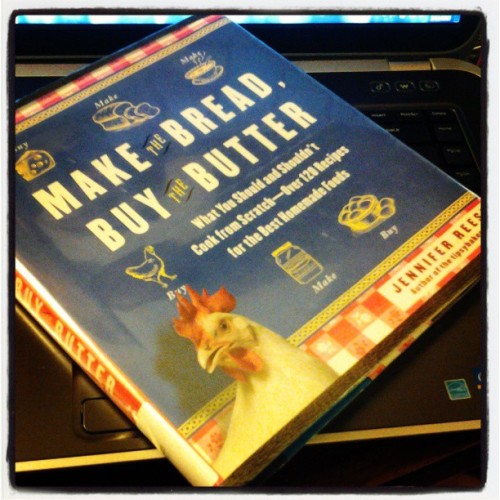
I don’t own this book yet. But I’ve had it checked out of the library a majority of the weeks it’s been in the collection, which means that it’s well past time for me to get off my ass and buy a copy, innit? Anyway, Jennifer Reese‘s Make the Bread, Buy the Butter (subtitled What You Should and Shouldn’t Cook From Scratch) is a terrific cookbook. Not just a collection of recipes, it’s a chronicle of one woman’s quest to take more of a do-it-yourself (DIY) approach to her family’s food preparation, and the discoveries she made along the way that there are some things that you certainly should make for yourself (either because it’s easier, or cheaper, or just plain better, or all three), and that there are other things that you’re just fine buying for yourself at the store.

I haven’t done a whole lot of cooking out of the book yet (one new wrinkle is The Wife’s adoption of a gluten-free diet, which has us going in other food directions currently), but there are a lot of good insights here on food and making it yourself and the fact that sometimes it’s just fine to not do things from scratch. The book is full of frank observations, like this:

If bay leaf didn’t exist, would anyone miss it? I’ve never tasted anything and thought, This stew is just crying out for bay leaf. But I keep buying and using it nonetheless.

And Reese’s explorations are hard-core. This isn’t just about making your own breads or spice mixes or your own peanut butter. She writes about keeping — and killing — her own chickens, and keeping goats. She writes about making her own hot dogs (her conclusion? Just buy ’em.). And she writes thusly about a dish that’s wonderful when made at home, but may or may not be worth all the effort: fried chicken.

One rainy Sunday a few years ago, Isabel, Owen, and I decided to pass the afternoon by watching a DVD of The Fellowship of the Ring, that movie about hobbits and elves and Orcs that we’d been hearing about. One hundred and seventy-eight minutes later, during which we neither moved nor spoke, we looked at each other, eyes glazed. We walked straight to the car, drove to the video store, and rented The Two Towers and The Return of the King. It was getting on dusk when I pulled into the Kentucky Fried Chicken down the hill and bought dinner.

My kids were shocked. Happy, but shocked. What was going on with Mom? KFC? I wondered that myself. But we were hungry and the chicken was hot and we had five more hours of Viggo Mortensen to watch. Fifteen minutes after I pulled into the KFC, we were back on the sofa with the bucket on the coffee table, eating mediocre chicken and mashed potatoes and biscuits and watching The Two Towers. It was one of the happiest nights of my adult life and my children still get dreamy and nostalgic talking about it.

Not long ago, I cooked a grand fried chicken dinner out of Ad Hoc At Home by Thomas Keller. I bought the book based on rave reviews of Keller’s chicken, which is brined and air-dried before it is dipped in multiple coatings and fried. The effort paid off; the recipe did not disappoint. TO go with that incredible chicken — because you can’t serve fried chicken without fixins — I mashed potatoes and baked biscuits. There was a salad in there somewhere, too. Frying chicken is messy and nerve-racking because oil spatters and spits and stings your forearms and you have to do it at the last minute, which is also when you’re mashing potatoes and pulling biscuits out of the oven and pouring glasses of water and calling to everyone that dinner is ready. Leave it in the pan too long, and the chicken is ruined; take it out too soon and it’s a health hazard. You really have to be up for the logistical challenge.

And fried chicken comes with baggage: You expect fried chicken to be so good that people lick their fingers. Literally. You expect people to linger at the table and loosen their belts, lean back in their chairs, tell stories, pull out a bottle of corn likker. You expect people to somehow recognize that this isn’t a meal like all other meals.

Sometimes all of that will happen.

Sometimes it will not.

By the time we sat down, I was bleak with exhaustion, everyone was ravenous, and we put away that chicken in about ten minutes flat. The coating formed a crispy sheath around meat that, thanks to brining, was juicy and flavorful through to the bone. The potatoes were a celestial cloud of starch and butter; the biscuits, perfection. But I don’t remember a thing anyone said; I don’t remember anyone lingering at the table or thanking me or recognizing that the meal was special or iconic or hanging around afterward to drink corn likker. One of these days I will forget the evening ever happened. I suspect Mark and the children already have. But that night we ate KFC on the sofa and watched The Two Towers? That, we will never forget.

Sometimes I have to remind myself that the symbols of wholesome domestic happiness — hot biscuits, a platter of home-fried free-range chicken, a family sitting around a table — are not domestic happiness. The family sitting in front of the TV with the bucket may be experiencing more joy and grace and love. Or, of course, they may not be.

Should you make your own fried chicken or buy KFC? Reese says there’s no easy answer to that, and I tend to agree. I’ve made my own fried chicken, and had a good time doing it. And you can probably tell by my self-photos that I’ve had my share of KFC.

I need to buy this book…and even after I do, I’ll probably keep checking it out periodically, just to keep its circulation numbers up.

Share This Post

From the Books: “Coming of Age in the Milky Way”

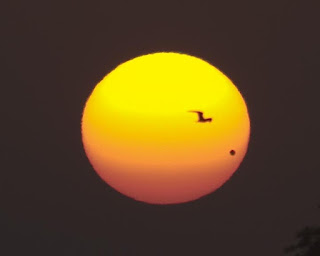
Last night saw a rare, and spectacular, astronomical event: the transit of Venus across the Sun. There were many amazing pictures from this event, and Phil Plait provided some terrific coverage. The event reminded me, specifically, of a passage from a favorite book of mine, and one which I’ve been planning to dig out for a re-read soon: Coming of Age in the Milky Way by Timothy Ferris.

This book constitutes a one-volume history of the human species’s discovery of its own roots in, and relation to, the Universe. In that respect, the book covers quite a bit of the same ground as Carl Sagan’s Cosmos, although Ferris’s focus is more on a narrative approach than Sagan’s more free-form exploration of the Cosmos. Still, Coming of Age in the Milky Way contains some of the finest science writing I’ve read, and I strongly recommend it.

In the following selection, Ferris relates the mobilization of the scientific world in the 1700s to use that era’s coming transit of Venus as a means of measuring the distances between the planets, further establishing the size of what was then thought to be the entire Universe. The transits had been predicted by Edmund Halley nearly a century before, and he had admonished his scientific descendants to take advantage of the opportunity, because by recording the timing of the transits as they unfolded from different parts of the world, a triangulation could be employed to survey the size of our sky.

What’s most amazing to me about this is the sheer hardship endured in the name of scientific discovery, hardship that we tend to overlook in the onward march of discovery today, when the transits can be observed and recorded by spacecraft orbiting our world and beaming their data back to us so that I, sitting at my desk, can look at the images on my laptop. I can see the transit of Venus without getting up from my desk, except to get a bottle of water. These guys? Read on to see what they had to put up with to see a Venusian transit….

As for Venus, its transit on December 6-7, 1631, was visible only from the New World and appears to have been viewed by not a single human being, and the transit of November 24, 1639, was observed by two people, the English astronomer and clergyman Jeremiah Horrocks and his friend William Crabtree. Alarmingly for Horrocks, who was a clergyman, the transit occurred on a Sunday, when he was obliged to preach two sermons. He rushed home from church, peered through his telescope at 3:15 pm, and saw Venus, “the object of my most sanguine wishes…just wholly centered on the Sun’s disk.” Venus, like Mercury, looked smaller than had been predicted – Kepler thought Venus would cover one quarter of the sun, an enormous overestimate – and so to behold its apparent tiny size helped improve human appreciation of interplanetary distances. But Horrocks had no way to measure the apparent diameter of the disk precisely, and, since he was but one observer, he could not have triangulated Venus even if he had possessed an accurate clock. Crabtree, for his part, was so overwhelmed by the sight of an entire world dwarfed by the Sun that he made no coherent notes at all, prompting Horrocks to protest that “we astronomers have a certain…disposition [to be] distractedly delighted with light and trifling circumstances.”

But the world had changed by the time the transits of Venus of 1761 and 1769 came due. Astronomy had become an organized science, conducted by professionals, sponsored by scientific societies, and supported by government funds. Now at last, it was felt, science had the resources to sound the dimensions of the solar system. Halley’s implorations were remembered, and the transits were scrutinized by scores of observers equipped with micrometers, accurate clocks, and brass telescopes mounted on hardwood tripods at sites as far away as Siberia, South Africa, Mexico, and the South Pacific.

And, to an extent, the transit observers succeeded, though not without suffering some sufficient tribulations to remind them that while the motions of the planets may be sublime the affairs of this world are marbled with chaos. The astronomer Charles Mason and the surveyor Jeremiah Dixon, later of the Mason-Dixon Line, were attacked by a French frigate while making their way to Africa (this was during the Seven Years’ War) with a loss of eleven dead and thirty-seven wounded; they reached Cape Town under military escort and observed the 1761 transit, only to find that they differed by many seconds in their estimate of the time when Venus had entered and left the disk of the sun. William Wales timed the transit from Hudson Bay, Canada, after enduring mosquitoes, horseflies, and a winter sufficiently severe that, as he noted with empirical exactitude, a half-pint of brandy left unattended iced over in only five minutes. Jean-Baptiste Chappe d’Auteroche, dispatched by the French academy into the depths of Russia, raced across the frozen Volga and through Siberian forests in horse-drawn sleds, arrived at Tobolsk six days prior to the transit, posted guards to repel angry mobs who blamed him for causing spring floods by interfering with the sun, and managed to observe the transit. He died eight years later in Baja California after timing the 1769 transit, of an epidemic that spared but one member of his party, who dutifully returned his data to Paris. Alexandra-Gui Pingre was rained out for most of the transit in Madagascar, lost his ship to the British and was returned to Lisbon under British guns; a humanist as well as a scientist, he took comfort in the ship’s rations of spirits: “Liquor,” he wrote, “gives us the necessary strength for determining the distance of…the sun.”

Least fortunate of all was Guillaume le Gentil, who sailed from France on March 26, 1760, planning to observe the transit the following year from the east coast of India. Monsoons blew his ship off course, and transit day found him becalmed in the middle of the Indian Ocean, unable to make any useful observations. Determined to redeem the expedition by observing the second transit, Le Gentil booked passage to India, built an observatory atop an obsolete powder magazine in Pondicherry, and waited. The sky remained marvelously clear throughout May, only to cloud over on June 4, the morning of the transit, then clear again as soon as the transit was over.

[excerpt of Le Gentil’s journal excised]

Worse lay ahead. Stricken with dysentery, Le Gentil remained in India for another nine months, bedridden. He then booked passage home aboard a Spanish warship that was demasted in a hurricane off the Cape of Good Hope and blown off course north of the Azores before finally limping into port at Cadiz. Le Gentil crossed the Pyrenees and at last set foot on French soil, after eleven years, six months, and thirteen days of absence. Upon his return to Paris he learned that he had been declared dead, his estate looted, and its remains divided up among his heirs and creditors. He renounced astronomy, married, and retired to write his memoirs. Cassini, eulogizing Le Gentil, praised his character but allowed that “in his sea voyages he had contracted a little unsociability and brusqueness.

(top image via)

Share This Post

From the Books: Lester Bangs on Dick Clark

Awww, dammit, Dick Clark is dead.

I’m not old enough for Dick Clark to be a rock-n-roll icon for me; he was a game show host first, and such is how I’ll default to remembering him. “Audience please, may we have absolute quiet. All right. For one hundred thousand dollars, here is your first subject. GO!”

I don’t have a lot to say about Dick Clark. The guy was an omnipresent fixture, and even in the much-derided appearances of his on New Year’s Rockin’ Eve the last few years, even as he struggled to form words, I could really see the spark in his eye, the one that said, “Yeah, I’m on teevee and how cool is that!”

But here is an excerpt from an interview that Lester Bangs did with Dick Clark for Creem, back in 1973. After some intro, Bangs notes that Clark’s thoughts spring from his head fully-made. (Keep in mind, folks, this interview took place 39 years ago, and is a product of its time.)

How wired would you have to get, for instance, to compete with this natural life stylin’ poppa’s rap: “There was a lady the other day that gave a fascinating speech in acceptance of an honorary degree she got at some college somewhere. Dolly Cole, she’s the wife of the chairman of the board of General Motors, so you know obviously where her politics lie and where her thinking goes, but she came up with a great line, she’s a self-educated lady and very charming, I did five television shows with her once, I got to know her reasonably well – she said to the graduating class, she apologized for her truck-driver language in front, she said, ‘All of you here attending this school who are complaining of the materialistic world can be assured that there are a couple of parents home working their ass off to keep you here.’ Which is an interesting thought. The other great line I read, and this is fabulous, is that in this generation of young people who all wanta be individualistic, the line is, ‘Look, I wanna be different just like everybody else!,’ we are really coming into a carbon-copy generation. It’s really unique. As a student of young people, I’ve never seen such a one-dimensional group of people in all my life – in thinking, in dress, even in music habits.”

I mean, did you ever! What I wouldn’t give to talk, hell, write like that – what incredible organization, what lucidity. But I suspected the facile flash of the superficial, generalized savant, so I lammed into him: Just why are you so interested in young people, Dick?

“Sheer unadulterated greed. That’s a facetious answer; it’s mostly true. It’s been a very good livelihood secondarily, and I would appreciate it if you wouldn’t excerpt it and just publish that part. I enjoy it. If I didn’t, there’s no amount of money in the world could make me do what I do. And let’s face it, it’s a hell of an interesting way to make a living. You never know from day to day what young people are gonna do next.”

That reminds me, Dick. Whadda you think of fag-rock?

He gets a worried look. “Do you think this is going to be widespread?”

Sure! David Bowie, Lou Reed, all those guys at the top of the charts, the queers are taking over the country!

He chews on that one a minute, and comes back typically unruffled, reflective: “Anything that’s new takes a while before it gets disseminated across the country. You get the JC Penney versions of fashions of what the style leaders are wearing. There’s an interesting premise in all of this, in the youth world, you take the lunatic fringe, the avant-garde, the style leaders, the nuts. And if you are careful enough to determine what they come up with that’s a legitimate trend, then you’ll be able to figure out eventually what the people in the middle, I don’t mean necessarily geographically but in the case of our country it is pretty much the middle, will be doing in the next number of months.

“Bisexual…what’s the other word, AC/DC? I think its partially fad and partially goldfish swallowing, as protest was. A lot of kids got into protest because it was ‘the thing’. It was not popular to criticize legitimate protest at the time, but I used to make the joke about the kid who had the sign in the bedroom closet that said ‘SHAME’, and would at any given moment take the sign and go out and march. The sign was apropos to anything. That may be what’s happening with the fag-drag crazy transsexual rock scene. I think that’s a quickie. I think more importantly that’s an indication of the desire to have show business return to music. That’s why you have an Elton John, a Liberace, an Alice Cooper. That’s show biz. We all know Alice is a put-on, a shuck. But what’s funny is when you read the sociological commentators and how torn up the whole straight world is over this craziness. I can’t attach any significance to that.”

Does he then see the hope of rock’s future in relatively wholesome groups like Slade, or the bubblegum androgyny of Marc Bolan? Nope. “I don’t think Slade will make it in the States for the same reason T. Rex didn’t make it. He thought he was Mick Jagger. He was Donny Osmond. Print it. The schmuck. I went over there at the time that there was a necessity to fill our subteen gap of idols, to try to convince [Bolan’s] people that it would be a good time to move on the American market in that area. The trouble was, the poor fellow believed his own publicity, when you had Ringo Starr running around taking pictures of him with an 8-mm camera. He believed he was going to be Mick Jagger, which he is not. He’s been so many things in his career I don’t guess he knows who he is. And he has been so ill advised – this happens with so many artistic people – a man of obviously great talents, but no business acumen. And so therefore never the twain shall cross and he went into the sewer.

“I’m always distressed by the supposedly bright people who don’t know what they are. Take the Monkees, who thought they were the Beatles. They could have had a very nice thing going in their area for another couple of years, despite the fact that it was a shuck. It was a commercially built commodity for which there was an audience from which they could have made a great deal of money and retired and passed it on to their children. Instead Mickey Dolenz thought he was Paul McCartney. He went up to Monterey and they laughed at him.

“Again statistically, look at the record books and you’ll see that every ten years in the middle of the decade some sort of freak superstar arises. You can take it back to Rudy Vallee and Bing Crosby, through Frank Sinatra and Perry Como, then you had Bill Haley and Elvis, the Rolling Stones and the Beatles, so now you’re upon it again. Sometime in the next two years there’ll be an individual who will be a white, male, single performing artist. Probably American.”

Changing the subject to his show, I wondered if he consciously strived to put forth a certain image of American youth in the kids that appeared on “American Bandstand”.

“Well, I dunno. They’re kind of middle-of-the-road kids, I guess. It wouldn’t be a typical concert audience because they’re dressed differently. The only dress requirements we have are that the girls can’t wear pants suits. It’s only because of the visual thing, because it’s a hell of a lot more interesting to watch a girl in a skirt. And with long hair in closeups it’s very difficult to distinguish male from female, so you use that attractive element. That’s only a matter of practicality,” he adds. “it’s not a prejudice on my part. I’m not a big leg man or anything.”

For some reason, Dick, hippies and counterculturites seem to think you’re stodgy. I asked him if he had a clue and he came back with both barrels. “That was very predominant about three or four years ago, but it’s become passe now. It was a good institution to play games off of. Than it suddenly dawned on a lot of them that I’d been around for twenty years and was carrying the ball for them and that’s the reason they were in business. I’m very cynical toward the underground press, of which you are one. I’ll be here longer than you will, is my attitude. I will be very happy to have you make fun of me or do whatever you want, I really don’t care.

“They have found now that there must be some semblance of order to stay alive. That’s why FM underground freeform radio died. Because you can’t turn seven freaky guys loose on the air to do whatever they wanta do whenever they wanta do it, play the same cut seventeen times or play some obtuse album, ’cause who cares?

“A lot of the whole world that kids don’t understand is politics and money. When you learn politics, money, the advertising world, where the skeletons are buried, you have then matured enough to stay alive. It’s part of the game. And a lot of kids don’t learn until they’re out wandering around saying, ‘Hey, I wonder why the place I was working at went out of business.’ They told too many people to shove it. That’s what happened to the Smothers Brothers. What a wonderful tool they had, except they painted one of the three major networks into a corner and said, ‘There’s no way for you to get out and we’ll win.’ They’re winning minor dollars, but it won’t amount to much by the time they pay the lawyers. So one must learn to screw the system from within.”

Okay, Dick, but just for the record, what did you do when you were a kid? “I was a student of the black arts. I was a hypnotist at thirteen. I lived all the way through that, my whole life I had bookshelves full of this stuff. And then when it got very big in the late sixties I said I better get out of this, I can’t stand listening to all of this again. I was a big hit at all the parties, reading palms, putting people out….”

So now how do you see yourself, the adult Dick Clark? As a moral leader for youth?

“I’m just the storekeeper. The shelves are empty, I put the stock on. Make no comment pro or con. Irving Berlin said, ‘Popular music is popular because a lot of people like it.’ That doesn’t mean it’s good or bad – that’s the equivalent of arguing the merits of hot dogs versus hamburgers. What the hell difference does it make?”

(From the collection Psychotic Reactions and Carburetor Dung, by Lester Bangs.)

Share This Post

Planets ending with ‘is’

Time to talk about some books I’ve read recently.

:: Somehow, in my life as a science fiction reader, I’d never read Dune until just a few weeks ago. Now, that’s nothing really abnormal; there are lots of SF classics I haven’t read. I haven’t read Dhalgren. I haven’t read The Book of the New Sun. I’ve read only one of Banks’s Culture novels. I still haven’t read A Canticle for Leibowitz. And I haven’t read…well, you get the idea.

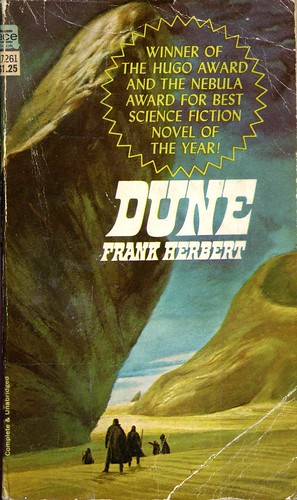
Dune by Frank Herbert

So, why not Dune? I actually started it, ten or eleven years ago, but it either didn’t grab me or something else came along that I wanted to read more. I do recall that my first attempt at Dune flummoxed me a bit because I had to flip back to the book’s glossary so often that it threw me out of the book a lot. Still, I always intended to return to Dune, and I finally have.

This just in: Dune is a great book. Water, also, is wet.

Again, as before, it took me a while to get into Dune, and this time I just generally found a certain coolness to the overall emotional tone of the book. Everything felt like it was at a distance, somehow. This isn’t a criticism per se, but I found myself admiring the book more than really getting involved in it. But still – it’s a great book.

What makes the book great are a combination of factors. First, the setting, the desert planet of Arrakis. Yes, I’ve seen desert planets before, but Dune was there before all of the ones that I’ve seen, and Herbert imbues this world with an impressive sense of scale and an even more impressive sense of importance. Whenever you depict a world where conditions are about as harsh for humans as can possibly be, you need to create a reason for them to live there, and this Herbert accomplishes impressively. (The reason is, of course, the spice called “melange”, which is important because…well, that’s beyond the scope of this post.)

Even better is how Herbert is able to depict the society that lives on Arrakis, the nomadic-bedouin-like Fremen. Herbert brilliantly depicts just what the effects upon society would be on a world where water is as precious as it is on Arrakis, as people have to wear special suits that reclaim every bit of moisture their bodies excrete, and Herbert has thought things through to the point where an act that we on Earth wouldn’t even think twice about – like spitting – is deeply significant on Arrakis. Herbert’s attention to detail is superb, and he packs a lot of detail into the book.

Oh yeah, and sandworms. Sandworms are all kinds of awesome. I won’t say anything more than that.

As noted above, I wasn’t as emotionally involved in the book as I like to be, but the book’s other strengths compensated for this. Part of the problem was the glossary-flipping I had to do a lot of this time around as I did the first time; another part is Herbert’s structuring the novel by including quotes from fictional texts of his world before his chapter. This device does create some dramatic tension in one key respect – establishing that one particular character is a horrible traitor well before the treason happens – but in other ways, those text quotes were sometimes distracting.

I’m not sure if I will read Herbert’s sequels to Dune. I own them all, having picked them up at library book sales, but the general consensus out there as I’ve sussed it out seems to be that the sequels aren’t nearly as good as the first one and that they drop in quality each time out. We’ll see.

(Seriously, folks. Sandworms.)

:: I suppose that most casual SF fans are only aware of Leigh Brackett, if at all, as the writer of the first draft of the screenplay to The Empire Strikes Back. Brackett was a prolific SF writer during the middle of the 20th century, though, and she produced a lot of fine space opera and planetary fantasy stories. In fact, Leigh Brackett is required reading for anyone interested in those strongly-related SF subgenres, and not least because she was simply a fine, fine writer.

I’ve only read a little bit of Brackett thus far, but I’ve loved everything of hers that I’ve read to date, and I can now add to that list of titles her novel The Starmen of Llyrdis.

starmen of llyrdis

A human male, Michael Trehearne, is approached by a beautiful girl who tells him that he looks like one of the Vardda, a race of humanoids who are the only beings in the galaxy who can travel between the stars. This gives them a monopoly over all interstellar trade, and most of the planet-bound species in the Galaxy hate them for it.

Trehearne is brought into the fold as a Vardda, but at the same time, he is viewed with suspicion by them, a suspicion that manifests throughout the book in betrayals and schemes and plots against him. Eventually Trehearne learns a deep secret of the Vardda: the fact that many years before, one of their scientists had figured out how it is that the Vardda can travel the stars, and how to give that ability to other species. Trehearne is now at the center of events that could change the galaxy forever.

Brackett’s writing is poetic and beautiful as she weaves a tale of adventure and galaxy-spanning mystery that even has a few action set-pieces. The story is a bit heavily skewed toward the male end of the spectrum, as might be expected of a book written in 1952, and in terms of style, there’s not a lot of humor in the book. But those are quibbles that are better taken in the context of the era in which Leigh Brackett wrote, and The Starmen of Llyrdis is a fascinating and entertaining space opera.

Share This Post

From the Books: “A Pound of Paper”

Some time ago I read a book called A Pound of Paper: Confessions of a Book Addict, by John Baxter. The book is a memoir of Baxter’s years as a book collector and sometimes dealer, and it’s full of amusing anecdotes about that craft. Here’s one of them:

One in a row of three-storey detached homes built in the Twenties, the house and garden had the shabby look of a place run to seed, belying the red MGB sports car parked in front. The car’s owner opened the door, a young man of the type known as “Hooray Henry”, in yuppie uniform of pressed jeans, flannel shirt, Hush Puppies, no socks, and — my God! — a cravat.

“You’re the book chaps, yah?”

“Yah,” I said. “I mean, yeah.”

“Come in, come in. Haven’t much time. Lots to do.”

He led us into the front room, lined floor to ceiling with big books in uniform leather bindings. Sorting papers was a girl dressed in the female equivalent of his outfit; same jeans, same shoes, same no socks.

“These are the book chaps, sweet,” he said.

She spared us an uninterested glance and went back to the papers.

“The house belonged to my fiancee’s father,” he said. “I’m helping her with the sale. Now these,” he went on, waving around the walls, “are not for sale. A valuer from Sotheby’s will be here tomorrow. That understood?”

Martin nodded enthusiastically, groping at the same time for his tobacco pouch and the makings. I looked around the books with my best poker face. Even I knew that bound volumes of the Proceedings of the British Dental Association were worth about as much as telephone directories. Both he and Sotheby’s man were in for a mauvais quart d’heure.

“The rest are upstairs.” He led us up the staircase. At the top was a large room lined with empty shelves, in the middle of which was a neat parallelepiped, two meters by one by one, of the books that had been on them. “You can have any of these. See if there’s anything you want. I’ll be downstairs.”

As his steps receded, Martin, nodding with pursed lips, as if listening to an unheard voice, picked up one of the books. It was a first edition of P.G. Wodehouse’s The Heart of a Goof in its original gaudy dust wrapper with its gold motif. I’d seen one less good in a catalogue at a hundred pounds.

There were more underneath, all in their wrappers. Eric Ambler novels, Sapper, Taffrail, John Buchan — and Graham Greene; my heart jumped as I spotted the near diaphonous wartime cover of A Gun for Sale and the plain cream one of his first novel, The Man Within.

“Boots rebinds,” Martin said, peeling off the Wodehouse wrapper to reveal the plain cloth cover. “Boots rebound everything, but they kept the dust wrappers. At the end of the year, they put them back on and sold the books at a shilling each.” He turned the spine to me, showing the “one shilling” label.

“What are they worth?”

“The books? Ten quid each, maybe. The wrappers…” He shrugged. “Hundreds.”

“Each?”

“Well, the Wodehouses anyway. And the Greenes. The Buchans…”

We tried to calculate a total, but hadn’t got far when the young man bounded up the stairs again.

“Well, what do you think? Anything here you can use?”

“Oh dear, oh dear…” Martin muttered. In moments of stress, he betrayed his middle-class origins by descending into a variation on the maiden-aunt’s fluster that sat oddly with his boho look. He didn’t quite wring his hands, though he came close. “I suppose…two hundred quid for the lot?”

Said with more confidence, the sum might have seemed almost insulting, but Martin’s nervousness, not to mention his wardrobe, suggested that £200 was all he had in the world.

“And you’ll take them away — tonight?”

“Car’s outside,” I said, not revealing that it was a Fiat with the cubic capacity of a shoebox. I took out my chequebook. “Who do I make it out to?”

We spent an hour ferrying the books to the car, convinced that at any minute he’d realize the treasure he was giving up. Each trip just made the experience more intense. If there is anything more pleasurable than not giving a sucker an even break, I don’t know what it is.”

How fun it would have been to hear the chuckling of the Sotheby’s valuer the next day, huh?

Share This Post

From the Books: Dungeon, Fire and Sword

(A series in which I post longer excerpts from books I read)

This post is apropos of my post the other day on the movie Kingdom of Heaven. I’ve long been fascinated, along with many others, of the tale of the Knights Templar, the order of monastic knights founded during the Crusades who were later undone when the Pope and the King of France turned against them, ultimately leading to their final grand master, Jacques de Molay, being burned at the stake. Many legends have sprung up round the demise of the Templars, such as the disappearance of their fabulous treasure; the fleet of Templar ships that supposedly set sail from France when the uprising against them began, never to be seen again; the curse called down by Jacques de Molay on all those who betrayed the Templars. But the true story of the Templars is no less compelling than the legends, and it’s the true story that forms the backbone of John J. Robinson’s wonderful book Dungeon, Fire and Sword: The Knights Templar in the Crusades.

Robinson takes the approach of storyteller rather than dry historian as he recounts the tale of the Templars and their role in the larger Crusades that led to their founding in the first place. The Crusades are the ultimate period, I suppose, for those who love high adventure and drama in their history; they are replete with heroes and villains, with honor and treachery, with heroism and cowardice, with secular ambition and spiritual devotion. I haven’t read many books on the Crusades, so I can’t give Robinson’s book a comparative recommendation on that score, but it is one of the best history books I’ve ever read. He makes the history come alive, which is no mean feat.

Excerpted below is Robinson’s account of the events that took place at the Horns of Hattin. King Guy of Jerusalem has decided to march out to meet the forces of Saladin, at the behest of the Templar grand master, Gerard de Ridfort. The battle turned out to be a complete disaster, as the Christian forces made one mistake after another that played into the hands of Saladin, the Muslim leader. Thus it was that one of the most resounding defeats in the entire history of the Crusades was suffered by the Christian army:

That afternoon they reached the barren shelf above the village of Hattin. Ahead of them was a rock structure that rose into two summits, known locally as the Horns of Hattin. Beyond it, the road dropped to the Sea of Galilee, but Saladin’s army was across the road. Gerard sent word to King Guy [King of Jerusalem, 1186-1190 AD] that his harrassed Templars could go no further that day and that the Christians should make camp where they were. Most of the barons, including Raymond of Tripoli, wanted to press on immediately and fight their way through to the life-giving waters of the great lake. The army just could not go on for more hours without water. Once again the Templar grand master won out, and the king ordered the army to make camp. Some fo the men struggled to the slope of the Horns of Hattin, where they had been told they would find a well. They found it, but it was dry. No form of discipline could keep reins on men crazed with thirst, and several groups broke away to search for water. They were easily killed off by Muslim outposts.

Knowing that the Christians were already overcome with heat and thirst, Saladin decided to add to that discomfort by depriving them of sleep. The nobles had tents, but the whole armychose to sleep in the open to enjoy the cooling breeze. The Muslims set fire to the dry brush that covered the hills. Soon the breeze carried the hot acrid smoke into the Christian camp, making it difficult to breathe. Using the cover of the smoke and the darkness, Saladin positioned his troops throughout the night, so that when dawn broke, the army of Jerusalem found itself completely surrounded.

A whole night after a whole day without water was driving men mad with thirst, made worse by the dawn reflecting off the waters of the fabled lake below them. Some suddenly started to run for the water, and as the momentum built, thousands of foot soldiers rushed down the hill, not to fight, but to drink. Those who were not chopped down by the Muslim cavalry as they ran were herded together and taken prisoner. Raymond of Tripoli led a charge against the Muslims, but they simply opened their ranks and let his party gallop through them, then closed ranks behind him. Once outside, there was no way Raymond’s party could rejoin their comrades, so eventually they rode off the battlefield and back to Tripoli. Some of those left behind were convinced that they had witnessed an act of treachery.

The remaining knights fought to their limits, making charge after charge and repelling the cavalry sweeps of the Muslims, but they were steadily driven back up the hill.

Saladin’s son al-Afdal remembered: “When I saw them retreating with the Muslims in pursuit, I cried out in joy, ‘We have beaten them!’ The sultan pointed to the bright red royal tent of King Guy at the top of the hill and said, ‘Be silent. We shall not defeat them until that tent falls.’ As he spoke, the tent fell.”

The Christians were beaten as much by sheer exhaustion as by numbers. When the victorious Muslims broke through to the center of the Crusader defense they found knights and barons, including the king himself, prostrate on the ground with no strength left to lift their arms, much less their weapons. The leading nobles were all made prisoner and taken to a regal pavilion set up for Saladin on the battlefield. There the sultan greeted them with courtesy, inviting King Guy to sit by his side. Knowing that his royal guest was suffering from severe thirst, Saladin handed him a cup of cool water. Guy gratefully took a long drink, then handed the cup to Reynald of Chatillon. Saladin immediately asked Guy to remember that it was he, not the sultan, who had passed the cup to Reynald. That should have told them what the sultan had on his mind. Saladin was telling them that what would happen next did not violate the Muslim laws of hospitality that protected a man who was given food or drink by his host.

Saladin then turned to Reynald of Chatillon, whose crimes he began to recite angrily, cataloging Reynald’s lies, his betrayals of trust, his breaking of one truce after another. Made even angrier by Reynald’s arrogant reply, Saladin grabbed up a sword and struck off his head. He quickly assured the shocked Christian nobles that they were not condemned to share Reynald’s fate. They would be ransomed or exchanged.

Such mercy did not extend to the Knights of the Temple and the Hospitallers who ahd been taken in the battle. They were to be the star performers in a bizarre and brutal drama. Saladin was being visited by a group of Muslim Sufis from Egypt. Although fanatic Muslims, the ascetic Sufis were students of the Koran, not warriors. Saladin announced that they would have the honor or cutting off the heads of hundreds of captured knights of the military orders. Afraid the deny the great sultan, they took the proffered swords in hand as Grand Master de Ridfort was forced to watch. When a lucky stroke cleanly severed a neck, a cheer went up from the watching Muslim soldiers, while taunts and shouted suggestions went to those who hacked away at their victims six, seven, or eight times to get the head separated from the body. It was a grotesque carnival of blood, and one can only speculate on de Ridfort’s thoughts as he watched the horror for which he was principally responsible, knowing as well that he was the only captured warrior monk who was to be spared this death by amateur executioners.

Saladin took time for one other piece of business. The bishop of Acre had been killed in the fight, and the Muslims had taken the holy relic of the True Cross. Saladin expressed his intention to have it taken to Damascus to be placed under the doorstep of the principle mosque of the city, so that each time one of the faithful entered the mosque he would trample on the Christian relic. It was the ultimate humiliation. It was not, however, the ultimate victory. The Christians still held the holy city of Jerusalem.

Robinson wrote another book, Born in Blood, on the history of the Freemasons. I wish he’d written more; he had a deft touch for narrative in history.

Share This Post

From the Books

A series wherein I post longer excerpts from books I’ve read.

I’ve been toying with the notion of writing a film script, as a different kind of challenge. I haven’t worked in the screenplay format since many years ago, when I was writing Star Wars fanfic; those stories I wrote as scripts. (OK, to tell the truth, I’ve already been tinkering with screenplay format, producing a script for a movie about an unemployed writer-type, down on his luck in life, who starts over from scratch in his mid-thirties by taking a job as a janitor in a grocery store. You know, fantasy. That project is unlikely to ever see the light of day, though.)

The script that I really want to write, though, is an idea that’s been kicking around my head for several years now. It always surprises me that there really aren’t a whole lot of movies out there about classical music and the people from its history. Sure, there’s Amadeus, but what else is there? Just reading through just about any composer’s life reveals a world ripe for harvesting of stories, and hey, the soundtracks would pretty much select themselves, right?

Anyhow, one might think that I’d be hankering to write a movie about Hector Berlioz, and maybe that’ll come one day, but the story that’s capturing my attention now is what may be the most important love story in classical music history: that of Robert and Clara Schumann. Their story is passionate, romantic, and tragic, and it saw the production of some of the most lyrical music of the Romantic era. What a great costume drama that would make!

The basic facts are these. Robert Schumann was one of the most archetypal of all Romantic-era figures. His life was fairly short (46 years), he fought madness and alcoholism all his life, he attempted suicide twice in his life, and eventually died in a sanitarium two years after his second suicide attempt (in which he was pulled from the Rhine river by fisherman after he had flung himself into it). He was also one of the greatest composers of the Romantic era, and a noted music critic as well, producing some of the most enduring piano music, art songs, and concertos of all time. His symphonies are also staples of the orchestral repertoire.

Through all this was Clara, whom he met when she was just a child, and yet he courted her anyway, to the chagrin of her father, who tried to keep his daughter from a man he respected but still saw as a lunatic (not entirely inaccurately, either), until the two finally wed after a lengthy court battle. Their marriage was loving and devoted, but not without trial; Clara was one of the great piano virtuosos of the nineteenth century, but her career had to be put on hold so Robert could compose. She would endure ten pregnancies and lose three children, and when she eventually lose Robert as well, she would live another forty years after his death. Her deep friendship with Johannes Brahms forms an interesting postscript to her marriage to Robert Schumann; Brahms would never marry, and many have speculated that this was because he was in love with Clara his entire life. (No evidence exists that their relationship ever became physical.)

So, of late, I’ve been doing some preliminary research into the lives of Robert and Clara Schumann, including reading their letters, which have been gathered into a two-volume collection, edited by Eva Weissweiler. These letters are illuminating in many ways. Letters tend to be the most revealing of all writings from decades (or centuries) gone by, and in this age of quick e-mails or notes hastily scrawled on a Post-It, it’s amazing to read these long missives and remember that correspondence was more than just a way for people apart to keep in touch with one another; letter-writing was a major way of passing time in an age when any form of entertainment other than reading entailed dressing up and leaving home. People were literary because they had to be, lest they die of boredom. It’s tempting to read these letters and think “Wow, people back then really knew how to be in love”, but I’m not sure it’s the passion that’s changed, just the expression of it. But it’s impossible to read these letters and not feel the passion radiating from them, in some cases 170 years after they were written and dispatched to secret intermediaries (lest Clara’s father find them and put their relationship to a definitive end).

Here are a few passages from their letters that stood out for me.

Clara to Robert, January 1838

But don’t think that I am angry with you for this; on the contrary, I am happy to know that you don’t love me because of my talent, but, as you once wrote on a little piece of paper, “I don’t love you because you are a great artist; no, I love you, because you are so kind.” That please me immensely, and I have never forgotten it.

You cannot lose me; that would be impossible; my spirit would follow you forever.

Robert to Clara, February 1838

“Sometimes it feels as if a great many alleys were running pell mell through my heart and as if my thoughts and feelings were bustling about in there in all directions and running back and forth, just as people do, and they were asking one another, “Where does this one lead?” – to Clara – “and this one?” – to Clara – everything leads to you. The business with the alleys in the heart is a curious thought, isn’t it? And they sometimes lead to the lips and suddenly tehere’s a kiss, and the lovely girl snuggles up to the man, and their names are Clara and Robert–“

Clara to Robert, March 1838

What would you like me to do, my dear Robert? Should I embrace you, should I give your hand a hearty squeeze, should I cry, should I laugh? I am in the mood to do all of these things, because your latest letters were so precious, as cheerful as the loveliest spring.

I am very bored with traveling now; I am longing very much for rest; how much I would like to compose, but I can’t do that here at all. I have to practice in the morning, and we have visitors until late in the evening; then I am completely exhausted, as you surely see from my letters because they often indicate that my head is totally empty. –But you should always recognize my heart, because it remains untouched by the events of the day. If I can compose something for the journal, I will. “Macbeth” appears to be very beautiful; –I don’t think that anything of mine would compare favorably to it. I am like you. There are many alleys running through my heart, too, but they are even narrower, and there are more of them.

My mind has hardly investigated one of them when it encounters the next one, and so on, ad infinitum. I cannot stay with one idea; right away there is another one – the fault is yours alone – I don’t know what this will lead to, I always console myself by thinking that I am a woman, and they weren’t born to compose. I often doubt myself. But I remember that you did not want to speak of doubts anymore; I agree with you! Doubt is a disastrous word and also a disastrous state to be in.

Robert to Clara, March, 1838

Where should I begin to tell you what kind of person you are making of me, my love, magnificent one! Your letter provided me with one delight after another. What a life you’re opening before me, what prospects! Sometimes when I read through your letter I feel like the first human might have felt when the angel led him through the new creation, from peak to peak; each beautiful region followed by even more beautiful ones, and the angel then says, “All of this shall be yours.”

I’m not sure how I’d use these; maybe in the typical way of having them read as voiceovers. I haven’t really given much thought at all as to the form such a film might take; this is all just preliminary stuff, and I don’t know if I’ll ever even get around to writing this. But I hope to.

This much I do know: the end credits must roll, at least in part, as “Traumerei” plays. Here is “Traumerei”, played by Vladimir Horowitz in Moscow in 1988. He often played “Traumerei” as an encore.

What a love story Robert and Clara had!

Share This Post

From the Books: The Proud Tower

(A series of posts in which I post longer than usual excerpts from books of mine.)

A number of the liberal-leaning blogs I read have been arguing of late that the filibuster in the US Senate needs to be done away with, as it is a fundamentally undemocratic thing whose use has become so frequent and entrenched over the last few years as to render the Senate into a body which de facto requires a supermajority in order to pass anything. (Example.) I tend to agree with this argument; the filibuster’s main virtue seems to be that it’s been that way forever, and that, in itself, is never much of a reason to keep doing anything.

But I’m reminded of a historical episode I read about in a wonderful book by Barbara Tuchman, The Proud Tower, in which she describes a similar problem faced once by a Republican Speaker of the House named Thomas B. Reed, at the end of the nineteenth century.

He [Reed] was determined, on taking up the gavel as Speaker, to put into effect a plan on which he had long deliberated, consulting no one, and on which he risked his entire political future. He knew that the fight would focus upon him the nation’s attention and also that if he failed his Congressional career would be over. The stakes were high: he would either break “the tyranny of the minority” by the which the House was paralyzed into a state of “helpless inanity”, or he would resign.

The system Speaker Reed had decided to challenge was known as the silent – or disappearing – quorum. It was a practice whereby the minority party could prevent any legislation obnoxious to it by refusing a quorum, that is, by demanding a roll call and them remaining silent when their names were called. Since the rules prescribed that a member’s presence was established only by a viva voce reply to the roll, and since it required only a majority of the whole to constituted a quorum, the silent filibuster could effectively stop the House from doing business.

To Reed the issue was survival of representative government. If the Democrats could prevent that legislation which the Republicans by virtue of their electoral victory could rightfully expect to enact, they would in effect be setting aside the verdict of the election. The rights of the minority, he believed, were preserved by freedom to debate and to vote but when the minority was able to frustrate action by the majority, “it becomes a tyranny”. He believed that legislation, not merely deliberation, was the business of Congress. The duty of the Speaker to his party and country was to see that that business was accomplished, not merely to umpire debate.

He reached his decision to attack the silent quorum, and planned his campaign, alone, partly because no one else would have thought there was a chance of success and partly because he was not sure that even his own party would support him. There were indications that they might not. Because of Reed’s known views on the silent filibuster it was clear that quorum-counting would be an issue in the new Congress. REED WILL COUNT THEM, predicted a headline in the Washington Post, and the story beneath it said that even Mr. Cannon, Reed’s closest lieutenant, was, opposed to the attempt. The Democrats were manning their defenses. Ex-Speaker Carlisle let it be known that any legislation enacted by a quorum which had not been established by a “recorded vote” woul dbe taken to court as unconstitutional.

Reed, however, had satisfied himself that he would be upheld if it came to law, and on the attitude of his own party he was prepared to gamble. He shrewdly judged that the Democrats in their rage would provoke the Republicans to rally to his support. When the first of the contested elections appeared on the schedule for January 29 he was ready. As expected, the Democrats raised a cry of no quorum and demanded a roll call. Reed’s moment had come. Without a flicker of expression on the great white moon face, “the largest human face I ever saw”, as a colleague described it, without any quickening of the drawling voice, he announced, “The Chair directs the Clerk to record the names of the following members present and refusing to vote,” and began reading off the names himself. Instantly, according to a reporter, “pandemonium broke loose. The storm was furious…and it is to doubted if ever there was such wild excitement, burning indignation, scathing denunciation and really dangerous conditions as existed in the House” during the next five days. Republicans were wildly applauding, all the Democrats were “yelling and shrieking and pounding on their desks” while the voice of their future Speaker, Crisp of Georgia, boomed, “I appeal! I appeal from the decision of the Chair!” The explosion was “as violent as any ever witnessed in any parliament,” a member recalled later. “Mr. Blanchard, Mr. Bland, Mr. Blount, Mr. Breckinridge of Arkansas, Mr. Breckinridge of Kentucky…”

Up jumped the Kentuckian, “famous for his silver hair and silver tongue.” “I deny the power of the Speaker and denounce it as revolutionary!” he called.

The resonant twang from the Chair continued unregarding, “Mr. Bullock, Mr. Bynum, Mr. Carlisle, Mr. Chipman, Mr. Clement, Mr. Covert, Mr. Crisp, Mr. Cummings” – through hisses and catcalls and cries of “Appeal” irresistably rolling down the alphabet – “Mr. Lawler, Mr. Lee, Mr. McAdoo, Mr. McCreary…”

“I deny your right, Mr. Speaker, to count me as present!” bellowed McCreary.

For the first time the Speaker stopped, held the hall in silence for a pause as an actor hold an audience, then blandly spoke: “The Chair is making a statement of fact that the gentleman is present. Does he deny it?”

It’s a fascinating tale. It doesn’t end there with that one act of Reed’s, of course; few things of this nature ever do. The Republicans would later lose Congress so badly that the Democrats were able to raise a quorum by themselves, and they then restored the silent quorum. This backfired after the next election cycle, however; the Democratic majority was greatly reduced such that now-Minority Leader Reed was able to frustrate Democratic legislative aims by using the silent quorum himself, until the Democrats finally relented and allowed the silent quorum to end forever.

(The Proud Tower is one of my favorite history books, by the way. It is a large-scale picture — a historical snapshot, if you will — of the state of the the world as it was moving inexorably toward World War I.)

Share This Post