From the Books: Ursula K. Le Guin on Tolkien

Author Ursula K. Le Guin has died.

Calling Le Guin an “author” is true, but it doesn’t do her justice, and that’s coming from one who has not read nearly enough of her work. Not even close. Le Guin was a cultural force, particularly in the genres of fantasy and science fiction where her influence is felt so keenly that her name ranks with the very highest of titans in the fields. Le Guin’s brilliance shone for decades, not just in her fiction but in the examples she set in her interactions with the rest of the field and in her thoughts to which she gave voice in many essays. Le Guin was one of the absolute giants, and her passing at the age of 88 is one more milestone in the history of two genres that still strive for respect and acceptance.

I have a small book that I got years ago as a reader’s companion volume to the Book of the Month Club’s editions of The Lord of the Rings. (The book is cleverly titled, A Reader’s Companion to THE HOBBIT and THE LORD OF THE RINGS.) It contains a number of short essays about JRR Tolkien and his writing, and the final essay in the book, called “The Staring Eye”, is Le Guin’s. Here is a part of it:

They were displayed on the new acquisitions rack of the university library: three handsome books, in the Houghton Mifflin edition, with beige and black dust jackets, each centered with a staring black and red Eye.

Sometimes one, or two, or all three of them were out; sometimes all three were together. I was aware of them every time I was in the library, which was often. I was uneasily aware of them. They stared at me.

The Saturday Review had run a special notice upon the publication of the last volume, praising the work with uncharacteristic vigor and conviction. I had thought then, I must have a look at this. But when it appeared in the library, I shied away from it. i was afraid of it. It looks dull, I thought–like the Saturday Review. It’s probably affected. It’s probably allegorical. Once I went so far as to pick up Volume II, when it alone was on the rack, and look at the first page. “The Two Towers.” People were rushing around on a hill, looking for one another. The language looked a bit stilted. I put it back. The Eye stared through me.

I was (for reasons now obscure to me) reading all of Gissing. I think I had gone to the library to return Born in Exile, when I stopped to circle warily about the new acquisitions rack, and there they were again, all three volumes, staring. I had had about enough of the Grub Street Blues. Oh well, why not? I checked out Volume I and went home with it.

Next morning I was there at nine, and checked out the others. I read the three volumes in three days. Three weeks later I was still, at times, inhabiting Middle Earth: walking, like the Elves, in dreams waking, seeing both worlds at once, the perishing and the imperishable.

Tonight, eighteen years later, just before sitting down to write this, I was reading aloud to our nine-year-old. We have just arrived at the ruined gates of Isengard, and found Merry and Pippin sitting amongst the ruins having a snack and a smoke. THe nine-year-old likes Merry, but doesn’t much like Pippin. I never could tell them apart to that extent.

This is the third time I have read the book aloud–the nine-year-old has elder sisters, who read it now for themselves. We seem to have acquired three editions of it. I have no idea how many times I have read it myself. I reread a great deal, but have lost count only with Dickens, Tolstoy, and Tolkien.

Yet I believe tha tmy hesitation, my instinctive distrust of those three volumes in the university library, was well founded. To put it in the book’s own terms: Something of great inherent power, even if wholly good in itself, may work destruction if used in ignorance, or at the wrong time. One must be ready; one must be strong enough.

I envy those who, born later than I, read Tolkien as children–my own children among them. I certainly have had no scruples about exposing them to it at a tender age, when their resistance is minimal. To have known, at age ten or thirteen, of the existence of Ents, and of Lothlorien–what luck!

In the essay Le Guin goes on to think about what her experience with Tolkien might have meant to her as a writer of the fantastic had she come to it earlier in life than when she did. It’s interesting to consider. For myself? I came to Tolkien first when I was eight or so, via the animated The Hobbit, and three or four years later via the books. I have no idea how it affect me, as a writer of the fantastic, but then, Ursula Le Guin was a genius, and I’m only me.

I have intended to re-read Le Guin’s A Wizard of Earthsea this year already; I have now moved it up in the planned rotation. I read it in eighth grade, I think; I recall liking it, but I never read past it. To this day my familiarity with Ursula Le Guin is more through her essays and nonfiction than through her fiction (I also read The Dispossessed, and remember it about as well, which is more reflective of me as a young reader than her as a writer). This needs to change.

Ursula K. Le Guin lived to be 88, and she leaves behind an enormous legacy not just in her own works but in all the authors on whom she was a huge influence. Her life may be over, but the ripples in time left by her having been here? Those are just beginning.

Thank you, Ursula K. Le Guin. You’ll be read for a long, long time.
Share This Post

From the Books: THE COMING OF THE KING

So yesterday I saw a New York Times article linked on Twitter in which apparently some members of former European aristocracy are starting to raise the notion that maybe, just maybe, world problems might be helped somewhat by a return to monarchy. I confess I didn’t bother reading the article because…well, the whole notion just sounds goofy. But I did note the name of the first person quoted in the article: one Count Nikolai Tolstoy, who is a member of onetime Russian nobility, a distant cousin of Leo Tolstoy of War and Peace fame, and the writer of a fantasy novel about the wizard Merlin called The Coming of the King.

As it happens, I bought this book way back when I was in college and going through the big Arthurian phase of my reading life. There was a couple of years where if I was reading a book not related to any of my classes, it was an Arthurian book of one sort or another: either fantasy novels retelling the tale, or a nonfiction book about the legends or the larger category of British folklore from which the Arthurian matter springs. Tolstoy’s novel is…well, I started it and got about seventy pages in before I gave up. His writing style was very formal and almost stilted (not unlike The Silmarillion), but what got me was a passage that ranks as one of the strangest passages I have ever read in a fantasy novel. I thought that I had shared this before, but I did a cursory search of the archives and couldn’t find it, so here is is anew.

I don’t even recall the contextual events in which this takes place, save that it is a big feast-type party or something at the King’s great hall. Tolstoy is describing some of the evening’s entertainment here, and…well, this happens. I swear that this is from a novel that actually got published.

Low before the king bowed the seven newcomers; and bowed low they remained, with buttocks bare gleaming from the ruddy glare of the king’s hearth. For they were the far-famed farters of the Island of the Mighty, whose skill in farting surpassed any that might be found in Prydyn, or Ywerdon, or distant Lydau across the Sea of Udd.

Wonderfully loud was the farting of the royal farters at the feasting of King Gwydno Garanhir upon the Kalan Gaeaf; wonderfully lour, skillfully sonorous, and evil-smelling beyond the achieving of all others of their calling. At first they emitted with rare delicacy the seven notes of the scale, moving up and down the line in harmony, high and low. Then they blew forth tunes such as cowherds and milkmaids sing. They whistled high and they whistled low in semblance of the whistling of the keepers of the king’s kennels. or of unseen birds that pipe in the brake.

But these wonderful feats were as nothing to what followed, and an ecstasy came upon the Men of the North as each of the performers excelled his fellow with some new and marvelous display of art and skill. Marvelously true to reality was the snorting of war horses, the braying of trumpets, the roaring of stags, the rumble of thunder, the bellowing of bulls, the snarling of wildcats, and long, low drone of a homing cockchafer on a summer’s eve.

Well-fed were the performers upon dulse and lentils and beans, but not beyond the space of half an hour were they able to sustain their skillful performance. There came a moment when their conductor gave vent to a long, low whistling sound like a serpent retiring to its heathery laid; so sibilantly soft, stealthy-sounding, and stalely stinking as to instill an awed silence upon the assembled company. It was a signal for the departure of the troop, and with a final effort of such loudness and force and vigor that men swore afterward it set the goblets rattling upon the royal board, and all but extinguished the pine torches flaring in their sockets and even the great hearth burning beneath the royal cauldron.

Like the gale before which no man is able to stand upright, which blows without ceasing from the mouth of that Cave in the land of Gwent which men call Chwith Gwent, was that mightiest of farts which was in the North at that time. There were those in the king’s hall, however, who feared lest the performance might arouse storms and tempests in the winter sky, avowing they could hear afar off in the mountains the rolling of Taran’s wheel.

It was amid smoke and confusion and stench that the king’s farters flew from the banquet hall to the hostel set apart for them. It was long before the pleasure passed and laughter died away and tongues were stilled, so delightful was their performance to the Men of the North.

As noted, I have little idea what to make of this, and I recall that I read very little farther in the book after this.

As for the novel itself, it was apparently at one point to be the first book in a trilogy of novels about Merlin, but the next books never appeared. Count Tolstoy was apparently involved in some sort of legal action involving libel, which put a bit of a kibosh on his writing at the time. To my knowledge these books have never appeared.

And there, folks, is the strangest thing I’ve ever read in a fantasy novel.

Share This Post

From the Books: THE RETURN OF THE KING

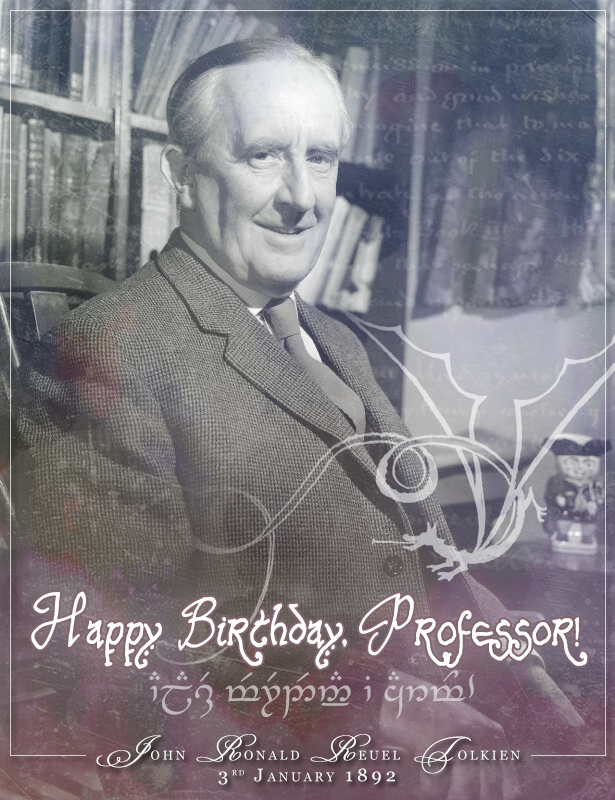
It’s JRR Tolkien’s birthday!

Tolkien is, naturally, one of my favorite of all authors. He wasn’t my first foray into epic fantasy–that would be Lloyd Alexander–but Tolkien cemented my love of that genre for keeps. He is, for me, as profound an influence on my own storytelling as George Lucas.

Here is one my very favorite passages in a book chock-full of favorite passages. This is from The Return of the King, the chapter titled “The Siege of Gondor”.

In rode the Lord of the Nazgul. A great black shape against the fires beyond he loomed up, grown to a vast menace of despair. In rode the Lord of the Nazgul, under the archway that no enemy ever yet had passed, and all fled before his face. 

All save one. There waiting, silent and still in the space before the Gate, sat Gandalf upon Shadowfax: Shadowfax who alone among the free horses of the earth endured the terror, unmoving, streadfast as a graven image in Rath Dinen. 

‘You cannot enter here,’ said Gandalf, and the huge shadow halted. ‘Go back to the abyss prepared for you! Go back! Fall into the nothingness that awaits you and your Master. Go!’ 

The Black Rider flung back his hood, and behold! he had a kingly crown; and yet upon no head visible was it set. The red fires shone between it and the mantled shoulders vast and dark. From a mouth unseen there came a deadly laughter. 

‘Old fool!’ he said. ‘Old fool! This is my hour. Do you not know Death when you see it? Die now and curse in vain!’ And with that he lifted high his sword and flames ran down the blade.

Gandalf did not move. And in that very moment, away in some courtyard of the City, a cock crowed. Shrill and clear he crowed, recking nothing of wizardry or war, welcoming only the morning that in the sky far above the shadows of death was coming with the dawn. 

And as if in answer there came from far away another note. Horns, horns, horns. In dark Mindolluin’s sides they dimly echoed. Great horns of the North wildly blowing. Rohan had come at last. 

That is one of those passages that, every time I read it, I pray to whatever powers there are that one day I might write something half so wonderful.

Happy birthday, Professor Tolkien! Long may your stories shine, into the next Age and beyond!

Share This Post

From the Books: “I Never Met a Story I Didn’t Like”

I borrowed this book from the library a few weeks ago, and after plowing through it (and finding it quite hilarious), I reviewed in on Goodreads. But for this space I wanted to excerpt a particular chapter that I found interesting. Author Todd Snider is a folk singer by trade, so his advice here is directed specifically at singers, but I think it can be applied to anyone in a creative endeavor.

Young singers sometimes think it’s about making people like you, but it’s not. It’s about how many people you can get to decide whether or not they like you. That’s what you have to do to fill your refrigerator. Do it every day, nine to five.

You are not trying to be liked. You are trying to be judged, as often as you possibly can, so you can keep your refrigerator full.

If I was better at what i did, people would say nastier things about me.

The truth of this is that you asked someone — everyone — to feel something. And if they do feel something, you do not get to control what that feeling is. Whether it’s a fan, your mom, a journalist, or the paper boy, you sing them your song and ask them to feel. Don’t be a dick and try to control what and how they feel after that. Do the world a favor and leave those people alone. They already did you the favor of listening to your whole f***ing song. Now you want to tell them to do something else? Or you want to be angry because they did what you asked them to do? Jesus Christ.

When my first record came out, I saw a review of myself. The writer began, “I hate Todd Snider.” That was the first line of the review. It got me past my waist into the water. Come on in, kid, the water is freezing. “I hate Todd Snider, and I’m about to tell you why,” was the full first line, in a San Diego newspaper article that was supposed to be previewing my show. When’s the last time someone told you they hated you, un-ironically? Teenage girls don’t count.

I wrote a letter back to the person who wrote that review. I still have the letter. I pull it out and read it when I need to feel embarrassed for myself.

Making up songs, critics will tell people that you’ve done well or poorly. Again, those are the critics that you have asked — begged, really — to have an opinion. And then they give you one, if you’re lucky. A bad review is a good review. The worst review they can give you is no review at all, and that’s the one they give almost everybody.

That’s an interesting notion: by reacting to your work at all, someone is doing you a favor, even if they think your work is the worst thing ever and they are willing to tell people that. I’m not entirely sure I agree here, but the general notion seems to be that if you’re going to be an artist, you do not want to inspire indifference, and that’s something I completely agree with.

(Good book, by the way, if you’re interested in stories from the world of country-folk music.)

Share This Post

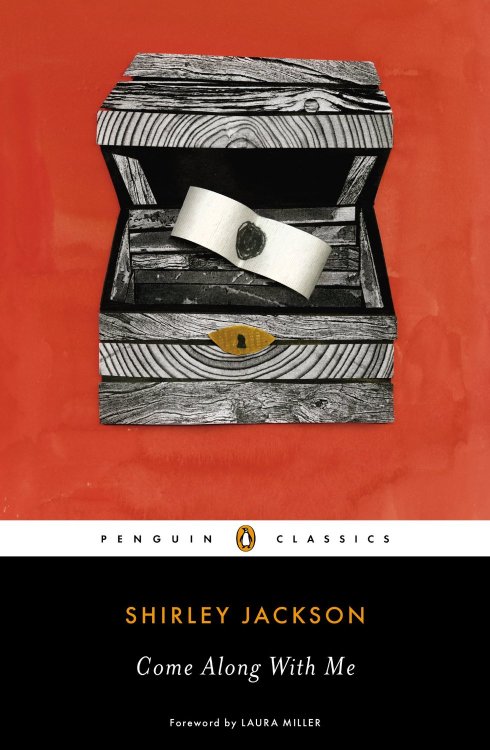
From the Books: “Come Along With Me”, Shirley Jackson

After last week’s entry, a more positive extract, this time, from the same book: Shirley Jackson’s anthology Come Along With Me. This is from an essay titled “Notes for a Young Writer”. I don’t read a whole lot of writing advice these days, figuring that at this point in my life I’m either going to swim or sink whilst valiantly attempting to swim. This, though, is an old favorite of mine.

In the country of the story the writer is king. He makes all the rules, with the only reservation that he must not ask more than a readaer can reasonably grant. Remember, the reader is a very tough customer indeed, stubborn, dragging his feet, easily irritated. He will willingly agree to suspend disbelief for a time: he will go along with you if it is necessary for your story that you both assume temporarily that there rally is a Land of Oz, but he will not suspend reason, he will not agree, for any story ever written, that he can see the Land of Oz from his window. As a matter of fact, you would do well to picture your typical reader as someone lying in a hammock on a soft summer day, with children playing loudly near by, a television set and a radio both going at once, a sound truck blaring past in the street, birds singing and dogs barking; this fellow has a cool drink and a pillow for his head, and all you have to do with your story is catch his attention and hold it. Remember, your story is an uneasy bargain with your reader. Your end of the bargain is to play fair, and keep him interested, his end of the bargain is to keep reading. It is just terribly terribly easy to put a story down half-read and go off and do something else. Nevertheless, for as long as the story does go on you are the boss. You have the right to assume that the reader will accept the story on your own terms. You have the right to assume that the reader, however lazy, will exert some small intelligence while he is reading. Suppose you are writing a story about a castle. You do not need to describe every tower, every man at arms, every stone; your reader must bring his own complement of men at arms and towers; you need only describe one gardener to imply that the castle is well stocked with servants. In your stories, then, set your own landscape with its own horizons, put your characters in where you think they belong, and move them as you please.

The entire essay is well-worth tracking down, especially if you are in the company of a writer.

Share This Post

From the Books: “Come Along With Me”, by Shirley Jackson

This book is a collection of stories and essays by Shirley Jackson, the great writer of often dark fiction, if not outright horror, from the middle of the last century. Jackson’s life seems to have been generally free of drama, which surely disappoints anyone looking for demons and skeletons in her personal closet to account for the apparent darkness her imagination often generated.

Jackson’s most famous works are likely the novel The Haunting of Hill House, one of the definitive horror novels of all time (particularly in the “haunted house” subgenre), and the short story “The Lottery”. This particular tale may not be as shocking today as it was when it first appeared in the pages of The New Yorker in 1948, but even so, I remember when I first read it, the mounting sense of dread in the brief tale, the disbelief of what it looked like the people in this little town were about to do. “They’re not going through with it,” I remember thinking. “Surely they’re not. They’ll turn back. They’ll stop before it gets to that.”

Reaction to the story was stunning and, often, angry: angry that someone out there might write such a thing, angry that so august a magazine as The New Yorker would print it. The reaction made its way to Jackson’s own mailbox, and she describes those reactions in an essay that is, in its way, maybe as disturbing as the original story itself. Here is part of “Biography of a Story”.

On the morning of June 28, 1948, I walked down to the post office in our little Vermont town to pick up the mail. I was quite casual about it, as I recall – I opened the box, took out a couple of bills and a letter or two, talked to the postmaster for a few minutes, and left, never supposing that it was the last time for months that I was able to pick up the mail with an active feeling of panic. By the next week I had had to change my mailbox to the largest one in the post office, and casual conversation with the postmaster was out of the question, because he wasn’t speaking to me. June 28, 1948 was the day The New Yorker came out with a story of mine in it. It was not my first published story, nor my last, but I have been assured over and over that if it had been the only story I ever wrote or published, there would be people who would not forget my name.

I had written the story three weeks before, on a bright June morning when summer seemed to have come at last, with blue skies and warm sun and no heavenly signs to warn me that my morning’s work was anything but just another story. The idea had come to me while I was pushing my daughter up the hill in her stroller – it was, as I say, a warm morning, and the hill was steep, and beside my daughter the stroller held the day’s groceries – and perhaps the effort of that last fifty yards up the hill put an edge to the story; at any rate, I had the idea fairly clearly in my mind when I put my daughter in her playpen and the frozen vegetables in the refrigerator, and, writing the story, I found that it went quickly and easily, moving from beginning to end without pause. As a matter of fact, when I read it over later I decided that except for one or two minor corrections, it needed no changes, and the story I finally typed up and sent off to my agent the next day was almost word for word the original draft. This, as any writer of stories can tell you, is not a usual thing. All I know is that when I came to read the story over I felt strongly that I didn’t want to fuss with it. I didn’t think it was perfect, but I didn’t want to fuss with it. It was, I thought, a serious, straightforward story, and I was pleased and a little surprised at the ease with which it had been written; I was reasonably proud of it, and hoped that my agent would sell it to some magazine and I would have the gratification of seeing it in print.

My agent did not care for the story, but – as she said in her note at the time – her job was to sell it, not to like it. She sent it at once to The New Yorker, and about a week after the story had been written I received a telephone call from the fiction editor of The New Yorker; it was quite clear that he did not really care for the story, either, but The New Yorker was going to buy it. He asked for one change – that the date mentioned in the story be changed to coincide with the date of the issue of the magazine in which the story would appear, and I said of course. He then asked, hesitantly, if I had any particular interpretation of my own for the story; Mr. Harold Ross, then the editor of The New Yorker, was not altogether sure he understood the story, and wondered if I cared to enlarge upon its meaning. I said no. Mr. Ross, he said, thought that the story might be puzzling to some people, and in case anyone telephoned the magazine, as sometimes happened, or wrote in asking about the story, was there anything in particular I wanted them to say? No, I said, nothing in particular; it was just a story I wrote.

I had no more preparation than that. I went on picking up the mail every morning, pushing my daughter up and down the hill in her stroller, anticipating pleasurably the check from The New Yorker, and shopping for groceries. The weather stayed nice and it looked as though it was going to be a good summer. Then, on June 28, The New Yorker came out with my story.

The letters, as Jackson reports, are almost entirely full of either confusion, distaste, or outright vitriol. Jackson rather drolly notes that one of the most terrifying aspects of writing is “the realization that they [stories] are going to be read, and read by strangers.” The people most moved to comment, in that day by mail, are almost always those most incensed by the tale, and Jackson also notes her relief that the volumes of mail she received, though large, likely did not constitute a reasonable survey of the opinion of the reading public. Small consolation, I suppose, when you’re the one whose mail is overflowing and whose own mailman isn’t speaking to you. But at least Shirley Jackson kept on writing. Her best work was likely still to come.

Oh, and if you haven’t read “The Lottery”, please do. If nothing else, it shows how effective a horror tale you can craft without one single hint of the supernatural. That’s quite a statement about human behavior and human nature – and maybe that’s what Jackson intended all along, when she tossed off this little tale which occurred to her while pushing her kid in the stroller.

Share This Post

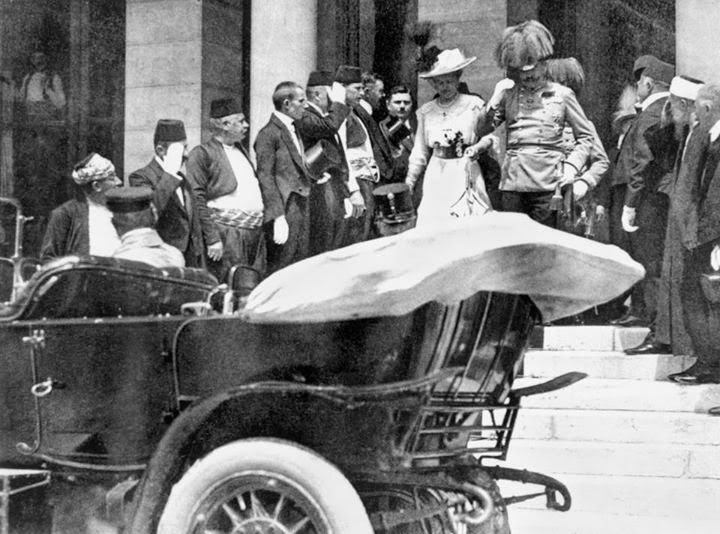
A Century since the Conflagration

One hundred years ago, it began. And in a lot of ways, it hasn’t ended…but then, can we even say that “it” really started one hundred years ago, as opposed to just one particular long and sickening phase of “it”?

How the assassination of one particular member of just one of Europe’s many royal families ended up causing that entire continent to dissolve into a four-year war that killed millions and did nothing more than set the stage for the even worse war to come less than thirty years later is one of the scariest of all historical tales, in my opinion. Reading about the assassination itself, the sequence of events that morning, is maddening, especially when you learn that the only reason Gavrilo Princip found himself standing close enough to Franz Ferdinand to shoot him at point-blank range was that the Archduke’s driver hadn’t got the message to drive the alternate route that morning. Almost as maddening is the way the rest of the royalty turned the Archduke’s and his wife’s funerals into an occasion for massaging old angers and familial dislikes…but when you’re dealing with royalty, familial angers and old grudges get magnified to national scales, which is how wars start. There’s just something so creepily medieval about the way World War I started.

From Barbara Tuchman’s book The Guns of August:

“Some damned foolish thing in the Balkans,” Bismarck had predicted, would ignite the next war. The assassination of the Austrian heir apparent, Archduke Franz Ferdinand, by Serbian nationalists on June 28, 1914, satisfied his condition. Austria-Hungary, with the bellicose frivolity of senile empires, determined to use the occasion to absorb Serbia as she had absorbed Bosnia and Herzegovina in 1909. Russia on that occasion, weakened by the war with Japan, had been forced to acquiesce by a German ultimatum followed by the Kaiser’s appearance in “shining armor”, as he put it, at the side of his ally, Austria. To avenge that humiliation and for the sake of her prestige as the major Slav power, Russia was now prepared to put on the shining armor herself. On July 5 Germany assured Austria that she could count on Germany’s “faithful support” if whatever punitive action she took against Serbia brought her into conflict with Russia. This was the signal that let loose the irresistible onrush of events. On July 23 Austria delivered an ultimatum to Serbia, on July 26 rejected the Serbian reply (although the Kaiser, now nervous, admitted that it “dissipates every reason for war”), on July 28 declared war on Serbia, on July 29 bombarded Belgrade. On that day Russia mobilized along her Austrian frontier and on July 30 both Austria and Russia ordered general mobilization. On July 31 Germany issued an ultimatum to Russia to demobilize within twelve hours and “make us a distinct declaration to that effect.”

War pressed against every frontier. Suddenly dismayed, governments struggled and twisted to fend it off. It was no use. Agents at frontiers were reporting every cavalry patrol as a deployment to beat the mobilization gun. General staffs, goaded by their relentless timetables, were pounding the table for the signal to move lest their opponents gain an hour’s head start. Appalled upon the brink, the chiefs of state who would be ultimately responsible for their country’s fate attempted to back away but the pull of military schedules dragged them forward.

One of the scariest aspects of war, to me, is how it so often just seems to happen. War is this emergent thing, egged on by people in power who seem to genuinely enjoy a state of war. War is certainly compelling, and tempting for people like me who like to craft epic fiction; you don’t get more epic than war. But it’s still horrific to read accounts of how World War I started and see the degree to which people seemed to suddenly realize, “Oh my God, we’re actually gonna do this! Abort! Abort!” only to be dragged, inexorably, into the meat grinder because other parts of the human psyche took over: the ones that hold grudges, the ones that massage anger and care for it and let it grow like some awful, malignant flower.

World War I didn’t have to happen, and yet, it did, because…it just had to. Why? I return, again and again, to a line of dialogue in a play I saw in college, called A Walk in the Woods. The play, by Lee Blessing, shows to arms negotiators, one Russian and one American, taking a break during the unending arms talks during the Cold War to go for walks together, during which they discuss the nature of the Sisyphean task they have been assigned. The Russian keeps returning to his view, over and over, that their job is doomed to failure because humans just plain like war. This is brought home in a line that’s stuck with me ever since I saw the play: “If mankind truly hated war, there would be millions of US, and only two soldiers.

Wars happen because people want them to. That we seem to want it as frequently as we do is one of the worst things about our species.

Share This Post

From the Books: Danny the Champion of the World

I’ve mentioned Roald Dahl’s amazing Danny the Champion of the World in this space before, because it’s quite simply one of my favorite books of all time. To this day I read it every few years, and I still find myself drawn into Dahl’s world of a father and son living in a Gypsy caravan in the English countryside, from where they run their little petrol station. Dahl creates an entire little world here, filling young Danny’s universe with magic and love and light and, since it’s a Dahl novel, just enough adult-world scariness. I’m always amazed at how Dahl draws me into this pastoral world, getting me involved and invested before the real story even starts, when young Danny wakes up one night and realizes that Dad isn’t there. Where has he gone? Well, for that answer, I strongly recommend reading the book yourself. The answer involves pheasants and an extremely unpleasant rich guy down the road…and that’s all I’ll say.

I will, however, offer this brief passage, in which Danny describes his father.

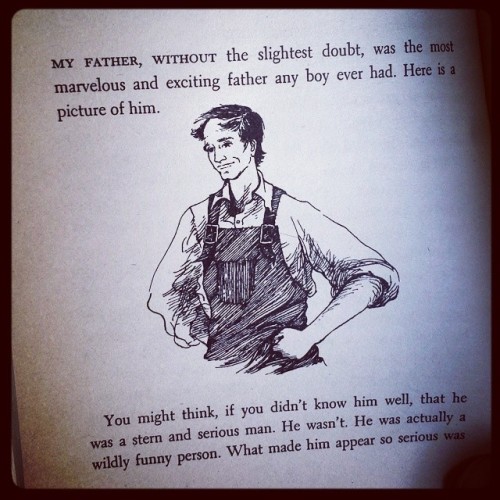
My father, without the slightest doubt, was the most marvelous and exciting father any boy ever had. Here is a picture of him.

You might think, if you didn’t know him well, that he was a stern and serious man. He wasn’t. He was actually a wildly funny person. What made him appear so serious was the fact that he never smiled with his mouth. He did it all with his eyes. He had brilliant blue eyes and when he thought of something funny, his eyes would flash and, if you looked carefully, you could actually see a tiny little golden spark dancing in the middle of each eye. But the mouth never moved.

I was glad my father was an eye-smiler. It meant he never gave me a fake smile because it’s impossible to make your eyes twinkle if you aren’t feeling twinkly yourself. A mouth-smile is different. You can fake a mouth-smile any time you want, simply by moving your lips. I’ve also learned that a real mouth-smile always has an eye-smile to go with it. So watch out, I say, when someone smiles at you with his mouth but his eyes stay the same. It’s sure to be a phony.

Lest you think that eye-smiling is a thing that Dahl made up here…it isn’t. Eye-smiling is real. I know. And when you see one, you will, too.

Share This Post

From the Books: Douglas R. Hofstadter on the Rubik’s Cube

My uncle Jerry once told me an awful joke:

What goes, “Click–do I have it yet? Click–do I have it yet? Click–do I have it yet?”

Answer: Stevie Wonder doing a Rubik’s Cube.

I know. Awful.

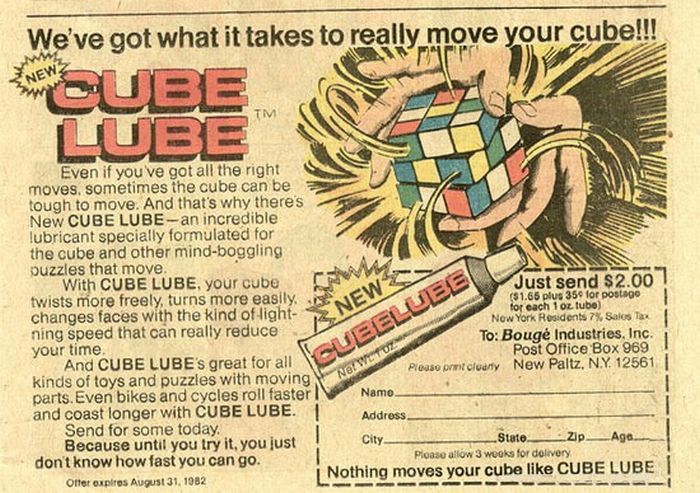
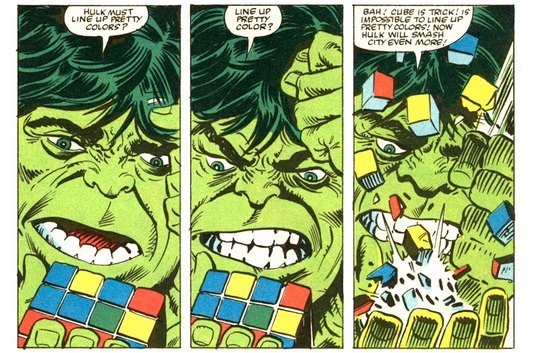
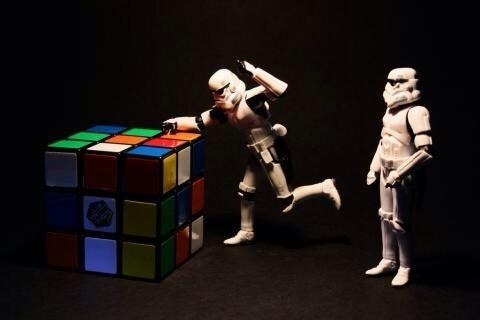
Anyway, many squeals of delight reverberated through the online world yesterday as Google’s doodle turned out to be a quite-functional Rubik’s Cube, in honor of the puzzle’s 40th anniversary. That’s amazing to me, another milestone of a passage of time that just doesn’t feel that long. I remember the first times I saw the puzzle, in the toy store of the Beaverton Mall in Portland, OR. This was late 1980 or early 1981, when the Cube was just starting to become the most popular thing going.

Eventually I got one, courtesy my parents, and I fiddled with it a lot until I could get two sides complete at the same time. But I was never able to crack the thing entirely, and I think my father was intrigued by the puzzle’s mathematical nature, so he sprang for a solution book, through which we pored until we both saw how the thing worked and how it could be returned to its pristine state, usually in a smaller-than-expected sequence of moves. The logical approach to solving the Cube, which I have long since forgotten, was really quite elegant, and I occasionally want to revisit it, now that I’m old enough to appreciate such things. At the time, for an awkward fifth grader in a new school, the ability to solve a Rubik’s Cube turned out to be quite the ice-breaker. (It may have also cemented my reputation as a soft and nerdy kid, but hey, it wasn’t like I was going to be on the football team anytime soon, anyway.)

Years later, in college, I bought a book by Douglas Hofstadter called Metamagical Themas, which was the title of a series of columns Hofstadter wrote for Scientific American back in the day. Hofstadter is an interesting person, although frankly whenever I read him (and I haven’t read him in too, too long), I got the feeling that I was peeking through a knothole in a fence into an awfully grand universe. In short, he was often way over my head. But he did write two columns about the Rubik’s Cube, which he found appealing as a puzzle and as a mathematical object. Both columns are presented in the book, and I excerpt the first of them here:

The Magic Cube is much more than just a puzzle. It is an ingenious mechanical invention, a pastime, a learning tool, a source of metaphors, an inspiration. It now seems an inevitable object, but it took a long time to be discovered. Somehow, though, the time was ripe, because the idea germinated and developed nearly in parallel in Hungary and Japan and perhaps even elsewhere. A report surfaced recently of a French inspector general named Semah, who claims to remember encountering such a cube made out of wood in 1920 in Istanbul and then again in 1935 in Marseilles. Of course, without confirmation the claims seem dubious, but still titillating. In any event, Rubik’s work was completed by 1975, and his Hungarian patent bears that date. Quite independently, Terutoshi Ishige, a self-taught engineer and owner of a small ironworks near Tokyo, came up with much the same design within a year of Rubik and filed for a Japanese patent in 1976. Ishige also deserves credit for this wonderful insight.

When I first heard the cube described over the telephone, it sounded like a physical impossibility. By all logic, it ought to fall apart into its constituent “cubies” (one of the many useful and amusing terms invented by “cubists” around the world). Take any corner cubie — what is it attached to? By imagining rotating each of the three faces to which it belongs, you can see that the corner cubie in question is detachable from each of its three edge-cubie neighbors. So how in the world is it held in place? Some people postulate magnets, rubber bands, or elaborate systems of twisting wires in the interior of the cube, yet the design is remarkably simple and involves no such items.

In fact, the Magic Cube can be disassembled in a few seconds, revealing an internal structure so simple that one has to ponder how it can do what it does. To see what holds it together, first observe that there are three types of cubie: six center cubies, twelve edge cubies, and eight corner cubies. Each center cubie has only one “facelet”; edge cubies have two, corner cubies have three. Moreover, the six center cubies are really not cubical at all — they are just square facades covering the tips of axles that sprout out from a sixfold spindle in the cube’s heart. The other cubies, however, are nearly complete little cubes, except that each one has a blunt little “foot” reaching toward the middle of the cube, and some curved nicks facing inward.

The basic trick is that the cubies mutually hold one another in by means of their feet, without any cubie actually being attached to any other. Edge cubies hold corner cubies’ feet, corner cubies hold edge cubies’ feet. Center cubies are the keystones. As any layer, say the top one, rotates, it holds itself together horizontally, and is held in place vertically by its own center and by the equatorial layer below it. The equatorial layer has a sunken center track (formed by the nicks in its cubies) that guides the motion of the upper layer’s feet and helps to hold the upper layer together. Unless you’re a mechanical genius, you can’t really understand this without a picture, or better yet, the real thing.

It is likely that many people will buy cubes, little suspecting the profound difficulty of the “basic mathematical problem”. They will innocently turn four or five faces, and suddenly find themselves hopelessly lost. Then, perhaps frantically, they will begin turning face after face one way and then another, as it dawns on them that they have irretrievably lost something precious. When this first happened to me, it reminded me of how I felt as a small boy, when I accidentally let go of a toy balloon and helplessly watched it drift irretrievably into the sky.

It is a face that the cube can be randomized with just a few turns. Let that be a warning to the beginner. Many beginners try to claw their way back to START by first getting a single face done. Then, a bit stymied, they leave their partially solved cube lying around where a friend may spot it. The well known “Don’t touch it!” syndrome sets in when the friend innocently picks it up and says, “What’s this?” The would-be solver, terrified that all their hard-won progress will be destroyed, shrieks, “Don’t touch it!” Ironically, victory can come only through a more flexible attitude allowing precisely that destruction.

In a postscript, Hofstadter adds:

I finally must confront the matter of the cube fad’s passing. David Singmaster’s Cubic Circular is going under after Volume 8. Many thousands of Megaminxes [a puzzle similar to a Rubik’s Cube, but dodecahedral in shape] were melted down for their plastic. Uwe Meffert’s puzzle club seems to have been a flop. The Skewb and many other wonderful objects I described never hit the stands. A few that did were almost immediately gone forever. So…have we seen the last of the Magic Cube? Are those cubes you bought going to be collector’s items? Well, I am always loath to predict the future, but in this case I will make an exception. I am bullish on the cube. It seemed to seize the imagination wherever it went. Despite the line concluding my second cube column, the cubic fad finally did spill over into the Soviet Union.

In my opinion, the world simply overdosed on cube-mania for a while. We humans are now collectively sick of the cube, but our turned-off state won’t last too long — no more than it lasts when you tell yourself “I’ll never eat spaghetti again!” after gorging on it. I predict that cubes will resurface slowly, here and there, and I am even hopeful that some new varieties will appear now and then. This is Mother Lode country. There may never again be quite the Gold Rush we witnessed a couple of years ago, but there’s still plenty of gold in them thar hills!

I’ve just decided that I needed a Megaminx. Among other things, the shape of the dodechedron plays a role in the Princesses In SPACE!!! (not the actual title) series.

Long live the Cube!

Share This Post

A bit of parenting advice

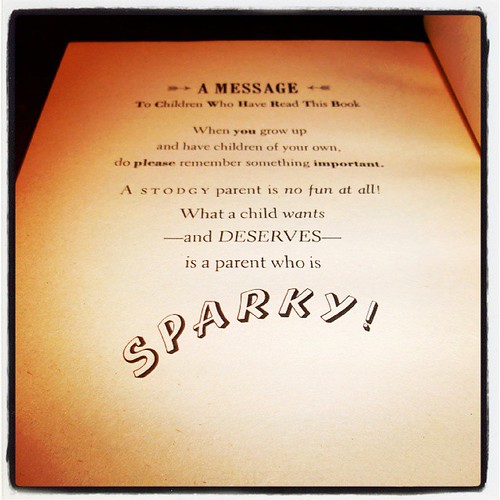
Courtesy Roald Dahl, in his amazing book Danny the Champion of the World. If you haven’t read this beautiful, funny, moving, and exciting story, what’s keeping you!

Share This Post