“These deadly rays will be YOUR death!”

A while back I posted about an old SF B-movie I saw when I was a kid, Battle Beyond the Stars. I saw Battle in this old, somewhat beat-up theater in Hillsboro, OR that often showed double features – which I remember my parents sending me off to with their blessing, only now realizing that it was probably a great way to get an annoying kid out of the house for a few hours. Battle was the main feature that day; the lead-in was another SF flick called Starcrash. Yup, I saw Starcrash in its theatrical run.

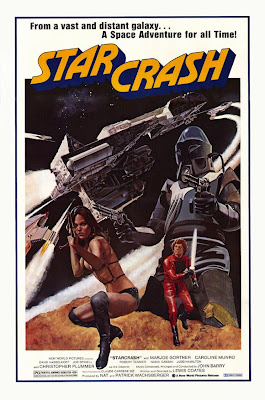
If you’re a fan of SF movies, you’ve probably heard of Starcrash — and not in a particularly good way, either. It’s one of the legendarily bad movies of SF history, made on a shoestring budget to capitalize on the SF craze initiated by Star Wars in 1977. I remember kind of digging the movie, when I was 8 years old, but I never saw it again…until a month or so ago. I tracked the film down, wondering just how bad it really was. Is it really one of the worst movies in SF history? Or is it a bit better than I remember?

Well, it’s bad. Really bad. Its badness exists on some kind of epic level. Starcrash is almost a primal force of nature in its badness. Seriously, this is a bad bad BAD movie. But it does have that nice virtue of being bad on a level that’s entertaining in a “watch it just to laugh at it” kind of way.

The main characters is a female star pilot and criminal named Stella Star, who is gamely played by Caroline Munro, a buxom, gorgeous woman whose best-known role was a femme fatale who tries to kill James Bond in The Spy Who Loved Me, but upon whom Bond turns the tables and kills instead. (Interesting Bond trivia: Munro’s Spy Who Loved Me character, Naomi, is the first woman directly killed by James Bond in the movie series. Sure, he’s responsible for a lot of women dying, but she’s the first we ever see expire by his hand.) Stella is flying around with a curly-headed guy named Akton, when they incur the wrath of a couple of space cops, one of whom is a robot named Elle. They are basically blackmailed into searching for a lost ship that carried on it the son of the Emperor of space, or something like that. This is important because there are bad guys about, led by an evil Count, planning the conquering of the Empire. Or something like that.

Starcrash is one of those movies where when you try to summarize it, you find yourself saying vague things and using the phrase “or something like that” a lot.

Much of the middle section of the film settles into routine: Stella and friends go to a planet, find the Prince isn’t there, evade some dangers, and go to the next planet. Eventually there is betrayal, a bunch of mystical stuff involving Akton that makes no sense at all, the Prince turns up (played by David Hasselhoff!), we meet the Emperor (played with benevolent and soporific droning by Christopher Plummer), and we finally find out what the title “Starcrash” means. It involves crashing. Among the stars.

Below the fold are some screencaps of the glory that is Starcrash.

This is what space looks like. Kinda trippy – lots of stars of different colors.

Stella Star, on the right, and her trusty sidekick Akton. Ships in this movie are boxy and square on the outside, and filled with circles and ovals on the insides. Weird.

Stella’s line here – believe it or not – is “First you gotta catch me, you dirty cop!” Note the goofy smile on Akton’s face. That’s his main facial expression.

The evil count.

The evil count dispatches his robot assassins!

Stella is taken prisoner and put into a forced labor camp. Wearing this. Zowie!!!

Oh noes! Attack of the fifty-foot big-breasted sword-bearing robot!

Oh noes! Attack of the badly animated robot assassins!

Oh noes! ‘Tis the Hoff!

Hey, a sword that’s a laser! A saber made of light! What an idea!

The Emperor on his throne, which looks like…geez, how would you describe that thing?

If you decide to watch Starcrash, please prepare yourself for a bad movie. Drinking may help.

Here’s the trailer!

(Poster via)

Share This Post

Punking

Castle is just such a good show. It really is. I’ve sung its praises before, but I really loved last night’s episode. It revolved around a murder in the New York City steampunk community, and among the show’s usual strengths — wonderful dialogue, great chemistry in the cast, et cetera — I liked the depiction of the steampunk community. Basically, Castle did not take the easy way out and depict steampunk as a geeky, nerdy, uncool thing.

Now, I’m not the world’s biggest fan of steampunk; I like a good steampunk tale as much as anybody, but I don’t love it more than other stuff. But steampunk is cool and fun, and Castle made it look…cool and fun, right down to Castle’s pitch-perfect definition of steampunk to Detective Beckett:

[Steampunk is] a subculture that embraces the simplicity and romance of the past and at the same time couples it with the hope and promise and sheer supercoolness of futuristic design.

How perfect is that! I can’t help but wonder how, say, the CSI shows would depict such a steampunk club. They’d no doubt make it a creepy, eerie, nasty thing that only people with horrible social skills could embrace. Kind of like how they depicted furries and “sploshers” and midget conventions and lots of other stuff.

Kudos to Castle! Best show on teevee.

Share This Post

Alas, poor Yori! I knew her, Horatio….

Via Cultural Compulsive Disorder, I see this poster for TRON Legacy. It’s a Hungarian poster, actually. Apparently the marketing strategy in Hungary for this movie is a bit different from the one in this country so far:

But I also found this one out there somewhere, so maybe the marketing will now focus on the wimminfolk of TRON as opposed to the teaser posters to date, which have been all-lightcycles, all the time.

I’m looking forward to this movie, even with my trepidation that it may end up feeling more Matrix than TRON. That would be disappointing, given that I’m a big fan of the latter and not a very big fan at all of the former.

Share This Post

Krull

Ah, the fine lure of 1980s cheese movies! I loved Krull when it came out, and saw the thing twice. It hit all of my sweet spots at the time. But then, I was 12, and I’ve grown a bit more sophisticated since then. My sweet spots at the time? A young Prince thrust into Kingship by the sudden onset of war; sword fights; aliens with ray guns; aged wizards come to nudge the young Prince toward destiny; a funky and mythical weapon; a really pretty Princess; the Prince’s motley collection of allies, most of whom are outlaws; perils like enormous spiders and quicksand-filled swamps and a monstrous villain who lives in an impregnable fortress of rock.

Yeah, those were all of my sweet spots when I was 12. And as it turns out, these are still a lot of sweet spots now that I’m 38! Which is probably why I still have a lot of fondness for Krull even though it’s more cheerfully goofy to me now than the serious bit of heroic fantasy I thought it was back then.

The plot of Krull is…well, from my list of “sweet spots” above, you can pretty much figure it out for yourself. There’s a planet called Krull, which is invaded by a force of soldiers called “Slayers” who wield ray guns and fly around the galaxy in a giant mountain-shaped fortress made of rock that lands on one world after another for conquering. This enormous spaceship lands on a planet, whereupon its hordes of ray-gun wielding soldiers in space armor ride out on horseback to take over. Yowza!

But the planet Krull isn’t to be taken so lightly. Two Kings decide to put their kingdoms together, by marrying their son and daughter. But on the eve of Prince Colwyn’s wedding, the Slayers attack and kill the two old Kings and kidnap Princess Lyssa! Oh noes! Colwyn wakes up the next morning, amidst the wreckage of battle, to find his father dead, his bride a prisoner, and a cranky old wizard (who is not named Obi Wan or Gandalf) binding his wounds and telling him to get up off his arse because he’s a King now and he needs to go fight the Slayers and their horrible leader who is known by the horrifyingly scary name “The Beast”.

And off they go. First they’re off to pick up a nifty weapon called a “Glaive”, which is basically a really ornate throwing star that seems to work by remote control or mental command or something like that. Then they need to find a powerful Seer, because they need to know where The Beast’s fortress is going to be (it changes location every morning). Along the way they meet some brigand-outlaw types and recruit them to their cause. And so on.

It’s all very typical, although I didn’t realize it when the movie came out. It’s full of British actors, which always helps lend an air of weight and believability to the most ludicrous plots. The film is full of beautiful shots of wonderful vistas (its director of photography, Peter Suschitsky, also shot The Empire Strikes Back), but a lot of it doesn’t make a whole lot of sense. The Glaive is touted as an amazing weapon, but by the time we get to see it in action, it’s actually a bit disappointing; poor Lysette Anthony as our beautiful Princess literally has nothing to do as she is a prisoner for ninety percent of the movie; some of the film’s events feel contrived, as if the screenwriter felt the need to pad out the running time and tick off some well-worn fantasy conventions along the way.

The most notable aspect of Krull now, nearly thirty years after it came out (holy crap!), is its score by James Horner. It’s typical young Horner: big and muscular, with lots of nods to various classical masters and to Jerry Goldsmith. Horner’s tendency toward self-referencing isn’t in much evidence at this point in his career, although there are places where the score sounds a lot like his most noted score to that point, Star Trek II: The Wrath of Khan. The score also has two of the best melodies of Horner’s entire career (the heroic “Main Theme” and the love theme).

Krull really needs to be seen through the prism of time, for what it is: an artifact of the 1980s. If this movie were to be released anew today, it would be laughed off the screen, with its occasionally murky visual effects and its earnest and irony-free script. Oh well. I still have a soft spot for it. The scene where Colwyn and friends ride the Firemares across a thousand leagues is still a thrilling bit, even with some wretched 1980s-style rear-projection, and Ken Marshall is, all things considered, a pretty good Prince Colwyn. I imagine that as Hollywood gets more and more focused on remaking old properties, a new version of Krull is probably inevitable at some point. I’m not sure how I’d feel about that.

For a taste of Krull, here’s a video of one of the best tracks from the score, “Riding the Firemares”. The main theme kicks in at about the :37 mark. Try to not have that tune in your head for days. I had that theme in my head for years, which is amazing considering that for many years, the score album to Krull was nearly impossible to find. I didn’t locate a copy myself until I was in, of all places, a Barnes&Noble in Cedar Rapids, IA in 1995, and that was a single-disc album with lousy sound that left off most of the score. The entire score has been re-released on a couple of film music labels since then (including La La Land Records, just in the last month or two).

ADDENDUM: Oh, what the heck. Here’s the actual scene of “Riding the Firemares”. The idea here is that Colwyn and company has learned where the Beast’s Fortress will be the next morning…but the location is a thousand leagues away, so the only way they can clear that distance in time is to try to capture, harness, and ride the Firemares. What are Firemares? They’re horses. Really, really fast horses. Horses so fast that when they really get going, well…here’s what happens.

For the main action, skip to the 4:30 mark. Excuse the cruddy video quality; this is the only clip I’ve found that has the entire scene. (The cyclops dude remains behind because his people are cursed to know the day they will die, and he knows this is his day, or something like that.)

Even with the bad rear-projection — oh, what George Lucas’s ILM could have done with this scene — it’s a terribly fun part of the movie.

Share This Post

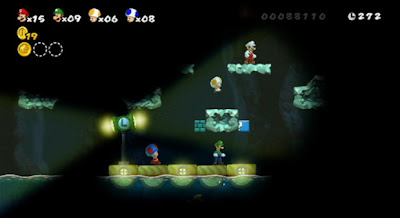
Let’s-a Play!

Yesterday I achieved something grand. Something wonderful. Something that will, I think, live on in the annals of my life as one of my finer deeds.

I beat Super Mario Bros. on the Wii!

OK, now that I’ve written the words right out, it doesn’t seem quite so momentous. But this is the first video game I’ve beaten since college. So, huzzah for me!

Mario's number one!!!

What did I think of Super Mario Bros.? It’s really a great game. It just is. There’s so much cool stuff in it, and it’s not entirely linear, in that I know there are things in it that I never saw on my way from the first level on World One to the last on World Eight. Here are some things I liked about the game:

Variety. It’s not the same screen, over and over and over again. In these kinds of games — “clearing level” games, which go all the way back to Pac-Man and Space Invaders — you have to get through an entire level before moving on to the next. Used to be that the “next one” was basically the exact same level again, but a little harder by making the things that can kill you move faster, or start closer to you, or stuff like that. With Ms Pac-Man, you started to see literally different levels: a new maze every few screens. (Well, a total of four mazes, anyway.) Well, as computing power of game systems goes up, so do the possible levels, so now Mario’s not just running up the same set of girders and ladders anymore; now he’s running through eight different “worlds”, each of which boasts seven or eight “levels”.

In some levels you run through desert landscapes, riding on the tops of gushing geysers of sand. In others you slip and slide your way through snowy mountains and ice-filled caverns. There are spelunking levels that take place in darkness so you can’t see where you’re going or what’s coming at you, and there are flying levels where you are literally jumping around the sky without a safety net.

(I’d be lying if I didn’t see the final world, World Eight, with its volcanoes raining lava and rocks down upon you and its lakes of fire, as the planet Mustafar from Revenge of the Sith….)

Rewards.

Super Mario Bros. has a pretty good reward system. You never feel like you’re just knocking off one level after another, ad nauseam. There are small things to achieve along the way: the collection of regular coins and “star coins”, the collection of power-ups, extra challenges such as carrying those little toad-guys through levels unscathed.

Short levels.

I wish I could remember where I read this, but a review of the game I read recently compared the levels to Pringles: they’re short enough that you tend to think, after you’ve completed one, “Ach, what’s one more!” Some levels are a bit longer than others, it’s true, but none are epically long. I did find all of the levels on World Eight surprisingly short — but I wonder if they were actually shorter, or if they just seemed that way to me because, by the time one earns one’s way to World Eight, one’s gameplay must be pretty good.

Variable difficulties.

In general, the game gets more difficult as you go through it, as all such games do. But my experience was that Super Mario Bros. doesn’t maintain an inexorable ratcheting-up of the difficulty with each level. I suppose this would be different for everyone, but there were times I’d die multiple times on a level before getting through it by the skin of my teeth (there’s a level on World Five that I absolutely loathed), and then the following one turns out to be comparatively easy. Super Mario Bros. seems to be almost set up to make progress pleasurable. I appreciated that after I’d get through a tough level, the next one wouldn’t suck the life out of me by being even tougher.

Humor.

There are a lot of little whimsical touches in the game, like the way the ghosts in the ghost houses cover their eyes when they want you to think they’re not watching you, or the monsters who literally throw up big metal balls with spikes on them to toss at you.

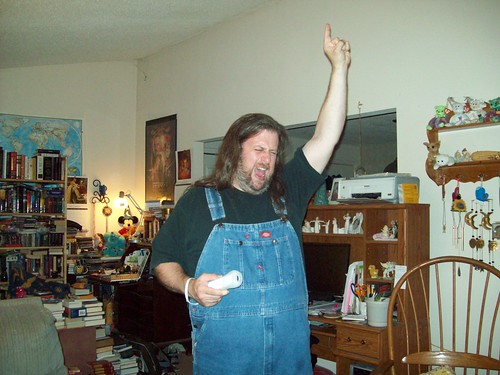
The fat guy in overalls gets the girl!

Well, yeah!

And now…geez, I need a new game or two. Hmmmmm…maybe Super Mario Galaxy. And Star Wars: The Force Unleashed. Or maybe that Lee Trevino golf game that Marge bought Bart for Christmas that one year….

Share This Post

Striking Back

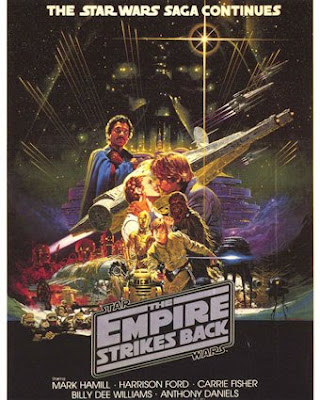
So, thirty years have passed since the release of Star Wars Episode V: The Empire Strikes Back. Wow, I guess. As luck would have it, I watched the film not too long ago — a couple of months, probably — and it still holds up extremely well. This is unsurprising, of course; the film is a bona fide classic.

I’ve read some tributes here and there around the Interweb and around Blogistan specifically, and I’ve found myself of mixed mind about the good words being said about the movie, mainly because a very large portion of comment seems to be of the “Wow, remember thirty years ago when Star Wars didn’t suck?” variety. I’m saddened by that, but hey, nothing I can do about it, either. It gets tiring, though — it seems that every event or happening or milestone that returns Star Wars to public consciousness is followed by the usual “George Lucas is the richest hack in history” comment. Oh well. Par for the course. Put it this way: I’m not much looking forward to 2013’s 30th anniversary of Return of the Jedi.

Empire came out when I was just eight years old, living in Hillsboro, OR. I didn’t see it for a few weeks after it came out, and yet, in those pre-Interweb days, I was able to go see the sequel to Star Wars three or four weeks after its release with zero idea of its story, other than what I’d seen in the TV commercials and such. I knew there was a snowy planet where the Rebels were fighting these big metal dinosaurs, I knew that there was a space chase through some asteroids, and I knew that there was a new character played by some guy named Billy Dee. That’s about it. I certainly had no idea that there was a Jedi master named Yoda, and I was actually surprised when the goofy little green guy in the swamp turned out to be Yoda. I was horribly dismayed when Han Solo got put into carbon freeze, but I thought, “Hey, no prob, they’ll save him before the movie ends.” Yeah…my first ever experience with a cliffhanger.

And I had no idea whatsoever that Darth Vader might be Luke Skywalker’s father.

How was this possible? Well, again, it was pre-Interweb, and pre-cable teevee, and all the rest of that. Also, I was lucky that my school district at the time let out for summer vacation in the first days of June, so Empire had been out for all of two weeks before I lost most contact with my schoolmates, most of whom hadn’t yet seen the movie either. So there was nobody to spoil the thing for me. I went into that movie almost completely blind. Empire was the last Star Wars film I was able to do that with.

Empire is, of course, now nearly universally hailed as the best of all Star Wars movies. There’s a lot to that, to be honest; the film earns its reputation with a superb script, amazingly paced and shot action sequences, a darker turn of events, and what may well be the best music John Williams has ever written. When pressed, I will almost always name A New Hope as my personal favorite Star Wars film, but the pro-Empire arguments are compelling.

Empire‘s beloved status really only started to grow after Return of the Jedi came out three years later. I don’t think it’s so much because Jedi was a bad film, as much as Empire‘s nature — being the middle act of a three-act story — meant that it could only really be appreciated once all the acts were out there, and the middle act’s true function and relation to the rest of the story could be judged. If I preferred Empire when I was a kid, it was mainly because it was shinier and newer than the older, more familiar film.

Here, in tribute, are my two favorite tracks from the entire brilliant score to The Empire Strikes Back. Empire was the first record album I ever bought with my own money. I didn’t even have my own record player at the time, and I had to listen to it in my parents’ bedroom when I wanted to hear it. I’d later get a record player that Christmas (it also had an 8-track tape player!), and Empire was the first thing I played on it. I played that album (a 2-LP set) to death over the next few years, wearing out the gatefold record jacket and putting numerous pops and scratches into the LP’s grooves themselves. Back then, John Williams would arrange his albums to make a “better listening experience”, which meant that tracks were not arranged on the album in the order they were heard in the film and that tracks from entirely different parts of the film were sometimes combined into a single track on the album. I played that album so much that even now, when I listen to subsequent remasterings of the Empire score, with all the tracks in film order, my brain still expects the original album order, with its tracks bearing titles like “The Heroics of Luke and Han”.

The first track is my favorite action cue from the score. Many fans would cite “The Asteroid Field” as theirs, but for me, it’s “The Clash of Lightsabers” all the way. This track underscores the second part of Luke’s duel with Vader, after they’ve moved from the carbon freezing chamber to a mechanical anteroom where Vader starts using the Force to hurl machine parts at Luke. It begins mysteriously and becomes more and more ominous as Vader toys with Luke; the music howls when the big window behind Luke is shattered and the wind begins to pour through the room, sweeping Luke out into the shaft, where he manages to catch onto the gantry and pull himself to safety. Then we cut (at the 1:38 mark) to Leia, Chewie, Lando and the droids as they work their way back to the Millennium Falcon. Lando’s theme (at the 2:00 mark) plays as he announces the evacuation of Cloud City. The rest of the track builds and builds (love the great brass bit starting at 2:36) which ends in first triumph as R2-D2 opens the door to the landing platform, and then the desperate version of the film’s Love Theme as the heroes race for their ship and freedom. This is one of my favorite action cues in all film music.

Second is from earlier in the film, on Dagobah: “Yoda and the Force”. This scene is, for me, the philosophical and emotional heart of just about all of Star Wars, when Yoda takes advantage of the sinking of Luke’s X-wing into the swamp to try to get through to Luke as to what it truly means to feel the Force. It’s a wonderful cue, from the meditative string writing to the noble statement of Yoda’s Theme as he lifts the ship from the water.

Happy birthday, Empire. You’ve never looked better.

Share This Post

Quiver, pathetic humans!

I saw this at SamuraiFrog‘s place, and I had to do it myself. Used to play some AD&D back in the day (mainly college). In the big campaign we did, I had two characters. One was a lawful-good cleric-ranger, and he was fun to play (I interpreted him as a real prude — Captain Picard with a sword and even less of a sense of humor), but the character I was really invested in was my chaotic-good necromancer. I played him as an arrogant wise-ass with an odd love of black humor. So this guy is probably right in line.

I Am A: Neutral Good Human Sorcerer (5th Level)

Ability Scores:

Strength-14

Dexterity-12

Constitution-13

Intelligence-14

Wisdom-10

Charisma-12

Alignment:
Neutral Good A neutral good character does the best that a good person can do. He is devoted to helping others. He works with kings and magistrates but does not feel beholden to them. Neutral good is the best alignment you can be because it means doing what is good without bias for or against order. However, neutral good can be a dangerous alignment because it advances mediocrity by limiting the actions of the truly capable.

Race:
Humans are the most adaptable of the common races. Short generations and a penchant for migration and conquest have made them physically diverse as well. Humans are often unorthodox in their dress, sporting unusual hairstyles, fanciful clothes, tattoos, and the like.

Class:
Sorcerers are arcane spellcasters who manipulate magic energy with imagination and talent rather than studious discipline. They have no books, no mentors, no theories just raw power that they direct at will. Sorcerers know fewer spells than wizards do and acquire them more slowly, but they can cast individual spells more often and have no need to prepare their incantations ahead of time. Also unlike wizards, sorcerers cannot specialize in a school of magic. Since sorcerers gain their powers without undergoing the years of rigorous study that wizards go through, they have more time to learn fighting skills and are proficient with simple weapons. Charisma is very important for sorcerers; the higher their value in this ability, the higher the spell level they can cast.

Find out What Kind of Dungeons and Dragons Character Would You Be?, courtesy of Easydamus (e-mail)

Share This Post

De-rez!

SamuraiFrog points this out: a very well-made trailer for the movie TRON, the original 1982 classic, using only footage from the movie but edited in the style of trailers these days:

Compare with the actual original trailer from 1982:

Trailers have sure come a long way, haven’t they?

Share This Post