“It isn’t fair, it isn’t right” (From the Books)

A literary anniversary went by last week, and I do want to mark its passing: on June 26, 1948, seventy-five years ago, The New Yorker published a new story by author Shirley Jackson. By this time Jackson was an established writer, albeit early on in her career, and her June, 1948 appearance in The New Yorker is the event that put her on the literary map, so to speak. And what an event that story’s publication was: that story became one of the most controversial ever published by that magazine, and to this day the story is a classic of the horror genre, which is even more notable as it does not contain one bit of supernatural behavior in it. No, this story is a simple one of the horror of human interactions and human adherence to tradition, and most disturbingly, the oh so human way of managing to put human life into a position of secondary, or even tertiary, importance.

The story is “The Lottery”. You can read it here. I recommend doing so; it’s a great work that has lost none of its ability to disturb in all its years. It’s not a long read, and I wouldn’t dream of spoiling it, if you haven’t read it.

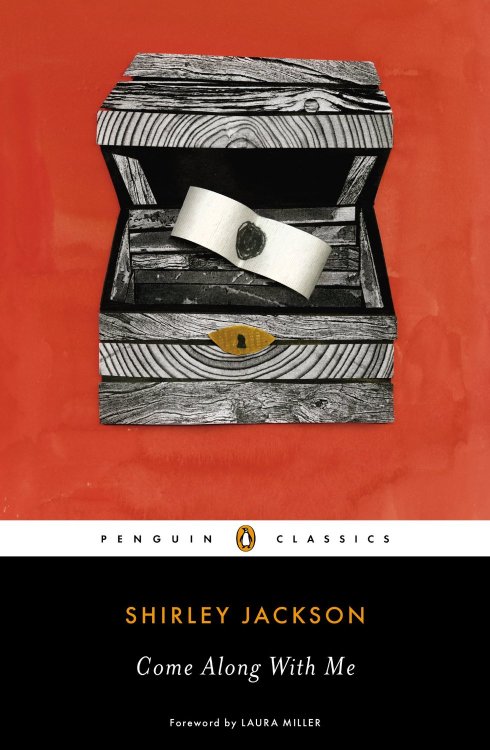
Jackson would later write a lecture about her experiences with the reaction to “The Lottery”. I don’t know where or when she actually delivered this lecture, but it’s been anthologized in a book called Come Along With Me, which anthologizes several of her stories, a couple of lectures, and a novel draft on which she was working at the time of her untimely death in 1965.

Here is a portion of that lecture:

On the morning of June 28, 1948, I walked down to the post office in our little Vermont town to pick up the mail. I was quite casual about it, as I recall–I opened the box, took out a couple of bills and a letter or two, talked to the postmaster for a few minutes, and left, never supposing that it was the last time for months that I was to pick up the mail without an active feeling of panic. By the next week I had had to change my mailbox to the largest one in the post office, and casual conversation with the postmaster was out of the question, because he wasn’t speaking to me. June 28, 1948 was the day The New Yorker came out with a story of mine in it. It was not my first published story, nor my last, but I have been assured over and over that if it had been the only story I ever wrote or published, there would be people who would not forget my name.

I had written the story three weeks before, on a bright June morning when summer seemed to have come at last, with blue skies and warm sun and no heavenly signs to warn me that my morning’s work was anything but just another story. The idea had come to me while I was pushing my daughter up the hill in her stroller–it was, as I say, a warm morning, and the hill was steep, and beside my daughter the stroller held the day’s groceries–and perhaps the effort of that last fifty yards up the hill put an edge to the story; at any rate, I had the idea fairly clearly in my mind when I put my daughter in her playpen and the frozen vegetables in the refrigerator, and, writing the story, I found that it went quickly and easily, moving from beginning to end without pause. As a matter of fact, when I read it over later and decided that except for one or two minor corrections, it needed no changes, and the story I finally typed up and sent off to my agent the next day was almost word for word the original draft. This, as any writer of stories can tell you, is not a usual thing. All I know is that when I came to read the story over I felt strongly that I didn’t want to fuss with it. I didn’t think it was perfect, but I didn’t want to fuss with it. It was, I thought, a serious, straightforward story, and I was pleased and a little surpised at the ease with which it had been written; I was reasonably proud of it, and hoped that my agent would sell it to some magazine and I would have the gratification of seeing it in print.

My agent did not care for the story, but–as she said in her note at the time–her job was to sell it, not to like it. She sent it at once to The New Yorker, and about a week after the story had been written I received a telephone call from the fiction editor of The New Yorker; ti was quite clear that he did not really care for the story, either, but The New Yorker was going to buy it. He asked for one change–that the date mentioned in the story be changed to coincide with the date of the issue of the magazine in which the story would appear, and I said of course. He then asked, hesitantly, if I had any particular interpretation of my own for the story; Mr. Harold Ross, then the editor of The New Yorker, was not altogether sure that he understood the story, and wondered if I would care to enlarge upon its meaning. I said no. Mr. Ross, he said, thought that the story might be puzzling to some people, and in case anyone telephoned the magazine, as sometimes happened, or wrote in asking about the story, was there anything in particular I wanted them to say? No, I said, nothing in particular; it was just a story I wrote.

I had no more preparation than that. I went on picking up the mail every morning, pushing my daughter up and down the hill in her stroller, anticipating pleasurably the check from The New Yorker, and shopping for groceries. The weather stayed nice and it looked as though it was going to be a good summer. Then, on June 28, The New Yorker came out with my story.

What ensues is an encapsulation of Jackson’s reaction to the reactions to her story, which roughly fall into general groups: those who wonder if the events described in the story are based on reality, those who think the story is disturbing fiction, and…well, those pretty much are the two camps. Jackson’s story even inspired a number of “Cancel my subscription!” reactions. One particular such demand is phrased quite well:

Heretofore mine has been almost a stockholder’s pride in The New Yorker. I shared my copy with my friends as I do the other possessions which I most enjoy. When your latest issue arrived, my new distaste kept me from removing the brown paper wrapping, and into the wastebasket it went. Since I can’t conceive that I’ll develop interest in it again, save the results of your efforts that indignity every week and cancel my subscription immediately.

Ouch.

The New Yorker did a retrospective of reader reaction to “The Lottery” ten years ago, which you can find here; one interesting tidbit is that the magazine did not always label its fiction and nonfiction pieces, so perhaps the befuddlement of some readers who couldn’t determine on their own that “The Lottery” was just a story with no basis in the daily life of any small town in America is to be excused. I don’t know, I wasn’t there. But surely these events would have been common knowledge if they were real, yes? I mean, wouldn’t everyone know about that small town in such-and-such a state where every year they got everyone in the town together and held a lottery to choose one of its denizens for–wait. That would be spoiling it, if you haven’t read “The Lottery”.
Share This Post

The Past harmonizes: 11/22/63, by Stephen King

(Re-upping this one after a discussion of Stephen King on Twitter, and specifically this book, made me remember this post!)


One odd bit of Star Trek lore that I didn’t know about until I read one of William Shatner’s Star Trek Memories books is that, during the 1980s when the Trek movie series was in “another sequel every two years” mode, Gene Roddenberry had a pet idea that he kept trying to get Paramount to adopt for whatever the next movie happened to be. This notion had the Klingons taking over the galaxy by going back in time to Earth in 1963, and preventing President Kennedy’s assassination. In order to fix things, Kirk and company have to go back as well and make sure that JFK dies like he’s supposed to; according to this site, Spock himself is the shooter behind the grassy knoll. I’m not sure how that would have gone over – frankly, it sounds a bit dour and depressing. That worked in the episode “The City on the Edge of Forever”, when Kirk had to stand by and allow a woman with whom he’d fallen in love to die in order to preserve history, but this story, if what Roddenberry truly had in mind, somehow crosses a line. Maybe it’s by having Spock actually kill JFK. I’m glad that movie never got made.

There’s always been something compelling about the JFK assassination to alternate history types and time-travel writers. I think there’s a definite sense to JFK’s murder as one of those singular events in history that neatly separates what came before it from what came after, and as with all such moments, there’s a definite feeling that if the event could be changed, what came after would change, too – mainly for the better, I think the argument goes. Certainly the general opinion seems to hold that had JFK not died in Dallas, but gone on to reelection and a second term, the 1960s might not have been as turbulent as they turned out, with Vietnam possibly not escalating as it did, with civil rights possibly having an easier road to passage, and so on. Obviously there is no way to evaluate such beliefs, but the closest we’re able to come to doing so lies in the power of fiction.

(I wonder if 9-11-01 is going to replace the JFK assassination in the public mind as the most recent ‘focal point in time’. After all, the events of 11-22-1963 happened almost 50 years ago, well before the lifetimes of most Americans living today. I wonder if there will be time travel stories involving time travelers showing up at Logan Airport to prevent the boarding of Mohammad Atta and friends….)

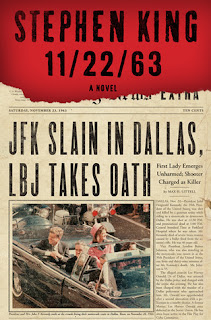
This brings me to Stephen King’s latest novel, 11-22-63. This is a time-travel story, in which a man from our time travels back with the intention of preventing the Kennedy assassination.

Jake Epping is a teacher whose marriage has just ended and who is apparently emotionally damaged in some way: he tells us up front that he simply does not cry, no matter what happens. Jake never cries, he tells us (the book is in first person, from Jake’s point-of-view), and he is haunted by the various injustices of history, such as the janitor who takes his adult education course and whose term essay smacks Jake between the eyes with a first sentence that refers to when the janitor’s dad ‘murdirt my mother and two brothers and hurt me bad’. This haunts Jake, and it’s all he can think of – even as his friend Al, who owns the local diner and who is going to die very soon of cancer, tells him of his own little secret.

In the basement of the diner is a gateway through time. Walk through it, and you emerge outside a factory in Lisbon Falls, Maine, on September 9, 1958. Walk back through, and you’re back in 2011 – exactly two minutes later than when you left. And if you go back in time again, no matter how long you’ve waited to do so, you go back to that exact same moment on September 9, 1958 – which means that any changes you have made to the past are now reset.

This limiting of the time travel possibilities is one of the masterstrokes of King’s novel. There’s no ‘setting a date and then hitting 88 mph’, no ‘slingshotting your starship around the sun’. You can only go back in time to a single place, to a single time, and you can only return to a single place, to a single time. And if you are ambitious enough – as Jake soon will be – to try and change history, if you want your changes to be permanent, you can never go back again. And if, like Jake, you decide that you’re going to try and keep JFK from being killed, that means that you can go back…and then you have to spend five years living there in the past until that fateful day. November 22, 1963.

King seems less interested in the various paradoxes of time travel stories, many of which have become clichees, than he seems to be in history as a force in itself. As he makes his life in the past, Jake – now going by the alias ‘George Amberson’ – frequently discovers ways that the past seems to be trying to right itself even as he messes with things. “The past harmonizes”, he tells us, again and again, and as the book goes on, the level of uncertainty involved in Jake’s self-appointed mission grows and grows and grows. Jake has to try and figure out if Lee Harvey Oswald was part of some kind of conspiracy, or if he acted alone; he has to try and decide if he should intercede earlier or later. He takes a ‘dry run’ early on, interceding on his janitor friend’s behalf when his father shows up to kill his family, and in such ways Jake discovers things about killing – even justified killing – that are troubling.

This is not a scary novel, but it is a haunting one. King masterfully keeps us aware of the onward march of time, so that the date of the title never really fades from memory, even as Jake is living out the five years he has to live out in the past, making a life for himself in a small town in Texas where he makes friends with local teachers and, in the ultimate complication, falls in love. Still, through all this there is a constant sense of growing doom, the constant ticking of King’s time bomb growing ever more and more insistent. Will he stop Oswald? If so, how? And will it matter in the end?

The time travel aspects of the story are, initially, pretty benign in nature, and we learn that Al is using the time portal to buy ground beef at 1958 prices, which enables him to sell his burgers in his diner for significantly cheaper than anyone else can manage. Jake discovers, though, that the past has ways of resisting change, and although King never really spells out much of the mechanism behind that sort of thing, it soon becomes clear that the bigger the change one is trying to make in history, the harsher the resistance one will meet.

11/22/63 is a thrilling King page-turner, loaded with emotional resonance, King’s keen eye for detail, and a bittersweet ending that is satisfying but not in an expected way. Parts of the book read as if Stephen King had written a mash-up of Back to the Future and Oliver Stone’s JFK. In other parts, though, the feel is pure King – especially in one section, taking place in Derry, Maine, where events bring Jake Epping into contact with two of the kids from IT. King is best at suggesting dark forces at work that we cannot understand – or perhaps I should say, forces that we cannot understand whose goals and priorities do not align with ours. Is history something we influence, or is it a force all to its own? 11/22/63 explores that question, even if it may not have a definitive answer.

(One final note: Throughout the book, Jake notes that ‘the past harmonizes’ – which means, history has a way of making things even out, of settling the books. A lot of times, what we call coincidence is this ‘harmonizing of the past’. Well, maybe fiction harmonizes, too; there’s a point in the book that actually features a pie fight. I read that just a day or two before my own pieing last week. How’s that for synchronicity!)

Share This Post

THE CHILLING KILLING WIND: COVER REVEAL!!!!

Well, I could do a bunch of preamble stuff, but why bother? Here it is!

Click to embiggen!

The blurb text reads:

Tonight, former detective John Lazarus will finally put his old life behind him. He has a new job as a teacher, a new home, and a new love. All he has to do is get through tonight’s execution of Roy Edgar Chalmers, the last of the three men who killed John’s wife in a botched robbery. Once Chalmers is dead, John Lazarus will be done with his old life at last.

But tomorrow the murders will start: strange, violent crimes whose only connection is the pair of voices exhorting the perpetrators to kill. As an occasional police consultant, John Lazarus will increasingly suspect that something abnormal is at the heart of these killings. And when Roy Edgar Chalmers, not nearly so dead as he should be, approaches him for help, John Lazarus will realize that maybe his old life isn’t quite done with him….

Release is coming soon, folks!

(And don’t forget to check out the book’s prologue!)


Share This Post

From the Books: “Come Along With Me”, by Shirley Jackson

This book is a collection of stories and essays by Shirley Jackson, the great writer of often dark fiction, if not outright horror, from the middle of the last century. Jackson’s life seems to have been generally free of drama, which surely disappoints anyone looking for demons and skeletons in her personal closet to account for the apparent darkness her imagination often generated.

Jackson’s most famous works are likely the novel The Haunting of Hill House, one of the definitive horror novels of all time (particularly in the “haunted house” subgenre), and the short story “The Lottery”. This particular tale may not be as shocking today as it was when it first appeared in the pages of The New Yorker in 1948, but even so, I remember when I first read it, the mounting sense of dread in the brief tale, the disbelief of what it looked like the people in this little town were about to do. “They’re not going through with it,” I remember thinking. “Surely they’re not. They’ll turn back. They’ll stop before it gets to that.”

Reaction to the story was stunning and, often, angry: angry that someone out there might write such a thing, angry that so august a magazine as The New Yorker would print it. The reaction made its way to Jackson’s own mailbox, and she describes those reactions in an essay that is, in its way, maybe as disturbing as the original story itself. Here is part of “Biography of a Story”.

On the morning of June 28, 1948, I walked down to the post office in our little Vermont town to pick up the mail. I was quite casual about it, as I recall – I opened the box, took out a couple of bills and a letter or two, talked to the postmaster for a few minutes, and left, never supposing that it was the last time for months that I was able to pick up the mail with an active feeling of panic. By the next week I had had to change my mailbox to the largest one in the post office, and casual conversation with the postmaster was out of the question, because he wasn’t speaking to me. June 28, 1948 was the day The New Yorker came out with a story of mine in it. It was not my first published story, nor my last, but I have been assured over and over that if it had been the only story I ever wrote or published, there would be people who would not forget my name.

I had written the story three weeks before, on a bright June morning when summer seemed to have come at last, with blue skies and warm sun and no heavenly signs to warn me that my morning’s work was anything but just another story. The idea had come to me while I was pushing my daughter up the hill in her stroller – it was, as I say, a warm morning, and the hill was steep, and beside my daughter the stroller held the day’s groceries – and perhaps the effort of that last fifty yards up the hill put an edge to the story; at any rate, I had the idea fairly clearly in my mind when I put my daughter in her playpen and the frozen vegetables in the refrigerator, and, writing the story, I found that it went quickly and easily, moving from beginning to end without pause. As a matter of fact, when I read it over later I decided that except for one or two minor corrections, it needed no changes, and the story I finally typed up and sent off to my agent the next day was almost word for word the original draft. This, as any writer of stories can tell you, is not a usual thing. All I know is that when I came to read the story over I felt strongly that I didn’t want to fuss with it. I didn’t think it was perfect, but I didn’t want to fuss with it. It was, I thought, a serious, straightforward story, and I was pleased and a little surprised at the ease with which it had been written; I was reasonably proud of it, and hoped that my agent would sell it to some magazine and I would have the gratification of seeing it in print.

My agent did not care for the story, but – as she said in her note at the time – her job was to sell it, not to like it. She sent it at once to The New Yorker, and about a week after the story had been written I received a telephone call from the fiction editor of The New Yorker; it was quite clear that he did not really care for the story, either, but The New Yorker was going to buy it. He asked for one change – that the date mentioned in the story be changed to coincide with the date of the issue of the magazine in which the story would appear, and I said of course. He then asked, hesitantly, if I had any particular interpretation of my own for the story; Mr. Harold Ross, then the editor of The New Yorker, was not altogether sure he understood the story, and wondered if I cared to enlarge upon its meaning. I said no. Mr. Ross, he said, thought that the story might be puzzling to some people, and in case anyone telephoned the magazine, as sometimes happened, or wrote in asking about the story, was there anything in particular I wanted them to say? No, I said, nothing in particular; it was just a story I wrote.

I had no more preparation than that. I went on picking up the mail every morning, pushing my daughter up and down the hill in her stroller, anticipating pleasurably the check from The New Yorker, and shopping for groceries. The weather stayed nice and it looked as though it was going to be a good summer. Then, on June 28, The New Yorker came out with my story.

The letters, as Jackson reports, are almost entirely full of either confusion, distaste, or outright vitriol. Jackson rather drolly notes that one of the most terrifying aspects of writing is “the realization that they [stories] are going to be read, and read by strangers.” The people most moved to comment, in that day by mail, are almost always those most incensed by the tale, and Jackson also notes her relief that the volumes of mail she received, though large, likely did not constitute a reasonable survey of the opinion of the reading public. Small consolation, I suppose, when you’re the one whose mail is overflowing and whose own mailman isn’t speaking to you. But at least Shirley Jackson kept on writing. Her best work was likely still to come.

Oh, and if you haven’t read “The Lottery”, please do. If nothing else, it shows how effective a horror tale you can craft without one single hint of the supernatural. That’s quite a statement about human behavior and human nature – and maybe that’s what Jackson intended all along, when she tossed off this little tale which occurred to her while pushing her kid in the stroller.

Share This Post

X-Files Case Report: “Pilot”

So I’ve decided to embark on something of a long-term project here: rewatching The X-Files. I’d like to rewatch the entire series, start to finish, series pilot to final episode of Season Nine, with the first movie (Fight the Future) thrown in between Seasons Five and Six, and culminating in the movie from a couple of years ago (which I still haven’t seen). Obviously this will take a while, and while I’m not going to try to do this on a weekly basis, I’m hoping for at least two or three of these a month. Maybe more, when I watch them in clusters, as may well happen.

Why? Well, why not? Among the blogs I follow which focus on F/SF/H stuff, rewatches of movies and teevee series and re-reads of books and book series are always in vogue, and right now, nobody that I follow is doing an X-Files rewatch, which gives me a niche. This also gives me a longterm source of content (always nice), and it gives me an excuse to revisit a show that was once beloved to me.

Don’t get me wrong, there: as far as I know, I still love The X-Files. The show was an iron-clad, “can’t miss it” event at Casa Jaquandor for most of its run. But with relatively few exceptions, I only saw the episodes a single time each, upon their initial airings; and there are quite a few episodes from the first three seasons that I’ve never seen. I’m interested now, seventeen years after Season One, partly in how well the show has aged. We’ll see!

My fandom of The X-Files was slow to blossom. I was only dimly aware of the show’s existence for most of the first season. In fact, this was back when FOX was still a fairly fledgling network with only a couple of notable shows to its name (The Simpsons, Married With Children), and if I remember correctly, back then, FOX didn’t even have enough shows to put together and entire weekly lineup. (In some ways, FOX still doesn’t. There are no 10:00 shows on FOX.) I heard of this show that had FBI agents investigating paranormal stuff, but I didn’t watch until my mother, who did watch, recommended the show to me. So I saw a couple of episodes during the first season and came away somewhat favorably impressed, but my attention wasn’t grabbed enough to make me a regular viewer until somewhere in the middle of Season Three.

I’m lucky that I came along then, and not later; the show’s “mytharc” was still pretty manageable at that point, and a new viewer could pick up the basics pretty quickly. I do remember, though, a special episode that aired sometime toward the end of Season Three that was basically a summation of the show to that point. I found that very helpful, and a short while later, the show’s popularity led to video releases of early episodes. Of course, this was before DVD, so these video releases consisted of sets of VHS tapes with two episodes each, and only selected episodes at that – no complete seasons here, just the most important “mytharc” shows with a few of the better “monster of the week” shows thrown in. Anyway, I was hooked, and I didn’t fall by the wayside until Season Nine, which struck me as rudderless, pallid, and just too-much-of-a-good-thing. We’ll see what we find as we go, though.

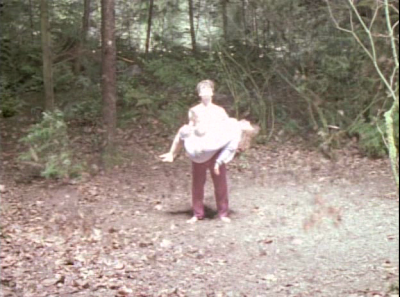
Which brings me to the Pilot Episode. It opens with a teaser sequence, set in the Pacific Northwest, that shows a girl in her nightrobe running through a forest, until she stumbles in a clearing. Here she is met by a human-shaped figure (whose features we cannot see) who is accompanied by a brilliant light; the wind whips up, there is lots of noise, the leaves are blown in circles around them as the light brightens. Cut to twelve hours later, and the girl’s body is found in the clearing by the cops, sporting two circular wounds near her backside. The chief ID’s the body, noting that she went to school with his son; another cop says, “Class of 1989? It’s happening again, isn’t it?”

Cut to Washington, DC and the FBI Headquarters, where a beautiful young agent named Dana Scully reports to her superiors for assignment. She is to work alongside another agent, named Fox Mulder, who has been using his time to investigate cases that are outside the official FBI mainstream. These cases, called “the X-files”, are the kinds of thing nobody wants anything to do with – except for Agent Mulder, who later suggests that it’s only by way of his friends in Congress that he is able to do this work at all. Scully is being assigned for her scientific, skeptical approach; when she asks if she is being expected to debunk Mulder’s work, her superiors manage to say Yes and No in that wonderful bureaucratic way of not saying much at all. Off Scully goes to meet Agent Mulder, who has just caught wind of this strange case brewing out in the Pacific Northwest. After some introductions, Mulder briefs Scully on the odd case and the wounds on the bodies (of which there are four), and then they’re off to Oregon to do some investigating.

This really is one of the better pilot episodes to a show I’ve seen. In the space of about five to ten minutes, we get: an intriguing mystery for the first episode; an establishment of a supernatural/paranormal mood; the introduction of our two main characters, both to us and to each other; the establishment of certain tropes within their relationship; the tense conflict between the official FBI and Agent Mulder; and some initial conflict between Mulder and Scully. They would later come to trust each other in the implicit way of two people who are absolute soul-mates, but there is still constant tension between her skepticism and his willingness to take wild leaps in logic in order to press his case. (Oh, and in the first scene in the FBI Headquarters, there’s an ominous looking fellow lurking in the background who is always fingering a lit cigarette.)

This first case of theirs also sets up so many of the tropes that would dominate the show for the entirety of its run. Alien abduction. Lost time. Mystery elements that are never able to be conclusively explained because the evidence is somehow destroyed or compromised. Implants of unknown origin. Secret government storehouses where old evidence is squirreled away, never to be seriously investigated again. Autopsies of mysteriously deceased persons, and autopsies of mysteriously deceased things that may or may not be persons. Locals who are unwilling to talk to the two FBI agents, and the one local who is. The fact that Agent Mulder is haunted by the disappearance/abduction of his sister. And the solving of the mystery in an unfulfilling way that leaves Scully nothing to report on.

I also noticed that the show’s look that would dominate the first five seasons – dark, cloudy, foreboding, often raining – is in full effect here, as is the moody synth-driven music by Mark Snow (minus the famous main theme, which wouldn’t arrive until the second episode). I was surprised, watching the Pilot episode again, to see just how much of the show’s eventual theme and feel was present right there from the beginning. Everything except The Truth being Out There. But don’t worry – it is. Oh yes.

(Oh, and I promise not to make this series into one long love-letter to Gillian Anderson. But I had no recollection of the pilot featuring a scene with her in her underwear…her skin lit only by the light of a single burning candle….)

Share This Post